The Soviet Union has published its emigration rules for the first time, saying they have been revised to speed up applications. But the new code also gives authorities broad grounds for denying exit visas. In the past, applicants said exit visas were granted or denied without explanation. Foreign Minister Eduard A. Shevardnadze said last week that new laws were being adopted to develop international contacts and “resolve in a humanitarian spirit” problems of family reunification. But the new regulations, which take effect January 1, appear to codify existing procedures rather than significantly loosen emigration policy.
The Soviet Union, trying to sell itself as a potential economic partner, put a four-page advertising section into the Friday issue of The International Herald Tribune. The advertising package in the American-owned daily, which is published in Paris, seemed to be aimed principally at American and Western European business officials, but it included appeals for trade with countries in North Africa and Southeast Asia. The paper, with a circulation of about 164,000, is printed simultaneously at eight sites in Europe, Asia and North America and is distributed in more than 100 countries.
While the superpowers negotiate possible cuts in nuclear weapons, some nations are expanding their nuclear arsenals and others are joining the ranks of those possessing or able to build such arms. The extent of the nuclear spread is suggested by the growing probability that Israel is a nuclear power, by the ability of India and Pakistan to produce weapons if they choose and by the French and British arsenals. Peter Clawson of the Union of Concerned Scientists in Cambridge, Massachusetts, said in an interview that Soviet-American arms reductions might draw China, France and Britain into cuts, and Soviet-American restraints on nuclear testing could lend credibility to calls for smaller nations not to test. But he added that it was not clear if Pakistan, India or Israel could be dissuaded. In theory, any country with an uncontrolled civilian nuclear power program can divert nuclear materials from peaceful use to weapons. In the 1960’s, in an effort to curb the spread of weapons beyond the nations that already had them, the Soviet Union, the United States and Britain completed a treaty on nonproliferation.
An outlawed Protestant group took responsibility today for planting four explosive devices in Dublin and warned that it would step up its bombing campaign unless the Irish Government abandoned an accord with Britain. Two small, grenade-type devices planted in garbage cans on O’Connell Street, Dublin’s main thoroughfare, exploded Friday night, causing minor fires and scattering rubbish, but inflicting no injuries, the police said.
Divers and salvage crews found 11 more bodies and recovered a key section of the Chinook helicopter that plunged into the North Sea near the Shetland Islands on Thursday, killing 45 people. David King, chief inspector of the Accident Investigation Bureau of Britain’s Department of Transport, said the one-ton front fuselage section was “the most significant piece we have recovered so far.” He said most of the 11 bodies were in the section. Investigators hope that wreckage and the helicopter’s cockpit voice recorder, recovered Friday, will provide clues to what caused the world’s worst civilian helicopter accident. Only two people survived the crash.
If Israel does have nuclear weapons, as so many military experts believe, under what conditions might it use them? Could it deploy them tactically, in the context of a ground war with one of its Arab neighbors? Or would it use the bomb only as a last-ditch weapon should Israel ever find itself on the verge of destruction? Considering that Israeli military officials never even discuss whether Israel has a nuclear ability, getting them to comment on what Israel’s nuclear strategy might be is even more difficult. The official line has always been that “Israel will not be the first country in the Middle East to introduce nuclear weapons.” But reports such as the one that appeared recently in The Sunday Times of London, that Israel has 100 atomic bombs, are seen as helpful to what appears to be Israel’s nuclear strategy.
Administration officials said today that the reports about Washington’s secret involvement in arms shipments to Iran had caused serious credibility problems for the United States with key countries around the world. The affair has also put deep strains on Secretary of State George P. Shultz’s relations with the White House because, Administration officials say, the State Department had opposed the covert mission and had been deliberately denied information about it. Tensions within the Administration were running high today, and aides to Mr. Shultz said the affair could lead to his resignation. The aides also confirmed that he had been told not to discuss the Iran operation publicly. Administration officials said Friday that contacts with Iran had been approved by President Reagan and were intended to end Teheran’s support for terrorism and win release of American hostages held in Lebanon by a group believed to have ties to Iran. The original decision did not cover arms sales to Iran but these were agreed to later, using Israeli middlemen to help win the release of three hostages.
Reaction in Europe has been varied to reports that the United States provided military spare parts to Iran and secretly negotiated with Teheran in efforts to free American hostages in Lebanon. The responses this week ranged from support in Italy to caution and restraint from British officials to chiding comments by the French Foreign Minister. Government officials in many countries adopted a wait-and-see attitude, but many news organizations were quick to label the American action hypocritical, saying Washington was pursuing what one British commentator called a “risky” course.
A global watch on shipments of arms to the Persian Gulf indicated last spring that “many thousands of tons” in increased American-made weapons were quietly being sent to Iran, an executive of the Danish Seamen’s Union said today. “This was far beyond the normal shipments from arms dealers and smugglers, and I would say you cannot have those amounts being shipped without the government of the producing country being aware,” Henrik Berlau, vice president of the union, asserted. The union, which tries to track the use of merchant ships in international arms traffic, has no documentary proof of official American involvement, Mr. Berlau stressed. He conceded that private dealers, not governments, traditionally engage in the lucrative weapons trade.
Members of Congress said today that they would investigate whether the Reagan Administration had used the White House staff to circumvent Congressional restrictions on foreign policy and covert operations. They expressed concern that officials of the National Security Council had been the focal point for covert operations involving two of of the Administration’s most sensitive foreign policy initiatives: support for the Nicaraguan rebels and secret arms shipments to Iran. “There’s nothing wrong with secret diplomacy, but if you are doing it as a way to get around specific laws, then everything is wrong,” said Senator Patrick Leahy, the Vermont Democrat who is vice chairman of the Senate Select Committee on Intelligence. “If you use a White House staffer to get around the prohibition of American involvement in Central America, that’s absolutely wrong.”
Thousands of Afghan troops backed by tanks and helicopter gunships have launched a major offensive in northern Afghanistan in an attempt to recapture a guerrilla-held fort, rebel sources said. Jamiat-i-Islami, one of the largest groups fighting the Kabul government, said the Afghan army began the drive November 3 in Takhar province, near the Soviet border. Reports told of heavy fighting with losses on both sides. The rebels captured the fort last August after several days of fighting in which the garrison of about 300 soldiers was killed or captured.
A preliminary decision by the United States to send early-warning radar planes to Pakistan has created irritations in Islamabad and outright anger in India. The reactions in both capitals have dismayed American officials and underscored the difficulty of Washington’s attempt to be friendly with two countries that deeply distrust each other and have fought three wars since 1947. Announcing the decision about the radar planes last month, Defense Secretary Caspar W. Weinberger said Pakistan needed an early-warning system “as quickly as possible” to defend against incursions by planes from Afghanistan. Pakistani officials say that at least 650 incursions have occurred this year, more than double the number last year, and that Pakistani territory has routinely been bombed and strafed. But in New Delhi, Prime Minister Rajiv Gandhi’s Government protested the announcement, arguing that the planes would improve Pakistan’s ability to attack India. In Parliament this week, speaker after speaker denounced the United States. Meanwhile, the American decision has rankled feelings in Pakistan for different reasons. In that country, officials have taken offense over the suggestion that American personnel might be needed to help operate the aircraft.
Despite progress in narrowing their differences, negotiators trying to end the guerrilla war in Sri Lanka were set back this week when guerrilla spokesmen rejected proposals offered by the Sri Lankan Government. An Indian Government spokesman said talks would continue, however, and he noted that the guerrilla leaders had not rejected the negotiating process itself. The guerrilla insurgency is led by militant Tamils seeking an independent state in the northern and eastern part of the island nation, off the southern tip of India. The Colombo Government is dominated by the majority Sinhalese ethnic group.
A senior United States official said today that he had urged the South Korean Government and the opposition to negotiate a compromise to resolve the political crisis and that he remained optimistic about a peaceful solution. The official, Assistant Secretary of State Gaston J. Sigur Jr., said at a news conference, “I have said here that the way to achieve the successful movement toward democracy in this country is through negotiation and compromise.”
Approval for Japan’s leader wanes as he enters his fifth year in office. As this month began, Yasuhiro Nakasone accomplished something that no Japanese Prime Minister had managed in 18 years: he entered his fifth consecutive year in office. Since Eisaku Sato, who started his fifth year in 1968 and lasted in office until 1972, Prime Ministers have been expected to serve two years and then step aside to give someone else a turn. Japanese political analysts are treating the start of Mr. Nakasone’s fifth year as a significant milestone. But they also question whether he can survive another full year.
Philippine President Corazon C. Aquino said today that Defense Minister Juan Ponce Enrile had promised to “do his best” to avert a coup during her four-day visit to Japan next week. He was said to have made the pledge at a meeting on Friday evening arranged by the armed forces chief, Gen. Fidel V. Ramos. Military sources said the general had succeeded in defusing a plot by officers close to Mr. Enrile. “I just said that just assure me that nothing happens while I’m in Japan,” Mrs. Aquino said today, referring to Mr. Enrile. “I told him that, and he said he’s going to do his best.”
In an election that will end an era of Montreal politics, citizens will vote Sunday to pick a successor to Jean Drapeau, the city’s Mayor for the last 26 years. The candidates are Jean Dore, 41 years old, a labor lawyer who appears to be the favorite, and Claude Dupras, 54, a consulting engineer who is Mr. Drapeau’s handpicked choice to succeed him. A poll this week in the daily Le Journal de Montreal indicated that Mr. Dore has the support of 71 percent of the voters, compared with 29 percent for Mr. Dupras. Mayor Drapeau’s Civic Party is in reality a private club, closed to popular membership. The party consists only of Mr. Drapeau’s handpicked group of city councilors and potential candidates for municipal seats.
Mexico and the Soviet Union are in the process of establishing closer relations, and the Mexican Government, concerned that the new diplomatic initiative is being misunderstood in Washington, is seeking to reassure the United States. Mexican officials are particularly concerned about persistent reports circulating in Washington and Mexico City that the Russians want to open consulates in Tijuana and Ciudad Juarez on the border with the United States. United States officials say they believe such consulates would be bases for increased Soviet espionage efforts in California and southern New Mexico, where some of the research connected with “Star Wars,” the space-based missile defense system, is conducted.
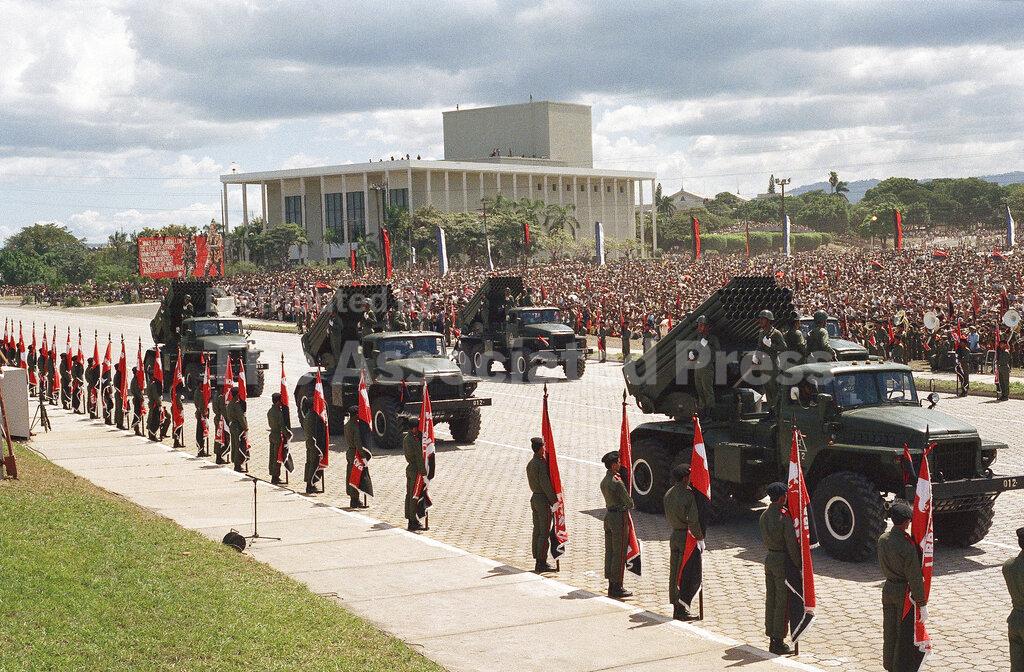
For the first time in recent years, the Sandinista Government staged a full-scale military parade today to show off its troops and weapons. As a large crowd watched, Soviet-built tanks, armored vehicles and artillery pieces passed by a reviewing stand occupied by all nine members of the Sandinista National Directorate. Diplomats and Government officials said the parade was intended to demonstrate that Nicaragua is equipped to confront an expected widening of warfare here. Congress recently appropriated $100 million to support anti-Sandinista rebel groups.
Venezuelan President Jaime Lusinchi inaugurated the Guri Dam, one of the world’s most powerful hydroelectric plants, completed after 23 years of construction at a cost of $5.2 billion. “This is a great work in every respect, one that all Venezuelans can take pride in,” Lusinchi said before pressing the button to start the plant that will meet about 75% of the country’s electricity needs. Officially known as the Raul Leoni Dam, the plant on the Caroni River, 400 miles southeast of Caracas, has a 10,000-megawatt generating capacity.
A leftist Peruvian newspaper reported that the bodies of nearly 50 people who were missing after their arrest by soldiers and police had been found in a mass grave. El Nuevo Diaro said the remains of workers, women and students were uncovered by relatives at Erapata, 35 miles from Ayacucho, the state capital. Ayacucho police said they had not heard of the reported discovery of the mass grave. Prosecutors have filed charges against military officers for responsibility in the killing and burying of victims in two mass graves found in 1984 and 1985 in the nearby hamlet of Pucayacu.
Hooded gunmen from the Peruvian Maoist guerrilla movement Shining Path killed a candidate for the Huancayo Town Council today, a day before nationwide municipal elections, the police said. The candidate, Angelica Quintana, a member of President Alan Garcia’s Aprista Party, was shot in the control booth of a radio station where she was conducting an Andean music program, the police in Huancayo said.
Two crash experts from the International Civil Aviation Organization have arrived in Maputo to help the Mozambican Government investigate the crash that killed the country’s President, Samora M. Machel. Another expert was to arrive by Monday. It was not known whether their arrivals would affect the refusal of the South African Government to send flight recorders recovered from the Soviet-built airliner to Moscow so technicians can decode information that might help determine the cause of the crash.
Hundreds of black South African miners ended a two-day strike at Evander, 65 miles east of Johannesburg, only hours after clashes between strikers and mine security officers who fired tear gas and rubber bullets. A company spokesman said security officers at the Kinross Gold Mine dispersed “unruly mobs” of strikers who tried to prevent colleagues from going to work. The strike was triggered by the dismissal of a labor leader. In Port Elizabeth, General Motors accused labor unions of cutting communications and said its plants would not open on Monday.
An Administration report charges that the Supreme Court has systematically undermined state sovereignty for more than 50 years and proposes a strategy to correct what it calls an “erroneous judicial reading” of the Constitution. The confidential report concludes, after a 15-month study, that the Court has improperly pre-empted and invalidated the states’ legitimate exercise of their sovereign powers, leaving them to act only as “satrapies” or “administrative units” of a “virtually omnipotent national government.” The 90-page document, a copy of which was obtained by The New York Times, says the Supreme Court showed “indifference” to the principle of federalism in 1973 when it guaranteed women access to abortion and limited the states’ power to regulate abortion. Moreover, it says court rulings on the reapportionment of state legislatures since 1962 represent “an unprecedented intrusion” into state affairs.
President Reagan makes a radio address to the Nation on reform of the Federal Budget process. President Reagan said today that he would make revision of the Federal budget process his top legislative priority next year, comparing it to his successful crusade for tax revision this year. “Budget reform is an idea whose time has come,” Mr. Reagan said in his weekly radio address from Camp David, Marylandd. The President complained about what he called “this year’s budget fiasco” in which he said he was forced to sign a single piece of legislation appropriating half a trillion dollars for all Federal agencies.
The President and First Lady watch the movie “Red River.”
A record 58% of the nation’s 1985 high school graduates went on to college, and most other graduates were able to find jobs, according to a Labor Department report. But students who dropped out of high school during the 1984-85 school year fared poorly in the job market. Only 62% were working in October, 1985, the department’s Monthly Labor Review said. During the 1970s, the proportion of high school graduates entering college each year hovered around 50% to 52%, but it has been rising for the last several years, reaching 55% in 1984.
One-third of the electorate who describe themselves as “born-again” or evangelical Christians gives Vice President George Bush a crucial margin of support in early test elections against Colorado Senator Gary Hart, the leading Democratic challenger for the presidency in 1988, according to the Gallup Poll. In combined results of two recent surveys, Bush was found to be the choice of 50% of registered evangelicals, to 40% for Hart, with 10% undecided. Bush also leads New York Governor Mario M. Cuomo, 59% to 29%. However, among non-evangelicals, Hart holds a 48%–43% edge over Bush, with Cuomo still trailing Bush, 39% to 50%.
Mother Teresa dedicated a hospice for AIDS victims in a Washington neighborhood where residents have angrily objected to the facility. “Let us thank God for giving us this beautiful gift, this home,” she said at a dedication Mass at the building, located on a relatively secluded hilltop surrounded by 12 acres of parkland. The Missionaries of Charity, the order founded by Mother Teresa, is establishing the home, which will house terminally ill and AIDS patients in the last stages of the disease. Residents of the neighborhood, where homes sell in the $100,000 range, have protested the plan, worrying that it will hurt their investments and stable community.
Senator Edward M. Kennedy said today that he would take over the Senate Labor and Human Resources Committee, clarifying the probable lineup of key chairmanships when the Democrats assume control of the Senate next year. His decision, announced in Boston, to head that committee rather than the Judiciary Committee leaves that chairmanship to Senator Joseph R. Biden Jr., a Delaware Democrat who is a possible Presidential contender in 1988. Moderate to conservative Democratic Senators from the South and Southwest will be in control of 9 of the 17 key committees. The Democrats won 55 seats to the Republicans’ 45 in the elections Tuesday. The chairmanships, which will be formally decided by the Senate Democratic caucus, are generally awarded on the basis of seniority among members of the majority party.
More than 140 memorials to veterans of Vietnam are completed or under way in 45 states, Puerto Rico and American Samoa. The 143 projects, most of them privately financed, cost a total of $20 million. The monuments, most numerous in the South, range from modest structures by volunteers and amateur sculptors at town halls and county seats to ambitious, wall-like replicas of the national Vietnam Veterans Memorial on The Mall in Washington. A Vietnam veterans’ leader, Jan C. Scruggs, said the projects were symbols of “separating the war from the warrior,” in terms of reconciliation.
A former Air Force sergeant, Allen John Davies, who is suspected of trying to pass military secrets to Soviet agents was freed on $200,000 bail Friday. A preliminary hearing was scheduled for November 14 to determine whether he should be charged with attempted espionage, the authorities said. Mr. Davies was released to the custody of his parents Friday. He was ordered to live with his parents in nearby Cupertino and report to the Federal authorities daily. Mr. Davies, who is 33 years old and lives in San Jose, was arrested October 27 for attempting to pass classified military information to an agent of the Federal Bureau of Investigation who was posing as a Soviet spy.
The General Motors Corporation said today that it would permanently lay off 1,300 hourly workers later this month at its year-old Buick City assembly plant at Flint, Mich. The new round of layoffs follows an announcement Thursday that G.M. was closing 11 older manufacturing sites in four states and laying off 29,000 workers starting next year to save $500 million a year.
A South Korean fishing vessel was seized at sea and its crew of 56 arrested by the Coast Guard after a fisherman attempted to rape a U.S. observer who had boarded the vessel, officials in Anchorage, Alaska, said. The woman, an employee of the National Marine Fisheries Service, fended off the alleged rapist but was injured in the attack aboard the Shin Yang Ho on October 22, officials said. She was unable to get off the boat for a week after the attack. The 330-foot vessel was seized in the Bering Sea about 90 miles northeast of Dutch Harbor and its entire crew arrested, the Coast Guard said. The boat is being taken to Kodiak, Alaska.
Hundreds of Cubans in American jails could be released soon because of a policy switch by the Reagan Administration, which has been frustrated in its efforts to repatriate them to Cuba. Immigration and Naturalization Service officials confirmed that the change, which could affect 3,000 detainees, was prompted after Cuban President Fidel Castro broke off an agreement that could have sent most of them home. The detainees were among the 125,000 Cubans who came to the United States in 1980 in a massive boatlift across the Florida Straits after Castro allowed them to leave. Some considered dangerous were imprisoned upon their arrival and others were held after committing crimes here.
San Francisco has apparently become the nation’s first city to give voter approval to the concept of equal pay for jobs of comparable worth among city workers. The voters Tuesday approved an amendment of the city’s charter to require that the Civil Service Commission make yearly surveys of salaries and that the City Board of Supervisors use these surveys to approve pay increases. The measure passed with 60.1 percent of the vote. The city has set aside about $30 million for the first two years of pay increases.
Fourteen cars of a 126-car freight train derailed near Clarkton, North Carolina, and a methanol tanker burned after the engineer braked in a futile effort to avoid hitting a man on the tracks, authorities said. The man, Barry Wayne Landreth, 28, of Linden, North Carolina, was killed, but none of the four crewmen on the CSX train were injured, the Bladen County Sheriff’s Department reported. Officials said the chemical car was allowed to burn after nearby residents were evacuated.
A Missouri shopping mall is unique. Looking for the latest copy of “Dietary Goals of the U.S.?” Need the “Pocket Guide to Chemical Hazards” right away? Or “Time and Frequency: Theory and Fundamentals’?’ “That one sells, believe it or not,” said Kitty Burton, manager of the only United States Government Bookstore situated in a suburban shopping mall. At Bannister Mall here, you can get those titles and many others, including the 20-volume “History of North American Indians.”
Seattle’s cocaine users are the target of a campaign by the United States Attorney there to dry up demand for the drug. Customers are identified by electronic surveillance and prosecuted. “Some people with discretionary income make the choice to buy cocaine just the way they decide to buy prepared pasta,” said Gene Anderson, United States Attorney for Western Washington. He would not discuss how many suspects might eventually be brought into court. Reports published here estimate that more than 20 will be prosecuted on charges of being customers and say they will include prominent figures in broadcasting, law and business.
Fossils show dinosaurs died out later than had been thought. New fossil evidence, especially discoveries in China, is showing that dinosaurs did not die out suddenly and that they apparently survived at least a million years after they were generally thought to have become extinct, according to recent findings. The discoveries raise serious questions about current theories holding that the dinosaurs perished 65 million years ago in a global catastrophe caused by an asteroid or comet striking the Earth. That may have happened, some scientists are now saying, but it is much less certain that it precipitated the dinosaur extinction. Robert E. Sloan, a paleontologist at the University of Minnesota, reported yesterday that in China dinosaur bones, teeth, eggs and footprints were found embedded in sediments laid down after the hypothesized impact at the end of the Cretaceous period of geologic time. An analysis of the sediments by Dr. Sloan showed that some dinosaurs existed a million years into the Tertiary period, when mammals were beginning to replace reptiles.
The new influenza strain that health officials warned about in August has arrived in the United States with the first reported cases of the 1986-87 influenza season, the Centers for Disease Control in Atlanta report. The virus had been isolated this fall in five patients in the United States, three in Texas and one each in New York and Hawaii, the agency said. The Federal agency said Thursday that an early analysis of the viruses found in New York and Hawaii showed they appeared to be similar to the Taiwan flu, the strain the agency reported three months ago after it was discovered in Southeast Asia.
A strong storm system near the border of Minnesota and Ontario spread snow, low temperatures and very high winds across the Dakotas and parts of Minnesota yesterday, while the Southeast had record high temperatures. About 15 inches of snow covered the ground at Minot Air Force Base in North Dakota.
Andrew Lloyd Webber’s musical “Song and Dance”, starring Bernadette Peters, closes at Royale Theater, NYC, after 474 performances and a Tony Award for Peters.
Born:
Sammie Lee Hill, NFL defensive tackle (Detroit Lions, Tennessee Titans), in West Blockton, Alabama.
Kevin Hobbs, NFL defensive back (Seattle Seahawks, Detroit Lions), in Tampa, Florida.
Kevin Haslam, NFL tackle (Jacksonville Jaguars, San Diego Chargers), in Mahwah, New Jersey.
Aaron Swartz, American computer programmer, internet hackitvist, activist, and entrepreneur (Reddit, Creative Commons, Open Library), in Highland Park, Illinois (d. 2013).
Died:
Vyacheslav Molotov, 96, Soviet Russian politician (Soviet Minister of Foreign Affairs, 1939-1949, 1953-1956).
Beatrice Kay, 79, American vaudevillian, singer (“Mention My Name In Sheboygan”), and actress (“Calvin and the Colonel”; “Underworld U.S.A.”).

