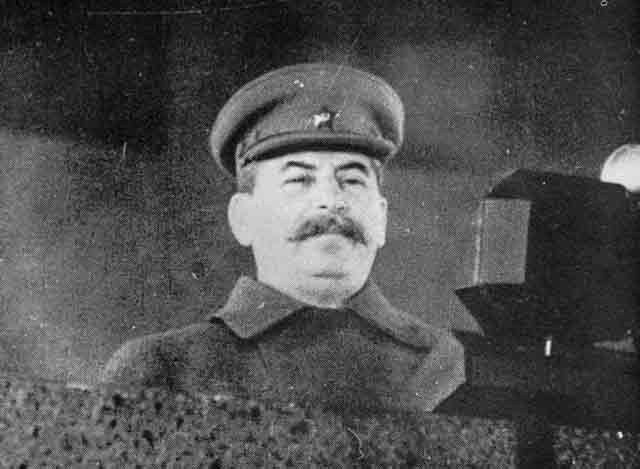
In an important symbolic event, Soviet troops marched in Red Square to commemorate the anniversary of the October Revolution as per the annual tradition. Soldiers taking part in the parade marched straight on to the front line. World War II is a war of parades. All of the victorious powers have them, from the joint Soviet-German parade in Brest-Litovsk on 22 September 1939 until the US Military parade down Fifth Avenue in New York City by the 82nd Airborne Division on 12 January 1946. On 7 November 1941, Joseph Stalin outdoes them all and presides over the most important and memorable parade of the 20th Century. It is a massive display of Soviet military might through Red Square with the Wehrmacht standing almost within sight of Moscow. It is more than a parade, it is a demonstration of will and steel.
The occasion is the Anniversary of the October Revolution. On the night before this 7 November 1941 military parade, Stalin gives a rare and odd radio address in which he begins by talking about the peacetime successes of the first half of 1941, gives a somewhat, um, “nuanced” summary of the current situation, and then launches into a weird attack on his western allies for not helping enough. Today is the main event, with two Soviet divisions taken from their duties on Moscow’s defense line marching past Red Square.
It is an overcast day, which is fortunate because the clouds keep the Luftwaffe away. Stalin arrives at his reviewing podium in a special train at 07:00, stepping out first to obligatory applause before the members of his retinue follow along behind him. The thunderous applause lasts for ten minutes, long enough for Stalin to climb the podium’s steps and arrange his politburo and Moscow city authority minions around him. This is Stalin’s first public appearance since the May Day parade, and some observers feel that Stalin looks older and wearier — but nobody would dare to say that publicly. Then, everyone awaits the tramping soldiers.
The actual parade begins promptly at 08:00. Troops, tanks, and artillery whose barrels are still hot from action against the panzers roll past the reviewing stand, through Red Square, beside Lenin’s (now empty) mausoleum, and on past St. Basil’s Cathedral. Their final turn is to the west, as they do not stop before rolling back to their positions on the front lines opposing the German 4th Army. The parade is possible in part because the 4th Army has dug trenches and assumed a defensive winter posture.
After the vast array of men and machines is gone, Stalin begins to speak. The speech is basically a rehash of his radio broadcast of the night before, complete with the phony casualty figures that appear to have been made up out of whole cloth and some vague generalizations about how the Germans had underestimated the Red Army. The event is a propaganda sensation, not just in the USSR, but around the world. Stalin succeeds in establishing to a skeptical world that it is still business as usual in Moscow, that he is still there, that the Red Army still has time for parades, and that the Germans still have a lot of work left to do to win the war. In essence, Stalin ignores as beneath contempt the artillery just over the horizon and the Luftwaffe planes that could have ruined the whole thing. He demonstrates to the world how inconsequential the German threat really is. The parade of 7 November 1941 becomes the finest, and perhaps only, shining moment in Stalin’s reign of tyranny and cruelty.
Speaking from Red Square in Moscow, Stalin made a speech during the October Revolution anniversary celebration predicting that even though German troops were less than 100 miles from Moscow, they were facing disaster. Soviet Marshal Josef Stalin addressed the Soviet Union in a speech delivered over the radio from Moscow on the anniversary of the 1917 revolution. In the speech he would state that Soviet losses were 350,000 killed, 378,000 missing, and 1,020,000 wounded and that during the same time period the Germans had casualties of 4,500,000 men. This was only the second time during his three-decade rule that he addressed the people directly. The first time was earlier that year on July 2, 1941. Stalin’s claims of German casualties were grossly exaggerated. Stalin also called on the west to establish a “second front” in Europe against the Nazis. He told a rally of Moscow party workers: “There is no doubt that the absence of a second front is making the enemy’s task easier, but we hope that a second front will be established, and in the near future, thus relieving the task of the Russian army.”
The delegates, meeting in the ornate marble hall of the Mayakosvsky Underground station because of the Luftwaffe’s continuous attacks, gave Stalin a thunderous welcome and cheered again when he told then that the Germans, who had been given orders to kill everything Russian, “would get their war of annihilation and would be exterminated without mercy”. It was a brave speech to make with the Germans hammering at the gates of Moscow, but Stalin was full of confidence: “Our army must win, and will win. The German army must be defeated, and will be defeated.”
There are three basic facts, he said, which will lead to Hitler’s army being crushed: “The first of these facts is the instability of German imperialism, and Hitler’s New Order. We are assured that Hitler acts like Napoleon in everything. I can tell you that Hitler no more resembles Napoleon that a kitten resembles a lion.”
“Secondly, Napoleon fought for liberal forces against reactionary forces. Hitler is fighting for reaction and will perish by the hand of the progressive forces.
Thirdly, who doubts that Britain and the United States will give us full support to conquer Hitler? …. Modern war is a war of machines. The war will be won by the one who has an overwhelming superiority on the output of machines. This is one of the fundamental reasons for the inevitable doom of the predatory Nazi imperialism. Our task is now revenge.” Today, at the traditional military parade before Lenin’s tomb in Red Square, Stalin urged the army to defend “Holy Russia.” The soldiers, in full battle kit, marched straight from Red Square to take their place in Moscow’s front line.
Meanwhile, in Berlin, the German Army High Command (OKH) was determined to continue the advance on Moscow in spite of up to 80 Soviet Army divisions in front of them.
The war does not stop just because Stalin decides to hold a celebration of survival. The German 8th Panzer Division continues approaching Tikhvin and beats off a sharp and disastrous counterattack by 14 Soviet tanks of the 60th Tank Division. After losing all but two of their tanks, the Soviets withdraw and General Harpe’s division continues advancing until it is only seven kilometers from Tikhvin.
Much further south, in the Black Sea, one of the great tragedies of the war unfolds. Soviet hospital ship Armenia departed Yalta, Ukraine at 0800 hours with 7,000 civilians and wounded troops aboard, against orders forbidding sailing during daylight hours. At 1129 hours, despite the red cross marking, she was attacked by a He 111 bomber of German KG26. She sinks within four minutes. Only 8 people survived. This is a virtual companion piece to the tragic sinking of the military transport Wilhelm Gustloff in 1945, but few remember the tragedy of hospital ship Armenia.
There is little question that on 7 November 1941, the entire invasion of the Soviet Union is at a critical point. The Wehrmacht stands just outside Moscow but has lost its momentum. The last thing the Germans want is to have to camp out in the fields and forests through a savage Russian winter. General Guderian notes in his diary that his men are beginning to suffer from severe frostbite. There is one bright spot for the Germans, however, because along with all its problems, the winter cold is making the ground hard again. Trucks and tanks and horses and men are regaining the ability to move without getting stuck in the mud. There may be one last chance for a run at key objectives before the blizzards shut down major operations until the spring.
Minsk: 12,000 Jews are slaughtered and buried in mass graves outside the city.
Official records were given out by the U.S. State Department today to prove that through its agency Finland was informed as far back as Aug. 18 of Russian willingness to discuss peace with her on the basis of territorial compensation to Finland.
British merchant ship Nottingham, on her maiden voyage, spotted German submarine U-74 in the North Atlantic and attempted to ram her. At 2234 hours U-74 counterattacked, sinking Nottingham. All 62 aboard escaped in lifeboats, but they were never seen again.
RAF Bomber Command, Night of 7/8 November 1941
The operations of this night proved to be of great significance. No doubt frustrated by the recent long run of bad weather and poor bombing results, Sir Richard Peirse decided to mount a major effort on this night, with Berlin as the main target. He persisted in this decision despite a late weather forecast which showed that there would be a large area of bad weather with storms, thick cloud, icing and hail over the North Sea routes by which the bombers would need to fly to Berlin and back. Air Vice-Marshal Slessor of 5 Group objected to the plan and was allowed to withdraw his part of the Berlin force and send it to Cologne instead.
392 aircraft were sent out on the night’s operations. This was a new record effort for Bomber Command and probably represents the maximum number of serviceable aircraft with crews available at that time.
Berlin
169 aircraft – 101 Wellingtons, 42 Whitleys, 17 Stirlings, 9 Halifaxes – of 1, 3 and 4 Groups. 21 aircraft – 10 Wellingtons, 9 Whitleys, 2 Stirlings – were lost, 124 percent of those dispatched. 73 aircraft reached the general area of Berlin but could only claim fires on the outskirts of the city, with other results being ‘unobserved’. Berlin reports scattered bombing in many areas. Premises hit by the bombing were: 1 industrial, 2 railway, 2 public utility (a gasometer at Staaken was burnt out), 2 official buildings, 30 houses, 16 wooden garden houses, and 1 farm building. The only buildings classed as ‘destroyed’ were 14 of the houses. Casualties were: 11 people killed, 44 injured, 637 people bombed out and receiving official help, with a further number going to the homes of relatives and friends.
This was the last major raid on Berlin until January 1943.
Cologne
61 Hampdens and 14 Manchesters of 5 Group. No aircraft lost.
Crews reported many fires but Cologne recorded only 8 high-explosive and 60 incendiary bombs, with 5 people killed and 5 injured, 2 houses destroyed and 14 damaged; there was no industrial damage.
Mannheim
53 Wellingtons and 2 Stirlings of 1 and 3 Groups. 7 Wellingtons lost.
43 crews bombed in this area and reported a large fire. A specific request to Mannheim for a report for this particularly important night brought the reply that there was no record of any bombs falling in the city. It is not known where the bombs of this force fell.
Minor Operations: 30 Halifaxes, Hampdens, Wellingtons and Whitleys were sent on ‘rover patrols’ in the Essen and other areas; 6 aircraft – 2 Hampdens, 2 Wellingtons, 1 Halifax, 1 Whitley – were lost from these flights. 28 aircraft sent to Ostend and 22 to Boulogne operated without loss. 13 Halifaxes went minelaying near Oslo and 3 were lost.
Total effort for the night: 392 sorties, 37 aircraft (94 percent) lost. This loss was more than double the previous highest for night operations. It is probable that many of the casualties crashed in the North Sea, suffering from icing or fuel exhaustion in the bad weather conditions there.
U-74, commanded by Kapitänleutnant Eitel-Friedrich Kentrat, sank British steamer Nottingham (8532grt) in 53-24N, 31-51W. At 2234 hours on 7 Nov 1941 the unescorted Nottingham (Master Francis Cecil Pretty, OBE, DSC), on her maiden voyage, was hit in the stern by a stern torpedo from U-74 about 550 miles southeast of Cape Farewell after she tried to ram the U-boat. At 2250 hours, the ship was missed by a spread of two torpedoes because she stopped, but sank after being hit by a coup de grâce at 2259 hours. The crew was seen to abandon ship in lifeboats, but they were never seen again. The master, 55 crew members and six gunners were lost. The 8,532 ton Nottingham was carrying general cargo, including whisky and was bound for New York, New York.
Heavy cruiser HMS Berwick departed Hvalfjord on Denmark Strait patrol.
Destroyer HMS Echo departed London at 0800 for Sheerness on completion of a long refit. The destroyer arrived at 1400 to embark ammunition and fuel. Destroyer Echo departed Sheerness at 1330/8th for Scapa Flow, arriving at 0830/10th. En route, destroyer Echo assisted damaged tug Buccaneer.
Destroyer HMS Montrose departed Scapa Flow for Loch Alsh to act under Rear Admiral Minelaying. The destroyer arrived at 1700.
Destroyer HMAS Norman departed Scapa Flow at 1345 for Wick to embark Crown Prince Olaf of Norway and his staff for passage to Scapa Flow. The destroyer arrived back at Scapa Flow at 1700.
Sloop HMS Lowestoft departed Scapa Flow at 1500 to join convoy WN 2 for onward passage to Rosyth. Sloop Lowestoft had completed working up practices and was being assigned to Commander in Chief, Rosyth.
Minesweeper HMS Albury damaged by a near miss of German bombing off the east coast of Scotland. The damage required five weeks to repair.
Submarine HMS Trident made an unsuccessful attack on minesweeper MRS 3 (steamer Bali (1428grt) in 71-6N, 26-57E.
German steamer Frauenburg (2111grt) was sunk on a mine off Windau.
Submarine HMS Upholder departed Malta for patrol off Cephalonia.
In operations from escort aircraft carrier HMS Audacity, supporting convoy OG.76, the Martlet piloted by Sub Lt (A) N. H. Patterson while landing in heavy seas went over the side. Patterson was picked up by an escort ship.
Convoy ON.34 departed Liverpool, escorted by destroyers HMS Caldwell, HMS Vanoc, and HMS Volunteer and corvettes HMS Acanthus, HMS Gentian, HMS Hibiscus, HMS Honeysuckle, HMS Myosotis, and HMS Sweetbriar. Corvettes HMCS Chicoutimi and HMCS Sherbrooke joined on the 8th and HMCS Sherbrooke was detached later that day. Corvettes Hibiscus, Periwinkle, and Sweetbriar were detached on the 10th. The remainder of the escort was detached on the 12th when joined by American destroyers USS Benson, USS Edison, USS Hilary P. Jones, USS Niblack, and USS Tarbell. The convoy was dispersed on the 21st and the escort detached.
Convoy OS.11 departed Liverpool. The convoy was joined by destroyer HMS Clare, sloops HMS Aberdeen, HMS Enchantress, HMS Ibis, and HMS Stork on the 8th. The destroyer was detached on the 25th, sloops Aberdeen, Enchantress, and Ibis on the 26th, and Stork on the 16th. Also joining on the 8th were corvettes HMS Coltsfoot and HMS Orchis, and escort vessel HMS Walney. Corvette Coltsfoot was detached on the 12th, escort vessel Walney on the 25th, and corvette Orchis arrived with the convoy on the 28th. On the 10th, escort vessel HMS Hartland joined the convoy and was detached on the 25th. On the 24th, destroyer HMS Brilliant, corvettes HMS Bergamot, HMS Crocus, and HMS Nigella, and anti-submarine whaler HMS Southern Pride joined the convoy and arrived with the convoy at Freetown on the 28th.
Italian convoy BETA departed Naples for Tripoli on the 7th with troopships German Duisberg (7389grt), San Marco (3113grt), Maria (6339grt), and Sagitta (5153grt) and tanker Minatitlan (7599grt) from Naples and Rina Corrado (5180grt) and tanker Conte Di Misurata (5014grt) from Messina, escorted by destroyers Maestrale, Euro, Fulmine, Grecale, Oriani, and Libeccio. The convoy was covered by heavy cruisers Trento and Trieste and destroyers Granatiere, Fucliere, Bersagliere, and Alpino which departed Messina on the 8th. On the 8th, light cruisers HMS Aurora and HMS Penelope and destroyers HMS Lance and HMS Lively departed Malta to attack this convoy. At 0100/9th, the convoy was attacked by Force K. The entire convoy and destroyer Fulmine were sunk. Destroyers Euro and Grecale were damaged by the British ships. Destroyer Grecale was taken in tow by destroyer Oriani. Destroyers Maestrale, Euro, Oriani, Alpino, Fucliere, and Bersagliere rescued 704 survivors from the convoy. Destroyer Libeccio, rescuing survivors, was torpedoed at 0640 by Submarine HMS Upholder in 36-50N, 18-10E. The destroyer was taken in tow by destroyer Euro, but was sunk when she experienced an internal collapse. Submarine Upholder at 1107 on the 9th, unsuccessfully attacked the heavy cruisers Trento and Trieste in 37-12N, 18-33E.
Today in Washington, President Roosevelt issued a proclamation establishing an emergency board to mediate a dispute between the Railway Express Agency and the International Brotherhood of Teamsters, Chauffeurs, Warehousemen and Helpers of America, A. F. of L. He instructed Edward R. Stettinius Jr., Lease-lend Administrator, to expedite aid to Russia. His callers included Mayor La Guardia, officers of the American Newspaper Guild and John J. Pelley, president of the American Association of Railroads.
The Senate passed, 50 to 37, amendments repealing restrictions on shipping imposed by the Neutrality Act, confirmed the nomination of Rear Admiral Ben Moreell to be Chief of the Navy Bureau of Docks and Yards, and adjourned at 9:28 PM until noon Monday.
The House received a request from the President for $58,160,725 for development of airport facilities, received the Voorhis bill to compel subcontracting of defense orders and adjourned at 12:51 PM until noon Monday. The Rivers and Harbors Committee approved the $1,000,000,000 Rivers and Harbors Authorization Bill.
The U.S. Congress amended the Neutrality act to allow the arming of merchants and transporting war goods to warring nations. This action was taken after a month of debate. The U.S. Senate voted 50 to 37 tonight to amend the neutrality act so American ships may mount guns for their protection and sail through any seas and to any ports, including combat zones and the harbor of belligerent nations. It took this action at the end of a long day and evening of tense and sometimes dramatic debate, which found the opposition to the Roosevelt foreign policy making a last ditch stand against legislation which it frequently called a prelude to war. The measure now goes back to the house for action upon highly important and controversial Senate amendments. As originally passed by the House, the revision resolution called only for the arming of American ships. This action, reversing the nation’s six-year policy of keeping its ships from carrying contraband of war to belligerent nations, was taken after all amendment attempts failed. The upper chamber defeated, 50 to 38, an amendment by Senator Thomas of Oklahoma to permit arming our merchantmen but forbid them from entering combat zones, and subsequently voted, 49 to 38, against another proposal by Senator Clark of Missouri to keep them out of both combat zones and belligerent ports. Just before the final vote was taken Senator Clark of Missouri, one of the bitter opponents of the Administration bill, offered an amendment to repeal the entire Neutrality Act. He explained to the chamber that this was “the Willkie amendment offered in honor of the undisputed leader of the war party in, the United States.” The amendment was treated as a political maneuver and defeated, 78 to 11.
The navy announced tonight it would take over construction of $10,500,000 in defense projects at three military establishments in the San Diego area if striking A.F.L. building tradesmen did not return to their jobs by Monday. Rear-Admiral C. S. Blakely, 11th naval district commandant, said he had been directed by the navy department to inform union leaders if the men on strike did not resume work at 8 a.m. Monday, contractors on the projects would be granted permission to obtain employment from any other sources that may be obtained. “Failing in this, the government will take over the entire work under the contracts affected and carry on the projects with civil service employees,” the navy announced.
The defense high command committed itself today to an unprecedented policy of rationing “critical” materials to the nation’s industry. Contemplating gradual elimination of the present complicated system of priorities, the supply priorities and allocations board took its first step toward what it called an “all-out allocations program.” It ordered the office of production management to prepare complete reports on the 1942 production programs of each industry.
President Roosevelt today instructed Edward R. Stettinius Jr., the Lease-Lend Administrator, to arrange “as quickly as possible” with Soviet officials the transfer of war supplies to Russia under the Lend-Lease Act.
Dr. Henry Field was summoned to the office of U.S. President Franklin D. Roosevelt’s secretary, Grace Tully, who “told Field that the President was ordering him to produce, in the shortest time possible the full names and addresses of each American-born and foreign-born Japanese listed by locality within each state” and that “it was to be done by using the 1930 and 1940 censuses.”
The House Rivers and Harbors Committee approved a $1,000,000,000 authorization bill today for a score of projects, including the St. Lawrence seaway and power development.
President Roosevelt announced today the appointment of Secretary Ickes as “Solid Fuels Coordinator for National Defense” and charged him with assuring an adequate supply of coal and coke for armaments, industrial and civilian purposes.
A strike of 350,000 operating employees of the railroads will be called soon to enforce a demand for a 30 percent wage increase, executives of the Big Five brotherhoods announced tonight. No official date has been set, but it is expected the strike will be ordered for December 5.
President Roosevelt appointed an emergency fact-finding board today to investigate and report in thirty days on the dispute between the International Brotherhood of Teamsters, Chauffeurs, Warehousemen and Helpers of America and the Railway Express Agency, Inc., which threatens to tie up express freight in twenty-eight cities.
Two wildcat strikes by small groups of men made 20,000 Ford automobile workers idle today, and at the same time a C.I.O. embargo on the shipment of axles from the Rouge plant in Detroit to the Canadian Ford Company threatened the production of war equipment there.
Clement R. Attlee, Lord Privy Seal and Deputy Prime Minister of Great Britain, said at a press conference at the British Embassy in Washington today that he was “quite certain” the joint action of Britain and the United States in the industrial field would “enable us to defeat Hitlerism.”
All ranks of official, diplomatic and resident society were represented in unprecedented numbers at the reception held today at the old Russian Embassy on Sixteenth Street in Washington in celebration of the October Revolution, which gave birth to the Union of Soviet Socialist Republics. For more than two hours the Soviet charge d’affaires, Andrei A. Gromyko, Mrs. Gromyko and Mrs. Constantine A. Umansky, wife of the Soviet Ambassador, exchanged greetings with more than 2,500 guests, whose automobiles blocked traffic outside. Mrs. Henry A. Wallace, wife of the Vice President; Mrs. Cordell Hull, wife of the Secretary of State; Secretary and Mrs. Jesse H. Jones, Mrs. Claude R. Wickard, wife of the Secretary of Agriculture; Mrs. Stanley Reed, wife of Associate Justice Reed, and Sir Ian Campbell, Minister Resident and counselor of the British Embassy, were early arrivals.
Bette Davis became the first female president of the Academy of Motion Picture Arts and Sciences.
The following Communications Intelligence Summary is sent from Commander Edwin Layton to Admiral Husband E. Kimmel, Commander in Chief United States Fleet:
“General.-Volume of intercepted traffic larger than usual. Due to the use of the general call “All Major Force Flags” on the UTU for delivery to all Combined Fleet units, affiliation of unidentified calls with forces to which attached is very difficult. Use of large number of alternate calls for major fleet forces, many of which have not yet been definitely identified or associated with known calls, renders the picture more confusing. Appearance of the prefix “JITSU” (authenticator for bona fide traffic) in several messages indicates that a communication drill is being held but without indication as to what units are participating and therefore much of the traffic is suspected of being “drill.” Jaluit Radio is handling traffic direct with Yokosuka Radio probably due to congestion of Mandate circuits from the Marshalls caused by heavy concentrations in that area.
“Air.-Continued high traffic level for all classes of air activities, mainly centered in the Taiwan area, but also with all air activities in the Mandates included in headings of messages. Dispatches originated by Fourth Fleet Command included Air Forces, Base Forces, Air Stations, and all types of Mandate activities in long headings.
“Fleet.-Fourth Fleet Command remains in Truk area. There are indications that portions of the First Fleet may be moving to the Takao area but identifications are not sufficiently certain to confirm this.
“Greatest effort is being made to increase the number of identified calls to facilitate analysis of the traffic but Orange changes in methods of handling fleet traffic renders this more difficult than had been hoped.”
A wave of conjecture that the United States is “clearing the decks” against a possible clash with Japan followed President Roosevelt’s disclosure today he was considering withdrawal of the 970 marines stationed in China. The president carefully refrained from giving a reason for the contemplated move, but some army and navy authorities have argued presence of small American forces in Pelping, Tientsin and Shanghai were liabilities rather than a protection for American lives and interests.
Secretary of State Hull warned the United States Cabinet that relations with Japan were extremely critical.
MacArthur informs Hart that he will not accept Navy control of patrol flights. Hart requests guidance from Navy Department on mobilization and deployment plans. No answer was received.
Destroyers USS Lansdale (DD-426), USS Charles F. Hughes (DD-428), and USS Gleaves (DD-423), while in TU 4.1.2 escorting convoy ON.30, make depth charge attacks on sound contact. Destroyer Madison (DD-425) sights bleeding whale soon thereafter, leading to the conclusion that the warships had attacked a large marine mammal.
First flight of the AAF GB-1 guided glide bomb, containing preset guidance.
The American $1,000,000,000 loan to Russia, announced at the moment when Saburo Kurusu is en route to Washington as a special Japanese envoy in a final effort to obtain an easement of the economic blockade against Japan, made a rather painful impression in Japan.
Japanese Navy conducted a carrier exercise.
The Combined Fleet Operations Order No. 2 states, “This order was issued by Commander-in-Chief, Combined Fleet, after he had received verbal notification from Chief, Naval General Staff, that 8 December had been tentatively selected as “Y” Day.”
Dow Jones Industrial Average: 118.33 (-0.51)
Born:
William H. Neukom, American attorney and lead lawyer for Microsoft (1978-2002), in Chicago, Illinois (d. 2025).
Angelo Scola, Catholic cardinal, in Malgrate, Italy.
Died:
Albin Zollinger, 46, Swiss writer.
Naval Construction:
The U.S. Navy SC-497-class (110-foot wooden hull) submarine chaser USS PC-673 (later SC-673) is laid down by the Thomas Knutson Shipbuilding Corp. (Halesite, Long Island, New York, U.S.A.).
The Kriegsmarine (German Navy) Type VIIC U-boat U-419 is laid down by Danziger Werft AG, Danzig (werk 120).
The Royal Navy escort carrier HMS Nairana (D 05) is laid down as a merchant ship by the John Brown Shipbuilding & Engineering Company Ltd. (Clydebank, Scotland).
The U.S. Navy YMS-1-class auxiliary motor minesweeper USS YMS-35 is launched by the Hiltebrant Dry Dock Co. (Kingston, New York, U.S.A.).
The Royal Navy Fairmile B-class motor launch HMS ML 307 is commissioned.
The Royal Navy Assurance-class rescue tug HMS Jaunty (W 30) is commissioned.
The Royal New Zealand Navy Isles-class minesweeping trawler HMNZS Killegray (T 174) is commissioned. Her first commanding officer is Lieutenant Arthur Allan Bell, RNZNVR.
The Вое́нно-морско́й флот СССР (ВМФ) (Soviet Navy) “M” (Malyutka)-class (3rd group, Type XII) submarine M-116 is commissioned.
The Вое́нно-морско́й флот СССР (ВМФ) (Soviet Navy) Project 7-class (Gnevny-class) destroyer Razumny (Разумный, “Sensible”) is commissioned.

