The Soviet Union has issued new regulations on emigration that Soviet spokesmen say will ease the process of leaving the country. But Soviet citizens seeking emigration say the measures will do little to change existing practices. The regulations, which were published in a list of resolutions of the Soviet Government and which take effect January 1, marked the first time Moscow had spelled out acceptable grounds for applying to emigrate, as well as grounds for denying the application. Although the decree appeared to make few substantive alterations in existing practices, both Western diplomats and people who have been denied permission to leave said it could herald a more flexible policy. Reunification of Relatives The decree, which has the power of law, declared that applications to leave the Soviet Union would be considered on the grounds of “reunification with members of one’s family, meetings with close relatives, marriage, visiting seriously ailing relatives, visiting the graves of close relatives, resolving inheritance issues and other valid reasons.”
The Soviet Defense Minister, Marshal Sergei L. Sokolov, who has been out of public view for the last two months, failed to review the Revolution Day parade in Red Square today, increasing the speculation that he is seriously ill. In his stead, the troops of the Moscow garrison were reviewed by General Pyotr G. Lushev, one of three First Deputy Defense Ministers, who has been filling in for Marshal Sokolov at major functions and who is viewed by Western military experts as the most likely candidate to become the next Defense Minister. Although Marshal Sokolov’s name has continued to appear under documents requiring the Defense Minister’s signature, he last made a public appearance on September 9.
A controversy has arisen over an American press report in which Prime Minister Jacques Chirac is quoted as saying senior West German officials believe Israel masterminded a terrorist plot in London in April. In the report, which appears in today’s issue of The Washington Times, Mr. Chirac says in an interview that both the West German Chancellor, Helmut Kohl, and Foreign Minister Hans-Dietrich Genscher did not believe in Syrian involvement in the incident, which led Britain to break diplomatic relations with Syria last month. Mr. Chirac, the newspaper said, told an interviewer of the West German belief that the plot to blow up an El Al Israel Airlines passenger plane was a fake, carried out by the Israelis in conjunction with “renegades” in the Syrian secret services who wanted to embarrass the Syrian President, Hafez al-Assad. Israeli officials said they were “staggered” by the remarks attributed to Mr. Chirac. One Israeli official was quoted by Reuters as saying: “I am staggered. It’s unbelievable. The story is of course ridiculous.”
The police in Israel have summoned for questioning 4 of the 27 Israelis who returned today from a meeting with Palestine Liberation Organization representatives in Rumania, the Israeli radio reported. The four Israelis were handed the summons orders when they landed in Ben-Gurion International Airport today. It was the first time Israelis had openly met with P.L.O. members since a law banning meetings with “terrorist organizations” was passed in August. Latif Dori, a delegation organizers who received a summons, said the trip had been a protest against the law. The offense carries a penalty of up to three years in jail. The meeting broken off early, reportedly because of Arab pressure or terrorist threats against the participants.
Lebanese and Syrian mediators have abandoned efforts to stop the fighting around Palestinian districts here and in southern Lebanon. Cease-fires have repeatedly been ignored in recent weeks by the combatants from Amal, Lebanon’s mainstream Shiite Moslem movement, and Palestinian guerrilla groups. Meanwhile, 4 people died today and 11 were wounded in fighting near Burj al Brajneh, one of three Palestinian areas in south Beirut.
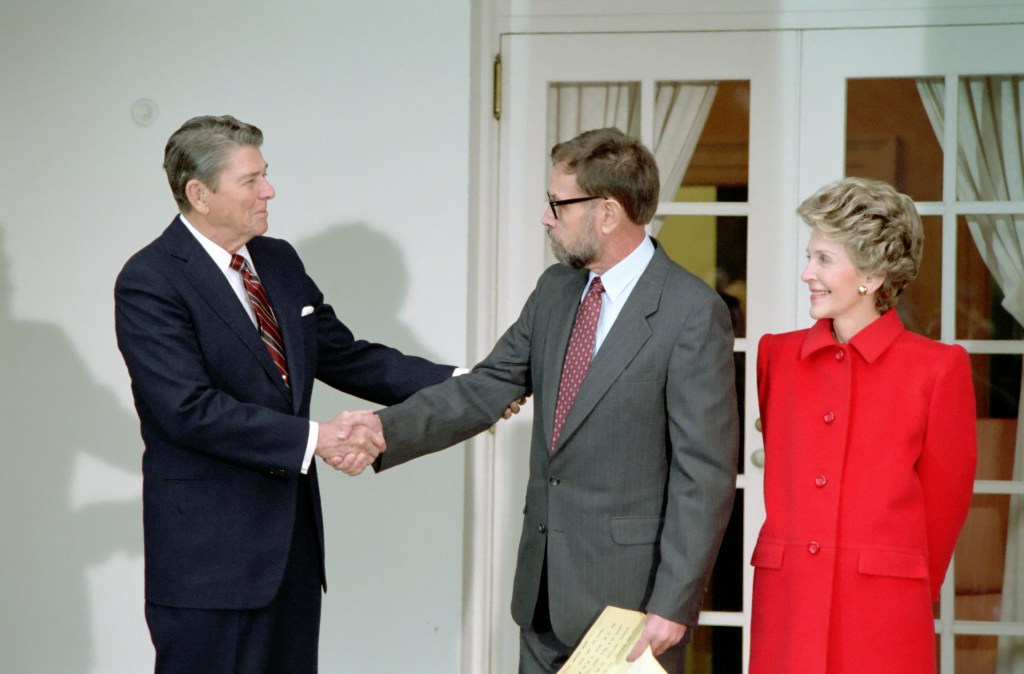
With President Reagan at his side, David P. Jacobsen, the former American hostage, pleaded with journalists today “in the name of God” to “back off” and refrain from reporting the details of hostage negotiations. “A simple speculation on your part could cause the death of my dear friend Tom Sutherland or Terry Anderson or Joe Cicippio or any of the other hostages,” Mr. Jacobsen said in a choked voice, standing with President and Mrs. Reagan in the White House Rose Garden. Mr. Jacobsen, a 55-year-old hospital administrator from Huntington Beach, California, was released Sunday after more than 17 months in captivity. Since Tuesday, when Iran said Robert C. McFarlane, the former national security adviser, and four other Americans had made a secret trip to Tehran, there have been published reports that the United States was providing military spare parts to Iran in a secret operation to gain the release of American hostages.
President Reagan approved a broad plan 18 months ago for secret contacts with Iran, Administration officials said today. They said the contacts were intended to improve relations with Iran, end Tehran’s support for terrorism and revolution and help gain the release of the American hostages held in Lebanon by the Islamic Holy War group, a shadowy Shiite Muslim organization believed to have links to Iran. The plan did not mention supplying arms and spare parts to Iran, Administration officials said. But they said that shortly afterward, the White House accepted an Israeli offer to use its contacts in Iran to deliver American-made arms. Providing the most detailed explanation to date of the Reagan Administration’s secret diplomacy with Iran, the officials said the United States undertook what one official called a “two-track” policy in the region.
Secretary of State George P. Shultz said today that he remained opposed to any negotiations with terrorists for the release of American hostages. Mr. Shultz made his comments on his Air Force jet returning to the United States from Paris. He said he had been ordered by the White House not to comment on reports that Robert C. McFarlane, the former national security adviser, had secretly negotiated with Iranian officials and helped arrange for arms to be supplied to Iran to secure the release, over a period of time, of three American hostages held in Lebanon. After saying many times that he would not comment, Mr. Shultz, expressing some exasperation, said: “The White House is in charge of the executive branch, and they have issued a statement that all questions shall be answered by the White House. And that’s why I say, ‘Ask the White House,’ and I have no comment to make myself.
Reaction in Europe to reports that the United States provided military spare parts to Iran and secretly negotiated with Teheran in an attempt to free American hostages in Lebanon ranged from support in Italy to caution and restraint on the part of British officials to chiding comments by the French Foreign Minister. While Government officials in many countries preferred to adopt a wait-and-see attitude, many news organizations were quick to label the American action “hypocritical,” saying Washington was pursuing a “risky” course.
Some outsiders are quick to characterize two former students of Ayatollah Ruhollah Khomeini as political rivals locked in a bitter power struggle as they position themselves for the post-Khomeini era in Iran. The two former students are Ayatollah Hussein Ali Montazeri and Hojatolislam Hashemi Rafsanjani, who wield more power and influence than anyone in Iran except Ayatollah Kohmeini. And indeed, both Ayatollah Montazeri and Hojatolislam Rafsanjani have bitterly attacked factionalism among revolutionary officials. Thursday the leftist Lebanese newspaper As Safir quoted Ayatollah Montazeri as saying that unity inside the Iranian regime is lacking, a remark that some analysts interpreted as a veiled criticism of Hojatolislam Rafsanjani. But despite their political ambitions and differences in power bases, personalities and certain policies, the two former Khomeini students share many of the same political views and are believed to work well together.
Agricultural privatization has swept through rural China, drawing on the strength of traditional medicine, such as herbal remedies, acupuncture, special breathing exercises and massage.
An anti-Government demonstration in Port-au-Prince involving thousands of protesters erupted in violence this afternoon with one policeman reported killed and at least six other people wounded. After a peaceful march through the capital earlier today, gunfire and rock-throwing broke out as people gathered for a second march in mid-afternoon. It was the first major outbreak since June of street violence in Haiti.
Fears of a coup reached a crisis stage in Manila today, and some sources said a move by a group of military officers had been narrowly averted, at least for the moment. Those involved in the events today declined for the most part to discuss them with reporters, but there were indications that intense maneuvering had occurred to block action by officers associated with Defense Minister Juan Ponce Enrile. President Corazon C. Aquino said the military had been placed on full alert, although she said she was confident there would be no coup. The military reported that broadcast stations and public utilities had been placed under guard.
Manila debt payment talks collapsed yesterday. The Philippines and its commercial bank creditors had been negotiating new repayment terms for its $3.6 billion debt.
A new AIDS virus discovered in west Africa last year may be as deadly as the original virus and could pose an international health threat, according to a prominent French researcher. The researcher, Dr. Luc Montagnier of the Pasteur Institute in Paris, said the new virus was first thought to cause only rare cases of acquired immune deficiency syndrome. But he said new evidence suggested that the virus, designatewd LAV-II, was a major cause of the disease in west Africa and had spread to several countries in western Europe.
Mozambique has dismissed South African suggestions that it was involved in a plot to overthrow the Malawi Government, and it accused Pretoria of hindering the investigation into the plane crash that killed President Samora M. Machel. The official press agency reported Thursday that the Mozambican Minister of Information, Teodato Hunguana, said the Pretoria report was an attempt to divert attention from questions about Mr. Machel’s death.
About 200 leading South African business officials attended an economic conference today with Government leaders, including President P. W. Botha, but avoided public confrontation with Pretoria over apartheid. Business analysts said the conference might modify the image of big business among blacks. For months, business organizations have sought to publicly distance themselves from the Government and its racial policies. Warren Clewlow of the giant Barlow Rand Corporation said the emphasis of the gathering was economics, but he said some business leaders had urged the ending of segregation laws.
Voter turnout in 1986 was the lowest since 1942 and the third-lowest in American history, according to a preliminary study made public today. The study, conducted by the Committee for the Study of the American Electorate, a nonpartisan research group, estimated that only 37.3 percent of the population of voting age cast ballots in Tuesday’s elections, down 3.8 percentage points from 1982, the last off-year election. Every region experienced a decline in turnout since the election four years ago, the study said, with the smallest decline occurring in the 13 Southern states and the biggest in the West, New England and the industrial states of the Midwest. Curtis B. Gans, the committee’s director, said he believed the drop was in part a result of growing disenchantment with American politics and the “demagogic and distorted political advertising” that dominated this year’s statewide campaigns. He said his data included absentee votes and those cast for minor parties.
President Reagan participates in a meeting with his advisors to discuss recent domestic and international developments affecting the economy.
President Reagan welcomes recently released U.S. hostage, David Jacobsen, to the White House.
When President Reagan signed the landmark immigration bill Thursday he brought joy to millions of illegal aliens who may now claim amnesty and remain in this country legally. But for some other aliens like Leila S. Reid of the Philippines it brought nothing but frustration. Even though she has lived in the United States for 11 years, she is not eligible. The reason is that she has maintained legal immigration status for all those years and now the Immigration and Naturalization Service says it will not extend her visa to remain in the United States. In one of the oddest twists of American law, the new immigration legislation requires aliens to prove “continuous unlawful residence” since before January 1, 1982, to be eligible for amnesty. But those like Mrs. Reid, who have assiduously maintained lawful immigration status, must continue to pursue normal channels to gain legal residency, a costly process that can take up to 10 years in the cases of aliens from countries such as the Philippines.
The Deputy Secretary of the Treasury today called the nation’s biggest businesses “bloated” and “inefficient.” He added that the “populist” political forces that Congress and the Administration had marshaled in overhauling the tax system were now turning against big business. The official, Richard G. Darman, said in a luncheon speech to American and Japanese business executives at the Japan Society in New York that the Federal budget deficits, the cause most often cited for the economy’s sluggishness, posed important problems. But he added, “I believe we have deeper cultural problems that demand our attention.
California Chief Justice Rose Elizabeth Bird said today that her defeat in the election Tuesday would embolden leaders of the New Right, corporations and both political parties to seek control of many state courts through the ballot box. “I think it shows the vulnerability of this branch of government,” Chief Justice Bird said of the decision by California voters to deny new terms on the California Supreme Court to her and two other liberal Justices, Joseph Grodin and Cruz Reynoso. They were the first members of the court removed by voters since the passage of a law in 1934 that required appointed judges to be confirmed by voters periodically. Chief Justice Bird asserted that the Reagan Administration had found, “by appointing people to work your will,” that it could reshape the Federal judiciary and achieve through court decisions objectives it could not achieve in Congress.
Democrats scored modest gains in state legislatures around the country in the elections Tuesday, basically regaining the ground the party lost in the Reagan landslide two years ago. The Democrats did not lose any legislative chamber they had controlled outright and picked up sixthat had been held by Republicans. In 1984, Republicans won seven chambers away from Democratic control. Both parties viewed the legislative races as battles for long-term, grass-roots strength nationally, and they put more money and effort into those races this year than ever before.
The economy generated an exceptionally large number of new jobs in October but the number of Americans competing for them also rose sharply, the Labor Department reported today. As a result, the unemployment rate remained at 6.9 percent, the same rate that prevailed in September and in the final quarter of 1985. The civilian jobless rate, which excludes the military, also remained unchanged last month at 7 percent, the department reported. Most analysts regarded the latest, somewhat anomalous, labor market report as mildly favorable but said the job growth was not nearly so strong as the raw figures suggested. Much of the gain was in part-time jobs, particularly among teen-agers and women, and there was little sign of an improvement in the battered industrial sector of the economy.
A Federal district judge in Minnesota today held unconstitutional a state law requiring women under 18 years old either to notify both parents or to obtain judicial approval before getting abortions. The judge, Donald D. Alsop, said his ruling was apparently the first examination by any court as to how such a law had worked “in actual operation.” He suggested the evidence contradicted the Supreme Court’s “assumption” that such laws could foster helpful consultation between pregnant teen-agers and their parents. The Supreme Court has cited what it sees as the benefits of such consultation in upholding laws somewhat similar to Minnesota’s, but it has not yet been presented with a case involving testimony about how such a parental notification law has worked in practice.
Two pilots avoided possible disaster when they chose not to land in the fog at Tampa International Airport on Thursday. A pilot who attempted to land was killed when his plane hit a jet on the taxiway.
The New York State Health Commissioner said yesterday that he would be willing to consider a small demonstration project in New York City to determine whether giving clean needles to intravenous drug addicts would reduce the spread of AIDS. Mayor Koch said he would support such a demonstration. Frances Tarlton, a Health Department spokesman, said the possession or use of hypodermic needles was a criminal offense in the state. But she added that the Health Commissioner, Dr. David Axelrod, was empowered under state health regulations to conduct a limited demonstration project that used them.
Four employees at the Hanford Nuclear Reservation were found to have been contaminated with plutonium Thursday after radiation detection alarms were set off by one of the workers, a spokesman said today. Bill Klink, a spokesman for Rockwell Hanford Operations, said the source of the contamination at the Plutonium Finishing Plant was not known and that the incident was being investigated. Sixty other employees were checked but no further contamination was found, he said. The alarms were triggered when a woman worker passed through the door of a laboratory where air samples gathered from various plant locations are tested for radiation, Mr Klink said. He said two women and a man were contaminated on the hands and another woman was contaminated on her face. The four were scrubbed with soap and water and a “cleaning chemical” was used on the woman with facial contamination, he said. He said no internal contamination was found.
Opponents of Omaha, Nebraska Mayor Michael Boyle said today that their petition drive on Election Day surpassed the number of signatures needed to force an election in January on removing him from office. Volunteers guided by computer profiles of voting patterns waited outside polling places in Omaha Tuesday to find registered voters. The move began after some residents became upset at Mr. Boyle’s leadership, including his dismissal of the city’s Police Chief and two other senior officers last month. Mr. Boyle apologized to the residents Thursday for what he described as “excesses that I may have taken” in his five years in office.
Playboy seeks more concessions in its suit against Edwin Meese’s Commission on Pornography. To settle the lawsuit, the Government has offered to state that Playboy has never been found “obscene.”
Alaska, where nearly everything costs more, leads the nation in spending for education, both in teacher pay and expenses for pupils. Teachers get the lowest salary scale in South Dakota; Utah ranks 50th in spending per pupil. Nationally, the nation’s school systems spent an average of $3,723 on each pupil in the 1985-86 school year, and the typical teacher salary was $25,313, according to information compiled by the National Education Association.
The Army, in “a major shift in American Army thinking,” will begin assigning its combat troops by unit rather than as individuals to lift morale, foster loyalty and improve fighting ability, senior officers said today. The change would keep soldiers in the same unit from the time they were trained through their deployment overseas and afterward in a concept based on the theory that troops who stay together would fight better because they would care more about one another. “This is a major shift in American Army thinking” because the emphasis previously had been on the individual, not units, said Lieutenant General Robert Elton, deputy chief of staff for personnel.
Flint, Michigan, rises and falls with G.M. The company’s decision to close two of its Flint plants and lay off 7,000 workers is viewed by the town as an economic blow and a personal affront.
The Beverly Hills Hotel is for sale. The controlling owners, Ivan F. Boesky and his wife, Seema, deny rumors that a dispute among differing family interests is prompting the sale.
Chris Evert Lloyd has withdrawn from the $1 million Virginia Slims Championships and will be out of action until January because of a knee injury, it was announced yesterday. “I am still having ongoing pain in my left knee,” Mrs. Lloyd said.
Speculators became leery of some takeover situations yesterday, and fundamental investors were bothered by the market’s general sluggishness. As a result, Wall Street experienced its second consecutive loss. But stock prices were down only a bit, as Wall Street tried to assess whether the market had enough life in it to push prices above the records set in early September. The market’s softness was evident yesterday in the Dow Jones industrial average, which declined 5.06, to 1,886.53. For the week the Dow was up 8.72 points. Volume tailed off, with only 142.3 million shares changing hands, compared with 165.3 million shares Thursday.
Dow Jones Industrial Average: 1886.53 (-5.06)
Born:
David Nelson, NFL wide receiver and tight end (Buffalo Bills, New York Jets), in Wichita Falls, Texas.
Patrick Trahan, NFL linebacker (Chicago Bears), in Baton Rouge, Louisiana.
Andy Hull, American singer-songwriter, and guitarist (Manchester Orchestra — “The Gold”), in Atlanta, Georgia.
Died:
Tracy Pew, 28, Australian musician (The Birthday Party), of a brain hemorrhage, after sustaining head injuries during an epileptic seizure.

