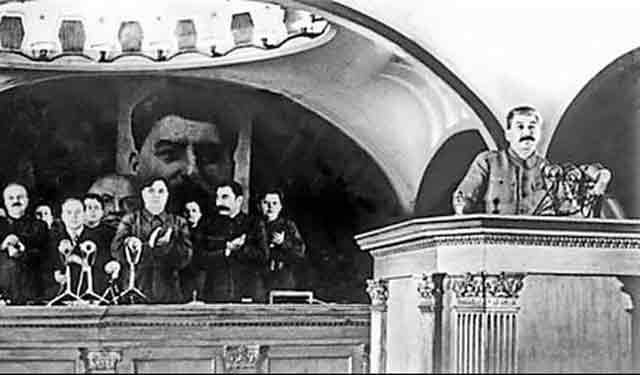
Joseph Stalin made a radio address broadcast worldwide declaring that Hitler’s “crazy plan” to draw Britain and the United States into a coalition to destroy the Soviet Union had failed. Stalin said that a coalition of the United States, Britain and the USSR was “now a reality” and expressed his hopes that a “second front” would be established “in the near future..”
Stalin, apparently in preparation for a major military parade to be held in Moscow tomorrow on the Anniversary of the October Revolution, makes a rare and peculiar radio broadcast on 6 November 1941. The speech, given at the celebration meeting of the Moscow Soviet of Working People’s Deputies and Moscow Party Public Organizations, is heard around the world (though, of course, it is in Russian and not many people outside Russia will understand it). Stalin’s last such address was on 3 July 1941 when he vowed to fight Hitler to the end. The situation has only gotten worse since July, and the German panzers at the time of this speech surround Moscow in three major directions (northwest, west, and south). However, the mere fact that the Soviet Union has survived this long is worthy of celebration.
Stalin begins the long speech in a remarkably mundane fashion (given the circumstances) by noting “successes in the realm of peaceful construction for the past year,” but quickly switches to the “war with the German invaders who perfidiously attacked our peace-loving country.” He calls the conflict a “war of liberation” and then says he will “sum up the results of the war for the second half of the past year” — as if he is about to go over a financial statement at a corporation.
Soviet media throughout World War II is never very forthcoming and always remains ambiguous about areas that have been lost. in this way, the situation is completely alien to foreign listeners who have media that do report such facts. It is typical for Soviet state media (and it is all state media) to say merely that there is “fighting in the direction of” a certain place. Savvy listeners (such as British war correspondent Alexander Werth, listening in Moscow) understand such references to mean that the place mentioned has been lost — even though the media never actually admit to that. So, when Stalin gives a precise list of places lost, it is the first time that the Soviet state actually admits to these defeats. Stalin says:
“The enemy has seized a large part of the Ukraine, Byelorussia, Moldavia Lithuania, Latvia, Esthonia and a number of other regions, has forced his way into the Donetz Basin, hangs like a black cloud over Leningrad and is threatening our glorious capital, Moscow.”
This is a very accurate summary of the situation — though Stalin does not mention the Crimea or territory lost to Finland. What he lists is bad enough and a rare dose of honesty for the Soviet people.
Stalin also gives precise casualty figures, but these seem a bit fanciful and the product of wishful thinking:
“In four months of war we have lost 350,000 in killed, and 378,000 missing, and our wounded number 1,020,000. In the same period the enemy has in killed, wounded and prisoners lost more than four and a half million men.”
While German losses have indeed been heavy, they are nowhere near four million men — which is a million soldiers more than the Wehrmacht began the war with. Soviet losses at Kyiv alone totaled roughly the numbers that Stalin gives for killed and missing for the entire conflict to date. Certainly, Stalin has better information than this available to him, but it sounds better to say that German losses exceed Soviet losses when the reverse is true.
After noting that the Germans “gravely miscalculated,” which absolutely appears to have been true, Stalin concludes with a somewhat backhanded plea for more help from his allies. He notes that “there are a number of factors unfavorable to the Red Army,” which at first glance seems like an amazing admission, but which immediately turns into an implied accusation that the Allies are not doing their fair share of the fighting. Stalin argues:
“One of the reasons for the reverses of the Red Army is the absence of a second front in Europe against the German-fascist troops. The fact of the matter is that at the present time there are still no armies of Great Britain or the United States of America on the European continent to wage war against the German-fascist troops, with the result that the Germans are not compelled to dissipate their forces and to wage war on two fronts, in the West and in the East. Well, the effect of this is that the Germans, considering their rear in the West secure, are able to move all their troops and the troops of their allies in Europe against our country.”
Then, Stalin completely omits the help that the Allies actually are giving the Soviet Union, which is Lend-Lease supplies. After noting that “the Germans are producing considerably more tanks,” he says:
“There is only one way of nullifying the Germans’ superiority in tanks and thus radically improving the position of our army. This way is, not only to increase the output of tanks in our country several times over, but also sharply to increase the production of anti-tank aircraft, anti-tank riffles and guns, and anti-tank grenades and mortars, and to construct more anti-tank trenches and every other kind of anti-tank obstacle.”
It is a jaw-dropping exercise in blame-shifting by Stalin. Although Germany is invading, the root cause of the USSR’s troubles, Stalin very strongly implies, is the failure of the Western Allies to help out. Not only is there no second front, but they aren’t giving any other help, either (at least according to this speech). This curious anti-Western attitude is one that Stalin will retain throughout the war and in the post-war years as well. Thus, this speech of 6 November 1941 casts a very long shadow that extends well past 1945.
Frostbite began to make its appearance among German troops fighting in the Soviet Union.
The Finnish advance into Russia was halted.
Ivan Bagramyan was awarded the Order of the Red Banner for the first time.
Between 15,000 and 18,000 Jews were taken to the Sosenki forest outside of Rovno and massacred over the next two days.
The Jager Report (issued on 1 December 1941) noted that 340 adult male, 749 adult female, and 252 children, all Jews, were killed in Vilnius, Lithuania for a total of 1,341 people.
Haj Amin el-Husseini, Mufti of Jerusalem and leading champion of Arab nationalism, arrived in Berlin from Rome today for what, it is said, will be “a sojourn of long duration.” A special statement describing the Mufti, who fled Iran during the British campaign there, as “the famous warrior against Judaism and oppression,” declared that he had been received by representatives of the Reich government with “warmth and all the ceremony due this great man.”
Yugoslav quarters in London charged today that Axis forces had slain more than 300,000 Serbian men, women and children, including virtually the entire populations of some towns, in a campaign to exterminate the Serbian race.
By taking the lead in “the crusade against bolshevism” Germany has “acquired rightful title to the gratitude of the world,” writes Marshal Henri Philippe Petain, Chief of the French State, in a letter he has sent to Colonel Jean Labonne, commanding the Legion of French Volunteers Against Bolshevism.
British minesweeping trawler HMS Flotta was lost when she foundered off the east coast of Scotland, United Kingdom. She was damaged running aground on 29 Oct 1941.
A small number of Wellington bombers based in Malta conducted an attack on Naples, Italy after dark.
RAF Bomber Command, Night of 6/7 November 1941
Minor Operations
9 Wellingtons to Le Havre, 6 Hampdens on patrols off the German coast and over the mainland, 15 Hampdens minelaying near Oslo, 3 O.T.U. sorties. 1 minelaying Hampden lost.
The British Royal Fleet Auxiliary oiler RFA Olwen reported that she had made the “raider” signal when what was probably a surfaced submarine had fired upon her at dawn on November 4. Ten U.S. and British warships had searched for two days for a phantom enemy.
Destroyer HMS Montrose departed Scapa Flow with Rear Admiral Destroyers Home Fleet for passage to Scrabster. The destroyer arrived back at Scapa Flow at 1330.
Light cruiser HMS Kenya and destroyers HMS Bedouin and HMS Intrepid were ordered to return to Seidisfjord from Iceland — Faroes patrol. After refueling, the ships would proceed to cover minelaying operation SN.83B, sailing on the 8th. However, in heavy weather, the destroyers were forced to return to Seidisfjord.
Light cruiser HMS Trinidad departed the Clyde for Scapa Flow, arriving on the 7th.
Destroyer HMS Beaufort departed the Clyde at 1630 for Scapa Flow. The destroyer arrived at 2100/7th for working up practices.
Submarine HMS Sealion arrived at Murmansk from Scapa Flow.
15th Cruiser Squadron was at sea from Alexandria for gunnery exercises.
Anti-submarine whaler HMS Kos 19 sighted a periscope thirty two miles west of Alexandria at 2220/5th. The whaler was joined by anti-submarine whaler HMS Falk, corvette HMS Snapdragon, and anti-submarine boat MA/SB 2. Destroyer HMS Encounter was also sent from Alexandria to assist. Destroyers HMS Decoy and HMS Hotspur joined at daylight on the 6th. The destroyers were recalled to harbour at 1800 and no success was obtained. Oil patches were sighted in this area on the 7th and destroyers HMS Kipling and HMS Hotspur were sent to hunt in the area. The search continued during the night of 7/8 November. Destroyer Encounter joined the destroyers at daylight and the three destroyers were then involved in screening light cruiser HMS Neptune during a practice bombardment at Aboukir. The destroyers returned to Alexandria on the 9th.
Armed boarding vessel HMS Arpha fractured her propeller shaft while laying beacons at Anchorage G (Ginsah) in the Suez Gulf. The vessel was beached at Towila. Indian sloop HMIS Sutlej was sent to assist her. On the 9th, the vessel was refloated and towed by tug Confederate, screened by sloop Sutlej, to Gimsah. Vessel Arpha, in tow of tug Confederate and escorted by sloop Sutlej, arrived at Suez on the 14th.
Light cruiser HMS Mauritius arrived at Singapore with convoy WS.11X from Colombo.
American light cruiser USS Omaha and destroyer USS Somers captured German blockade runner Odenwald (5098grt), which had departed Yokohama on 21 August carrying Japanese rubber to Germany, off Recife in the South Atlantic.
Convoy SL.92 departed Freetown escorted by destroyers HMS Vansittart and HMS Velox to 11 November and corvettes HMS Burdock and HMS Marguerite to 11 November and corvette HMS Starwort to 12 November. On the 11th, sloop HMS Egret to 29 November and escort vessels HMS Banff and HMS Fishguard to 1 December joined the convoy. On the 12th, heavy cruiser HMS Dorsetshire and light cruiser HMS Dunedin joined the convoy to 13 November. Destroyers HMS Badsworth, HMS Croome, HMS Foresight, and HMS Fury joined on the 24th to 25 November and destroyer HMS Forester joined on the 25th for that day only. Corvette HMS Montbretia and anti-submarine trawler HMS Man O’ War escorted the convoy on the 30th only. Anti-submarine trawler HMS Arab escorted the convoy on 1 December only. The convoy arrived at Liverpool on 1 December.
President Roosevelt in Washington today addressed the International Labor Organization in a broadcast from the East Room of the White House. He sent to Congress a request for $30,000,000 to provide additional power transmission facilities at the Bonneville Dam.
The Senate completed Congressional action on the $170,000,000 defense highway bill, considered Neutrality Act revisions and recessed at 4:49 PM until 11 AM tomorrow. The Military Affairs Committee discussed the bill to increase the pay of the armed forces and the Privileges and Elections Committee heard further testimony in the Langer case.
The House approved the conference report on the $170,000,000 defense highway bill, received the Fish resolution to declare war on Germany, heard Representative Short criticize Wendell Willkie and adjourned at 2:04 PM until noon on Monday. The Ways and Means Committee discussed the Treasury request for immediate consideration of a new tax bill.
Administration leaders in Congress, confident they have enough support to win, called on the opposition today to stop talking and vote tomorrow to arm American merchant ships and send them all over the world. At the end of the tenth day of the Senate debate on revision of the Neutrality Act, opponents of the measure conceded that they did not have enough votes to block the Administration’s resolution, and indicated their willingness to close discussion tomorrow, or Monday at the latest.
Leaders of the Senate bloc opposing neutrality revision held a strategy meeting late today, decided to abandon any idea of filibustering against the pending legislation and reported they might consent to a final senate vote by nightfall tomorrow. Attending the conference were Senators Wheeler, Montana Democrat, LaFollette, Wisconsin Progressive, Nye, North Dakota Republican, Clark, Missouri Democrat, and Bilbo, Mississippi Democrat.
A violent attack on Wendell L. Willkie for his attitude on foreign affairs was made in the House today by Representative Short, Republican, of Missouri. It was applauded for a minute by the Republican side and even some Democrats joined in, urging that Mr. Short receive more time.
President Roosevelt threw the vast lease-lend coffers of the United States open to Russia tonight, granting the Soviets a $1,000,000,000 credit, without interest, to buy weapons to battle Hitler. The announcement came unexpectedly from the state department which made public correspondence in which Joseph Stalin thanked Mr. Roosevelt for this “unusually substantial aid” in the “great struggle against our common enemy, bloodthirsty Hitlerism.”
President Roosevelt announces a loan of 1 billion dollars (US) to the USSR for financing Lend-Lease supplies. The Soviet Government announced today the appointment of Maxim Litvinov to be Ambassador to the United States. The announcement said that the Washington government had given its agreement to the selection of Mr. Litvinov, who, as Foreign Commissar, journeyed to the United States in 1933 for the negotiations that led to American recognition of the Soviet Union. Mr. Litvinov succeeds Constantine A. Umansky, who is now in Kuibyshev and will join the management of Tass, the official Soviet news agency.
Navy Secretary Frank Knox appealed to A.F.L. building tradesmen to end a strike hampering defense building In San Diego yesterday and Sidney Hillman, associate O.P.M. director, denounced a walkout of aircraft welders as an “outlaw, wildcat proposition.” The navy secretary sent a telegram to San Diego A.F.L. leaders declaring that any strike against defense building, such as that Involving 1,435 San Diego building trades workers at the naval training station and the marine corps’ Camp Elliott, was “severely detrimental” to defense efforts and “in violation of a formal agreement” between the O.P.M. and the A.F.L.
President Roosevelt today denounced misguided industrialists and labor leaders who place personal advantage above the nation’s welfare and declared that no individual or group shall prevail against the commitment of the American people to destroy Hitlerism. Warning again that the United States and the entire western hemisphere are included in the “Nazi scheme of world domination,” he said Americans must make their “full sacrifices now” and produce to the limit, work three shifts a day, entrust industrial grievances to the proper government agencies, and deliver the goods to “the battle front of the entire world.”
The House Ways and Means Committee decided today to defer “temporarily” consideration of Secretary Morgenthau’s “suggestion” for a new tax bill, and thus apparently shelved for this session of Congress any probability of enactment of legislation for new levies for revenue or anti-inflationary purposes.
U.S. President Franklin D. Roosevelt told the International Labor Organization that the United States had begun post-war planning, saying “We have learned too well that social problems and economic problems are not separate watertight compartments in the international any more than in the national sphere. In international as in national affairs, economic policy can no longer be an end in itself. It is merely a means for achieving social objectives. There must be no place in the post-war world for special privilege for either individuals or nations.”
Franklin Roosevelt had dinner with Princess Märtha of Sweden (Crown Princess of Norway) at the White House in Washington D.C., United States.
George E. Browne and Willie Bioff, Chicago hoodlums who won control of the 125,000 members of the International Alliance of Theatrical Stage Employes, were found guilty in Federal Court yesterday of violating the anti-racketeering statute on three counts.
Unsuccessful search for German raider reported by British RFA oiler Olwen on 4 November is not entirely fruitless: TG 3.6, light cruiser USS Omaha (CL-4) (Captain Theodore E. Chandler) and destroyer USS Somers (DD-381), en route to Recife, Brazil, returning from the 3,023-mile patrol, captures German blockade runner Odenwald, disguised as U.S. freighter Willmoto, in Atlantic equatorial waters, 00°40’N, 28°04’W. Boarding party from Omaha (Lieutenant George K. Carmichael) reaches Odenwald as Germans explode charges to scuttle the ship. Omaha’s sailors, however, joined by a diesel engine specialist from Somers, prevent Odenwald’s loss while the cruiser’s SOCs and her accompanying destroyer screen the operation. The three ships then proceed to Trinidad because of possible complications with the Brazilian government; in view of the precarious fuel state in the American ships, Somers’s crew ingeniously rigs a sail that cuts fuel consumption and allows her to reach her destination with fuel to spare. British RFA oiler Olwen subsequently reports that she had made the “raider” signal when what was probably a surfaced submarine had fired upon her at dawn on 4 November 1941. Ten U.S. and British warships had searched for two days for a phantom enemy.
Destroyer USS Madison (DD-425), on the flank of convoy ON.39, carries out depth charge attack at 45°50’N, 40°40’W; investigation later proves their quarry to have been a whale.
Clarence Tinker was named the commanding officer of the U.S. 3rd Fighter Command.
Joseph Rochefort’s cryptanalytic team in U.S. Territory of Hawaii continued to encounter a great deal of dummy radio traffic being sent by the Japanese Navy.
Brereton issues training order directing that all units were to work “maximum hours” and specifying that 40% of all training flights were to be at night.
The Japanese Government today lodged a “most solemn” protest with the Soviet Government against the sinking of the Kehi Maru and demanded that the Soviets “reply with sincerity.” The protest was presented by Vice Foreign Minister Haruhiki Nishi to Soviet Ambassador Constantin Smetanin, who had been summoned to the Foreign Office and remained there an hour.
The Japanese military mobilized for war.
Japan’s patience has “reached the point of exhaustion” and her army may strike next at the Burma road to cut off American supplies to China unless the United States comes to terms with her special envoy, Saburo Kurusu, the foreign office organ, Japan Times and Advertiser, declared tonight. “There is always the possibility, even the probability of a direct march on the Burma road,” the editorial said, “to force America to abandon what is tantamount to direct military operations against Japan at the expense of the American people.” Kurusu’s trip by plane across the Pacific was described as “a last opportunity (for the United States) to make amends for aggression and restore the occasion for an amicable settlement.”
The possibility that the threatening Japanese moves in Indo-China against Yunnan and the Burma route into China might conceal preparations for a sudden invasion of Borneo was raised in Singapore today by some competent observers.
A troopship convoy from the United Kingdom arrived today in Singapore, bringing reinforcements several thousand strong, for Britain’s Far Eastern command. The arrivals included many men for the Royal Air Force, infantry, anti-aircraft and searchlight units and auxiliary services.
General Rikichi Ando was named the commanding officer of the Taiwan Army.
Dow Jones Industrial Average: 118.84 (-1.01)
Born:
Ray Perkins, NFL wide receiver (NFL Champions-Colts, 1968 [lost Super Bowl III; 1970 [won Super Bowl V]; Baltimore Colts); and NFL and NCAA head coach (New York Giants, University of Alabama, Tampa Bay Buccaneers, Arkansas State University), in Mount Olive, Mississippi (d. 2020).
Ralph Heck, NFL linebacker (Philadelphia Eagles, Atlanta Falcons, New York Giants), in Pittsburgh, Pennsylvania (d. 2025).
Lonnie Sanders, NFL cornerback (Washington Redskins, St. Louis Cardinals), in Detroit, Michigan.
Gary Schroen, American CIA operative who led the first trip into Afghanistan after 9/11, in East St. Louis, Illinois (d. 2022).
Doug Sahm, musician (founder of the Sir Douglas Quintet — “Mendocino”; Texas Tornadoes — “Adios Mexico”, in San Antonio, Texas (d. 1999).
Guy Clark, American country singer (“Heartbroke”), in Monahans, Texas (d. 2016).
Naval Construction:
The U.S. Navy YMS-1-class auxiliary motor minesweeper USS YMS-24 is laid down by the Greenport Basin and Construction Co. (Greenport, Long Island, New York, U.S.A.).
The Royal Navy “T”-class (Third Group) submarine HMS Token (P 328) is laid down by the Portsmouth Dockyard (Portsmouth, U.K.).
The Royal Navy River-class frigate HMS Ballinderry (K 255) is laid down by the Blyth Shipbuilding & Drydock Co. Ltd. (Blyth, U.K.); completed by Hawthorn Leslie & Co. (Hebburn-on-Tyne, U.K.) and Fletcher.
The Royal Navy MMS I-class motor minesweeper HMS MMS 81 (J 581) is launched by George Forbes (Peterhead, England, U.K.).
The Royal Navy Fairmile B-class motor launch HMCS ML 055 is commissioned.
The Royal Navy harbor defence motor launch HMS HDML 1054 is commissioned.
The Nihon Kaigun (Imperial Japanese Navy) B1 type (I-15-class) submarine HIJMS I-26 is commissioned. Her first commanding officer is Commander Yokota Minoru.
The Kriegsmarine (German Navy) Type VIIC U-boat U-595 is commissioned. Her first commanding officer is Oberleutnant zur See Jürgen Quaet-Faslem.

