The Government of Prime Minister Adolfo Suárez González is prepared to negotiate the conditions of next year’s scheduled elections with opposition groups once its program for changing the government makes its way out of Parliament later this month, according to well-placed sources. Government and opposition informants say that if the bill emerges largely intact from the Parliament controlled by the right wing. Mr. Suárez will hold discussions with the opposition on such vital issues as the electoral law, access to the state-run television and guarantees of free assembly during the campaign. The bill would give Spain a popularly elected two-chamber parliament next spring. Wielding a combination of blandishments, appeals to patriotism and veiled threats — including that of dissolving the unrepresentative body — Mr. Suárez seems confident of getting the necessary two-thirds majority in the 561-member Parliament. The Cabinet agreed yesterday to the formation of a vaguely empowered advisory body called the Economic and Social Council, which will probably absorb the 150 members of Parliament who represent Government-run trade unions that are being dismantled. This clearly was a vote-buying gimmick.
The Soviet Government expressed its hope today for continued improvement in Soviet-American relations during Jimmy Carter’s Presidency, but it did so with a trace of uncertainty that seemed to reflect the unanswered questions being asked here about what kind of foreign policy will emerge under a Carter administration.
Britain’s Labor Government, beset by the country’s worst economic crisis since the depression of the 1930’s, voted today to carry on despite a severe setback in three special elections last night. The elections reduced its control over Parliament to a single vote. The opposition Conservatives gained two of three normally solid Labor seats in the by-elections. The jubilant Conservative leader, Margaret Thatcher, raising a glass of champagne in a victory toast, said the Labor Government was crumbling and must call a general election soon. But Prime Minister James Callaghan issued a statement saying that the admittedly disappointing election results would “in no way affect the Government’s determination to pursue the task of national recovery.” Such a swift reaction to by-election results was believed intended to give as surances to foreign countries.
The sale of British military jet engines to China and the export of European and Japanese bail-bearing machinery to the Soviet Union are creating doubt about NATO’s ability to embargo strategic goods to its potential enemies. That conclusion emerges from a 27-page transcript of secret testimony given by United States intelligence officials in April to the House subcommittee on international trade and commerce. For the last 25 years the United States, its partners in the Atlantic alliance and Japan have maintained a coordinating body as a mechanism to prevent advanced technology and strategic goods . from reaching potential foes. But, Congressional sources say, the United States has been strict in its application of embargo restrictions while European partners have adopted the attitude, “When in doubt, trade.” Representative Jonathan B. Bingham, Democrat of the Bronx, released the declassified transcript yesterday saying: “Under the agreement, our allies are supposed to coordinate their export control policies with us in these sensitive product areas. Obviously the system didn’t work this time. This raises serious questions about our allies’ good will and about whether the Administration did all it could to obtain their cooperation.”
Geoffrey Platt, a laboratory technician at the British Microbiological Research Establishment in Porton Down, Wiltshire, accidentally became the first European victim of the Ebola virus when he accidentally got pricked by a contaminated needle while handling samples from Africa. Platt was successfully treated with human interferon and convalescent serum and he fully recovered.
In Rimini, the second and last Lotta Continua congress ended; during it, the party’s political line was violently contested by the working-class base and above all by feminist militants. Adriano Sofri and the leading group decide to – de facto – disband the party, without an official act.
In Sicily, a wave of rain and mud, coming from Mount Erice, devastated Trapani city and countryside, causing 16 victims.
The USSR performs a nuclear test.
The Palestine Liberation Organization, weakened by its setbacks in the Lebanese civil war and seriously divided by factional disputes, is beginning a period of painful self-reappraisal. The reappraisal is expected to begin formally in the next few days at a meeting of the P.L.O.’s Executive Committee. To be decided is what the organization should do, immediately and in the long run, now that it is forced to operate under the close surveillance of Syria. The Executive Committee is expected to take up the problems of existence under the thumb of Syria, which in effect will have virtually total control of Lebanon through its army’s domination of the Arab peacekeeping force that will take up positions in the country in the next few days. The P.L.O. must also deal with serious Syrian pressure for replacement of Yasser Arafat as the organization’s leader. The importance and urgency of the Executive Committee session, according to Arab and Western analysts, stem from the official announcement that the Palestine National Council will meet next month for the first time since June 1974. The council, which is a sort of parliament in exile of the Palestinian people and in theory controls Mr. Arafat’s Executive Committee, but not in fact, is expected to try to coordinate efforts towards the immediate and eventual goals.
India’s Lok Sabha voted, 180 to 34 to postpone parliamentary elections for the second consecutive year. The 1976 elections had been canceled later in 1975. The ruling Congress Party was joined by India’s Communist Party in approving the plan, while most opposition deputies continued their boycott of votes on legislation. After the vote by the Lok Sabha, and the approval of the ceremonial upper house (the Rajya Sabha), the 1977 voting was postponed until 1978.
The U.S. State Department, concerned about long-term security interests in northeast Asia, sought to reassure South Korea today that despite revelations of questionable Korean activities in this country, American military ties to Korea “remain unchanged.” A spokesman was authorized to say that “our basic relations with the Republic of Korea continue” as does “our desire to maintain close, constructive and friendly ties.” He said “our security interests in Korea remain unchanged.” The statement, however, was principally an effort to assuage South Korean anxiety caused by the press reports stemming from a Justice Department investigation of Korean activities here. It did not disguise a deep-seated and widespread concern at the highest Administration levels that the inquiry may produce a major crisis in Korean-American relations, with a carryover into Japanese-American relations as well. The whole issue has produced a problem at the highest levels. Officials such as Philip C. Habib, the Under Secretary for Political Affairs and a former ambassador to Seoul, have made no secret of their dislike of Park Tong Sun, known here as Tongsun Park, the South Korean businessman at the center of the investigation. They have given the Justice Department all the material in State Department files about questionable South Korean activities to aid the investigation.
An official Chinese spokesman yesterday denied reports that Chinese officials told visiting foreigners earlier this week that the widow of Mao Zedong and three other radicals would be put on trial for plotting a coup. Wall posters had previously revealed that an official investigation commission had been formed to investigate the activities of the four purged radicals. However, news reports yesterday quoted members of a Finnish delegation as saying that they had been told by Chinese officials that the investigation would be followed by a trial of the four. Responding to queries about the reports, the spokesmen declared yesterday that no one said the four would be put on trial. He would not go further and categorically rule out a trial. Because there were differences of opinion even within the delegation over what the Chinese officials had actually said. It seemed possible that there had been a language problem and that the words investigation and trial were confused. Many diplomats here believe the matter is at most a controversy over legal niceties. They feel the investigatory commission is charged with building the case against the four radicals and recommending punishment, which Chinese officials have already indicated will be incarceration for life. It is possible that a brief trial will be held to ratify the commission’s findings.
A prisoner-exchange accord has been reached between the United States and Mexico, the State Department announced. The agreement affects about 600 Americans now in Mexican jails and about 1,200 Mexicans in United States federal prisons.
In a major migration, Latin America’s rural poor are swarming to the cities, seeking jobs and a better life. By 1990 two-thirds of all Latin Americans will be living in cities. The main reasons for the migration have been the failure of farmlands to support workers, a rise in urban industrial and service jobs and easier transportation.
A $1 billion steel complex was inaugurated by Mexico in a move to help meet rising domestic demand and produce a small surplus for sale abroad. The state-owned complex, known as Sicartsa, and built on the Pacific Coast, is starting production with a capacity of 1.3 million tons a year.
The first epidemic of Ebola virus was brought to an end as the last of 280 victims died. By November 20, the World Health Organization announced that the virus was contained. There would be no further epidemics until a new outbreak 19 years later in 1995. On suggestion by virologist Karl Johnson, the nation’s health agency gave the illness the name “Ebola virus disease”, after the Ebola River valley on November 30.
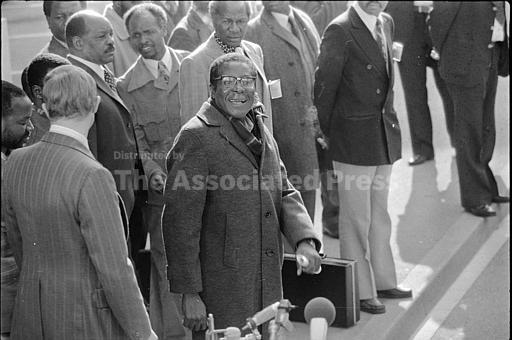
The white Rhodesian government reaffirmed its commitment to carrying out the British-American plan for black majority rule. Prime Minister Ian Smith said in Salisbury that if the Geneva conference failed, an accord might be worked out with black moderates. But he added that “there is still a chance” for success at the Geneva talks. “Too much effort has been put into this idea, into this theme.” said Mr. Smith at a news conference here. “I certainly would be reluctant to let the work go by the boards. The momentum that the Anglo-American agreement generated, I believe this will continue.” In Geneva, meanwhile, hopes for agreement received another setback when aides of Robert Mugabe, political spokesman for the guerrilla forces fighting Mr. Smith’s Government, said he would leave the talks for Mozambique. Mr. Smith sought to make it clear, however, that his departure from Geneva did not mean that the talks there had already failed.
Unemployment remained high and there was no gain in employment last month, the Labor Department reported. The jobless rate returned to 7.9 percent, the August figure, from 7.8 percent in September. The number of unemployed rose to 7,569,000, and those with jobs held basically at 87.8 million. The unemployment rate and the total
number of people out of work have been essentially unchanged since July. The number of persons with jobs was also basically unchanged. Wall Street analysts said the unemployment figures, as well as uncertainties about policies to be followed by the Jimmy Carter administration, contributed to the stock market’s third sharpest loss of the year today.
President Ford and President-elect Carter are expected to confer in Washington later this month on the transfer of power. The announcement was made by Jack Watson, Mr. Carter’s chief liaison with the White House, after a 2½ hour planning session with Mr. Ford’s transition team at the White House. Mr. Carter, at home in Plains, Georgia, telephoned his thanks to backers around the nation and reviewed transition reports by his staff. Mr. Watson said that Mr. Carter would probably remain in Georgia for most of the transition period between now and Inaugural Day. Jan. 20. But he added that a meeting between the outgoing and incoming Presidents was discussed this afternoon and that he expected such a meeting would take place “late this month.” He said that after his first meeting with Mr. Ford’s transition staff he could foresee “no problem” in effecting a smooth transfer of power.
Jimmy Carter’s election to the presidency had the irony in which Southerners delight. The returns indicate that the most faithful supporters anywhere for the white former Georgia Governor were black Southerners — the kind of people he played with as a boy, drifted away from in manhood and later made peace with in his maturity. Not even Southerners were prepared for the surge in regional pride on election day.
All three presidential debates aided Mr. Carter, according to Patrick Caddell, the Carter pollster. Speaking at the National Press Club, Mr. Caddell explained that the debates had interrupted the campaign at times when polls showed President Ford “closing on” Mr. Carter, so the interruptions were welcomed by Democrats.
Governor Wendell R. Anderson was urged today by Minnesota’s A.F.L.C.I.O. to arrange his own appointment to succeed Vice President-elect Walter F. Mondale in the United States Senate.
The trial of three men accused of kidnapping 25 Chowchilla schoolchildren and their bus driver was ordered moved out of Madera County today. Judge Jack L. Hammerberg of Superior Court also granted defense motions to keep grand jury transcripts in the case sealed at least until a trial jury is sequestered. Both rulings had been expected. Judge Hammerberg said that he had granted the venue change to avoid any possibility that the case might be prejudiced and overturned on appeal. The judge said that the state Superior Court system would provide a list of counties that would hold the trial and that he would select one of them. Attorneys for three young San Francisco Peninsula men accused of kidnapping had argued that a change in the site of the trial was necessary because of the emotional involvement in the case of residents of this county in central California. The prosecution had opposed the motion. The defendants are Frederick N. Woods, 24 years old, of Woodside, James Schoenfeld, 24, and his brother, Richard, 23, both of Atherton. All three have pleaded not guilty to 27 counts of kidnapping and 18 of robbery involving personal items taken from the victims.
The Nuclear Regulatory Commission ruled today that the construction permit for the Seabrook nuclear power plant would remain in effect. Carl Gustin, a spokesman for the commission, said that the agency determined after October 26 oral arguments that the problems of disposing of radioactive waste were not sufficient to halt construction of the $2 billion project. The commission’s appeals board once ordered a halt of construction because the waste problem was unresolved, The full commission suspended the appeals decision pending further hearings on the waste problem and issuance of a new environmental survey of the waste problem.
A second auto strike this year was averted 11 minutes before a deadline when the Chrysler Corporation and the United Automobile Workers reached tentative accord on a new three-year contract. The union had previously shut down the Ford Motor Company for 28 days. Specific terms of the agreement were not immediately announced. But William M. O’Brien, a Chrysler vice president who is the company’s chief negotiator, said that it was “reasonably close” to the settlement that ended the Ford strike. “Basically” said Douglas A. Fraser, the chief union negotiator, “we followed the Ford pact.” The most important feature of that settlement was a provision that opened the door to a four-day workweek at five days’ pay.
Federal mediators reported “some progress” yesterday in negotiations between the International Brotherhood of Teamsters and the United Parcel Service in their efforts to settle the union’s long East Coast strike. Negotiations, which have been going on at teamster headquarters in Washington, were recessed yesterday and are scheduled to resume early next week. Talks on secondary issues were scheduled to continue in the meantime. James F. Scearce, director of the Federal Mediation and Conciliation Service, described the negotiations over the last two days as encouraging.
The Secret Service, Congressional sources said today, has identified the author of an anonymous letter that prompted at least one scientist to hypothesize that the 29 victims of “Legionnaire’s disease” may have been murdered. An aide to Representative John M. Murphy, Democrat of Staten Island and Lower Manhattan, chairman of a subcommittee that will open hearings in Philadelphia the week of November 22 into the disease, said that the Secret Service had traced the anonymous letter to a New York City man. “We know who he is but we are not going to identify him. At this point no action is being taken against him,” the aide said. Dr. William Sunderman Jr., of the University of Connecticut, got the letter July 28, four days after the convention, when the first complaints of high fever and chest pains were being received from conventioneers. The letter mentioned the poison nickel carbonyl in a rambling attack on the “authority and military type” leaders of the nation, Dr. Sunderman, in his tests of victims of the disease, had found the poison in the victims’ tissue. Dr. Sunderman turned the letter over to the Federal authorities, who traced the man, they said, because he had a record “of having written other letters critical of persons in authority.”
The third trial of former Mayor Joseph L. Alioto’s $12.5 million libel suit against the defunct magazine Look ended in a mistrial today in a 5-to-1 deadlock. It was not known how the jury was split. The jurors declared a deadlock yesterday, but were ordered by the judge to try again to reach a verdict. After about an hour of deliberation today, jurors sent Federal District Judge Russel Smith a note saying “further deliberation would yield no further results.” The issue before the panel was whether the 1969 Look article, which alleged that Mr. Alioto was “enmeshed in a web of alliance with the Mafia,” had been published with malice.
A realty group accused of a swindle designed to sell undeveloped desert land called Rio Rancho Estates in New Mexico went on trial in Federal District Court in Manhattan. An 80-count indictment accused 10 defendants, including the Amrep Corporation, two subsidiaries, and seven top officers of deceptively seeking to sell “raw desert land” to thousands of investors for $200 million.
Major League Baseball:
New American League franchises in Seattle and Toronto fill up their rosters by selecting 30 players apiece from unprotected players on other American League rosters. outfielder Ruppert Jones (Seattle) and utility man Bob Bailor (Toronto) are the first choices.
The Pirates trade catcher Manny Sanguillen and an estimated $100,000 to the A’s for manager Chuck Tanner. Sanguillan will return to play for Tanner.
Baltimore’s Jim Palmer easily outpoints Detroit’s sensational rookie Mark Fidrych to win the American League Cy Young Award.
Stock prices plunged, paced by sharp drops in blue-chip issues. The Dow Jones industrial average registered its third steepest decline of 1976, tumbling 17.37 points to close at 943.07, its lowest level of the week.
Dow Jones Industrial Average: 943.07 (-17.37, -1.81%)
Born:
Sean Brown, Canadian NHL defenseman (Edmonton Oilers, Boston Bruins, New Jersey Devils, Vancouver Canucks), in Oshawa, Ontario, Canada.
Phillip Crosby, NFL fullback (Buffalo Bills), in Bessemer City, North Carolina.
Liu Rodríguez, Venezuelan second baseman and shortstop (Chicago White Sox), in Caracas, Venezuela.
Park Jung-chul, South Korean television star; in Seoul.
Died:
Helen Purdy Beale, 83, American plant virologist known for her invention of the serology processes in identification of diseases that affect crops.

