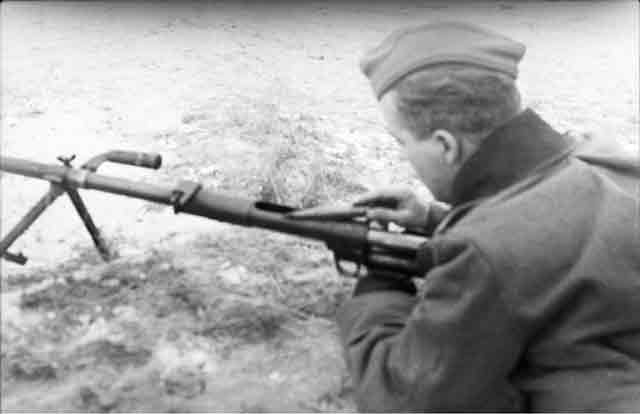
The PTRD-41 (Protivotankovoye Ruzhyo Degtyaryova) is a Soviet single-shot, bolt-action anti-tank rifle designed by Vasily Degtyaryov and introduced in 1941 during World War II. Rushed into production shortly after the 1941 German invasion, over 290,000 units were built by the Degtyaryov plant. Guns captured by the Germans were given the designation 14.5 mm PzB 783(r). While rendered obsolete against the thick frontal armor of late-war heavy tanks, it remained effective against light armor, half-tracks, truck convoys, fuel tanks, and fortifications (pillboxes and machine gun nests).
The situation on the central and northern sectors of the Eastern Front on 4 November 1941 is fairly quiet. The mud of the Rasputitsa (change of seasons) has paralyzed most German advances, while the Soviets are calibrating their defenses around Moscow and Leningrad by shifting troops around. At Tula, the buildup by both sides continues, as the Wehrmacht sends elements of German 31st, 131st, and 296th Infantry Divisions forward while the Soviets send the 413th Siberian Rifle Division (Maj. General Aleksei Dmitrievich Tereshkovo) south from Moscow by train. The Soviet forces defending Tikhvin north of Moscow launch another attack with the 60th Tank Division and the 4th Guards Rifle Division against General Harpe’s 12th Panzer Division, but are repelled after heavy fighting.
In the southern end of the Eastern Front, though, the Rasputitsa has not hit as hard as in the north, so the Germans have a somewhat easier time advancing. In the Crimea, OKH Chief of Staff Franz Halder notes in his diary:
“Eleventh Army continues its advance although the mountainous terrain around Sevastopol is affording the enemy greater opportunities for resistance.”
While General von Manstein’s 11th Army is finding that Sevastopol is going to be a hard nut to crack, further east the 170th Infantry Division expands the German hold on the Crimea by taking Feodosiya at the base of the Kerch peninsula. The Soviets have withdrawn in good order to a short line defending Kerch which leaves Sevastopol in the west completely isolated. However, both Red Army redoubts are well-garrisoned and easy to defend due to natural terrain features.
Elsewhere in the Army Group South sector, the problem for the Germans is not so much the Soviets as the weather. The Soviets are retreating everywhere, which Halder sees as both an opportunity and a problem. The opportunity is obvious:
“Despite the overwhelming difficulties of movement, we must find means to occupy the areas evacuated by the enemy.”
The problems are a little more subtle:
“Viewed as a whole, the situation is determined by railroad capacity and flow of supplies. There is no point in pushing operations onward before we have not, step by step, established a solid foundation for them. Failing to do that inevitably would bring fatal reverses down upon us.”
These words would be well worth remembering in late 1942 when Soviet retreats will also create tempting opportunities.
In the far north, the Axis also accomplishes a major objective that has mixed longer-term implications. The Soviets have occupied the Finnish port of Hanko, given to them at the conclusion of the Winter War in early 1940, throughout the conflict to date. However, ultimately the position is untenable, so before dawn today the Soviets finally evacuate the small garrison. Soviet destroyers Smetlivy and Surovy carry the Soviet troops out before dawn, with Smetlivy being hit by Finnish coastal artillery that causes it to sink on the way back to Leningrad. Several hundred people perish. The Finns then occupy Hanko, solidifying Axis control of the eastern Baltic and achieving one of their war aims. Such successes, however, reduce the Finnish incentive to continue fighting because their entire reason to fight is to recover lost territory. Now that is it is recovered… why keep fighting?
Of course, as the Germans can persuasively argue, the Finns aren’t truly safe until the Soviet Union is defeated, but the Finns increasingly feel that this is solely a German responsibility. The Finns also are concerned about warnings from Great Britain and the United States about fighting Stalin. The bottom line is that as the Finns chalk up successes at places like Hanko, a sort of paralysis settles over their military effort. It is not that they stop fighting, as the Finns fight hard throughout the war. Rather, it is a growing desire for the war to just go away and for the men to go home. The Red Army, however, lurks just over the horizon and it has no intention of letting the Finns enjoy their conquests for long.
The repair work on light cruiser Voroshilov, damaged two days prior by German aircraft, began.
Soviet submarine M-34 was lost somewhere off Constanza, Romania in the Black Sea; she was presumed to have struck a mine.
Leicester, U.K.: A woman who refused to sign up for war work with the army ordnance department is fined £2.
Cape Town: British and South African naval ships have intercepted a Vichy French convoy carrying tin and rubber from Indochina to Germany. The convoy of five ships, escorted by a sloop, the D’Iberville, was captured by four cruisers. The ships tried to scuttle, but boarding parties took them over and prevented the holds from flooding. The action has already drawn predictable protest from Vichy which regards it as akin to piracy. The convoy was carrying “supplies for the natives of French West Africa, and for French people in the unoccupied zone”, according to a statement from Vichy. “There was no contraband or material that could be used for war.” For some time Britain has watched impotently while Germany brings vital war supplied into Europe on French vessels. On 30 March a convoy of four French merchantmen escorted by the destroyer Simoun was seen passing the Straits of Gibraltar. When Royal Navy ships ordered the convoy to halt it took refuge in the Algerian port of Nemours. At the time Vichy said that the ships were bringing food to the native Algerians. Later the convoy reached Marseilles. It was carrying rubber from Thailand. This time the Allies have ensured that the rubber has not got through.
RAF Bomber Command, Night of 4/5 November 1941
Essen
28 Wellingtons; only 9 crews claimed to have found and attacked the Krupps works. No aircraft lost.
Minor Operations: 20 aircraft to Dunkirk and Ostend, 9 Hampdens on shipping patrols in the Frisians and in the Kiel area, 24 Hampdens and 4 Manchesters minelaying in Kiel Bay. No losses.
The British Royal Fleet Auxiliary oiler RFA Olwen reported the German surface raider attack in the central Atlantic Ocean. Commander-in-Chief, South Atlantic, Vice Admiral Algernon U. Willis, RN, ordered the heavy cruiser HMS Dorsetshire and the armed merchant cruiser HMS Canton to investigate. The light cruiser HMS Dunedin and special service vessels HMS Queen Emma and Princess Beatrix were ordered to depart Freetown, Sierra Leone to join in the search. The HMS Dorsetshire and HMS Canton parted company, with the former heading southeast and the latter steaming toward a position to the northwest, to be supported by U.S. Navy Task Group 3.6, composed of the light cruiser USS Omaha (CL-4) and destroyer USS Somers (DD-381), which are at that time well to the northwest of the reported enemy position. The light cruiser USS Memphis (CL-4) and destroyers USS Davis (DD-395) and USS Jouett (DD-396), near to the Olwen’s position, searched the area without result. The USS Omaha and USS Somers searched unsuccessfully for survivors through November 6.
Light cruiser HMS Kenya and destroyers HMS Bedouin and HMS Intrepid departed Seidisfjord at 2055 to cover the trawler patrol line west of the Iceland-Faroes minefield. Convoy PQ.3, which these ships were to have escorted, were ordered to remain at Hvalfjord until further notice.
Minelaying cruisers HMS Manxman and HMS Welshman departed Loch Alsh at 2300 for Scapa Flow, where they arrived at 0800/5th.
Destroyer HMS Wheatland departed the Clyde at 1245 for Scapa Flow to carry out working up practices. The destroyer arrived at 0815/5th.
Destroyer HMS Montrose departed Scapa Flow at 2030 for Rosyth. The destroyer arrived at 0700/5th.
Free French submarine Minerve arrived at Dundee after patrol off Norway.
British sailing vessel Britisher (95grt) was sunk on a mine just north of West Mouse Buoy, off Maplin. Both crewmen were lost.
Dutch motor vessel Madjoe (249grt) was sunk on a mine in 51-34-38N, 3-50-30W. The crew of four, two gunners, and the pilot were all lost on the vessel.
Italian submarine Dandolo damaged French tanker TARN (4220grt) in 36N, 2E, off Algiers.
Soviet destroyer Smetlivy was mined off Hango.
Greek destroyer RHS Kondouriotis departed Alexandria for docking at Suez.
An Italian convoy of steamers Bosforo (3567grt) and German Savona (2120grt), escorted by torpedo boat Pegaso departed Brindisi for Benghazi on the 4th. The Benghazi convoy was sighted by British aircraft on the 8th as it left the Adriatic. The convoy was heavily attacked by Malta based aircraft. Steamer Savona was damaged in the attack and returned to Brindisi. Steamer Bosforo and torpedo boat Pegaso put into Navarino. The ships later departed and arrived at Benghazi on the 12th.
Submarine HMS Trusty arrived at Malta after off patrol off Cephalonia.
Convoy SC.53 departed Sydney, CB escorted by corvettes HMCS Battleford, HMCS Dunvegan, and HMCS Sorel. Corvettes HMCS Dunvegan and HMCS Sorel were detached on the 6th when relieved by destroyer HMS Burnham and corvettes HMCS Algoma, HMCS Arvida, HMCS Chambly, HMCS Dauphin, and HMCS Matapedia. American destroyer USS Dale was with the convoy on 10 to 12 November. Corvettes HMCS Algoma and HMCS Battleford were detached on the 11th. Destroyer Burnham and the remaining corvettes were detached on the 20th when relieved by destroyers HMS Caldwell, HMS Vanoc, and HMS Volunteer and corvettes HMS Hibiscus, HMS Periwinkle, and HMS Sweetbriar. The convoy arrived at Liverpool on the 24th.
In Washington tonight, the Senate debated Neutrality Act revision, passed the bill empowering the Secretaries of the Navy and the Treasury to regulate the use of harbors, confirmed the nomination of Colonel Myron C, Cramer as judge advocate general of the Army, and recessed at 6 PM until noon tomorrow. The Privileges and Elections Committee continued hearings on the Langer case; the Education and Labor subcommittee heard support for long-range public works planning.
The House received President Roosevelt’s request for a $449,820,000 supplemental appropriation for the Navy, heard Representative Knutson urge Congressional investigation of military and civilian air crashes, and adjourned at 12:29 until noon tomorrow.
President Roosevelt tonight called for longer hours of work to produce munitions to defeat Hitler, and appealed to the public to halt waste and unnecessary use of materials required for the armaments program. The appeal was made public just before he left Hyde Park for Washington. In his statement, issued in connection with Civilian Defense Week, proclaimed for November 11–16, the President said the public must make sacrifices to preserve the American way-of life “from the pagan slavery proposed by the would-be dictators of the world.”
Foes of the Roosevelt foreign policy joined in a concerted attack upon the administration today for warning Finland to end its conflict with Russia. In reply, administration supporters charged them with endeavoring to divert attention from the real issue before the senate and the nation. This, said Senator Lee, Oklahoma Democrat, was whether the United States is to help those, meaning Russia in this instance, “who stand as, a barrier between the United States and war.” The day’s debate on neutrality act revision also brought declarations from Senators Bilbo, Mississippi Democrat, and Lodge, Massachusetts Republican, who previously had supported much of the administration’s foreign policy, that they would oppose removing restrictions which keep American ships out of combat zones.
Administration spokesmen in the Senate attacked the isolationist bloc today for following “a policy of inaction which leads to blood and bondage.” The attack came as opposition efforts were concentrated against revision of the Neutrality Act to permit American merchant ships to go into combat zones and enter belligerent ports. The other major proposal before the Senate, revision to permit the arming of American merchant vessels, had little discussion today. Before galleries which engaged in demonstrations against further delay of the vote, the’ Administration leaders emphasized that the government’s “policy of action” had saved England, while the policy of inaction had already “led fifteen other countries to war.”
Fiorello H. La Guardia was re-elected to a third term as Mayor of New York City. In the closest city election since the McClellan-Hearst contest in 1905, Mayor La Guardia yesterday defeated District Attorney William O’Dwyer of Kings, his Democratic opponent, by a plurality of 133,841. The total vote was 1,187,978 for Mayor La Guardia and 1,050,397 for Mr. O’Dwyer.
Viscount Halifax was pelted with eggs and tomatoes by isolationist women demonstrators in Detroit as he was leaving City Hall. Halifax was afterwards quoted as saying, “How fortunate you Americans are, in Britain we get only one egg a week and we are glad of those.” The quote was actually fabricated by someone in the British Press Service, but it was widely disseminated in the media and created a burst of sympathy and goodwill towards the British and Halifax in particular.
The treasury announced today its debt has gone over $54,000,000,000. The treasury’s obligations lumped overnight by $509,047,881 to a record total of $54,093,095,752 because of the issuance of new treasury notes to refund approximately a half billion dollars of Reconstruction Finance Corp. and Commodity Credit Corp. notes. The treasury debt has been rising rapidly on account of defense expenditures, and now is nearly $10,000,000,000 higher than it was a year ago.
A welders strike that has nearly paralyzed shipbuilding in the Long Beach, Los Angeles and Puget Sound yards was scheduled to branch into three California airplane plants at midnight. With approximately 8,300 shipyards’ welders here and in the Puget Sound district out, fellow workers in Lockheed and Vega aircraft factories in Burbank and at the Consolidated Aircraft Corp., San Diego, were under orders to walk out at 12 o’clock.
PBYs (VP 73) continue to provide air coverage for convoy ON.31.
American cruisers USS Omaha and USS Memphis, accompanied by three destroyers, are sortied to hunt for German surface raiders. British RFA oiler Olwen reports German surface raider attack at 03°04’N, 22°42’W. Commander-in-Chief, South Atlantic, Vice Admiral Algernon U. Willis, RN, orders heavy cruiser HMS Dorsetshire (accompanied by armed merchant cruiser HMS Canton) to investigate. Light cruiser HMS Dunedin and special service vessels HMS Queen Emma and Princess Beatrix are ordered to depart Freetown, Sierra Leone to join in the search. Dorsetshire and Canton part company, with the former heading southeast and the latter steaming toward a position to the northwest, to be supported by TG 3.6, light cruiser USS Omaha (CL-4) and destroyer USS Somers (DD-381), which are at that time well to the northwest of the reported enemy position. Light cruiser USS Memphis (CL-4) and destroyers USS Davis (DD-395) and USS Jouett (DD-396), near to Olwen’s position, search the area without result; Omaha and Somers search unsuccessfully for survivors (see 5-6 November).
All the Navy’s new bases in the Western Hemisphere will be in operation early next year. While they will not necessarily be completed in detail within the next few months, they will be prepared to handle a program involving 15,000 planes and provide operations and maintenance stations from Arctic to tropic regions, it was added.
Dolph Camilli of the Brooklyn Dodgers was named the National League’s Most Valuable Player.
The Japanese press is continuing its campaign to bring the United States to “self-reflection” about its Far Eastern policy. There is a growing crescendo, though with some confusion and contradiction in arguments. The Japan Times Advertiser, organ of the Foreign Office, today made up its own list of what the United States must do “or face the alternatives” — as follows:
- All military and economic aid to Chungking must cease.
- China must be left “free to deal with Japan,” and Chungking must be advised to make peace with Japan.
- Military and economic encirclement of Japan must end.
- Japan’s “co-prosperity sphere” must be acknowledged, and Manchukuo, China, Indo-China, Thailand, the Netherlands Indies and other States and protectorates must be allowed to establish their own political and economic relations with Japan without interference of any kind.
- Manchukuo must be recognized; “nobody will undo what has been done there.”
- The freezing of Japanese and Chinese assets must be ended unconditionally.
- Trade treaties must be restored and all restrictions on shipping and commerce ended.
The National General Mobilization Council of the new Cabinet is scheduled to hold its first meeting Friday.
The N.Y.K. liner Hikawa Maru departed tonight for Japan with 400 passengers aboard, most of them Japanese nationals leaving the United States and Canada because of the Far Eastern situation. Sailing was postponed four hours after the scheduled 3 p.m. departure to permit customs officials to make a “down-to-the-skin” search of outgoing passengers and baggage.
Major General Brereton arrives on Pan American Clipper to take up his appointment as Commander, FEAF, bringing with him a draft of revised Rainbow-5 calling for defense of entire Philippine Commonwealth.
General Douglas MacArthur, commander of U.S. Army Forces Far East, receives a letter from General George C. Marshall, Chief of Staff, U.S. Army, indicating that the Congress would “… give us everything we asked for.” However, the tanks, guns and men requested would not be arriving until April 1942.
New Zealand light cruiser HMNZS Achilles arrived at Auckland.
Born:
Walt Rock, NFL tackle and defensive end (San Francisco 49ers, Washington Redskins), in Cleveland, Ohio (d. 2026).
Margaret Markey, American legislator who introduced the Child Victims Act of 2019, in Queens, New York, New York (d. 2025).
Martin Brozius, Dutch actor (Goede Tijden Slechte Tijden), in Hoorn, Noord-Holland, Netherlands (d. 2009).
Richard James Gill, Australian music educator, in Sydney, New South Wales, Australia (d. 2018).
Naval Construction:
The Royal Navy YMS-1-class auxiliary motor minesweeper HMS BYMS 2006 (J 806) is laid down by the Wheeler Shipbuilding Corp. (Whitestone, Long Island, New York, U.S.A.).
The U.S. Navy SC-497-class (110-foot wooden hull) submarine chaser USS PC-651 (later SC-651) is laid down by the Westergard Boat Works Inc. (Biloxi, Mississippi, U.S.A.).
The U.S. Navy SC-497-class (110-foot wooden hull) submarine chasers USS PC-662 (later SC-662) and USS PC-663 (later SC-663) are laid down by the Fisher Boat Works, Detroit, Michigan.
The Royal Navy MMS I-class motor minesweeper HMS MMS 100 (J 600) is launched by Wagstaff & Hatfield (Port Greville, Canada).
The Royal Navy Isles-class minesweeping trawler HMS Westray (T 182) is launched by J. Lewis & Sons Ltd. (Aberdeen, Scotland).
The Royal Navy R-1-class submarine HMS Unbroken (P 42) is launched by Vickers Armstrong (Barrow-in-Furness, U.K.). She is later transferred to the Вое́нно-морско́й флот СССР (ВМФ) (Soviet Navy), becoming the V-2 in 1944.
The Royal Navy harbor defence motor launch HMS HDML 1086 is commissioned.
The Royal New Zealand Navy Isles-class minesweeping trawler HMNZS Sanda (T 160) is commissioned. Her first commanding officer is Lieutenant Commander (retired) Norman Leggatt Mackie, RNR.
The Royal Navy “U”-class (Third Group) submarine HMS P-511, formerly the U.S. Navy USS R-3, is commissioned. Her first commanding officer in British service is Lieutenant Bevil Grenfell Heslop, DSC, RN.
The Polish Navy S-1-class submarine ORP Jastrząb (P 551), former the U.S. Navy submarine USS S-25, is commissioned. Her first commanding officer in Polish service is Kpt.mar. (Lieutenant Commander) Boleslaw Szymon Romanowski, ORP.
The Kriegsmarine (German Navy) Type IXC U-boat U-509 is commissioned. Her first commanding officer is Korvettenkapitän Karl-Heinz Wolff.
The Royal Navy Flower-class corvette HMS Rockrose (K 51) is commissioned. Her first commanding officer is Lieutenant Commander John Dudley Birch, RNR.
The Royal Navy King George V-class battleship HMS Duke of York (17) is commissioned. Her first commanding officer is Captain Cecil H. J. Harcourt, RN.

