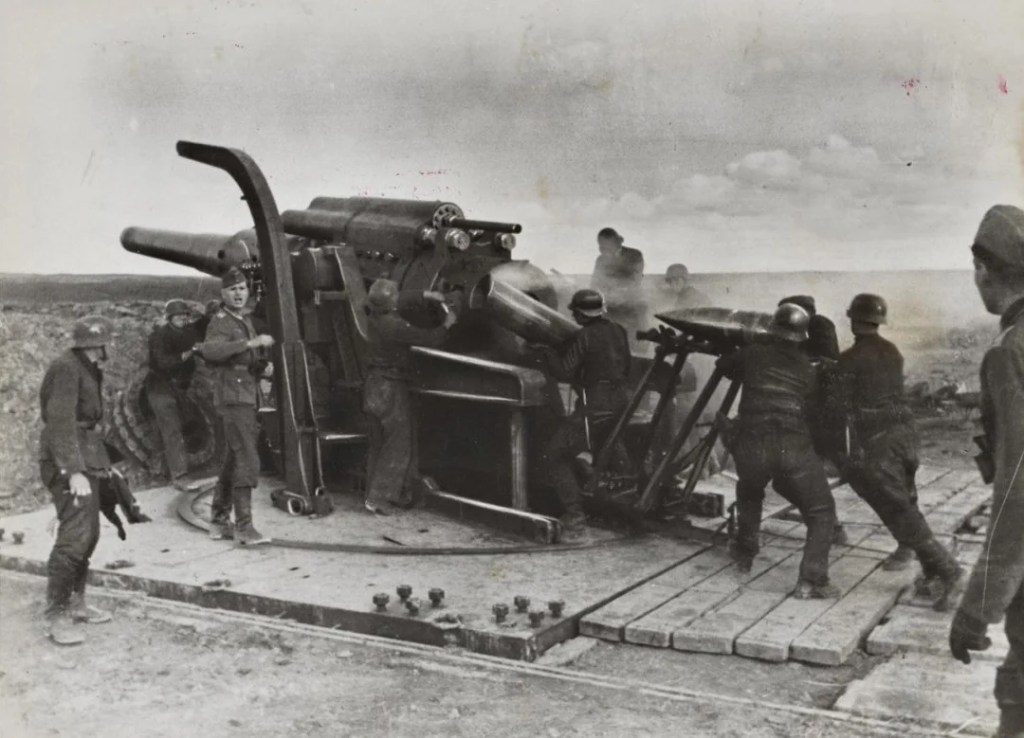
Erich von Manstein is one of the few generals that Adolf Hitler respects — though he doesn’t particularly like him. Because of this respect, earned through conceptualizing such brilliant strategies as the Panzer advance through the Ardennes in May 1940, von Manstein has enjoyed rapid promotions. Having begun the war as Chief of Staff for General Gerd von Rundstedt, von Manstein now is in command of 11th Army, which is tasked with a mission dear to Hitler’s heart: conquering the Crimea. The Crimea, in Hitler’s view, is essential in order to prevent the Red Air Force from using it to bomb the Romanian oil fields — although the Soviets have rarely done that. Hitler also sees the sunny Crimean beaches as a sort of Riviera of the East for top German officials. So, even though militarily the Crimea is of distinctly secondary importance in terms of German grand strategy, it is an area that Hitler has very definite feelings about.
On 2 November 1941, von Manstein takes a major step toward his current objective when his 11th Army forces — mostly infantry — reaches the Black Sea coast south of Simferopol. This cuts the key Soviet Naval Base at Sevastopol from any land reinforcement or supplies, effectively encircling it. There are still large Red Army forces on the Crimea, but they are far to the east on the Kerch Peninsula and unlikely to break through the Wehrmacht forces flooding south through the Perekop Isthmus While the Soviets can still send ships to Sevastopol, it is a hazardous journey from the nearest base at Novorossisk in the Caucasus. Sevastopol is crowded with both army and civilian refugees from Odesa so another evacuation will be a massive undertaking. Evacuation from Sevastopol is not contemplated at this time — in fact, Soviet transports are bringing troops into the port for its defense.
Following customary Wehrmacht practice of the “no guts, no glory” variety, Generalleutnant Rudolf Sintzenich’s 132nd Infantry Division attempts to take Sevastopol in a coup de main. The Germans make it near the town of Bakhchisaray before being stopped by Soviet 8th Naval Brigade and salvos from the 305mm guns at 30th coastal battery. After losing 428 casualties, 40 trucks, and several armored vehicles, von Manstein halts the foolhardy attack and turns his attention to conquering as much of the rest of the Crimea as he can. The Soviet Black Sea Fleet is busy taking troops off at Yalta, Yevpatoria, Feodosiya, and other Crimean ports and taking them to Sevastopol. The Luftwaffe is active, with Junkers Ju 88 bombers damaging light cruiser Voroshilov with two 250 kg bombs, which jam the rudder, flood a magazine, and start a fire in No. 3 turret. The only thing that prevents greater damage to the Black Sea Fleet is that the Luftwaffe maintains a very light presence in the Crimea — a fact about which von Manstein often complains. However, in the grand scheme of things, the Crimea is a sideshow and the real action is to the north at Moscow and to the east at Rostov-on-Don.
The Wehrmacht is continuing its advance on Tikhvin to the north of Moscow. This campaign is a lot less flashy than surrounding Sevastopol but could be of real strategic significance. General Rudolf Schmidt’s 39th Army Corps (motorized) has made good progress since its leap across the Volkhov River in late October, but it has had to pause to regroup and restock. The Soviets today counterattack it in two places. On the north flank, what are effectively two Soviet divisions hit General Josef Harpe’s 12th Panzer Division hard. However, the divisional artillery inflicts massive casualties and the Red Army attack falters. In the south, a separate Red Army force composed of 60th Tank Division and 4th Guards Rifle Division has a little better luck, but the divisional artillery is able to beat off this attack, too. These failed attacks open the gateway to Tikhvin, which is one of the most vital spots on the entire Eastern Front because it controls the roads and railways that are supplying Leningrad via Lake Ladoga.
The much-maligned Italian troops on the Eastern Front also have a good day. In combination with the XLIX Gebirgskorps (General of the Mountain Troops L. Kuebler), the Italians capture Horlivka. This has been a key strong point on the Soviet line in southern Russia, and its capture is a reflection of the troubles that the Soviet 12th Army is having. Plus, Italian successes in Russia are so rare that they are always worth mentioning. The German 15th Infantry Division also captures Aremovsk, another town that the Red Army has been defending fiercely.
Fighting stubborn rearguard actions all the way, Red Army troops in Crimea fell back to a point just north of Simferopol, the capital, after German forces, strongly supported by mechanized materiel and dive-bomber formations, had broken the Russian center, a Soviet spokesman acknowledged this morning.
Both sides believe that the end is near for Moscow, and thus for the entire Soviet Union. General Georgy Zhukov, in command of the Western Front, gives a frank appraisal to Commissar Zhdanov in Leningrad:
“We are now operating in the West [the Western Front] — on the approaches to Moscow. The main thing is that Konev and Budenny are missing all of their armed forces. I received from them only a trace — a headquarters and 98 men from Budenny and a headquarters and two reserve regiments from Konev.”
Meanwhile, at Rautenberg, Hitler meets with Admiral Wilhelm Canaris, the head of the Abwehr (military intelligence). As Hitler is wont to do, he looks far beyond the messy battles that still have to be won and confides in Canaris — who secretly does not think much of Hitlerism — that he plans to cleanse Slavic cities and “Germanize” them with new German inhabitants and names. Of course, it is nice and warm in the Führer’s headquarters, but things are a little different at the Front.
The Finnish conquest of East Karelia was completed when the Soviets withdrew from Kondopoga.
The Russian request that Britain declare war on Finland, Rumania and Hungary, learned of in London definitely today, is still under consideration and no decision has yet been reached.
German Major General Friedrich Eberhardt, military commander of Kiev, issues an order declaring that 300 hostages will be shot for the next act of sabotage. By the end of the month, the number has been raised to 400.
Light cruiser Voroshilov was damaged by two 250-kilogram bombs from German aircraft, flooding a magazine, causing a fire in turret No. 3, and jamming the rudder.
Over 2,000 enslaved Jews from Zagare, Poland attacked their Lithuanian guards, wounding seven. As reprisal, 150 of them were shot on the spot, and the rest were executed later.
Informed spokesmen in Berlin said tonight that they did not believe the question of invoking the Three-power pact “arises at all at this time” in connection with Germany’s formal declaration that the United States attacked her.
Outside Uzice, Yugoslavia, elements of Josip Broz Tito’s partisan force and Chetnik forces under Draza Mihailovic, both anti-Nazi forces, attacked one another.
British submarine HMS Proteus made the first successful radar attack by a submarine as she damaged Italian tanker Tampico off Andros 50 miles southeast of Athens, Greece. Italian torpedo boats Monzambano and Castelfidardo counterattacked and chased off the British submarine.
In Britain the Minister of Food announced an extension of food rationing to include canned meat, canned fish and canned beans to become effective from 17 November 1941.
Confronted with an unexpected coal shortage, the British Government appealed today to housewives to stop washing dishes and clothes under open faucets, discontinue day-long playing of the radio and dispense with heating in their bedrooms.
A Vichy French convoy of freighters and passenger ships was captured north of Madagascar by British cruisers.
Aircraftsman Charles Leonard Wheatley received the George Medal for gallantry while putting out a fire threatening to detonate high explosive bombs on a crash-landed Manchester bomber.
RAF Bomber Command, Day of 2 November 1941
4 Blenheims on an uneventful shipping sweep off Norway.
This day’s sweep ended the long series of shipping searches and attacks carried out by the Blenheim squadrons of 2 Group. Since commencing these raids in March 1941, when Bomber Command was directed to turn its main attention on German U-boats and surface vessels, the Blenheims had pressed home their attacks on heavily defended ships in the most gallant manner. An Admiralty assessment committee estimated that 101 ships, totaling 328,000 tons, had been sunk or seriously damaged in this period. Post-war German records showed that 29 ships of 29,836 tons were actually sunk and 21 ships of 43,715 tons were seriously damaged.* The Blenheim squadrons lost 139 aircraft on low-level shipping and harbour raids during this period plus many more aircraft badly damaged. The Blenheim shipping campaign was now called off because these casualties could no longer be justified.
U-208, commanded by Oberleutnant zur See Alfred Schlieper, sank British steamer Larpool (3872grt) 250 miles east, southeast of Cape Race. At 0526 hours on 2 November 1941 U-208 fired a spread of two G7e torpedoes from a rather long distance at the unescorted Larpool (Master Charles Patton) which was steaming at 8 knots in rough sea and strong wind about 150 miles east-southeast of Cape Race. The ship had been in station #91 of convoy ON.27, leading the outside starboard column, but experienced bad weather shortly after departure and eventually lost contact with the convoy during the night of 28/29 October. One of the torpedoes hit her on port side forward after a running time of 5 minutes and 38 seconds, but had not much effect. Nevertheless, the 39 crew members and four gunners (the ship was armed with one 12pdr and two machine guns) immediately began to abandon ship, first releasing the rafts and then launching both lifeboats. The master had just put his personal papers in the port lifeboat in charge of the second officer when it drifted away as the painter had parted. He went to the other side and discovered that the starboard boat in charge of the chief officer had already pulled clear, shouting to them to bring it back alongside, but was surprised when the chief officer answered from the after deck. His lifeboat had been filled with water from the engine room discharge, so he and four other crewmen went aft to launch one of the small boats there and eventually abandoned ship together with the master, who ordered all boats to remain nearby in order to reboard her at daylight as he did not believe that she will sink. In the meantime, the U-boat moved closer and fired two more torpedoes as a coup de grâce from only 300 meters at 0717 hours, that struck the drifting Larpool on port side amidships and at the bow, causing her to break in two and sink within 40 seconds. As the master and chief officer were in the small boat, the starboard lifeboat with 15 occupants was left in charge of the third officer, while the remaining survivors were in the port lifeboat. All boats set sail and soon lost sight of each other, experiencing a very heavy westerly gale with strong wind, very rough sea and extremely cold temperatures. This probably led to the loss of the 19 crew members and three gunners in the second officer’s boat that was reported missing after being last seen by the boatswain on the day of the sinking. The small boat with six men only made little headway, in fact one day there were blown back about 50 miles, but they kept heading for the south of Newfoundland and eventually made landfall near Burin on 10 November. Four crew members died of exposure in the third officer’s boat before ten crew members and one gunner were rescued by HMCS Bittersweet (K 182) (A/LtCdr J.A. Woods, RCNR) after 13 days at sea and landed at Halifax. All survivors suffered severely from exposure, thirst and swollen feed from the icy water in the half-filled boats. The 3,872 ton Larpool was carrying general cargo and was bound for British Guiana.
Battleship HMS Duke of York departed Rosyth at 0800 with heavy cruiser HMS Berwick and destroyers HMS Punjabi and HMS Escapade for Scapa Flow, carrying out practices en route. Destroyer HMS Tartar, en route from Sheerness to Scapa Flow, joined this force off May Island. Heavy cruiser Berwick arrived at Scapa Flow on the 2nd. Destroyer HMS Impulsive departed Scapa Flow at 0700 pm 3 November to relieve destroyer Punjabi on the screen of battleship Duke of York which was carrying out trials to the west of the Orkneys. Destroyer Punjabi arrived at Scapa Flow at 1010/3rd. The battleship and her destroyers arrived at Scapa Flow later on the 3rd.
Destroyer HMS Southwold departed Scapa Flow at 1200 for the Clyde on completion of a reduced working up program. The destroyer was to carry out boiler cleaning at Greenock before proceeding with convoy WS.12 Z for service in the Mediterranean. The destroyer arrived at 0730/3rd and began boiler cleaning.
Submarine HMS P.35 departed Scapa Flow to patrol off Norway.
British steamer Brynmill 9743grt) was sunk by German bombing four miles 210° from 59A Buoy, East Dudgeon. The entire crew was rescued.
British steamer Marie Dawn (2157grt) was badly damaged by German bombing twenty miles from Spurn Point. The steamer sank on the 3rd four miles 210° from 59A Buoy, Humber. The entire crew was rescued.
British fishing trawler Caliph (226grt) was sunk by German bombing eleven miles south of Old Head of Kinsale. One crewman died of wounds.
British hopper barge Foremost 45 (824grt) was sunk by a mine in 51-21-10N, 51-21-06W. One crewman was lost on the barge.
British tanker Agility (522grt) and British steamer Thyra III (828grt) were damaged by German bombing in Great Yarmouth Roads. The tanker arrived at Great Yarmouth on the 3rd. The steamer was towed to Great Yarmouth arriving on the 3rd.
Swedish steamer Ingeren (6123grt) was damaged by British bombing west of Borkum. The steamer arrived at Emden for repairs.
Battleship HMS Rodney, escorted by destroyers HMS Gurkha, HMS Zulu, HMS Lightning, and HNLMS Isaac Sweers, departed Gibraltar to meet aircraft carrier HMS Argus and aircraft transport Athene, escorted by destroyers HMS Laforey, HMS Highlander, HMS Havelock, and HMS Harvester. At 42N, 20W, the two groups met. Battleship Rodney with destroyers Highlander, Havelock, and Harvester proceeded to Scapa Flow to return to the Home Fleet. Aircraft carrier Argus, transport Athene, and destroyers Laforey, Zulu, Gurkha, Lightning, and Isaac Sweers proceeded to Gibraltar, arriving on the 8th.
Minelaying cruiser HMS Abdiel and destroyers carried troops to Famagusta to relieve the troops garrisoned there in Operation GLENCOE. About 250 troops were embarked in each destroyer and three hundred troops and seventy tons of stores were embarked in Abdiel. The operations called for 11,000 Indian and 3400 British troops to be transport from Alexandria to Famagusta and 15,000 British troops to be transported from Famagusta to Palestine. Forces were divided into three groups for the Operation. Group A was minelaying cruiser Abdiel (Rear Admiral Destroyers embarked) and destroyers HMS Jaguar and HMS Hasty departing Alexandria at 1500 for Famagusta. Group B was destroyers HMS Jervis, HMS Kandahar, HMS Kimberley, and HMS Kingston departing Alexandria at 1700. Group C was destroyers HMAS Napier, HMAS Nizam, HMS Kipling, and HMS Jackal departing Alexandria at 1900. En route destroyer Kipling broke down in 31-46N, 30-22E at 2300/2nd. Her troops were transferred to destroyer Jackal which took the destroyer in tow for Alexandria. Destroyer HMS Decoy from Alexandria took over the tow at daylight on the 3rd. Destroyer HMS Jupiter departed Alexandria and took destroyer Kipling’s place. Groups A,B, and C arrived at Famagusta at 0730, 1230, and 1630, respectively. Rear Admiral Destroyers disembarked at Famagusta. The destroyers disembarked the troops and embarked equivalent contingents of troops. The ships departed for Haifa. The ships of Group A and B arrived at Haifa during the night of 3/4 November. Group C arrived at 1400. All ships disembarked their troops, embarked Indian troops, and sailed for Cyprus at 0730, 1230, and 1630, respectively. The groups arrived at Famagusta during the night of 4/5 November and sailed again at four hour intervals. They arrived at Haifa at 0400, 0830, and 1200, respectively. They departed again with Indian troops at 0700, noon, and 1630, respectively, on the 5th for Famagusta. The Groups arrived at Famagusta on the 5th and sailed again with further contingents, arriving at Haifa at 0300, 0800, and 1200/6th. They departed Famagusta after embarking more troops and refueling. The destroyers departed Famagusta during the night of 6/7 November and arrived at Haifa on the 7th. They sailed again during the day with the final contingent for Famagusta. Rear Admiral Destroyers reembarked on cruiser minelayer Abdiel. Destroyer Kingston remained at Haifa with defects and her troops were spread among the other ships of Group B. The ships arrived at Haifa at 0300, 0500, and noon on the 8th, respectively. At 1400/8th, the entire force departed for Haifa with minelaying cruiser Abdiel and destroyers Jervis, Kandahar, Kimberley, Kingston, Jaguar, Hasty, HMAS Napier, HMAS Nizam, Jackal, and Jupiter. The ships carried out an anti-submarine sweep as they returned to Alexandria, where they all arrived on the 9th.
Minesweeper HMS Bagshot sighted a submarine periscope 22 miles 282° from Ras el Tin. Destroyer HMS Decoy and a motor anti-submarine boat were sent from Alexandria to assist. Anti-submarine whalers HMS Thorgrim and HMS Kos 19 were sent from patrol.
Polish submarine ORP Sokol damaged Italian steamer Balilla (2469grt) in 38-22N, 12-20E, northwest of Trapani with torpedoes and gunfire. Submarine HMS Utmost sank the damaged Balilla later in the day with gunfire.
Submarine HMS Thrasher unsuccessfully attacked a minelayer off Benghazi.
French sloop D’Iberville was escorting an unnumbered convoy of steamers ships Cap Padaran (8009grt), Bangkok (8056grt), Compiegne (9986grt), Cap Touraine (8009grt), and Commandant Dorise (5529grt) intercepted by six South African minesweeping whalers, supported by cruisers HMS Devonshire and HMS Colombo and armed merchant cruisers HMS Carthage and HMS Carnarvon Castle south of the Cape of Good Hope in Operation BELLRINGER. The ships, which departed Madagascar on 25 October, carried 900 tons of graphite and 30,000 tons of rice which were taken by the British. Sloop D’Iberville withdrew unmolested. Steamer Cap Padaran was immobilized by her crew. She was taken in tow by cruiser armed merchant cruiser Carthage, escorted by minesweeping whaler HMSAS Stellenberg and taken to Port Elizabeth. Steamer Bangkok was set on fire by her crewmen and abandoned, with light cruiser Colombo and whaler HMSAS Nigel taking off the crew. The other three steamers were brought into South African ports. Cap Touraine was escorted by heavy cruiser Devonshire and minesweeping whaler HMSAS Steenberg to Port Elizabeth. Commandant Dorise was escorted by armed merchant cruiser Carnarvon Castle and minesweeping whaler HMSAS Gun 9 to East London. Compiegne was escorted by light cruiser Colombo and minesweeping whaler Nigel to East London. The other two South African minesweeping whalers involved were HMSAS Southern Barrier and HMSAS Terje.
Turkish auxiliary ship Kaynakdere (also identified as Karaltepe, 145grt) was sunk by Soviet submarine ShCh-214 off Cape Midia. The crew of eight was all rescued.
The vital sections of the Neutrality Act will be repealed by the Senate this week and American merchant vessels will be carrying munitions into British ports within a month, Administration leaders in Congress predicted tonight. Senator Connally, Democrat of Texas, chairman of the Foreign Relations Committee, said he expected the Senate to vote Wednesday to amend the Neutrality Act to permit the Government to arm American merchantmen and send them anywhere in the world. “We are sure of 50 votes and will probably get 55 or 56,” Senator Connally said. “All we need is 49. We will probably get three or four Senators who are still on the fence and when the vote starts going our way we may get several more.” Senator Connally added that he had been told by the majority leader in the House, Representative McCormack of Massachusetts, that the Administration had enough support in the lower chamber to eliminate the vital sections of the Neutrality Act in a vote on the conference report perhaps next week. “We would rather have the House concur in the Senate action,” Senator Connally said. “But that would probably take longer than getting a favorable vote in the conference report.”
President Roosevelt today placed the entire Coast Guard under the orders of the Secretary of the Navy as an emergency measure. The action amplified an order of June 4 by which the President transferred the ocean-going part of the Coast Guard to the Navy. The June 4 order was affirmation of verbal instruction given about four weeks earlier. There was no immediate transfer of Coast Guard ships, however, because of the difficulty of providing replacement for the functions provided by these vessels, which engage in iceberg patrol and send weather information from points at sea. The full import of the announcement today was not immediately clear, but it was indicated that the Coast Guard would remain under Navy jurisdiction for the period of the emergency. The action was manifestly taken to strengthen the defenses of the nation and had, perhaps, some connection with the Battle of the Atlantic, in which the Nazi submarine campaign has been intensified.
An Administration campaign was reported in the making today for reversal of the House Banking Committee’s decision to permit farm prices to rise considerably higher before ceiling could be imposed. Informed sources said that protests against the committee’s action probably would be taken directly to President Roosevelt, and his open support asked for amendment of the bill when it comes up in the House, probably next week. One Administration spokesman said that price control would be “practically no good” if food costs were to rise even more. Some committee members agreed. “The committee bill invites and encourages, rather than deters, inflation.” Representative Gore of Tennessee said. He served notice. that he would renew his campaign for an overall price control bill, such as Bernard M. Baruch, chairman of the War Industries Board twenty years ago, advocated. The committee twice rejected that proposal, which in brief, calls for putting a ceiling on prices, wages and rents as they stood on a selected date. Representative Gifford, Republican, of Massachusetts, expressed the opinion that “the public had better digest this bill a little.” Representative Brown of Georgia, sponsor of the broader farm provision, sharply disagreed with those who said it would lead to material increases in the cost of food.
From the birthplace of grassroots Republicanism a groundswell stemmed today to challenge the party leadership of Wendell L. Willkie, whom Indiana gave to the nation a year ago as a candidate for president, Senator Raymond E. Willis, the senior G.O.P. statesman from Hoosierland, and four other Republican members of congress were united in a joint pledge of opposition to the administration’s effort “to involve this country in an undeclared war.” The action followed by less than two weeks Willkie’s national appeal for a G.O.P. renunciation of isolationism and adoption of a creed of increased aid to Britain in defense of democracy.
Welders at three major aircraft factories agreed today to call a strike at midnight Tuesday unless the national labor relations board authorizes an election to determine bargaining rights. The workers, numbering about 500 and meeting in an open air theater, represented Lockheed Aircraft Corp. and its subsidiary, Vega Airplane Co., of Burbank, and the Consolidated Aircraft Corp. of San Diego. James Goss, business representative of the United Aircraft Welders of America, said a strike would immediately affect Lockheed and Vega, which maintain night shifts, but Consolidated would not be affected until 7 a.m. Wednesday when the day shift reports.
Erskine Caldwell, novelist, and his wife, Margaret Bourke-White, photographer, returned to New York yesterday aboard the Pan American Airways’ Atlantic Clipper after five months in Russia. They expressed the opinion that “we will all be ‘heiling’ Hitler within the next eighteen months” unless all-out aid is given the Soviet Union. Miss Bourke-White, who photographed Joseph Stalin in Moscow, had high praise for the Russian leader, who gave her the impression that she was “looking at the most powerful man in the world.” She said Stalin was not impressive physically — “about 5 feet 5 inches tall” — but that his personality and manner were “extraordinary.” “I felt that he is a man who can make absolute decisions and who is a real leader of the people,” she declared. “The political situation is unshakable in Russia and there is no indication of any organized opposition, fifth column, or any other signs of brewing revolt. The people are 100 per cent behind their government in the fight against the invader.”
[Ed: Fetch me my barf bucket. Margaret was a gifted photographer, and a complete idiot.]
A B-17 Army flying fortress on the way from Reno to Sacramento broke up in a snowstorm and crashed today on a peak of the Sierra Nevada Mountains, the Army announced tonight. The B-17 took off from Reno piloted by 1st Lieutenant Leo M. H. Walker bound for McClellan Field. The bomber did not have a command radio and had only the radio compass for navigation. In the vicinity of Lake Tahoe was an overcast and the radio became static and lost communication and were unable to check in with Donner Summit and flew on a more southernly route when the no. 1 engine supercharger began to loose pressure and climbed to 14,000′ while the co-pilot attempted to fix the issue and managed to maintain the pressure and continued the flight. After 45 minutes, the instruments stopped working and pitot tube heat was turned on without fixing the issue. With only the turn and bank indicator functioning, the pilots decided to abort the flight and turned back towards Reno and throttled up the engines to climb to 18,000′ as the bomber pulled to the right. As they attempted to hold a straight line course, they cut engine power and had problems with controls and ordered everyone aboard to have their parachutes on and prepare to bail out. The bomber seemed to be handling normally when it nosed up slightly and the pilots pushed the controls down to compensate and they failed to respond. Suddenly, the B-17 rolled over upside down, righted itself then entered a spin and began to break apart. Aboard, six were able to bail out and two were thrown clear. All eight were able to deploy their parachutes and land safely. The pilot was trapped in the cockpit and died on impact when the bomber crashed onto Tells Peak to the southwest of Lake Tahoe. Officially, this bomber was written off on November 5, 1941. Lieutenant Walker was buried at Highland Cemetery in Hattiesburg, Mississippi.
TF.14 (Rear Admiral H. Kent Hewitt) (see 25 October 1941 for composition) reaches MOMP and exchanges convoy “Cargo” for CT.5, eight British transports carrying 20,000 British troops earmarked for the Middle East. Convoy CT.5’s first destination is Halifax, Nova Scotia.
U.S. Navy Martin PBM Mariners (VP-74) provide air coverage for convoy ON.30.
Following last week’s announcement that basic wages in Canada would be stabilized and providing for a compulsory “cost of living bonus” according to the rate at which prices might rise, the government today issued a second order-in-council putting a ceiling on prices.
U.S. Army Intelligence prepares the following estimate regarding the situation in the Far East:
- After four years of war in China, Japan is militarily over-extended on the mainland of Asia, economically weak, and psychologically aware of the fact that her economic structure is crumbling.
- For obvious reasons both Germany and China would like to embroil the United State in a large scale war with Japan. While Japan is reluctant to go to war with us, her political and economic situations demand action. She has the following alternatives:
- a. Attack Siberia to neutralize the threat on her flank and rear.
- b. Occupy Thailand as a base from which to launch an offensive against Burma or Malaya.
- c. Contain or isolate the Philippine Islands and Hong Kong and seize the Netherlands East Indies.
- d. Launch a direct attack on Singapore.
- e. Make a determined effort to bring the war in China to a close by cutting China’s last supply route, the Burma Road.
- f. Bide her time while disposing her forces from north to such in such a way that she will be able to seize the opportunity for successful aggression in whatever direction it presents itself.
- A Japanese attack on Siberia is unlikely as long as Russian resistance in Europe continues, and as long as the Siberian forces are not materially reduced in strength. Action under b above might, and under c or d above would certainly bring Japan into armed conflict with ABD powers-a situation which Japan, at present, wishes to avoid.
- A drive from Indo-China into Yunnan would probably not involve Japan with any Third Power. Although an extremely difficult operation for the Japanese, requiring elaborate preparation on their part, a successful drive into Yunnan and across the Burma Road, even if it did not cause China’s early capitulation would nevertheless, be a terrific blow at her chances of holding out. It would not however, have the effect of immediately releasing any considerable Japanese force for use elsewhere, since long-drawn out mopping up operations would probably be necessary.
- Because of the ruggedness of the terrain in southern Yunnan, and the almost complete lack of communications, the Chinese, if determined, could put up a very strong resistance even with the means now at their disposal. Such a defense would further deplete Japan’s meager resources and immobilize her remaining reserves. (For a description of the terrain see Tab A.)
- Japan’s most probable line of action, therefore, will be to continue her efforts to secure a relaxation of American economic pressure while completing her plans and arranging her forces for an advance in the direction which will be most fruitful of quick results.
Following up its statement Saturday, that, unless the United States relaxed its economic pressure on Japan, a clash in the Pacific was inevitable, the official Domei news agency declared today, on the authority of the same “well-informed quarters, that Premier General Hideki Tojo in his speech at the opening of the extraordinary session of the Diet on November 15 would make clear there was a time limit in the Japanese negotiations with the United States. According to these “well-informed quarters” the Tojo government was formed for a vigorous prosecution of definite national policies, because the United States was sticking to the status quo and refused to recognize Japan’s program for the creation of a new order in East Asia. For that reason, Domei stated, Premier Tojo would express his grim determination to pursue these national policies, based on Japan’s aspiration for a world peace founded on a new world order, and would place responsibility for future developments on American efforts to procrastinate in all negotiations for a peaceful settlement.
Japanese Foreign Minister Togo Shigenori sends the following message to the Japanese embassy in Washington, D.C.: “The Government has for a number of days since the forming of the new Cabinet been holding meetings with the Imperial headquarters. We have carefully considered a fundamental policy for improving relations between Japan and America, but we expect to reach a final decision in a meeting on the morning of the 5th and will let you know the result at once. This will be our Government’s last effort to improve diplomatic relations. The situation is very grave. When we resume negotiations, the situation makes it urgent that we reach a decision at once. This is at present only for your information. When we take up these negotiations once more, we trust you will handle everything with the greatest of care.”
Wake Island received reinforcement from the U.S. Marine Corps 1st Defense Battalion in Pearl Harbor, U.S. Territory of Hawaii. The island’s defense now consisted of 15 officers and 373 enlisted Marines.
Tatsuta Maru arrived at Honolulu, U.S. Territory of Hawaii, embarked Japanese nationals who wished to return to Japan due to the rapidly deteriorating US-Japan relations, and then departed for Japan; she would become the last passenger ship to leave the U.S. before the start of the Pacific War.
The new demarcations of the frontier between the Mongolian Peoples Republic and Japanese-dominated Manchukuo along a 250-kilometer stretch in the Bor Nor region has been settled in conference at Harbin between Mongolian and Manchukuoan delegations, supported by Soviet and Japanese advisers, it was announced this afternoon.
[Ed: The Japanese are not going North…]
Hugh Woods and William L. Boyd of the China National Air Corporation (CNAC) made the first flight over the Hump, the China-Burma air supply route.
The man assigned to the conquest of Malaya, Lieutenant General Tomoyuki Yamashita, is appointed the commander of the 25th Army, based on Hainan Island. Yamashita is a burly officer who has served as military attaché in Switzerland and as commander of the Kwantung Army in China. The 25th Army is destined to invade Malaya and take Singapore.
Born:
Dave Stockton, American golfer (PGA Championship 1970, 1976), in San Bernardino, California.
Archie Sutton, NFL tackle (Minnesota Vikings), in New Orleans, Louisiana (d. 2015).
Ed Adamchik, NFL center (New York Giants, Pittsburgh Steelers), in Johnstown, Pennsylvania.
Bill Connors, MLB pitcher (Chicago Cubs, New York Mets), in Schenectady, New York (d. 2018).
Bruce Welch, guitarist, producer and member of The Shadows, in Bognor Regis, Sussex, England, United Kingdom.
Brian Poole, English pop-rock singer (Brian Poole & The Tremeloes — “Someone, Someone”), in Barking, England, United Kingdom.
Died:
Simon Guggenheim, 73, American businessman and philanthropist.
Naval Construction:
The Kriegsmarine (German Navy) Type IXC/40 U-boat U-191 is laid down by AG Weser, Bremen (werk 1037).
The Royal Navy Flower-class corvette HMS Musk (K 289) is laid down by the Morton Engineering and Drydock Co., Ltd., Quebec, Canada. In 1942 she is transferred under reverse lend-lease to the U.S. Navy and is commissioned as the corvette USS Might (PG-94).
The Royal Navy Flower-class corvette HMS Snowflake (K 211) is commissioned. Her first commanding officer is Lieutenant Harold Geeves Chesterman, RNR.

