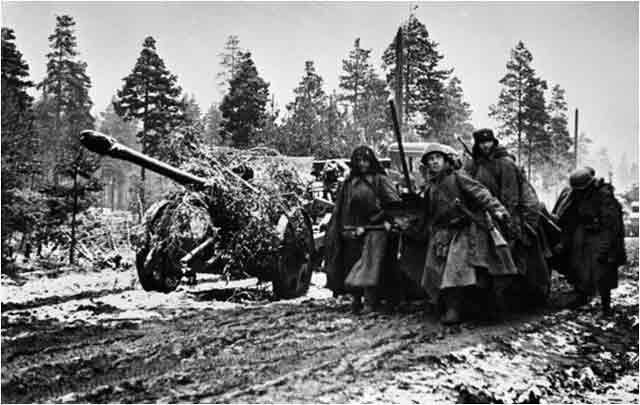
The last Finnish offensive commences in the Kestenga sector. The Finns encircle two Soviet regiments and destroy them. At 06:00 on 1 November 1941, German and Finnish artillery open fire on the front west of Loukhi. Shortly thereafter, a major Axis attack commences. The Axis objective in this sector has been to cut the Murmansk railway line and thus isolate further the Soviet Union from its western allies. Despite some promising gains toward Loukhi in August, this sector has been dormant since 23 August 1941, when Finnish Major General Hjalmar Siilasvuo halted his attack due to increased Soviet resistance.
The situation in November is different than it had been in August, however. For one thing, the Red Army has had over two months to reinforce its troops and build fortifications. In the typically convoluted command arrangements that Germany always creates with its allies, the Axis forces are under the command of both Finnish and German commanders, with the Finnish commanders having operational control and the German ones strategic — at least theoretically. The reality in such situations, though, is somewhat different than the diagram of command arrangements. For instance, in North Africa, General Rommel has primarily Wehrmacht forces, so he basically ignores his Italian “minder.” On the Finnish Front, the forces are primarily Finnish — both in numbers and quality — so, the local commander is Finnish and he basically has control. In practice, this means that Maj. General Hjalmar Siilasvuo’s Finnish III Army Corps, which technically is subordinated to General Falkenhorst’s German Gebirgsarmee Norwegen, has control. The Axis forces include the SS Division Nord, meaning that this is the only time during World War II when an SS division fights under foreign (non-German) command.
Another difference is the weather. This temperature when this attack opens is minus 4 degrees Fahrenheit. This is one situation when winter weather actually favors the Axis troops, as the Finnish troops proved during the 1939-40 Winter War that they operate better in extreme cold than do the Soviet troops (or German troops, for that matter). Thus, opening this offensive as winter starts to bite has some advantages from the Wehrmacht perspective.
The Finns have proven to be experts at “motti” tactics in the marshy and forested terrain, so having them in command makes sense to everyone. There is one problem, however, which is that the Finns have proven unwilling to pursue the objectives that the Germans want. For instance, the Finns have refused to attack Leningrad from the north despite the Wehrmacht asking them to do so. In addition, they have refused to advance beyond the Svir River into territory that historically has been Russian. The Finns view themselves as co-belligerents, not allies, which makes cooperation tricky at times. Thus, having the Finns in operational control also means that they can stop their attacks when the Germans think they should continue. In short, the Germans have mounting suspicions about the Finnish desire to do more than simply occupy lost territory and defeat the Red Army. This making having Finnish commanders deciding the course of operations problematic for Falkenhorst.
On 1 November 1941, however, everything goes well for German-Finnish cooperation. General Siilasvuo sends the SS Division Nord on a sweeping hook to the left while two Finnish Divisions (Group J and Group F) attack directly. The Finns use their proven tactics of infiltrating the Soviet lines, while the SS men only have to manage not to get lost in the woods while trying the outflank the entire Soviet defensive line. Everything goes well during the first day, and the SS division advances an impressive five miles before running into another Soviet defensive line. The Soviets take heavy casualties and the Axis troops take many hundreds of prisoners. Two Soviet regiments are quickly surrounded and eventually eliminated. Things suddenly look better for the Axis in the far north, but actually getting to the Murmansk railroad remains to be achieved.
Troops of the German 11.Armee captured Simferopol, Russia. To the southwest in Sevastopol, the Soviet 30th Coastal Battery bombarded the German 132nd Infantry Division at 1230 hours near the village of Bazarchik, slowing its preparations for an assault.
Elements of the German 39th Panzer Division cut the rail connection between Vologda and Tikhvin. This would close the airhead to Leningrad and extend the cordon 100 miles (161 kilometers).
Marshal Shaposhnikov becomes Chief of Staff of the Soviet Armed Forces.
German forces launch a major offensive aimed at Rostov-on-Don and the Caucasus, and clear up the last remnants of resistance at Simferopol, a vital communications center in the Crimea.
General der Gebirgstruppe Rudolf Konrad was named the commanding officer of the German 7th Mountain Division.
After sundown, the Red Army evacuated the first group, 4,230 men, of the 28,000 men from the Hanko Peninsula, Finland to Leningrad, Russia via naval vessels. On the return trip to Hanko, Soviet minelayer Marti and minesweeper T-210 were damged by mines, and submarine Kalev was lost, probably to a mine as well.
The Jews of Bukovina, like those of Bessarabia, are uprooted from their homes in more than 100 communities this month, then marched away and interned. Within a year, more than 120,000 of them had died.
By this time, more than 15,000 Jews have been deported from throughout Serbia to the concentration camp at Zemun west of Belgrade.
Heydrich reports to the Foreign Ministry that a thirty-point program for a so-called neo-pagan “National Reich Church,” circulated as a leaflet in Germany and attributed by Allied propaganda to Rosenberg, was actually written in 1937 by an eccentric from Stettin (G). Heydrich attributes its reappearance to Catholic elements out to discredit the regime.
As an experiment, 1200 prisoners at Buchenwald are taken to the “euthanasia” institute at Bernberg, and gassed this month.
The RSHA puts gassing-vans at the disposal of the Security Police and the SD Einsatzgruppen in the next two months.
Jews in Slovakia were required to travel in separate train compartments and send and receive letters marked with the Star of David.
Vichy France opens a punishment and isolation camp at Hadjerat-M’Guil. It contains 170 prisoners, nine of whom are tortured and murdered in conditions of the worst brutality. Two of the murdered are Jews, one of whom had earlier been released from a concentration camp in Germany in 1939 and fled to France.
A formal statement from Adolf Hitler claimed that the United States “has attacked Germany” and that Roosevelt had been placed before the “tribunal” for world judgment. Germany disputed the American account of the sinking of the Reuben James and claimed that a German submarine only attacked after American destroyers attacked German submarines first.
The German government issues a statement denying the charges made by U.S. President Franklin D. Roosevelt that the USN destroyers USS Greer (DD-145) and USS Kearny (DD-432) were attacked by German submarines without any provocation; that the exact opposite is true in that the U-boats fired torpedoes only after they were tracked and depth-charged for hours by these U.S. vessels.
Yugoslav nationalist force the Chetniks attacks Tito’s partisans in Uzice, Yugoslavia
RAF Bomber Command, Day of 1 November 1941
16 Blenheims on raids to airfields in Brittany and on uneventful sweeps off Norway. No losses.
RAF Bomber Command, Night of 1/2 November 1941
Kiel
134 aircraft – 72 Wellingtons, 32 Hampdens, 30 Whitleys – to attack harbour targets. 2 Whitleys and 1 Hampden lost.
Only 70 crews reported reaching the target area. Kiel’s records state that search-lights could not penetrate thick, low cloud and that aircraft were heard to the east but no bombs fell in Kiel.
Minor Operations: 17 aircraft to Brest, 13 to Le Havre, 5 Hampdens and 2 Manchesters minelaying in Kiel Bay, 4 Hampdens made a night shipping patrol off the Frisians and bombed a convoy without scoring hits, 3 O.T.U. sorties. 1 Hampden from the shipping patrol was lost.
Installation is made of the first RAF centimetric AI radar Mk. VII this month.
Heinrich Prinz zu Sayn-Wittgenstein was made the commanding officer of the 9th Squadron in the German Nachtjagdgeschwader 2 wing.
A newly issued Typhoon fighter of British No. 56 Squadron plunged into the ground near East Harling, Norfolk, England, United Kingdom, killing Pilot Officer J. F. Deck. Subsequent investigations revealed that he had suffered from carbon monoxide poisoning leading to the entire Typhoon fleet being grounded for modifications to cockpit sealing and the fitting of improved extended exhausts, although the problem was never satisfactorily resolved.
U-68, commanded by Korvettenkapitän Karl-Friedrich Merten, sank British steamer Bradford City (4953grt) at 22-59S, 9-49E. At 0654 hours on 1 Nov 1941 the unescorted Bradford City (Master Henry Paul) was hit by one of three torpedoes from U-68 about 300 miles west of Walvis Bay, South West Africa. Shortly afterwards the submerged U-boat collided slightly with its target because they had problems in keeping the depth and came to the surface only 10 metres from the ship. Luckily for the Germans the crew was already abandoning ship in two lifeboats and did not fire at the U-boat, which immediately dived again and only had a bent bow from this encounter. The ship developed a list to port and sank quickly. The master, 36 crew members and eight gunners were then questioned by the Germans and later made landfall near Walvis Bay and were rescued by South African troops. The 4,953 ton Bradford City was carrying sugar and rum and was bound for the United Kingdom.
U-552 and U-567 made unsuccessful attacks on convoy HX.156, both claiming damaging steamers.
U-75 was attacked by British aircraft in 33-44N, 24-48E. The submarine received light damage.
Heavy cruiser HMS Berwick with destroyers HMS Punjabi and HMS Escapade departed Scapa Flow at 0430 for Rosyth, arriving at 1600 that day.
Light cruiser HMS Arethusa, escorted by destroyer HMS Valorous and torpedo school ship HMS Lairds Isle, departed the Tyne to complete refit at Rosyth, where they arrived later that day.
Light cruisers HMS Edinburgh and HMS Sheffield departed Scapa Flow for Hvalfjord, where they arrived on the 3rd.
Aircraft carrier HMS Argus and aircraft transport HMS Athene departed the Clyde ferrying aircraft to Gibraltar, escorted by destroyers HMS Laforey, HMS Highlander, HMS Havelock, and HMS Harvester. On the 2nd, a Swordfish of Argus’ 818 Squadron ditched and its pilot, Lt A. S. Campbell, and crewmen were picked up by destroyer Laforey.
Destroyer HMS Beaufort departed Liverpool at 1100 for the Clyde, carrying out speed trials en route. The destroyer arrived at 2240 that day.
The British Admiralty directed that destroyers HMS Arrow, HMS Antelope, HMS Active, HMS Anthony, and HMS Achates should join Western Approaches when former Force H destroyers HMS Faulknor, HMS Forester, HMS Foresight, and HMS Fury become available to the Home Fleet.
Destroyer HMS Chelsea was damaged in a collision with British trawler Canning (148grt) at Liverpool. The destroyer sustained only minor damage and spent no time out of service.
British steamer Kingsland (3669grt) was damaged by German bombing in the North Sea.
Swedish steamer Braheholm (5676grt) was damaged by British bombing off the Dutch coast. One crewman was killed.
Swedish steamer Sigrid (1093grt) was sunk on a mine near Kiel. Ten crewmen were lost on the steamer.
Rear Admiral Philip Vian assumed command of Cruiser Squadron 15 with his flag on light cruiser HMS Naiad. The Mediterranean Fleet cruisers at that time were Cruiser Squadron 7 (Rawlings) with HMS Ajax, HMS Neptune, and Australian light cruiser HMAS Hobart Cruiser Squadron 15 (Vian) with HMS Naiad, HMS Galatea, HMS Euryalus, and later by HMS Dido on 31 December. The cruisers Ajax and Neptune of Cruiser Squadron 7 were transferred to Malta as Force B and arrived there on the 29th.
Force K of light cruisers HMS Aurora and HMS Penelope and destroyers HMS Lance and HMS Lively departed Malta and were at sea during the night of 1/2 November. No contact was made and the ships returned to Malta on the 2nd.
Submarine HMS Utmost sank Italian steamer Marigola (5996grt) 2.3 miles 165° from Kuriat Island.
Wellington bombers attacked Italian steamer Capo Arma (3195grt), escorted by torpedo boat Procione, en route to Benghasi from Brindisi. The steamer was damaged by the bombing, but was able to reach Benghasi on the 1st.
A Swordfish of 830 Squadron failed to return from an operation in which six Swordfish unsuccessfully searched for a convoy. Sub Lt W. E. Cotton, Sub Lt D. H. Stokes RNVR, and Leading Airman E. A. Robson were picked up by an Italian ship after seven days adrift.
On the 8th, destroyer HMS Duncan departed Gibraltar to proceed to refitting at Chatham. On the 8th, the joined convoys SL.91 and SL.91G split into SL.91GF and SL.91GS. SL.91GF arrived at Liverpool on the 18th and SL.91GS on the 19th.
Lt A. C. Wilkinson with Leading Airman A.G. Gilbert and Leading Airman N. C. Moulden of light cruiser HMS Newcastle were killed when their Walrus of 700 Squadron crashed three and a half miles west of Bermuda on a dive bombing exercise.
Soviet cruiser Voroshilov was mined and badly damaged off Fidonissi Island in the Black Sea. The cruiser was repaired at Poti, completing in February 1942.
Convoy ON.32 departed Liverpool, escorted by New Zealand trawler HMNZS Moa, en route to the Pacific. The convoy was joined on the 2nd by destroyers HMS Douglas, HMS Leamington, and HMS Skate and corvettes HMS Abelia and HMS Anemone. On the 6th, the 2 November reinforcements were detached when joined by destroyers HMCS Restigouche and HMCS St. Croix and corvettes HMCS Agassiz, HMCS Albernie, FFL Alysse, HMCS Amherst, and HMCS Bittersweet. Destroyer Restigouche was detached on the 13th and the rest of the escort, less trawler Moa, on the 14th. The convoy arrived at Halifax on the 16th.
Convoy OS.9G, escorted by Dutch destroyer HNLMS Isaac Sweers, sloops HMS Fowey and HMS Leith, and corvette HMS Stonecrop, joined off Gibraltar by destroyer HMS Wild Swan, arrived at Gibraltar.
Convoy SL.91G departed Gibraltar to join SL.91, escorted by corvette HMS Carnation and with destroyers HMS Sikh and HMS Vidette, corvette HMS Azalea, and anti-submarine trawlers HMS Stella Carina and HMS Lady Hogarth. Destroyer Vidette and the trawlers were detached on the 6th and the rest on the 8th. On the 2nd, sloop HMS Fowey and corvette HMS Stonecrop departed Gibraltar to overtake the convoy and proceed to England. Sloop HMS Leith with corvettes HMS Heliotrope and HMS Campion departed Gibraltar on the 3rd escorting Dutch steamer Tysa to join convoy SL.91G. Destroyer HMS Wild Swan was local escort for this movement. Destroyer HMS Duncan and French sloop Commandant Duboc sailed on the 4th to join the convoy. The destroyer was en route to Chatham for refit. When German raiders were reported as moving into the Atlantic, destroyers Duncan and Sikh returned to Gibraltar to escort Force H. Battleship HMS Rodney, at sea with destroyers HMS Zulu, HMS Gurkha, HMS Lightning, and HNLMS Isaac Sweers to meet aircraft carrier HMS Argus, was ordered to join destroyers HMS Highlander, HMS Havelock, and HMS Harvester in 55-40N, 17-45W. Oiler RFA Dingledale, escorted by corvettes HMS Jonquil and HMS Coreopsis and submarine HMS Clyde, departed Gibraltar on the 7th to patrol in position 34N, 30W. Sloop Commandant Duboc had been detached from the convoy with defects and arrived at Gibraltar on the 7th.
Relations between the United States and the Reich are extremely murky right now. President Roosevelt has committed the United States to full opposition to Adolf Hitler and Germany short of actually sending troops to Europe, while Hitler already has been counseled by Admiral Raeder, commander of the Kriegsmarine, that “There is no longer any difference between British and American ships.” The sinking of the destroyer USS Reuben James by U-552 on 31 October 1941 has thrown those relations even closer to open warfare, which obviously is already is the case on the North Atlantic convoy routes. However, at least technically, the two powers are not at war.
Hitler follows events overseas with great interest throughout the war. His cronies often see him with foreign newspapers — how much he understands the English language is an open question. He learns quickly about the sinking of the Reuben James, perhaps from his intelligence services as it is unlikely that the U-boat which sank the Reuben James could have known its identity and reported it. Knowing that this inevitably will result in another flurry of words from Roosevelt and no doubt some more illegal U.S. Navy activities (as he sees it), Hitler preempts the U.S. president by issuing his own statement on the matter. It claims that the United States “has attacked the Reich” and that the world’s “tribunal” is judging Roosevelt. Regarding the sinking of the Reuben James, he claims that it was justified because the destroyer attacked the U-boat.
The Reuben James indeed is on Roosevelt’s mind. As his wife Eleanor writes today:
“The news of the torpedoing of one of our destroyers off Iceland was the first thing that the President spoke of this morning, and that has cast a shadow over the whole day. I cannot help but think of every one of the 120 men and their families, who are anxiously awaiting news.”
Roosevelt acts later in the day. He signs an executive order reassigning the U.S. Coast Guard from the Treasury Department to the Navy so that might be used in the burgeoning sea war. He also urges Congress to further amend the Neutrality Acts of the 1930s to allow the arming of U.S. merchant vessels so that they can defend themselves in war zones.
The legalities of the situation are confused, and some favor the Reich. It has been traditional for active combatants to establish a reasonable zone in which neutrals are warned they enter at their own peril. For instance, during World War I a U-boat sank the Lusitania and that was accepted by the United States as a natural consequence of entering a war zone. The U.S. Navy is actively escorting freighters on the convoy routes and attacking U-boats upon detection, which is distinctly unfriendly conduct and at least arguably an act of war in itself. On the other hand, the United States believes that the freedom of the seas is paramount and its navy and other vessels are permitted to keep its sea lanes open. These ambiguities, along with very mixed American public opinion about getting involved in another overseas war, keep FDR from actually declaring war. However, the distinction between being at war and at peace is being corroded in the process.
Executive Order 8929 by President Roosevelt placed the U.S. Coast Guard under the control of U.S. Navy for the duration of national emergency:
By virtue of the authority vested in me by section 1 of the act of Congress approved January 28, 1915, 38 Stat. 800 (U.S.C., title 14, sec. 1), as amended by sections 5 and 6 of the act of July 11, 1941, Public Law 166, 77th Congress, 1st Session, it is hereby directed that the Coast Guard shall from this date, until further orders, operate as a part of the Navy, subject to the orders of the Secretary of the Navy.
All Coast Guard personnel operating as a part of the Navy, subject to the orders of the Secretary of the Navy, pursuant to this order, shall, while so serving, be subject to the laws enacted for the government of the Navy: Provided, That in the initiation, prosecution, and completion of disciplinary action, including remission or mitigation of punishments for any offense committed by any officer or enlisted man of the Coast Guard, the jurisdiction shall depend upon and be in accordance with the laws and regulations of the Department having jurisdiction of the person of such offender at the various stages of such action: Provided further, That any punishment imposed and executed in accordance with the provisions of this paragraph shall not exceed that to which the offender was liable at the time of the commission of the offense.
Franklin D. Roosevelt,
The White House,
November 1, 1941.
The German Government formally declared today that the United States “attacked Germany” in incidents involving the American destroyers Greer and Kearny. Berlin sources did not indicate whether an attempt would be made to invoke the Tri-Power Axis Pact, under which Germany, Italy and Japan agreed to help each other in case of a” attack on any of the partners by a power not engaged in the European or Chinese war. It was said that “nothing is known” of any attempt to invoke the pact. The official statement was issued from Adolf Hitler’s headquarters to counter President Roosevelt’s assertion that Germany had started the shooting.
German-American relations entered a phase of greater tension tonight with a charge from Adolf Hitler that American destroyers had engaged in aggression and a declaration from Secretary of the Navy Knox that “we are in this fight to the finish.” Knox’s assertion was made in an address to a Marine Corps audience at Quantico, Va., while his subordinates at the navy department hopefully awaited word from the north Atlantic increasing the list of known survivors of the torpedoed destroyer Reuben James. Forty-four enlisted men had been rescued out of a personal roster of about 120. The fact these survivors were safe and the destroyer had been torpedoed and sunk while on convoy duty was all the Information the department had.
William D. Hassett, his secretary, said today that President Roosevelt had no comment to make upon Nazi charges that the United States has started a shooting war. The President made his position clear in yesterday’s press conference, Mr. Hassett remarked. At that time Mr. Roosevelt said that the sinking of the United States destroyer Reuben James had not altered this country’s foreign policy and indicated that he had not given consideration to breaking diplomatic relations with Germany as a result. In a press conference Tuesday, the President made clear his disdain of Nazi charges, as reiterated in a communique today, that he had “lied” in asserting this government is in possession of a map showing German plans for conquest of Latin America.
The Senate agreed today to speed consideration of neutrality revision as Senator Ball, Minnesota Republican, declared a freedom-of-the-seas policy was necessary for this country’s survival and Senator Clark, Missouri Democrat, dared President Roosevelt to ask congress for a declaration of war.
The Neutrality Act was called “an act of appeasement” toward Hitler today by Senator Green of Rhode Island, who urged its repeal. Continuing the debate today in the Senate over revision of the law, he declared the United States had said in effect that if we gave up some neutral rights, our remaining rights would be respected.
Senator Alben W. Barkley of Kentucky, addressing a mass meeting of Zionist organizations in Carnegie Hall last night, urged formation of a Jewish Army in Palestine as “part of the world front that the forces of freedom are maintaining against the aggressor” and called for the full establishment of a Jewish homeland in Palestine “when the time comes for the building up of a new world.”
Michael W. Etzel, 22, admitted to F.B.I, agents that “several times” he cut vital electric wiring on Martin bombers in Baltimore factory where he was employed. His father and other relatives live in Germany.
The American Eagle squadron shot down more German airplanes in October than any other R.A.F. fighter squadron, the air ministry news service stated tonight. These American volunteer pilots destroyed nine of the 81 German planes credited to the fighter command for the month, a statement said.
The House Banking Committee approved a commodity price control bill tonight after refusing to include wages and voting to prohibit ceilings on farm commodities lower than some of the highest agricultural prices in history. Chairman Steagall, Alabama Democrat, said the committee vote on the bill was 18 to 5. With the farm bloc in full control, the committee accepted a formula for farm price ceilings which government experts said would permit food prices to rise as much as 20 percent above the 110 percent of parity level contained in the administration’s original bill.
California Attorney-General Earl Warren’s twin campaigns against illegal book-making and gambling got a setback and a boost, respectively, today by far-reaching decisions of the state supreme court. The court, without a dissent, ruled that disseminating racing news to bookies did not qualify as a “public nuisance” under the law. But at the same time it held that gambling houses might be successfully prosecuted under the “public nuisance” label.
American PBY Catalina aircraft provided air cover for Atlantic convoy ON.30.
Destroyers USS Dallas (DD-199), USS Ellis (DD-154), and USS Eberle (DD-430), screening convoy HX.157, carry out depth charge attacks on sound contacts off St. John’s, Newfoundland.
U.S. Marine Corps established the 2nd Joint Training Force at Camp Elliot, California, United States under Major General Clayton B. Vogel. It was composed of the U.S. Marine Corps 2nd Marine Division and the U.S. Army 3rd Infantry Division.
The Rainbow Bridge across the Niagara River opened to traffic, connecting the United States and Canada.
Ansel Adams took the photograph “Moonrise, Hernandez, New Mexico.”
Army and Notre Dame, meeting in the rain and mud at the Yankee Stadium as 76,000 looked on, battled to a scoreless tie in one of the features of a big day on the nation’s gridirons. Another huge crowd of 73,391 in Philadelphia saw Navy thoroughly outplay Penn to win by the margin of a touchdown, 13–6. Captain Franny Lee made an 88-yard touchdown dash to give Harvard a close decision over Princeton, 6–4.
President Roosevelt and Prime Minister W.L. Mackenzie King of Canada began an intimate conference in Hyde Park, New York today and, according to reports, they are discussing plans for a coordinated American-Canadian program in production and shipping in an attempt to make certain that a large volume of armaments reaches Russia.
Corvettes HMCS Kitchener renamed HMCS Vancouver and HMCS Fort William renamed HMCS Fredericton.
Joseph C. Grew, the U.S. ambassador to Japan, sends a second telegram to President Roosevelt warning that the Japanese may be planning an attack on an American target. Japan might “resort with dangerous and dramatic suddenness to measures which might make inevitable war with the United States.” He also states that “. . . underestimating Japan’s obvious preparations to implement a program in the event the alternative peace program fails, would be short-sighted. Similarly it would be short-sighted for American policy to be based upon the belief that Japanese preparations are no more than saber rattling, merely intended to give moral support to the high pressure diplomacy of Japan.”
Japan is completing her war structure for an armed clash in the Pacific “that now seems inevitable” and can be averted only if the United States alleviates its economic pressure on this country.
U.S. Navy formed the Pacific Escort Force at Pearl Harbor to protect transports and certain merchant vessels carrying troops and valuable military cargoes between Hawaii and the Far East.
On this date, Japan time, the Combined Fleet Order No. 1 was issued for additional radio communications to be generated to make U.S. cryptanalytic efforts more difficult.
Japanese naval staff officers Suzuki & Maejima arrive at Pearl Harbor.
Joseph Rochefort’s cryptanalytic team of the U.S. Navy in Pearl Harbor, Territory of Hawaii reported that all Japanese Navy call signs had changed.
Army Intelligence prepares Intelligence Bulletin 148 for General George C. Marshall, Chief of Staff U.S. Army, stating that “recent developments in the international situation, and particularly in the Pacific, indicate the possibility of a Japanese invasion of Yunnan Province in an attempt to cut China’s life-line, the Burma Road.”
The U.S. Fourth Army began a secret program to teach the Japanese language to military students. The first class met in an abandoned hangar on Crissy Field, at the Presidio of San Francisco. The students consisted of 58 Nisei of “unquestioned loyalty reasonably qualified in the Japanese language” and two Caucasians. On May 1, 1942, the Fourth Army Language School held a small graduation ceremony for about 40 Nisei and two Caucasian reserve officers. Ten students were held back to serve as instructors. The rest were on their way within days to serve in overseas assignments. Before the end of the war, the school, which was renamed the Military Intelligence Service Language School, would train over 4,800 Japanese linguists.
Chinese troops have reoccupied Chengchow, important junction of the Lung-Hal and Peiping-Hankow railways in Honan Province, a Chinese military spokesman said today. Japanese forces took Chengchow in a swift attack last month. They announced their withdrawal yesterday.
Zhao Chengshou began to distance himself from the Japanese and the Chinese collaborators.
Japanese Navy Captain Gihachi Takayanagi (former commanding officer of battleship Ise) relieved Rear Admiral Shutoku Miyazato as the Chief Equipping Officer of Battleship No. 1, as Miyazato was being transferred to become the Chief of Personnel for Kure Naval District.
Dow Jones Industrial Average: 118.11 (+0.29)
Born:
Robert Foxworth, American actor (“The Questor Tapes”, Chase-“Falcon Crest”, “Frankenstein”, “Babylon 5”), in Houston, Texas.
Marina Baura, Spanish actress, in Galicia, Spain.
Joe Caldwell, Team USA, NBA, and ABA shooting guard and small forward (Olympic gold medal, 1964; NBA All Star, 1969, 1970; ABA All Star, 1971, 1973; Detroit Pistons, St. Louis-Atlanta Hawks; Carolina Cougars-Spirits of St. Louis), in Texas City, Texas.
Dave Meggyesy, NFL linebacker (St. Louis Cardinals) and author (“Out of Their League”), in Cleveland, Ohio.
Nigel Dempster, British journalist and author, in Calcutta, British India (d. 2007).
Naval Construction:
The U.S. Navy Accentor-class coastal minesweeper USS Royal (AMc-102) is laid down by Anderson & Cristofani (San Francisco, California, U.S.A.).
The Royal Australian Navy Bathurst-class minesweeper-corvette HMAS Bunbury (J 241) is laid down by Evans Deakin Ltd. (Brisbane, Queensland, Australia).
The U.S. Navy Gato-class submarine USS Hake (SS-256) is laid down by the Electric Boat Co. (Groton, Connecticut, U.S.A.).
The Royal Navy “U”-class destroyer (Flotilla leader) HMS Grenville (R 97) is laid down by Swan Hunter and Wigham Richardson Ltd. (Wallsend-on-Tyne, U.K.); completed by Wallsend.
The U.S. Navy YMS-1-class auxiliary motor minesweeper USS YMS-20 is launched by the Greenport Basin and Construction Co. (Greenport, Long Island, New York, U.S.A.).
The U.S. Navy YMS-1-class auxiliary motor minesweeper USS YMS-54 is launched by the Gibbs Gas Engine Co. (Jacksonville, Florida, U.S.A.).
The Kriegsmarine (German Navy) Type IXC U-boat U-166 is launched by Deutsche Schiff und Maschinenbau AG, Bremen (werk 705).
The U.S. Navy light cruiser USS Cleveland (CL-55), lead ship of her class of 52 (27 completed as cruisers, 9 more completed as Independence-class light aircraft carriers), is launched by the New York Shipbuilding Corp. (Camden, New Jersey, U.S.A.).
The Royal Canadian Navy Fairmile B-class motor launch HMCS ML 060 is commissioned.
The Royal Navy British Power Boat 70-foot-class motor anti-submarine boat HMS MA/SB 37 is commissioned.
The U.S. Navy Aloe-class net tender USS Mulberry (YN-22; later AN-27) is placed in service.
The Kriegsmarine (German Navy) Type VIID U-boat U-214 is commissioned. Her first commanding officer is Oberleutnant zur See Günther Reeder.
The U.S. Navy Gato-class submarine USS Drum (SS-228) is commissioned. Her first commanding officer is Lieutenant Commander Robert Henry Rice, USN.
The Royal Navy Flower-class corvette HMS Coltsfoot (K 140) is commissioned. Her first commanding officer is T/Lieutenant the Hon. William Keith Rous, RNVR.
The Royal Navy Flower-class corvette HMS Fritillary (K 199) is commissioned. Her first commanding officer is Lieutenant Commander Wallace Hamilton Barker, RNR.

