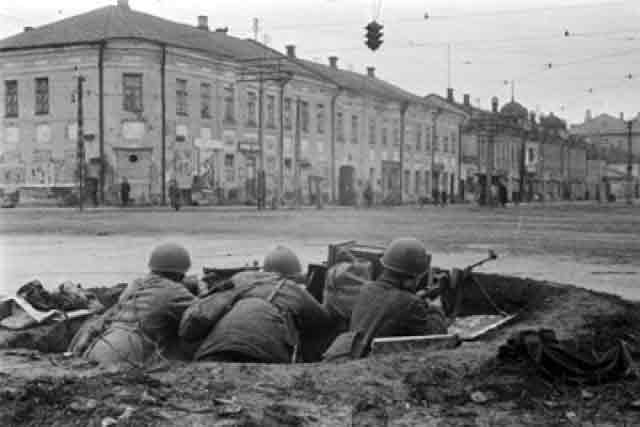
After a breakneck advance over the past five days from Mtsensk to Tula, a distance of about 140 km, General Heinz Guderian’s 2nd Panzer Army troops are on the outskirts of Tula as 30 October 1941 begins. Blasting through the muddy Rasputitsa weather, the panzers’ advance was reminiscent of the heady days of the Blitzkrieg in France, befitting Guderian’s “Fast Heinz” nickname. Oberst (Colonel) Heinrich Eberbach uses the entire armored strength of the 2nd Panzer Army to blow through all opposition. As planned, after a good night’s rest, Eberbach instructs his Kampfgruppe Eberbach, the reinforced 5th Panzer Brigade in XXIV Panzer Corps (General Geyr von Schweppenburg) to attack the city’s defenders at 05:30. The goal is to quickly overcome Tula’s ragtag defenders and continue north to Moscow.
Tula is an important center of armaments production and controls the highway north to Moscow, a straight run 184 km to the north. However, it’s only real value on 30 October is as an obstacle to General Guderian’s continued advance to the north. Key objectives in Tula include the Tula Arms Plant and the Klokovo airbase. The 2nd Panzer Army’s quick advance from Mtsensk has caught the Red Army by surprise, so it is only defended by a few regular army units of 50th Army, commanded by Major General Arkadii Nikolaevich Ermakov, and a 1500-man local volunteer battalion (the Tula’s Worker’s Regiment). Early on 30 October, the headquarters of the reconstituted 260th Rifle Division (Colonel N.V. Revyakin), arrives at Tula along with units of the 732nd Air Defense Regiment (Major M.T. Bondarenko). The entire commander is under General Vasilii Stepanovich Popov.
While the Tula Defense Zone has been hurriedly assembled, the defenders are amply equipped with anti-aircraft artillery. The recently formed Tula Defense Committee under the command of First Secretary of the Party of the Tula District, V.G. Zhavoronkoy, and garrison commander Colonel Ivanov have mobilized all inhabitants between the ages of 17 and 50 to build entrenchments, antitank ditches, minefields, and strong points. However, this work has been in progress for barely a week.
The German artillery begins firing at 05:30 in a cold autumn rain. Then, the panzers of the 3rd Panzer Division and the Infantry Regiment Grossdeutschland (Colonel Walter Hörnlein) begin to advance, supported by infantry. The attack hits the workers’ area of Krasny Perekop and the battle soon degenerates into hand-to-hand combat. The panzers lose their effectiveness in the quarter’s narrow streets and it falls to infantry to battle it out. The advantage seesaws throughout the day, with the defenders holding a defensive line in a park and behind cemetery walls while they await reinforcements.
The problem for the Germans is that they have used all of their armor to make this push. Thus, they have nothing nearby left to bring forward as reinforcements. The Red Army, however, does. The Soviets push the Germans back at 15:30 when tanks from Colonel I. Yuschuka’s 32nd Tank Brigade arrive. A renewed German attack at 16:00 advances to the Vsekhsviatsky Cemetery, which is successfully defended by the workers’ militia, and then to the Tula Weapons-Technical School. Due to a lack of progress, Eberbach is forced to end the attack at dusk. The Germans pull back and build defensive lines of their own.
The Tula attack is very costly for both sides but is a clear Red Army defensive victory. The Soviets claim to knock out about 30 Wehrmacht panzers, with both sides losing hundreds of men. The Soviets continue to reinforce Tula throughout the night, with their tank strength growing to seven T-34s, five heavy KV-Is, and 22 older T-60s. The Soviets also bring up Katyusha rocket launchers and the 413th Rifle Division (Major General Aleksei Dmitrievich Tereshkova). The Germans never again seriously challenge Soviet control of Tula. Tula is named a Hero City by the Soviet government in 1976 due to the stand made on 30 October 1941.
Meanwhile, the German troops began to feel the cold Russian winter.
The German advance on Moscow halts. Until winter fully sets in, the soft muddy ground will not allow them sufficient mobility to continue. German Army Group Center reports heavy fighting in the Volkolamsk, Mozhaisk and Kaluga areas. Although successful in these battles, the Germans call a temporary halt in their advance on Moscow as Soviet counter attacks, depleted supply levels, and the worsening weather conditions make attack difficult.
Elements of the German 11th Army close on Sevastopol, beginning a siege, which would last for nine months. German 132nd Infantry Division reached the outskirts of Sevastopol, Russia. After sundown, Soviet cruiser Krasnyi Kavkaz brought in the Soviet 8th Naval Infantry Brigade from Novorossiysk as reinforcements, while the Soviet Black Sea Fleet relocated many of its warships out of Sevastopol as a safety measure.
Karl Burk was awarded the Iron Cross 2nd Class.
Allied convoy PQ.2 arrived at Arkhangelsk, Russia.
The Jager Report (issued on 1 December 1941) noted that 382 adult male, 789 adult female, and 362 children, all Jews, were killed in Vilnius, Lithuania for a total of 1,553 people.
Bishop Wienken informs Bishop Hilfrich of Limburg that negotiations concerning the deportations of Catholic “non-Aryans” have been started at the highest levels.
Reinhard Heydrich appointed Siegfried Seidl the commandant of the camp-ghetto soon to be known as the Theresienstadt Concentration Camp in occupied Czechoslovakia.
Germany is tightening her belt another notch for the Winter. Civilian passenger train services, already curtailed to a third of peacetime schedules, will be further cut. As of November 1 official permits will be required to buy tickets for any but local trains.
German submarine U-106 damaged oiler USS Salinas 700 miles east of Newfoundland at 0900 hours. While USS Salinas limped to Argentia, Newfoundland for repairs, U-106 was chased by escort vessels for nine hours, surviving but sustaining serious damage.
RAF Hudson bombers have struck a body blow at the German Navy’s supply system in the northern seas. A raid on the Norwegian port of Aalesund is thought to have left six supply ships irreparably damaged. The Hudsons flew through driving snow over the North Sea to find a target lit by moonlight. One pilot described how he hit his target from 30 feet before flying across the town at rooftop height, firing machine guns. He then put incendiary bombs through a factory roof. Norwegians resent occupation more than the raids.
The British cabinet received the report that, in the week ending 29 October 1941, 886 ships (including 24 ships flying flags of neutral nations) were convoyed; 113 destroyers (including 24 American destroyers), 117 smaller ships, and 9 anti-aircraft ships were deployed as convoy escorts. During the war thus far, a total of 86,687 ships had been convoyed, of which 451 were lost by enemy action. In terms of goods transported, the report indicated that, in the week ending 25 Oct 1941, 1,435,869 tons of supplies were imported into Britain, which was an increase from 789,286 tons from the previous seven-day period.
Icelandic Premier Hermann Jonasson and his entire coalition cabinet resumed their offices today after nine days of negotiations and a plea by the regent, Sweinm Bjoernsson. Jonasson’s government had resigned during a dispute over “internal problems” caused by the presence of British and American armies of occupation.
RAF Bomber Command, Night of 30/31 October 1941
1 Stirling dropped leaflets over France and returned safely.
U.S. Navy fleet oiler USS Salinas (8246grt) was torpedoed by U-106 700 miles east of Newfoundland. At 0707 hours on 30 October 1941 the fleet oiler USS Salinas (AO 19) (Cdr Harley Francis Cope, USN) in station #14 of convoy ON.28 was hit on port side by two torpedoes from U-106 about 610 miles east of Newfoundland. The damaged tanker managed to reach Argentia under own power on 3 November, was repaired at Brooklyn and returned to service in April 1942.
Minelayers HMS Menetheus, HMS Port Quebec, and HMS Welshman, escorted by destroyers HMS Brighton, HMS Offa, and HMS Oribi, departed Loch Alsh to carry out minelaying operation SN.83 A. Destroyer HMS Onslow departed Scapa Flow at 1200 and joined the force in 58-45N, 5-42W. Light cruiser HMS Sheffield departed Scapa Flow at 0900/31st to cover the minelaying force.
Destroyer HMS Ashanti departed Scapa Flow at 0900 for Scrabster to embark a party of military officers taking passage in light cruiser HMS Kenya to Archangel. The destroyer arrived back at Scapa Flow at 1300.
Submarine HMS P.35 departed Dundee for Scapa Flow, arriving on the 31st.
Submarine HMS Trident departed Murmansk on patrol, then to return to the United Kingdom.
T/Sub Lt (A) P. Fahrenholtz RNVR, of 780 Squadron was killed when his Proctor aircraft collided with a Shark aircraft, piloted by A/Sub Lt (A) J. E. Hampson RNVR, at Worthy Down.
Corvette HMS Snapdragon arrived at Suez from the United Kingdom to join the Mediterranean Fleet. The corvette arrived at Alexandria on the 31st.
Destroyer HMS Wishart arrived at Gibraltar after refitting in the UK.
Submarine HMS Olympus departed Gibraltar for patrol in the Gulf of Lyons.
Convoy ST.7 departed Freetown, escorted by destroyer HMS Vansittart and corvettes HMS Armeria and HMS Cyclamen. The convoy arrived at Takoradi on 4 November.
In Washington, President Roosevelt conferred today with W. Averell Harriman and other members of the United States Mission to Moscow; discussed labor conditions in the aviation industry with Richard Frankensteen of the Congress of Industrial Organizations and received other callers. He sent to the Senate the nomination of Anthony J. Drexel Biddle Jr., as Minister to the Greek Government in London.
The Senate considered Neutrality Act amendments, confirmed the nomination of Warner W. Gardner as Solicitor for the Labor Department and recessed at 4:58 PM until noon tomorrow.
The House received the Celler resolution for severance of relations with Germany, heard Representative Kennedy of New York demand removal of Mayor La Guardia as Director of the Office of Civilian Defense and adjourned at 1:39 PM until noon on Monday. The Banking and Currency Committee considered provisions of the Price Control Bill and the Interstate Commerce Committee heard witnesses on amendments to the Securities Acts.
U.S. President Franklin D. Roosevelt offered Russia one billion dollars in credit without interest payments, the return to begin five years after the war’s end and to be completed in a ten-year period. Roosevelt stated that “In an effort to obviate any financial difficulties immediate arrangements are to be made so that supplies up to one billion dollars in value may be affected under the Lend Lease Act.”
President Roosevelt ordered the army tonight to take over operation of the plant of Air Associates, Inc., at Bendix, N. J., saying a labor dispute made stoppage of production imminent and the company “has failed to carry out its part” of recommendations by the defense mediation board. Under the president’s instructions, Secretary of War Stimson ordered troops from Governor’s Island, in nearby New York harbor, to move into the plant tomorrow morning. War Department production specialists, backed by legal experts from the judge advocate general’s office, were assigned to the plant. The company has contracts both with the government and with aircraft companies for the supply of plane parts and equipment. This was the third occasion on which the federal government has taken over production stopped or threatened by labor disputes. The president announced his action in a formal statement issued at mid-evening by White House Secretary Stephen Early.
Denouncing John L. Lewis as a traitor for calling the captive coal mine strike during the national defense emergency, Representative Russell of Texas introduced a bill today to make the fomenting of defense strikes a treasonable offense.
A four-day strike of 53,000 captive coal miners was terminated today under a 17-day truce accepted by John L. Lewis, United Mine Workers’ president, and Myron C. Taylor, director and former board chairman of United States Steel Corp. The mines were scheduled to start reopening tonight or tomorrow, and operations were expected to be back to normal by Saturday. Under the agreement, suggested by President Roosevelt last night in a letter to William H. Davis, chairman of the defense mediation board, the mines will continue to operate pending a second attempt by the board to mediate the dispute over a demand for a union shop. Neither mine operators nor the union, however, will be bound to accept the board’s recommendations.
Dissatisfaction with the manner in which the Administration has been dealing with labor strikes in defense industries was said today to be narrowing the chances of the Senate’s passage of “all-out” repeal of vital sections of the Neutrality Act of 1939, as sought by the White House.
Famed aviator Charles Lindbergh addresses 20,000 people at an America First rally in Madison Square Garden. Lindbergh continues his familiar refrain, claiming that President Roosevelt is using “dictatorship and subterfuge” to draw the United States into the “European War.” The isolationist position continues to attract a large segment of the U.S. population which not only wants to remain at peace but also wants the draft to end.
Associate Director Sidney Hillman of the Office of Production Management tonight renewed his appeal to 3,000 striking members of the United Welders, Cutters and Helpers union (independent) to return to work immediately at the Los Angeles and Seattle shipyards pending settlement of their jurisdictional dispute with the American Federation of Labor. The walkout, hindering work on $805,000,000 worth of defense shipbuilding, grew out of refusal of the A.F.L. national convention to grant the welders, formerly members of the A.F.L. Metal Trades council, a charter for an autonomous union.
Formation of an armed Jewish corps in the Near East to serve on a basis of equality with Britain’s other allies, and denunciation of England’s “crystallization policy” which curtailed Jewish immigration to the Holy Land, were stressed in resolutions adopted at the closed political session of the annual convention of Hadassah, women’s Zionist Organization of America, at its session tonight.
The U.S.O. organization was officially established to provide entertainment for stateside military personnel and later overseas troops.
Douglas DC-3A-269, msn 2124, registered NC21712 by the U.S. airline Northwest Orient Airlines, crashes in fog and mist near Moorehead, Minnesota, at 0204 hours local. This is Northwest Flight 5 en route from Minneapolis, Minnesota, to Fargo, North Dakota, carrying 13 passengers and a crew of two; the pilot, Clarence Bates, is thrown clear of the wreckage and is the lone survivor. The accident report states that the aircraft crashed due to accumulation of ice on the wings and other surfaces of the airplane, increasing the stalling speed and the drag of the airplane on the power required to maintain flight. The action of the captain in descending to attempt a landing at Fargo with known icing conditions and critical ceiling conditions instead of proceeding to an available alternate is to blame.
Douglas DC-3-277B, msn 2207, registered NC25663 by the U.S. airline American Airlines, crashes near St. Thomas, Ontario, Canada, at 2210 hours local. This is American Flight 1 from New York City to Detroit, Michigan via Buffalo, New York and Chicago, Illinois, carrying 17 passengers and three crew; all 20 aboard are killed. The aircraft circled a wooded area three or four times looking for a landing spot before stalling and diving into a plowed field. The cause of the crash is never determined.
Oiler USS Salinas (AO-19), in convoy ON.28, is torpedoed by German submarine U-106 about 700 miles east of Newfoundland. Only one of Salinas’s crew is injured.
TU 4.1.6 (Commander George W. Johnson), screening ON.28, attacks sound contacts; destroyer USS Bernadou (DD-153) carries out five depth charge attacks and fires at what was most likely German submarine U-67, forcing her to submerge; USS DuPont (DD-152) carries out three depth charge attacks; USS MacLeish (DD-220) and USS Sampson (DD-394) one apiece. USS Lea (DD-118) escorts Salinas (which will reach port under her own power); they will be joined en route by Coast Guard cutter USCGS Campbell and tug USS Cherokee (AT-66).
TU 4.1.1 (Captain Marion Y. Cohen) contacts MOMP-bound convoy HX 157 at 45°43’N, 55°37’W. The convoy will not be attacked by U-boats (see 1 November).
Japanese Premier General Hideki Tojo in two addresses yesterday reiterated the government’s determination to press forward unswervingly with Japan’s plans for a league of East Asian nations, and newspapers today saw in the government’s attitude the likelihood of a showdown in Japanese-American relations shortly after Parliament meets in special session on November 15. Many editors agreed that United States policy toward this country was based essentially upon a determination that Japan should not be the dominant power in a strongly organized East Asian bloc of nations and believed that the possibility of any understanding between Washington and Tokyo was rapidly disappearing. The future of Japanese-American negotiations should be apparent by the time the five-day special session of the Diet is convened, Asahi said, predicting that the Premier and his associates would make “unprecedented” statements to the nation and the world of this country’s decision to go ahead.
The current diplomatic conversations between Japan and the United States looking to an adjustment of differences will offer no prospect of an easing of the situation before the Japanese Diet meets on November 15 if Japan waits for this government to take the lead by making economic concessions, according to all indications today.
Tatsuta Maru arrived at San Francisco, California, United States and disembarked non-Japanese passengers who departed due to the rapidly deteriorating US-Japan relations, including El Salvadorian Consul General Leon Siguenza and Commander P. D. Perkins of the American Foreign Office in Japan. She then embarked Japanese nationals who wished to leave the U.S. for similar reasons, and departed San Francisco.
Dow Jones Industrial Average: 119.18 (-0.19)
Born:
Otis Williams [né Miles], American baritone R&B and pop singer and songwriter (The Temptations — “Just My Imagination”), in Texarkana, Texas.
Jim Ray Hart, MLB third baseman and outfielder (All-Star, 1966; San Francisco Giants, New York Yankees), in Hookerton, North Carolina (d. 2016).
Theodor W. Hänsch, physicist and Nobel laureate, in Heidelberg, Germany.
Ganga Stone [Ingrid Hedley Stone], American AIDS hospice volunteer and co-founder of God’s Love We Deliver, in Manhattan, New York, New York (d. 2021)
Died:
(Leon) “Chu” Berry, 33, American swing jazz tenor saxophonist (Fletcher Henderson; Cab Calloway), in a car accident.
Naval Construction:
The U.S. Navy ammunition ship USS Sangay (AE-10), sole ship of her class, is laid down [as MV Cape Sable] by the Pennsylvania Shipyards Inc. (Beaumont, Texas, U.S.A.)
The U.S. Navy Auk-class minesweeper USS Pioneer (AM-105) is laid down by the Pennsylvania Shipyards Inc. (Beaumont, Texas, U.S.A.).
The Kriegsmarine (German Navy) Type VIIC U-boat U-640 is laid down by Blohm & Voss, Hamburg (werk 616).
The Royal Navy “T”-class (Third Group) submarine HMS Tireless (P 327) is laid down by the Portsmouth Dockyard (Portsmouth, U.K.).
The Royal Indian Navy Black Swan-class sloop HMIS Godavari (U 52) is laid down by Thornycroft (Southampton, U.K.).
The U.S. Navy Fletcher-class destroyer USS Abner Read (DD-526) is laid down by the Bethlehem Shipbuilding Corp., (San Francisco, California, U.S.A.).
The Royal Navy MMS I-class motor minesweeper HMS MMS 107 (J 607) is launched by Chantiers Maritime (St. Laurent, Canada); completed by Clare Shipbuilding (Meteghan, Canada).
The Kriegsmarine (German Navy) Type VIIC U-boat U-602 is launched by Blohm & Voss, Hamburg (werk 578).
The Вое́нно-морско́й флот СССР (ВМФ) (Soviet Navy) “S” (Stalinec)-class (2nd group, Type IX-modified) submarine S-53 is launched by Dalzavod (Vladivostok, U.S.S.R.) / Yard 202.
The U.S. Navy Benson-class destroyer USS Laffey (DD-459) is launched by the Bethlehem Shipbuilding Co. (San Francisco, California, U.S.A.).
The Royal Canadian Navy Bangor-class (VTE Reciprocating-engined) minesweeper HMCS Drummondville (J 253) is commissioned. Her first commanding officer is Lieutenant James Phillip Fraser, RCNR.
The Royal Navy Fairmile B-class motor launch HMS ML 292 is commissioned.
The Royal Navy Fairmile C-class motor gun boat HMS MGB 335 is commissioned.
The U.S. Navy Aloe-class net tender USS Nutmeg (YN-28; later AN-33) is placed in service.
The Royal Canadian Navy Bangor-class (VTE Reciprocating-engined) minesweeper HMCS Drummondville (J 253) is commissioned. Her first commanding officer is T/Lieutenant James Phillip Fraser, RCNR.
The Regia Marina (Royal Italian Navy) submarine Acciaio, name ship of her class of 13, is commissioned.
The Kriegsmarine (German Navy) Type VIIC U-boat U-378 is commissioned. Her first commanding officer is Kapitänleutnant Alfred Hoschatt.
The Kriegsmarine (German Navy) Type VIIC U-boat U-594 commissioned. Her first commanding officer is Kapitänleutnant Dietrich Hoffmann.

