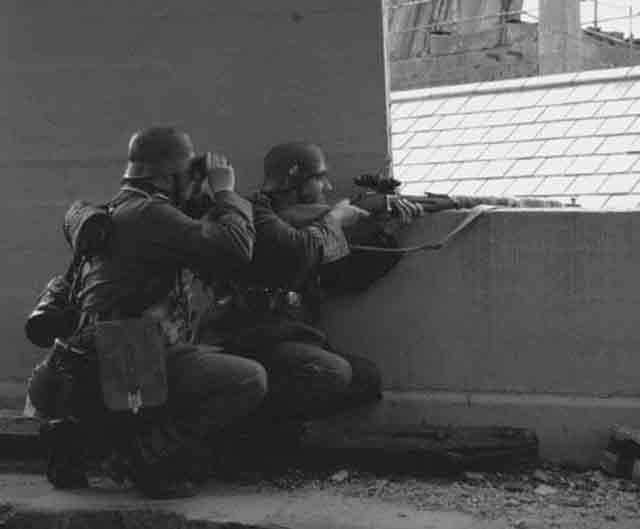
While much of the Eastern Front is bogged down by the annual fall Rasputitsa, or muddy season, on 27 October 1941 it has not yet reached its full level in the southernmost sectors. General Erich von Manstein’s 11th Army breaks through into the Crimea after a long struggle against fierce Red Army resistance in the Perekop Isthmus. The Soviet 51st Army retreats in the fog and mud toward the bastion of Sevastopol in the southwest, and to the Kerch Peninsula in the east. Pretty much everyone expects a fairly quick German victory and occupation.
The Crimea is one of the foundations of von Manstein’s reputation — it is the reason he becomes a field marshal. However, in the grand scheme of World War II, the Crimea is a sideshow. It is useful to capture the Soviet naval base at Sevastopol, but the Soviet Black Sea fleet is never much of a hindrance to German operations. Hitler, however, is fixated on the Crimea — as he tells Finnish Marshal Mannerheim in June 1942, worries about Soviet bombers operating from the Crimea against the Romanian oil fields were one of the reasons he invaded the USSR in the first place. So, while objectively it might make more sense to simply seal off the Crimea and instead focus on the drive into the Caucasus, where success would effectively surround the Crimea anyway, its capture and retention lead to a major campaign. This ultimately is profitless and strategically pointless but occupies some of the best Wehrmacht minds and troops throughout the war.
Elsewhere, the Germans make some small gains. Just to the north of the Crimea, the Soviet 12th Army of Soviet Southwest Front continues withdrawing gradually and exposes more cities for the Germans to capture. German Sixth Army, for instance, takes Kramatorsk in the Donetsk Oblast north of Stalino when the city surrenders without a fight. Italian troops are involved in the Wehrmacht’s occupation of the industrial Donets Basin, and the OKW issues a communique about their efforts:
“In the Donets Basin, an attempt to retard our advance was prevented by Italian troops. The enemy was thrown back with heavy and bloody losses and left several hundred prisoners in the hands of our allies.”
The Soviet defenders in the southern sector are outmatched at this stage. However, their retreat is orderly and efficient, preventing outright breakthroughs and forcing the Germans to advance at a measured pace.
Further north, the German attack on Moscow, Operation Typhoon, is mostly shut down pending an improvement in the weather but does make some gains in some places. On the extreme southern axis of the advance, General Guderian’s 2nd Panzer Army continues up the road from Mtsensk toward Moscow, with the main forces of Kampfgruppe Eberbach at Plavsk south of Tula. On the northwest axis of the advance, the 4th Panzer Army makes progress at Volokolamsk, where it has been stalled for two weeks. At Mozhaysk, the 4th Army stops dead and is allowed by Army Group Center commander Field Marshal Fedor von Bock to dig trenches — when it is supposed to be attacking. The Wehrmacht is on the outskirts of Moscow and in a good position to attack the city, but past battles have worn it down so much that it cannot make significant progress until conditions improve.
Soviet forces launched multiple counter-attacks around Moscow, Russia, trying to blunt the German advance. German troops were now positioned in the west at Volokolamsk 60 kilometers from Moscow and in the south at Plavsk 110 kilometers from Moscow. Soviet forces launch desperate attacks against the Germans in front of Moscow. The attacks are bloodily repulsed but do buy some time for the Soviets.
The Soviets defending Tikhvin, north of Moscow, are now under the command of General Fedyuninsky, and he makes an immediate impact. He orders three Red Army divisions to attack advance elements of General Harpe’s 12th Panzer Division at the village of Sitomlia about 40 km northeast of Budogsh’ (Budogoshch). While Harpe’s small unit is wildly outgunned, its commander decides to fight and goes into a defensive crouch while calling for reinforcements. The Red Army units attack piecemeal, like the bad guys in a karate flick who attack the hero only one at a time. Harpe is able to shift his men around just enough to hold the attackers off until help arrives. General Rudolf Schmidt, commander of 39th Army Corps and the man in charge of this portion of the advance, quickly sends the 8th Panzer and 18th Motorized Divisions to rescue the trapped men, which is accomplished by nightfall. The 12th Panzer reconnaissance team winds up doing its job — identifying the enemy units — but not quite in the way it had planned.
The supreme commander of the Moscow armies, General Gregory K. Zhukov, directed his troops to die before giving more ground, thus ordering them: “Not a step back! Halt the Fascists! Don’t let them reach Moscow! “Every man must fight like ten!”
The Jager Report (issued on 1 December 1941) noted that 946 adult male, 184 adult female, and 73 children, all Jews, were killed in Vilnius, Lithuania for a total of 1,203 people.
The Bishop of Limberg informs Bishop Wienken, the episcopate’s troubleshooter in Berlin, that the transport of Jews from Frankfurt earlier in the month had included Catholic “non-Aryans” to whom no preferred treatment had been granted. Their fate was especially sad, he said, because they were regarded by the other Jews as apostates (turncoats).
Bishop Berning reports to Cardinal Bertram that the Gestapo has refused their request for permission to allow Jewish Catholics to wear the Star of David while in Church.
Kalisz, Poland: Germans kill 290 Jews from an old people’s home in the first trial of a van specially adapted to suffocate them with engine exhaust fumes.
Kovno, Lithuania: 9,000 Jews including 4,273 children are massacred by German Einsatzkommandos.
Harold H. Tittmann, assistant to U.S. President Franklin D. Roosevelt’s special emissary to the Vatican, attempts to get the Pope to issue a public protest against the German’s mass shooting of hostages. He is told that this could not be done since it would jeopardize the situation of the German Catholics.
Lord Mountbatten replaced Roger Keyes as the British Chief of Combined Operations. 41 year old Lord Louis Mountbatten has been appointed director of Combined Operations and told to put some zip into hit-and-run attacks on German positions on the Continent. Lord Louis, who is related to most of Europe’s royal families, gained his reputation for courage and audacity when, virtually single-handedly, he brought his destroyer HMS Kelly back to port under continuous German air attack after she had been torpedoed in the North Sea. Lord Louis’s father, Prince Louis of Battenberg, who settled in Britain, was forced by anti-German hysteria to resign as first sea lord during the Great War. Lord Louis is determined to erase this slur on his family’s reputation; he hopes one day to succeed to his father’s old job.
Carroll McColpin, an American flying with 71 Squadron RAF, becomes an ace with his fifth German aircraft victory today.
HMS Cossack, damaged by German submarine U-563 300 miles west of Gibraltar on 24 October 1941, sank while under tow.
The British submarine HMS Tetrarch, one day out of Malta, sent its last communication before being lost in the Mediterranean Sea, probably to a naval mine; all 62 aboard were killed.
Palestinian Arab leader Amin al-Husseini arrived in Rome for talks with Fascist leaders.
RAF Bomber Command, Day of 27 October 1941
6 Blenheims on sweeps off the Dutch coast. A convoy was attacked but no results were seen. 2 Blenheims lost.
Destroyer HMAS Norman departed Archangel with the Trade Union Congress delegation and members of the Russian Labour Delegation. The destroyer called at Seidisfjord at 1400/31st to refuel and departed at 0645 on 1 November. The destroyer arrived at Scrabster at 1000 on 2 November. She then proceed to Scapa Flow arriving at 1200 that day.
Submarine HMS Sealion arrived at Scapa Flow from Portsmouth.
Midshipman D. M. Jones and Naval Airman A. G. Davis were killed when their Proctor of 755/756 Squadron collided with an Oxford over Upper Heyford village.
British steamer Antiope (4545grt) was sunk by German bombing in 53-10-45N, 1-06E. One crewman was lost on the steamer.
Dutch steamer Friesland (2662grt) was sunk by German bombing in 53-04N, 1-35E. Eleven crewmen and two gunners were lost on the steamer.
Swedish steamer Gunlog (1424grt) was sunk by British bombing off Den Helder.
Submarine HMS Tetrarch (Lt Cdr G. H. Greenway), which had departed Alexandria on the 17th and Malta on the 26th en route to a refit in England, was lost on a mine in the Sicilian Channel. Greenway, Lt E. J. Cornish-Bowden, Lt K. W. M. Meyrick, Lt D. R. Stavert, Sub Lt R. B. Houston, Lt (E) P. R. Phillips, Lt C. H. Walmsley RNR, Sub Lt W. E. Evans RNR, and fifty four men were lost in the submarine. Meyrick of submarine HMS Talisman, Stavert of submarine HMS Unique, and Walmsley of submarine HMS Upright were passengers for the voyage.
Submarine HMS Unbeaten unsuccessfully attacked a German submarine off Augusta.
Motor torpedo boats MTB.68 and MTB.215 laid mines in Bardia Harbour during the night of 26\27 October. The boats returned to Mersa Matruh after the operation.
Battleship HMS Malaya and destroyers HMS Lightning, HMS Sikh, and HMS Zulu arrived at Gibraltar. On entering harbour, the battleship took a sheer and rammed steamers Hoegh Hood, which broke adrift, and Clan Macdonald. The battleship sustained small holes in her forecastle and lost her sheet anchor. Damage to Clan Macdonald was minor, but Hoegh Hood required six weeks repair.
In Washington, President Roosevelt in a letter today made his third request of John L. Lewis that “captive” coal mines be kept open while a labor contract is being negotiated. He nominated Captain James L. Kauffman to be a rear admiral and Lieutenant Colonels Thomas C. Daniels and Frederick R. Wunderlich to be colonels. In the morning he met with party leaders of Congress.
The Senate opened debate on Neutrality Act revision, completed Congressional action on the lease-lend and supplemental defense appropriation bills, confirmed the nomination of Brigadier General Seth Williams to be Marine Corps quartermaster, received the Wheeler bill authorizing the Interstate Commerce Commission to waive restrictions on trucking during the emergency and recessed at 4:20 PM until noon tomorrow. The. Defense Investigating Committee heard Floyd Odlum testify on the effect of the defense program on small business.
The House approved the conference report on the lend-lease bill, received the Fulmer bill for aid to distressed cotton farms, received its special committee’s report on air crashes and adjourned at 1:05 PM until noon Thursday.
President Franklin D. Roosevelt made an address on Navy Day declaring that “America has been attacked,” referring to the Kearny incident ten days earlier. “I say that we do not propose to take this lying down. Our determination not to take it lying down has been expressed in the orders to the American Navy to shoot on sight. Those orders stand.” The president also said that “when we have helped to end the curse of Hitlerism we shall help to establish a new peace which will give to decent people everywhere a better chance to live and prosper in security and in freedom and in faith. Each day that passes we are producing and providing more and more arms for the men who are fighting on actual battle-fronts. That is our primary task..” Roosevelt also spoke of Nazi designs on South America (as revealed by a map obtained through “intelligence sources”) and all religions by stating “This map makes clear the Nazi design not only against South America but against the United States itself … All of U.S. Americans, of all opinions, are faced with the choice between the kind of world we want to live in and the kind of world which Hitler and his hordes would impose upon us.”
An Administration demand that America free itself from the shackles of her neutrality law and meet Adolf Hitler’s challenge to the freedom of the seas was countered in the Senate today by a proposal that instead this government offer the Axis the alternative of “reasonable negotiations” or our all-out entry into the war.
Complete repeal of the Neutrality Act was urged today by Frank Knox, Secretary of the Navy, in a speech made at a “Navy and Total Defense Day luncheon” here today.
Secretary Hull takes the position that the foreign policy of the United States is now based upon the primary consideration of self-defense, and that whatever steps are necessary must be taken to assure national safety against a move ment for world conquest led by Adolf Hitler.
Viscount Halifax, the British Ambassador, was greeted with cries of “Open up a Western front!” last night when he spoke at a Russian war relief rally at Madison Square Garden. With other speakers, Lord Halifax pleaded for all-out help to the Soviet armies.
The trial of twenty-eight people indicted on a charge of being in violation of the 1861 Sedition Act and the Smith Act began at the Federal District Court in Minneapolis, Minnesota, United States.
President Roosevelt tonight again appealed to John L. Lewis, head of the United Mine Workers (C.I.O.), to order immediate reopening of the captive coal mines of steel companies amid indications he is ready to wield a legislative big stick against unwarranted defense strikes. Lewis showed no signs of relenting and had “no comment” on the latest communication from the president. He had contended in his second letter to the chief executive that the strike involving 53,000 workers was not impairing defense output. Mr. Roosevelt directed his third appeal to the union chieftain a few hours after he indicated to congressional leaders that his patience is about exhausted and that he is on the verge of requesting legislation to correct the defense labor situation.
The present strike in the coal mines operated by subsidiaries of the United States Steel Corporation will make necessary an immediate and substantial reduction in the steel-making operations of the corporation, Benjamin F. Fairless, its president, stated last night.
John L. Lewis’s refusal to continue operations at the “captive” mines of the major steel corporations when requested to do so by President Roosevelt for the second time within forty-eight hours evoked a storm of criticism in both houses of Congress today with demands for immediate action by the Congress and the Chief Executive.
In his Navy Day address, President Roosevelt made pointed reference last night to strikes hampering the nation defense effort and the leaders on both sides who are causing them. He said:
“Our nation will and must speak from every assembly line, yes, from every coal mine, the all inclusive whole of our vast industrial machine.
Our factories and our shipyards are constantly expanding.
Our output must be multiplied.
That output cannot be hampered by the selfish obstruction of any small minority, a small but dangerous minority of industrial managers who, perhaps, hold out for extra profits or for ‘business as usual.’
And it cannot be hampered by the selfish obstruction of a small but dangerous minority of labor leaders for a minute.
For labor as a whole knows that that small minority is a menace to the true cause of labor itself, as well as for the nation as a whole.”
John Cudahy, former ambassador to Belgium, gave the Senate Foreign Relations committee this account of an Interview ho obtained, as a journalist, with Adolf Hitler: “When I had this famous interview with Hitler some four months ago, I put up to him, first of all, because it was of great interest to the American people at that time, the question of convoys. I had always been told that Hitler was a great ranter and raver and there was one story going the rounds, and quite authentic, that in one of his rages he fell on the floor and started chewing a rug, but I found him in this interview very calm and composed and very lucid in his mental processes. He told me about convoys very quietly, ‘You know as well as I do that convoys mean war.’”
A federal district court jury today convicted the billion-dollar tobacco industry’s three largest companies, one subsidiary and 13 officers on four counts of violating the Sherman anti-trust law. Returning a verdict after 20 weeks of trial, the jury upheld the government’s charge that the major tobacco companies, including five firms not involved in the trial, had conspired to fix prices of tobacco products. The convicted companies were the American Tobacco Co., the R. J. Reynolds Tobacco Co. and the Liggett & Meyers Tobacco Co. Found Guilty on All Four Counts They were found guilty on each of the four counts charged by the government: combination and conspiracy in restraint of trade by price fixing; monopolization of the industry; attempts to monopolize, and combination and conspiracy to monopolize. The American Suppliers, Inc., a subsidiary of American Tobacco, also was found guilty on the four counts of the indictment. Officers of the major companies convicted on all counts were: George Washington Hill, president; James E. Lipscomb Jr., vice-president; Paul M. Hahn, vice-president, and Vincent Riggio, vice-president, of American Tobacco. Other Defendants’ Names, Titles Given S. Clay Williams, board chairman; William N. Reynolds, executive committee chairman; James A. Gray, president; James W. Glenn, vice-president, and Edward A. Darr, sales manager, of the R. J. Reynolds Tobacco Co. James W. Andrew, president; William A. Blount, manager; Edward H. Thurston, vice-president, and George W. Whitaker, vice-president, of Liggett & Myers. Maximum penalty provided by law would carry a $5,000 fine on each count for each company and individual and a one-year prison sentence for each individual. The trial opened June 2 before Federal Judge H. Church Ford, with the government represented by a corps of 25 lawyers, economists and investigators under Assistant Attorney-General Edward H. Miller. A battery of more than 75 counsel and Investigators represented the tobacco companies. Federal evidence was produced from an estimated four tons of records and documents representing findings of a two-year Justice Department examination of the charges.
Settlement of the twenty-four-day strike at the Bendix, N.J., plant of Air Associates, Inc., arranged in Washington last Friday, hit a snag yesterday when union and company spokesmen disagreed in their interpretations of the agreement.
A strike over a wage Issue by 5,800 C.I.O. workers at the huge Robins Drydock and Repair Company yards in Brooklyn tied up repairs on at least fourteen merchant ships yesterday morning and led the National Defense Mediation Board to urge utmost caution on both union and company “in the interest of national defense,” pending mediation “at the earliest possible moment” by the board.
Harold H. Tittmann, assistant to Roosevelt’s special emissary to the Vatican, attempts to get the Pope to issue a public protest against the German’s mass shooting of hostages. He is told that this could not be done since it would jeopardize the situation of the German Catholics.
Post of Air Surgeon was created within the Army Air Forces
TU 4.1.6 (Commander George W. Johnson) screens convoy ON.28. During the day, destroyers USS DuPont (DD-152) and USS Sampson (DD-394) each carry out two depth charge attacks against suspected U-boat contacts.
Destroyer USS Hilary P. Jones (DD-427) is damaged by heavy seas while screening convoy HX.156.
F. Scott Fitzgerald’s unfinished novel The Last Tycoon was posthumously published by Charles Scribner’s Sons.
The movie “The Big Store” starring the Marx Brothers, went on general release.
The Canadian ‘C’ Force, comprised of two infantry battalions totaling 1,975 men, departed from Vancouver, British Columbia, for Hong Kong to reinforce the garrison. The Canadian troops were embarked in the fast New Zealand passenger liner (turned troopship) Awatea (13,500 GRT). Awatea was advertised in 1936, the year of her launching, as “the fastest ship in the Antipodes.” She was escorted by the armed merchant cruiser HMCS Prince Robert, a converted Canadian National Steamships passenger ship, Cdr. F.G. Hart RCN CO. The decision to deploy, and potentially to evacuate, C Force was dictated entirely by the availability of military sealift provided and controlled by the British War Office. The sailing date was fixed by British authorities and could not be altered to accommodate Canadian requirements. The training and logistical support provisions for C Force were dictated by factors entirely outside of either Canadian naval or military control. Unit and individual training was far from complete when the ships sailed. Because the troopship was overcrowded, 109 members of the Royal Rifles of Canada were transported in Prince Robert. The conversion of Prince Robert to an armed merchant cruiser eliminated her cargo holds as an alternate for the large volume of materiel that could not be embarked in Awatea. C Force’s total cargo space requirements totaled 195,000 cubic feet: 125,000 for motor transport and 70,000 for other stores. Awatea had only 45,000 cubic feet of freight capacity. A priority list of transport vehicles was selected for loading. The vehicles were embarked on four rail cars and rushed to Vancouver, but did not arrive until 28 October, by which time the troopship had sailed with two cargo holds practically empty. The Philippine 8½-knot freighter Don José (10,900 GRT) was contracted to carry C Force’s 212 vehicles and departed Vancouver on 4 November. A shipment of automotive spare parts was loaded in the Norwegian 14-knot freighter Fernplant (5,300 GRT) on 22 November Prince Robert and Awatea sailed across the North Pacific at a brisk 20 knots, stopping at Honolulu and Manila for fuel, which Prince Robert also did on the return trip. Don José was routed by American authorities via the Torres Strait and Molucca Passage to Manila, instead of direct to Shanghai and then Hong Kong before proceeding to Manila, as originally intended. Prince Robert and Awatea, escorted by the light cruiser HMS Danae, arrived in Hong Kong on 16 November. Fernplant discharged her cargo in Los Angeles on 10 December, several days after the commencement of hostilities, and it was eventually returned to Canada. Don José arrived in Manila on 12 December and disembarked C Force’s vehicles for use by the U.S. Army. All of these vehicles were either captured or destroyed by the Japanese. Canadian Chief of the General Staff, General Kenneth Stuart testified at the Duff Commission of Inquiry into the disaster at Hong Kong that “[t]he shortage of shipping, particularly ships equipped to carry personnel, had been a problem since the beginning of the war and had become more of a problem as each month passes.” Stuart claimed that “there was no alternative but to accept the course we did,” which was “to proceed as directed in the cable received from the United Kingdom.” It seems no questions were directed at the RCN during the inquiry over the wisdom of converting the three Prince-class liners into auxiliary cruisers when a national requirement for troopships existed from the first days of the war and was becoming a critical problem of strategic proportions.
Eleven Canadian newspaper writers and editors, including a Bishop of the Church of England and a canon of the Roman Catholic Church, declared yesterday after arriving here from England that “total warfare,” including an invasion of Germany, must be waged by “all the great nations of the world which are opposed to aggression” if Hitlerism is to be crushed.
The Chicago Daily Tribune dismissed the possibility of war with Japan, editorializing, “She cannot attack us. That is a military impossibility. Even our base at Hawaii is beyond the effective striking power of her fleet.”
There are 41 days to Pearl Harbor.
A raid by twenty Japanese soldiers across the tensely patrolled Soviet-Japanese Far Eastern frontier, precipitating a clash in which both sides suffered casualties, was reported today by Tass, the official Soviet news agency.
Pursuing the line of thought recently expressed in an authoritative editorial in the Japan Times Advertiser, the newspaper Miyako urges the Japanese Government to mediate between Russia and Germany in the name of humanity and the “new order.”
Britain’s determination to renew strong protests against the continued Japanese detention of Graham Martyr and J.D. Mason, British subjects arrested early in September, was affirmed here today. The essential purpose Is to let Premier Hideki Tojo know — If he had any doubt — that whatever the outcome of the talks between Japan and the United States, the position taken by the United States will be fully backed by this country.
Admiral Thomas Hart, having changed his mind on moving the U.S. fleet at the Philippine Islands south to combine with the British allies, decided to base his main force in Manila Bay.
USS Arizona (BB-39) entered the Pearl Harbor Navy Yard, U.S. Territory of Hawaii for overhaul, during which she would receive a mounting atop her foremast for future installation of a search radar.
MacArthur authorizes USAFFE to conduct site surveys in surrounding territories. The Hawaii Department had sent out teams for this purpose earlier in this month.
U.S. military officials in the Philippines send the following radio message to Washington, D.C.: “General southward movement of Japanese shipping in western Pacific is reported by British sources two aircraft carriers have been operating among mandated islands, of which Kaga repeat Kaga still present following planes reported based there: Palau repeat Palau, eight flying boats, Saipan repeat Saipan eight fighters, six heavy bombers; Truk repeat Truk, six fighters, six heavy bombers: Jalu repeat Jalu, eight flying boats, twelve flight planes; Wotje repeat Wotje, eight flying boats.”
Dow Jones Industrial Average: 119.43 (-1.30)
Born:
Dave Costa, AFL-NFL defensive tackle (AFL All-Star, 1963, 1967–1969; Oakland Raiders, Buffalo Bills, Denver Broncos, San Diego Chargers), in Yonkers, New York (d. 2013).
Len St. Jean, AFL-NFL guard and defensive end (AFL All-Star, 1966; Boston-New England Patriots), in Newberry, Michigan (d. 2025).
Dick Trickle, American auto racer (7 x ARTGO Championships, ASA AC-Delco Challenge Championship 1984, 1985; NASCAR Rookie of the Year, 1989), in Wisconsin Rapids, Wisconsin (d. 2013, by suicide).
Don Partridge, British folk-pop singer-songwriter and one-man band (“Blue Eyes”, “Breakfast on Pluto”), in Bournemouth, England, United Kingdom (d. 2010, of a heart attack).
Gerd Brantenberg, author, teacher and feminist writer, in Oslo, Norway.
Naval Construction:
The Royal Navy Fairmile B-class motor launch HMS ML 392 is laid down by Le Blanc Shipbuilding (Weymouth, Canada).
The U.S. Navy Auk-class minesweeper USS Pilot (AM-104) is laid down by Pennsylvania Shipyards Inc. (Beaumont, Texas, U.S.A.).
The U.S. Navy Bogue-class escort aircraft carrier USS Card (AVG-11, then ACV-11, finally CVE-11) is laid down as a civilian merchant hull, type C3-S-A1 by the Seattle-Tacoma Shipbuilding Corp. (Seattle, Washington, U.S.A.).
The U.S. Navy YMS-1-class auxiliary motor minesweeper USS YMS-118 is launched by the Harbor Boat Building Co. (Terminal Island, California, U.S.A.).
The U.S. Navy Gato-class submarine USS Grouper (SS-214) is launched by the Electric Boat Co. (Groton, Connecticut, U.S.A.).
The Royal Navy Fairmile B-class motor launch HMS ML 341 is commissioned.
The U.S. Navy stores ship USS Uranus (AF-14) is commissioned. Her first commanding officer is Commander Orrin R. Hewitt.
The U.S. Navy Aloe-class net tender USS Hazel (YN-24; later AN-29) is placed in service. Her first commanding officer is Lieutenant (j.g.) Albert Warrington Brown, USN.
The Royal Navy British Power Boat 63-foot-class motor anti-submarine boat HMS MA/SB 35 is commissioned.
The Royal Navy monitor HMS Roberts (F 40), lead ship of her class of 2, is commissioned. Her first commanding officer is Captain John Gerald Yerburgh Loveband, RN.

