The British pound plunged in a record setback, dropping more than 5 cents to close at $1.595. The decline followed an article in the Sunday Times of London that said that the United States and the International Monetary Fund had agreed that the pound should drop to $1.50 as a prerequisite for a $3.9 billion loan that London wants from the fund. England’s Central Bank tried and then gave up efforts to stem the selling pressure.
The International Monetary Fund, after lending heavily for two years, has less available money. If the world economic slump continues, the fund may face problems in meeting loan demands next year. The I.M.F.’s stock of lendable funds has dropped from $11.5 billion 18 months ago to about $6.3 billion and may fall to $4.6 billion by the end of the year, it is estimated.
The Soviet Union, after vigorous United States encouragement, has applied to join major rate-setting conferences covering two key North Atlantic shipping routes. Bringing the fast-expanding Russian merchant fleet into the conferences is expected to prevent chaos on world trade routes and a Soviet-American confrontation over the Russians’ slashing of rates.
A bumper Soviet grain harvest was announced by Leonid Brezhnev, the Communist Party leader. He told the Central Committee that the harvest could reach or exceed the record crop of 222.5 million tons reaped in 1973. The excellent showing, which agricultural specialists attribute to good weather and timely rains, contrasts with last year’s harvest of 140 million tons, which forced the Russians to slaughter some livestock for lack of fodder and to buy grain in the West. Wide year‐to‐year fluctuations have been typical of Soviet farm production. The Soviet leader made the announcement in a speech on economic and foreign affairs, in which he defended his own policy of accommodation with the West. He conceded that détente had slowed down “through no fault of ours” and blamed in part the election campaigns in the United States and West Germany for contributing to the cooling of the East‐West relationship.
About 30 Moscow Jews who had been demonstrating over delays in receiving permission to emigrate to Israel were arrested in a move to cut off further protests. Reports from friends and families said that some had been arrested at home or while leaving, and others intercepted as they approached the site of their protests.
A 20-year-old soldier died and at least 11 others were injured in a weekend of bombings and shootings aimed at the British army in Northern Ireland, authorities said. Two of the injured soldiers were reported in critical condition. The army charged the attacks were attempts by the Provisional wing of the Irish Republican Army to restore credibility after several weeks of gains by the women’s peace movement.
A 24-hour strike of Italy’s railroad workers brought added problems to the government, which is trying to stave off economic disaster with harsh austerity measures. The work stoppage, designed to force rail officials to agree to a new contract, raised the crucial issue of whether labor unions would accept wage restraint, changing a system under which wages have been raised automatically every three months to match increases in the cost of living.
A U.N. General Assembly committee adopted a resolution calling on all governments to make it a punishable offense to recruit, finance or train mercenary soldiers on their territory. The action also urged governments to prohibit their nationals from serving as mercenaries. The United States, Britain, France and Israel voted against the resolution because of objections to parts of it. The vote was 102 to 4, with 24 abstentions.
President Anwar el-Sadat of Egypt and President Hafez el-Assad of Syria told the conference of Arab heads of state and government that opened here today that there was no room for dissent from or disagreement with the plan for ending the war in Lebanon adopted last week in Riyadh, Saudi Arabia. In the wake of the two leaders speeches, 19 of 21 representatives of Arab nations and the Palestine Liberation Organization, including 14 heads of state, approved the settlement devised at a six-party conference in Riyadh. Only Iraq and Libya opposed the agreement, which includes the formation of a 30,000‐man multinational Arab peacekeeping force for Lebanon. Iraq refused to approve the agreement after trying to persuade the conference to consider the divisive issue of Syria’s large‐scale military intervention in Lebanon. The issue provoked sharp argument here last night at a preparatory meeting of foreign ministers. Libya, whose delegation arrived in Cairo after the opening formal session had ended this afternoon, and Iraq have been the most acerbic critics of Syrian intervention with a force put at 23,000 troops and 500 tanks.
The Shah of Iran said the chairman of the U.S. Joint Chiefs of Staff, General George S. Brown, apologized for suggesting that the shah might be thinking of reviving the Persian Empire. The shah, describing the remarks as “truly hilarious,” said General Brown had sent his deepest regrets. Brown had said in an interview, “Gosh, the programs the shah has coming, it just makes you wonder whether he doesn’t some day have visions of the Persian Empire.”
With most of its opposition members staying away in protest, the Indian Parliament convened today to consider a far-reaching set of constitutional amendments that would significantly alter the balances of government. The changes, which Prime Minister Indira Gandhi says are designed “to meet the changing needs of the people,” would significantly enhance the powers of Parliament and the Prime Minister, and diminish the power of the judiciary. Fundamental human rights in India would be made subordinate to the Government’s economic and social goals; the country’s largely ceremonial President would be prohibited from acting against the wishes of the Prime Minister, and Parliament would be empowered to ban “antinational” activities and associations. “The democratic institutions in the Constitution are basically sound,” Law Minister H.R. Gokhale said, in a speech this afternoon opening the discussion in the ornate, green‐carpeted chamber.
China’s new authorities said in a major editorial today that they would carry out the ambitious program of economic development originally put forward in early 1975 by the late Prime Minister, Chou En‐lai, but criticized this year in the anti rightist campaign. The pledge to return to Chou’s plan, which called for the modernization of China by the end of the century, was the first official indication of the policies Hua Kuo‐feng, China’s new leader, and his associates will pursue. It represents a major triumph for the veteran party bureaucrats, long championed by Chou, who are often termed the “moderates.”
Despite the huge rally in Peking yesterday to celebrate the appointment of Hua Kuo‐feng as the new chairman of the Chinese Communist Party and the downfall of China’s four senior leftists, there are still several key questions that the country’s new authorities have not yet answered. Foremost among these are:
•When will China name new leaders to fill the many top party government and army posts left vacant by the ouster of the leftists and the death of Mao Zedong, Prime Minister Chou En‐lai and several other leaders? At the rally yesterday, the surviving leaders appeared in their old party rank, suggesting that a new lineup had not yet been worked out and that it may still be some time before agreement can be reached on one.
•What were the actual crimes of the four leftists and what has happened to them? Adding to the already lengthy list of charges against them, a major editorial today in Peking papers said Mao’s widow, Chiang Ching, had conspired since as early as 1974 to make herself chairman of the party and had ignored Mao’s orders to stop. The editorial also charged that the leftists had “maintained an illicit foreign relationship” and “betrayed important party and state secrets.” That might have been a reference to a series of highly revealing interviews Miss Chiang gave to an American scholar, Roxane Witke, in 1972. Mao was reported angered by the interviews.
•How much support do the leftists still have on the Central Committee and in the provinces, and will this be a continuing problem that may be holding up full meeting of the Central Committee to decide on a new leadership lineup? By some estimates, about one third of the Central Committee members may be sympathetic to the leftists, since they were named to it as a result of their activities during the Cultural Revolution.
•Will Mr. Hua and his associates among the veteran party bureaucrats and army commanders be able to restore discipline and revive confidence in the party’s leadership among China’s 850 million people? Both have shown signs of breaking down this year, with an increase in worker absenteeism, reports of factional squabbling in factories, and even several armed hank robberies.
•Will the latest abrupt turn of the political wheel with an anti-leftist campaign replacing the earlier anti-rightist campaign, tend to disillusion further many young Chinese about politics and the party?
Canada is embroiled in a political crisis that its leaders fear may break up its confederation, with possible separation by French-speaking Quebec, its biggest province. Long-simmering hostilities between French-speaking and English-speaking Canadians have been fueled by widespread economic insecurity over inflation and unemployment.
A British navy frigate using sonar has located the wreckage of the Cuban airliner that crashed in the Caribbean off Barbados earlier this month, killing all 73 persons aboard. A Barbados official said that the main body of the DC-8 jet was found under 1,800 feet of water 4.8 miles off Barbados. The location of the wreckage may be a factor in determining who should prosecute two Venezuelans arrested in Trinidad and accused of placing bombs aboard the plane.
A Colombian domestic Taxi Aéreo El Venado DC-3 airliner developed engine trouble, burst into flames and crashed seconds after takeoff from Yopal, 115 miles east of Bogota, with an intended destination of Cúcuta. All 32 persons aboard — 27 passengers and 5 crew members, including a woman copilot — were killed. All were believed to be Colombians. The pilot reported engine trouble to the control tower as the plane left the ground.
The University of Ilorin, commonly referred to in Nigeria as Unilorin, began its first classes, serving 200 undergraduate students in the city of Ilorin in Kwara State. Within 30 years, Unilorin would have more than 20,000 students and as of 45 years later, 48,000 undergraduates.
Rhodesia’s Prime Minister Ian Smith denied sharply in Geneva that he had been “conned” by U.S. Secretary of State Henry A. Kissinger into agreeing to a controversial program that would lead to black majority rule in Rhodesia within two years. Smith suggested, however, that he might ask Kissinger to come to the opening of a Geneva conference on Rhodesia’s future Thursday to set the record straight on Kissinger’s Rhodesian negotiations. And in Washington, although officials would not rule out such a trip, they said that Kissinger thinks it would be highly inappropriate to try to resolve a dispute between Rhodesia’s white and black nationalist leaders over the peace plan.
Transkei’s independence from South Africa was accepted by Chief Kaiser Matanzima at a formal ceremony in Umtata, the capital. But the new state, the first of South Africa’s black homelands to receive this status, has not been recognized by other nations, which regard the step as part of South Africa’s apartheid policy.
The International Red Cross ousted from South Africa.
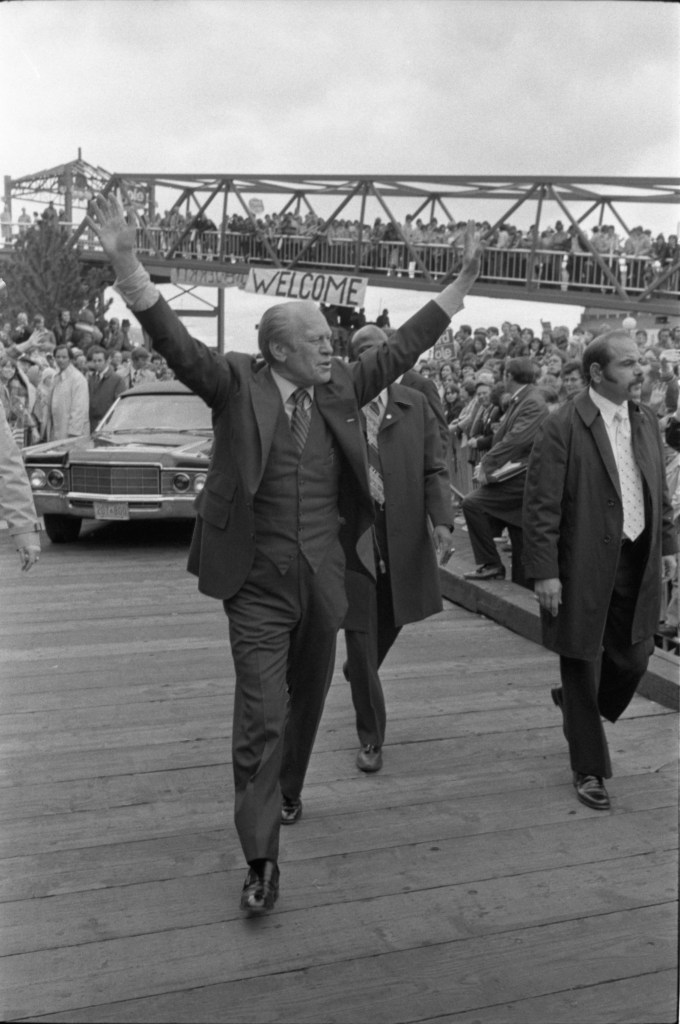
President Ford swooped across Puget Sound today aboard a hydrofoil boat, establishing a first in Presidential campaign travel. He also promoted airplane noise control at the home of the Boeing Company and celebrated Veterans Day by helping to plant a fir tree at a hospital here. The events were by no means atypical of the Ford campaign. Eight days before the voters choose between Mr. Ford and Jimmy Carter, the President’s candidacy has been boiled down to a cross‐country exercise in symbolism. On an itinerary that ranged from the Mexican border, in San Diego, to the Canadian frontier here and finally to Pittsburgh, Mr. Ford sought to identify with some facet of each region on his itinerary. Outside the Boeing flight center in Seattle, the President proclaimed that he was “proud” of the airplane manufacturer’s contributions to travel and, for the benefit of environmentalists in the Pacific Northwest, he reiterated his intention to reduce noise pollution.
Jimmy Carter got his last leisure time in his hometown of Plains, Georgia today before a final, frenetic week of campaigning that will take him coast to coast into the crucial, closely contested states where his political fate may hang in the balance. Starting tomorrow, the Democratic Presidential candidate’s schedule calls for appearances in the next seven days in New York, Pennsylvania, Ohio, Illinois, Texas and California, with stops in Missouri, South Carolina and Louisiana. His 11th‐hour strategy is based, aides said today, on the narrow margins between him and President Ford reflected in polling in the six larger states whose electoral votes could very well determine victory or defeat for the former Georgia Governor.
Organized labor has been waging the biggest, most costly and most sophisticated campaign in its history in support of a presidential candidate — Jimmy Carter. Most national political authorities agree that if labor’s effort succeeds, Mr. Carter will be President. If it fails, he very likely will not.
Governor Edmund Brown Jr. of California addressed a campaign rally this afternoon at the State University Agricultural and Technical College in Farmington, Long Island, New York, and though the appearance was on behalf of the Democratic Presidential candidate Jimmy Carter, the speech was described by some as “pure Brown”. “We are facing the prospect of downward social mobility,” the Governor told the audience of 300 college students in the circular auditorium of Roosevelt Hall, which was curtained into a semicircle to create a more intimate atmosphere. Mr. Brown spoke for 40 minutes, discarding a formal speech to field questions shouted from the audience. Rather than “recycle Gerald Ford another four years,” Governor Brown urged his audience, “send him back to Michigan for some postgraduate training.”
After campaign stops in Ohio yesterday and Pennsylvania early today, Senator Walter F, Mondale, the Democratic Vice‐Presidential candidate, made a day‐long tour through four New Jersey counties, meeting enthusiastic crowds and identifying the Democratic Presidential campaign more closely with New Jersey Senate and Congressional races.
Senator Robert J. Dole, the Republican Vice-Presidential candidate, used Veterans Day as an occasion today to renew his suggestions that the Democrats were responsible for four wars in this century, while at the same time saying at a news conference that he had had “some reservations” about American involvement in World War II.
Clarence Norris, the last known survivor of the nine Scottsboro Boys, was pardoned by Alabama Governor George C. Wallace. After spending five years on death row and 15 years total in prison for a crime he had not committed, Norris was paroled in 1946 and left Alabama without permission. On November 29, 1976, Norris, a warehouse employee for the government of New York City, returned to Alabama for the first time since 1946 and accepted the pardon. Mr. Norris, now 64 and a warehouseman working for New York City, said at a news conference that “a man should never give up hope.” In 1931 he and eight other black youths were charged with raping two white women. After 15 years in prison, five on death row, he was released on parole and left Alabama without permission.
A massive search was under way for the arsonist responsible for a fire that killed 25 persons in a social club in the Bronx. The police had first suspected a man who had an argument with his wife during the club dance, but they said that this likelihood was increasingly doubtful. Investigators said that the case was now wide open.
Universal Studios and the Walt Disney Company filed a lawsuit in the federal court in California against the Sony Corporation of America to prohibit the sale of Sony’s videocassette recording system, the Betamax, and seeking a ruling that would bar video recording in general for the general public. The case would eventually be decided by the U.S. Supreme Court in favor of Sony, and for video recording of television programs in general, in 1984.
The 5th Enterprise space shuttle prototype, approach & lands test (ALT) flight.
Bands of angry whites, most of them students, had brushes with the police on the streets of South Boston today in a one-day school boycott that started with two attempts at bombing integrated schools. The police reported 22 arrests, most for disorderly conduct. A stick of dynamite, apparently undetonated because of a flawed fuse, was discovered in a steel grate at the front door of Charlestown High School. At South Boston High, six bottles of gasoline and oil were heaved through a back window into a home economics classroom. A burning highway flare was pitched into the room after the three beer bottles and three brandy bottles, but the police said it failed to set off the gasoline that spread from the shattered flasks.
The George Prince could have avoided its fatal crash with the Norwegian tanker Frosta but it never responded to warning whistles, the first mate of the tanker said at the Coast Guard inquiry in New Orleans. Peder Crasvaer said the 120-foot ferry appeared to dart slightly off a collision course, then returned to a path directly in line with the bow of the 664-foot vessel. Asked if the ferry could have avoided the collision if it had switched course when the first warning whistle sounded, Crasvaer replied, “Yes, it could. Absolutely.” The accident occurred Wednesday at a bend in the river about 30 miles north of New Orleans. Divers have recovered 64 bodies, although as many as 100 persons may have died. There were 18 survivors.
Governor Edwin Edwards of Louisiana acknowledged today that his wife, Elaine, was given $10,000 in 1971 by Park Tong Sun, known in the United States as Tongsun Park, a South Korean businessman who has been identified by Korean and American intelligence sources as a member of the South Korean Central Intelligence Agency. At the time, Mr. Edwards was a Member of Congress running for governor. He said that the money was a personal gift to his wife for her and their children, and he knew nothing of it until “late 1973 or early 1974.” Mr. Edwards, who became Governor in 1972, told a news conference today that all he knew about Mr. Park was that he was a businessman. He said he thought Mr. Park was not close to the South Korean Government.
Angry commercial fishermen gathered in Seattle after a fisherman was shot by a state Fisheries Department officer in Washington’s continuing fish war. William Carlson, 24, was reported in serious condition after surgery for wounds in the forehead. Fisheries officers said Carlson attempted to ram a patrol boat with his fishing vessel, the Alaskan Revenge. The patrol boat had been ticketing another craft for alleged illegal fishing. The conflict with non-Indian fishermen began two years ago when a federal judge ruled in favor of Indians in a dispute over fishing rights for salmon and the non-Indian fishermen got a smaller share of the harvest.
Puyallup Indians retained control of a Washington juvenile detention facility in Tacoma that they seized Saturday on grounds the property should be returned to the tribe. Sixty-two of the young Indians at Cascadia Reception-Diagnostic Center were moved but 73 were still inside, said Neil Peterson, director of community services for the Department of Social and Health Services. Some Indian tribal policemen guarding entrances wore sidearms and a state spokesman said the Cascadia director was kept out by Indians armed with rifles. A spokesman for the Puyallup Tribal Council said the council had been negotiating with the state for five years, seeking return of the land adjacent to the reservation.
Cruise ships should be subjected to more rigorous sanitary inspection because time and again passengers are made ill by dirty food and unsanitary conditions, said an article in the current edition of Public Health Reports, the official journal of the U.S. Public Health Service. It cited a study of the medical logs of 2,445 cruises departing from U.S. ports that found a significant level of gastrointestinal illness in about 10% of the voyages. “At present no regular, uniform inspections are made of sanitary conditions aboard international passenger ships,” the report said.
A man arrested earlier at Homer, Louisiana, for anti-Catholic vandalism was booked on a murder charge in the shooting death of a Roman Catholic priest. Sheriff James R. Oakes of Claiborne Parish said little was known about the man, John B. Abercrombie, 26, of nearby Athens. “It’s my understanding that he moved here from out-of-state four or five months ago.” Oakes said. “We haven’t been able to find out which state. He made no statement.” The Rev. Theodore M. Lelieveld was shot twice in the chest when he answered the door at the rectory of St. Margaret Church last Thursday. The shooting came shortly after the priest had reported that someone had fired a pellet rifle through a church window. It was the latest in a series of vandalism attacks on area Catholic churches.
American colleges, reversing a trend of recent years. are restoring the concept of a “general education.” This holds that a student should take courses in each of the major branches of learning. Faculties that abandoned or relaxed such requirements under pressure to give students increased freedom have made the shift as a new mood of academic seriousness grows among students.
A controversial plan backed by the Federal Government could make Berkeley, California the first city in the nation to charge motorists a daily fee for the use of its streets. The United States Urban Mass Transportation Administration’s proposal to charge drivers from $1 to $2 a day is currently the subject of a study approved. by the Berkeley City Council. Money raised by the daily charge would pay for shuttle buses to transport people from the outskirts of the city, where parking lots would be built. The Federal agency approached Berkeley officials with the proposal after efforts to persuade several other cities to try the plan met with little success. The proposal includes two possible. methods of raising revenues — the $1 to $2 daily charge for driving on all city streets and a similar charge for driving on Tunnel Road, the main corridor into Berkeley from suburban areas.
Bill Arnsparger was dismissed as coach of the New York Giants after his team lost seven successive games. His assistant, John McVay, was appointed to succeed him. Wellington Mara, president of the club, said that at this point it had to “see if the people we have can respond to a personality other than Bill.”
NFL Monday Night Football:
The Washington Redskins defeated the St. Louis Cardinals, 20–10. Mike Thomas’ seven-yard touchdown run gave the Redskins a 13–10 lead and Eddie Brown sealed the victory 1:26 later with a 71-yard punt return touchdown in a heavy rain, the NFC’s longest punt return in 1976, as Washington tied St. Louis for second in the NFC East, one game behind Dallas. Jim Hart drove the Cardinals 65 yards for a second quarter touchdown and Jim Bakken gave St. Louis a 10–6 lead early in the fourth quarter but an NFL record of eight lost fumbles that annulled several Cardinal scoring attempts led to the loss.
St. Louis Cardinals 10, Washington Redskins 20
Stock prices moved narrowly and closed slightly lower in one of the most sluggish sessions of the year. Declines barely exceeded advances on the Big Board, and the Dow Jones industrial average eased 0.75 to chose at 938. Credit markets continued their severe slump. Bond prices dropped sharply and interest rates rose, as the yield on the Treasury’s new two-year notes rose to 6.11 percent from 5.96 percent.
Dow Jones Industrial Average: 938.00 (-0.75, -0.08%)
Born:
Anton Sikharulidze, Russian pairs figure skater, 2002 Olympic gold medalist and 1998 and 1999 world champion with partner Elena Berezhnaya; in Leningrad, Russian SFSR, Soviet Union (now Saint Petersburg, Russia).
Chris Hanson, NFL punter (Pro Bowl, 2002; Green Bay Packers, Jacksonville Jaguars, New England Patriots), in Senoia, Georgia.
Died:
Raymond Queneau, 73, French humorist and novelist.
Antonin Raymond, 88, Czech-American architect.

