Adolph Hitler met with Heinrich Himmler, head of the SS, and Reinhard Heydrich, the man in charge of the forthcoming genocide program, and pronounced: “It’s not a bad idea, by the way, that public rumor attributes to us a plan to exterminate the Jews.”
Adolf Eichmann approves a scheme to gas Jews using exhaust fumes in specially adapted vans.
Rumanian troops massacred Ukrainian civilians in the village of Dalnik near Odessa, setting fire to warehouses full of people. The three-day Odessa massacre ended with some 25,000 to 34,000 Jews and 15,000 Romani murdered.
50 communists were executed by the Germans at Camp Souge, France in retaliation for the killing of German occupation administrator Hans-Gottfried Reimers three days prior.
Bulgarian courts-martial are working overtime, foreign circles learned today, and evidence of several recent executions has been uncovered. The former police chief of Varna, Anton Prudkin, and an accomplice have been put to death for “sabotage and conspiracy.”
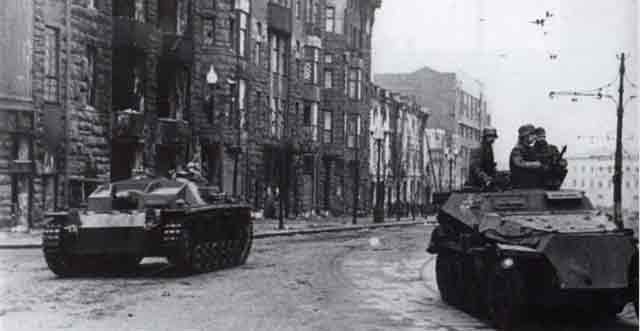
Operation TYPHOON, the final German advance on Moscow, has been more or less successful as of 24 October 1941. The Germans have pierced the outer Soviet defensive ring around the Soviet capital in a couple of places and continue putting pressure on the city’s defenses. However, Red Army resistance has been fanatical in places, particularly to the south of the city. There, General Guderian’s 2nd Panzer Army has been stuck at Mtsensk, over 300 km from the city. While this is not an outlandishly far distance to drive, it is twice as far as the German forces advancing on the west and northwest axes. This is a major problem for Operation TYPHOON because Guderian’s force has been the leading edge of Army Group Center throughout Operation BARBAROSSA. Today, Guderian makes a dramatic change that produces immediate results.
The problem for Guderian is similar to the one facing the entire Wehrmacht, and that is heavy losses during four months of ferocious combat. For Guderian, the problem has been magnified because his panzers have led the way for the entire Wehrmacht, always at the forefront of the fighting. Guderian’s command was the one diverted to the south in order to complete the encirclement of Kyiv. That was a dramatic victory, bagging over 600,000 Soviet prisoners with many more killed and wounded. In most wars, that would have ended matters — but not in the Soviet Union. All of the endless combat has whittled Guderian’s panzer force to a mere shadow of what it was in June. Whereas each of Guderian’s panzer divisions had a starting establishment of over 300 tanks, now his entire force of “runners” is under 100. An additional problem is that Guderian’s Panzer III and Panzer IV tanks are outclassed by the Soviet T-34 and KV tanks that are suddenly appearing in large numbers. This has led to dramatic losses due to the panzers’ inadequate armor.
On 24 October 1941, Guderian adds a novel twist to standard German Army (Heer) doctrine of concentration of forces in order to blast through the Soviet defenses at Mtsensk. He takes the remaining panzers from all of his divisions and concentrates them into a single brigade (Kampfgruppe Eberbach) under the command of under Colonel Heinrich Eberbach (commander of 4th Panzer Division of XXIV Panzer Corps). This massive concentration of force smashes through the bewildered Soviet defenders and advances 18 miles to Chern’ in one giant leap. While still far from Moscow, the Germans regain the initiative and force the Soviets to defend against this new threat from a direction they thought was under control. If the Heer is to have any chance of taking Moscow in 1941, Guderian’s panzers have to make that happen. However, with Guderian’s dwindling forces, this is the last throw of the dice — so it has to succeed or the entire invasion may fail to reach its major objective. It is a desperate drive using everything that remains, and it can only succeed if Soviet defenses finally are crumbling on the fringes of Moscow.
Elsewhere, the Germans also have renewed momentum. With the Bryansk pocket eliminated, the German 9th Army is free to support the 3rd Panzer Army at Kalinin (Tver). Much further south, the 1st Panzer Army makes good progress through the industrial Donbas region, while the 57th Infantry Division of 6th Army (von Reichenau) marches into Kharkiv after it is abandoned by Soviet 38th Army. This is a major achievement, but the Soviets have evacuated or destroyed all of the industrial equipment there. This was accomplished using 320 trains carrying the equipment from 70 factories. Kharkiv remains an important conquest and becomes the most heavily fought over city in the Soviet Union, but already it has been rendered mostly useless by the retreating Soviets.
German troops captured Belgorod, Russia.
The last Soviet remnants of the Bryansk Pocket surrender. The German Ninth Army, freed from the operation, moves to support the Third Panzer Army at Kalinn but fails to jump start the stalled offensive there.
After sundown, British minelaying cruiser HMS Abdiel and destroyers HMS Kandahar, HMS Kingston, and HMS Griffin departed Alexandria, Egypt with troops and supplies for Tobruk, Libya, returning with troops of Australian 9th Division early in the next day.
German submarine U-563 attacked Allied convoy HG.75 300 miles west of Gibraltar at 0038 hours, damaging British destroyer HMS Cossack with a torpedo; 159 were killed, 60 survived. At 0636 hours, U-564 joined in on the attack, sinking British ships Carsbreck, Ariosto, and Alhama; 30 were killed, 96 survived.
British minesweeping trawlers HMS Lucienne Jeanne and HMT Emilion struck naval mines and sank in the Thames Estuary in southern England, United Kingdom.
The last combat between a Gloster Gladiator and a CR-42 occurs near Ambazzo, when a 3 Squadron RSAAF (Royal South African Air Force) intercepts an Italian fighter.
RAF Bomber Command, Day of 24 October 1941
18 Blenheims on uneventful sweeps off the Dutch coast.
RAF Bomber Command, Night of 24/25 October 1941
Frankfurt
70 aircraft; only 8 reported reaching the target area, in difficult weather conditions, 57 aircraft bombed elsewhere. 4 aircraft – 2 Wellingtons, 1 Hampden, 1 Whitley – lost.
Minor Operations: 12 Wellingtons to Emden, 6 Stirlings to Brest, 1 Wellington to Cherbourg. No losses.
Destroyer HMS Cossack (G 03) (Captain E. L. Berthon DSC) was torpedoed by U-563, commanded by Oberleutnant zur See Klaus Bargsten, west of Gibraltar late on the 23rd. At 0030 hours on 24 Oct 1941, U-563 fired one torpedo at a steamer in convoy HG.75 which seemed to hit after a running time of 4 minutes 44 seconds. Eight minutes later, a spread of two torpedoes was fired against a turning destroyer which missed, but detonations were heard behind. In fact, HMS Cossack (G 03) (Capt E.L. Berthon, DSO and Bar, DSC, RN) was struck by one torpedo forward of the bridge, when she was at the rear of the convoy. The explosion blew off the bow section and destroyed most of the forward section, killing the commander. The survivors (29 of them wounded) on Carley floats were picked up by HMS Legion (F 74) (Cdr R.F. Jessel, RN) and HMS Carnation (K 00) (LtCdr G.W. Houchen, OBE, RNR). The next morning, some volunteers reboarded the wrecked ship and got the engines running. The tug HMS Thames arrived from Gibraltar and took the destroyer in tow, escorted by HMS Jonquil (K 68) (LtCdr R.E.H. Partington, RNR). On 27 October, the weather worsened and prevented the salvage, so the tow was slipped and the corvette took off the skeleton crew. HMS Cossack (G 03) sank shortly afterwards in 35°12N/08°17W.
U-564, commanded by Oberleutnant zur See Reinhard Suhren, sank British steamers Carsbreck and Ariosto (2176grt) in 36-20N, 10-50W and British steamer Alhama (1352grt) in 35-42N, 10-58W from convoy HG.75/24th. After 0636 hours on 24 Oct 1941, U-564 fired five torpedoes at the convoy HG.75 about 300 miles west of Gibraltar. The first three exploded in columns of red fire on different ships after 21, 31 and 41 seconds. The last two were heard to detonate after 3 minutes 14 seconds and 3 minutes 56 seconds. Suhren claimed five ships damaged with 25000 tons. In fact, three ships, the Carsbreck, Ariosto and Alhama were torpedoed and sunk.
The master, 19 crew members, and four gunners from the Carsbreck (Master John Dugald Muir) were lost. 16 crew members and two gunners were picked up by FFL Commandant Duboc, transferred to HMS Ariguani (F 105) which was torpedoed and damaged by U-83 (Kraus) two days later. The vessel was abandoned, but later reboarded and towed to Gibraltar. The survivors from the Carsbreck were picked up by HMS Campion (K 108) (LtCdr A. Johnson, RNVR), transferred to HMS Vidette (D 48) (LtCdr E.N. Walmsley, RN) and landed at Gibraltar. The 3,670 ton Carsbreck was carrying iron ore, including cork and ore and was bound for Barrow, England.
The Ariosto (Master Harold Hill) was the ship of the convoy commodore F.L.J. Butler, RNR, RD. Five crew members and one gunner were lost. The master, the commodore, six naval staff members, 30 crew members, three gunners, three passengers and one DBS were rescued: 38 survivors were picked up by the Swedish motor merchant Pacific and landed at Barrow and seven survivors by HMS Lamerton (L 88) (LtCdr H.C. Simms, RN) and landed at Gibraltar. The 2,176 ton Ariosto was carrying general cargo, including cork and ore and was bound for Liverpool, England.
The master, 25 crew members and seven gunners from the Alhama (Master Alexander Cameron) were picked up by the FFL Commandant Duboc and transferred to the HMS Lamerton (L 88) (LtCdr H.C. Simms). 18 survivors were later transferred to the HMS Hesperus (H 57) (LtCdr A.A. Tait) and landed at Liverpool, and 15 survivors were transferred to the HMS Rochester (L 50) (Cdr C.B. Allen) and landed at Londonderry on 3 November. The 1,352 ton Alhama was carrying tartaric acid, onions, wines, cork, and general cargo and was bound for Belfast, Ireland.
Destroyer HMS Montrose departed Sheerness at 0713 for Scapa Flow, via Methil, to carry out working up exercises. The destroyer arrived at Methil at 1000/25th and after landing trial parties departed again. She arrived at Scapa Flow at 1700 that day.
Destroyer HMS Antelope departed Scapa Flow at 0930 for Scrabster with the Engineer in Chief. After this duty, the destroyer returned to Scapa Flow.
Minesweeping trawler HMS Emilion (201grt, Sub Lt J. W. S. Allison RNVR) was sunk on a mine in the vicinity of B.6 Buoy, Barrow Deep. There were no casualties on the trawler.
Minesweeping trawler HMS Lucienne Jeanne (264grt, Skipper S. E. George RNR) was sunk by a mine in the vicinity of B.6 Buoy, Barrow Deep.
Minelaying cruiser HMS Abdiel and destroyers HMS Kandahar, HMS Kingston, and HMS Griffin departed Alexandria on serial nine of the CULTIVATE operation. The ships arrived back at Alexandria on the 25th.
Submarine HMS Tetrarch arrived at Malta from Alexandria with stores and kerosene.
British steamer Clan Ferguson (7347grt) departed Malta to proceed independently to Gibraltar. The steamer was attacked by air shortly after leaving Malta and was recalled and arrived back at 0900/25th.
The Gibraltar section of convoy OS.9 was detached from the main convoy, escorted by sloops HMS Leith and HMS Fowey and corvette HMS Stonecrop. Destroyer HMS DUNCAN departed Gibraltar on the 24th and, after assisting destroyer HMS Cossack, refueled at Ponta Delgada on the 30th. She then sailed to join the convoy. Destroyer HMS Wild Swan departed Gibraltar on the 25th to join the convoy. Destroyers HMS Gurkha and HNLMS Isaac Sweers departed Gibraltar on the 28th to join. Convoy OS.9G arrived at Gibraltar on 1 November.
Submarine HMS Truant damaged Italian steamer Padenna (1589grt) off Bari.
Submarine HMS Triumph attacked Spanish steamer Isora (316grt) in the Aegean, but no hits were made.
In Washington, President Roosevelt conferred with Sidney Hillman, Associate Director of the Office of Production Management, and William H. Davis, chairman of the National Defense Mediation Board, on the coal strike situation; with John D. Biggers, Lend-Lease Administrator in London, and with other callers. He disclosed at a press conference plans to double tank production in a. new arms expansion program. He signed the bill increasing the funds of the Reconstruction Finance Corporation by $1.500,000.000.
The Senate and House were in recess.
The Senate Foreign Relations Committee concluded hearings on the resolution to permit the arming of merchant ships and the Defense Investigation Committee continues hearings on OPM labor policies.
President Roosevelt stated today that Congress would be requested soon to provide funds to double the tank-building program. Experience in Europe and Africa, he said, demonstrated that this country needs more of these weapons. Although Mr. Roosevelt confined himself to saying that factories will be erected and plants expanded for building thousands more tanks than those already scheduled, it was understood that annual production plans call for at least 25,000 more medium tanks and a great increase in heavy and light types. Facilities will be increased, he indicated, for turning out cannon and machine guns, treads and reserve parts for the machines. This request Mr. Roosevelt made clear, will be only the first of several which will go to Congress this Fall and early next Spring for increasing the base of the victory armaments program, and to make it large enough eventually to permit the overwhelming of Hitlerism. Although officials at present talk only of plans to double the $60,000,000,000 appropriated or authorized for armaments, some officials privately are expressing the belief that, if the war continues four or five years, about $240,000,000,000 may be put into the productive effort.
The movement for outright repeal of all important restrictive provisions of the Neutrality Act, as precipitated by a combination of “Willkie Republicans” and New Deal Democrats, will receive its first test tomorrow when the Senate Foreign Relations Committee passes on the House-approved resolution to remove the ban against arming American merchant ships. Senator Pepper of Florida said today that he would force the issue by moving to amend the House resolution by adding the language introduced Monday by himself and Senators Lee of Oklahoma and Green of Florida, providing for repeal of the prohibitions against American vessels calling at belligerent ports and traversing combat areas. None of the Republican trio who introduced a measure to the same effect is on the Foreign Relations Committee, but they hoped to induce Senator White of Maine to present their proposal for consideration. The authors of the Republican version of “all out” repeal are Senators Bridges of New Hampshire, Austin of Vermont and Gurney of South Dakota.
Some concern is being expressed privately in Congressional circles over the apparently dimming prospects of realizing President Roosevelt’s aim for adequate price-control legislation to halt inflationary trends. The reason for what leaders regard as the discouraging situation comes about through the recent fusing of powerful groups, which, if not curbed, would be able to get what they wanted. The labor group wants no curbs on wage increases. The farm group wants no ceiling on agricultural products. The two could block all price-control legislation, although, as a “face-saving” device, they might be willing, many think, to allow an innocuous measure to go to the White House. The labor group, which has been backed in its “no wage ceiling” program by some Administration officials, opposes anything that would halt the rising wage scales which officials of the House Appropriations Committee estimated today had added $8,000,000,000 to the three-year defense program. No one in authority on Capitol Hill would even guess what the total rise in wages had added since May, 1940, to the expenses of the government and individuals.
For the first time in this war the King of England has reviewed United States army personnel on British soil. Twenty-five United States army signal corps lieutenants who have come to England as military observers and American civilian technicians were among many hundreds of RAF Men drawn up at this RAF reception center Thursday when King George VI and Queen Elizabeth reviewed personnel from the dominions and colonies and the United States.
A secretary to Representative Hamilton Fish, New York Republican, was indicted for perjury today and a federal prosecutor labeled the accused man a key figure in the distribution, under government frank, of propaganda “master-minded by foreign agents.” The secretary, George Hill, was indicted on a charge of telling untruths before a grand jury which has been investigating activities of alleged foreign agents for several months. He was accused of testifying falsely about the disposition of mail bags alleged to contain franked envelopes and speeches of members of congress opposed to the administration’s foreign policy and with falsely denying he knew George Sylvester Viereck, a publicist indicted two weeks ago on charges of withholding information when he registered with the State Department as an agent of German interests.
Franklin Roosevelt hosted Princess Märtha of Sweden (Crown Princess of Norway) at his home in Hyde Park, New York, United States.
Under-Secretary of War Robert P. Patterson and William S. Knudsen, director general of the Office of Production Management, announced tonight acceptance by Air Associates, Inc., at Bendix, New Jersey, of recommendations by the National Defense Mediation Board.
President Roosevelt asked John L. Lewis, president of the United Mine Workers, C.I.O., today to prevent the strike of 53,000 workers in the captive coal mines threatened for tomorrow midnight.
William S. Knudsen, OPM Director General, asked the Defense Plant Corporation today to provide funds for the construction of a 500,000-ton steel plate mill and a plant capable of turning out 30,000 tons of steel casting at Pittsburgh, California.
Secretary Ickes urged today intensive activity on the part of the oil industry to increase the country’s production of high octane gasoline for airplanes to at least 100,000 barrels daily by January 1, 1943. The government, he said, stands ready “with definite plans to assist in the financing” of new refining plants for aviation fuel.
A twin-motored Army Air Corps B-18A Bolo bomber headed for its home base at Fort Douglas, Utah, from Hamilton Field by way of Sacramento, crashed in flames during a heavy fog today on the higher of the twin sisters peaks in Suisun Valley, killing the five occupants. five crew members on board were killed instantly in the impact and the intense post-crash fire. The flight was commanded by Army Air Corps Captain F. S. Nelson. A search plane from Hamilton Field air corps base sighted wreckage of the bomber from the air later today.
[Ed: Twin Sisters is just a few miles from my house.]
General Douglas MacArthur requests an additional US $3 million (US $43.6 million in 2008 dollars) to build facilities at Del Monte (Mindanao) and five other airfields.
Tatsuta Maru departed Honolulu, U.S. Territory of Hawaii for San Francisco, California, United States.
The Soviet embassy in Chungking said today that Russia had notified China she was unable to continue war shipments, The embassy said that Soviet supplies had diminished since the start the Russo-German war and that Russia needed all her material for her own fight.
The decision of the Tojo Cabinet to petition Emperor Hirohito for the convocation of an extraordinary session of the Diet beginning November 15 took the country by surprise and caused many to speculate regarding its significance.
The American government has abandoned hope of coming to terms with Japan, Secretary of the Navy Knox dramatically indicated today, adding a “collision” in the Orient appears virtually inevitable. So “extremely strained” is the situation, the navy chief told a small group of defense manufacturers meeting in his office, that it is no longer considered advisable to rely upon the transpacific route for shipping war supplies to Russia, and a North Atlantic route ending at Archangel was viewed as preferable even though that Arctic port is largely icebound in winter. Speaking rapidly in a tense, low voice, Knox described conditions in the Orient in these words: “The situation out in the Far East is extremely strained. We are satisfied in our own minds that the Japanese have no intention of giving up their plans for expansion. If they pursue that course a collision there is inevitable.”
There are now only 44 days until the Pearl Harbor raid.
Dow Jones Industrial Average: 121.18 (+0.71)
Born:
Frank Aendenboom, Flemish actor (“Lion of Flanders”), in Antwerp, Belgium (d. 2018).
William H. Dobelle, American biomedical engineer (Nobel Prize in Physiology or Medicine, 2013 nominee), in Massachusetts (d. 2004).
Naval Construction:
The Royal Navy YMS-1-class auxiliary motor minesweeper HMS BYMS 2022 (J 822) is laid down by the Seattle Ship Building and Dry Dock Co. (Seattle, Washington, U.S.A.).
The U.S. Navy YMS-1-class auxiliary motor minesweepers USS YMS-82 and USS YMS-83 are laid down by the Stadium Yacht Basin (Cleveland, Ohio, U.S.A.).
The Royal Navy Isles-class minesweeping trawler HMS Ensay (T 216) is laid down by Cook, Welton & Gemmill (Beverley, U.K.); completed by Holmes.
The U.S. Navy SC-497-class (110-foot wooden hull) submarine chaser USS PC-528 (later SC-528) is laid down by the Mathis Yacht Building Co. (Camden, New Jersey, U.S.A.).
The U.S. Navy Gato-class submarine USS Shad (SS-235) is laid down at Portsmouth Navy Yard, Kittery, Maine.
The U.S. Navy SC-497-class (110-foot wooden hull) submarine chaser USS PC-499 (later SC-499) is launched by the Fisher Boat Works (Detroit, Michigan, U.S.A.).
The Royal Navy Flower-class corvette HMS Saxifrage (K 04) is launched by Charles Hill & Sons Ltd. (Bristol, U.K.); completed by Richardson, Westgarth & Clark.
The U.S. Navy cargo ship USS Aquila (AK-47) [ex-Tunis] is commissioned. Her first commanding officer is Lieutenant Commander Samuel Stark Fried, USN.
The Royal Navy LCT (Mk 2)-class landing craft, tank HMS LCT 133 is commissioned.
The U.S. Navy Accentor-class coastal minesweeper USS Aggressor (AMc-64) is commissioned.
The Royal New Zealand Navy Isles-class minesweeping trawler HMNZS Inchkeith (T 155) is commissioned. Her first commanding officer is Lieutenant Henry Alfred Dunnet, RNR.

