The Odessa Massacre
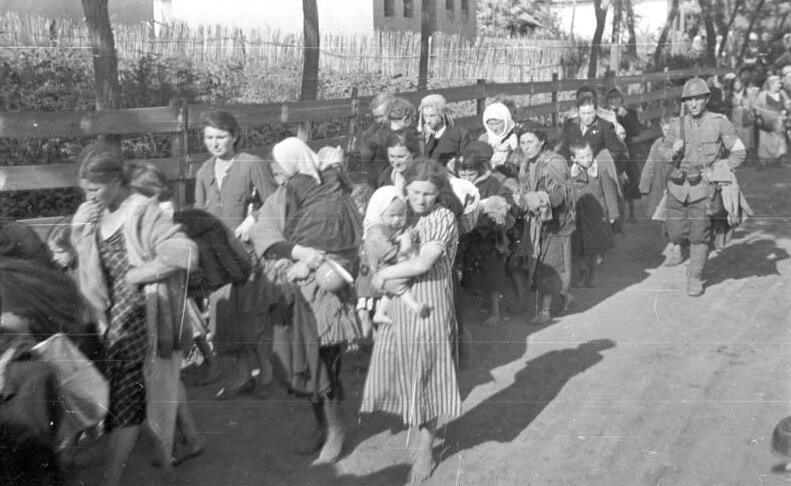
There are many massacres during World War II, and all of them are horrible. However, certain incidents stand out in stark relief for taking barbarity to a new level. On 23 October 1941, events play out in Odessa which remaining stunning in the depth of their violence and depravity. This is the Odessa Massacre.
After the Red Army abandoned Odessa on the night of 15 October and Romanian troops entered it on 16 October 1941 after a 73-day siege, things temporarily settled down in the large seaport. However, before the boarded ships and left, the Soviet troops set explosives in a large building on Marazlievskaya Street which they had used as the headquarters of the NKVD (Soviet state security service, similar to the Gestapo). Other retreating Soviet troops had done this elsewhere previously, most notably in Kyiv, but the Romanians either did not suspect there might be booby traps, or they did not check carefully enough for them. On 22 October, a full week after the Soviets departed, the Soviets detonated the mine (either through a time-delay fuse or by radio signal) in the Marazlievskaya building and a massive explosion leveled it. The blast killed 67 people, including the Romanian Major General Ion Glogojanu, commander of the Romanian 10th Division, and 51 of his staff. Among the dead were four German Kriegsmarine officers, 35 soldiers, 16 officers, and nine civilians. The occupying authorities — those that survive — are furious.
The Romanians and Germans did not know immediately who set the explosion, but they knew who they could punish for it. Romanian leader Ion Antonescu ordered immediate reprisals against local civilians. He required that 100 Communists and people the Jewish faith be executed for each of the 35 ordinary soldiers who perished in the blast and 300 for each officer killed. Obviously, this was going to amount to a lot of deaths. The Romanian Commander of troops, Gendarmerie Lieutenant Colonel Mihail Niculescu, issues an order:
“Military Command of the mountains. Odessa brings to the attention of the population of Odessa and its surroundings that after the terrorist act committed against the Military Command on October 22, on the day of October 23, 1941, were shot: for every German or Romanian officer and civilian official 200 Bolsheviks, and for every German or Romanian soldier 100 Bolsheviks. Taken hostage, which, if repeated such acts, will be shot together with their families.”
However, what transpired as a result far exceeded these totals.
The next phase of horror begins on 23 October 1941. A German SS Einsatzgruppe arrives at the destroyed Marazlievskaya building, survey the damage along with Romanian security troops, and they immediately set to work. The troops simply walk across the street to an apartment building, drag all the residents out, and shoot or hang all of them. Then, they raid nearby streets and markets before heading out into the suburbs and executing everyone that they find. A reported hundred men are shot at the Big Fountain, about 200 at the Slobodka market, 251 in Moldavanka, 400 are hanged in Aleksandrovsky Prospekt — the carnage is everywhere. Some hostages are marched down Lustdorf Road to an industrial area, where they are shot or burned alive.
In addition to this first rampage, the Odessa city government issues an order on 23 October 1941 requiring all people of Jewish descent to report to the village of Dalnik on 24 October. The penalty for non-compliance is death. The killings continue. The total number of deaths in this incident is unknown, but 22,000 bodies are found in a mass grave after the war. It is estimated that the city loses 10% of its population in the Odessa Massacre. While many different dates are submitted for the start of the Holocaust, 23 October 1941 is a good candidate.
Depending on the accepted terms of reference and scope, the Odessa massacre refers either to the events of 22–24 October 1941 in which some 25,000 to 34,000 Jews were shot or burned, or to the murder of well over 100,000 Jews in the town and the areas between the Dniester and Bug rivers, during the Romanian and German occupation which took place following the massacre. As of 2018, it was estimated that up to 30,000 people, mostly Ukrainian Jews, were murdered in the actual massacre, which occurred 22–23 October 1941. The primary perpetrators were Romanian soldiers, Einsatzgruppe SS and local ethnic Germans.
The German government officially banned the emigration of Jews.
2,014 German Jews originally from Cologne, Germany arrived at the Lodz Ghetto in Poland.
Catholic Provost Bernhard Lichtenberg, who right through the stepped-up antisemitic agitation, continues to say a daily prayer for the Jews, is finally arrested in Berlin. During questioning by the SS, the Father Lichtenberg asserts that the deportation of the Jews is irreconcilable with Christian moral law, and asks to be allowed to accompany the deportees as their spiritual adviser. He is sentenced to two years imprisonment for abuse of the pulpit. Upon his release in 1943 he immediately resumes his ministry, both pastoral and social, and is arrested again and sentenced to the Dachau concentration camp. He dies in a rail car en route to Dachau. On 23 June 1996, Pope John Paul II declared Lichtenberg and Karl Leisner blessed martyrs. He has also been awarded the title of Righteous among the Nations.
The first of the two Mesovouno massacres was carried out by the Wehrmacht in the Greek village of Mesovouno. On 23 October 1941, Wehrmacht soldiers gathered all men aged 16–69 years old, killed them with machine guns and set the houses on fire. In 1944 the village was razed by Nazi troops two days before the massacre of the village Pyrgoi in Ptolemaida. A total of 268 civilians were killed. In the 1941 massacre, Mesovouno was part of a series of mass executions by the Nazis that took place from 17 to 28 of October, the rest being the executions of the inhabitants of the villages Kalokastro and Kerdylia in Serres, of Kleisto, Kidonia and Ambelofyto in Kilkis.
Soviet Marshal Josef Stalin reorganized the Soviet army command system giving Colonel General Georgy Zhukov command of central zone operations. Marshal Semyon Timoshenko was shifted to southern front while Marshals Semyon Budyonny and Kliment Voroshilov were charged with formation of new Soviet armies.
The Soviet attempt to break out of Leningrad, Russia south of Lake Ladoga was halted by the Germans. Meanwhile, 120 kilometers to the east, two divisions of the Soviet 54th Army were dispatched to reinforce Tikhvin, which had been under attack by the Germans.
The 3rd Panzer Division of the German Panzergruppe 2 outflanked Soviet troops at Mtensk, Russia, 100 kilometers south of Moscow.
In London, General de Gaulle asks resistance members to stop murdering German military personnel, to avoid further retaliation against the French populace. Charles de Gaulle met with leaders of resistance movements, asking them to bide their time and protect the lives of innocents.
German merchant raider Kormoran completed taking on 4,000 tons of diesel oil and 6 months of supply from supply ship Kulmerland off Cape Leeuwin, Australia.
The British destroyer HMS Cossack was torpedoed and damaged in the Atlantic Ocean by the German submarine U-563. The Cossack tried to return to Gibraltar for repairs but would sink in bad weather four days later.
Four crew members of German submarine U-106, on watch on the deck, were swept overboard in the Bay of Biscay and were all lost.
Soviet submarine ShCh-323 sank German merchant ship Baltenland in the Baltic Sea.
British cruisers HMS Ajax, HMS Neptune, and HMS Hobart, escorted by destroyers HMS Eridge and HMS Avonvale, departed Alexandria, Egypt and bombarded Bardia, Libya. Meanwhile, also from Alexandria, British destroyers HMS Napier, HMS Nizam, HMS Jupiter, and HMS Hasty bombarded Sollum, Egypt.
RAF Bomber Command, Day of 23 October 1941
12 Blenheims to Lannion and Morlaix airfields. Only Lannion was found, and bombed in poor weather conditions. No Blenheims lost.
RAF Bomber Command, Night of 23/24 October 1941
Kiel
114 aircraft – 43 Wellingtons, 38 Hampdens, 27 Whitleys, 6 Manchesters – to attack shipyards. 1 Hampden lost.
Only 69 crews reached the target area. Kiel reports a raid in two widely separated waves. The second attack caused the most damage, with hits on the Deutsche Werke U-boat yard, the naval base, a bakery, a dance-hall and several houses. 4 people were killed – one on a ship in the harbour – and 5 people injured. The diarist, Detlef Boelck, records his great satisfaction and confidence in the local defences when 3 bombers were caught in searchlights at the same time and 1 was shot down while trying to dive out of the beams.
Minor Operations: 13 aircraft to Le Havre, 9 Stirlings to Brest, 4 aircraft to Cherbourg. 1 Hampden lost on the Le Havre raid.
Battleship HMS Prince of Wales and destroyers HMS Electra and HMS Express departed Scapa Flow at 0700 for the Clyde. The ships arrived in the Clyde at 0500/24th. Vice Admiral Curteis transferred his flag to battlecruiser HMS Renown. and Admiral Sir Tom S. V. Philips, KCB, raised his flag was Commander in Chief, Eastern Fleet. Battleship Prince of Wales and destroyers HMS Hesperus, Express, and Electra departed the Clyde at 1500 for the Far East. Destroyer HMS Legion, after refueling in the Azores, joined the screen on the 28th. Destroyers Express and Electra were detached to Ponta Delgada to refuel. On the destroyers’ return to the screen on the 29th, destroyers Legion and Hesperus were detached, Hesperus to return to the UK and Legion to Gibraltar. On 5 November, the ships arrived at Freetown. The battleship and destroyers Express and Electra arrived at Simonstown on 16 November and Colombo on 28 November. Battleship Prince of Wales and destroyers Express and Electra departed Colombo on 30 November and joined battlecruiser HMS Repulse and destroyers HMS Encounter and HMS Jupiter, which came out from Trincomalee. The Ships arrived at Singapore on 2 December.
Minesweepers HMS Salamander and HMS Halcyon arrived at Seidisfjord to refuel on the 22nd and departed again at 0900/23rd for Scapa Flow, where they arrived at 1100/26th.
Minesweepers HMS Harrier and HMS Britomart arrived at Seidisfjord at 1800 from Spitzbergen to refuel. They departed and arrived at Scapa Flow at 1000/25th.
An Albacore aircraft from Aircraft carrier HMS Victorious did not return from exercises near Rona off Scapa Flow. T/A/Sub Lt (A) A. K. Hopkins RNVR, T/A/Sub Lt (A) P. D. Sayer RNVR, and Leading Airman N. Weldon of the 832 Squadron were lost. In the same exercise, a Fulmar of 800 Squadron from aircraft carrier HMS Indomitable also failed to return. A/Sub Lt (A) J. H. Miln and T/Sub Lt (A) F. J. Stamper RNVR were lost.
Light cruisers HMS Ajax, HMS Neptune, and HMAS Hobart with destroyers HMAS Napier, HMAS Nizam, HMS Jupiter, HMS Hasty, HMS Eridge, and HMS Avonvale departed Alexandria to bombard enemy positions at Bardia. Destroyers HMAS Napier, HMAS Nizam, Jupiter, and Hasty were detached and conducted a bombardment of Sollum. The light cruisers, escorted by destroyers HMS Eridge and HMS Avonvale, bombarded Bardia. The ships all returned to Alexandria on the 24th.
Anti-aircraft ship HMS Carlisle departed Alexandria to return to the Red Sea for duty in the Suez Escort Force. The ship arrived at Suez on the 25th.
Submarine HMS Triumph sank Greek caique Pangiotis (120grt) and damaged caique Aghia Paraskeva (120grt) in the Gulf of Petali.
Submarine HMS Truant sank Greek steamer Virginia S. (3885grt) in 39-48N, 19-06E from a convoy of steamer Virginia S. and tankers Balcik and Balkam, escorted by escort ship Arborea. The submarine also claimed damage on the escort, which was not hit.
Submarine HMS Rorqual laid mines off Cavoli.
Unescorted merchant ships Dunedin Star and City of Lincoln, en route to Gibraltar from Malta, were attacked without success by Italian aircraft off Bone. The next day on the 24th, Italian sloop Corrispondente Beta sighted British steamer Empire Guillemot off La Galita Island near Cape Bon. The sloop was able to guide the bombers to the steamer which was sunk. Ten crewmen and one gunner were lost on the steamer. Twenty eight crewmen and five gunners were taken prisoners.
Italian steamer Achille (2415grt) was sunk by British bombing in 38-26, 11-24E.
Soviet submarine ShCh-323 sank German steamer Baltenland (3724grt) in the Baltic.
Convoy SC.51 departed Sydney CB escorted by armed merchant cruiser HMS Worcestershire and corvettes HMCS Battleford, HMCS Dunvegan, and HMCS Sorel. The corvettes were detached on the 25th when the convoy was joined by corvettes HMCS Arrowhead, HMCS Chilliwack, HMS Polyanthus, HMS Primrose, HMCS Snowberry, and HMCS Trail. Corvette Polyanthus was detached on 2 November and the rest of the corvettes on 4 November. Destroyers HMS Malcolm, HMS Sardonyx, and HMS Watchman joined on 4 November and corvettes HMS Arabis, HMS Dahlia, and HMS Monkshood, and anti-submarine trawlers HMS Northern Gem and HMS Northern Spray joined. Corvettes Arabis and Monkshood were detached on 7 November. On 8 November, the armed merchant cruiser, destroyer Sardonyx, and corvette Dahlia were detached. The convoy arrived at Liverpool on 9 November.
President Roosevelt Roosevelt conferred with Archbishop Francis J. Spellman and other callers today in Washington. He sent to the Senate the nomination of Representative Charles A. Leavy to be a United States District Judge for the Western District of Washington.
The Senate passed the $5,985,000,000 lend-lease bill with amendments, confirmed the nomination of Brigadier General Dawson Olmstead as chief signal officer of the Army and adjourned at 5:10 PM until noon on Monday. The defense investigating committee heard Sidney Hillman, A. D. Lewis and others on defense labor policies and the Foreign Relations Committee heard further opposition to Neutrality Act revision.
The House passed the bill providing for regulation by the Interstate Commerce Commission of freight forwarders and adjourned at 2:42 PM until noon on Monday.
The U.S. Senate stamped approval, 59 to 13, on a $5,985,000,000 lend-lease appropriation today, after writing into the measure a provision restricting food purchases under the program to United States-grown products. With little more than four hours debate, the chamber passed and sent back to the house a revised measure containing total appropriations of $6,160,039,000, including $175,039,000 in miscellaneous funds for government departments. Overriding a protest that it was putting the seal of approval on an undeclared war,” the chamber approved the major appropriation without change in the form adopted previously by the house.
An increase in public sentiment for changing the Neutrality Act to permit American ships to carry war supplies to Britain has taken place in the last ten days — a period during which Congress has been hotly debating the issue of revising the neutrality law. 54% now favor such aid — up from just 30% in April.
The White House rebuked the Maritime Commission today for disclosing Boston was to be the chief point of embarkation for Russian aid shipments, and the State Department emphatically denied Japanese-American tension had anything to do with the decision. Stephen Early, presidential secretary, expressed surprise on learning of the announcement, and said: “Aid will go to Russia as the president said, on schedule and in quantities promised by the American mission to Moscow. But when, and from where, it will go, the White House will have nothing to do with. We might as well send a telegram to Hitler as to announce it.”
William C. Bullitt, former U. S. ambassador to France, declared today that the United States is “going to war whether you like it or not.” “We are going to war, because American production is not enough to keep us out of it,” the former ambassador told 500 guests at a luncheon given in his honor at the Union league. “What is happening,” he said, “is a race between the speed with which we can make our resources effective and the time that Hitler can make the resources of the conquered countries effective. We are doing a job that is really not good enough. Why? We are caught in a conflict of emotions so deep we cannot resolve it. We want to defeat Hitler, but we do not want to go to war. These viewpoints are incompatible.”
A proposal that the United States Government offer itself as a mediator to negotiate peace between Hitler and the non-Axis Allies was made to the Senate Foreign Relations Committee today by John Cudahy, former Ambassador to Belgium.
Secretary Ickes, who reported last Summer the existence of a petroleum shortage on the East Coast and restricted sale and use of petroleum, declared today that the shortage was being rapidly eliminated and that closing of gasoline stations between 7 PM and 7 AM would no longer be necessary.
The Right Rev. Francis J. Spellman, Archbishop of New York and long in service at the Vatican, had an unannounced luncheon conference with President Roosevelt today. Myron C. Taylor, the President’s personal envoy to the Vatican, was in the White House at the time of the meeting.
The Consolidated Aircraft Corp. reported today it planned to triple its production of bombers by midyear of 1942. Major R. H. Fleet, company president, said the firm’s vast 1942 production program was geared to reach by midyear a point where plane deliveries every 10 working days would equal the total output for the first decade of Consolidated’s history. Its blackout aircraft plants which will produce Consolidated bombers will be in operation in Ft. Worth, Texas and Tulsa, Okla., before midyear of 1942. In announcing plans for erection of the plants, Consolidated said the Midwest factories initially would produce four-motor B-24 bombers for the U.S. Army Air Force at the rate of 50 a month.
The War Department is preparing to expand the army air forces to 400,000 or more men, possibly a larger number than any other combat branch, Secretary Stimson announced today. More than doubling the army’s present aerial might, the goal will be reached by next June 30, Stimson predicted, adding a subsequent increase to 500,000 was possible. Only the infantry’s “doughboys” now rival these numbers.
W. H. Harrison, OPM production director, revealed today plans to double tank production and speed up the output of new and more modern long-range bombers so that the British would be able, and the United States prepared, to fight the enemy wherever he is.
Selective service officials tonight took steps to reclassify nearly 1,300 striking Seattle welders who had been deferred from armed service because of employment in defense industries. The King County selective service board asked employers to furnish for reclassification the names of workmen whose walkout in five Puget Sound shipyards threatened $365,000,000 worth of defense contracts, in addition to other defense jobs in this area. Some shipyards already have furnished the names to the board, it was learned at a meeting between employers and the A.F.L. metal trades council. Five hundred welders employed at the Tacoma yard of the Seattle-Tacoma Shipbuilding Corp. joined the strike today, and it was believed selective service authorities there may take similar action.
Mass picketing by between 2,000 and 3,000 C.I.O. adherents temporarily shut down the plant of Air Associates, Inc., in Bendix, New Jersey this morning, but this afternoon the company succeeded in resuming production on $5,000,000 defense orders by rushing 500 non-striking employees into the plant by a back road.
A.D. Lewis, chairman of the United Construction Workers Organizing Committee (C.I.O.) and a brother of John L. Lewis, charged today that Sidney Hillman’s Labor Division of the Office of Production Management had acted, in effect as “a recruiting agency for the American Federation of Labor in connection with defense projects.”
Walt Disney’s feature-length animated musical “Dumbo” opens at the Broadway Theater in New York City.
The Japanese Cabinet has decided to convoke the Diet in a five-day extraordinary session November 15 to approve additional expenditures, increased taxation and stimulation of rice production.
The Japanese liner Tatsuta Maru arrived at Honolulu, U.S. Territory of Hawaii at 1000 hours and disembarked 273 American nationals who wished to return to the U.S. due to the rapidly deteriorating U.S.-Japan relations. Two Japanese intelligence agents who carried instructions for the consulate and a supply of radios for civilian spies already in place on Oahu, Hawaii were also disembarked. Another 333 American nationals continue on to San Francisco.
The Imperial Japanese Navy aircraft carrier HIJMS Kaga was relieved as the flagship of Carrier Division 1 of the Japanese Navy First Air Fleet.
Despite the absence of a formal declared pact of mutual defense against the Japanese, Anglo-Netherland cooperation in the Far East is becoming increasingly open and extensive. Within the last week Britons on liaison assignments in the Netherlands Indies and Netherlanders in a similar capacity in Malaya have been permitted to wear uniforms and the local press has been allowed to mention for the first time that British officers were on duty with Netherland forces in the Indies.
U.S. Army Transport Tasker H. Bliss arrives in Manila with 10 more pilots for the 24th Pursuit Group.
Rear Admiral H. M. Bemis, commandant of the Sixteenth Naval District in the Philippine Islands, arrived today on the liner President Coolidge. “We in the Philippines are just waiting for the whistle to blow,” he said. “We are all ready.”
Dow Jones Industrial Average: 120.47 (-0.09)
Born:
Winston Hill, AFL-NFL tackle (Hall of Fame, inducted, 2020; AFL Champions, Super Bowl III-Jets, 1968; AFL All-Star, 1964, 1967–1969; Pro Bowl, 1970–1973; New York Jets, Los Angeles Rams), in Joaquin, Texas (d. 2016).
Mel Winkler, American actor (“Devil in a Blue Dress”), in St. Louis, Missouri (d. 2020).
Igor Smirnov, Transnistrian politician, President of breakaway region of Moldova, in Petropavlovsk-Kamchatsky, Soviet Union.
Naval Construction:
The U.S. Navy Navajo-class fleet tug USS Pawnee (AT-74) is laid down by the United Engineering Co. (Alameda, California, U.S.A.).
The Royal Navy Fish-class ASW trawler HMS Grayling (T 243) is laid down by Cochrane & Sons Shipbuilders Ltd. (Selby, U.K.); completed by Amos & Smith.
The Royal Navy Bangor-class (Turbine-engined) minesweeper HMS Bootle (J 143) is launched by Ailsa Shipbuilding Co. Ltd. (Troon, Scotland).
The U.S. Navy 77-foot Elco patrol motor torpedo boat USS PT-63 is launched by the Electric Launch Company Ltd. (Elco), (Bayonne, New Jersey, U.S.A.).
The Kriegsmarine (German Navy) Type VIID U-boat U-216 is launched by F. Krupp Germaniawerft AG, Kiel (werk 648).
The Royal Navy harbor defence motor launch HMS HDML 1083 is commissioned.
The Royal Navy Vosper 70-foot patrol motor torpedo boat HMS MTB 57 is commissioned.
The Royal Australian Navy Bathurst-class minesweeper-corvette HMAS Wollongong (J 172) is commissioned. Her first commanding officer is T/Lieutenant Gordon Alexander Keith, RANR(S).
The Kriegsmarine (German Navy) Type VIIC U-boat U-593 is commissioned. Her first commanding officer is Kapitänleutnant Gerd Kelbling.
The Royal Navy Flower-class corvette HMS Thyme (K 210) is commissioned. Her first commanding officer is T/Lieutenant Alan Rochfort Mackay, RNZNVR.

