Operation TYPHOON, the German attack on Moscow, has been gaining ground in fits and starts against furious Soviet opposition. On 22 October 1941, the Wehrmacht experiences another day of success in some areas but problems in others. It is a very emotional day of highs and lows on both sides, with some good omens and bad ones. Overall, the German Army (Heer) improves its position, but the weather increasingly is becoming almost as big an obstacle as the Red Army.
There are several German successes. One takes place at the village of Naro-Fominsk, one of the linchpins of Moscow’s second line of defense only 43 miles from the city itself. The 2nd Battalion (Major Lübke) of the 479th Infantry Regiment of the 258th Infantry Division (Major General W. Hellmich) manages to create a wedge in the Soviet line at Naro-Fominsk on the main road into Moscow from the southwest. Just south of there, the 3rd Infantry Division (motorized, General der Artillerie Curt Jahn) also creates a 7-mile wedge in the Soviet line with a successful crossing of the Nara River by the 29th Motorized Infantry Regiment. They are supported by the 8th Motorized Infantry Regiment, which provides essential flank protection. Even further south, about 20 miles away, the 98th Infantry Division (Lieutenant General Erich Schröck) also crosses the Nara River. Schröck’s men meet up with the 19th Panzer Division (Lieutenant General O. von Knoblesdorff) at Gorki, where they capture a road bridge.
So, the day goes well for the Germans on the southwest axis of the advance. However, the Red Army if far from defeated in the battle for Moscow and is fighting hard everywhere. At Mtensk, the German 4th Panzer Division of the XXIV Panzer Corps (General Geyr von Schweppenburg) of General Guderian’s 2nd Panzer Army remains stuck fast. This is the most important axis of advance, along the main road coming from the south, because it offers the only prospect of actually surrounding the capital. The battle is wearing out the panzers, and Guderian’s entire command is down to less than 100 tanks — when a single division at the beginning of Operation Barbarossa had over 300. Guderian begins the process of combining all of the panzers under his command into a single brigade in the 4th Panzer Division, a reflection of how significant his losses have been.
There are some troubling signs on the Soviet side, too. During its violent battle on the Nara, the 8th Motorized Infantry Regiment takes 1,700 prisoners, including 52 officers. These turn out to mostly local Muscovite workers and workers militias drafted at the last minute along with some odds and ends from Ukraine. They seem happy to be captured, swearing at their political commissars and ripping their insignia off. Some shout “Voyna Kaputt” — “The War is Over!” — as they surrender. This is a welcome sign to the Germans, who throughout Operation BARBAROSSA have been looking for signs of disintegration in the Red Army.
However, the ultimate decision on the day comes from the weather. The Rasputitsa (change of seasons) now is in full swing, and the Wehrmacht proves ill-suited to cope with endless fields of deep mud and swollen creeks. German trucks can get no traction, horses get trapped, and even the panzers have difficulty. German tanks are ideally suited to paved roads and hard fields, but their treads are not as wide as Soviet tank treads and thus they gain less traction. While the panzers are not stopped, they are slowed, and to a much greater degree than are the Soviet T-34 and KV tanks. Rather than fight the mud while also trying to fight the Red Army, Field Marshal Fedor von Bock pauses the advance until the temperature falls further and the mud freezes enough to provide some traction.
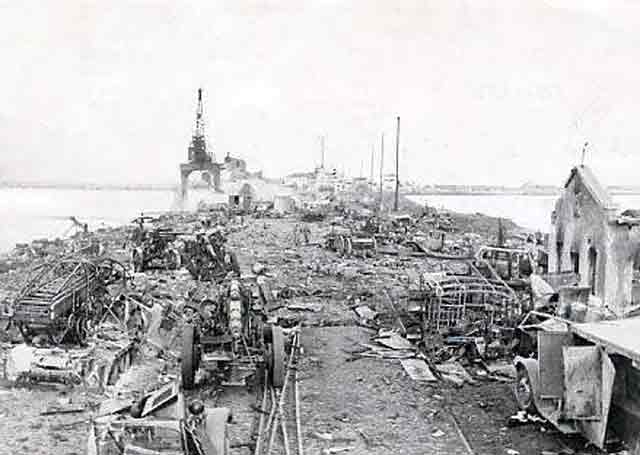
At Odessa far to the south, the Soviets gain some revenge for their loss of the city through a deadly means. As Soviet troops have done before at Kyiv and smaller towns, the retreating Soviet Coastal Army left behind some bombs which they can detonate by radio signal or are simply time-delayed. Today, several days after the Romanians entered the city and their suspicions have gone away, the Soviets detonate one at the Romanian Command Headquarters.
The detonation at Odessa kills 67 men, including Romanian Major General Ion Glogojanu, 16 of his staff including 4 Kriegsmarine officers, 35 other soldiers, and nine civilians (some being used as interpreters). Romanian leader Ion Antonescu orders reprisals, announcing that 100 communist and Jewish hostages would be executed for every enlisted man killed by the explosion and 300 for each officer.
The Romanians also do something that hints that even a victory over the Soviet Union will not satisfy their territorial desires. Antonescu denounces the 30 August 1940 Second Vienna Award, which gave Hungary territory in northern Transylvania claimed by Romania. Hitler’s plan was for Romania to be satisfied by being given the Transnistria province in the Soviet Union that it really wanted. Today’s action suggests that Romania’s military success at Odessa has only whetted its appetite for territory. From this point forward, the Germans are as much concerned with keeping their Romanian and Hungarian allies’ troops separated as much as they are using them to fight the Red Army.
Georgy Zhukov took command of Soviet central sector.
An explosion at the Rumanian Command Headquarters in Odessa, Ukraine killed 67, including Rumanian General Glogojeanu and four German Navy officers. The explosion was caused by a time-delayed bomb left by Soviet Coastal Army personnel during the evacuation.
Enraged Rumanian leader Ion Antonescu ordered reprisals. Two hundred hostages were to be shot for every officer killed and one hundred for every soldier. Originally these were to be Communists, but in Rumanian eyes Jews were essentially the same thing. Executions took place in Odessa and the outlying districts — hangings, head shots, machine gunnings en-masse, and other methods as struck the fancy of individual military commanders. The reprisals quickly got out of hand, and became an orgy of killing and mutilation directed mainly against the city’s Jewish population. Elements of the German “Einsatzgruppe D” execution commando — which had been given free rein to “cleanse” the areas occupied by Rumanian forces, and had already shot some five to six thousand Jews and Communists in Bessarabia, also participated in this prolonged massacre. Totals of victims executed in reprisal actions range from between nineteen and twenty-three thousand according to official Rumanian accounts all the way up to forty-one thousand when the outlying districts are included. There were for the most part Rumanian actions. Victims of the local SS Einsatzgruppe were in addition to these horrifying excesses.
In the Ukraine, the Germans post a notice is posted in Kiev informing the citizens that 100 hostages will be shot for every act of sabotage.
The assassination of Colonel Karl Hotz in Nantes, France two days prior brought reprisal deaths of 48 French civilians (mostly communist resistance fighters) with the promise of 50 more deaths if the assassin was not caught. The shooting of a German major in Bordeaux, France brought 100 arrests and 50 immediate executions.
Marshal Philippe Pétain and Admiral François Darlan broadcast an appeal to the French nation calling restraint from any actions against the occupying German troops which could bring down reprisals on hostages.
German submarine U-68 sank British oiler RFA Darkdale off St. Helena in the South Atlantic at 0142 hours, destroying 3,000 tons of fuel oil, 850 tons of aviation fuel, and 500 tons of diesel oil; 41 were killed, 4 survived including the captain. Darkdale was the first British ship to be sunk south of the Equator in WW2.
Rumania denounced the Second Vienna Award. This pact, which was forced upon Rumania by Germany and Italy on August 30, 1940, awarded northern Transylvania to Hungary.
With British success in Libya cutting off the airborne reinforcement route, the Regia Aeronautica (Royal Italian Air Force) is put on strict fuel rationing.
The Icelandic government resigned today. Disagreement over methods for dealing with the rising cost of living, salaries and other problems associated with the influx of American and British troops brought the crisis to the coalition government. Premier Hermann Jonasson handed the resignations to the regent, who will decide later whether to accept them. Jonasson has been prime minister for seven years. He formally protested when British troops were sent to Iceland early in the year, but cordial relations were restored between the two countries. The government subsequently agreed to the landing of American troops with the provisions granted by the United States that the forces be withdrawn at the end of the war, that they be large enough to meet every eventuality and that no attempt be made to compromise the absolute independence and sovereignty of Iceland. The agreement governing the American occupation was approved by the Althing (parliament) by a 39-3 vote.
RAF Bomber Command, Day of 22 October 1941
3 Blenheims on an uneventful sweep off the Dutch coast.
RAF Bomber Command, Night of 22/23 October 1941
Mannheim
123 aircraft – 50 Wellingtons, 45 Hampdens, 22 Whitleys, 6 Halifaxes. 3 Wellingtons and 1 Hampden lost.
Crews encountered thick cloud and icing conditions and only 58 crews claimed to have reached the Mannheim area. 42 aircraft bombed alternative targets. Mannheim reports a very light attack with 25 high-explosive and approximately 30 incendiary bombs. 1 house was destroyed and 35 damaged. 6 people were killed and 1 person injured.
Minor Operations: 22 aircraft to Le Havre, 6 Stirlings to Brest. 1 Wellington lost from the Le Havre raid.
U-564 sank British steamers Carsbeck and Ariosto (2176grt) in 36-20N, 10-50W and British steamer Alhama (1352grt) in 35-42N, 10-58W from convoy HG.75/24th. The submarine also claimed damaging two other steamers.
Nineteen crewmen and four gunners were lost on the steamer Carsbeck. Five crewmen and one gunner were lost on steamer Ariosto. The entire crew of steamer Alhama was rescued. French sloop Commandant Duboc joined the convoy on the 25th.
German steamer U-84 damaged CAM ship HMS Ariguani (6746grt, Cdr R. A. Thorburn (ret)) in 37-50N, 16-10W from convoy HG.75/26th. The submarine claimed sinking two other steamers. Destroyer HMS Vidette attempted to take ship Ariguani in tow, but was unsuccessful. In the tow of tug HMS Thames and escorted by corvettes HMS Jonquil, HMS Heliotrope, and HMS Campion, the anti-aircraft ship arrived at Gibraltar on 2 November. U-563 attacked Corvette Heliotrope in convoy HG.75/26th, but did not damage her. The submarine claimed damaging two steamers. Corvette Campion was detached on the 26th and destroyers HMS Lamerton and HMS Legion and corvettes HMS Bluebell, HMS Carnation, and HMS Heliotrope on the 27th. Destroyers Lamerton and Legion proceeded to Ponta Delgada to refuel. Destroyer Lamerton then sailed to rejoin the convoy. Destroyer Legion sailed to join battleship HMS Prince of Wales and escort her while destroyers HMS Electra and HMS Express refueled at Ponta Delgada.
On 27 September, U-564 claimed sinking a steamer in convoy HG.75.
U-432 sank British steamer Ulea (1574grt) from convoy HG.75/28th in 41-17N, 21-40W. The submarine claimed sinking another steamer. Thirteen crew, three gunners, and three passengers were lost on the steamer. Nine survivors were rescued by corvette HMS Bluebell. French sloop Commandant Duboc and corvettes HMS La Malouine and HMS Mallow were detached on the 29th. The convoy was joined on the 30th by sloop HMS Londonderry from convoy SL.90 and sloop HMS Aberdeen and destroyer HMS Hesperus on the 31st from the UK. The convoy arrived at Liverpool on 3 November.
Submarine HMS Urge damaged Italian steamer Marigola (5996grt) off the east coast of Tunisia in 35-50N, 11-06E. On the 30th, steamer Marigola was further damaged by submarine HMS Utmost gunfire, 2.3 miles 165° from Kuriat Island. The steamer was finally sunk on 1 November, when submarine Utmost returned and torpedoed the hulk.
U-68, commanded by Korvettenkapitän Karl-Friedrich Merten, sank British tanker Darkdale (8145grt) at St Helena. At 0142 hours on 22 October 1941 the Darkdale (Master Thomas H. Card) was torpedoed and sunk by U-68 while anchored as a storage ship in Jamestown harbour, St. Helena. The tanker caught fire after being hit by a torpedo, exploded and sank. 38 crew members and three gunners were lost. The master, five crew members and three gunners survived the sinking, but only two of the men had actually been aboard when the ship was hit and were rescued by harbour craft after jumping overboard. The 8,145 ton Darkdale was carrying fuel oil, aviation gasoline, diesel oil, and lubricating oil.
Battleship HMS Malaya departed the Clyde escorted by destroyer HMS Lightning for the Clyde to join Force H. Destroyer HMS Laforey was delayed for docking to repair weather damage. The battleship was joined by destroyers HMS Havelock and HMS Harvester for escort. Battleship Malaya and destroyers Lightning, HMS Zulu, and HMS Sikh arrived at Gibraltar on the 27th.
Destroyer HMS Intrepid departed London at 0650 for Sheerness after refitting. The destroyer departed Sheerness at 1230/23rd and arrived at Scapa Flow at 1700/25th.
Minelayer HMS Port Quebec, escorted by destroyer HMS Newark, laid minefield SN.24 C.
Minesweeping trawler HMS Alder (560grt, T/Skipper G. E. Yates RNR) was grounded and declared a total loss on the east coast of Scotland.
Minelaying cruiser HMS Latona and destroyers HMS Kingston, HMS Encounter, and HMS Hotspur departed Alexandria on serial seven of the CULTIVATE operation. Minesweeping whaler HMS Soika’s LL sweep had been cut in an air raid at Tobruk. The cable fouled on Hotspur’s propeller. The destroyer was able to return to Alexandria at reduced speed. No damage was done to the ship. The ships returned to Alexandria on the 23rd.
Corvette HMS Peony departed Haifa with armed boarding vessel HMS Chantala and steamer British Colonel (6999grt) for Alexandria.
Corvette HMS Erica escorted cable ship Bullfinch from Alexandria to Port Said. The corvette then departed Port Said and escorted mine carrier Gurna from Port Said to Haifa.
Italian steamer Maria Pompei (1407grt) was sunk on a mine at Cattaro.
Destroyer HMS Gurkha and Dutch destroyer HNLMS Isaac Sweers departed Freetown on the 15th with convoy 90. After refueling at Bathurst, the destroyers proceeded to Gibraltar, arriving on the 22nd.
Convoy ON.29 departed Liverpool. The convoy was joined on the 23rd by destroyers HMS Broke, HMCS Buxton, HMS Verity, and HMS Wolverine, corvettes HMS Begonia, HMS Camellia, HMS Eglantine, HMS Larkspur, HMS Montbretia and HMCS Moose Jaw, and naval trawlers HMS Bute, HMS Celia, HMS Hamlet, and HMS Macbeth, and anti-submarine trawler HMS King Sol. Destroyer Verity, corvette Begonia, and the naval trawlers were detached on the 26th. American destroyer USS Wilkes and corvettes HMCS Eyebright, HMCS Kenogami, HMCS Lethbridge, HMCS Mayflower, HMCS Nanaimo, and HMCS Prescott joined on the 28th. The remaining ships of the original escort were detached on the 28th. Destroyer HMS Broadway and corvettes FS Aconit, HMCS Cobalt, HMCS Galt, and HMCS Windflower joined on 4 November. The escorts were detached on 5 November when the convoy was dispersed.
Convoy HG.75 departed Gibraltar escorted by sloop HMS Rochester (SO ), catapult ship HMS Ariguani, and corvettes HMS Bluebell, HMS Campion, HMS Carnation, HMS Heliotrope, HMS La Malouine, and HMS Mallow. The convoy was reinforced by destroyer HMS Lamerton and destroyers HMS Cossack, HMS Legion, and HMS Vidette sent to assist the convoy. Destroyer Cossack (Captain E. L. Berthon DSC) was torpedoed by U-563 west of Gibraltar late on the 23rd. One rating was killed on the destroyer. Berthon, Lt M. F. Isaac, Lt H. W. M. Rose, Lt W. G. Wheeler RAN, and 150 ratings were missing. Four ratings died of wounds. T/Paymaster Lt G. Craven RNVR, Lt H. T. Crispin, Lt A. Davies, Sub Lt P. A. C. Day, Lt R. W. Hughes, and twenty three ratings were wounded. The survivors were rescued by destroyer Legion and sloop Commandant Duboc. Corvette Carnation was able to pass a towing line to destroyer Cossack with destroyer Legion standing by. Destroyer Duncan departed Gibraltar on the 24th with medical supplies and a surgeon. Destroyer HMS Duncan was to then join convoy OS.9G. Tug HMS Thames and corvette HMS Jonquil departed Gibraltar on the 24th to assist the destroyer. The destroyer was towed by tug Thames and escorted by corvettes Jonquil and Carnation. The destroyer foundered on the 27th. Corvette Jonquil took off the last of the crew on the destroyer. The tug Thames had been diverted to assist damaged anti-aircraft ship Ariguani, but tug Rollicker was en route to assist.
Convoy HX.156 departed Halifax escorted by destroyer HMCS Annapolis. The destroyer was relieved on the 24th by American destroyers USS Benson, USS Hilary P. Jones, USS Niblack, USS Reuben James, and USS Tarbell. Destroyer Reuben James was lost on the 31st. Destroyers HMS Verity and HMS Wolverine and corvettes HMS Camellia, HMS Larkspur, and HMS Montbretia joined on the 31st. The American group was detached on 1 November when relieved by destroyers HMS Broke and HMCS Buxton, corvettes HMS Begonia and HMS Eglantine, and anti-submarine trawler HMS King Sol. The destroyers and corvettes Begonia and Camellia were detached on 4 November. The convoy arrived at Liverpool on 5 November.
In Washington today, President Roosevelt in a proclamation designated the six days beginning with Armistice Day as a period during which each American should meditate on the part he should play in the home defense of the nation. His callers included Governor Chase A. Clark of Idaho, Senator Thomas of the same State, Chairman Crowley of the FDIC, Viscount Halifax, the British Ambassador; Norman H. Davis and Secretary Knox.
The Senate was in recess. The defense investigating committee heard Sidney Hillman, and the Foreign Relations Committee heard opposition to revision of the Neutrality Act.
The House passed the bill establishing a new system for removing Federal judges for misbehavior. The Banking and Currency Committee continued hearings on the Price-Control Bill, and the Agriculture Committee reported the bill to retain the soil-conservation program under the Department of Agriculture.
The White House gave at least indirect endorsement today to the movement in Congress to repeal all remaining restrictions of the Neutrality Act of 1939, so that American merchant ships may go anywhere on the seven seas under their own flag and the protection of their own guns. While witnesses were appearing before the Senate Foreign Relations Committee in opposition to the House-approved ship-arming amendment, termed by many supporters of Mr. Roosevelt’s foreign policy as a “piece-meal” approach to neutrality revision, Stephen T. Early, the President’s secretary, indicated the Chief Executive’s position. Mr. Early left little doubt that the President would like to see Congress go the whole way now and add to the resolution repealing restrictions against arming merchant ships repeal of the prohibitions in Sections 2 and 3 of the Neutrality Act against American ships calling at belligerent ports and entering combat zones. The issue has been forced in the Senate by a group of Mr. Roosevelt’s most ardent Democratic supporters, on the one hand, and a group of Republican adherents to Roosevelt foreign policy, on the other. Each introduced its own measure for repealing the remaining restrictions of the act.
Indications were multiplying tonight that administration Senate forces would take the lead in an effort to expand the armed ship bill so as to permit American merchant vessels to sail anywhere on the high seas. After the senate foreign relations committee had spent the day hearing opposition witnesses contend that the house-approved measure authorizing ship arming would push the country closer to war, Chairman Connally, Texas Democrat, told reporters he was “having some amendments prepared for possible use later.” Connally reiterated previous statements that he favors elimination of neutrality act provisions which prevent American flag ships from entering belligerent ports or combat areas.
The America First Committee asked President Roosevelt tonight to settle the issue of peace or war by submitting to congress “a resolution for the declaration of a state of war between the United States and the German Reich.” The organization, in an open letter to the White House, served notice it would vigorously oppose adoption of such a resolution, but maintained that “the integrity of this nation and loyalty to the constitution demand that the decision between peace or war now be made by congress.”
Unanimous support of outright repeal of the Neutrality, Act was voted yesterday by 100 members of the New York City League for a Declared War during the first of a series of luncheon meetings held at Town Hall. This declaration was substantiated by a telegram sent to Senator Styles Bridges of New Hampshire, leader of this move in the upper house, at the suggestion of Maurice Davidson.
A delegation of 300 women from Brooklyn and Northern New Jersey, representing the America First Committee, delivered a letter today to the office of Senator Connally, chairman of the Foreign Relations Committee, protesting against the pending bill to legalize the arming of American merchantmen.
The Maritime Commission tonight announced that after next Tuesday all shipments of war materiel to Russia would go through the port of Boston, immediately reviving earlier rumors that the new Japanese Government of General Hideki Tojo had informed the United States that shipments to Vladivostok would be intercepted.
The Office of Production Management accused defense strikers today of aiding Hitler. It declared in a formal statement that “the interruption of work by strikes or slowdowns is the greatest help the aggressors can get in these days when materiel on the battlefield is everything.” The action by the OPM council reflected the growing concern in official circles over the renewal of defense labor disputes. It was the strongest denunciation of work stoppages by the OPM since Mr. Knudsen and Secretary Knox called on strikers at the Allis-Chalmers Manufacturing Company in Milwaukee to go back to work against the advice of the union’s leaders.
Sidney Hillman assumed full responsibility today before the Senate Committee investigating defense contracts for the action of the Federal Works Agency in withholding from the Currier Lumber Company of Detroit, the low bidder, a contract for a defense housing project involving 300 dwellings.
Frederick Joubert Duquesne testified yesterday at the Brooklyn espionage trial that he had informed the Federal Bureau of Investigation that William G. Sebold, counter-espionage agent for the FBI and principal government witness, was a “dangerous lunatic” because he had urged Duquesne to “put dynamite in President Roosevelt’s church in Hyde Park.”
American battleships USS Oklahoma (BB-36) and USS Arizona (BB-39) were damaged in a collision in the Hawaiian Operating Area.
Final flight of 26 B-17’s under LTC Eugene Eubank arrive in Hawaii.
The three-act dramatic play Candle in the Wind premiered at the Shubert Theatre in New York City.
Tokyo conducted its first practice blackout. As part of elaborate air defense maneuvers a complete blackout went into effect in Tokyo tonight. Although ordered some time ago it served to bring to some persons the possible implications of what government officials and the press have so often proclaimed to be the greatest crisis in Japan’s history, for which the “wartime Cabinet” is mobilizing the entire nation.
The Japanese Foreign Office sends messages to Japanese embassies in Singapore, Federated Malay States, and Batavia, Netherlands East Indies, inquiring about the air forces in both locations.
Japanese Prince Takahito married Yuriko Takagi.
Australian heavy cruiser HMAS Australia departed Colombo after embarking mines from a lighter in the harbour. She proceeded to Mauritius where she refueled. After refueling, she proceeded. The cruiser arrived at Kerguelen Islands on 1 November. After searching the various islands by landing party and aircraft, eighteen mines were laid in Gazelle Basin, Long Island Sound, Island Harbour, and Tucker Strait. Crozet Islands were searched on 6 and 7 November. Heavy cruiser HMAS Australia arrived at Durban on 11 November.
Dow Jones Industrial Average: 120.56 (-0.51)
Born:
Wilbur Wood, MLB pitcher (MLB All-Star 1971, 1972, 1974; AL wins leader 1972, 1973; Boston Red Sox, Pittsburgh Pirates, Chicago White Sox), in Cambridge, Massachusetts (d. 2026).
Charles Keating, British actor (“Another World”), in London, England, United Kingdom (d. 2014).
Valeri Kitka, Ukrainian classical composer (“Frescoes of St. Sofia Cathedral of Kiev”), and educator, in Volodymyrivka, Ukrainian SSR, Soviet Union.
Died:
Guy Môquet, 17, French Communist militant (executed).
Naval Construction:
The U.S. Navy PC-461-class (173-foot steel hull) submarine chasers USS PC-467 and USS PC-469 are laid down by George Lawley & Sons Inc. (Neponset, Massachusetts, U.S.A.).
The Royal Navy LCT (Mk 2)-class landing craft, tank HMS LCT 165 is launched by Tees-Side Bridge (Middlesbrough, U.K.).
The Royal Navy MMS I-class motor minesweeper HMS MMS 135 (J 635) is launched by Clapson & Sons Ltd. (Barton, England, U.K.).
The Royal Indian Navy Basset-class minesweeping trawler HMIS Baroda (T 249) is launched by Shalimar Engineering and Shipbuilding (Seebpore, India).
The Royal Navy Fish-class ASW trawler HMS Whiting (T 232) is launched by Cochrane & Sons Shipbuilders Ltd. (Selby, U.K.); completed by Holmes.
The Nihon Kaigun (Imperial Japanese Navy) Type B1 (I-15-class) submarine HIJMS I-37 is launched by the Kure Naval Arsenal (Kure, Hiroshima Prefecture, Japan).
The U.S. Navy Gato-class submarine USS Trigger (SS-237) is launched by the Mare Island Navy Yard (Vallejo, California, U.S.A.).
The Nihon Kaigun (Imperial Japanese Navy) light cruiser HIJMS Agano (阿賀野), lead ship of her class of 4, is launched by the Sasebo Naval Arsenal (Sasebo, Nagasaki, Japan).
The Royal Navy Fairmile B-class motor launch HMS ML 344 is commissioned.
The Nihon Kaigun (Imperial Japanese Navy) minelayer HIJMS Tsugaru (津軽), sole ship of her class, is commissioned. Her first commanding officer is Captain Inagaki Yoshiaki.
The Kriegsmarine (German Navy) Type VIIC U-boat U-406 is commissioned. Her first commanding officer is Oberleutnant zur See Horst Dieterichs.
The U.S. Navy Gleaves-class destroyer USS Bristol (DD-453) is commissioned. Her first commanding officer is Lieutenant Commander Chester Clark Wood, USN.

