The Rasputitsa
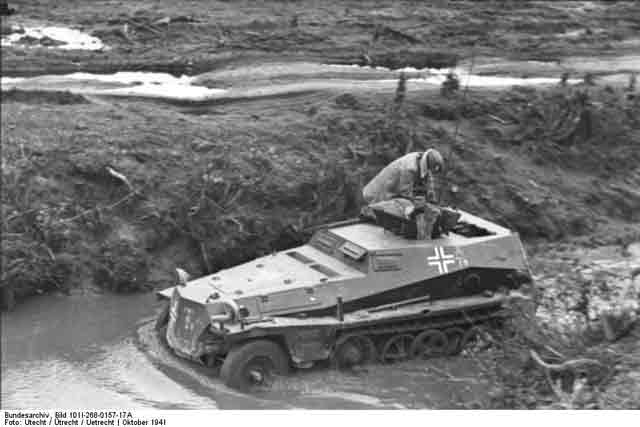
The weather in northern and central Russia has been deteriorating for two weeks as of 21 October 1941, with intermittent snow and rain as the temperature hovers around freezing. The snow has not been sticking, but as it melts, it has been exacerbating a problem with German transportation that was only a nuisance during the summer.
The dirt roads were manageable during the summer and fall, even if uncomfortably dusty, but all of the water both from precipitation on the roads and runoff from surrounding areas into low-lying routes now is becoming a real problem. This is the “Rasputitsa,” the muddy season that occurs every spring and fall during the change of seasons. The weather always is a very important factor in the campaign on the Eastern Front, helping both sides at times but favoring the Soviets when it counts the most.
The Soviets are used to the Rasputitsa, of course, but it is a new and unexpected phenomenon for German soldiers who have never before had the slightest interest in Russia. The deep mud slows the German supply trucks to a halt. The truck drivers attempt to go around the puddles and streams flowing across the roads, but they just extend the ruts further out until areas 50 meters across in places become impassable quagmires. Even horses get stuck, and men marching through the muddy stretches sometimes lose their boots. It is not as if the weather only affects the Wehrmacht, but the Russians have two advantages: their equipment is adapted to the conditions, and they are only attempting to hold their ground for the moment. On days like this, little happens, which may be confusing when other days show major German gains, but the impact of the weather cannot be denied during World War II.
Of course, the weather does not stop everything, especially in the south where the Rasputitsa is not as dramatic and hits a little later. General von Manstein’s 11th Army continues advancing deep into the Perekop Isthmus in the entrance to the Crimea, and units of Sixth Army approach within seven miles of the key industrial city of Kharkiv. The Soviets in Kharkiv are busy also, finishing the loading of the Kramatorsk heavy-machine factory equipment onto railcars for a hurried move to the Urals. The factory workers are not as valuable as the equipment, so they must walk the first 20 miles to another train station. However, as good Communists, they are only too happy to do what comrade Stalin wants. The Germans are seven miles (11 kilometers) behind them.
In the Ukraine, units of the German Sixth Army capture Stalino in the industrial Donets Basin.
Stalin, meanwhile, has been watching the Wehrmacht approaching Moscow from three different directions — northwest, west, and southwest — with growing alarm. In moments of crisis, Stalin always turns to a trusted handful of men who may not be infallible, but at least remain completely loyal through thick and thin. Today, he elevates General Georgy Zhukov, his most competent officer, from command of the West Front to command of all military forces in the Moscow defensive area. Zhukov had recently arrived in Moscow on October 10, 1941 after he had stabilized the situation in Leningrad. It is not so much that Zhukov is the world’s most brilliant strategist or tactician that makes him effective as it is that he has Stalin’s complete confidence. This gives Zhukov more discretion to “assume” what Stalin wants than any other officer — though, of course, this has its limits as well. As Zhukov later puts it, there is as much distance between him and Stalin as there is between a field marshal and the lowliest private. A somewhat similar to the situation that later develops in the Wehrmacht between Hitler and Field Marshals von Manstein and Model, but Zhukov’s relationship with Stalin is unique.
However limited his real authority may be, Zhukov’s relationship of confidence with Stalin gives him more call on the Soviet Union’s abundant resources and more latitude to take chances with strategy than any other general. The problem for Stalin, though, is that there are multiple military problems to solve — at Leningrad, on the Volkhov River north of Moscow, in the Crimea, at Kharkiv, and at Rostov-on-Don — and there is only one Zhukov. Stalin keeping Zhukov at Moscow when there are so many other critical places in peril is perhaps the ultimate vindication of the many German generals who urged Hitler to focus on the Soviet capital throughout 1941.
Soviet submarine M-58 hit a mine laid by the Romanians and sank in the Black Sea near the opening of the Danube River, killing all 19 aboard.
Horst Böhme was promoted to the rank of SS-Standartenführer in Czechoslavokia.
Georg von Küchler was mentioned in the Wehrmachtbericht daily radio report.
The Kragujevac massacre continued in Yugoslavia, 2,778–2,794 people are killed by the German army.
The Jager Report (issued on 1 December 1941) noted that 718 adult male, 1,063 adult female, and 586 children, all Jews, were killed in Vilnius, Lithuania for a total of 2,367 people.
Fifty hostages were shot in Nantes, France, this morning — in reprisal for the killing of Lt-Col Karl Holz, the local German commander. He was shot six times as he walked past the cathedral yesterday morning, two of the bullets hitting his neck. Now the Vichy authorities have announced that, “considering the gravity of the crime”, 50 more hostages will be shot unless the killers are found by tomorrow. The statement coincides with a visit to occupied France by Admiral Darlan, the Vichy vice-premier. General Stülpnagel, commander of the German occupation forces, described the killers as “cowardly criminals, paid for by England and Moscow”. So far — after an enthusiastic round-up which netted the prefect of Loire, the commandant of the Nantes Gendarmerie and three perfectly innocent policemen — they have not been found. Since the Germans invaded the USSR and the French Communist Party roused itself from a policy of “masterful inactivity”, there has been a steady increase in anti-German terrorism, though the majority of the French have had no strong feelings either way. What are slowly changing their attitudes are the German and Vichy counter-measures. So far 131 Frenchmen have been executed as hostages; no one can tell in which direction opinion will go.
The severest anti-Jewish, drive in almost three years appeared to be in progress in Germany and the Bohemia-Moravia Protectorate today, with thousands being dispatched to Poland on short notice or evicted from their Berlin homes into wooden hutments on the city’s outskirts. The police have stepped up their check-ups on Jews in the streets and pamphlets. have been distributed to thousands of Berlin households warning Germans: “Remember what the Jew has done to our people. Every Jew is your enemy. Every German who aids a Jew for reasons of false sentiment — even by only showing a friendly attitude toward Jews — commits treason against his own people.”
[Ed: ‘Tis a pity we did not have the Bomb in 1941.]
British cruiser HMS Abdiel and destroyers HMS Napier, HMS Hasty, and HMS Decoy departed Alexandria, Egypt with supplies for Tobruk, Libya, returning with men of the Australian 9th Division in the early hours of the following day.
The cruisers HMS Aurora (Captain W. G. Agnew) and HMS Penelope (Captain A. D. Nicholl) arrived in Malta and with the destroyers HMS Lance and HMS Lively formed a small squadron known as Force K. For some reason Force K always seemed to go to sea on a Saturday.
German submarine U-79 hit British gunboat HMS Gnat with a torpedo 30 miles northwest of Bardia, Libya at 0334 hours, blowing away 20 feet of her bow but caused no casualties. Gnat would be successfully towed back to Alexandria, Egypt where she would serve as a stationary anti-aircraft gun platform.
German submarine U-123 damaged British armed merchant cruiser HMS Aurania with a torpedo 400 miles west of Ireland at 0428 hours; a lifeboat launched sank with 2 killed, 3 rescued by destroyer HMS Croome, and 1 captured by U-123; Aurania was escorting Allied convoy SL-89 and would be successfully towed to port for repairs. At 2200 hours, German submarine U-82 attacked the same convoy, sinking the ships Serbino (14 were killed, 51 survived) and Treverbyn (all 46 aboard were killed).
A civilian on the island of St. Helena in the South Atlantic spotted a submarine off its coast, but the report was not regarded as important. The submarine was most likely German submarine U-68, which would strike on the next day.
RAF Bomber Command, Day of 21 October 1941
17 Blenheims on coastal sweeps. Hits were claimed on 2 ships off Terschelling. 2 Blenheims lost.
RAF Bomber Command, Night of 21/22 October 1941
Bremen
136 aircraft of 5 types to attack shipyards. 2 Wellingtons and 1 Hampden lost.
Crews reported industrial haze which caused difficulty in identifying targets. Bremen reports scattered bombing, mostly in housing areas, though damage was caused to 4 small industrial firms and 1 bomb fell in the Vulkan shipyard. 17 people were killed, 29 injured and 70 bombed out.
Minor Operations: 12 Hampdens and Wellingtons to Boulogne, 4 Manchesters minelaying in Kiel Bay. No losses.
U-123, commanded by Kapitänleutnant Reinhard Hardegen, damaged armed merchant cruiser HMS Aurania (A/Captain I. W. Whitehorn), which was travelling behind convoy SL.89, in 50N, 19W. At 0428 hours on 21 Oct 1941, U-123 fired a spread of three torpedoes at HMS Aurania (F 28) (A/Capt Ivan Walter Whitehorn, RN), which was travelling zigzagging at 135 knots in a group of five armed merchant cruisers behind convoy SL.89 and was hit at the bow and underneath the bridge by two torpedoes. The flooding of #3 hold caused a 25 degree list to port, but empty drums in the other holds kept the ship afloat. The master managed to correct the list to 15 degrees and the ship soon continued on a zigzag course at 8 knots. The U-boat was chased away by an escort. Due to a misunderstanding, one lifeboat containing six men was launched and swamped upon hitting the water. Gunner Charles Stewart, Able Seamen Cornelius O´Keefe and Abed Graves were picked up by HMS Croome (L 62) (LtCdr J.D. Hayes, RN), but Leading Seamen Bertie Edward Shaw, George R. Brown and Able Seaman Victor A. Pancott were reported missing. At 1009 hours, U-123 came upon the sinking lifeboat, but only Bertie E. Shaw was left in it and taken as prisoner on board. On 23 October, HMS Aurania (F 28) arrived at Rothesay Bay under escort by HMS Totland (Y 88) (LtCdr S.G.C. Rawson, RN). The ship was under repair for 19 months and returned to service as repair ship HMS Artifex (F 28).
U-82, commanded by Oberleutnant zur See Siegfried Rollmann, sank British steamer Serbino (4099grt), from convoy SL.89, in 51-10N, 19-20W. At 2203 hours on 21 Oct 1941 the Serbino (Master Lawrence Edwin Brooks) in convoy SL.89 was hit amidships by one torpedo from U-82 and sank west of Fastnet. Eleven crew members and three gunners were lost. The master, 49 crew members and one gunner were picked up by HMS Asphodel (K 56) (LtCdr K.W. Stewart, RN) and landed at Gourock. The 4,099 ton Serbino was carrying general cargo, including sisal and was bound for Liverpool, England.
U-82 next sank British steamer Treverbyn (5218grt) from convoy SL.89 in 51N, 19W. At 2231 hours on 21 Oct 1941 the Treverbyn (Master Henry Edwards, OBE) in convoy SL.89 was hit amidships by one torpedo from U-82 and sank in 3 minutes southwest of Cape Clear. The master, 35 crew members and ten gunners were lost. The 5,281 ton Treverbyn was carrying iron ore and was bound for Cardiff, Wales.
Gunboat HMS Gnat (T 60) was damaged by U-79, commanded by Kapitänleutnant Wolfgang Kaufmann, in 32-08N, 25-22E, thirty miles northeast of Bardia at 0445. At 0334 hours on 21 Oct 1941, HMS Gnat (T 60) was hit in the bow by a torpedo from U-79 about 30 miles northeast of Bardia. The bow was blown away to the 6in gun and the badly damaged ship towed to Alexandria, where she was beached on the 23rd. Later, an attempt was made to weld Gnat’s stern onto gunboat Cricket’s bow, but this was unsuccessful. The ship was declared a total loss, but used as AA platform in the harbour defence until scrapped in 1945.
Destroyers HMS Jervis, HMS Jupiter, and HMS Kandahar departed Alexandria to bombard the enemy gun battery near Tobruk. The battery was bombarded during the night of 21/22 October.
When U-75 was reported by aircraft in 32-07N, 29-44E, at 1052 on the 22nd, destroyers HMS Jupiter and HMS Kandahar were detached to hunt. Another report was received some five hours later. Destroyer Jupiter, short of fuel, was sent into Alexandria. Destroyer HMS Decoy departed Alexandria to join destroyer Kandahar in the hunt. Also, sloop HMS Flamingo, which had departed Alexandria earlier for Port Said, was diverted to hunt for the submarine. Destroyers Kandahar and Decoy arrived at Alexandria on the 23rd. Sloop Flamingo was detached to continue her voyage to Port Said to return to the Suez Escort Force.
Heavy cruiser HMS Berwick, having completed engine repairs, departed Rosyth for Scapa Flow, where she arrived later that day.
Destroyer HMS Electra departed Rosyth at 1600 for Scapa Flow. The destroyer joined destroyer HMS Antelope and both arrived at Scapa Flow at 0630/22nd.
Minesweepers HMS Fitzroy, HMS Elgin, HMS Lydd, and HMS Ross of the 4th Minesweeping Squadron and minesweeping trawlers HMS Ronaldsay, HMS Cava, and HMS Cape Nyemetski departed Scapa Flow for the Faroes for a clearance sweep. The ships arrived in the Faroes on the 22nd and began the clearance work on the 23rd. On the 24th, minesweepers HMS Kellet and HMS Selkirk arrived in the Faroes from Aberdeen to assist in the work.
Minelayers HMS Manxman and HMS Welshman departed Loch Alsh on the 12th and embarked mines at Milford Haven on the 13th. The minelaying cruisers departed Plymouth on the 21st and laid minefield HG.off Lorient late that night.
Free French destroyer Triomphant departed Suva on the 17th and arrived at Bora Bora on the 21st. The destroyer was damaged in a very minor collision in harbor. On the 21st, the destroyer sailed from Bora Bora, arriving at Papeete, Tahiti on the 22nd.
Swedish steamer Hilda (1237grt) was sunk by British bombing five miles west of Ymuiden.
Tug Helen Barbara was abandoned and lost in heavy weather.
Minelaying cruiser HMS Abdiel and destroyers HMAS Napier, HMS Hasty, and HMS Decoy departed Alexandria on serial six of the CULTIVATE operation. The ships returned to Alexandria on the 22nd.
Anti-submarine trawler HMS Wolborough and steamer Gebel Kebir departed Alexandria with Motor launch ML.1061 on serial 8 of the CULTIVATE operation. The steamer was damaged by German bombing off Tobruk and was towed into harbour by the trawler. Two motor launches intended as escorts were attacked by German bombers at dusk on the 22nd, sustaining only superficial damage. Both arrived at Tobruk.
Italian destroyers Da Noli, Zeno, and Pessagno departed Benghazi for Augusta on the 20th after a troop carrying mission. The destroyers were attacked early on the 21st fifteen miles north of Benghazi by submarine.
Submarine HMS Rorqual laid mines off Sardinia during the night of 21/22 October. The submarine laid ten miles southeast of Cavioli Island and forty mines southeast of Cape Ferrato. Italian steamer Salpi (2710grt) was sunk two miles east of Cape Ferrato on this minefield on 9 February.
Submarine HMS Unique arrived at Malta from patrol.
Aircraft carriers HMS Eagle and HMS Argus and destroyers HMS Foresight, HMS Forester, and HMS Fury departed Gibraltar to the United Kingdom. Local escort was provided by destroyers HMS Vidette and HMS Lamerton until 0915 and 1140 that day and HMS Zulu and HMS Sikh until 24 October. U-83 attacked Aircraft carriers Eagle and Argus west of Gibraltar on the 21st. Upon meeting battleship HMS Malaya and destroyer HMS Lightning in 48N, 17-35W, destroyers Zulu and Sikh joined the battleship and destroyer Lightning and escorted them to Gibraltar, arriving on the 27th. Destroyers HMS Harvester and HMS Havelock were detached from battleship Malaya and joined the aircraft carriers. The two aircraft carriers and the destroyers arrived in the Clyde on the 26th.
Dutch submarine HNLMS O.24 arrived at Gibraltar from patrol in the Tyrrhenian Sea.
Today in Washington, President Roosevelt announced at his press conference the sinking of the American flag vessel Lehigh in the South Atlantic. In the morning he conferred with party leaders from the Capitol. His callers included William H. Davis, W. Averell Harriman, William J. Donovan, Sidney Hillman and a group from the Argentine Chamber of Deputies headed by Señor Don Jones Luis Cantilo, speaker.
The Senate passed the bill changing the method of reapportioning House seats; confirmed the nomination of Herschel V. Johnson as Minister to Sweden, and recessed at 2:09 PM until noon Thursday. The Foreign Relations Committee considered neutrality revision; the Appropriations Committee approved the lease-lend and supplemental defense appropriation bill; the Agriculture Committee approved a measure to relieve wheat growers of marketing penalties in certain cases; the Defense Investigating Committee heard Floyd B. Odlum.
The House passed the $170,000,000 Defense Highway Bill; received the Cannon bill providing increased pay for service men; received the Dickstein bill to clarify allegiance of persons holding dual citizenship; received a delegation from the Argentine Chamber of Deputies; received a special committee report on defense migratory labor; completed Congressional action on the bill extending the period for the filing of Defense Plant Amortization Tax Certificates, and adjourned at 4:27 PM until noon tomorrow. The Banking and Currency Committee heard Secretary Wickard, on the Price Control Bill.
Two more American owned merchant ships, one flying the Stars and Stripes and the other the flag of Panama, have been sent to the bottom of the ocean in the spreading battle of the Atlantic, President Roosevelt and the State Department announced today. The two ships carried seventy-one in their crews, and one had four stowaways aboard. Of these seventy-five persons only thirty-nine were definitely known to have been rescued, leaving thirty-six still to be accounted for. The President revealed dramatically in his press conference that the merchant ship Lehigh, flying the American flag, was torpedoed and sunk about 9 o’clock Sunday night by a submarine in the South Atlantic, well outside any declared “German combat zone.” He indicated strongly that the submarine was German. The President said that one boat-load of survivors from the American crew of the Lehigh had been picked up and that a search was being conducted for two additional boatloads. The Maritime Commission revealed that the British vessel Vimy had picked up twenty-two of the Lehigh’s thirty-nine crewmen, but her master, with remaining members of the crew, was still adrift.
Disclosure of the sinking of two more American-owned merchant ships combined today with the urgent appeals of Secretary Hull and Admiral Stark, Chief of Naval Operations, to give added impetus to quick Senate action on revision of the Neutrality Act to permit the arming of this country’s merchantmen. The President’s announcement that the freighter Lehigh, flying the Stars and Stripes, had been torpedoed in the South Atlantic came just as the Foreign Relations Committee was adjourning a meeting at which Secretary Hull and Admiral Stark had appealed for immediate adoption of the armed ship resolution which has been passed by the House. News of the sinking of the Bold Venture, American-owned vessel under Panamanian registry, came later as opponents of the legislation were planning their list of witnesses for tomorrow’s hearing.
Members of the Senate Foreign’ Relations Committee said today that Admiral Harold R. Stark, chief of naval operations, told them that the U.S. Destroyer Kearny was on convoy duty last Friday when it was torpedoed in Icelandic waters by a German submarine.
Wendell L. Willkie and more than 100 other Republicans appealed tonight to G.O.P. congressmen to lead their party back to political leadership by outright repeal of the neutrality act or by rewriting it without provisions obstructing aid to Britain and her allies. “Millions upon millions of Republicans are resolved that the ugly smudge of obstructive isolationism shall be removed from the face of their party…” Willkie said in a statement to which was appended the repeal appeal to congress.
The Senate Agriculture Committee approved legislation today that would remove the penalty of about 49 cents a bushel on so-called excess wheat for farmers with short crops. The measure already has been passed by the House. A similar bill was vetoed by President Roosevelt several weeks ago when Congress attached riders seeking to freeze government loan stocks of wheat and cotton. Under the existing farm act, if a wheat farmer planted in excess of his acreage allotment all wheat grown on the excess acreage was subject to penalty. The new measure would permit the farmer to market up to normal production without penalty. Senators from wheat areas said it would help thousands of Winter wheat growers who decided to plant excess acreage last year, when the penalty on excess production was 15 cents a bushel.
The House adopted by a voice vote and returned to the Senate with an amendment today a bill providing $170,000,000 in authorizations for the improvement of strategic defense highways and access roads to defense plants.
Strikers at the Great Lakes Steel Corp. in Detroit voted to return to work last night shortly after a C.I.O. official warned that federal troops were ready to march in unless they went back to work immediately. The men booed and hissed his announcement but later voted to give mediators 30 days in which to arrive at a settlement. In another strike where government intervention appeared likely, Sheriff William R. Browne gave notice that “violence appears inevitable” if the government takes over the plant of Air Associates, Inc., at Bendix, New Jersey. Browne telegraphed his warning to Mrs. Elinore Herrick, regional director of the labor board, and asked her to try to prevent such action.
Twenty-eight persons were injured in a train accident, fourteen of them so seriously that they were admitted to Rahway Hospital, when the crack Embassy Limited of the Pennsylvania Railroad, bound from New York to Washington, sideswiped a New York-to-Philadelphia local at Woodbridge, New Jersey at 3:58 o’clock this afternoon.
Sydney M. Buchanan, 23-year-old Baltimore, Md., mechanic, today was sentenced to 18 months in a federal detention jail for sending two extortion notes to film actress Hedy Lamarr. After pleading not guilty to the charges, Buchanan changed his plea to guilty and admitted threatening the actress with physical injury unless she sent him $500.
In tests with MAD (Magnetic Airborne Detector) equipment, a PBY Catalina from NAS Quonset Point, Rhode Island, locates the USN submarine USS S-48. The tests are carried out in cooperation with the National Defense Research Committee.
The comic book superhero Wonder Woman made her first appearance in All Star Comics issue #8 (cover date December 1941/January 1942), scripted by William Moulton Marston, a psychologist already famous for inventing the polygraph (lie detector).
The comic book villain The Penguin (Oswald Chesterfield Cobblepot) made his first appearance in Detective Comics issue #58 (cover date December).
Both the Penguin and Wonder Woman eventually make their way into television series, motion pictures, and other media such as video games.
Japan’s new “wartime” Cabinet today held its first regular session, at which Foreign. Minister Shigenori Togo reported the repercussions that the Cabinet change had produced in Britain, the United States, Germany and other countries. On the basis of these reports it appears that simultaneously with a speeding of national mobilization and expansion of the armament program the government of General Hideki Tojo will direct its “armed” diplomacy toward a resumption of the Washington negotiations in an effort to obtain, in the words of Foreign Minister Togo, a “peace with justice” that will safeguard Japan’s existence and prestige and take account of realities.
With General Tojo now the Japanese Prime Minister, everyone with a basic understanding of Japanese politics realizes that the war party is in control in Tokyo. However, everyone also knows that the Emperor continues to desire peace. Accordingly, the Foreign Office sends out a very mixed message to Ambassador Kichisaburō Nomura in Washington that contains an obvious hint of menace:
“The new cabinet differs in no way from the former one in its sincere desire to adjust Japanese-United States relations on a fair basis. Our country has said practically all she can say in the way of expressing of opinions and setting forth our stands. We feel that we have now reached a point where no further positive action can be taken by us except to urge the United States to reconsider her views. We urge, therefore, that, choosing an opportune moment, either you or Wakasugi let it be known to the United States by indirection that our country is not in a position to spend much more time discussing this matter. Please continue the talks, emphasizing our desire for a formal United States counter-proposal to our proposal of 25 September.”
Nomura is also a member of the “peace faction’ has been doing everything that he can to defuse a conflict. This has included numerous official and off-the-record meetings with top American officials such as U.S. Secretary of State Cordell Hull. While he may not convey the obvious threat implied in these instructions, the Americans are reading the Japanese diplomatic codes and certainly are in a position to get the message whether Nomura tells them or not.
The following message is sent from the Japanese representative in Davao, Mindanao Island, to Tokyo: “As an air base for central Mindanao district, 300 men are being managed by Americans, and the ground is now being leveled. An underground hangar and underground oil tanks are planned; however, the material for this is delayed so that building on this is not progressing as planned. Already several times a week planes are flying here, and it seems they are expecting large heavy bomber planes too, very soon.”
Philippine President Manuel Quezon assembled the heads of his civilian emergency administration with representatives of Far Eastern armed forces in the United States High Commissioner’s office for a report on the progress of civilian protection measures.
Dow Jones Industrial Average: 121.07 (+0.94)
Born:
Kevin Freeman, American equestrian (Olympics silver medal, team eventing, 1964, 1968, 1972), in Portland, Oregon (d. 2023).
Ron Davis, MLB outfielder (Houston Astros, St. Louis Cardinals, Pittsburgh Pirates), in Roanoke Rapids, North Carolina (d. 1992).
Marina Ripa di Meana (née Punturieri), Italian socialite, animal rights activist, countess, and writer (“My First Forty Years”), in Reggio Calabria, Kingdom of Italy (d. 2018).
Steve Cropper, American rock and soul guitarist (Booker T & MGs; The Blues Brothers), songwriter (“Sittin’ On) The Dock Of The Bay”), and producer (Otis Redding), in Willow Springs, Missouri (d. 2025).
Died:
Stanley Graham, 40, New Zealand mass murderer (died of wounds sustained in shootout with police yesterday).
Naval Construction:
The U.S. Navy Osage-class vehicle landing ship USS Monitor (LSV-5) is laid down as netlayer AN-1 by the Ingalls Shipbuilding Corp. (Pascagoula, Mississippi, U.S.A.). She was redesignated AP-160 on 2 August 1943, and first commissioned on 18 March 1944. Due to delays in construction, the ship was transferred under her own power to Todd Shipyards, Brooklyn, New York for completion on 2 April. Redesignated as a Landing Ship, Vehicle, on 21 April 1944, USS Monitor (LSV-5) was commissioned for service on 14 June 1944.
The U.S. Navy Adroit-class minesweeper USS Firm (AM-98) is laid down by Pthe enn-Jersey Shipbuilding Co. (Camden, New Jersey, U.S.A.).
The U.S. Navy SC-497-class (110-foot wooden hull) submarine chaser USS PC-650 (later SC-650) is laid down by the Westergard Boat Works Inc. (Biloxi, Mississippi, U.S.A.).
The Kriegsmarine (German Navy) Type VIIC U-boat U-271 is laid down by Bremer Vulkan-Vegesacker Werft, Bremen-Vegesack (werk 36).
The Kriegsmarine (German Navy) Type VIIC U-boat U-418 is laid down by Danziger Werft AG, Danzig (werk 119).
The Kriegsmarine (German Navy) Type VIIC U-boat U-713 is laid down by H C Stülcken Sohn, Hamburg (werk 779).
The Royal Navy modified Black Swan-class sloops HMS Starling (U 66) and HMS Woodcock (U 90) are laid down by the Fairfield Shipbuilding & Engineering Co. (Govan, Scotland).
The Royal Navy Bar-class boom defense vessel HMS Barcross (Z 185) is launched by the Blyth Dry Docks & Shipbuilding Co Ltd (Cowpen Quay, Blyth, England, UK).
The Royal Navy Bar-class boom defense vessel HMS Barford (Z 209) is launched by W. Simons & Co. Ltd. (Renfrew, Scotland).
The Royal Navy LCT (Mk 2)-class landing craft, tank HMS LCT 127 is launched by Tees-Side Bridge (Middlesbrough, U.K.).
The U.S. Navy YMS-1-class auxiliary motor minesweeper USS YMS-34 is launched by the Hiltebrant Dry Dock Co. (Kingston, New York, U.S.A.).
The Royal Navy MMS I-class motor minesweeper HMS MMS 57 (J 557) is launched by John Noble Ltd. (Fraserburgh, Scotland, U.K.).
The Royal Navy MMS I-class motor minesweeper HMS MMS 99 (J 599) is launched by Wagstaff & Hatfield (Port Greville, Canada).
The Royal Navy Isles-class minesweeping trawler HMS Kintyre (T 165) is launched by the Ardrossan Dockyard (Ardrossan, Scotland); completed by Plenty.
The Royal Navy Bangor-class (Turbine-engined) minesweeper HMS Brixham (J 105) is launched by the Blyth Shipbuilding & Drydock Co. Ltd. (Blyth, U.K.); completed by Whites M.E.
The Royal Navy Hill-class ASW trawler HMS Yestor (T 222) is launched by Cook, Welton & Gemmill (Beverley, U.K.); completed by Holmes.
The U.S. Navy Bogue-class escort aircraft carrier USS Copahee (AVG-12, then ACV-12, finally CVE-12) is launched by the Seattle-Tacoma Shipbuilding Corp. (Seattle, Washington, U.S.A.) as the civilian merchant ship Steel Architect, type C3-S-A1.
The Royal Navy Fairmile B-class motor launch HMS ML 295 is commissioned.
The Royal Navy Bar-class boom defense vessel HMS Barbridge (Z 222) is commissioned.
The Royal Navy MMS I-class motor minesweeper HMS MMS 56 (J 556) is commissioned. Her first commanding officer is R C Edwards, RNVR.
The Royal Navy British Power Boat 70-foot-class motor anti-submarine boat HMS MGB 21 is commissioned.
The Kriegsmarine (German Navy) Type IXC U-boat U-163 is commissioned. Her first commanding officer is Korvettenkapitän Kurt-Eduard Engelmann.
The Kriegsmarine (German Navy) Type VIIC U-boat U-253 is commissioned. Her first commanding officer is Oberleutnant zur See Adolf Friedrichs.
The Royal Canadian Navy Flower-class corvette HMCS Edmunston (K 106) is commissioned. Her first commanding officer is T/Lieutenant Raiffe Dillon Barrett, RCNR.
The Royal Canadian Navy Flower-class corvette HMCS The Pas (K 168) is commissioned. Her first commanding officer is T/Lieutenant Commander lbert Robert Ernmest Coleman, RCNR.

