The United States, in a surprise move, today ordered the expulsion of 55 Soviet diplomats by November 1. The action was in retaliation for Moscow’s ouster on Sunday of five American diplomats. It was the largest number of Soviet diplomats ever expelled from the United States. In Moscow, the Government press agency Tass termed the move “another step aimed at worsening Soviet-American relations.” Before the American announcement, Gennadi I. Gerasimov, the Foreign Ministry spokesman, said: “If the U.S. side insists on a continuation of the game according to the tit-for-tat principle, all this may go on endlessly. It seems to us that it is time this whole affair be rounded off.” The American action affects personnel at the Soviet Embassy in Washington and the consulate general in San Francisco. It is the latest in a series of expulsions that began September 17 when the United States ordered 25 members of the Soviet Mission to the United Nations to leave on the ground that they were intelligence agents. American officials disclosed for the first time that the Soviet Union was warned last month that retaliation for the ouster of the 25 would result in a countermove in which the entire Soviet diplomatic presence in the United States would be sharply reduced. Coming nine days after the Iceland meeting between President Reagan and Mikhail S. Gorbachev, the increase in expulsions raised questions about the effect on Soviet-American relations and prospects for a summit meeting in the United States.
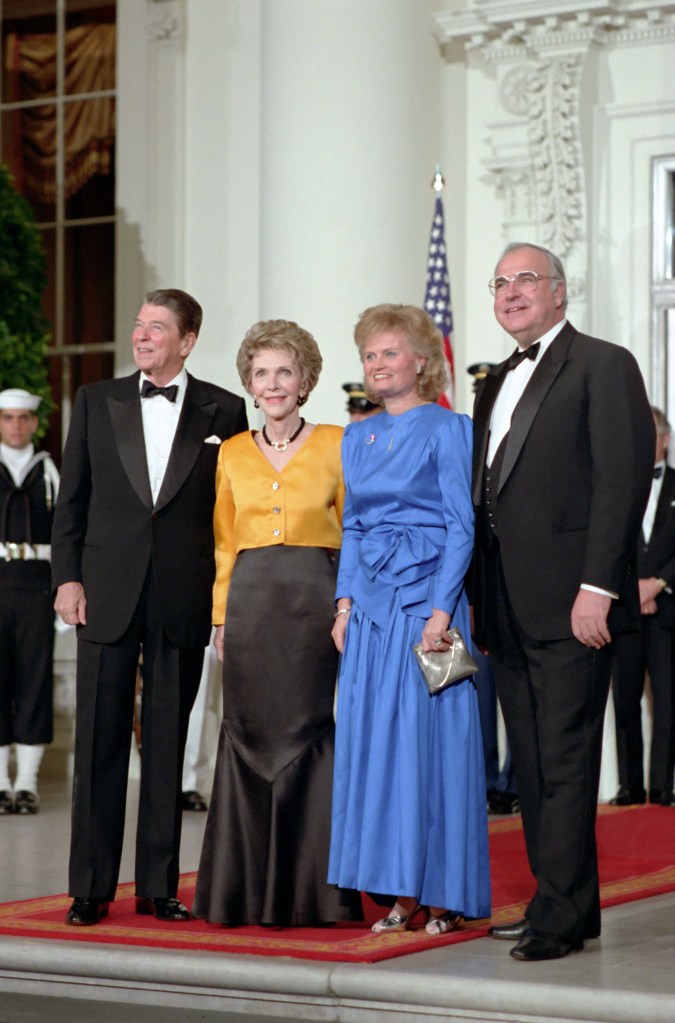
President Reagan welcomes the Chancellor of West Germany to the White House. Chancellor Helmut Kohl of West Germany met for an hour with President Reagan today to discuss the strategic arms negotiations that were conducted this month at the Iceland meeting with Mikhail S. Gorbachev. Although a senior Administration official insisted that Mr. Kohl supported the Reagan position on arms reductions, a spokesman for the Chancellor, Friedhelm Ost, was quoted by Reuters as expressing reservations. According to the Reuters account, Mr. Ost told reporters that the West German leader had sought assurances that if medium-range missiles were abolished in Europe, West Germany would not be left vulnerable to Soviet short-range weapons or conventional Warsaw Pact forces. Before the Reykjavik meeting, Mr. Kohl had urged that short-range nuclear weapons be included in the United States-Soviet discussions on arms reductions.
The President and First Lady host a state dinner in honor of their guest Chancellor Kohl.
Western European Governments and strategic arms experts are warning that some of the sweeping proposals aired at the Iceland meeting might be harmful to their military interests and undercut the NATO deterrence doctrine. Rather than being upset at what many commentators and political leaders have called the failure of President Reagan and Mikhail S. Gorbachev to reach a sweeping arms control agreement, several European officials say they are relieved that the talks did not result in accords that might have hurt the defense of Europe. “Reykjavik was broken off at the right time,” said a senior adviser to Chancellor Helmut Kohl of West Germany. “It’s time for stock-taking.”
Defense ministers of the Atlantic alliance told American delegates to a meeting here today that European support for sharp reductions in strategic nuclear forces hinged on further steps to insure a balance in conventional arms between NATO and the Warsaw Pact. As the first day of a two-day meeting of NATO’s Nuclear Planning Group wore on, the Europeans, especially the West Germans and the British, emphasized that their enthusiasm for nuclear arms control was tainted by concern over the potential loss of the protection afforded by nuclear weapons. In a news conference at the end of the day, Britain’s Defense Minister, George Younger, repeatedly warned that the elimination of strategic ballistic missiles would not be wise unless conventional arms, including chemical weapons, were also controlled. The British Government, he said, “would be extremely concerned at a final agreement to abolish strategic ballistic missiles altogether if there was not at the same time a very effective and appropriate reduction in conventional forces.”
West Berlin officials dropped efforts to prosecute aging members of the Nazi People’s Court, which sentenced more than 5,000 people to death, most of them political opponents of Adolf Hitler’s regime. In 1979, prosecutors began an investigation to see whether 83 former members of the Berlin-based court could be charged with murder, the only crime not covered by the statute of limitations. The prosecutors found either a lack of evidence or that many of the 83 were unable to stand trial. West Berlin Justice Minister Rupert Scholz, calling the court “an instrument of the worst terror,” criticized West German officials for not pressing charges earlier.
William J. Quinn, the first Irish Republican Army member extradited from the United States, arrived in Britain aboard a Royal Air Force jet and was charged with murder for the killing of London policeman Stephen Tibble in February, 1975. British officials say Tibble was shot three times while pursuing a suspect fleeing from an IRA hideout. Quinn, 38, a San Francisco resident and U.S. citizen who lived in Ireland for nine years, has denied the killing, which he contends was political. The U.S. Supreme Court last week refused to hear Quinn’s case, ending a five-year legal battle that began when he was arrested in September, 1981, in Daly City, California.
Millions of civil service employees staged a 24-hour strike today. The strike, organized by four unions, disrupted airline and train services, schools, public transportation, postal services, and electricity in some areas. The strike was called in “defense of the public sector” and to protest declining purchasing power and planned cuts in civil service jobs. In Paris, most public transport functioned during the morning rush hour and no serious problems developed. Traffic, however, built during the day as demonstrations got under way. By mid-afternoon, the busiest streets were gridlocked. The strike, the first test of strength between the unions and the Government of Prime Minister Jacques Chirac, is being seen as a measure of strength of the unions, which have been declining in political influence.
The British Broadcasting Corporation agreed today to pay out-of-court damages and make on-the-air apologies to two Conservative politicians who charged they had been libeled as right-wing extremists. The action represented a serious setback for the BBC in its long fight over fairness with the Thatcher Government. Prime Minister Margaret Thatcher and her fellow Conservatives have long accused the BBC of an anti-Tory bias in its news coverage. The BBC, a proud institution that has long projected impeccability in the tone of its newscasts, conceded that the contested reports were false and inappropriate for broadcast.
A car bomb in Athens today killed a man identified by the Palestine Liberation Organization as a high ranking P.L.O. official. The man, Abu Gazala, was killed early this morning in a car-bomb explosion in the eastern Athens suburb of Nea Smirni. A P.L.O. statement said Abu Gazala, 45 years old, was a member of the National Palestinian Council, the Revolutionary Council of Al Fatah and the Supreme Military Council of the Revolutionary Palestinian Forces. The P.L.O. accused Mossad, the Israeli intelligence agency, of being behind the car-bombing and said Mossad had also killed another high-ranking Palestinian, Khalid Nazal, in Athens in June. Mr. Nazal, 38, was shot dead by two gunmen outside his hotel in the center of Athens.
Israeli police arrested more than 150 Palestinian teen-agers in the occupied Gaza Strip after two days of anti-Israeli demonstrations. The operation in Rafah, an Arab town at the southern edge of the Gaza Strip, was one of the most massive Israeli security clampdowns in the area in recent years. Since Sunday, hundreds of Palestinian high school students have hurled stones at Israeli cars and blocked main roads with burning tires, a symbol of resistance to the 19-year Israeli occupation.
American writer Edward Tracy is kidnapped in Beirut. A Lebanese underground group said today that it had kidnapped another American, and asserted that he is an intelligence agent working for the United States and Israel. In a statement in Arabic delivered to the West Beirut office of a Western news agency, a group calling itself the Revolutionary Justice Organization said it had abducted the American, Edward Austin Tracy. There were no independent witnesses to the incident. In other developments today, a land mine apparently planted by French forces exploded in the garden of their abandoned embassy in Moslem-dominated West Beirut, wounding two French guards, and Lebanese radio reported that the British Government announced that it has withdrawn half its diplomats from Lebanon and that Portugal announced that it is closing its embassy in Beirut.
OPEC leaders agreed to continue production controls aimed at strengthening prices. But the 16-day marathon meeting, held in Geneva, ended in much disarray.
Iranian artillery pounded a railroad station at Basra, Iraq’s second largest city, in retaliation for an Iraqi air attack on a freight train near the town of Andimeshk, about 275 miles southwest of Tehran, both countries reported. The shelling began after Tehran radio issued repeated warnings to the people of Basra to keep away from the station and evacuate nearby homes. Iran said its heavy artillery fired more than 200 rounds at the railroad station. Iraq said homes and other buildings were damaged by the bombardment.
Erich Honecker, the first East German leader to visit China, received a red-carpet welcome in Peking (Beijing) today at the beginning of a six-day tour that formally restores Communist Party ties frozen since the 1960’s. Mr. Honecker, who flew to Peking after a visit to North Korea, was officially welcomed by President Li Xiannian in a colorful ceremony in Tiananmen Square, which was festooned with Chinese and East German flags. Mr. Li and Mr. Honecker went into the adjacent Great Hall of the People for a short meeting. The East German leader, who is also leader of his nation’s Communist Party, was then taken to the nearby Government compound for formal talks with the Chinese Party chief, Hu Yaobang. The two party leaders, who last met 33 years ago at a youth meeting in Bucharest, Rumania, greeted each other with a long hug and kisses.
More than 23,000 Filipino farmers marched on the presidential palace today in the largest leftist protest against President Corazon C. Aquino’s Government. They complained of military abuses and called for land redistribution. Members of a leftist farmers’ group, marching from north and south of the capital, gathered for 30 minutes at the United States Embassy before proceeding to the palace, where they rallied peacefully for two hours. The protesters tried to send an 11-member delegation to see Mrs. Aquino, but Agrarian Reform Minister Heherson Alvarez said she had a busy schedule and was unavailable.
Republic of the Marshall Islands signs the Compact of Free Association with the United States.
The United States and 16 Pacific nations are reported to have reached an agreement that will channel $60 million in fees and developmental aid to the region over the next five years in return for fishing rights. This marks the first time American tuna vessels have agreed to pay for access to large areas of Pacific waters.
In a country where one party has won every presidential election since its foundation 57 years ago, the real struggle for power takes place not at the polls but in the fierce competition to determine who should become the party’s candidate. Thus, if Mexico’s recent history is any guide, when the Institutional Revolutionary Party nominates its candidate around September 1987, it will also be announcing the winner of the July 1988 elections and the successor to President Miguel de la Madrid in December 1988. The mystery of this ritual is not how the party makes its choice, because, by tradition, it names the person indicated by the departing President. Rather, what insures 12 months of tension in Mexico is that no one knows what criteria Mr. de la Madrid will use to pick his successor.
Having brought steady growth and enviable stability to Mexico for more than half a century, this country’s special form of one-party rule is now being tested by a crisis marked by a slump in public confidence and new electoral challenges to its political monopoly. The immediate catalyst is an acute economic recession that has strained the loyalty of longtime supporters of the regime and alienated the traditionally apolitical middle classes, whose dreams of prosperity have been abruptly dashed. There is also widespread resentment in business, intellectual and opposition circles at what is seen as the Government’s use of fraud to guarantee the victory of the Institutional Revolutionary Party in recent elections in several states, including Chihuahua.
The downing by Nicaragua of a plane with an American crew carrying military equipment for rebel forces has revealed a largely clandestine United States-based supply operation. The network involves an array of private aid groups that is bewildering -intentionally so in some cases. They are operated by former high-ranking military officers and intelligence personnel, anti-Communist Cuban exiles and conservative American political groups concerned that America is yielding Central America to Communist control. The extent of the network emerged in interviews in recent days with Administration officials in Washington and with a number of people who took part in the supply effort in this country and in Latin America. The groups include such organizations as the World Anti-Communist League, headed by John K. Singlaub, a retired Army major general; the Civilian Materiel Assistance group organized by an Alabama Special Forces veteran; and a Florida-based organization of elite former Air Force covert operations specialists known as the Air Commandos Association, headed by Harry Aderholt, a retired Air Force general.
The Colombian government announced that it favors a plan to give a tax amnesty to cocaine traffickers if they pump millions of dollars earned from the drug trade into the economy. Finance Minister Cesar Gaviria said U.S. dollars obtained through drug dealing can now be legally brought into the country and exchanged for local currency at what is known as the “evil window” at the Colombian central bank. Gaviria told reporters that drug traffickers possess huge fortunes outside the country (up to $60 billion by some estimates) that could be incorporated into the local economy if the government would grant a tax amnesty.
Africa’s first human rights charter took effect, six years after it was drafted, clearing the way for appointment of a commission to investigate alleged atrocities and repression. Leaders of countries ratifying the charter are to choose the commission’s 11 members. It will be the first group with such investigative power on a continent where nearly every government has been accused of human rights violations. The commission will have no enforcement powers, however. The charter will be administered by the 50-member Organization of African Unity.
The hospitalized Soviet pilot of the plane that crashed and killed President Samora Machel of Mozambique was quoted in press reports as saying he had heard a loud noise just before the crash.
I.B.M. will divest its holdings in South Africa, but will continue to sell its products and services there. Business will be carried out by a new company being formed by its current employees to buy I.B.M. South Africa.
After the United States Congress imposed sanctions on South Africa, overriding a Presidential veto, something here seemed to change, as if the measures, far from frightening an embattled white regime, stiffened its resistance. In fact, within days of the Congressional decision last month, Pretoria’s white rulers seemed to revert to a traditional imagery of bullying and bluster that they had previously sought to avoid. Now, over the last two days, both the General Motors Corporation and the International Business Machines Corporation have announced their withdrawal from South Africa through the device of selling subsidiaries to local employees. And, if the past is any measure of predictability, much the same kind of defiance could be forthcoming.
President Reagan signed a bill modernizing the federal wiretap law to protect the privacy of high-tech communications. The bill outlaws eavesdropping on electronic mail, video conference calls, conversations on cellular car phones and computer-to-computer transmissions. Currently, the wiretap law protects only against interception of voice transmissions heard by the ear.
Education Secretary William J. Bennett announced that collections on unpaid student loans more than doubled in the last fiscal year. The Education Department collected more than $229 million in defaulted student loans in fiscal 1986. In fiscal 1985, $94 million in unpaid loans was collected by the department. The department said it is alerting 1.1 million debtors by mail to repay their loans or face the withholding of 1986 tax income refunds.
President Reagan today signed a law designed to reduce the deficit by $11.7 billion despite misgivings over what he said were “burdensome” tax provisions in a section of the bill that calls for the sale of Conrail, the Government-owned freight railroad. The provisions for cutting the deficit represent an effort to comply with the law requiring a balanced budget by 1991. That measure sets a ceiling of $154 billion on the deficit this fiscal year.
A political action committee announced a $300,000 TV advertising blitz to elevate “Star Wars” from a space-based defense system to a conservative-based political issue in seven key states two weeks before Election Day. The American Conservative Trust mounted a campaign that will begin airing Friday against five Democratic candidates in California, Colorado and Texas who are openly opposed to President Reagan’s Strategic Defense Initiative, including Senenator Alan Cranston (D-California). Carl Russell Channell, president of the conservative fund-raising group, said a series of ads will also be broadcast in North Carolina, Nevada, Florida and Alabama.
The Navy, declaring a new victory in its war against sole-source contracts, said it had relied on competition to award almost three-fourths of its contracts and more than half of its contract dollars in fiscal 1986. According to Rear Adm. Stuart Platt, the Navy was responsible for directly awarding contracts totaling about $44 billion during the fiscal year that ended September 30, covering everything from new ships to spare parts to support services at military installations. Of that total, about $23 billion, or more than 52%, of the contract dollars were awarded after competition between two or more firms, he said.
The Department of Transportation has granted automobile makers an indefinite exemption from the rule that requires eventual installation of air bags, self-fastening seat belts and other automatic restraint systems in convertible autos. The decision, issued Friday by the National Highway Traffic Safety Administration but not announced publicly, excludes convertibles from the agency’s 1984 rule that requires installation of such passive restraints in all passenger cars by September 1989. The transportation agency said it would decide later whether to apply the passenger restraint standards to convertibles made after September 1989. It did not indicate when that decision would be made.
An Anchorage, Alaska, cab driver, angry because the Anchorage Times yanked his full-page political ad, set off smoke grenades in the newspaper building and fired a rifle until the publisher grabbed the gun’s barrel and beat him up. Donald Lee Ramsey, 41, apparently was angered when Publisher Robert Atwood, 79, ordered a full-page political advertisement that Ramsey had submitted removed from the Times last week. The ad attacked Senator Frank H. Murkowski (R-Alaska), who is up for reelection. Advertising personnel characterized the ad as rambling and nonsensical and said Ramsey’s money was refunded.
Florida Governor Bob Graham today signed a new death warrant for Theodore Bundy, ordering his execution at 7 AM on November 18. Mr. Bundy was convicted of killing a 12-year-old schoolgirl, Kimberley Diane Leach, and two college sorority sisters, Lisa Levy and Margaret Bowman, in Florida in 1978 and is believed to have slain 36 other women around the country. The Governor also signed a death warrant for the execution on the same day of Nollie Lee Martin, who raped and killed Patricia Greenfield, a convenience store clerk in Delray Beach in 1977.
A major pipe manufacturer pleaded guilty to conspiring with suppliers to bilk public and private utility projects nationwide and agreed in U.S. District Court in Seattle to pay restitution of up to $4.9 million. The B. F. Shaw Co. of Wilmington, Delaware, admitted that it conspired with supply companies in Pennsylvania, New Jersey and Wisconsin to pad shipping costs, then passed on the inflated costs to utilities building projects under “cost-plus” contracts, including the Washington Public Power Supply System.
The Senate race in Washington is closer than expected. Slade Gorton, the Republican incumbent, may be slightly ahead, but Brock Adams, the Democrat and a former Transportation Secretary, has gained.
The Rev. Pat Robertson filed a libel suit today against former Representative Paul N. McCloskey Jr. of California and Representative Andrew Jacobs Jr. of Indiana, accusing them of making “wanton and reckless statements” about his military service in the Korean War. Mr. McCloskey, a Republican who served with Mr. Robertson in the First Marine Division, has said Mr. Robertson openly discussed with other marines his intention to seek the intervention of his father, A. Willis Robertson, then a Democratic Senator from Virginia, to avoid combat duty. Mr. Jacobs, a Democrat, asked Mr. McCloskey to put his recollections of Mr. Robertson’s military service in a letter, copies of which have been widely circulated by Democrats. The controversy over the war record of Mr. Robertson, the television evangelist who may seek the Republican Presidential nomination in 1988, has become a major political concern for Mr. Robertson.
The leaders of the United Mine Workers, in an effort to strengthen their proud but diminished union, are considering merging with another union after nearly 50 years of independence. Rich Trumka, president of the mine union, says he will ask delegates to a special union convention in Atlanta next week to authorize the leaders to merge or affiliate with another union. While Mr. Trumka and other union leaders will not talk about particulars, those familiar with their thinking say the United Steelworkers of America, the Oil, Chemical and Atomic Workers and the International Brotherhood of Electrical Workers are among the unions being viewed as potential merger partners.
Congress, in a little-noticed provision of the anti-drug legislation it passed before adjournment last week, has approved a requirement that the Federal Government set national standards for licensing commercial bus and truck drivers. President Reagan has said he will sign the bill, perhaps next week. The amendment was not opposed by the International Brotherhood of Teamsters, which represents most bus and truck drivers. Senator John C. Danforth, Republican of Missouri, who proposed the licensing amendment, said, “For the first time, every commercial driver will be required to meet national standards to secure a license.”
A gasoline station owner who fired at two armed robbers was found not guilty by a jury today of violating the Oak Park (Illinois) community’s ban on pistols. “I felt like I was finally in America again,” the owner, Don Bennett, said. If Mr. Bennett, 43 years old, had been found guilty by the Cook County Circuit jury, he could have been sentenced to six months in jail and fined $2,000. He was robbed of $1,200 in cash and jewelry in March, the seventh time he had been held up in 17 years, he said. He followed the gunmen through an alley and was shot at by one of the men. The owner then fired at their car with a .45-caliber pistol, but they escaped. No one was hit in the gunfire. When Mr. Bennett later went to the police in the Chicago suburb, he was arrested for violating the gun ban.
The body of an Air Force pilot was found today, a day after he ejected from his jet fighter before it crashed into a swamp near Uvalda, Georgia. Another crewman was found alive, dangling from a tree by his parachute lines. An Air Force spokesman, Capt. Edward Worley, said the F-4E jet on a training mission when it apparently hit a bird before crashing in the Oconee Swamp near Uvalda. The pilot was identified as Capt. Kenneth D. Hoggatt, 27 years old, of Woodbridge, Va. The other crewman, 1st Lieut. Thomas G. O’Reilly, 25, of New York City, was unhurt, said Sgt. Pat Miller, a spokesman for Moody Air Force Base.
Supplies of a new gold coin ran out after only two days of sales. Twenty-five dealers snapped up all 800,000 of the coins, called American Eagles, which the United States Mint began selling on Monday.
Poll takers use “focus groups” to examine public opinion. The poll takers say the small groups of voters, who are paid to discuss their views, help them analyze preferences more closely than questionnaires.
Tests of a living gene-altered virus used in an animal vaccine prompted criticism by the National Institutes of Health. It said the researcher, Dr. Saul Kit, should have sought Government approval for the tests.
One year after refusing to accept more than 20 science textbooks, the California Board of Education has voted to reject every mathematics textbook submitted for use in kindergarten through eighth-grade in the public schools. In a 10-to-1 vote October 10, the board upheld the conclusion of the State Curriculum Development and Supplemental Materials Commission that none of the textbooks met a new state framework for teaching mathematics. The board gave the 14 publishers one year to revise more than 150 textbooks and related workbooks and teachers’ instructional manuals. According to Joan Akers, mathematics coordinator for San Diego County, who is a member of the curriculum commission, the materials submitted continued to emphasize learning by memorization of rules rather than an understanding of concepts.
Major League Baseball, World Series, Game 3:
Len Dykstra’s leadoff home run helps Bob Ojeda beat his old team 7–1 to give the Mets their first win. The Sox now lead in the World Series, 2–1. Mets manager Davey Johnson gave his team a day off from practice and interviews with the media just before game 3, thinking it would make his team more focused and re-energize them after their exhausting NLCS win over the Astros. Johnson’s plan worked as the Mets started well when Lenny Dykstra led off the game with a home run. After two singles, Gary Carter followed with an RBI double, and Danny Heep drove in two runners with a single to give the Mets a 4–0 lead in the first inning. After the rocky start, Red Sox starter Oil Can Boyd settled down, but Bob Ojeda pitched well and Boston was unable to overcome their early deficit. In his first at bat of the World Series, Boston’s Don Baylor almost homered in the second inning but hit the Green Monster, resulting in a double.
Ojeda gave up an RBI single to Marty Barrett in the bottom of the third inning, but this would be the only Boston run of the game. Carter drove in two runners with a bases-loaded single in the seventh inning, and Ray Knight drove in Darryl Strawberry, who had singled and moved to third on two wild pitches, with a double in the eighth inning off of Joe Sambito. Roger McDowell pitched the final two frames to seal a 7–1 Mets victory.
New York Mets 7, Boston Red Sox 1
Trading was dull and stock prices closed mixed on Wall Street yesterday as investors, already puzzled about the economy’s direction, heard a number of conflicting forecasts for the third-quarter gross national product. The Dow Jones industrial average, after a 26-point loss on Monday, slid another 5.34 yesterday, to 1,805.68. But more issues rose than fell, 788 to 737.
Dow Jones Industrial Average: 1805.68 (-5.34)
Born:
Natalee Holloway, American teenage vacationer who disappeared in Aruba in 2005, in Clinton, Mississippi (declared dead in 2012).
C.C. Lee [Lee Chen-ch’ang], Taiwanese MLB, Nippon Professional Baseball, and Chinese Professional Baseball League pitcher (Cleveland Indians), in Peng-Hu County, Republic of China (Taiwan).
Alex Kew, British actor (“2point4 Children”), and singer-songwriter, in Buckinghamshire, England, United Kingdom.
Christopher Uckermann, Mexican-Swedish actor, and singer in the Latin pop group RBD, in Mexico City, Mexico.

