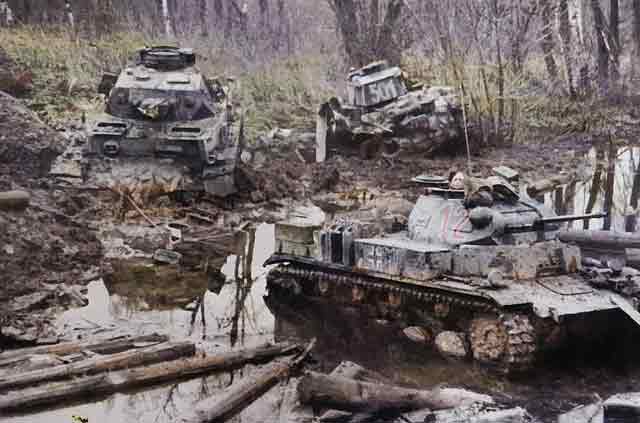
In northern Russia, Soviet General Fedyuninsky launched an attack south of Lake Ladoga with 70,000 troops and 97 tanks in an attempt to break through the Leningrad siege. Meanwhile, German troops moved to attack the rail and road junction at Tikhvin 120 kilometers to the east to strengthen the siege.
With most of the world’s attention focused on the defense of Moscow on 20 October 1941, the Germans remind everyone that they are a threat all along the Eastern Front by launching a surprise attack east from the vicinity of Leningrad. Despite having lost his armored formations to Army Group Center for Operation Typhoon, the attack on Moscow, Army Group North commander Ritter von Leeb has been working on this attack for weeks. The main objective is the town of Tikhvin, a key Soviet road and rail junction.
This attack was originally planned to begin on 6 October but was called off pending the arrival of fresh divisions. While von Leeb wanted to attack in the direction of Volkhov, Hitler ordered him to aim his offensive a little further south, from the vicinity of Chudovo toward Tikhvin. Once that city was taken, von Leeb could turn north along the railroad tracks and take Volkhov. Thus, it was a slightly more ambitious plan than von Leeb had in mind.
Field Marshal von Leeb has General Rudolf Schmidt’s 39th Army Corps (motorized), composed of 8th and 12th Panzer and 18th and 20th Motorized, attack toward Tikhvin. They are supported by the I Army Corps (11th, 21st, 126th, and 254th Infantry Divisions under the command of General Hans-Kuno von Both). They are opposed by Leningrad Front, commanded by Soviet Colonel-General Ivan Ivanovich Fedyuninsky. Fedyuninsky is a protege of Stalin’s favorite general, Georgy Zhukov, and leads 70,000 troops supported by 97 tanks.
Tikhvin in 1941 is an unprepossessing town but a vital Soviet road and rail connection between Moscow and the shores of Lake Ladoga. The supplies sent through Tikhvin (and thence through Volkhov) are ferried across Lake Ladoga and are absolutely critical to sustaining it. Tikhvin is part of the “Road of Life” during World War II due to its peculiar importance to Leningrad’s survival and also a status as an escape route for starving Leningrad inhabitants. Thus, Tikhvin is the key to Leningrad, and thus the Soviets are forced to defend it. If the Germans can take Tikhvin, they can starve Leningrad into submission.
Field Marshal von Leeb’s attack begins in the early hours of 16 October. It is preceded by a brief artillery barrage and achieves complete surprise, as the Soviets are focused on Leningrad and Moscow, not the area in between. The order “Kompanie vorwarts” (“Troops forward!”) is issued, and the main German assault led by General von Both’s infantry hits between Gruzino and Kirishi. General Otto Sponheimer’s 21st Infantry Division quickly crosses the 300-meter wide Volkhov River at Gruzino, and by the end of the day is entirely on the east bank. At Kirishi, General Herbert von Böckmann’s 11th Infantry Division also gets across the Volkhov River without any problems. It is a smashing success and the leaders at both German bridgeheads plan to expand their firm grips on the east bank on the 17th.
The Germans captured Borodino, 60 miles from Moscow.
There is heavy fighting near Mozhaysk and Malayaroslavets in the Moscow sector. German attacks continue to advance in Stalino (Donetsk).
Stalin declares a state of siege in Moscow. He appeals to all workers “to keep calm and orderly and to render the Red Army defending Moscow all possible help.” It also says that all enemies of public order are to be handed over at once to court martials and that all provocateurs, spies and other enemies inciting riot are to be shot on the spot.
Stalin has called on other Russians to support his call to arms. The author Alexei Tolstoy, a kinsman of the great novelist, issued a stirring message to the Red Army today: “Grit your teeth! Squeeze the enemy’s throat! Not a step backwards! Smash the German hoards with a storm of bombs and the fiery storm of artillery with the steel of your bayonets and the fury of your anger!”
The huge military machine of Germany has access to only 3% of the world’s crude oil assets — a little more than it had before the outbreak of war, but less than it needs. Germany’s problems would be solved if it captured the Soviet oilfields centered on Baku, in the Caucasus, which would quadruple its supplies. Meanwhile, the coming winter means that operations in Russia must slow. This will cut oil demand, but also means that the conquest of the Caucasus cannot take place before next spring.
In reprisal for partisan attacks the Germans executed 2,324 Serbian men and boys in the Yugoslavian town of Kragujevac, including 300 boys who were herded out of the First Boys High School on the previous day. Local German authorities announced that the mass execution was in response to a recent attack that saw 10 Germans killed and 26 wounded. Furious at partisan activity, Adolf Hitler had previously decreed that for every German soldier killed in attacks, 100 civilian would be executed, and for every German wounded, 50 would be executed. In the villages of Meckovac, Grosnica, Milatovac and Marsic a total of 427 civilians are executed. In the two villages of Draginac and Loznica, 2,950 hostages are massacred in retaliation for German losses in the fighting against partisans around Kraljevo. In the town of Kraljevo itself, 1,736 hostages, including 19 women, are shot. In the roundup of hostages in Kragujevac the 53 inmates of the town’s jail are murdered. Communists and their sympathizers are specifically targeted as are Jews. Within a week, over 4,000 innocent civilians are slaughtered in two of the largest massacres committed on Yugoslavian soil for what the German commander, General Franz Boehme, commander of the XVIII Mountain Corps, believes will give such a lasting impression on the partisans that they would willingly give up their struggle.
The Wehrmacht later issues the following statement:
“The cowardly and treacherous surprise attacks on German soldiers during the previous week, on which occasion 10 German soldiers were killed and 26 wounded, had to be punished. For that reason, 100 people were shot for each killed German soldier, and for each wounded 50, mainly communists, bandits, and their siders, 2300 altogether. Every similar case, even if it only sabotage, will be dealt with the same severity.”
— Chief of Local Command
This massacre is intended as a warning to other partisans in Serbia, of which there are many. There are many other such atrocities in the area during World War II, as the Serbians are hostile to German rule.
Lieutenant Colonel Fritz Hotz, the German commander in Nantes, was killed by the French resistance. 50 hostages were shot in reprisal.
Berlin dispatches said today that 55,000 of an estimated 65,000 Jews in the German capital would be deported to Russia and Poland. Social Demokraten said on the basis of the report that if deportation on the same principle were carried out throughout Germany. some 200,000 Jews would be affected. The dispatches said each deportee would be allowed to take along an extra suit, several shirts and six handkerchiefs.
Vigorous patrolling of Egypt’s frontier area resulted yesterday in several skirmishes that probably indicate a growing tension on both sides. For some time the Germans have been trying hard to find out what the British are doing, even essaying reconnaissance in force last month.
After sundown, British cruiser HMS Latona and destroyers HMS Kingston, HMS Encounters, and HMS Nizam departed Alexandria, Egypt for Tobruk, Libya, returning in the early hours of the next day. To protect them, British cruisers HMS Ajax and HMS Galatea and Australian cruiser HMAS Hobart, escorted by destroyers HMS Griffin and HMS Jaguar, bombarded German coastal guns near Tobruk.
In the “new order” in Europe Italy will have economic and political dominion over the Mediterranean, Dr. Walther Funk, German Minister of Economics and president of the Reichsbank, told a distinguished audience of Italians this morning at the University of Rome, where he was made a doctor honoris causa in economics and commerce.
Heavy fighting continues in Western Serbia between the German Army and the Serbian Chetnik armies and armed peasantry, according to reports in neutral foreign military circles and Yugoslav sources at Ankara and admissions by German authorities in the zone of the hostilities.
The United Kingdom and France concluded a Treaty of Mutual Assistance with Turkey.
RAF Bomber Command, Day of 20 October 1941
8 Blenheims on sweep of Dutch coast. 1 Flak ship was attacked off Terschelling, with either a hit or a near miss. No Blenheims lost.
RAF Bomber Command, Night of 20/21 October 1941
Bremen
153 aircraft – 82 Hampdens, 48 Wellingtons, 15 Stirlings, 8 Manchesters – to 2 aiming points. 5 aircraft – 2 Hampdens, 2 Wellingtons, 1 Manchester – lost.
Returning crews claimed to have started fires in the target area. The Bremen report records only that this was a ‘small raid’ and gives no details.
Wilhelmshaven
47 aircraft – 40 Whitleys, 4 Wellingtons, 3 Hampdens – none lost.
The weather was poor and crews reported scattered bombing. Wilhelmshaven reports 3 loads of bombs in areas of housing with 7 people killed and 7 injured.
Emden
35 Wellingtons and 1 Halifax, Fires were claimed on the docks and in the town. 1 Wellington lost.
Antwerp
35 aircraft; complete cloud cover resulted in most crews retaining their bombs. 3 Wellingtons lost.
Minor Operations: 5 Hampdens and 5 Manchesters minelaying in the Frisians and the Baltic, 8 O.T.U. sorties. No losses.
Total effort for the night: 284 sorties, 9 aircraft (3.2 percent) lost.
U-126, commanded by Kapitänleutnant Ernst Bauer, badly damaged British tanker British Mariner (6996grt) in 7-43N, 14-20W. At 0554 hours on 20 Oct 1941, U-126 attacked a small convoy of two tankers and one escort about 80 miles southwest of Freetown and fired one torpedo at each tanker from a distance of 400 meters. The first torpedo struck the British Mariner aft of the mast in the engine room. The propulsion of the second torpedo failed and it sank to the bottom. Bauer immediately fired a third torpedo, which was a surface runner and missed. The U-boat tried to follow the second tanker, but was chased away by the escort and later by an aircraft. The British Mariner (Master Henry Beattie) was abandoned by her crew, but was later reboarded and towed to Freetown by the Dutch tug Donau and HMS Hudson (W 02) (Master B.C. Weltevreden), arrving on 22 October. Three crew members were lost. The master, 44 crew members and three gunners were picked up by the British tug and landed at Freetown. The tanker was declared a total loss and transferred to the Ministry of War Transport (MoWT), which used her as oil hulk in Freetown harbour. It was planned to scuttled the hulk off Freetown in 1946, but she was bought by the salvage company W.E. Rippon & Son and 1948 renamed Tex.Africa. Broken up at Savona in April 1951. The 6,996 ton British Mariner was carrying ballast and was bound for Curaçao.
In the early morning hours during a gale, heavy cruiser HMS London was dragged into the baffle at Scapa Flow and heavy cruiser HMS Kent dragged into battleship HMS Malaya.
Battleship HMS Malaya departed Scapa Flow escorted by destroyers HMS Bedouin and HMS Punjabi for the Clyde at 1030. On meeting destroyers HMS Laforey and HMS Lightning, which had been detached from escort duty with aircraft carrier HMS Victorious, destroyers Bedouin and Punjabi returned to Scapa Flow. The battleship continued to the Clyde with destroyers Laforey and Lightning. Destroyer Laforey put into Stornoway at 1500/20th to land a cot case, injured in the gale. The destroyer put back to sea at 1700 and rejoined the battleship.
Destroyer HMS Southwold departed Scapa Flow at 1330 to embark the Engineer in Chief at Scrabster and returned to Scapa Flow at 1730.
Destroyer HMS Charlestown departed Scapa Flow at 1845 for Loch Alsh on completion of docking and repairs.
Submarine HMS Tigris departed Polyarnoe for Holy Loch, where she arrived on 3 November.
British steamer Cordelia (8190grt) was damaged by mining off Great Castle Head, Milford Haven. The tanker arrived at Milford Haven on the 20th.
Minelaying cruiser HMS Latona and destroyers HMS Kingston, HMAS Nizam, and HMS Encounter departed Alexandria on serial five of the CULTIVATE operation. The ships arrived back at Alexandria on the 21st.
Gunboat HMS Gnat bombarded an enemy gun battery near Tobruk during the night of 19/20 October. The gunboat departed Tobruk with the A lighters after dark on the 20th to return to Alexandria.
Light cruisers HMS Ajax, HMAS Hobart, and HMS Galatea departed Alexandria with destroyers HMS Griffin and HMS Jaguar to bombard the enemy gun battery near Tobruk during the night of 20/21 October. The bombardment was conducted during the night of 20/21 October.
Australian destroyer HMAS Vendetta departed Alexandria for Singapore and passed through the Suez Canal on the 21st. The destroyer was refitting at Singapore in December. She departed Singapore on 2 February in the tow of destroyer HMS Stronghold.
Panamanian steamer Indra (2032grt), which departed Bari for Huelva, was reported missing after this date.
Italian torpedo boat Altair struck a mine in the Gulf of Athens, in 35-45N, 23-52E. The torpedo boat later sank in tow. Torpedo boat Altair with armed merchant cruiser Barletta and torpedo boats Lupo and Monzambano were escorting a convoy of steamers Citta di Agrigento (2480grt), Citta di Marsala (2480grt), Tagliamento (5448grt), and Salzburg (1742grt). Torpedo boat Aldebaran going to her assistance also struck a mine and was sunk. The mines were part of a minefield of fifty mines laid by submarine HMS Rorqual on the 8th.
Submarine HMS Porpoise departed Gibraltar for Alexandria with stores and personnel.
Light cruiser HMS Hermione departed Gibraltar to search for a tanker reported by aircraft in 44-07N, 10-07W. The cruiser arrived back at Gibraltar on the 25th without having made contact.
Destroyer HMS Duncan and anti-submarine trawlers HMS St. Nectan and HMS Arctic Ranger departed Gibraltar to provide additional escort for tanker Velma en route to Gibraltar, escorted by corvettes HMS Jonquil and HMS Coreopsis. Tanker arrived on the 22nd, escorted by the destroyer and the two corvettes.
Convoy ON.28 departed Liverpool escorted by destroyers HMS Sabre and HMS Westcott, corvettes HMS Alisma and HMS Kingcup, and anti-submarine trawlers HMS Man O’ War and HMS Wellard. The trawlers were detached on the 23rd and destroyer HMS Venomous relieved destroyer HMS Westcott which was detached. On the 25th, the escort group was detached when relieved by American destroyers USS Bernadou, USS DuPont, USS Lea, USS MacLeish, and USS Sampson. Destroyer Lea was detached on the 30th. The American group was further reinformed on the 31st by Coast Guard cutter USCGS Campbell and destroyers USS Babbitt, USS Buck, USS Leary, USS Ludlow, and USS Schenck. The Americans were detached on 3 November when the convoy was dispersed.
Today in Washington, Senate considered the reapportionment bill, received one resolution to repeal Section 2 of the Neutrality Act and another to repeal the entire act, received the nomination of Brig. Gen. Seth Williams as Marine Corps quartermaster, received an amendment to authorize broader investigations under the Hatch Act and adjourned at 3:51 PM until noon tomorrow. The Foreign Relations Committee voted to hold limited, secret hearings on the resolution to permit arming of merchant ships.
The House met briefly and adjourned at 12:54 PM in respect to the late Representative Lawrence J. Connery of Massachusetts. The Banking and Currency Committee agreed to limit hearings on the price-control bill.
The United States’ answer to the torpedoing of the destroyer USS Kearny off Iceland with the loss of 11 men will consist of actions rather than words, Secretary of State Cordell Hull indicated at a press conference today. Hull ruled out any diplomatic protest, remarking that one does not often send diplomatic notes to an international highwayman. From Senator Pepper, Florida Democrat, came the assertion that “the time has come for the American people to put American might behind American right and reply to Hitler in the only language he knows: force.”
A half dozen senators, three Democrats and three Republicans, laid the issue of complete repeal of the Neutrality Act before the Senate today as the Foreign Relations Committee brushed aside minority protests of “gag rule” to order brief closed hearings on the House-approved armed ship bill. In a sudden move, highly disconcerting to the leadership of both major parties in Congress, three Republican Senators — Bridges of New Hampshire, Austin of Vermont and Gurney of South Dakota — today introduced an amendment to the House-approved armed ship resolution calling for outright repeal of the entire Neutrality Act of 1939 amending the law of 1937.
President Roosevelt will arrive in Washington early tomorrow to face a momentous decision as to whether the loss of eleven American sailors from the torpedoed destroyer Kearny is to lead to far-reaching action, such as a request for complete repeal of the Neutrality Act, or merely to mark another tragic incident in the Battle of the Atlantic. The President, who conferred for three hours today at his Hyde Park home with W. Averell Harriman, chief of the United States delegation to the recent tripartite conference at Moscow, will meet legislative leaders at the White House a short time after his return to the capital.
Advocating repeal of the Neutrality Act and asserting that “the best assurance of a just peace lies in the defeat of Hitler in battle,” Secretary Ickes declared here tonight that the United States must make a decision now.
Wendell L. Willkie predicted today that naval and air engagements between the United States and Germany were not far in the future. “The United States is already in the war and has been for some time,” Willkie said in the current Look magazine in answering a series of questions on current events. “If, however, by ‘war,’ shooting is meant,” he added, “I think there is a possibility that there will be some naval and perhaps aeronautical engagements between the United States and Germany before long.” In regard to differences of opinion in the Republican party on foreign policy, Willkie said; “Within four years those in the Republican party who believe in the international viewpoint will completely dominate the party, and the isolationists will be merely a memory. “If this is not true, the Republican party as we know it today will die, and some new party will arise and take its place.”
The speeding-up of United States aid to Russia in the present critical phase of the war was signalized by an announcement today that the government had advanced the Soviet Union $30,000,000 out of the Stabilization Fund against gold that Russia would send to this country.
The Texas Board of Education contracted for delivery of $2,000,000 worth of textbooks for public schools next year, but no histories or geographies were among them. World turmoil convinced the officials that new history or geography texts would be outmoded by the time of delivery. Still in use are those adopted by the board in 1938. Students of current history should read the newspapers, advised Board President Ben O’Neal.
The five operating brotherhoods rejected today last week’s offer by President Roosevelt’s five-man fact-finding board to arbitrate the railroad wage controversy, in which the board has been hearing evidence since September 16.
In one of a number of orders, the Supreme Court today denied a petition of the Ford Motor Company for review of lower court decisions upholding a Federal Trade Commission order to cease using the term “6 percent” in advertising automobile financing.
Cloudbursts which loosed as much as a foot of rain over central Kansas sent raging floods down on dozens of towns and communities today and threatened serious overflows along major rivers.
An accumulation of magnesium dust, apparently touched off by a spark, exploded at the Permanente magnesium plant at Los Altos, California, today, injuring two workmen. It was the second blast at the big plant within 48 hours and the fourth accident in three months.
Major Gen. Jacob L. Devers, commander of the armored force of the United States Army, declared here today that “there appears to be no defense against armored formations except by more numerous and stronger formations.” For that reason, he said, all elements of the armored force were “striving hard to be prepared to use our tanks and other armored vehicles as the spearhead of attack should the immediate need of our Army arise.”
Navy Secretary Knox, speaking today at the commissioning of the aircraft carrier USS Hornet, said that every man who lost his life on the destroyer USS Kearny lost it as a volunteer in an “ultimate sacrifice” so that men everywhere may “keep the hope of human freedom.”
War games and exercises were held at the Presidio in San Francisco, California.
PBYs (VP 73) provide air coverage for convoy ON.26.
“Regarding the Japanese Air Force, which many people, he said, were inclined to discount as a second-rate body equipped with obsolete aircraft and lacking skillful and daring pilots, Air Vice-Marshal Pulford said that he certainly does not underrate its capacity. When it was suggested to him that it might be compared with the Italian Air Force, he pointed out how completely the R.A.F. gained the mastery of the skies of the Middle East even when the Italians possessed great numerical superiority. He thinks that what the R.A.F. has done in the Middle East it could certainly do in the Far East against the Japanese. One of the best Japanese fighters is the ‘Zero’ naval fighter, but the Brewster Buffaloes at present with the R.A.F. in Malaya and Burma would have no difficulty in dealing with them. The Japanese, he said, have two bombers of the Mitsubishi type, one of which is used by the Navy and one by the Army — they are about equal in performance to the Whitley bomber in the R.A.F. He believes that Messerschmitt 109s are being produced in limited numbers in Japanese factories.”
— “The Times”, Oct 20, 1941, p. 4, col. 7.
Embarking on the task of executing Japan’s “immutable” policies, General Hideki Tojo, the new Premier, has issued two more declarations about his program, and in both he significantly emphasized the necessity for settling the war in China. One declaration was addressed to a conference of officers of the War Ministry yesterday and the other was presented before the staff of the Home Ministry on the occasion of Premier Tojo’s taking it over from Harumichi Tanabe, the outgoing Minister. “Every possible effort must be made,” he said to the Home Ministry staff, “to implement the unshakable national policy of establishing an East Asia co-prosperity sphere by disposing of the China affair. The present trend is grave. “Everything must be done to replenish our arms, expand the industrial capacity, advance the program for communications and national defense facilities and enhance the national spirit. I am determined to lead the national camp toward that end by enhancing the national spirit and respecting the will of the nation.”
Japanese luxury ocean liner Hikawa Maru departed Yokohama for Seattle.
Completion of negotiations for a united front in the Pacific area, composed of Britain, the United States, China, the Netherlands Indies, Australia and New Zealand, was reported today in Canberra.
Mass murderer Stanley Graham was mortally wounded in a shootout with police near his farm in Hokitika, New Zealand. He died of his wounds the next morning.
New Zealand light cruiser HMNZS Achilles departed Auckland to escort a U.S. liner to the Equator. The light cruiser departed the escort on the 27th for Suva, arriving on the 31st.
Dow Jones Industrial Average: 120.13 (+0.03)
Born:
Don Trull, AFL quarterback (Houston Oilers, Boston Patriots), in Oklahoma City, Oklahoma.
Anneke Wills, English actress, in Berkshire, England, United Kingdom.
Naval Construction:
The Kriegsmarine (German Navy) Type VIIC U-boat U-734 is laid down by F Schichau GmbH, Danzig (werk 1525).
The U.S. Navy Gato-class submarine USS Shad (SS-235) is laid down by the Portsmouth Navy Yard (Kittery, Maine, U.S.A.).
The Royal Navy “T”-class destroyer HMS Teazer (R 23) is laid down by the Cammell Laird Shipyard (Birkenhead, U.K.).
The Royal Navy LCT (Mk 2)-class landing craft, tank HMS LCT 145 is launched by Stockton Construction (Thornaby, U.K.).
The Royal Navy LCT (Mk 2)-class landing craft, tank HMS LCT 154 is launched by MacLellan (Old Kirkpatrick, Scotland, U.K.).
The Royal Canadian Navy Bangor-class (VTE Reciprocating-engined) minesweeper HMCS Bellechasse (J 170) is launched by the Burrard Dry Dock Co. Ltd. (Vancouver, British Columbia, Canada).
The U.S. Navy 77-foot Elco patrol motor torpedo boat USS PT-62 is launched by the Electric Launch Company Ltd. (Elco), (Bayonne, New Jersey, U.S.A.).
The U.S. Navy Gato-class submarine USS Haddock (SS-231) is launched by the Portsmouth Navy Yard (Kittery, Maine, U.S.A.).
The Kriegsmarine (German Navy) Type IXC U-boat U-508 is commissioned. Her first commanding officer is Oberleutnant zur See Georg Staats.
The Вое́нно-морско́й флот СССР (ВМФ) (Soviet Navy) “S” (Stalinec)-class (2nd group, Type IX-modified) submarine S-56 is commissioned.
The Вое́нно-морско́й флот СССР (ВМФ) (Soviet Navy) Project 7-class (Gnevny-class) destroyer Razumny (Разумный, “Sensible”) is completed.
The U.S. Navy Yorktown-class aircraft carrier USS Hornet (CV-8) is commissioned. Her first commanding officer is Captain Marc Andrew (“Pete”) Mitscher, USN.

