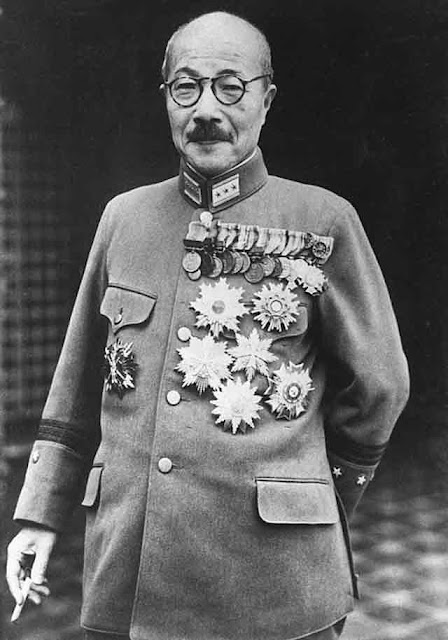
18 October 1941 is the day when the final card is dealt out in the grand poker game known as World War II. On the Allied side, we have Franklin D. Roosevelt, President of the United States since 1933; Winston Churchill, Prime Minister of Great Britain since 1940; and Joseph Stalin, leader of the Soviet Union since the 1920s. On the Axis side, there is Adolf Hitler, Führer of the Greater Reich since 1933; Benito Mussolini, leader of fascist Italy since the 1920s; Ion Antonescu, Prime Minister and Conducător of Romania since 1940; and now, at last, the final major leader of the conflict. His name is Hideki Tojo, and on 18 October 1941, General Tojo becomes the wartime leader (under the remote and sympathetic supervision of Emperor Hirohito) of Imperial Japan.
Tojo, known as Kamisori (the Razor), succeeds Prince Konoe (Konoye), who has resigned due to his failure to broker a peace deal with the United States. Everyone knows what the promotion of Tojo, the leader of the war faction in the cabinet, to the top slot means. Prince Takamatsu immediately writes in his diary:
“We have finally committed to war and now must do all we can to launch it powerfully. But we have clumsily telegraphed out intentions. We needn’t have signaled what we’re going to do; having [the entire Konoe cabinet] resign was too much. As matters stand now we can merely keep silent and without the least effort war will begin.”
This is hardly an enthusiastic endorsement for total war.
In order to better control what really matters during his tenure as Prime Minister, Tojo also continues to serve as War Minister. He becomes a widely caricatured figure in the United States, usually depicted with inhuman features and becoming the repository in the Western press of every negative stereotype and characteristic that can be flung at him. The media launches on a campaign to demonize Tojo, a time-honored tradition during wartime, and absolutely succeeds. Leading wartime Japan becomes one of the most thankless jobs of the conflict, not even earning the eternal scorn of Hitler or enduring the ridicule of Mussolini. Instead, Tojo just becomes yet another barbarian in the public mind, a savage who rides a bomb hurtling to earth and then falls off before it explodes — only to perish along with his nation. Whether this accurately summarizes the man is not really of consequence, as this is the image that lasts.
Konoe eventually convinces himself that the fault lies not in his stars, but in his… Emperor:
“Of course, His Majesty is a pacifist, and there is no doubt he wished to avoid war. When I told him that to initiate war is a mistake, he agreed. But the next day, he would tell me: “You were worried about it yesterday, but you do not have to worry so much.” Thus, gradually, he began to lean toward war. And the next time I met him, he leaned even more toward war. In short, I felt the Emperor was telling me: “My prime minister does not understand military matters, I know much more.” In short, the Emperor had absorbed the views of the army and navy high commands.”
The truth is somewhat more complex. Emperor Hirohito does not so much become a supporter of war as an opposer of other alternatives. Hirohito alone seems to understand the true choice being offered, and why this dilemma must resolve in the direction of a self-destructive conflict. He willingly embraces a Kabuki Dance of Death that can have only one outcome.
Being a supporter of war only because no alternatives seem workable may seem a distinction without a difference in terms of whether or not one actually desires war. However, the fact is that the Japanese believe President Roosevelt and the United States have completely boxed Imperial Japan into a corner. There is only one honorable way to exit this predicament, and it is not peaceful. Tojo’s sole virtual is that he offers a solution that does not involve humiliation — at least, not right away. Everyone may secretly understand (as they apparently do, according to later accounts) that Japan cannot possibly beat the United States and Great Britain in the long run. However, there is an almost conscious decision made that it is better in this situation to die with honor than surrender in despair. That this imperils the entire nation, let alone the Empire, is of small consequence next to the fear of losing face.
Tojo is a devoted subject of the Emperor and sometimes acts — sometimes to the nation’s detriment, as will soon become apparent — contrary to the nation’s best military interests in order to demonstrate that. He understands that the Emperor would prefer a peaceful outcome, and thus craftily makes his first radio speech as prime minister on the subject of “world peace.” However, Tojo is an outright hawk who seeks the final conquest of China, the establishment of a Greater East Asia Co-Prosperity Sphere in the western Pacific, and — most disastrously of all — a grand settling of scores with the United States. It is possible now — if you really try — to see Tojo as a tragic figure, a humbled, pathetic, and hopeless man alone on an enemy witness stand awaiting certain death. On 18 October 1941, however, Hideki Tojo is a figure of menace and ready to deal out the Ace of Spades across half the globe.
The German SS Reich and 10th Panzer Divisions captured Mozhaysk, Russia. In the evening, a motorcycle battalion of SS Reich Division found the Minsk Highway toward Moscow, Russia, 90 kilometers to the east, undefended.
German Colonel General Erich von Manstein launched his Eleventh Army against the Perekop Isthmus in Russia but fierce Soviet resistance on a narrow front caused the German advance to proceed extremely slowly.
Maloyaroslavets is captured by 19th Panzer Div. of the 4th Army’s LVII Pz. Korps.
Lavrentiy Beria ordered the execution of Nikolai Rychagov, Rychagov’s wife, and other “conspirators”.
Soviet spy Richard Sorge is arrested in Tokyo. Sorge has already transmitted to Moscow details about the Japanese strike southwards (and the lack of any move into Siberia), enabling Stalin to move troops from Siberia to the defense of Moscow. This is one of the most important intelligence coups of all time.
The expulsion of Berlin’s Jews begins today. The prime mover this expulsion is Albert Speer, Chancellor Adolf Hitler’s chief architect who has been given the task of rebuilding Berlin. A close friend of Joseph Goebbels, together in 1941, they planned for the clearance of the Jewish slum areas in the western part of the city. In doing so, Speer could then take control of around 34,000 houses and apartments and start his demolishing and rebuilding program. The first trainload of these expelled Jews left Berlin today. There are to be 130 trainloads altogether.
Heydrich and Himmler speak by phone, agreeing not to allow any Jews to leave German territory by going overseas.
British cruiser HMS Latona and destroyers HMS Jackal, HMS Havock, and HMS Nizam arrived in Alexandria, Egypt from Tobruk, Libya.
Eleven Albacore and two Swordfish aircraft of British No. 828 Squadron took off from HMS Ark Royal to reinforce Malta. One Swordfish torpedo bomber was lost en route, however.
The British destroyer HMS Broadwater escorting convoy SC.48 was sunk south of Iceland by the German submarine U-101.
Bluntly telling a crowd of munitions workers at a Midlands town today that “things are really desperate,” Ernest Bevin, Minister of Labor, called upon Britain for greater output of weapons and ammunition to stop a possible Nazi invasion attempt next year.
Picture Post, the British magazine founded in 1938 by Edward Hulton, which has reached a circulation of a million in the last two months, is now a national institution under its editor Tom Hopkinson. It has made its name by its brilliant picture treatment and its hard-hitting captions attacking Hitler at the time of appeasement. At home it criticizes military commanders, ineffective weapons and bureaucratic delays in helping air-raid victims. It founded a Home Guard training school at Osterley Park and gave tips on resistance fighting to its readers. Now it is running articles on post-war reforms such as full employment, minimum wages and a national health service. The response has been huge.
U-132, commanded by Kapitänleutnant Ernst Vogelsang, sank Soviet steamer Argun (3487grt) in 69-30N, 33-30E. At 1320 hours on 18 Oct 1941 the unescorted Argun (Master V.A. Greschner) was hit on the starboard side at the bow by one torpedo from U-132 five miles off the Gorodetzkij lighthouse. At 1340 hours, a first coup de grâce detonated prematurely, but a second fired 20 minutes later hit amidships and caused the ship to sink. When lost, the ship was under command of the pilot Klt I.M. Ljubimov. The crew and passengers abandoned ship in two lifeboats and were later picked up by the Soviet hydrographic vessel Mgla (Master I.E. Gorschkov), which was probably the icebreaker attacked by the U-boat at 1505 hours, but the G7a torpedo hit the ground. The 3,487 ton Argun was bound for Iokanga, Soviet Union.
At 2017 hours on 18 October 1941, U-132 fired one G7a torpedo at a steamer of 1500 grt north of Kackovskij in the Barents Sea and reported a hit after 16 seconds and the subsequent sinking of the vessel within 30 seconds. The victim was most likely SKR.11 (No 70) which was reported missing while on patrol at the entrance to the White Sea between 20 and 24 October 1941.
Destroyer HMS Broadwater (Lt Cdr W. M. L. Astwood) was sunk by U-101, commanded by Kapitänleutnant Ernst Mengersen, south of Iceland from convoy SC.48 on the 18th. During the night of 17/18 Oct 1941, U-101 tried for three hours to overtake convoy SC.48 south of Iceland and after several approaches were frustrated by the escorts fired a spread of four torpedoes at HMS Broadwater (H 81) (Cdr W.M.L. Astwood, RN (rtd)) astern of the convoy at 0420 hours. After 2 minutes 30 seconds, the destroyer was hit by a torpedo on the starboard side forward of the bridge and lost its complete bow. The three A/S trawlers of EG 3 were sent to her assistance with HMS Angle (FY 201) (T/Lt E. Playne, RNVR) going alongside to rescue the survivors and HMS Cape Warwick (FY 167) (T/Lt W.E. Goggin, RNR) and HMS St. Apollo (T/Lt R.H. Marchington, RNVR) screening the area but they did not notice U-77 (Schonder) which investigated the scene. At 0633 hours, the U-boat even unsuccessfully fired a torpedo at one of the shadows and then left the area after recognizing the vessels as small escorts. The rescue work proved to be difficult due to increasing sea and wind and the lifeboats and whalers became more and more waterlogged. Some of the men of HMS Broadwater remained behind because they thought that the ship could be saved. However, at daylight a crack became visible on the deck abaft the fourth funnel confirming that the back had been broken and the ship was beyond salvage. HMS Angle rescued 60 survivors and transferred seven of them, including the commander and chief engineer, to HMS Cape Warwick which had picked up 28 men and at 1420 hours they both left to land the survivors at Londonderry but en route one officer and two ratings died of wounds. HMS St. Apollo stood by the abandoned wreck of HMS Broadwater until she sank by the bow with a slight starboard list in 56°52N/18°25W at 1541 hours, hastened by 4-inch gunfire from the armed trawler. Five officers, 40 ratings and eleven survivors rescued from W.C. Teagle and Erviken the night before were lost.
U-559 attacked a destroyer escorting three lighters in 32-40N, 24-34E.
Destroyers HMS Antelope and HMS Anthony departed Scapa Flow at 1400 for the Clyde to escort destroyer depot ship HMS Forth from the Clyde to Rosyth. The destroyers arrived at 0900/19th. At 1800/19th, the destroyers and depot ship Forth departed the Clyde for Rosyth. The ships arrived off May Island at 1500/21st. The depot ship arrived at Rosyth at 1730. Destroyer Anthony proceeded to Immingham for refitting, arriving at 0700/22nd. Destroyer Antelope returned to Scapa Flow, arriving at 0630/22nd.
Minesweepers Fitzroy, Elgin, Ross, and Lydd arrived at Scapa Flow on passage to the Faroes for a clearance sweep.
British steamers Empire Ghyll (2011grt) and Mahseer (7911grt) were sunk on mines in Barrow Deep, four to five cables from B 7 Buoy, in 51-41N, 1-19E. Five crewmen and two gunners were lost on the steamer Empire Ghyll. The entire crew of steamer Mahseer was rescued.
Tug Assurance was grounded and declared a total loss at Lough Foyle.
Swedish steamer Ingeren (6123grt) was damaged by British bombing west of Borkum.
Minelaying cruiser HMS Abdiel and destroyers HMS Kandahar, HMS Griffin, and HMS Jaguar departed Alexandria on serial 3 of the CULTIVATE operation. Returning from Tobruk, destroyer Kandahar attacked a submarine off Bardia at 0330/19th. Cruiser Abdiel arrived back at Alexandria at noon on the 19th. The destroyers, after searching for the submarine, arrived back that afternoon.
Destroyers HMS Jervis and HMS Jupiter departed Alexandria escorting landing ship Glenroy from Port Said to Alexandria. The destroyers and landing ship arrived at Alexandria on the 19th.
An Italian convoy of steamers Marin Sanudo (5081grt), Probitas (5084grt), Beppe (4859grt), Paolina 4994grt), and Caterina (4786grt) departed Naples on the 16th for Tripoli, escorted by destroyers Folgore, Fulmine, Usodimare, Gioberti, Da Recco, and Sebenico. Torpedo boat Cigno escorted the convoy until Trapani. Torpedo boat Calliope also escorted the convoy. Steamer Amba Aradam (405grt) joined the convoy from Trapani. Torpedo boat Cascino joined the convoy from Tripoli. On the 18th, submarine Ursula damaged Italian steamer Beppe near Lampedusa. The steamer was taken in tow by tug Max Barendt and arrived at Tripoli on the 21st with destroyer Da Recco and torpedo boat Calliope. Steamer Caterina was badly damaged by British bombing on the 18th and sank 62 miles 350° from Tripoli on the 19th. Rest of the convoy arrived at Tripoli on the 19th.
Submarine HMS Truant departed Malta for patrol in the Adriatic.
Submarine HMS Rorqual departed Malta on a minelaying operation off the south of Sardinia. After the operation on 21 and 22 October, the submarine arrived at Gibraltar on the 26th
Submarine HMS Thunderbolt made an unsuccessful attack on a steamer in the Aegean.
Corvettes HMS Azalea and HMS Spiraea were directed that upon departing Bathurst to meet RFA oiler RFA Dingledale and escort her to Gibraltar. Corvette Spiraea arrived at Gibraltar on the 26th to refuel, then departed to rejoin the escort. The three ships arrived at Gibraltar on the 29th.
The prospect of a U.S. Senate battle over major revision of the neutrality law developed today as Senator Glass, Virginia Democrat, called the existing act “a craven piece of poltroonery” and announced that he would work for its complete repeal. Glass, a member of the Senate Foreign Relations Committee, told reporters that the house-approved amendment permitting the arming of ships should be discarded and that “we should repeal the whole damn thing.” Another foreign relations committeeman, Senator Pepper, Florida Democrat, expressed virtually the same views in an interview. He said he would urge repeal of all neutrality law provisions except that providing government control of munitions exports.
Wendell L. Willkie said tonight that the United States “must abandon hope for peace.” In a statement prepared for a Fight for Freedom radio program Willkie reviewed current events in Japan, Europe and the Atlantic and asserted: “We must remove the show and deception of hypocritical neutrality laws. We must abandon the hope of peace.” Because Mr. Willkie had a cold his speech was read by Dorothy Thompson. Mr. Willkie scoffed at those who sthink they can make peace with “the Nazi Neanderthals’” or their allies, “the new Nipponese Government, which is the same as the old, only bolder, bloodier, more totalitarian.” “Let us stop deluding ourselves,” he said. “Berlin, Tokyo and Rome are irrevocably linked by the dangerous dream of world conquest. Victory for one is a victory for all. Their aim is world domination — the destruction of liberty, the end of democracy.” Referring to the torpedoing of the Kearney, without mentioning her by name, Mr. Willkie continued: “Our ships will continue to be torpedoed and sunk unless we arm them fast. Axis victories will not end unless we deliver in rapidly increasing amounts our goods into the hands of those who are fighting for freedom on land and on sea. “But even this is not enough — we must remove the show and deception of hypocritical neutrality laws. We must abandon the hope of peace.”
President Roosevelt’s statement of labor policy to the convention of the American Federation of Labor is to be followed by a pronouncement to American Labor designating the procedure which should be followed in cooperating with the President’s plea for maximum defense production without strikes. The statement on’ procedure is being formulated for the signatures of the Federal agencies named by Mr. Roosevelt as dealing with labor disputes, the Department of Labor and the National Defense Mediation Board. Other signatories are expected to include William S. Knudsen, Director General, and Sidney Hillman, associate director general, of the Office of Production Management, and Secretaries Stimson and Knox.
The OPM labor division, listing strikes in progress, reported today that twenty-nine labor disputes were current in plants working on Army and Navy defense contracts, but contended that “only seven cases, involving approximately 11,000 workers, have any significant effect on the defense effort.”
Major R.H. Fleet, president of the Consolidated Aircraft Corporation, signed a labor contract with the machinists of the A.F.L. today, removing the strike threat from the huge bomber plant.
President Roosevelt has asked Congress to appropriate $50,000,000 for foreign war relief in a move interpreted in some quarters as an answer to Herbert Hoover’s demand that this country feed the starving peoples of Nazi-conquered nations.
Rising prices were reported today by both the Labor Department and the C.I.O. Living costs for moderate-income families are 9.6 per cent higher than in August, 1939, the month before the outbreak of the European war the department said.
National defense accomplishments of WPA, particularly in construction of airports and buildings for military posts before 1939, were cited today by Commissioner Howard C. Hunter in a report on WPA defense construction projects for the six-year period ended June 30.
Leon Henderson, Federal price administrator, revised upward today the prices of zinc scrap and secondary slab zinc and changed the pricing system from a “delivered” to a “shipping point” basis to afford an equal opportunity for all manufacturers to compete for supplies.
PBY (VP 73) drops package containing blood plasma and transfusion gear for use in treating the wounded on board Kearny (DD-432); Monssen (DD-435) retrieves the package but the gear becomes disengaged and sinks. PBM (VP 74) repeats the operation a few hours later; this time the drop is successful and Monssen retrieves the medical supplies intact. Destroyers Plunkett (DD-431), Livermore (DD-429) and Decatur (DD-341), meanwhile, make concerted depth charge attacks on sound contacts at 54°53’N, 33°08’W with no visible results. German submarines break off operations against SC 48.
The Willys-Overland “Jeep” has been made the Army’s standard light reconnaissance car and the Willys Company and the Ford Motor Company, in the first agreement of its kind since the first World War, has made an arrangement under which each will produce identical models of the vehicle.
USAAF B-17 Flying Fortresses and an RCAF Douglas (B-18) Digby make first landings at Torbay airbase at St. John’s.
Canadian Prime Minister W.L. Mackenzie King announces wage and price controls to combat inflation. On a national radio broadcast; he says 40% of national income must be spent on the war (vs. 10% in W.W.I). Declaring that Canada must now choose between guns and butter, Prime Minister Mackenzie King announced tonight in a broadcast that “the government has decided to halt the rise in prices, to undertake the control of all prices, and, where necessary, to take any other steps to control civilian consumption in fair and equitable ways.”
It was learned in Panama today from the most reliable sources that the Cabinet this afternoon resolved to allow ships under Panamanian registry to be armed and that public announcement of this decision was due soon.
Hideki Tojo was named 40th Prime Minister of Japan. Tojo replaced Prince Konoe Fumimaro who resigned on October 16, 1941. Tojo also assumed the offices of War Minister and Home Affairs Minister. Togo Shigenori was named the Foreign Minister and Admiral Shimada Shigetaro was named the Navy Minister. This Cabinet was judged by the Western powers to have a pro-war stance. One of General Tojo’s first moves has been to extend the deadline for diplomacy to prevent war with the United States until 25 November. This overturns the decision of the last imperial conference, calling for a decision on war or peace with the US no later than 15 October, which divided the Konoye cabinet and precipitated its resignation. General Tojo insisted on being given a “clean slate” on this issue before accepting his appointment from Emperor Hirohito. Tojo’s emergence as premier has been sudden. Until last night the favourite was Prince Higashikuni. However Marquis Kido, the emperor’s personal adviser, told the seven ex-premiers advising the emperor on a successor that General Tojo was the only candidate capable of controlling the war advocates in the army — blamed by many for this latest crisis. General Tojo, known as Kamisori [the Razor] retains his portfolio as war minister. It is the first time that Japan has had a serving general as prime minister.
Richard Sorge, one of the most successful spies in the history of espionage, has been arrested in Tokyo. The son of a German engineer and a Russian mother, he was brought up in Germany, joined the Communist Party, and became a Soviet agent in 1928, serving in America, China and Japan under journalistic cover. He then got Stalin’s permission to go back to Germany and become a member of the Nazi Party. He returned to Tokyo as correspondent for a Frankfurt newspaper. Sorge, a craggy-faced womaniser and drinker, soon charmed his way into the confidence of the German ambassador. He also set up a highly-placed ring of Japanese agents, and soon he was sending a flood of economic, political and military information back to Moscow. One of his major coups was to warn Stalin that Hitler was preparing to attack Russia. He gave the precise date for the invasion — but Stalin ignored him. Perhaps his greatest service to the Soviet cause was also his last. Just three days ago he was able to tell Moscow that the Japanese have no intention of attacking Russia. This means that Stalin will be able to transfer many divisions from Siberia to defend Moscow.
Official Washington adopted a “wait and see” attitude today toward the new government in Japan, but cautioned against assuming that the Tokyo cabinet change meant a radical departure in relations with the United States State Department officials let it be known that discussions with Japan in an effort to settle outstanding problems between the two countries had been proceeding right up to the time Lieut.-Gen. Hideki Tojo assumed the Japanese premiership.
The consensus of informed quarters in Singapore today was that formation of a new Cabinet by Japan’s military leaders signified a conviction the nation had reached an impasse and that the new government was likely to try to break it by force.
Heavy cruiser HMS Exeter arrived at Bombay. She departed on the 22nd for Colombo.
The USAAF 17th Pursuit Squadron transferred from Iba to Nichols, and the 3rd Pursuit Squadron was transferred from Clark AAF to Iba AAF for gunnery training. (Forward elements leave on October 3, 1941).
Dow Jones Industrial Average: 120.1 (+0.95)
Born:
Jibreel Khazan [Ezell Blair Jr], American civil rights activist (Greensboro Four lunch counter sit-in, 1960), historian, and lecturer, in Greensboro, North Carolina.
Billy Cox, American bass player (performed with Jimi Hendrix), in Wheeling, West Virginia.
Died:
Dirk Fock, 83, Dutch politician and Governor-General of the Dutch East Indies (1921-26).
Manuel Teixeira Gomes, 81, 7th President of Portugal (1923-25).
Naval Construction:
The U.S. Navy YMS-1-class auxiliary motor minesweeper USS YMS-91 is laid down by the Hubbards South Coast Co. (Newport Beach, California, U.S.A.).
The U.S. Navy Adroit-class minesweeper USS Fierce (AM-97) is laid down by the Nashville Bridge Co. (Nashville, Tennessee, U.S.A.).
The Kriegsmarine (German Navy) Type VIIC U-boats U-227 and U-228 are laid down by F. Krupp Germaniawerft AG, Kiel (werk 657 and 658).
The U.S. Navy YMS-1-class auxiliary motor minesweeper USS YMS-88 is launched by the Hubbards South Coast Co. (Newport Beach, California, U.S.A.).
The Royal Navy MMS I-class motor minesweeper HMS MMS 23 (J 523) is launched by the Husband’s Yacht Yard (Cracknor, England, U.K.).
The Royal Navy MMS I-class motor minesweeper HMS MMS 92 (J 592) is launched by HMS MMS 92 (J 592).
The U.S. Navy PC-461-class (173-foot steel hull) submarine chaser USS PC-490 is launched by the Dravo Corp. (Pittsburgh, Pennsylvania, U.S.A.).
The Kriegsmarine (German Navy) Type VIIC U-boat U-756 is launched by Kriegsmarinewerft (KMW), Wilhelmshaven (werk 139).
The Royal Navy Flower-class corvette HMS Pennywort (K 111) is launched by A & J Inglis Ltd. (Glasgow, Scotland); completed by Kincaid.
The Royal Navy Shakespeare-class minesweeping trawler HMS Rosalind (T 135) is commissioned. Her first commander is Skipper Eric George Littler, DSC, RD, RNR.
The Royal Navy Hunt-class (Type II) escort destroyer HMS Exmoor (L 08) [launched as HMS Burton] is commissioned. Her first commanding officer is Lieutenant Commander Lawrence St George Rich, RN.
.
.
.
50 Days to Pearl.

