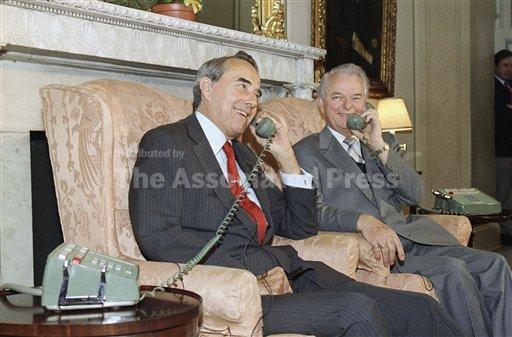
Moscow will allow some testing of anti-missile defense systems outside the laboratory. Administration officials say statements made privately indicate Moscow’s position on limiting “Star Wars” is not as demanding as previously thought. The Soviet Union has told U.S. officials it is prepared to allow some research and testing of the “Star Wars” defense system outside the laboratory, the New York Times reported. Quoting unnamed U.S. officials, the paper said the Soviet overtures have come since the Iceland summit last week and suggest that the Soviet attitude on limiting the Strategic Defense Initiative may not be as hard-lined as it first appeared. But questions remain as to what types of tests could be conducted and on the interpretation of the 1972 Anti-Ballistic Missile Treaty limiting research and testing of space-based defenses, the paper said. It quoted State Department spokesman Charles Redman as saying the U.S. would seek to clarify the questions at the Geneva arms talks.
President Reagan’s missile-defense program has made advances in the last two years but has run up against technical and financial barriers that are forcing changes in emphasis and direction. The program, known officially as the Strategic Defense Initiative and popularly as “Star Wars,” has already demonstrated that a missile can be attacked with a defensive weapon and that a target can be tracked in space. It has also helped spur scientific and technological advances needed to produce a defensive system. At the same time, the program has uncovered problems that make the job even more daunting than originally thought. The problems of discriminating real missiles from decoys, of coordinating the whole complex system, of launching its components into space, and of protecting them against an adversary are all proving more difficult than expected.
The White House spokesman, Larry Speakes, continued today to dispute an account by a group of reporters of his description of a Presidential briefing for legislators on American arms control proposals. Mr. Speakes denied that he said President Reagan had misspoken in informing lawmakers of the substance of proposals made to the Russians at the Iceland summit meeting last weekend. Mr. Speakes said that he never used the word “misspoken” and that this was an “inaccurate interpretation” of what he told reporters aboard Air Force One on Friday while Mr. Reagan was flying to Grand Forks, North Dakota. Nonetheless, one of the reporters aboard the plane insisted today that Mr. Speakes had acknowledged that the President made inaccurate statements in the Congressional briefing.
The Soviet Union has published figures on the size of the grain harvest for 1985, after five years of withholding information on the annual grain crop. Figures of the Central Statistical Administration this week showed that 191.6 million metric tons of grain were harvested last year, well below the annual goal of 239 million.
A suspected member of the Abu Nidal terrorist group arrested in London three weeks ago is being questioned by Swedish police in connection with the February 28 assassination of Prime Minister Olof Palme, the London Sunday Telegraph reported. The paper said that the man, a Swedish national, is one of six people arrested three weeks ago by British anti-terrorist detectives and that he was expelled to Sweden. There was no immediate comment from investigators in Stockholm, but police sources have said they suspect a loosely linked, right-wing group of Swedes and foreigners in the slaying. The newspaper said Palme was a friend of Palestine Liberation Organization leader Yasser Arafat, who is a bitter enemy of Abu Nidal.
A proclamation extolling the 1956 Hungarian uprising as “our common heritage and inspiration” was issued today in Budapest, East Berlin, Prague and Warsaw, along with the names of its 122 prominent Eastern European signers. The four-paragraph statement, the boldest open document ever issued in the East bloc, linked dissident writers, anti-totalitarian organizers and human rights activists from four of the six Warsaw Pact allies of the Soviet Union. After weeks of often difficult communications between the countries, the document was issued in time to mark the anniversary of the Hungarian revolt, which began 30 years ago next Thursday. It was quashed after brutal street fighting when Soviet tanks arrived 12 days later.
A week-old political crisis in Belgium suddenly deepened today with the resignation of Interior Minister Charles-Ferdinand Nothomb. Mr. Nothomb had been trying to solve the latest Belgian language conflict and failed. The Government of Prime Minister Wilfried Martens has been jeopardized by a bitter clash between Flemish speakers and French speakers in a town called Voeren near the Dutch border. The town’s Mayor, Jose Happart, was dismissed on Sept. 30 because he refuses to speak Flemish, which is much the same as Dutch. Two-thirds of the 4,700 townspeople speak French.
The man Greeks called a kapetanios returned to Greece after 34 years of exile in the Soviet Union. He is Markos Vafiadis, the legendary guerrilla captain in World War II. He led partisans against Nazi occupation forces during World War II and then, as General Markos, commanded a Communist army for two years in the Greek civil war against the overwhelming odds of American-backed Government troops. Now, after 34 years of enforced exile in the Soviet Union and expulsion as a revisionist from the Greek Communist Party he had helped to form, Mr. Vafiadis is back, aged 80, a kind of Odysseus of the political left, returned to his homeland after years of being blown to far-off places by the ill winds of the age. “I feel I am in my element,” he said at the end of a two-hour interview at a relative’s home on the outskirts of Athens.
The European Community has unveiled a six-year program to incorporate environmental protection into the 12-nation bloc’s economic and social policies. Anthony Fairclough, a senior European Community official, said in making the announcement Friday that the program meant environmental issues were no longer optional on the community’s agenda, but a constitutional obligation.
The Shiite Muslim militia Amal raised the possibility today that it might be prepared to exchange a captured Israeli airman for Lebanese prisoners held by Israel. An Amal official hinted that the flier, who was shot down in a raid over Lebanon on Thursday, could be involved in an exchange for Lebanese prisoners held in the Atlit jail in Israel and in a detention camp at Al Khiyam, in the enclave that Israel calls a “security zone” along its border with Lebanon. Today, the captured airman was reported to have been moved to the Syrian-controlled Bekaa region of eastern Lebanon in an effort to thwart any rescue attempt.
Saudi Arabia moved to break a deadlock at marathon talks in Geneva by agreeing to OPEC limits on oil production and proposing an increase in prices to at least $18 a barrel. In an unexpected shift, Saudi Arabia today dropped its demand for a major overhaul of OPEC’s production-sharing system. The move, in which the Saudi Oil Minister, Sheik Ahmed Zaki Yamani, acceded to the position of a group led by the Iranian Oil Minister, Gholam Reza Aghazadeh, paved the way for the extension of a temporary accord, now in force, that is intended to block a collapse of oil prices. Despite the breakthrough in the 13-day-old talks here, the shift meant that oil ministers from the Organization of Petroleum Exporting Countries fell short of their declared goal of setting permanent production quotas, based on objective economic criteria, for all 13 members. The effect of the move could be a steadying of oil prices worldwide, at least in the short term. Cartel ministers postponed until today a vote on approval of a final statement, extending the conference that began October 6 to a record-breaking 14 days. The powerful Saudis agreed to extend until the end of the year a two-month output ceiling that was due to expire October 31.
Britain deported 55 Bengalis out of about 3,500 Asians who entered the country just before enactment of a visa requirement for people from the Indian subcontinent. A spokesman for the Home Office in London said the 55 were put on a flight for Bangladesh because, although they were entering Britain as tourists, investigators found that they intended to take up residence. The spokesman said that 270 other newcomers from India, Pakistan and Bangladesh were being held for processing. Visas will also be required of visitors from Ghana and Nigeria, beginning later this year.
Queen Elizabeth sailed from China today, ending a weeklong visit that the Peking Government called a success despite controversy over the Duke of Edinburgh’s description of the capital as “ugly” and the Chinese people as having “slitty” eyes. The Queen, the first British monarch to visit China, and her husband left Canton’s port of Huangpu in darkness tonight aboard the royal yacht Britannia.
The South Korean Government was reported today to have pledged a crackdown on leftist dissidents. In the capital, witnesses said, about 2,000 anti-Government protesters clashed with riot policemen, who fired barrages of tear gas. The opposition New Korea Democratic Party, meanwhile, said it would step up its campaign for a new constitution and fight for the release of one of its lawmakers, who was arrested Thursday.
Defense Minister Juan Ponce Enrile, who has been in increasingly open conflict with his Cabinet colleagues, said today that he was considering the possibility of resigning in response to their criticism. His statement came during a tour of three southern islands that seemed to mimic some elements of a simultaneous swing by President Corazon C. Aquino through two neighboring islands. In his speeches to military and civilian audiences in Cebu, Jolo and this city in southern Mindanao, Mr. Enrile questioned the President’s policy of negotiating with Communist insurgents, calling it “simplistic and naive.” “Because of what I’m doing today, many of my colleagues in the Cabinet have been asking for my resignation,” he told a gathering of top officers of the southern military command.
Economic troubles and other problems in Mexico appear to be severe enough that the United States must worry about the possibility of social unrest and political instability there, according to American experts in and out of Government and Mexican officials and scholars. Interviews with more than two dozen American experts and reporting from Mexico found agreement that the foundation of the Mexican Government was being eroded by its failure to curtail pervasive corruption, drug trafficking and electoral fraud. A wide range of Mexican intellectuals, scholars, writers and Government officials concur that their country is in serious trouble and say its turmoil is likely to have a growing effect on relations with the United States. Mexico’s difficulties have created concern in Washington, not least because of the country’s strategic location. Since World War II, the United States’ ability to play an active role in world affairs has been premised on the knowledge that its 1,952-mile border with Mexico was secure. Serious problems in Mexico could force the United States to reassess its strategy and refocus its foreign policy.
The last imprisoned member of a United States-sponsored force that launched the Bay of Pigs invasion of Cuba in April 1961 was released from jail in Havana and arrived here today. The man, Ramon Conte Hernandez, 56 years old, who fought with the 2506 Brigade, was freed at the request of Senator Edward M. Kennedy, Democrat of Massachusetts. Mr. Conte, smiling and looking fit, was accompanied on his flight from Havana by his mother, Maria Hernandez Ojeda, 81. He was greeted by his wife, Hilda, whom he married in Cuba in 1956, and by family members and many of his brigade friends.
President Daniel Ortega Saavedra condemned President Reagan as an “international outlaw” today for signing a law allowing $100 million of American military assistance to go to Nicaraguan guerrillas. Mr. Ortega also called on all Latin American countries to support Nicaragua against what he called the coming rebel war and said the months ahead would be filled with preparations to defend Nicaragua. “The battle we will wage will be with rifles and millions of Nicaraguans with rifles,” Mr. Ortega said. Mr. Ortega, speaking at a news conference, pledged a mass military mobilization in Nicaragua and said the Government would immediately call for the United Nations Security Council to be called into session. At the United Nations, he said, he would seek condemnation of the $100 million of aid and would also appeal to the Latin American countries that call themselves the Contadora group and are seeking a negotiated settlement in Central America.
While the family of Eugene Hasenfus, the American flier captured in Nicaragua, struggles to rebuild its peaceful rural life, much of this quiet northeast Wisconsin community has plunged in to help. A legal defense fund has been set up at a local bank. A local printer is distributing colored notepads proclaiming, “Free Hasenfus.” High school students offer to run errands for his wife, Sally Hasenfus, a real estate agent who lives with her three children in a rambling lakefront home in the woods about six miles south of here. Neighbors and family care for the Hasenfus home and children.
Foreign Minister Guillermo Bedregal of Bolivia said Friday that about 170 American troops involved in an anti-cocaine drive would begin leaving Bolivia next week. Mr. Bedregal, in Lima for a meeting of the Latin American Economic System, said at a news conference that all the troops would be withdrawn by Nov. 25, leaving Bolivia with five or six Bell helicopters and trained pilots to continue the fight against drug trafficking.
United States weapons experts have accused Cuba of providing the arms found hidden in several caches in Chile recently. The experts say the amount of weapons was too large for Chilean guerrillas to have acquired on their own. In a summary of a study made available to reporters by Reagan Administration officials recently, the experts said the weapons appeared to be part of “sophisticated plans for a protracted conflict, rather than for a series of quick, hit-and-run operations designed to harass” Chilean Government forces. The unidentified experts who prepared the study said about 70 tons of munitions, including more than 3,300 American-made M-16 rifles and more than two million rounds of ammunition, was the largest clandestine leftist arsenal ever found in this hemisphere.
The Operation Rainbow international relief effort has airlifted 232 tons of food and medicine for starving people in southern Sudan, a government official said. Kamil Shawky, high commissioner for relief, said an Indonesian-chartered Hercules C-130 and a French-chartered DC-8, which began ferrying the aid October 12, had transported 179 tons to the government-held southern city of Juba and 53 tons to Isiro, in northern Zaire. The aid flown to Zaire will be trucked across the border into southern Sudan.
Royal Dutch-Shell may have to reconsider its decision to remain in South Africa if worldwide profits suffer because of opposition to apartheid, the head of the oil giant’s operations in South Africa said. John Wilson, executive chairman of Shell South Africa Ltd., told the Reuters news service that he has conveyed this warning to his senior executives. He said the parent company is being seriously challenged over its local operations because of Pretoria’s apartheid policies.
An exhausted 99th Congress completed its business and adjourned tonight, and the lawmakers eagerly headed home for a final stretch of campaigning before the November elections. In reviewing the last two years, Congressional leaders maintained that they had written a solid record of legislative achievement highlighted by major revisions of the nation’s tax regulations, immigration laws and budget procedures. However, the leaders conceded, it was also a Congressional session that had missed most of its deadlines, lapsed frequently into partisan fighting, and sometimes approached paralysis before ending at 9:34 PM. As a result, the lawmakers failed to make a significant impact on reducing the huge Federal budget deficit, which will be the principal issue facing the 100th Congress when it convenes in January. Representative Dan Rostenkowski, the Illinois Democrat who heads the House Ways and Means Committee, offered this epitaph for the 99th Congress: “It’s been tough, but it’s been productive.”
Legislation that would have authorized the Federal Government to spend billions of dollars on transportation programs and would have allowed states to raise the speed limit died today when House and Senate conferees announced they were unable to resolve their differences. With the 99th Congress heading for adjournment, the impasse means that a new surface transportation bill would have to be drawn up next year, if there is no lame duck session after the November elections. Mass transit systems across the country would largely be unaffected by the absence of a Federal surface transportation bill because about three-fourths of the financing of those systems is covered in a continuing resolution approved by Congress. That measure reduces by 2.5 percent the operating assistance that goes to mass transit systems in the nation’s 30 largest cities.
President Reagan, saying that he and his wife had already cast absentee ballots for the election November 4, urged citizens today to “show that you care about America’s future and get out and vote.” “Nancy and I voted last night,” Mr. Reagan said in his weekly radio address. “We won’t be home on Election Day, so we got absentee ballots. We filled them out, signed them and sent them on their way.” “If, like us, you are going to be away on November 4, why not arrange for your own absentee ballot?” Mr. Reagan said in a speech broadcast from the Presidential retreat in the mountains of Maryland. The Reagans’ voting precinct is in Solvang, California, near their ranch in the Santa Ynez mountains. The White House has not announced the Reagans’ plans for Election Day.
President Reagan signs six pieces of legislation into law.
Senator Gary Hart of Colorado continues to be the leading contender for the 1988 Democratic presidential nomination, with no strong challengers apparent at this early stage in the selection process, according to the latest Gallup poll. In simulated head-to-head contests for the nomination, Democrats and Democratic-leaning Independents choose Hart over his nearest rivals by wide margins. Hart currently leads Chrysler Corp. Chairman Lee A. Iacocca by a 2-to-1 ratio, 58% to 29%, with 13% undecided. He beats New York Gov. Mario M. Cuomo by a 54% -29% margin, with 7% undecided.
The California TV campaigns of Senator Alan Cranston, a Democrat, and his Republican challenger Representative Ed Zschau, seem certain to be the second most expensive in the nation’s history, exceeded only by the 1984 race in North Carolina between Senator Jesse Helms and former Governor James Hunt.
Thirty years ago, in the bayous of Louisiana and the cotton fields of Mississippi and other Southern states, it was unthinkable that a black would run for a seat in Congress — never mind stand a chance of winning. And few would have believed that the day would come when blacks, who were by and large barred from voting by well-enforced Jim Crow laws, would be in a position to help determine who wins or loses an election. But it has come down to this: Not only do Louisiana blacks have an opportunity to elect this state’s first black Representative since Reconstruction, but they could also be the decisive factor, if the vote is close, in whether Louisiana will elect its first Republican Senator in more than a century or keep the seat at stake in Democratic hands as the Democrats drive for control of the Senate. Allegations of Intimidation Today, black candidates in Louisiana, Mississippi and several other states are running strong in contests for an assortment of political offices. Moreover, black voters are being courted as never before by Republicans as well as Democrats. History has shown that blacks turn out heavily when there are black candidates.
With amnesty to be a key part of the nation’s new immigration laws, social service agencies are preparing to help an expected steady stream of illegal aliens who will want to prove their right to remain in the United States. Under the new law, aliens in this country illegally who can prove to the satisfaction of the Immigration and Naturalization Service that they arrived earlier than Jan. 1, 1982, may obtain permanent resident status and, eventually, citizenship. For many such people, who are mainly of Hispanic and Asian origin, it will mean the end of an existence under a cloud of anxiety and impermanence, social service officials say. Opponents of the amnesty assert that the reprieve will foster increased flouting of the immigration laws.
The NAACP dedicated its new headquarters in Baltimore, a city that is expected to elect its first black mayor next month. Benjamin L. Hooks, executive director of the National Assn. for the Advancement of Colored People, joined hundreds of distinguished blacks in politics, education and industry in dedicating the office building and grounds of the new complex of the 400,000-member organization, which was founded in 1909 in New York. Flags from all 50 states were presented by a representative of each state. The group said that it moved from Brooklyn, N.Y., because of the high rents and the need for more space.
A staff report by the Senate Special Committee on Aging charged that government health officials have withheld information about health problems associated with reusing kidney dialysis filters. The report said that Department of Health and Human Services officials toned down an article by government epidemiologists on the outbreak of serious bacterial infections among kidney patients at several clinics last spring. The dialysis filters, which are labeled “For Single Use Only” by manufacturers, cleanse the blood of about 78,000 kidney patients. Government officials estimate that as many as 60,000 patients undergo treatment with reused filters, which are cleaned with disinfectants such as formaldehyde.
A 12-year-old boy died in Lexington, Kentucky of a gunshot wound that authorities said was inflicted by a sixth-grade classmate. Keich Newby of Versailles, who was wounded after a football game in Versailles, died at the University of Kentucky Medical Center. Another 12-year-old, whose name was withheld, was charged with first-degree assault in connection with the shooting and released to the custody of his grandparents, said Woodford County Police Detective Ernest Shipp. He said a .38-caliber weapon was found at the scene and that several other youngsters present when the shooting occurred would be interviewed.
Wooden crates with Russian and Spanish writing on the outside and filled with live mortar shells and possibly radioactive materials washed ashore along a 50-mile stretch of Florida beaches, authorities said. Police and Navy officials speculated that the weapons came from the Soviet nuclear submarine that sank off the Bermuda coast October 6 or from a freighter that went down two weeks ago off Lake Worth Inlet. The Palm Beach bomb squad placed the weapons in a bombproof trailer. Sheriff Richard Wille said that between 16 and 20 crates were found.
Arizona officials said they were reluctant to make a televised appeal for a foster home for a 9-year-old AIDS victim, but were flooded with calls and now think the effort will pay off. Jack Stockslager, director of the Arizona Department of Economic Security, made an appeal on a local television station Wednesday for a temporary home for the girl. He said Friday that the agency had received more than 100 calls from people offering to help. The unidentified girl was placed under state care because of her home situation.
A Federal operation involving police helicopters following errant pilots flying in controlled airspace has been postponed because of advance publicity. “The advance notification has compromised the F.A.A.’s ability to come up with good technical data,” Ellie Brekke, a spokesman for the Federal Aviation Administration, said Friday.
The emergence of Savannah and Charleston as the key trading ports along the South Atlantic parallels the enormous population growth across the Southeast over the last decade. Savannah’s port is busier, but both are still growing.
The merger of two airlines in Minneapolis has an A.F.L.-C.I.O. affiliate fighting hard against the International Brotherhood of Teamsters to represent the flight attendants. At stake are $2 million a year in union dues and the right to represent 6,400 employees at Northwest Airlines, the nation’s third largest since it acquired crosstown rival Republic Airlines in August. The teamsters, who represented flight attendants at Northwest before the acquisition, have dispatched 15 organizers to locations from New York to Tokyo and are stuffing flight attendants’ mailboxes with weekly bulletins. The union also sent each worker a copy of a 20-minute videotape in which a series of flight attendants tell how glad they are to be teamsters.
Gary Moy, a Chinese-American teen-ager, was stabbed while in Brooklyn last June by a youth who told him that Chinese “don’t belong in this neighborhood.” In the last two years, there have been numerous assaults on Asian refugees who settled in Massachusetts, such as the case of 40 Cambodians who were left homeless when their building was destroyed by arson in Revere. Businesses owned by Koreans were fire-bombed in nine separate incidents in Washington. Vietnamese fishermen suffered from acts of violence and intimidation in Florida, Texas and California. Hundreds of Hmong refugees who escaped from Laos to settle in Philadelphia have again been forced to flee because of physical and verbal intimidation.
Trouble is following trouble at the Tennessee Valley Authority, the last major landmark of Franklin D. Roosevelt’s New Deal. The three-man board of directors of the Government-owned public power agency, facing such major problems as the shutdown of all five T.V.A. nuclear reactors and numerous safety deficiencies, thought it was solving its problems in January by hiring a tough “nuclear czar” from outside the agency. But late Friday afternoon, the salvage program undertaken by that “czar,” Steven A. White, a recently retired admiral of the nuclear Navy, and his temporary cadre of highly paid consultants, began to flounder, itself. Admiral White announced he was taking a leave of absence because of continuing questions about personal conflicts of interest. Charles C. Mason, a deputy, was named acting nuclear manager.
A blast of cold air swept down from Canada across the Great Lakes and Ohio Valley and into the Northeast. As the cold moved east, temperatures dipped to the 20s and 30s from the Great Lakes to New England, with Alpena, Mich., reaching 21 degrees, which tied its record low temperature. Rain showers were scattered from Idaho across northeast Nevada, Utah and southwest Wyoming. In Missouri, two disaster aid centers for the victims of heavy flooding were opened in St. Charles County.
Alaskans are recovering from floods last weekend. A food drop for 500 sled dogs trapped with their owners in the flooding that forced hundreds of people from their homes across south central Alaska was provided by volunteers. They also dropped food for the dogs’ owners.
“Fleetwood Mac” member Christine McVie (43) weds Portuguese keyboardist Eduardo Quintela; they divorce in 2003.
Former NFL player and television broadcaster Frank Gifford (56) marries 3rd wife Kathie Lee Johnson (35).
Major League Baseball, World Series, Game 1:
Just as they did against Houston in the National League Championship Series, the Mets opened the World Series by taking a 1–0 defeat. Boston’s Bruce Hurst dominated the Mets with his forkball and looping curve, allowing only four hits over eight innings to get the win. In the bottom of the sixth, Hurst got Ray Knight to ground into an inning-ending double play and thwart a scoring opportunity for the Mets. New York’s Ron Darling was equally effective, yielding only one unearned run in the seventh inning when second baseman Tim Teufel committed an error by letting a ground ball from Rich Gedman go through his legs, allowing Jim Rice to score from second. Red Sox closer Calvin Schiraldi, acquired from the Mets in the previous offseason, walked Darryl Strawberry to lead off the bottom of the ninth inning. However, Schiraldi got Knight to force out Strawberry at second base and then got Wally Backman to fly out to left field. With two outs, Danny Heep pinch hit for Rafael Santana. Schiraldi worked Heep to a 2–2 count and then struck him out swinging to solidify the victory. Mets’ legend Tom Seaver, now a member of the Red Sox, received a standing ovation from the Shea Stadium fans during the Game 1 introductions. Seaver did not pitch in the series because of a knee injury.
Boston Red Sox 1, New York Mets 0
Born:
Wilma Elles, German actress, model and fashion designer, in Cologne, West Germany.

