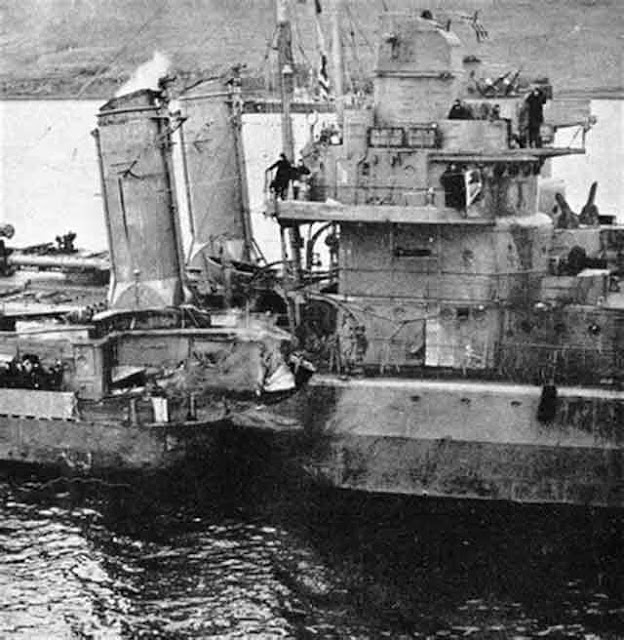
American destroyer USS Kearney (DD-432), escorting Allied convoy SC.48, was damaged by a torpedo from German submarine U-568 off Iceland at 0200 hours, killing 11 American navy men. Kearney suffered a direct hit from U-568 on the starboard side, but damage control limited flooding to the forward fire room enabling the ship to leave the danger area with power from the aft fire room. Regaining power in the forward fire room, Kearny, escorted by USS Greer (DD-145), the damaged Kearny proceeds to Hvalfjordur, Iceland at 10 knots, arriving 19 October. There she will undergo temporary repairs alongside repair ship USS Vulcan (AR-5) and get underway on 25 December 1941 for Massachusetts for permanent repairs.
Pursuant to President Roosevelt’s standing orders for U.S. Navy warships to protect convoys in the North Atlantic, the 1,630-ton destroyer USS Kearny (DD-432) is sailing with Convoy SC.48 south of Iceland when disaster strikes. During the night, U-568 (Kptlt. Joachim Preuss), on its second patrol out of St. Nazaire, spots Kearny illuminated by the fires of a burning freighter. Captain Preuss fires one torpedo that strikes Kearny in the starboard forward fire room (roughly amidships). Quick action by the Kearny’s crew seals off the flooding, but the ship sustains heavy damage.
Fortunately for the men of the Kearny, the fire room and engine room are separate, and they can use another fire room in the rear of the ship. Thus, it retains engine power despite the damage. The Kearny, under escort by USS Greer (DD-145), makes it safely back to Hvalfjordur, Iceland on the 19th, and then at the end of the year to Boston for repairs. There are 11 deaths and 22 injured, the first combat deaths for the U.S. Navy since World War I. U-568, meanwhile, survives a brief depth charge attack by HMCS Pictou and then escapes on the surface into the night.
The Kearny incident reflects the greatly increased (and controversial) role of U.S. Navy ships in the North Atlantic during 1941. The Kearny actively engaged in attacks on U-boats upon arriving at Convoy SC.48 on 16 October, dropping depth charges throughout the morning of the 17th. Thus, it “began hostilities.” The entire incident reflects the murky nature of U.S. involvement in World War II in October 1941, as the United States is not at war and at least arguably should not be engaging in military actions unless it wants to be at war. There are strong arguments of every side of questions like this: in brief, the U.S. maintains that it has a right to keep open its sea lanes and protect its ships, while German views peacetime U.S. military support of England as violating international law. There is nothing that the Reich can do to retaliate directly against the United States following this incident, or vice versa, short of declaring war. However, Hitler does hold a grudge, while Roosevelt decides that now is not the time to declare war. Active U.S. Navy participation in convoy protection is a very sensitive political topic both in 1941 and later.
Some feel that Roosevelt purposefully putting warships in harm’s way is a deliberate provocation. Hitler certainly does. He learns about the entire incident, either through the United States media, his spies, or codebreaking activities. Along with other incidents, he specifically mentions the Kearny incident — highlighting its participation in attacking the U-boats, of course — during his declaration of war on the United States on 11 December 1941.
In the center of the German advance on Moscow, Paul Hausser’s SS-Infanterie-Division (mot.) Das Reich and the attached “Hauenschild Brigade” of 10th Panzer Division batter against the defending Soviet 32nd Siberian Rifle Division from Vladivostok. The battle along the two parallel highways to Moscow (the Minsk and Moscow Highways) takes place at Borodino Field, site of the 1812 Napoleonic battle won by France at great cost. Just as at that earlier battle, the invading force pushes back the heroic defenders after fierce fighting. The Soviet troops fall back on Mozhaysk, the anchor of the main defensive ring around Moscow. The Stavka, alarmed by the continued German advance against elite troops, beings pulling troops north from Ukraine for the defense of Moscow.
German troops captured Taganrog in southern Russia, a port city on the Sea of Azov.
Stavka formally established the Kalinin Front under Ivan Konev.
Berlin police worked all last night searching Jews’ homes for food, tobacco and money, it was reported today, and a considerable number of Jews were said to have been arrested. Jews were being evicted from apartments in Berlin and other cities, reportedly to make room for “Aryan” families whose homes were destroyed by air raids. Jews are forbidden to seek new apartments, but must report to Jewish community authorities who tell them where to go, it was reported. Many Jews arrived today from the Rhineland and they, together with a considerable number of Berlin Jews, will be transferred to Poland or elsewhere in Eastern Europe. The number mentioned in the transfer is 20,000.
The German propaganda ministry declared Luxembourg Judenfrei, “Free of Jews”.
The first transport of deported Czech Jews departed for various locations in Eastern Europe.
Seventeen more Czechs have been executed for high treason, possessing guns and sabotage, it was announced today. Most of them were small business men or peasants. Eight were sentenced to be shot at Bruenn for high treason and possessing arms; five, including three Jews, were sentenced to be hanged at Prague for sabotage, and four more were sentenced to be shot at Prague for treason and possessing arms. The Bruenn and Prague courts have turned over fifty-five more cases to the Gestapo, it was reported, and have acquitted one person.
German submarine U-97 attacked a small Allied convoy 50 miles west of Alexandria, Egypt at 0325 hours, sinking Greek ship Samos (31 killed, 3 survived) and British tanker Pass of Balmaha (all 20 aboard were killed).
British cruiser HMS Latona and destroyers HMS Jackal, HMS Havock, and HMS Nizam departed Alexandria, Egypt for Tobruk, Libya.
In a long, brutal day at sea, seven ships of convoy SC.48 are sunk, and U.S. Navy destroyer USS Kearney is damaged by a German torpedo.
RAF Bomber Command, Day of 17 October 1941
12 Blenheims on an uneventful sweep off Cherbourg.
U-432, commanded by Oberleutnant zur See Heinz-Otto Schultze, sank Panamanian steamer Bold Venture (6595grt) and Greek steamer Evros (5283grt) in 57N, 24-30W and Norwegian tanker Barfonn (9739grt) in 56-58N, 25-04W from convoy SC.48. Between 0342 and 0346 hours on 17 Oct 1941, U-432 attacked three ships in convoy SC.48 while moving on the surface between the seventh and eight columns, first hitting the Bold Venture in station #91 with one torpedo. At 0343 hours, a spread of two torpedoes missed a ship in the eight column but one hit was claimed on a ship beyond which is not confirmed by Allied reports. The U-boat then fired its stern torpedo and sank Evros in station #63.
The Bold Venture, armed with one 4in and two machine guns, had originally been in station #94 but changed to #91 after the ships ahead of her were lost or straggled from the convoy. She was hit by the torpedo on port side aft, setting the cargo of cotton on fire, collapsing the mainmast and breaking off the poop which caused the ship to sink by the stern within 10 minutes. The survivors were picked up after two hours by HMCS Wetaskiwin (K 175) (LtCdr G.S. Windeyer, RCN) and landed in Reykjavik on 24 October. The 3,222 ton Bold Venture was carrying cotton, iron, steel, copper, and wood and was bound for Glasgow, Scotland.
The Evros was hit amidships by the torpedo, broke in two and sank immediately due to her heavy cargo. There were no survivors despite initial reports that two had been rescued, apparently a mistake in name when two men from Erviken were picked up. The 5,283 ton Evros was carrying iron ore and was bound for Ardrossan, Scotland.
After sinking two ships in convoy SC.48 from within the columns on 17 Oct 1941, U-432 spotted Barfonn (Master Erling Ellingsen Vorberg) in station #53, headed towards her and fired the last loaded torpedo at 0400 hours. The tanker was hit on starboard side in the after part of the engine room, stopped and abandoned by the master and most of the crew in three lifeboats when settling quickly by the stern. The first mate, first engineer and four men remained aboard to save the ship, but in the meantime the U-boat reloaded one of its torpedo tubes while circling the disabled vessel and fired the coup de grâce at 0448 hours. The torpedo hit on the port side amidships under the bridge and ignited the cargo, illuminating the whole area and causing the tanker to capsize and sink with only the forecastle remaining above water. About 30 minutes later, the master, 22 crew members and one gunner (the ship was armed with one 3in and two machine guns) in the lifeboats were picked up by HMCS Wetaskiwin (K 175) (LtCdr G.S. Windeyer, RCN). Only two of the men who remained behind survived by jumping overboard and swimming to a raft. At 0620 hours, they were picked up by HMCS Baddeck (K 147) (T/Lt A.H. Easton, RCNR) which continued to search the area until daylight, but no more survivors were found. 13 crew members and one gunner were lost. All survivors were landed at Reykjavik on 24 October. In the afternoon, the destroyers USS Livermore (DD-429) (LtCdr V. Huber, USN), USS Plunkett (DD-431) (LtCdr W.A. Graham, USN) and USS Decatur (DD-341) (LtCdr J.C. Sowell, USN) passed the area of the night action after they were detached from the convoy and spotted an object that was identified by them as upturned U-boat wreck in 56°56N/24°05W. More likely this was the capsized bow of Barfonn, which was then scuttled by the destroyers with 66 rounds of gunfire. The 9,739 ton Barfonn was carrying gas oil and was bound for Old Kirkpatrick, Scotland.
U-558, commanded by Kapitänleutnant Günther Krech, sank British tanker W. C. Teagle (9552grt) in 57N, 25W, Norwegian tanker Erviken (6595grt) in 56-10N, 24-30W, and Norwegian steamer Rym (1369grt) in 57-01N, 24-20W from convoy SC.48. At 0131 hours on 17 Oct 1941, U-558 fired one torpedo at W.C. Teagle in station #103 of convoy SC.48 and sank her about 600 miles west of Rockall. Erviken in station #104 and Rym in station #85 both slowed down to pick up survivors, the latter actually had to alter course to avoid a collision. At 0149 hours, the U-boat sank the stopped Erviken with a stern torpedo. Seeing this the Rym immediately tried to reach the convoy again at full speed but was chased not only by U-558 but also by U-432 (Schultze), which observed how Krech torpedoed and sank her at 0214 hours.
The W.C. Teagle (Master Harold Redvers Barlow) was hit on the starboard side aft, caught fire and sank suddenly by the stern after 5 minutes before most of the crew were able to abandon ship. Nine survivors were picked up by HMS Broadwater (H 81) (Cdr W.M.L. Astwood, RN (rtd)), but were lost when the destroyer was sunk the next night. Eventually the only survivor was radio operator Norman D. Houston, who rescued himself on a raft, observed Erviken being torpedoed nearby and was picked up by HMS Veronica (K 37) (LtCdr D.F. White, RNR (rtd)) after about 4 hours and landed at Londonderry. The master, 31 crew members and three gunners (the ship was armed with one 4in and six machine guns) were lost.The 9,552 ton W.C. Teagle was carrying fuel oil and was bound for Swansea, Wales.
Erviken (Master Paul Heesch) was hit on the starboard side just in front of the bridge in #2 hold, broke in two and sank within 3 minutes. The ship sank so fast that the crew had no time to launch the lifeboats and the survivors rescued themselves on rafts or clung to debris. After about 3 hours, two men on a raft were picked up by HMS Abelia (K 184) (T/Lt F. Ardern, RNR) which launched a boat and picked up another man from wreckage, but then lost her boat because it became water logged. At the same time HMS Veronica (K 37) (LtCdr D.F. White, RNR) picked up 11 survivors from two rafts and after locating the still drifting wreck of Rym remained in the area until dawn. Two survivors were picked up by HMS Broadwater (H 81) (Cdr W.M.L. Astwood, RN), but were lost when the destroyer was sunk the next night. The survivors were landed at Londonderry, those in HMS Veronica on 19 October and those in HMS Abelia on 22 October. The master and 23 crew members were lost The 6,595 ton Erviken was carrying phosphate and was bound for Liverpool, England.
The Rym (Master Conrad Rustad), armed with five machine guns, was hit by a torpedo on the starboard side between #1 and #2 hatches and broke in two. The forward part was torn away to port and the ship only kept together by the deck cargo of timber with a heavy list to starboard. The bridge and the starboard lifeboat had been destroyed, so 16 survivors abandoned ship in the port boat. The master, the first engineer and three crewmen remained aboard and tried to save the ship. HMS Veronica (K 37) (LtCdr D.F. White, RNR (rtd)) arrived about three hours after the ship was torpedoed, picked up the men in the boat and stayed in the area until dawn. At daylight it became clear that the vessel could not be saved so the five men went aboard the corvette, which rejoined the convoy after scuttling the wreck by gunfire. The survivors were landed at Londonderry on 19 October. The 1,369 ton Rym was carrying timber and was bound for Londonderry, England.
U-568, commanded by Oberleutnant zur See Joachim Preuss, damaged American destroyer USS Kearny (DD-432), which joined convoy SC.48 after escorting convoy ON.24, in 57N, 24W. USS Kearny (LtCdr A.L. Danis, USN) was part of the Task Unit 414, which was detached from convoy ON.24 to reinforce the escort of convoy SC.48 under attack by U-boats southwest of Iceland on 15 Oct 1941. During the night of 16/17 October, U-568 tried to overtake the convoy on its port side for several hours but each time a destroyer with two funnels, identified as of the A or D class, disturbed her approaches and finally a spread of four torpedoes was fired at the warship at 0415 hours. The Germans observed one hit after 1 minute 39 seconds and the subsequent sinking of the destroyer after it broke in two. However, USS Kearny was not sunk by the hit on her starboard side abreast of #1 fire room but she was temporarily disabled because all power had been lost and unable to send a distress signal until 0442 hours. The explosion killed eleven men and wounded 22 others, eight of them seriously. The crew of the destroyer managed to regain power from the after fire room and headed towards Iceland at 10 knots, escorted by USS Greer (DD-145) (LtCdr L.H. Frost, USN) and joined in the evening by USS Monssen (DD-436) (LtCdr R.N. Smoot, USN) coming from Hvalfjordur where the ships safely arrived on 19 October. After temporary repairs alongside the repair ship USS Vulcan (AR-5) she left Iceland to Boston on 25 December for permanent repairs and returned to service on 5 April 1942. The men of the USS Kearney were the first American military casualties of the war.
Corvette HMS Gladiolus (Lt Cdr H. M. C. Sanders DSC, DSC, RD RNR) in convoy SC.48 was sunk by U-553, commanded by Kapitänleutnant Karl Thurmann, in the North Atlantic. On 16/17 October 1941, HMS Gladiolus (K 34) (LtCdr H.M.C. Sanders, DSO, DSC, RD, RNR) was reported missing after a night action fought between five U-boats and the escorts of the convoy SC.48. She was on her station astern of the port wing of the convoy when the U-boat attacks began and disappeared with all hands. The commander, four officers, 59 ratings and one survivor from Empire Heron picked up one night earlier were lost. Between 0000 and 0005 hours on 17 October, U-553 fired three carefully aimed single torpedoes at three different tankers in the port wing of convoy SC.48, but missed. Thurmann assumed that the torpedoes ran too deep, so the fourth torpedo was set to 2 meters depth and fired at a fourth tanker which was seen to explode in a ball of fire after being hit amidships. More likely is that all torpedoes missed their targets because he had underestimated the speed of the convoy, but the last apparently hit HMS Gladiolus by chance astern of the convoy, igniting her magazine and causing her to sink immediately with all hands.
Minelaying cruiser HMS Latona and destroyers HMAS Nizam, HMS Jackal, and HMS Havock, departed Alexandria on the second series of the CULTIVATE operation to Tobruk. The ships returned to Alexandria on the 18th.
U-97 sank Greek steamer Samos (1208grt) and British tanker Pass of Balmaha (758grt), which departed Alexandria, escorted by anti-submarine whaler KOS 19, on the 16th, in 31-14N, 28-50E proceeding to Mersa Matrah for Serial 4 of the CULTIVATE operation. At 0055 hours on 17 Oct 1941, U-97 spotted a small convoy, consisting of the Samos and Pass of Balmaha under escort by HMS Cocker about 50 miles west of Alexandria. The ships formed the 4th convoy for Operation CULTIVATE, the relief of the Tobruk garrison. A first spread of three torpedoes missed at 0217 hours, but a second spread of two torpedoes fired at 0325 hours hit and sank the Samos. The second merchant was sunk with a spread of two torpedoes at 0400 hours.
Twenty-four crew members, three gunners and four British passengers from Samos were lost. The survivors were picked up by HMS Cocker and landed at Alexandria. The 1,208 ton Samos was carrying government stores and was bound for Tobruk, Libya.
The Pass of Balmaha (Master Stanley Kilby Hardy) was hit by one torpedo and disappeared in a flaming inferno, a cloud of smoke and flames was seen rising about 300 meters. The master, 15 crew members and four gunners were lost. The 758 ton Pass of Balmaha was carrying aviation fuel and petrol and was bound for Tobruk, Libya.
A Swordfish of 767 Squadron crashed at Hallom Mill, Frickheim. T/Sub Lt (A) S. J. Carpenter RNVR, died of injuries on the 20th.
Anti-submarine trawler HMS Ophelia, which had been repairing at Akureyri, departed that port for Scapa Flow.
German steamer Paula Faulbaum (1922grt) was lost in a stranding near Stockholm.
Armed boarding vessel HMS Chantala departed Alexandria to carry cargo to Syria.
Submarines HMS Ursula, HMS P.34, and HMS Rorqual departed Malta for operations off Kuriat. Submarine Rorqual was forced to return to Malta with defects.
Convoy PQ.2 departed Scapa Flow at 1630 with steamers Empire Baffin (6978grt), Hartlebury (5082grt), Queen City (4814grt), Harpalion (5486grt), Orient City (5095grt), and Temple Arch (5138grt), escorted destroyers HMS Icarus and HMS Eclipse and minesweepers HMS Bramble, HMS Seagull, and HMS Speedy from 18 to 30 October. Heavy cruiser HMS Norfolk departed Scapa Flow early on the 18th and overtook the convoy, joining for ocean escort. Destroyers Eclipse and Icarus refueled at Seidisfjord on the 20th and rejoined the convoy. On the 29th, minesweepers HMS Gossamer, HMS Hussar, and HMS Leda from Archangel joined the convoy and escorted it to Archangel, arriving at 1000/30th.
Convoy ST.6 departed Freetown, escorted by sloop HMS Bridgewater and corvettes HMS Amaranthus, HMS Auricula, HMS Marguerite, and HMS Woodruff. The convoy arrived at Takoradi on the 22nd.
Convoy HG.75 sailing was postponed. Two anti-submarine forces of destroyers HMS Lamerton, HMS Vidette, and HMS Duncan and of sloop HMS Rochester and the 37th Escort Group of corvettes HMS Bluebell, HMS Campion, HMS Carnation, HMS Heliotrope, HMS Mallow, and HMS La Malouine departed Gibraltar to sweep in the western approaches to the Strait.
Convoy SC.50 departed Sydney CB escorted by corvette HMCS Sorel. Corvette HMCS Sorel was detached on the 19th when relieved by destroyer HMCS St. Croix and corvettes HMCS Agassiz, HMCS Alberni, FS Alysse, HMCS Bittersweet, HMCS Collingwood, and HMCS Windflower joined the convoy. Corvette HMCS Windflower was detached on the 20th. Destroyer HMCS Restigouche joined on the 25th. Destroyer HMCS St. Croix on the 26th, and corvettes HMCS Agassiz, HMCS Alberni, Alysse, HMCS Bittersweet, HMCS Collingwood on the 31st. Destroyers HMS Keppel, HMS Rockingham, HMS Sabre, and HMS Venomous, corvettes HMS Alisma and HMS Kingcup, and anti-submarine trawler HMS Lady Elsa joined on the 31st. The convoy arrived at Liverpool on 4 November.
In Washington today, White House announced that President Roosevelt had signed the property requisitioning bill. The Navy Department announced the torpedoing off Iceland of the United States destroyer Kearny.
The Senate was in recess.
The House passed the resolution amending the neutrality act to permit the arming of merchant ships and adjourned at 2:53 until noon on Monday.
A tense, solemn House of Representatives, stirred but not excited by the torpedoing of the United States destroyer Kearny, voted by an almost 2-to-1 majority today to authorize the arming of American merchant ships to protect them and their crews from Nazi “pirates.” The brief but momentous measure, repealing the Neutrality Act’s two-year-old ban on the arming of merchantmen, was sent to the senate by the overwhelming roll call vote of 259 to 138.
President Roosevelt stated today that the United States destroyer Kearny was within the American defense zone when it was torpedoed. He made it clear that his orders to the Navy to shoot on sight at German and Italian raiders operating in waters considered vital to American defense had not been changed. Spending the weekend at his Hyde Park home, the President told reporters attending a regular press conference that within three minutes of his arrival here this morning. Secretary Knox had informed him of the torpedoing of the destroyer. The Executive added that he was in constant telephonic communication with both Secretary Hull and Secretary Knox over wires connecting his estate with the national capital. This information was obtained from Mr. Roosevelt only by questioning. The Executive declined to discuss further at this time either the Kearny incident or developments in the Far East.
Amid growing tension over developments abroad, high administration sources revealed today they were studying a proposed $50,000,000,000 a year “victory program.” While the program Is only In the study stage, it was learned authoritatively that President Roosevelt had ordered the army, navy and office of production management to map out a program that would match the productive efforts of the Germans. The Germans are supposed to be spending more than half of their national income on arms, and $50,000,000,000 a year would be about half the prospective American national income. Officials who revealed these studies, however, cautioned that “there is nothing formal about this,” and pointed out that it has not gone far enough yet to be taken up even tentatively with the budget bureau.
Alfred M. Landon cautioned the Republican party tonight against running interference for a “small group who are using the national defense emergency as a smoke screen for their attempts to build a collective State.” Mr. Landon, in an address broadcast over a National Broadcasting Company chain and delivered before the Second District Women’s Republican Club, reaffirmed his support of national defense, but warned against a “hear-no-evil, see-no-evil, do-no-evil” attitude toward the Roosevelt Administration. “It is not politics from without,” Mr. Landon said. “It is politics and disorganization from within the White House that is obstructing the maximum production of war equipment. While the President has repeatedly proclaimed a national policy of destroying Hitler, we are unprepared for the physical effect of war. The draftees have been in the Army nine months, and we are still the finest unequipped Army in the world. This is no time to be kindly and generous to a Chief Executive who has refused to tell industry, or labor, or even the Army and Navy, what is or may be expected of them. Oh, yes, he is good at making phrases about this country being the arsenal of democracy. But after two years, we are still too much of a papier-mâché arsenal.”
The battle to protect convoy SC.48 continues. SC.48 is the first U.S. Navy-escorted convoy to engage German submarines in battle, but despite the presence of the three modern U.S. destroyers and two flush-deckers — USS Decatur (DD-341) and HMCS Columbia [ex-US destroyer Haraden (DD-183)], and four Canadian corvettes, the enemy torpedoes six ships and an escort vessel in a total elapsed time of four hours and forty-seven minutes. U-432 sinks Greek steamer Evros at 57°00’N, 24°30’W, Panamanian steamer Bold Venture and Norwegian motor tanker Barfonn at 56°58’N, 25°04’W; U-558 sinks British tanker W.C. Teagle at 57°00’N, 25°00’W, and Norwegian steamship Rym at 57°01’N, 24°20’W. U-553 sinks Norwegian steamer Erviken at 56°10’N, 24°30’W, and conducts unsuccessful approach on destroyer USS Plunkett (DD-431). Destroyer USS Kearny (DD-432) is torpedoed by U-568 southwest of Iceland, 57°00’N, 24°00’W; 11 of Kearny’s crew are killed, 22 injured (see 18 October). Soon thereafter, U-101 torpedoes and sinks British destroyer HMS Broadwater [ex-US destroyer Mason (DD-191)], at 57°01’N, 19°08’W. Lost on board the British flush-decker are two survivors from Ervinger and nine from W.C. Teagle. Escorted by USS Greer (DD-145), the damaged Kearny proceeds to Hvalfjordur, Iceland. There she will undergo repairs alongside repair ship USS Vulcan (AR-5) and eventually return to the United States. Iceland-based PBYs (VP 73) arrive to provide air coverage for SC.48.
Destroyer USS Charles F. Hughes (DD-428) and USS Gleaves (DD-423), while screening convoy HX 154, depth-charge suspicious contacts at 54°40’N, 33°59’W, and 54°40’N, 33°59’W (see 19 October).
Delegates to the annual convention of the American Federation of Labor started for home today after taking action which President Green declared would “strengthen and develop the national defense program and result in carrying out the no-strike policy of the A.F. of L. in a more universal way.”
President Roosevelt was reported today to be hopeful that the Office of Production Management would work out a solution of the problem of jurisdictional disputes which are hampering the defense program. Deeply concerned by reports from William S. Knudsen, director general of the OPM, describing the retardation of defense orders for the Army and Navy by quarrels between unions, the President is understood to have asked for a formula to end such conflicts. Reports from Hyde Park that the President had indicated early action by the OPM on defense strikes caused diverse reactions in Washington.
The successful use of a double-barreled vaccine which simultaneously protects children against diphtheria and whooping cough was reported today to the American Public Health Association at the final session of its annual convention here.
In the U.S., the motion picture “Week-End in Havana” is released today. This musical comedy, directed by Walter Lang, stars Alice Faye, Carmen Miranda, John Payne, Cesar Romero, Sheldon Leonard and Billy Gilbert; Hugh Beaumont (later “Ward Cleaver”) appears in an uncredited bit part. The plot is typical musical fluff with Payne taking Faye to Havana for business purposes where they meet night club singer Miranda.
General Tojo Hideki becomes Japanese Premier after the Konoe Government resigns. A memo for the U.S. Joint Chiefs of Staff states, “Any cabinet selected by General Tojo may be expected to have Axis leanings but will be otherwise anti-foreign and highly nationalistic.” Tojo formed and swore in a new Japanese Cabinet today, with himself as Premier, War Minister and Home Minister and Shigenori Togo, former Ambassador to both Berlin and Moscow, as Foreign Minister of a government reported pledged to pursue a strong foreign policy.
The Foreign Ministry in Tokyo sends a telegram to the embassy in Washington, DC, which includes the following: “The resignation was brought about by a split within the Cabinet. It is true that one of the main items on which opinion differed was on the matter of stationing troops or evacuating them from China. However, regardless of the make-up of the new Cabinet, negotiations with the United States shall be continued along the lines already formulated. There shall be no changes in this respect.”
As if to serve notice that it was feeling fit for any showdown in the Pacific, the United States Navy announced tonight that its program of constructing air bases in that vast ocean is progressing very well. Without so much as a mention of Japan, where an axis-minded premier has just been chosen, the official announcement said: “In short, the new Pacific bases program is keeping well apace of the general expansion program of the navy in building up the nation’s two ocean navy to the greatest array of seapower the world has ever seen.”
Admiral Harold Stark, Chief of Naval Operations, informed Admiral Husband Kimmel that in his personal opinion that while he expected Japan to take action sometime in the near future, an attack on Pearl Harbor was not likely. Stark’s equivocations and carefully and politically couched statements helped to contribute to the general confusion in communication between Washington and Pearl Harbor during the approach to Pearl Harbor.
The selection of Lieutenant General Hideki Tojo to head Japan’s new “total war” Government means that Japan intends immediately to attack Russia and risk war with Britain and the United States, the Chinese Foreign Minister, Dr. Quo Tai-chi, said tonight.
Commander in Chief Pacific Fleet (Admiral Husband E. Kimmel) sends two submarines to Midway and two to Wake on “simulated war patrols” (see 26 October).
The U.S. Navy orders all U.S. merchant ships in Asiatic waters to put into friendly ports.
The U.S. began evacuating non-essential personnel from Guam, Mariana Islands.
Colonel H. George, A-4 (supply) under Major General Lewis H. Brereton, Commanding General Far East Air Force (USAAC), sends a request to Hugh Casey, MacArthur’s engineer, to construct housing and messing for one air group at Del Monte, a natural meadow in the Del Monte pineapple plantation on Mindanao.
Resignation of the Prince Konoe Cabinet is causing renewed tension in the Allied part of the Pacific, where it is well realized that even if the new Cabinet masquerades as liberal it could not have been formed without the concurrence of war and navy leaders who would have refused to appoint Ministers for their departments unless the Cabinet as a whole and its policies met with their approval.
Dow Jones Industrial Average: 119.15 (+0.63)
Born:
Jim Seals, American singer-songwriter, guitarist, and fiddler (Seals & Crofts — “Get Closer”, “Summer Breeze”), in Sidney, Texas (d. 2022).
Alan Howard, British rock bassist (Brian Poole & The Tremeloes — “Do You Love Me?”), in Bromley, England, United Kingdom.
Earl Thomas Conley, American singer-songwriter with 18 No. 1 country hits (“Once In A Blue Moon”; “Angel In Disguise”; Too Many Times”), in Portsmouth, Ohio (d. 2019).
Sarita Joshi, actress, in Pune, British India.
Naval Construction:
The Kriegsmarine (German Navy) Type VIIC U-boat U-637 is laid down by Blohm & Voss, Hamburg (werk 613).
The Royal Australian Navy Bathurst-class minesweeper-corvette HMAS Cessnock (J 175) is launched by the Cockatoo Docks and Engineering Co. Ltd. (Sydney, New South Wales, Australia).
The Royal Navy Hunt-class (Type II) escort destroyer HMS Wilton is launched by Yarrow Shipbuilders Ltd. (Scotstoun, Scotland).
The Royal Canadian Navy Fairmile B-class motor launch HMCS ML 054 is commissioned.
The Royal Navy Fairmile B-class motor launch HMS ML 347 is commissioned.
The Royal Navy “U”-class (Third Group) submarine HMS P 38 (P 38) is commissioned. Her first commanding officer is Lieutenant Rowland John Hemingway, DSC, RN.

