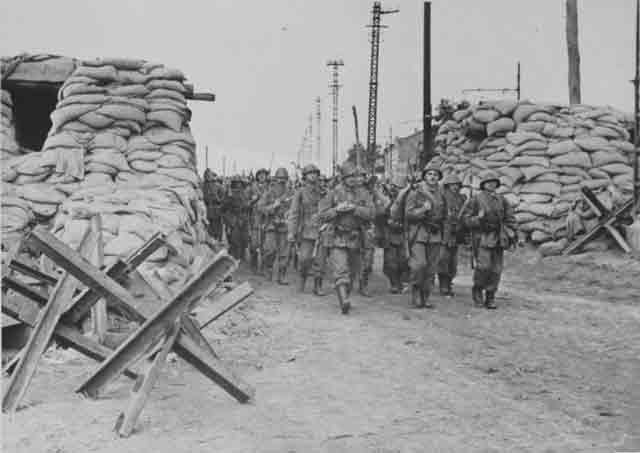
A full 73 days after they began the siege of Odessa, Romanian troops enter the city late in the afternoon of 16 October 1941. They find Odessa empty, the last Soviet evacuation ships having left well before sunrise at 05:10. The fortifications are still there, but many buildings are burning and everything else of value is wrecked. Its defenders had sailed for Sevastopol during the night in a secret evacuation involving 30 ships and 35,000 men. The rearguard was taken on board at 4am. The last man to leave was Captain Makarenko, the commander of the port. Most of the garrison and party officials had already been evacuated, along with several thousand prisoners. All the material that had to be left behind was burnt. The big guns of the 95th Rifle Division were dumped into the harbor.
Both sides justifiably can claim a victory at Odessa. The Romanian 4th Army captures an important port and completes the occupation of Transnistria, their long-desired territory in the East. The Romanians inflict roughly the same number of casualties on the Soviets as they themselves incur (accounts vary wildly, but losses seem to be roughly even). Capturing Odesa solidifies Axis control of the Black Sea coast and provides a useful port to supply the troops operating farther east. It also proves handy for operating warships and warplanes to aid in the eventual capture of the Crimea.
While the Romanians capture the town and thus “win,” the Soviets can claim an important defensive victory. They hold up the Axis advance for over two months during good campaigning season, inflicting 98,000 casualties (17,729 dead, 63,345 wounded, 11,471 missing people) on the Romanians and attached German forces, and escape with their forces almost intact. About 121,000 Soviet troops escape, along with 1000 trucks and 20,000 tons of ammunition. These troops and their equipment will go to good use in their new quarters in Sevastopol, which already is threatened by General von Manstein’s 11th Army. The evacuating troops dump the big artillery guns of the 95th Rifle Division into Odessa Harbor and destroy numerous port facilities and other installations of value to the enemy.
The Romanians, after suffering 98,000 casualties in the siege, are making the most of the Soviet withdrawal: “Troops of our Fourth Army marched into Odessa this afternoon. The last nests of resistance are being cleared up in street fighting. The population greeted German and Romanian forces with enthusiasm.” In fact the Romanian dictator, Ion Antonescu, is so angry at the Russian escape that he has sacked the army’s commander.
It is common to call the Romanian capture of Odessa a “Pyrrhic Victory.” This is because of the length of time that it takes and the number of casualties that the Romanians incur for something they don’t really need and which is of no lasting value. There is no question on either score. The siege lasts much longer than anticipated and casualties are heavy. However, the Romanians don’t really care how long the victory takes, and, to them at the moment, the casualties are worth the gain. Their war aim was to capture Odessa and the nearby region. Having done that, the Romanians consider the war effectively over for their country — with the minor proviso that they continue helping the Germans to defeat the Soviet Union. Of course, the Soviet defeat is a foregone conclusion, so that is a small price to pay.
Having achieved their own war aims, the Romanians immediately begin demobilizing their army. They reduce it in size from nearly 900,000 men to 465,000 by the end of the year. Since this was the plan all along, the German war effort is not really impacted much by the length of time it took to capture Romania. That is, Romania would not have given the Wehrmacht any more help even if casualties had been lighter and the siege shorter because Romania simply would have demobilized its army earlier. So, in that sense, the lengthy siege that leads to the capture of Odessa is not Pyrrhic at all, it is simply tedious.
However, in a larger sense, the Romanian capture of Odessa does have, if not a strictly Pyrrhic effect, a terribly negative impact on the Romanian state for many years. By having joined the Wehrmacht in its war of conquest and gained such a high-profile victory, Romania angers both the Soviets and the Western Allies. Ultimately, Romania winds up at war with both Great Britain and the United States as a result — and, obviously, the Soviet menace never ends, it just temporarily recedes. The reduced military assistance that Romania continues to give to Germany at places like Stalingrad ends very badly, as we shall see. In an even larger sense, Romania’s international reputation is stained for decades by its repressive Transnistria Governate. That territory becomes the scene of horrible events that form an integral part of the Holocaust. The local Romanians pay dearly when the Soviets recapture the city. Of course, hindsight is perfect, but Romania would have been better served by never having joined Germany in Operation BARBAROSSA and never having coveted Odessa.
The German Army advances within 60 miles (96 km) of Moscow.
Over half a million men, women and children complete building new defenses around the city of Moscow — 5,000 miles of trenches, 60 miles of anti-tank ditches and 177 miles of barbed wire.
Molotov has told the foreign embassies that they are to be evacuated to Kuibyshev. The streets are full of charred paper as secret documents are burnt. Party members are tearing up their cards. Pictures of Stalin are being taken down.
There is panic in the air as rumors spread that German tanks are in the suburbs. There is no transport; the buses and taxis have been commandeered to take troops to the front. Some officials and policemen, fearful of what will happen to them if the Germans arrive, are fleeing the city, and looters are taking advantage of their departure. General Zhukov, recalled from Leningrad, is working feverishly to organize a new line of defense. He has ordered the setting up of artillery and anti-tank strongpoint to ambush the German Panzers on their approach routes.
Reinforcements are being rushed to Moscow from other sector. Workers battalions, armed by Moscow’s own factories, are taking their places in the front line. In the midst of all this feverish activity, the Associated Press correspondent has been asked to write a story on Lenin’s tomb. He had time to send one message — “Tomb closed” — before he joined the exodus to Kuibyshev.
Tanks of SS Reich Division and 10th Panzer Division attacked the Mozhaysk Line at Borodino, Russia 125 kilometers west of the Soviet capital of Moscow; lacking infantry support, Soviet troops halted the attacks. While thousands of civilians continued to flee the city, the Soviet government and diplomatic corps moves to Kuibyshev 1,500 miles to the east; Joseph Stalin, however, chose to stay.
German Luftwaffe I./KG 4 was relocated to Pskov (German: Pleskau), Russia.
A large group of Latvian military leaders was executed by the Soviets.
The Soviets executed the wives of Mikhail Tukhachevsky and his fellow accused (and already executed) conspirators.
The Jager Report (issued on 1 December 1941) noted that 382 adult male, 507 adult female, and 257 children, all Jews, were killed in Vilnius, Lithuania for a total of 1,146 people.
A round of mass deportation of Jews from Germany began.
The Jewish population of Lubny and neighboring towns were ordered to report for relocation. The 1,900 Jews who obeyed the order were taken to an antitank trench outside the town and shot.
German submarine U-568 sank British ship Empire Heron of Allied convoy SC.48, 400 miles west of Ireland at 0114 hours; 42 were killed, 1 survived and picked up by escorting corvette HMS Gladiolus (Lieutenant Commander H. M. C. Sanders). Later in the day, however, HMS Gladiolus was lost from an unknown cause.
RAF Pilot Officer A. J. Heyworth was able to return hom to Britain after his Wellington bomber suffered serious damage while bombing Mannheim, Germany. He flew most of the way on only one engine while the other was aflame.
German merchant raider Kormoran made rendezvous with supply ship Kulmerland off Cape Leeuwin, Australia and began to take on fuel and supplies.
Marshal Petain orders the arrest of Daladier, Reynaud, Mandel and Blum, former Prime Ministers of France, together with General Gamelin. They are charged with the French defeat. All three are captured and tried in February 1942. The powerful defense put up by the three so greatly discomfited the Vichy authorities and so irritated the Germans that in April the hearings are suspended indefinitely and the three are handed over to the Germans and held until the end of the war.
RAF Bomber Command, Day of 16 October 1941
12 Blenheims on an uneventful sweep off Cherbourg.
RAF Bomber Command, Night of 16/17 October 1941
Duisburg
87 aircraft – 47 Wellingtons, 26 Hampdens, 14 Whitleys – with 8 further Hampdens carrying out searchlight-suppression flights. The target was cloud-covered and only estimated positions were bombed. 1 Wellington lost.
Minor Operations: 22 aircraft to Dunkirk, 15 aircraft to Ostend. 1 Wellington lost.
U-568, commanded by Oberleutnant zur See Joachim Preuss, sank British steamer Empire Heron (6023grt) from convoy SC.48 in 56-10N, 24-30W. At 0114 hours on 16 Oct 1941, U-568 fired a spread of three torpedoes at the convoy SC.48 southeast of Cape Farewell and hit Empire Heron (Master James Dick Ross) in station #92 on the starboard side with two torpedoes after 88 seconds, causing the ship to sink fast by the stern. A sole survivor was rescued by HMS Gladiolus (K 34) (LtCdr H.M.C. Sanders, DSO, DSC, RD, RNR) astern of the convoy, but he died when the corvette was herself torpedoed and sunk the next night. The master, 33 crew members and nine gunners were lost. The 6,023 ton Empire Heron was carrying sulfur and was bound for Manchester, England.
Light cruiser HMS Edinburgh departed the Clyde for Scapa Flow, where she arrived on the 17th.
Destroyers HMS Laforey and HMS Lightning departed Scapa Flow at 1230 to embark passengers and stores in the Clyde prior to transfer to Force H. The destroyers arrived at 0900/17th.
T/A/Sub Lt (A) A. C. Scott RNVR, was killed in a Hurricane of 759 Squadron which crashed at Yeovilton.
British steamer Edenvale (444grt) was damaged by German bombing off Old Head of Kinsale.
Battleship HMS Rodney, aircraft carrier HMS Ark Royal, light cruiser HMS Hermione, and destroyers HMS Cossack, HMS Forester, HMS Foresight, HMS Fury, HMS Legion, HMS Sikh, and HMS Zulu departed Gibraltar for Operation CALLBOY. On the 18th, eleven Albacore and two Swordfish of the 828 Squadron under Lt Cdr D. E. Langmore were flown off the aircraft carrier to Malta. One Swordfish was lost en route and pilot T/Sub Lt (A) D. M. Muller RNVR, and Observer T/Sub Lt (A) A. S. Denby RNVR were lost. Pilots T/Sub Lt (A) T. G. Davison RNVR, and T/Sub Lt (A) D. J. Dunyan RNVR, and observer A/Sub Lt (A) W. N. Jones RNVR, of 828 Squadron did not depart Ark Royal in CALLBOY, but joined the Squadron at Hal Far later. Force H arrived back at Gibraltar on the 19th. Also, in this operation, light cruisers HMS Aurora and HMS Penelope and destroyers HMS Lance and HMS Lively proceeded to Malta. The cruisers departed Gibraltar at 0515/19th and met the destroyers forty miles off Europa Point. They arrived at Malta at 0915/21st as Force K. British steamers City of Lincoln, Dunedin Star, and Empire Guillemot departed Malta at 1000/22nd to make independent passage to Gibraltar. Force H arrived back at Gibraltar on the 19th.
British steamers Clan Macdonald and Empire Guillemot departed Malta, independently, for Gibraltar at 1000. Steamer Empire Guillemot returned with engine problems. Steamer Empire Guillemot was able to sail on the 22nd.
Convoy ON.27 departed Liverpool. On the 17th, the convoy was joined by destroyers HMS Vanoc and HMS Volunteer and corvettes HMS Campanula, HMS Gentian, HMS Hibiscus, HMS Honeysuckle, HMS Myosotis, HMS Periwinkle, and HMS Sweetbriar. The destroyers were detached on the 23rd. On the 23rd, destroyers HMCS Columbia and HMCS Skeena and corvettes HMCS Brandon, HMCS Camrose, HMS Mimosa, HMCS Shediac, and HMCS Wetaskiwin joined. The original group of corvettes were detached on the 24th. Corvette HMCS Brandon was detached on 1 November and the rest on 2 November when the convoy dispersed.
Convoy HX.155 departed Halifax escorted by corvettes HMCS Drumheller and HMCS Summerside. The corvettes were relieved on the 18th by American destroyers USS Bainbridge, USS Overton, USS Roe, USS Sturtevant, and USS Truxton. The American group was relieved on the 25th by destroyer HMS Volunteer and corvettes HMS Campanula, HMS Gentian, HMS Honeysuckle, HMS Myosotis, HMS Periwinkle, and HMS Sweetbriar. All but corvettes Gentian and Periwinkle were detached on the 30th. The convoy arrived at Liverpool on the 31st.
Today in Washington, President Roosevelt conferred with Secretaries Hull, Stimson and Knox, General Marshall and Admiral Stark on the Far Eastern situation. He received members of the Supreme Court. He sent to the Senate the nominations of Representative J. Joseph Smith to be a District Judge for Connecticut and Brigadier General Dawson Olmsted to be chief signal officer of the Army.
The Senate passed the bill transferring Army construction activities to the Army Engineers Corps, approved a resolution increasing the size of the Defense Investigating Committee, received the Stimson letter explaining the Iceland defense set-up, heard discussion of foreign policy and criticism of the Argentine trade agreement and recessed at 2:23 PM until noon on Monday.
The House debated Neutrality Act revision proposals and adjourned at 8 PM until 11 AM tomorrow,
Evidences of Republican disunity on the question of arming merchant ships multiplied today as the House debated that issue at a session which ran into the night and cleared the way for a final vote, and assured approval, tomorrow. First, Representative Fish, New York Republican, frequent critic of administration foreign policy, announced he intended to vote for the bill repealing the neutrality act’s prohibition against putting guns on merchantmen. Then, Representative Cluett, New York Republican, sharply criticized the opposition he said had, come from a majority of House Republicans to “practically every move made by the president and his advisers in the departments of the army and navy to bring to this country that security which is vital to us and to those who are fighting for us and the principles we espouse.”
The United States Government was calm but determined today in the face of a possibility that ultranationalists, eager for further conquests, might take over direction of affairs in Japan, where the government of Prince Fumimaro Konoe resigned after having been under fire of extremists.
A plea by Senator Wheeler for a seven-man committee to plan for cushioning the national economy against possible dislocations after the war emergency’ touched off a Senate debate today over international affairs. In the course of the discussion Senator Hill of Alabama said he favored taking every step necessary to insure our safety in view of the Japanese situation. In commenting upon the resignation of the Japanese Cabinet and the Japanese newspaper attacks on this country, Senator Hill said: “The situation looks to me to be a very serious one. It looks as though Russia is going to cave in and if that happens Japan is going to move. I am in favor of the United States taking every step necessary in order to take advantage of every possible situation and insure in every way our security.” Senator Hill said it seemed to him “Incredible that Japan would want to fight the United States,” but he added, “we are in a time of incredibility, when Hitler and his Japanese allies are out to conquer the world.”
A priorities violator charged with “bootlegging” scarce materials for non-defense uses was penalized today by Donald M. Nelson, Priorities Director of the Office of Production Management, in the first action of the kind. Mr. Nelson ruled that the Central Pattern and Foundry Company of Chicago would be prohibited until March 31, 1942, from engaging in aluminum operations after it completed current defense orders, which will take from three weeks to a month. The company had “diverted much-needed aluminum from vital defense production,” Mr. Nelson said, to fill orders for “juke box” castings, coin operated machines, railroad coach seat parts, kodak parts and vacuum cleaner castings, “and thereby held up and delayed the defense program of the United States.”
Latin-American countries will get about $150,000,000 in aid for the construction of defense bases and other military purposes if Congress approves the pending Lend-Lease Bill, authoritative quarters said today.
Contending the Consolidated Aircraft Corp. wage dispute was one between management and the government, the A.F.L. machinists executive board tonight decided to hold strike plans in abeyance to permit a settlement in Washington, D. C. The board members at a session attended by Paul Porter, assistant to Sidney Hillman, co-chief of the O.P.M., called upon the membership to remain at work a “reasonable length of time” to give the government ample time to settle the wage differences.
The American Federation of Labor endorsed at its convention today the supplying of “all material and assistance possible” to Soviet Russia, “a people brutally attacked.”
United States troops in Iceland are under their own commander and any attack on that island would be defended by the United States and British troops “by cooperation” rather than through a joint military command, Secretary Stimson informed Senator Vandenberg today in response to the latter’s request to clear up the status of our soldiers there.
Major General George H. Brett, chief of the United States Army Air Corps, said today the Near East war front was being “completely refurnished with American aircraft as rapidly as possible.” He described British pilots as “tremendously pleased.”
Battle to protect convoy SC.48 continues. German submarines U-502 and U-568 reestablish contact before retiring upon arrival of TU 4.1.4 (Captain Hewlett Thebaud). Destroyer USS Livermore (DD-429) sweeps ahead of the convoy, depth-charges U-553; destroyer USS Kearny (DD-432), sweeping astern, drops charges to discourage tracking submarines. Later, U-502 and U-568, augmented by U-432, U-553, and U-558 renew attack upon SC 48. The U-boats commence a determined assault on SC 48 during the night of 16-17 October.
Destroyer USS Charles F. Hughes (DD-428), while escorting convoy HX 154, rescues the only seven survivors of British freighter Hatasu (torpedoed and sunk by German submarine U-431 on 2 October, 600 miles east of Cape Race), at 51°56’N, 35°58’W.
The “Gordo” comic strip by Gus Arriola first appears in newspapers.
A broad denial was issued by Secretary of State Cordell Hull today of charges that the United States Government engineered the coup d’etat that unseated Dr. Arnulfo Arias as President of Panama.
Japanese Prime Minister Fumimaro Konoe submitted his letter of resignation. He recommended Prince Naruhiko Higashikuni as his successor. This action was taken because Konoe had become politically isolated and convinced that the Emperor no longer trusted him and because of increasing tension with his army minister, Lieutenant General Tojo Hideki. Later, Konoe justified himself to his chief cabinet secretary, Kenji Tomita: “Of course His Majesty is a pacifist, and there is no doubt he wished to avoid war. When I told him that to initiate war is a mistake, he agreed. But the next day, he would tell me: “You were worried about it yesterday, but you do not have to worry so much.” Thus, gradually, he began to lead toward war. And the next time I met him, he leaned even more toward war. In short, I felt the Emperor was telling me: “My prime minister does not understand military matters, I know much more.” In short, the Emperor had absorbed the views of the army and navy high commands.”
Prince Naruhiko Higashikuni was recommended by Konoe and Tojo as Konoe’s replacement because it was generally felt that he was the only person who could control the Army and the Navy. Emperor Hirohito rejected this option, arguing that a member of the imperial family should not have to eventually carry the responsibility for a war against the West. Following the advice of his Lord Keeper of the Privy Seal, Koichi Kido, Hirohito chose Tojo, who was known for his devotion to the imperial institution. Hirohito Emperor summoned Tojo to the Imperial Palace and instructed him to form a new government. Tojo was given one order from the Emperor: To make a policy review of what had been sanctioned by the Imperial Conferences. Tojo, who was on the side of the war, nevertheless accepted this order, and pledged to obey. Tojo was promoted to General in order to assume the post of Prime Minister.
The U.S. Navy Chief of Naval Operations sends the following message to the fleet commanders: “The resignation of the Japanese Cabinet has created a grave situation X If a new Cabinet is formed it will probably be strongly nationalistic and anti-American X If the Konoe Cabinet remains the effect will be that it will operate under a new mandate which will not include rapprochement with the US X In either case hostilities between Japan and Russia are a strong possibility X Since the US and Britain are held responsible by Japan for her present desperate situation there is also a possibility that Japan may attack these two powers X In view of these possibilities you will take due precautions including such preparatory deployments as will not disclose strategic intention nor constitute provocative actions against Japan X Second and third addressees (in the Pacific) inform appropriate Army and Naval district authorities X Acknowledge XX
Imposing a rule of strict secrecy, President Roosevelt conferred with top-flight military and foreign affairs advisers for an hour and three-quarters today, while on Capitol hill some legislators predicted that events in the far east might lead to a Japanese-American showdown. The situation in Japan, where the cabinet of Premier Prince Fumimaro Konoe has resigned, and in Russia, where Moscow is half ringed with hammering Nazis, was believed to have been canvassed as the president talked with his advisers.
The first impression in London following news of the fall of the Japanese Government was that the new Cabinet being formed in Tokyo would pursue a policy of more active cooperation with the Axis than its predecessors.
Successful conclusion of Manchukuo-Outer Mongolia border talks at Harbin.
Destroyers USS Peary (DD-225) and USS Pillsbury (DD-227) are damaged in collision during night exercises in Manila Bay, P.I.
Breaking a protracted silence on international affairs, United States High Commissioner Francis B. Sayre told a group of Manila business men today that “gradually the United States is moving closer toward the brink of war.”
U.S. Secretary of War Stimson asks State Department to arrange with Australians for use of airfields in New Guinea, New Britain, and Australia itself.
Dow Jones Industrial Average: 118.52 (-2.00)
Born:
Tim McCarver, MLB catcher (World Series champions, 1964, 1967; MLB All-Star 1966, 1967; St. Louis Cardinals, Philadelphia Phillies, Montral Expos, Boston Red Sox)) and sportscaster, in Memphis, Tennessee (d. 2023).
Mel Counts, NBA center and power forward (NBA Champions-Celtics, 1965, 1966; Boston Celtics, Baltimore Bullets, Los Angeles Lakers, Phoenix Suns, Philadelphia 76ers, New Orleans Jazz), in Coos Bay, Oregon.
Derek David Bourgeois, British composer, conductor and educator (National Youth Chamber Orchestra), in Kingston upon Thames, England, United Kingdom (d. 2017).
Erkki Jokinen, Finnish classical composer, noted for his embrace of the accordion, in Tervakoski, Finland.
Died:
Sergei Efron, 48, Russian poet and military officer (executed).
Harold Fowler McCormick, 69, American businessman.
Naval Construction:
The Royal Navy Isles-class minesweeping trawler HMS Unst (T 213) is laid down by Ferguson Bros. Ltd. (Port Glasgow, Scotland).
The U.S. Navy SC-497-class (110-foot wooden hull) submarine chaser USS PC-649 (later SC-649) is laid down by the Delaware Bay Shipbuilding Co. (Leesburg, New Jersey, U.S.A.).
The U.S. Navy SC-497-class (110-foot wooden hull) submarine chasers USS PC-666 (later SC-666) and USS PC-667 (later SC-667) are laid down by the Weaver Shipyards (Orange, Texas, U.S.A.).
The Kriegsmarine (German Navy) Type VIIC U-boat U-638 is laid down by Blohm & Voss, Hamburg (werk 614).
The Royal Navy River-class frigate HMS Wear (K 230) is laid down by the Smiths Dock Co., Ltd. (South Bank-on-Tees, U.K.)
The Kriegsmarine (German Navy) Type VIIC U-boat U-600 is launched by Blohm & Voss, Hamburg (werk 576).
The Royal Navy Fairmile B-class motor launch HMS ML 339 is commissioned.
The Royal Navy Fairmile C-class motor gun boat HMS MGB 333 is commissioned.
The Royal Navy Isles-class minesweeping trawler HMS Sluna (T 177) is commissioned. Her first commanding officer is Lieutenant Commander Eric William Middleton, RNVR.
The Kriegsmarine (German Navy) Type IXC U-boat U-160 is commissioned. Her first commanding officer is Oberleutnant zur See Georg Lassen.
The Kriegsmarine (German Navy) Type VIIC U-boat U-592 is commissioned. Her first commanding officer is Kapitänleutnant Carl Borm.
The Kriegsmarine (German Navy) Type VIIC U-boat U-703 is commissioned. Her first commanding officer is Oberleutnant zur See Heinz Bielfeld.
The Royal Navy Hunt-class (Type II) escort destroyer HMS Chiddingfold (L 31) is commissioned. Her first commanding officer is Lieutenant Lionel William Lendon Argles, RN.

