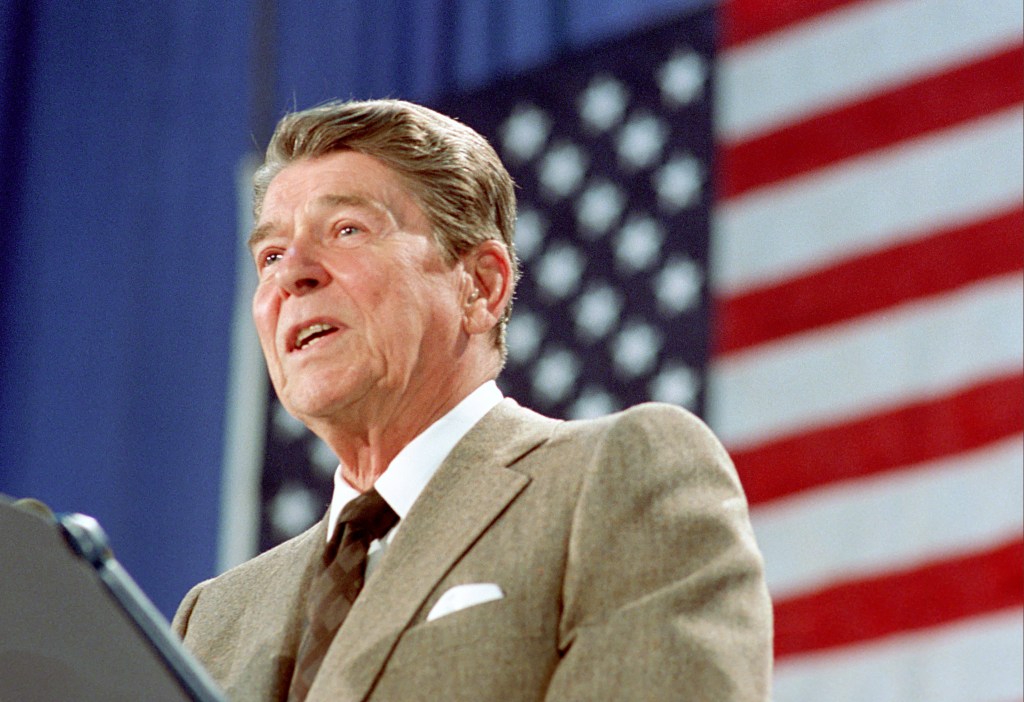
President Reagan today accused what he called “liberals” in Congress of trying to “chop up” the space-based missile defense program and playing into the hands of Mikhail S. Gorbachev. The criticism was the first attempt by Mr. Reagan to use the Iceland meeting as a partisan issue in the election campaign. It came at a rally here for Linda Chavez, the Republican Senate candidate in Maryland. In the meeting last weekend, Mr. Reagan and Mr. Gorbachev reached tentative understandings on a wide range of arms issues, but the talks broke down over Soviet insistence that the American missile defense program be limited to research and testing within the laboratory for 10 years. The President’s remarks in Baltimore were part of a White House effort to deflect domestic and international criticism from Mr. Reagan’s refusal to curb the program.
The Geneva arms talks resumed today, and the Americans characterized the Iceland meeting last weekend as an unexpectedly successful “serious and positive step. Max M. Kampelman, the chief American negotiator, said the United States believed the Iceland talks could help the resolution of the issues under discussion here. In candid and optimistic comments before today’s meetings of the subgroups on space defenses and on strategic arms, Mr. Kampelman said the United States was ready to “formalize” an agreement eliminating medium-range missiles in Europe and reducing them in Asia. He also said the United States would pursue a proposal to eliminate all ballistic missiles within 10 years. But he cautioned that differences remained over the United States’ space-based missile defense program, known officially as the Strategic Defense Initiative and popularly as “Star Wars.”
A Soviet arms negotiator said here today that medium-range nuclear missiles could be removed from Europe without linkage to the United States’ missile defense program. The negotiator, Viktor P. Karpov, referred at a news conference to the agreement in the Iceland talks that all Soviet and American medium-range missiles could be withdrawn from Europe and that these missiles elsewhere be limited to 100 warheads on Soviet missiles in Asia and to 100 on American missiles in the United States. The Soviet position had been that a medium-range accord could be concluded without reference to the dispute over the United States’ missile defense program, known officially as the Strategic Defense Initiative and popularly as “Star Wars.” But in Iceland, the Americans got the impression that all arms issues were now interrelated.
The reductions in long-range, strategic nuclear weapons tentatively agreed to in Iceland would be only 20 to 30 percent over a five-year period, according to arms-control experts. In discussing the Iceland meeting, officials have talked in general terms about a framework for cutting strategic arms by 50 percent in five years. Close examination, however, shows that the cuts would be smaller. While there would be deep cuts in the number of warheads on ballistic missiles, there would be none in the number of bombs and short-range missiles carried by strategic bombers. In fact, the number of bombs could grow.
The American public’s initial reaction to the Reykjavik summit meeting is quite supportive of President Reagan and very optimistic about the future of arms control, a New York Times/CBS News Poll shows. But there was no indication in the survey that this support had translated into advantages for Republicans in the November elections. Voting preferences among the 767 Americans interviewed by telephone Tuesday and on Wednesday morning were unchanged from the views of those same respondents two weeks earlier. Public reactions may deepen or swerve as the issue is debated, but the survey suggested that Mr. Reagan had, at the least, put his stamp on the first impressions in the mind of an American public that rarely focuses intently on foreign-policy issues. The poll was conducted as Administration officials, after President Reagan’s nationally broadcast speech Monday night, have been offering their view of events through dozens of newspaper and television interviews in what they describe as one of their most intense public-relations campaigns.
Former United States arms negotiators said today that President Reagan had missed an opportunity for a breakthrough in Iceland by declining to negotiate with the Soviet Union on the issue of how strictly to interpret the antiballistic missile treaty. They urged Mr. Reagan to reconsider his position and to affirm the traditional interpretation of the 1972 treaty, which sets tight limits on research. The Reagan Administration has said that it is observing the traditional interpretation for the time being. But it reserves the right to shift to a looser interpretation that would allow extensive testing and development of new “exotic” ABM systems, such as space-based lasers.
Days after President Reagan and Mikhail S. Gorbachev parted company in Iceland after appearing to be on the verge of making an arms pact of historic proportions, Administration officials and critics alike are still looking for answers to key questions about that meeting. How did a meeting designed, as both sides said, to give “impulses” to the arms talks explode into a full-fledged bargaining session? Was the Administration prepared for this, what exactly was agreed to, and do the two sides now agree on what was settled and what was not? Further, has the Administration shown that restricting tests of space-based weapons to the laboratory, as Moscow insists, would actually “kill” the Strategic Defense Initiative? Interview With Shultz Perhaps of the most elemental importance, has the Administration explained how it is prepared to maintain security for the United States and its allies in a world without nuclear weapons, in a world where Soviet conventional military superiority might then prove decisive? Secretary of State George P. Shultz addressed some of these questions in an hourlong interview yesterday with senior editors of The New York Times. It was devoted entirely to Mr. Reagan’s two-day meeting with the Soviet leader in Reykjavik last weekend.
Elie Wiesel will go to Moscow next week to meet with officials about a conference on non-Jewish victims of Nazism and to celebrate two Jewish holidays at a Moscow synagogue. Mr. Wiesel, a writer who survived Auschwitz and Buchenwald, won the Nobel Peace Prize Tuesday.
The last of the 25 Soviet diplomats ordered out of the United States as alleged spies have left the country, the State Department announced. Department spokesman Pete Martinez said Moscow completed compliance with last month’s order that it withdraw 25 of its diplomats assigned to the Soviet Mission to the United Nations. The diplomats left on flights that will take them home by way of Western Europe. A U.S. official, speaking on condition of anonymity, said that among the final five to depart were Valery Savchenko, said to be the KGB station chief at the mission, and Vladislav Skvortsov, believed to be the New York chief of the GRU (Soviet military. intelligence).
Lech Walesa and nine other prominent Poles urged President Reagan to lift the remaining U.S. economic sanctions imposed five years ago when Poland declared martial law. Economic assistance from the West is indispensable if Poland is to overcome its economic crisis, said a published statement the 10 signed. Walesa is the founder and former leader of the outlawed Solidarity trade union, which originally backed the sanctions. The group called on Reagan to restore Poland’s most-favored nation trading status and its access to guaranteed financial credits.
France today handed over a suspected top-ranking member of the Basque separatist guerrilla group E.T.A. to the Spanish police, Spanish state television said. It said the Basque, Joaquin Azcarate Echarrondo, was taken into custody at this northern border town. Mr. Azcarate is wanted in connection with five murders and is considered a close ally of the E.T.A. leader Domingo (Txomin) Iturbe Abasolo, deported from France to Gabon last July and now believed to be in Algeria, according to the television report. France has expelled 12 suspected Basque guerrillas since the summer when Prime Minister Jacques Chirac pledged full cooperation with Madrid in its efforts to crack down on political violence in the Spanish Basque region.
A Jordanian accused of trying to blow up an El Al airliner testified today that he thought he was smuggling drugs aboard the plane, not explosives. He also said the Syrian Ambassador here had offered him extensive help after the bomb plot had been uncovered. “Such a thing is against the Arabs,” the defendant, Nezar Hindawi, quoted the Ambassador as saying upon hearing his tale of how hand luggage that Mr. Hindawi insisted contained drugs was found to contain enough explosives to blow up the airliner. “Nobody who is a real human being could do such a thing.”
One person was killed and 65 others were wounded tonight when three hand grenades were thrown at a group of Israeli soldiers and their relatives as they were boarding buses near the Wailing Wall in Jerusalem. The Israeli police immediately arrested 15 Arab suspects and set up roadblocks on many streets in and around the Old City, according to a police spokesman, Rafi Levy. The attack was the most serious in Jerusalem since Palestinian gunmen killed one person and wounded 47 on a street here in April 1984. [ The Palestine Liberation Organization claimed responsibility for the attack through a spokesman in Cairo, Reuters reported. The spokesman said Yasser Arafat, the P.L.O. chairman, had decided to step up military operations inside Israel. Today’s attack occurred at 8:35 PM, just after about 300 recruits of the elite Givati Brigade finished a swearing-in ceremony at the floodlit Wailing Wall, the western wall of the Temple Mount and Judaism’s holiest site.
Israeli leaders continued to quarrel over key jobs in the next government, delaying for a second day Shimon Peres’ promised transfer of power to Foreign Minister Yitzhak Shamir. With the two sides unable to form a Cabinet, Parliament postponed indefinitely a meeting to approve a new government. Peres, caretaker prime minister, met with Shamir but made no progress, aides said. Industry and Trade Minister Ariel Sharon, a leader in Shamir’s Likud Bloc, accused Peres’ Labor Alignment of “trying to extort concessions from us” by holding up approval for key jobs. Under a rotation agreement worked out after an election deadlock in 1984, Shamir is due to become prime minister after Peres’ 25 months in power.
An Iranian airliner was attacked by Iraqi warplanes today as its passengers were disembarking at Shiraz airport, the Iranian press agency said. Three passengers were killed and 30 were wounded in the raid, said the Iranian report, received in London. It said the Iran Air Boeing 727 was discharging passengers at Shiraz, 440 miles south of Teheran, when it was attacked. In Baghdad, a military communique issued earlier said Iraqi warplanes struck at Shiraz air base today, destroying 23 United States-made C-130 transport planes on the ground. The report today was the second in eight months in which Iran said Iraq attacked a civilian airliner. It said a Fokker Friendship craft was shot down by Iraqi planes near Ahvaz in southeast Iran on February 20 and more than 40 people, including a top aide of Ayatollah Ruhollah Khomeini, the Iranian leader, were killed.
President Mohammad Zia ul-Haq raised the possibility today of asking the United States to mount occasional patrols in Pakistani airspace with early warning aircraft that could detect attacks coming from Afghanistan. Such patrols by American aircraft, which he said could not be based in Pakistan, would be a temporary measure that would help Pakistani F-16 fighter planes defend the nation’s borders, General Zia said in a news conference. In the longer run, he said, Pakistan would like to buy its own early warning aircraft from the United States, a request that will feature prominently in discussions on Thursday with Defense Secretary Caspar W. Weinberger, who is leading a team here to discuss a six-year, $1.74 billion military assistance program for Pakistan. The aid would begin in 1988.
Bangladesh held a presidential election today that was boycotted by the opposition to President H. M. Ershad but was still seen as strengthening his grip on the country after he lifts martial law, as he said he intends to do next month. General Ershad has ruled Bangladesh since seizing power in a coup in 1982, but he has now formed his own political party and resigned as army Chief of Staff with the intention of winning a five-year term as the country’s elected President. Because of the opposition boycott, General Ershad was considered certain to be declared victor in the race even before the votes were counted. Early returns this evening showed him receiving 90 percent of the votes against 11 lesser known aspirants.
A former Pentagon official told a House Foreign Affairs subcommittee that the question of American MIAs in Vietnam will never be resolved until Hanoi cooperates fully and U.S. teams can freely search Indochina. Retired Lt. Gen. Eugene F. Tighe Jr., former director of the Defense Intelligence Agency, who headed a panel that examined evidence on whether Americans are still being held prisoner, told the subcommittee there is “a strong possibility” some U.S. captives are still there.
The Vietnamese press agency said today that Chinese forces, backed by the heaviest shelling in months, had repeatedly attacked a Vietnamese village. The agency said that the Chinese were repulsed and that 90 intruders were “wiped out.” The agency, monitored in Bangkok, said about 35,000 artillery and mortar rounds pounded a village in Vị Xuyên district of Hà Tuyên Province Tuesday and that Chinese soldiers attacked the village three times in the early afternoon. The claim could not be independently confirmed. Most Western diplomats believe that while Vietnam and China occasionally clash along their common border, both sides exaggerate the scale of the fighting. The frontier has been tense since early 1979, when China mounted a 17-day, limited invasion of Vietnam because of Hanoi’s invasion of Cambodia and the ouster of the pro-Peking Khmer Rouge Government.
China said the ninth round of Sino-Soviet talks in Peking brought “no substantial change,” although Moscow agreed for the first time to discuss China’s longstanding demand for the removal of three major obstacles to improved relations. The obstacles are Soviet support for Vietnam’s occupation of Cambodia, the Soviet intervention in Afghanistan and the heavy militarization of the Sino-Soviet border. Western diplomats and Eastern European sources said the Soviets displayed more flexibility on these issues this time. Separate Sino-Soviet border talks will resume in February.
The Government of Taiwan said today that it was ready to lift martial law for the first time since Chiang Kai-shek’s forces retreated to Taiwan from mainland China in 1949. The state of martial law would be replaced with less-restrictive security rules. A statement from the ruling Nationalist Party said its 31-member Central Standing Committee approved the new regulations at its regular weekly meeting. It did not say when martial law would be lifted, explaining that time was needed to “legislate and review the regulations.”
A new Philippine constitution approved by a presidential panel this week may produce the first electoral challenge to the eight-month-old Government of President Corazon C. Aquino. The constitution, which was formally presented to the President today, will be put to a nationwide plebiscite in January that is developing into something of a vote of confidence in the Aquino administration. Once in place, the constitution would end the legal limbo in which Mrs. Aquino placed her administration last March when she scrapped the 1973 charter under which she was elected and declared herself the head of a “revolutionary government.” Mrs. Aquino has called the charter the “framework of the house of democracy that we hope to build.”
Elliott Abrams, the Assistant Secretary of State for Inter-American Affairs, repeated his assertion today that the United States Government had nothing to do with the supply flight shot down over Nicaragua on October 5. He told a Congressional subcommittee that the two American crewmen who were killed and the one who was captured were “brave men engaged in the task of helping the people of Nicaragua in their struggle for freedom.” Mr. Abrams was called before the Subcommittee on Western Hemisphere Affairs to answer accusations of Administration involvement in flights delivering weapons to the Nicaraguan rebels, known as contras, who are trying to overthrow the leftist Sandinista Government.
A Congressional investigation into links between the Nicaraguan rebels and the White House has centered on the role played by Robert Owen, a former Senate aide whose business card was found in the wreckage of a downed cargo plane in Nicaragua. More than a dozen people interviewed by the staff of Senator John Kerry, Democrat of Massachusetts, identified Mr. Owen as a key figure in organizing the supply network for the Nicaraguan rebels, also known as contras, according to Dick McCall, an aide to Senator Kerry. A report issued this week by Senator Kerry charges that Mr. Owen was an intermediary between the contras and Lieut. Col. Oliver North, a member of the National Security Council staff. The report also says that staff members of at least one conservative Senator have told Senator Kerry’s aides that they are interested in pursuing the role of Mr. Owen.
South Africa’s Black Sash civil-rights movement has accused the country’s security forces of “indiscriminate brutality and insensitivity” in their handling of the nation’s black youth. In a 33-page memorandum issued Tuesday, the organization, run by white women critical of Government policy, said a “long-term conditioning of whites to regard blacks as something less than human” had contributed to a “bullying abuse of power.” The report cited a series of signed and unsigned statements by black youths who said they had been beaten and tortured in the custody of the police and army. Moreoever, the report accused the security forces of indiscriminately opening fire and said some blacks had disappeared after being detained by the authorities.
Johannesburg’s city council, in an extraordinary political slight to the country’s chief of state, canceled plans to honor South African President Pieter W. Botha. The council’s management committee, deciding that Botha’s policies are too controversial and that he has become too divisive a figure, dropped “with regret” its plans to make him a “freeman” of Johannesburg at a banquet celebrating the city’s centenary next month. The embarrassed committee then canceled the banquet as well.
Three microscope design pioneers won the 1986 Nobel Prize in physics for greatly expanding humans’ ability to peer deep into the smallest facts of nature. The honor went to three Europeans — Dr. Ernst Ruska, Dr. Gerd Binnin and Dr. Heinrich Rohrer.
The 1986 Nobel Prize in chemistry was awarded to two Americans and a Canadian. The recipients are Dudley R. Herschbach of Harvard, Yuan T. Lee of the University of California at Berkeley and John C. Polanyi of the University of Toronto.
The House of Representatives tonight approved a $576 billion comprehensive appropriation bill for 1987 that would restrain the growth of Federal spending. The 235-to-172 vote came after House and Senate conferees agreed this morning on the compromise bill. The Senate is to take up the comprehensive bill Thursday. Prospects for passage there are considered good, Budget writers said that based on the conference agreement, it appeared Federal spending in 1987 would grow as little as 1 percent over 1986. This is far below the 4.5 percent increase in 1986 and well below the average annual increase of 11 percent from 1975 to 1985. The increase would be the smallest since Federal spending actually declined in 1965. The slowdown of spending set out in the measure, which includes the 13 separate appropriations needed to pay for Government operations, will help Congress move toward the $154 billion ceiling for the Federal deficit under the budget-balancing law.
The House approved and sent to the Senate a compromise $18-billion anti-pollution bill designed to continue a cleanup campaign along the nation’s waterways. The lawmakers moved to extend and strengthen the Clean Water Act, providing money to states through 1994 to build sewage and wastewater treatment facilities. While the legislation would end the federal grant program in 1994, a goal sought by the Reagan Administration, it spends three times as much in the interim as the Administration proposed in its budget.
The Senate tonight passed the latest version of an anti-drug bill, stripping the death penalty from the version that passed the House of Representatives last week. The bill passed by voice vote. The unanimity on the floor was the product of a long day of bipartisan negotiations. Senators agreed to overlook deep philosophical divisions on the death penalty for the sake of passing a bill that most of them regarded as an election-year imperative.
Killers of white victims, especially blacks who kill whites, are sentenced to die in such disproportionate numbers in Georgia as to recall the explicit racial discrimination of the slavery era, a defense lawyer argued before the Supreme Court today. In his oral argument on behalf of a black man condemned by a jury to die for killing a white policeman in a robbery, the lawyer, John Charles Boger, urged the Court to strike down Georgia’s death-sentencing process as unconstitutionally infected by racial discrimination. Mr. Boger’s argument, perhaps the broadest attack on the death penalty the Court has heard in the last decade, encountered skeptical questioning from five of the Justices. He said that statistical studies show beyond dispute that “Georgia sentences the killers of its white citizens to death at a rate nearly 11 times the rate at which it sentences killers of its white citizens.”
The Senate confirmed today the nominations of 18 ambassadors under a leadership agreement designed to placate Senator Jesse Helms. The agreement included confirmation of Helen Marie Taylor as a member of the delegation to the United Nations General Assembly. Senate aides said that Senator Helms, a North Carolina Republican, had insisted on Mrs. Taylor’s confirmation as the price for allowing the 18 ambassadorial nominations.
A prep school graduate accused of strangling his girlfriend in New York’s Central Park was charged with committing three penthouse burglaries for money to support his cocaine habit. Robert Chambers, 20, was charged with stealing more than $70,000 in goods, including furs and jewelry, during burglaries in 1985 of three apartments in Manhattan. Chambers has been accused of second-degree murder in the strangulation death of Jennifer Dawn Levin, 18, on August 26. He admitted killing her but said the death occurred accidentally.
A federal judge dismissed a lawsuit filed by two religious denominations and four congregations that accused federal agents of infiltrating church gatherings in 1984 with hidden tape recorders to gather evidence for the conspiracy trial of 11 sanctuary movement workers. U.S. District Judge Charles Hardy, in dismissing the suit in Phoenix, said that “it frankly offends me that the government is snooping into people’s churches” but that “sovereign immunity” protected the Immigration and Naturalization Service and the federal government from prosecution. Eight sanctuary workers were convicted last May 1 in Tucson. All were given probation.
Former FBI agent Robert S. Friedrick personally orchestrated an arrangement with Teamsters President Jackie Presser to block the union chief’s indictment and then flunked a lie detector test about his involvement with Presser, the federal government said. The U.S. attorney’s office disclosed in court papers that Friedrick was found to have been deceptive in many of his answers concerning Presser when he took the polygraph test last January. As an FBI agent, Friedrick in 1985 blocked the planned federal indictment of Presser by saying the union chief had authorization from the FBI to commit illegal acts, the government has charged.
A nuclear plant must pay $310,000 in fines for serious safety violations, the Nuclear Regulatory Commission announced. The agency linked the violations to an explosion that killed a worker at the Sequoyah Fuels Corporation plant in Gore, Okla. The company may appeal the fines.
Southern whites are shifting more and more from voting for Democrats to voting for independents and Republicans. Democrats in some key races are finding it difficult to assemble a biracial coalition essential for their success.
The lawyers for parents who are charging that Alabama pupils are threatened with brainwashing by humanist textbooks rested their case today. An attorney for the state then asked a Federal district judge to quash the lawsuit. The judge, W. Brevard Hand, who is hearing the case without a jury, withheld a ruling on the motion. Charles Coody, an attorney for the State Board of Education, argued that those bringing the suit failed to show that they were unable to practice their religion or that they were discriminated against on religious grounds. But Thomas Kotouc, an attorney for some 600 parents and teachers who brought the lawsuit, urged Judge Hand to rule in favor of those who assert that “secular humanism,” which puts man at the center of the universe rather than God, is a religion permeating some textbooks while other faiths are ignored under the doctrine of separation of church and state.
In Nevada, the authorities today stopped four of six peace activists whose peace group said the failure of United States-Soviet arms talks Sunday gave members a “heightened sense of urgency” to halt a nuclear weapons test set for Thursday. The four were taken into custody after being seen by a helicopter patrol, said Barbara Yoerg, a spokesman for the Department of Energy. They were being detained. The other two protesters were reported to be on the test range. The six headed for the nuclear test site Wednesday after entering the Nellis Air Force Base bombing and gunnery range Tuesday, said Larry Tasaday, a spokesman for the Rocky Mountain Peace Center in Boulder, Colorado. The Nellis range covers about three million acres of land and surrounds the 1,350-square mile test site on three sides. The nuclear device is 2,000 feet beneath the surface of Pahute Mesa, 100 miles northwest of Las Vegas. It is scheduled to have an explosive force of up to 150,000 tons of TNT.
A Philadelphia museum is celebrating its centennial. The University of Pennsylvania’s Museum of Archeology/Anthropology is one of the world’s premier institutions for the study of early human civilization and has a million artifacts.
Six key Navy ships are visiting Seattle after North Pacific maneuvers. Many sailors said the city was not an exciting port of call even though many groups offered them entertainment through a special Dial-a-Sailor telephone number.
In a finding that could revolutionize ulcer treatment, researchers said a bacterial infection treatable with a common drug may be associated with ulcers and gastritis. Dr. Barry Marshall of the Royal Perth Hospital in Perth, Australia, said at a meeting of the American College of Gastroenterology that a recently discovered bacterium, Campylobacter pyloridis, appears linked to the development of ulcers and gastritis. He said studies have shown that bismuth subsalicylate, a non-prescription drug that is an ingredient in Pepto-Bismol, kills the bacterium.
Scientists for the first time have identified a gene that they believe acts to prevent the formation of a cancer in humans. The achievement, reported in today’s issue of Nature, is expected to be important in helping to understand the processes by which cancers arise and why some people inherit a tendency to develop cancers. The research involved retinoblastoma, a cancer of the eye. The findings are also expected to clarify some of the mystery that surrounds the normal processes of cell growth and differentiation.
Scientists have found the gene that causes a common form of muscular dystrophy. The gene is responsible for Duchenne’s muscular dystrophy, which wastes muscles and is eventually fatal.
A red tide of toxic organisms that has killed hundreds of thousands of fish on the Texas coast forced the closing of Corpus Christi beaches and then spread south. A state biologist said a cold front that was expected to stall the red tide that has plagued the Texas coast for seven weeks instead spread it toward the Mexican border.
Three pioneers in microscope design won the 1986 Nobel Prize in physics yesterday for greatly expanding humans’ ability to peer deep into the smallest facets of nature. The honor went to Dr. Ernst Ruska, the German scientist who invented the electron microscope in 1931, and to Dr. Gerd Binnig of West Germany and Dr. Heinrich Rohrer of Switzerland, members of an I.B.M. laboratory in Zurich who in 1981 invented a device that can map surfaces in terms of their individual atoms. The devices stand as monuments at each end of five decades of explosive growth in microscopy. At the same time, the Nobel Prize in chemistry was awarded to two Americans and a Canadian who also created new tools for seeing the processes of the natural world: the chemical reactions that turn one kind of matter into another.
For the 1,000th time in her professional career, Martina Navratilova heard the words “Match, Miss Navratilova,” after she won her first-round meeting with Nathalie Tauziat of France, 6-3, 6-2, yesterday in a Porsche Grand Prix tournament in Fliderstadt, West Germany. In winning the 51-minute match, Miss Navratilova became only the second female player after Chris Evert Lloyd to reach that plateau. Mrs. Lloyd has won 1,143 matches.
Major League Baseball, American League Championship Series, Game 7:
Boston routs California 8–1 in the 7th game of the American League Championship Series and advances to the World Series. With momentum fully on their side in Game 7, the Red Sox loaded the bases in the second off John Candelaria with no outs on an error, single and walk. Rich Gedman’s groundout scored a run and after an intentional walk reloaded the bases, Wade Boggs’s two-run single made it 3–0 Red Sox. In the fourth Dave Henderson reached third on an error, then scored on Spike Owen’s single. After a two-out walk, Jim Rice’s three-run home run made it 7–0 Red Sox, all runs unearned. Dwight Evans’s home run in the seventh off Don Sutton made it 8–0 Red Sox. The Angels scored their only run of the game on Doug DeCinces’s RBI single off Calvin Schiraldi, the run charged to starter Roger Clemens. Schiraldi pitched two innings to close as the Red Sox advanced to the World Series with an 8–1 win after trailing the series three games to one. It was their first pennant in 11 years. The game caps yet another heartbreaking failure for Angels skipper Gene Mauch, who in game 5 was one strike away from reaching his first World Series in 25 seasons as a Major League manager. After the game, veteran second baseman Bobby Grich retires.
California Angels 1, Boston Red Sox 8
Major League Baseball, National League Championship Series, Game 6:
In one of the most famous games in baseball history, the Mets defeated Houston at the Astrodome 7–6 in 16 innings as Jesse Orosco struck out Kevin Bass on a slider for the final out with runners at first and second, and New York advanced to its third World Series in franchise history.
Houston took a 3–0 lead in the first inning against Bob Ojeda with an RBI double by Phil Garner, plus RBI singles from Glenn Davis and Jose Cruz, giving Astros’ starter Bob Knepper an early advantage. They were unable to add more runs as Bass was thrown out at third base following Alan Ashby’s botched attempt to lay down a suicide-squeeze bunt and then Ashby lined out to shortstop to end the inning. That lead held up for most of the game as Knepper was dominant, allowing no runs through the first eight innings. Meanwhile, Ojeda allowed nothing more through his next four frames, after which Rick Aguilera tossed three scoreless innings.
This set the stage for a Mets’ comeback in the top of the ninth that started when Lenny Dykstra tripled against Knepper to lead off. Mookie Wilson singled in Dykstra to cut it to 3–1 and then with one out, Keith Hernandez doubled to score Wilson and end Knepper’s night as the left-hander was replaced by Dave Smith, who walked Gary Carter and Darryl Strawberry. Ray Knight then hit a sacrifice fly to right to score Hernandez and tie the game before Danny Heep struck out swinging with the bases loaded to end the inning. Mets manager Davey Johnson used his bullpen aggressively, as Mike Scott, eventual series MVP, was scheduled to start in Game 7 and nobody on the Mets wanted to face him again. They had scored one run off of Scott in eighteen innings in his previous two outings, and several Mets players have since openly acknowledged that they considered this game a deciding game, playing it more like a Game 7 than a Game 6 because they were playing (despite the cockiness and arrogance that had characterized the team for most of the season) with the barely concealed belief that they would lose to Scott again if it got to Game 7. Roger McDowell came in to pitch for New York and allowed just one hit through five scoreless innings. Meanwhile, Houston pitchers Smith and Larry Andersen held the Mets hitless until the top of the 14th inning when Carter singled, Strawberry walked, and with one out Wally Backman singled off Aurelio López to plate Strawberry with the go-ahead run as Bass’ throw home sailed high. The Mets still had the bases loaded before Wilson struck out to end the threat.
The Mets were now three outs away from going to the World Series, but with one out in the bottom of the 14th inning Billy Hatcher homered off the left-field foul pole against Orosco to tie the game 4–4. However, in the top of the 16th inning Strawberry doubled to lead off against López, followed by Knight’s single that scored Strawberry to put the Mets ahead again. Jeff Calhoun then replaced López and threw two wild pitches, the second scoring Knight to put New York up by two. Dykstra then singled in Backman, who had walked, for a 7–4 Mets’ advantage.
The Mets needed each of those three runs as Houston rallied once again when with one out, Davey Lopes drew a pinch-hit walk, followed by Bill Doran’s single. Hatcher then singled in Lopes to make it 7–5, after which Denny Walling hit into a fielder’s choice for the second out. Davis followed with a single to centerfield that landed in front of a charging Dykstra, that brought home Doran to cut it to 7–6 and moved Walling into scoring position. Now the tying run was in scoring position and the winning run was at first base, and would-be Game 7 starter Mike Scott was waiting in the wings. Orosco, opposite Kevin Bass, eventually found himself at a full count. A strike away from a pennant, and simultaneously a misplaced pitch away from loading the bases, Orosco struck out Bass to end the threat, the game and the series and sent the Mets to a World Series duel with the Boston Red Sox, winning them their first pennant in 13 years. According to Orosco, prior to the at-bat against Bass, Keith Hernandez ordered him to throw nothing but breaking balls to Bass, telling Orosco, “If you throw another fastball, we’re gonna fight.”
Orosco pitched three innings for his third win of the series, marking the first time a reliever had won three games in a postseason series. The time of the game was 4 hours and 42 minutes and the 16 innings was the most that had been played in a postseason contest at that time. The Mets and Astros had also played a 15-inning contest that lasted 5 hours and 29 minutes during the regular season, which Houston won 9–8. In 2011, MLB Network ranked this as the fifth greatest game of the preceding 50 years. This was the last game in which the Astros wore their “tequila sunrise” (or “rainbow guts”) uniform top, which the franchise introduced in 1975 and became one of the most iconic, if infamous, uniforms in MLB history. The Astros demoted the tequila sunrise top to alternate status in 1987, and instead designated a white version of their restrained cream-colored road top as the official home top.
New York Mets 7, Houston Astros 6
A flurry of buying in the last hour of trading yesterday gave Wall Street its best gain in a month and a half. The result was a 31.49-point rise in the Dow Jones industrial average, to 1,831.69. It was the best single-day increase since the blue-chip barometer rose by 38.38 points on Sept. 4. Volume increased substantially from recent depressed levels.
Dow Jones Industrial Average: 1831.69 (+31.49)
Born:
Connor Barwin, NFL defensive end (Pro Bowl, 2014; Houston Texans, Philadelphia Eagles, Los Angeles Rams, New York Giants), in Southfield, Michigan.
Kentwan Balmer, NFL defensive tackle and defensive end (San Francisco 49ers, Seattle Seahawks, Washington Redskins), in Ashoskie, North Carolina.
Paul Walter Hauser, American actor and comedian (Black Bird), in Saginaw, Michigan.
Lee Donghae, Korean singer (Super Junior), in Mokpo, South Korea.

