Kalinin Falls
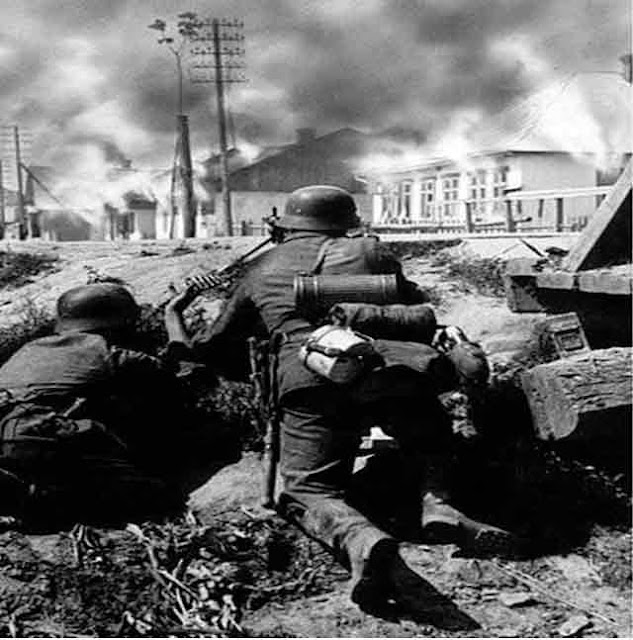
Operation TYPHOON, the German attack on Moscow, has transformed into an attempt to envelop the city by 14 October 14, 1941. The Soviets are hastily assembling their remaining Western Front troops and those finally arriving from the East in a defensive ring anchored on Mozhaysk (Mozhaisk) on the high road to the Soviet capital. Rather than try to batter their way into the city, the Germans instead are sending their panzers to the northeast and southeast. This is part of an increasing German pattern of focusing their advances only where the Soviets have the fewest defensive forces and not actually confronting them where they are strong, a tendency that will get them in trouble in 1942.
The Germans make good progress, but there’s a problem: the distances are immense. An advance of hundreds of kilometers against fierce opposition is necessary to encircle Moscow, and there are many natural features that favor the defense. Nevertheless, the Wehrmacht is off to a good beginning today. The 1st Panzer Division under the command of Generalleutnant Walter Krüger skirts the Soviet defenses and advances an astonishing 75 miles (120 km) to take Kalinin (Tver), an important city on the main Moscow-Leningrad road. This is an extraordinary achievement after going cross-country from the south, it still leaves the panzers 93 miles (150 km) away from Moscow. This advance also cuts the Moscow-Leningrad railway, but Army Group North already did that in September. These sorts of achievements look great in the abstract, but they do not actually achieve anything significant — they simply set the stage for achieving something eventually. When that will be, or rather if that will be, remains very much in doubt.
Krüger’s troops also capture a bridge across the Volga and establish a small bridgehead on the north bank. This not strategically important — it does not really aid the advance on Moscow — but it conceivably could aid an advance further east using the Volga as a shield to the south against flank attacks. It is symbolically important as the only intact bridge over the Volga that the Germans ever seize, either here or much further south in the Stalingrad area. However, on the all-important Smolensk highway to Moscow, The Soviet 32nd Siberian Rifle Division from Vladivostok is dug in now and armed to the teeth. It incorporates three infantry regiments and two armored brigades newly equipped with T-34s and KV-2s. This unit is only there because of the work of master spy Richard Sorge in Tokyo, who gave Stalin the information that led to its redeployment to the west.
While the general German plan now is to encircle Moscow, SS-Obergruppenfuhrer Paul Hausser probes the Soviet defenses at Borodino with his SS-Infanterie-Division (mot.) Das Reich and the attached “Hauenschild Brigade” of 10.Panzer Division. He gets an unpleasant surprise, as the Siberian troops are warmly attired, including fur caps, and amply equipped with the multi-purpose 7.62-cm gun that has proven extremely effective along with the Katyusha mortars (called “Stalin’s organs” by the Germans due to their distinctive sound). While the Germans already are familiar with the T-34s and KV-2s, for the first time the Soviets deploy them in mass formations. The Germans take heavy casualties, and commander Obergruppenfuhrer Hausser himself suffers a serious wound to his right eye that forces him to wear a patch over it for the remainder of the war. However, the panzers’ momentum proves unstoppable at this time, and they force their way through a key part of the Siberian line. Fighting continues at Borodino Field, but the Germans appear poised to overcome the Soviet defenses and continue moving east toward Moscow.
Overall, it is another good day for the Wehrmacht. The panzers blast through to new gains. However, the strength of Soviet resistance after almost four months of constant fighting is troubling. The presence of fresh and well-armed Soviet troops at the gates of Moscow is unexpected, and the vast distances that must be covered just to be in a position to attack are causing greater wear and tear on the panzers than in the past. The temperatures around Moscow are right around freezing, and the first heavy snowfall at Leningrad turns the entire area white. The lack of anti-freeze for vehicles forces the Germans to make a hard choice: they can either drain their radiators at night and hope that their vehicles don’t freeze solid, or run them periodically throughout the night to keep them warm and thereby waste fuel and give the enemy an extremely easy way to know where they are. For now, the problem is not acute, but it is getting worse every day as the temperature drops.
The partisan threat in the Soviet Union remains fairly muted as the panzers appear poised for victory. However, the rapid German advance has left many bypassed Red Army formations intact in between the roads. Today, the Germans begin Operation KARLSBAD to pacify the region between Smolensk and Minsk in the vicinity of Orsha and Vitebsk and along the Berezina River. These Soviet units, some of which include tanks and airplanes, are no match for a determined German offensive, but the Germans front is far to the east and focused on Moscow, not Orsha. Partisan operations prove extremely difficult because the Wehrmacht simply doesn’t have the spare infantry to enclose large areas under partisan control. Still, the attempt must be made, and Operation KARLSBAD is just the first of many anti-partisan operations that usually achieve little but must be attempted due to the vulnerability of German supply lines.
The Soviet troops in the Bryansk pocket in Russia were eliminated (50,000 captured), while the Vyazma pocket was within days of the same fate. In Berlin, Germany, Adolf Hitler ordered that the Soviet capital of Moscow was to be enveloped, not attacked directly. Meanwhile, in Moscow, Joseph Stalin briefed 23 senior Soviet military and civilian officials between 1530 and 1815 hours on a plan to evacuate the city in an orderly fashion; he ordered four theater groups (Lenin State Theater, Maxim Gorkiy Artistic Academic Theater, Little Academic Theater, and Vakhtangov Theater) to be evacuated first.
Army Group Centre commander Fedor von Bock announces the Vyazma Encirclement was over.
German troops capture Rshev, 100 miles (160.9 km) west of Moscow.
Premier Joseph Stalin calls General Georgi Zhukov, Commander of the Central Front, and asks, “You are convinced we shall be able to hold Moscow? I am asking this with pain in my heart. Answer truthfully, as you are a Communist.” Zhukov assured Stalin that the city would be held at all costs.
The first substantial snow of the season falls at Leningrad. Temperatures in the Moscow area fall hover around freezing. Rain and the subsequent mud slow the German advance toward Moscow.
Germany announced that all Jews within the 1933 border would be deported; these Jews were beginning to be deported to ghettos in Poland, Byelorussia, and Ukraine.
Ordnungspolizei Chief Kurt Daluege signed the first order for the deportation of Berlin’s Jews to the occupied territories of the east.
A new wave of arrests and executions is under way in Bulgaria in the Philoff government’s desperate attempt to stamp out sabotage and disorders in the capital and the provinces, according to foreign military intelligence sources at Ankara tonight.
Prime Minister Winston Churchill in the House of Commons today admitted “anxiety” over the plight of Russia, but refused to make a statement or sanction debate on aid to Russia or the possibility of a British invasion of Europe.
Italian Defence Chief Ugo Cavallero ordered that plans be completed for the occupation of Malta and that special units be trained to participate in the operation.
German submarine U-206 sank British corvette HMS Fleur de Lys (Lieutenant A. Collins; escorting Allied convoy OG-75) 60 miles west of Gibraltar at 0336 hours; 71 were killed, 3 survived and were rescued by a Spanish ship.
RAF Bomber Command, Night of 14/15 October 1941
Nuremberg
80 aircraft – 58 Wellingtons, 13 Whitleys, 5 Halifaxes, 4 Stirlings – were dispatched but conditions en route were very bad with icing and thick cloud. 51 aircraft bombed alternative targets; 14 aircraft claimed to have bombed the Nuremberg area but only one of these, a Whitley, claimed to have identified and bombed its allocated target in Nuremberg. 4 Wellingtons lost.
Nuremberg reports only 3 groups of bombs within the city area, although one of these hit the Siemens factory and destroyed a workshop there; these may have been the bombs of the individual Whitley quoted above. (This was the aircraft of Squadron Leader A. J. D. Snow, of 78 Squadron, which dropped 6 high-explosive bombs. Squadron Leader Snow was killed in a raid on Hamburg on 3/4 May 1942, just after 78 Squadron converted to Halifaxes. His body is buried at Sage War Cemetery, near Oldenburg.) Several houses were also hit in Nuremberg and 6 people were injured.
12 O.T.U. sorties were flown to France; 2 Wellingtons were lost.
German submarine U-553 encounters convoy SC.48 and summons help (see 15-18 October).
Corvette HMS Fleur de Lys (Lt A. Collins RNR), after convoy duty with OG.75, was sunk by U-206, commanded by Kapitänleutnant Herbert Opitz, west of Gibraltar, just as the corvette was preparing to enter harbor. At 0336 hours on 14 October 1941, U-206 fired a spread of three torpedoes at HMS Fleur de Lys (K 122) (Lt A. Collins, RNR) about 55 miles west of Gibraltar. The corvette had escorted the convoy OG.75 to port the day before and was ordered to patrol in the Straits of Gibraltar to search for U-boats that had chased the convoy. One of the torpedoes struck her on port side under the bridge after a running time of 92 seconds, causing the magazine to explode. The ship broke in two and both parts disappeared within a few minutes. The commander, four officers and 65 ratings were lost. Only three ratings, two of them injured, survived the sinking and were picked up after a few hours by the Spanish motor merchant Castillo Villafranca.
The Spanish sailing ship Aingeru Guardakoa was torpedoed and sunk by the U-204, commanded by Kapitänleutnant Walter Kell, in the Bay of Cadiz off Cape Roche in the eastern Atlantic Ocean. At 0045 hours on 14 Oct 1941 the unescorted and neutral Aingeru Guardakoa was torpedoed and sunk by U-204 off Cape Roche in the Bay of Cadiz. As the U-boat was later lost during the patrol the circumstances of this attack are not clear, but it seems the Germans mistook her for a British submarine chaser. At least two torpedoes were fired of which one was seen passing astern by a survivor, who heard a buzz and saw bubbles but thought that it was a shoal of sardines. The ship sank immediately after being hit and the master and four crew members clung to debris until they were picked up the next morning by a fishing boat and taken to its home port Santa Uxía de Ribeira, Spain. The 97-ton Aingeru Guardakoa was bound for Tangier.
Destroyer HMS Lightning departed Rosyth at 0800 for Scapa Flow on completion of boiler cleaning. The destroyer arrived at Scapa Flow at 1730 that day.
Destroyer HMS Active departed Scapa Flow for Hull at 1000 to carry out refitting. The destroyer arrived at 1310/15th.
Destroyer HMS Icarus departed the Humber at 1555 for Scapa Flow after refitting. The destroyer arrived at Scapa Flow at 1745/15th.
Minesweepers HMS Harrier, HMS Halcyon, HMS Salamander, and HMS Britomart departed Archangel for Seidisfjord.
Submarine HMS Tigris unsuccessfully attacked German steamers Minona and Tugela and Norwegian steamer Havbris in 71-05N, 27-10E.
British drifter Forerunner (92grt, T/Skipper W. Harmon RNR) was sunk in a collision in the Thames Estuary.
German light cruiser Koln bombarded Russian positions on Cape Ristna.
German auxiliary patrol vessel UJ 1709 (fishing vessel Carl Kampf (600grt)) was sunk west of Lister by British bombing.
Corvettes HMS Delphinium, HMS Salvia, HMS Peony, and HMS Erica and anti-submarine whaler HMS Protea rendezvoused off Capa Gata at 0800 and carried out an anti-submarine search of the area.
Anti-submarine whaler HMS Soika and tug C 307 departed Alexandria on serial 1 A of the CULTIVATE operation. The tug returned to Mersa Matruh.
Italian torpedo boat Pleiada was lost at Tripoli after heavy damage from British bombing on the 13th.
Ex-U.S. Coast Guard cutters/escorts HMS Sennen and HMS Totland departed Gibraltar to rendezvous with armed merchant cruisers HMS Wolfe, HMS Maloja, and HMS Ranpura in 42N, 28W and escort them to the UK. On the 15th, destroyer HMS Croome departed Gibraltar to join the escort.
Submarines HMS Unbeaten, HMS Urge, and HMS Upright departed Malta on short notice for an operation off Cape Passero. The submarines arrived back at Malta on the 16th, having sighted nothing but a hospital ship during the operation.
Submarine HMS Unique unsuccessfully attacked a steamer in 40-26N, 14-20E.
Convoy ON.26 departed Liverpool, escorted by destroyers HMS Beagle and HMS Salisbury, corvettes HMS Heather and HMS Narcissus, and anti-submarine trawlers HMS Arab and HMS Lady Madeleine. The escorts were detached on the 20th when relieved by American destroyers USS Babbitt, USS Badger, USS Broome, USS Leary, USS Mayo, and USS Schenck. The American destroyers were detached when the convoy dispersed on the 29th.
In Washington, President Roosevelt told reporters at his press conference that great quantities of war materials were being sent to Russia. His callers included Cordell Hull, Secretary of State; Sumner Welles, UnderSecretary of State; Julian Rainey, Francis Biddle, Attorney General, and David Sarnoff.
The Senate was in recess. An appropriations subcommittee heard testimony on the leaselend bill; the Naval Affairs Committee approved the bill for acquisition by the Navy of 400 small patrol vessels.
The House received the favorable committee report on the $170,000,000 defense highway bill and adjourned until 12:22 PM tomorrow as a mark of respect for the memory of Representative Lee E. Geyer of California, who died Thursday. The Foreign Affairs Committee heard opposition to Neutrality Act revision; the Military Affairs Committee deferred action on the bill for procurement by the Office of Civilian Defense of air raid defense facilities; the Banking and Currency Committee heard Isador Lubin testify for the price control bill.
Senate isolationist leaders, confronted with certain House approval of the administration’s plan to arm American merchant ships, decided today to stage a showdown battle against the proposal when it reaches the upper chamber. A clash between Republican and Democratic members as the House Foreign Affairs Committee heard opponents of revision of the Neutrality Act and a meeting at which eleven isolationist Senators laid plans to oppose the arming of merchant ships were today’s chief developments in the battle over the Administration’s current efforts to render more aid to Great Britain. Before the House committee opponents of President Roosevelt’s foreign policy called on him to keep all anti-aircraft and anti-submarine guns off merchant ships, keep seamen out of the danger zones and use his influence to bring about an immediate peace between Britain and the Axis powers. Representative Bloom of New York, who was accused, as committee chairman, of limiting the hearings so as to speed the passage of the Administration’s amendment to the Neutrality Act, predicted that the House would authorize the arming of merchant vessels on Friday.
Some Administration supporters indicated that an attempt would be made in the Senate not only to strike out Article VI of the act, which forbids the arming of merchantmen, but also to eliminate Article II, which prevents merchant vessels from going into the ports of Great Britain. The meeting of the eleven noninterventionist Senators was held in the office of Senator Johnson. In addition to the Californian, the group comprised Senators Wheeler, Taft, Gillette, La Follette, Clark of Idaho and Clark of Missouri, Walsh, Nye, Vandenberg and Capper. The opposition Senators were unanimous in insisting there would be no filibuster. Senator La Follette said there should be “full debate” but no blocking of a final vote. Senator Wheeler denied reports that the isolationist group was heading toward a split.
The Senate Appropriations Committee heard four Administration witnesses today urge speed in enactment of the second Lend-Lease bill for $5,985,000,000 for aid to countries fighting aggressors. Two developments came from the executive session of the committee. One was that a third request for lease-lend aid probably would be made in March. The second was that no aid for Russia was contemplated out of these funds, since the Soviet already has paid in gold or raw materials for all orders in this country. Future orders, so far as is now known, will be paid for in the same manner. Testifying behind closed doors were Secretary Stimson, Undersecretary Robert P. Patterson, General George Marshall, Chief of Staff, and Edward R. Stettinius Jr., Lend-Lease Administrator. Senator Adams, acting chairman of the committee, said after the session that the officials had informed the members that of the original $7,000,000,000 lease-lend appropriation, $4,000,000,000 had been contracted for and $3,000,000,000 allocated. The new fund, he said, was requested to further project aid in some categories of arms and supplies and to fill in the gaps in others which could not be met out of the original appropriation.
Secretary of State Cordell Hull announced today that Laurence A. Steinhardt, United States Ambassador to Soviet Russia, had canceled for the time being his plans to return to the United States for consultations and would remain in Moscow.
With a U. S. Navy prize crew aboard, the Busko, a drab little Norwegian fishing vessel which authorities said was used by a German gestapo agent to set up a secret radio station in Greenland, was brought to a Boston dock today under bristling guard. Her crew of 20 men and a woman all Norwegians, one of whom was believed to be an agent of the German gestapo were whisked before a closely guarded board of inquiry of the immigration service and held without bond on charges of entering the United States without proper documents.
Frank B. Burch, 67-year-old Akron lawyer and former Ohio state senator, pleaded guilty today to failing to register as an agent of the German government.
The biggest single delivery of military planes in history will be made Saturday as Vultee aircraft turns over 123 basic trainers to the army, the navy and the marines. The delivery will be made at Vultee’s factory in Downey and before the planes leave for various destinations they will fly in formation over Los Angeles.
Great Britain’s first aircraft carrier, the 24,000-ton Furious, is in the Philadelphia Navy Yard for extensive repairs and a general overhauling, it was disclosed today.
America’s first televised weather forecast was broadcast on New York’s station WNBT (later WNBC).
The Canadian Cabinet decides on a complete freeze of wages and prices as of 1 December under the Wartime Prices and Trade Board.
The United States and Argentina signed at Buenos Aires tonight a reciprocal trade agreement hailed by President Roosevelt and the Argentine ambassador as a landmark in the development of hemisphere collaboration. The United States and Argentina signed the agreement lowering duties on many imports to Argentina from the United States. The Americans were eager to get the deal signed in order to keep Argentina out of the economic sphere of the Axis.
Following a two-hour audience given the Premier, Prince Fumimaro Konoye, yesterday, Emperor Hirohito today received the War Minister, Lieutenant General Hideki Tojo, for an audience lasting more than an hour.
Tatsuta Maru was acquired by the Japanese Navy and was assigned to the Yokosuka Naval District, Japan. Her civilian crew was replaced by that from the military.
Hap Arnold writes MacArthur that the heavy bombers assigned to USAFFE were to be used to control not only the sea lanes but to bomb Japan itself. Date of receipt in the Philippines unknown.
New Zealand light cruiser HMNZS Achilles relieved Australian light cruiser HMAS Adelaide which was escorting a liner. Cruiser HMAS Adelaide proceeded to Sydney. Cruiser HMNZS Achilles and the liner arrived at Auckland on the 16th.
Dow Jones Industrial Average: 121.82 (-0.81)
Born:
Art Shamsky, MLB outfielder, pinch hitter, and first baseman (World Series Champions-Mets, 1969; Cincinnati Reds, New York Mets, Chicago Cubs, Oakland A’s), in St. Louis, Missouri.
Alexander Burdonsky, Russian theater director and Joseph Stalin’s grandson, in Samara, Russia (d. 2017).
Jim Courter, American politician (U.S. House of Representatives-R-New Jersey, 1979–1991), in Montclair, New Jersey.
Died:
Marie Frances Lisette Hanbury, British peeress and suffragist (b. 1868).
Naval Construction:
The Kriegsmarine (German Navy) Type VIIC/41 U-boats U-292, U-293, U-294, U-295, U-296, and U-297 are ordered from Bremer Vulkan-Vegesacker Werft, Bremen-Vegesack (werk 57–62).
The Kriegsmarine (German Navy) Type VIIC/41 U-boats U-317, U-318, U-319, U-320, U-321, and U-322 are ordered from Flender Werke AG, Lübeck (werk 317–322).
The Kriegsmarine (German Navy) Type VIIC/41 U-boats U-995, U-997, U-998, U-999, U-1000, U-1001, U-1002, U-1003, U-1004, U-1005, and U-1006 are ordered from Blohm & Voss, Hamburg (werk 195, 197–206).
The Kriegsmarine (German Navy) Type VIIC/41 U-boats U-1063, U-1064, and U-1065 are ordered from F. Krupp Germaniawerft AG, Kiel (werk 700–702).
The Kriegsmarine (German Navy) Type VIIC/41 U-boats U-1103, U-1104, U-1105, and U-1106 are ordered from Nordseewerke, Emden (werk 225–228).
The Kriegsmarine (German Navy) Type VIIC/41 U-boats U-1163, U-1164, U-1165, and U-1166 are ordered from Danziger Werft AG, Danzig (werk 135–138).
The Kriegsmarine (German Navy) Type VIIC U-boats U-1199, U-1200, U-1201, U-1202, U-1203, and U-1204 are ordered from F Schichau GmbH, Danzig (werk 1569–1574).
The Kriegsmarine (German Navy) Type IXC/40 U-boats U-1227, U-1228, U-1229, U-1230, U-1231, U-1232, U-1233, U-1234, and U-1235 are ordered from Deutsche Werft AG, Hamburg (werk 390–398).
The Royal Navy Isles-class minesweeping trawler HMS Baffin (T 275) is laid down by the Collingwood Shipyards Ltd. (Collingwood, Ontario, Canada). She is transferred to the Royal Canadian Navy and commissions as the HMCS Baffin (T 275).
The U.S. Navy PC-461-class (173-foot steel hull) submarine chaser USS PC-559 is laid down by the Jeffersonville Boat and Machine Co. (Jeffersonville, Indiana, U.S.A.).
The U.S. Navy PC-461-class (173-foot steel hull) submarine chaser USS PC-573 is laid down at the Dravo Corp. (Pittsburgh, Pennsylvania, U.S.A.).
The Kriegsmarine (German Navy) Type IXC/40 U-boat U-526 is laid down by Deutsche Werft AG, Hamburg (werk 341).
The Royal Navy “S”-class (Third Group) submarine HMS Syrtis (P 241) is laid down by the Cammell Laird Shipyard (Birkenhead, U.K.).
The Kriegsmarine (German Navy) Type VIIC U-boat U-410 is launched by Danziger Werft AG, Danzig (werk 111).
The Kriegsmarine (German Navy) Type VIIC U-boat U-659 is launched by Howaldtswerke Hamburg AG, Hamburg (werk 808).
The Royal Canadian Navy Flower-class corvette HMCS Regina (K 234) is launched by Marine Industries Ltd. (Sorel, Quebec, Canada).
The Royal Navy Fairmile B-class motor launch HMS ML 303 is commissioned.
The Royal Navy MMS I-class motor minesweeper HMS MMS 27 (J 527) is commissioned. Her first commanding officer is T/Lieutenant Eric Rhind Patrick, RNVR.
The Royal Canadian Navy Bangor-class (VTE Reciprocating-engined) minesweeper HMCS Thunder (J 156) is commissioned. Her first commanding officer is A/Lieutenant Commander Herman Dwight MacKay, RCNR.
The Royal Navy Fiji (Crown Colony)-class light cruiser HMS Trinidad (46) is completed. Her first commanding officer is Captain Leslie S. Saunders.

