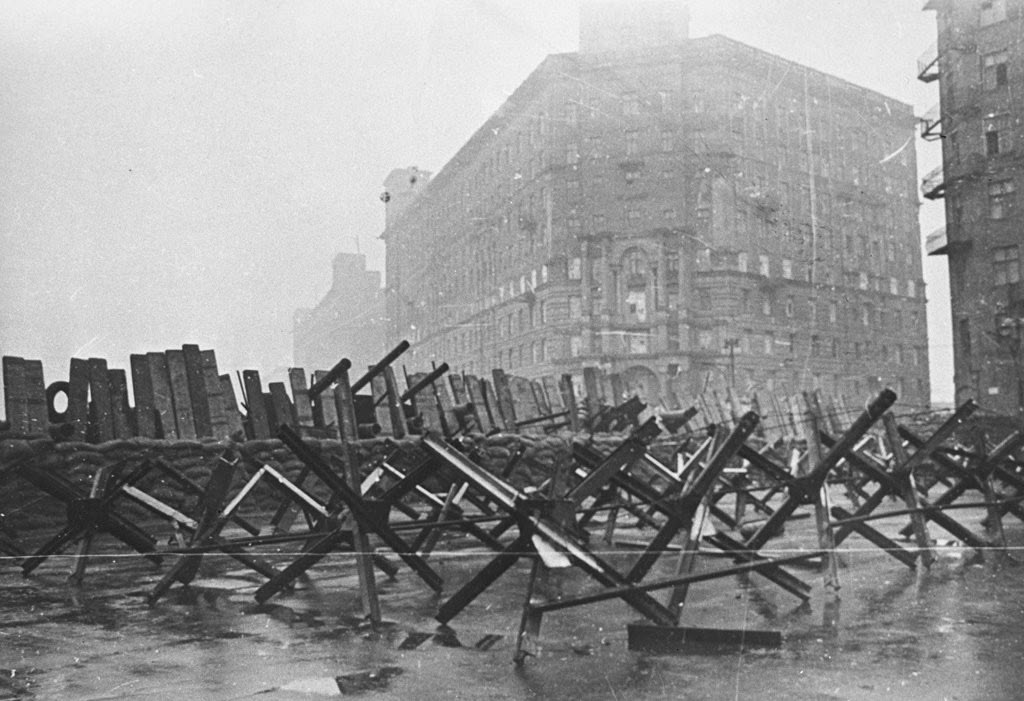
Different sources give different dates for the actual beginning of the Battle of Moscow during Operation Typhoon. A good starting date is 13 October 1941, because it is on this date that the German panzers first encounter the Mozhaysk (Mozhaisk) defense line that forms a half-circle around the Soviet capital.
Yesterday, Army Group North commander Field Marshal Fedor von Bock sent his worn and weary troops east in a final dash along the main road to Moscow. The leading elements on the main road, SS Obergruppenfuhrer Paul Hausser’s SS-Infanterie-Division (mot.) ‘Reich’ from XLVI. Armeekorps (mot.) reinforced with a Kampfgruppe from 10. Panzer-Division set out from the vicinity of Gagarin, which is still about 180 km east of Moscow. On Monday the 13th, the panzers encounter the Mozhaysk line, which Western Front commander General Georgy Zhukov has hastily assembled with about 90,000 troops. At noon, the Luftwaffe supports this movement by sending Junkers Ju 87 Stuka dive bombers escorted by Bf 109 fighters to attack Soviet positions at Borodino Field, site of the famous Napoleonic battle.
Assuming that there is a massive Soviet force to defend the capital, the Germans branch off the main road to the north and south. The nebulous plan is to encircle Moscow, with the first objectives being Kalinin (Tver) to the northeast and Kaluga and Tula to the southeast. The distances to be covered are immense by western European military standards, 180-200 km cross-country in each direction, but Russia is a large place and the Wehrmacht is forced to think in larger orders of magnitude than it is used to.
While the Germans are tested by the distances to be covered, they still hold the initiative. The Soviet situation, by contrast, is almost catastrophic. Resistance at Vyazma dies out as encircled Soviet troops either break out through swampy areas or surrender. General Rokossovsky and his HQ group abandon the area and slip out. General Yeremenko (Eremenko), in command of Bryansk Front, is wounded, evacuated, and relieved of command. Another disaster strikes at Rzhev, where Soviet 30th Army is eliminated. In an unusual turn of events for the Soviets, they are low on troops, so not only does the Red Army scrounge for any available men in the Moscow region and send them to the Mozhaysk Line, but they also draft 600 women to serve as soldiers. The Soviet 5th Army under General Leliushenko anchors the center of the Mozhaisk Defensive Line on the highway. However, the line itself is still under construction by about 250,000 Moscow women.
There is one bright spot for the Soviets. Based upon intelligence received from Richard Sorge in mid-September, Stalin has recalled seven Siberian divisions to the defense of Moscow. In addition to being fit, fresh, and well-trained troops, the Siberian troops also are experienced in and equipped for winter warfare. Considering that it already is snowing in the area, this is a major skill to have. These troops are beginning to arrive at the Moscow railway stations just at the right time. The 32nd Siberian Rifle Division under Colonel Polosukhin, supported by three tank brigades and the cadets from a Moscow military college, move up the highway to Borodino.
Vyazma is captured by the Germans essentially ending Soviet resistance of the nearby pocket. The Red Army was forced to retreat from Vyazma. German troops captured Kalinin (now Tver) and Rzhev northwest of Moscow, Russia; the Soviet 30th Army was encircled and wiped out at Rzhev. West of the Soviet capital, Soviet 18th and 19th Tank Brigades fell back from Gzhatsk (now Gagarin) toward Mozhaysk 30 kilometers closer to Moscow where the new main defensive line was being constructed.
Kaluga southwest of Moscow fell to the Germans.
The German First Panzer Group, advancing along the north coast of the Sea of Azoz, reaches the Mius River opposite Taganrog.
General Fedyuninsky was ordered to plan a breakout from Leningrad, Russia by attacking the area south of Lake Ladoga, which was to take place by 20 October 1941.
Allied convoy PQ.2 departed Liverpool, England, United Kingdom.
On October 13, 1941, Jews flooded out to the streets of Dnipropetrovsk in cold and damp weather. It was raining mixed with snow, the wind was blowing, and the roads and pedestrian paths turned into viscous mud. Thousands of women, children, and elderly men (young men were mainly called to arms or fled with the enterprises) were making their way to the heart of the city to the assembly point (the infamous German notion ‘Umschlagplatz’) at the intersection of Karl Marx and Zheleznaya streets. The main prospect in Dnipropetrovsk was named after the infamous socialist Karl Marx (1818-1883). From the early hours, the Jewish population filled a little square next to the city’s Main Department Store. The Germans on the spot, mainly the members of Police Battalion 314, had been present at the assembly point since the night and now turned a huge four-story building into a mass expropriation and looting area. The Jews with valuable personal possessions were led in and ordered to leave the baggage in the building. Jewelries, watches, wedding rings, bracelets, cigarette cases, and rich clothes were taken from defenseless people, and then they were pushed once again outside the building.
Thousands of those who came to the assembly point were deprived of their belongings and were disoriented regarding their destination. The versions that spread in the crows were a mix of self-made rumors, German disinformation, and often hopeful thinking. Some believed that they would be transferred from the city to special collective farms only for Jews in the rural areas of the region. More grotesque rumors suggested a journey to Palestine. More pragmatic people thought about the need to pay a contribution or move into the ghetto. People saw that Germans sorted their possessions on the spot, putting gold and silver in separate boxes with wooden handles, but could hardly imagine the execution of the whole Jewish population of Dnipropetrovsk. The members of the Police Battalion 314 continued to bring new groups of people from the central streets, and now they formed those who had already been robbed into large columns of 800-1000 people and routed them to Karl Libknecht Street. The street is one of the oldest in the city, emerging on the first city plans from 1791 as ‘Kazanska’ and was renamed after German socialist Karl Liebknecht (1871-1919) in 1923. In Independent Ukraine, the street was renamed after Ukrainian politician, historian, and statesman Mykhailo Hrushevsky (1866-1934).
The columns of people up to ten in a row were driven up a steep street with a large slope, which was a hard challenge, especially with the mud that day. The Germans showed no specific violence during this march, even allowing relatives from mixed families and neighbors to accompany the Jews in the column toward the city outskirts. From time to time, trucks with old, sick, and children passed by: those who could not cover the distance on foot without help. On several occasions, Germans passed near the column in open cars and laughed after breaking up horrified people. The members of the Police Battalion were mainly silent and met the questions about the destination with a brief ‘Zum campen’ (to the camp). On their way up the hill, the column passed near a large market area and Holy Trinity Cathedral, built in the mid-19th century. The first 2.5 kilometers were a dense urban area, and many local non-Jews could witness the exodus of Dnipropetrovsk’s Jewish community. One of the witnesses who testified after the War saw this column on the way to the Southern outskirts of the city and called it ‘The second exodus from Egypt,’ thus referring to a Biblical story. After covering about five kilometers from the assembly point, the crowd of people passed the local hippodrome opened in 1911 for up to 3000 visitors. The next location, which later found its way into the recollections of those who survived, was the New Jewish Cemetery. The local authorities of the Tsarist times designated 8.5 hectares back in 1900, and later on (in the 1920s) it was merged with the Christian and Muslim cemeteries nearby, with a total area of 33 hectares.
After passing the Jewish cemetery, the columns of people were directed leftwards (from modern Bohdan Khmelnytsky to Gagarina Streets) across the wasteland area next to a railway spur. Two kilometers further down the route, the procession finally reached one of the spurs of a giant local ravine called Krasnopovstancheskaya Balka. Just a few decades before, at the end of the 19th century, this ravine crossed the whole city of Ekaterinoslav from south to north, reaching the waters of the river Dnipro. In its lower part, it was called ‘Provalye’ (a lexical equivalent to a ravine without a bottom) because of the very steep, inaccessible slopes. Before the communists, it was officially known as ‘Dolgaia’ (long), then ‘Zhandarmskaia’ (gendarme), and in 1920 renamed Krasnopovstancheskaya (the Red rebels, a reference to Bolshevik revolution fighters). The ravine finally got its historical name back and was renamed ‘Dovga’ in 2015 (ukrainian pronunciation of ‘long’). After the war, the few survivors recalled that they had heard the sound of screams and gunfire when approaching the ravine. The situation was very similar to the massacre in Babyn Yar ravine in Kyiv a month before, on September 29-30, 1941. An outbreak of panic emerged in the ranks of people who had heard gunshots and screams, but they were directed by the Germans further. Some of the scared people cried, some tore their hair out, banged their heads on the ground, some elderly people had heart strokes, and a few went insane even before the execution started. People were directed to the edge of one of the spurs of the ravine, 15-20 meters deep, one group after another in a never-ending annihilation process. Every group had to wait its turn while hearing the heart-rending agony of the people before them.
When driven to the open space next to the ravine, the Germans ordered Jews to undress, leaving only underwear, then directed them to the edge by groups of 20-30 people, but with their backs to the ravine, and were machine-gunned. The bodies fell into the ravine, and the next group of Jews was taken here. While there were shooters among the Germans, others brought munitions instantly to avoid delays in the execution. Killed on the spot, wounded, and even unharmed people, mainly women and children, fell down the slopes of the ravine. Some mothers with breastfed children jumped themselves down while many Jews were forced to come to the edge. Similar to the Babyn Yar massacre in Kyiv, the executioners did not expect such a high number of people, and one day was not enough to kill all Jews who came or were brought by trucks, even considering the rotation of killing squads. When it got dark, the Germans halted the execution process until the next morning, thus leaving thousands of people in the open air on cold October days. A group of Jews tried to escape, but the Nazis fired into the air and contained the crowd on the spot. While the Germans cordoned off the area of the Botanic Garden and the wasteland, thousands of people were left in the open field. Women, children, and elderly people of both sexes who now mainly understood the nature of the process and their further fate, instinctively herded together to try to keep their bodies warm. Some could not withstand the nervous shock of their tragic situation and fell dead. Children were placed on top of their bodies because there was nowhere to put them. Many of them cried and begged to go home to their beds. Some old men were praying.
The executions resumed early in the morning of October 14 and continued all day, consuming more and more groups of those who were left to wait the day before. Apart from people already on the spot, Germans continued to bring Jews using trucks. At the same time, the assembly point next to the Department Store was no longer used anymore and the Jews were mainly brought from their homes throughout the city. In the Botanic Garden, half-dead people who lay on the ground were brought to the ravine and shot like the others. The area was full of dead bodies of those who did not live through the cold night, some frozen to the soil, and of children who were trampled in the ground by the crowd of people above them. In total, the execution lasted until 5. p.m. October 15 and demanded the lives of 11,000 people. In 1943, the Nazis organized two units aimed at eliminating the traces of mass killings of Jews in the occupied Eastern territories. The so-called Sonderkommando 1005b (Special unit 1005b) operated in Dnipropetrovsk in September and early October 1943, particularly digging out and burning corpses of the victims from 1941 in Krasnopovstancheskaya ravine near the Botanic Garden.
ltestenrat der Juden (Jewish Council) reports 750 Jews remaining in the country of Luxembourg.
Eight more Czech persons were executed today shortly after they had been condemned to death by a summary court on charges ranging from preparation for high treason to economic sabotage, according to an official announcement. The executions took place in Prague, and three of the persons, including two Jews, were hanged on charges of economic sabotage. The five others, charged with preparation for high treason and illegal possession of firearms, were shot. Four of the persons executed were from Prague, three from Perglitz and one from Roth-Kosteletz. Among them were a tradesman, a business man and a first lieutenant in the Czech Army.
Hitler comments on the US economy: “America can be paid only in gold. A commerce based on the exchange of products is not possible with America, for America suffers from a surplus of raw materials and a plethora of manufactured goods. This gold which the Americans receive in exchange for the labor they supply, they hide it away in their strongrooms — and they imagine the world will yield to this policy born in the smoky brain of a Jewish thinker! The result is their 13 million unemployed.”
The British Middle East commander, General Sir Claude J. E. Auchinleck, returned to Cairo today after a tour of Palestine and Syria. He inspected the defenses of Haifa, important Mediterranean oil port, and later toured the battlefields of the Syrian campaign. General Auchinleck visited Australian infantry and British horse cavalry units of the new army of the north which was formed to protect the Middle East against any attack from that direction.
Heinrich Kreipe was awarded the Knight’s Cross of the Iron Cross medal.
The former Mufti of Jerusalem, Haj Amin el Husseini, has fled from Tehran, Iran, to Albania in an Axis plane, it was learned today. The report said he went by way of Turkey after the Shah of Iran abdicated. It was said that Turkey at first refused to permit him to pass through the country and that transit was granted only after Franz von Papen, the German Ambassador, had interceded. The former Mufti had gone from Syria, where he went into exile in 1937, to Iran when France entered the war.
RAF Bomber Command, Day of 13 October 1941
18 Blenheims on Circus operations to Arques and Mazingarbe. 1 Blenheim lost.
RAF Bomber Command, Night of 13/14 October 1941
Düsseldorf
53 Wellingtons and 7 Stirlings; haze resulted in scattered bombing. 1 Wellington lost.
Cologne
30 Hampdens and 9 Manchesters; searchlight glare prevented target identification. Cologne reports only a few bombs, 6 people killed and 5 injured, and damage to 17 houses.
Minor Operations: 5 Wellingtons and 1 Stirling to Boulogne, 13 Hampdens minelaying in the Frisians and Kiel Bay. No losses.
The Royal Air Force reported today that heavy British, bombers raided the Libyan ports of Tripoli and Bengazi on Saturday night, hitting docks and airplane bases.
Heavy cruiser HMS Norfolk was at Scapa Flow. During firefighting exercises on the hulk Inverlane, an explosion killed Lt W. J. Van De Kasteele, the cruiser’s gunnery officer, and four ratings. The ship’s executive officer Cdr A. C. Luce died of injuries on the 20th.
Destroyer HMS Southwold departed Portsmouth at 1000 for Scapa Flow to carry out working up exercises. The destroyer arrived at 1300/15th.
Minelayer HMS Port Quebec, escorted by destroyer HMS Lancaster, laid minefield SN.24 B.
The Liverpool section of convoy PQ.2, escorted by minesweepers HMS Speedy and HMS Seagull departed Liverpool at 1030 for Scapa Flow, arriving at 0730/16th.
Destroyers HMAS Napier and HMS Jackal passed the Suez Canal northbound to return to the Mediterranean Fleet after being relieved in the Suez Escort Force by sloops HMS Falmouth and HMS Shoreham.
Motor torpedo boats MTB.68 and MTB.215 were ordered to patrol off Bardia to intercept a reported submarine.
Anti-submarine trawler HMS Loch Oskaig was attacked by a German Focke Wulf aircraft in 38-15N, 9-59W. Seven crewmen were wounded and considerable damage was done to the superstructure by cannon fire.
Submarine HMS P.31 departed Gibraltar for Malta, arriving on the 20th.
Submarine HMS Thorn departed Malta on patrol and then to proceed to Alexandria.
Dutch submarine HNLMS O.24 made an unsuccessful attack on a steamer in the southern Tyrrhenian Sea.
Convoy OS.9 departed Liverpool escorted by French sloop Commandant Domine which was detached on the 24th. On the 14th, sloops HMS Egret, HMS Fowey, and HMS Leith joined the convoy. The sloops were detached on 2 November for Egret and on 1 November for the other two. Also joining on the 14th were escort vessels HMS Banff and HMS Fishguard which were detached on 1 and 2 November, respectively, and corvettes HMS Hollyhock and HMS Stonecrop. Corvette Hollyhock arrived with the convoy on 5 November and Stonecrop was detached on 1 November. Corvettes HMS Burdock, HMS Clover, and HMS Nigella joined on the 31st and arrived with the convoy at Freetown on 5 November.
President Roosevelt issued a statement in Washington today saying that supplies to Russia are going forward in a constant stream. He conferred with Congressional leaders on the Neutrality Act and lend-lease legislation. His callers included Aubrey Williams, National Youth Administrator, with Representatives Albert Thomas and Butler B. Hare, and Leighton McCarthy, the Canadian Minister. He sent to the Senate the nominations of Hershel V. Johnston to be Minister to Sweden and Clifford J. Durr to be a member of the Federal Communications Commission.
The Senate completed Congressional action on the bill increasing the borrowing power and lending authority of the Reconstruction Finance Corporation by $1,500,000,000, and on the amendment to the Neutrality Act which permits naturalized Americans outside the United States to retain their citizenship, and adjourned at 3:09 PM out of respect to the late Representative Geyer until noon on Thursday.
With the House in recess, the Foreign Affairs Committee heard Secretaries Hull, Stimson and Knox, Admiral Harold R. Stark and Rear Admiral Emory S. Land on amendments to the Neutrality Act.
In an apparent effort to encourage Russian resistance to the vast German offensive, President Roosevelt proclaimed to the world today that the United States was rushing large amounts of supplies to help the Soviets’ “brave defense.” A formal statement issued by the White House declared: “The president announced today that within the past few days large amounts of supplies have been sent to Russia. He further stated that all of the munitions, including tanks, airplanes and trucks, promised at the Moscow conference for delivery in October, will be sent to Russia before the end of the month.
During a conference with leaders of Congress today, President Roosevelt was assured that the second lend-lease act, carrying an appropriation of $5,985 000,000 and already passed by the House, would quickly get favorable action in the Senate. Hearings will begin tomorrow before the Senate Finance Committee, Senator Adams said, and Senator Barkley, the majority leader, promised that the legislation would be ready for the Senate floor early next week. Mr. Roosevelt first conferred with Vice President Wallace, Senator Barkley, Speaker Rayburn of the House and Representative McCormack, House Majority Leader. Then he called in Senators Adams, McKellar and Glass, Democrats, and Lodge, Republican, for further discussion. Present also were Edward R. Stettinius Jr., Lease-Lend Administrator, and Harry L. Hopkins, special adviser to the President. The Russian situation was discussed briefly, Senator Barkley said. He added: “We talked about the lend-lease bill and the probability of its prompt consideration in the Senate. The Senate Committee on Appropriations will begin hearings on the measure tomorrow and the committee plans to finish its hearings in time to report the bill to the Senate for its consideration the first of next week. I cannot say what date the bill will reach the Senate floor, but it will be early next week.”
Secretary of State Hull spoke on behalf of arming American-flag ships engaged in foreign trade stating, “It is our right to arm our vessels for purposes of defense. That cannot be questioned… since section 6 of the Neutrality, Act was adopted, entirely new conditions have developed… The new conditions have been produced by the Hitler movement of world invasion. Hitler is endeavoring to conquer the European and African and other continents, and he therefore is desperately seeking to control the high seas. To this end he has projected his forces far out into the Atlantic with a policy of submarine lawlessness and terror. This broad movement of conquest, world-wide in its objectives, places squarely before the United States the urgent and most important question of self-defense… The intent of these attacks is to intimidate this country into weakening or abandoning the legitimate defenses of the hemisphere by retreating from the seas… The problem is to set up as swiftly as possible the most effective means of self-defense. The principle is that the first duty of an independent nation is to safeguard its own security…”
War Department officials reported today that mass production was now under way in a substantial number of the plants that make up the new $1,750,000,000 string of government owned munitions factories. Meanwhile Brigadier General Harry K. Rutherford, executive officer to the Under-Secretary of War, expressed belief that demands for munitions production would require use of all metal manufacturing concerns in the United States. Representative Smith, Democrat, of Connecticut, questioned General Rutherford during a House Military Subcommittee hearing on spreading defense contracts through small industries. Present munitions production, the War Department said, covers virtually every major category of ammunition and has begun to include some of the weapons that would be required in a full-dress war. The announced objective of the new plants is to develop the productive capacity to fill the battle needs of 4,000,000 troops. In the past three weeks five new plants have started turning out such material as rifle and machine-gun ammunition, shells for infantry mortars, and high explosive TNT for bombs, shells and torpedoes.
The Senate acted today to permit 3,000 to 5,000 of the naturalized Americans living abroad to retain their citizenship, which would have been forfeit, under the terms of the Nationality Act of 1940, if they were not in the United States by midnight tonight. The Senate passed and sent to the White House a bill to enable these persons to remain United States citizens. Under the Nationality Act naturalized Americans may remain in a foreign country only for a certain length of time unless they have special status, as specified in the act. The act gave a grace period of one year from its enactment on October 14 of last year for such citizens to return to the United States.
A nation-wide attack on every aspect of industrial, consumer and governmental waste, with the primary purpose of saving and salvaging every pound of usable material for use of defense industries or to prevent shortages in essential goods for civilian uses, will be started at once by a new Bureau of Industrial Conservation set up by the Office of Production Management.
Spokesmen for the country’s railroads offered today a counter-proposal to the wage demands of 1,260,000 organized railroad employees, conceding part of the wage Increases asked by the employees as a condition to calling off their strike vote.
Calling Treasury Secretary Morgenthau agriculture’s “public enemy No. 1,” Senator Bankhead of Alabama said today that members of Congress from farm States would oppose any attempt to clamp rigid price ceilings on agriculture.
The U.S. Navy disclosed today that the seizure of the German-sponsored radio station in Greenland and its Norwegian supply ship was made by a Coast Guard vessel, which was a part of the navy’s patrol of Greenland waters. The Norwegian vessel was not armed, nor was resistance put up by either its crew or the personnel manning the radio station ashore, the navy said.
A production order was placed for the improved Republic P-47D Thunderbolt fighter.
Joseph Rochefort was promoted to the rank of commander, retroactive effective to 1 April 1941.
The Japanese Foreign Ministry sends a message to the embassy in Washington. Part of the message states that “The situation at home is fast approaching a crisis and it is becoming absolutely essential that the two leaders meet if any adjustment of Japanese-U.S. relations is to be accomplished. I cannot go into details now, but please bear this fact in mind.”
Chinese forces have evacuated the city of Ichang, important Yangtze River base between Chungking and Hankow, after having held the city for three days, a War Office communiqué said tonight. The objective of the Ichang attack, the communiqué said, was to relieve Japanese military pressure on Changsha, capital of Hunan Province, and when the Japanese evacuated Changsha the Chinese drive was called off. It was admitted, too, that Japanese aerial bombing, which the communiqué described as “gas attacks,” also played a part in the Chinese decision to retire. Many civilians were killed by the Japanese bombing, it was said. Earlier a military spokesman said street fighting was continuing in Ichang and that the fate of the Japanese garrison depended upon whether Japanese reinforcements from Hankow could break through and reach the city. The spokesman accused the Japanese of using “poison gas” and “asphyxiating gas,” which, he said, are always used by the armed forces when they are surrounded.
Japanese dispatches tonight said 200,000 Chinese reinforcements were converging on Chengchow for a “desperate effort” to recapture that city. The dispatches indicated hostilities had broken out anew around Chengchow after a lull of a week since its capture by the Japanese. Chengchow is the important junction of the north-south Peiping-Hankow Railroad and the east-west Lung-Hai Railroad.
Foreign missionaries who were in Changsha during the four days of Japanese occupation of this capital of Honan Province early this month, told newspaper men today that the Japanese looted virtually every Chinese home and business establishment before retiring to their base in Yochow, to the north. The correspondents came here by plane from Chungking. The missionaries described the Japanese occupation as “hell let loose on earth.” and compared it to the looting of Nanking when that former Chinese national capital was captured by the Japanese Army four years ago. Women were raped and many civilians killed, it was charged. About forty-eight foreign residents inside the city, however, were not molested, and the Japanese troops, apparently acting under orders, avoided looting foreign-owned property. Japanese soldiers entered the grounds of several mission establishments and three refugee camps housing 17,000 Chinese, it was said, but missionaries were “able to eject them.”
A warning that the Japanese Government should “make peace in East Asia as early as possible” lest it be overtaken by peace in Europe, which would leave Japan exposed to combined pressure by the United States, Britain and Russia, was sounded yesterday by Kazmo Yukikata in the newspaper Kokumin, which claims close relations with the Japanese military.
Lieutenant General G. J. Berenschot, Commander in Chief of the Netherlands Indies Army, and thirteen others were killed today in two airplane crashes.
Born:
Paul Simon, American multiple Grammy Award-winning singer-songwriter (Simon & Garfunkel — “The Sound of Silence”; solo — “Kodachrome”; “Still Crazy After All These Years”; “Graceland”), and actor (“One Trick Pony”), in Newark, New Jersey.
Neil Aspinall, British rock and roll road manager (The Beatles), and music executive (Apple Records), in Prestatyn, Wales, UNited Kingdom (d. 2008).
Jim Price, MLB catcher and pinch hitter (World Series Champions-Tigers, 1968; 1968 Detroit Tigers) and broadcaster (ESPN, Detroit Tigers Radio Network), in Harrisburg, Pennsylvania (d. 2023).
Henry Schichtle, NFL quarterback (New York Giants), in Tulsa, Oklahoma.
Died:
David Devant, 73, English stage magician.
Naval Construction:
The Royal Navy Round Table-class minesweeping trawler HMS Sir Agravaine (T 230) is laid down by J. Lewis & Sons Ltd. (Aberdeen, Scotland).
The U.S. Navy YMS-1-class auxiliary motor minesweeper USS YMS-37 is laid down by the Hiltebrant Dry Dock Co. (Kingston, New York, U.S.A.).
The Royal Australian Navy Bathurst-class minesweeper-corvette HMAS Dubbo (J 251) is laid down by the Morts Dock & Enginering Co. Ltd. (Sydney, New South Wales, Australia).
The Kriegsmarine (German Navy) Type VIIC U-boat U-733 is laid down by F Schichau GmbH, Danzig (werk 1524).
The Kriegsmarine (German Navy) Type VIIC U-boat U-705 is launched by H C Stülcken Sohn, Hamburg (werk 764).
The Royal Navy Bar-class boom defense vessel HMS Barclose (Z 174) is commissioned.
The Royal Navy harbor defence motor launch HMS HDML 1072 is commissioned.
The Royal Navy Fairmile C-class motor gun boat HMS MGB 328 is commissioned.
The Royal Navy MMS I-class motor minesweeper HMS MMS 48 (J 548) is commissioned. Her first commanding officer is J Tatham, RNVR.

