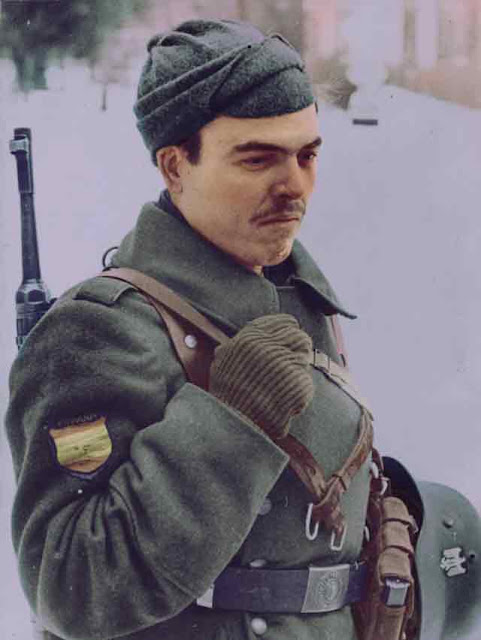
The all-Spanish volunteer Blue Division (250th Infantry Division) was deployed on the Volkhov River near Leningrad. On 12 October 1941, the Spanish Blue Division troops of the 250th Infantry Division in the German Army (Heer) numbering system deploy on the Volkhov River in the Army Group North sector. The Spanish troops establish their headquarters on the outskirts of Veliky Novgorod in a village called Grigorovo. The Blue Division is responsible for a 50 km section of the front which runs from north of Novgorod south along the banks of the Volkhov River and behind Lake Ilmen.
While used by the Wehrmacht as garrison troops to hold a quiet part of the line, the Spanish Blue Division is marked by high morale in its all-volunteer ranks. Serving on the eastern front is considered a high honor, and virtually everyone graduating from the Spanish military academy volunteers. While in the Soviet Union, General Agustín Muñoz Grandes, the Blue Division’s leader, has his men replace their symbolic Blue Division uniforms. These uniforms include the red berets of the Carlists, the khaki trousers of the Spanish Legion, and the blue shirts of the Falangists. While in German service, however, the men wear the ordinary field grey Heer uniform.
The Blue Division gets its nickname from its blue shirts, though those are only worn while on leave in Spain. As with other affiliated troops in the Wehrmacht, the Blue Division’s uniform is individualized with a special shoulder patch marking the soldiers’ nation of origin. In this case, the badge has the Spanish national colors with the word “Espana.”
The Blue Division men have good reason to be tired, as they have just completed a 900 km march from the nearest railhead at Suwałki, Poland. Throughout the war, the main means of transportation within the Wehrmacht remains the railway system, which is both a strength and a weakness of the German Army. The railways are easy to control and make quick moves across long distances possible and efficient. However, troop moves are restricted by the absence of railway workers in the occupied eastern territories, the insufficient numbers of Soviet locomotives and rail cars, and the vulnerability of the rail system to partisan attack and aerial bombing. The Soviet rails are of a different gauge than the German ones, and so German trains cannot just continue east until new rails are laid — a massive undertaking that requires time and men. The result is that the German infantry, like the Blue Division, is forced to walk long distances and cannot possibly keep pace with the panzers and panzer grenadiers leading the offensive.
It is unclear why the Germans diverted the Blue Division from the attack on Moscow, Operation Typhoon, their original assignment, to a quiet sector further north. Throughout the war, there is a general feeling within the Wehrmacht that “foreign” troops cannot be entrusted with critical missions. However, it also may be the case in this particular situation that the Germans want to keep the glory of taking Moscow to themselves — it would not do at all if a Spanish Division played a key role in taking the Soviet capital.
In any event, the German Army (Heer) does not seem to need any help at this point. The OKH today sends Army Group Center commander Field Marshal Fedor von Bock curt instructions:
“The Führer has reaffirmed his decision that the surrender of Moscow will not be accepted, even if it is offered by the enemy.”
With these “no surrender” orders in hand, von Bock orders an immediate advance on Moscow all along the line. However, like the Blue Division men, the German troops already have marched hundreds of kilometers, including a quick advance of 70 km just in the past five days — all while fighting. As usual, the panzers move quickly, with 1st Panzer Division taking Rzhev and Staritsa, while General Guderian’s Panzer Group 2 takes Kaluga about 100 miles southwest of Moscow. The German infantry is still marching to catch up, however, and two Soviet rifle divisions break out from the Vyazma pocket through swamps where the panzers can’t operate.
Even the panzers are feeling the strain, however. Where once missions could be accomplished by just one panzer division, now they have to be combined. Today, for instance, SS Obergruppenfuhrer Paul Hausser’s SS-Infanterie-Division (mot.) ‘Das Reich’ from XLVI. Armeekorps (mot.) is given a critical mission of pushing east along the Minsk-Moscow main road. However, it has been so weakened by months of constant combat that it must be joined by a Kampfgruppe from the 10th Panzer Division. The weather is terrible, the roads are muddy, and General Guderian notes in his diary that it snows throughout the day.
German troops captured Bryansk and Kaluga in Russia. On the northern flank of the German Army Group Center, the 1st Panzer Division takes Rhzev and moves on to the outskirts of the vital communications hub of Kalinn. On the southern flank, Kaluga (less than 100 miles southwest of Moscow falls to German forces. The worsening weather has caused problems with the advance, but has not been able to stop it. Today the Russians evacuate Bryansk, and civilians start to be evacuated from Moscow.
Over 440,000 Moscow citizens, mostly women, children and old men, are mobilized to build defenses in and around Moscow. In four days they would dig 60 miles (97 kilometers) of anti-tank ditches, 5,000 miles (8,047 kilometers) of troop trenches and lay 177 miles (285 kilometers) of barbed wire.
Remnants of the Soviet forces still encircled at Vyazma continue to attack east in a feeble attempts to escape the German encirclement.
The first large convoy from England reaches the Soviet port of Archangel, bringing 20 heavy tanks and 193 aircraft to the beleaguered Soviets.
German forces launched an attack against the Soviet garrison on the island of Hiiumaa in the Baltic Sea. Despite being outnumbered and lacking in ammunition, the garrison would hold out for six days.
Soviet submarine S-8 was lost off Öland, Sweden in the Baltic Sea to unknown reason; all 48 aboard were killed. She presumably struck a mine.
The Bloody Sunday massacre took place in the Stanisławów Ghetto. Before the Jews were enclosed in a ghetto, the Germans wanted first to “decimate” them. On October 12, 1941, they demonstrated how they meant to “solve” the “Jewish Question” in the area. This day was later called “Blutsonntag” (“Bloody Sunday”). Unlike the other districts of the General Government, in the region of Stanisławów the local German administration did not wait until the killing centers had been established. Thousands of Jews were gathered on the market square; then the German forces escorted them to the Jewish cemetery, where mass graves had already been prepared. On the way the German and Ukrainian escorts beat and tortured the Jews. At the cemetery the Jews were compelled to give away their valuables and show their papers. Some of them were then released, but the majority had to remain. The men of the Security Police (Sipo) then started the mass shootings, assisted by members of the German Order Police (Ordnungspolizei) and also the railroad police. Krüger personally took part in the shootings. The Germans ordered the Jews to undress in groups and then proceed to the graves where they were shot. They fell into the grave or were ordered to jump in before being shot. There was a victory celebration held that night at the German headquarters.
Some survivors have described the massacre in detail, revealing the incredible brutality applied by the German forces. Many survivors remember how bravely Dr. Tenenbaum of the Jewish council went to his death. Krüger, the head of the Gestapo, offered to set him free, but Tenenbaum said that he rejected this offer from a murderer and that he wanted to die with his brethren. In the evening those Jews still alive were allowed to leave the cemetery. The German forces shot between 8,000 and 12,000 Jews on that day. Seibald, the chairman of the Jewish council survived the massacre, but lived in hiding afterwards. Most probably he was also killed later on. On the day after the bloodbath, Lamm was called to the Gestapo headquarters, where they informed him that he would be the new chairman of the Jewish council. Among the members of the Jewish council in the ghetto was the engineer Julian Feuerman, who wrote a personal testimony in 1943 while he was in prison, but did not survive the war.
When the Soviet army reached Stanisławów on July 27, 1944, there were about one hundred Jews in the city who had survived in hiding. In total about 1,500 Jews from Stanisławów survived the war.
11,000 Jews of Dnepropetrovsk, Ukrainian SSR (today Dnipro, Ukraine) were massacred beginning this day, through October 15. The Germans decided to blame the Jewish population for the days of uncontrolled looting in late August. On October 2, 1941, the occupational authorities issued a decree, which ordered the Jewish community of Dnipropetrovsk to pay out a contribution of three million German marks or an equivalent of 30 million karbovanets in the designated period between October 12 and November 1. In case of late or incomplete payment of the fine, the order provided for taking “the strictest measures and, if necessary, increasing the amount of the fine’’. Employing such slander and accusations, the Nazis, on the one hand, discredited the Jews in the eyes of the rest of the townspeople, and on the other hand, they developed the thesis about the supposed criminal nature of the Jews. The first systematic killing of Jews in the Dnipropetrovsk region was unleashed as early as late August when Einsatzkommando 6 (EK6) of Einsatzgruppe C under Erhard Kroeger (1905–1987) executed 105 Jews in Kryvyi Rih. The unit continued mass killings in the rural areas and arrived at the city of Dnipropetrovsk between 23 and 28 September 1941 and until October 4 executed ‘’85 political functionaries, 14 saboteurs and robbers”, as well as 179 Jews, according to its report.
The decision to annihilate the entire Jewish population of Dnipropetrovsk came on October 12, 1941, during a meeting of representatives of the occupation authorities, representatives of the SD, the German police, the city administration, and the local police, at which the course of the future criminal action was discussed. Already in the afternoon, the heads of the divisions set the appropriate tasks for their subordinates. The entire Jewish population was to be informed by 5 a.m. On October 13, they were ordered to gather at the square next to the Central Department Store in the center of the city. Despite forming special patrols for this purpose, the task of informing Jews was mainly transferred over to street cleaners and house managers. Four days before, on October 8, all householders and house managers were ordered to submit lists of Jewish residents within three days. In case of non-compliance with the terms of execution of this order or submission of inaccurate information, managers and owners of buildings were to be prosecuted “according to the laws of wartime”. However, according to the data provided, on October 12, 1941, only 7,962 people of Jewish origin lived in the city. Of course, the real number of Jews was much higher (around 30,000). Such discrepancies were probably because many of them submitted only approximate data on the residents of the house, a certain number of Jews changed their place of residence and managed to avoid registration, and some of them managed to bypass the registration orders thanks to a note about another nationality in identification documents (passports).
In Operation CULTIVATE, British cruiser HMS Abdiel and destroyers HMS Hero, HMS Kipling, and HMS Nizam departed Alexandria, Egypt for Tobruk, Libya. German submarine U-75 discovered them and attacked 35 miles west of Tobruk, sinking two landing craft which resulted in the killing of 34 Allied personnel and 2 Italian prisoners of war. U-75 picked up one survivor, whom would be delivered to Germany for interrogations. A series of relief efforts for Tobruk begins today. During the next 14 days over 7,000 troops of the British 70th Infantry Division will be transferred in and almost 8,000 Australians will be pulled out. The British lose minelayer HMS Latona and damage to one destroyer.
By their victorious progress In Russia, Reichsführer Hitler’s armies are opening up new valuable markets for German industries after the war, according to an address delivered here today by Dr. Walther Funk, Reich Minister of Economics and President of the Reichsbank.
Five German regiments have arrived in Bulgaria en route to Northern Greece to take over police work from Italians and Bulgarians, who have failed to maintain order, a well-informed source said today.
Paul von Kleist was mentioned in the Wehrmachtbericht daily radio report.
Alexander Löhr was mentioned in the Wehrmachtbericht daily radio report.
After dark, German bombers attacked Manchester, Clayton, Denton, and Oldham in England, United Kingdom, causing generally light damage. 23 were killed at Oldham.
RAF Bomber Command, Day of 12 October 1941
24 Blenheims bombed Boulogne docks without loss.
RAF Bomber Command, Night of 12/13 October 1941
Nuremberg
152 aircraft – 82 Wellingtons, 54 Whitleys, 9 Halifaxes, 7 Stirlings – on the first large raid to this city. 8 aircraft – 5 Wellingtons, 1 each of the other types – lost and 5 more aircraft crashed in England.
Crews reported some fires started but some also said these were in villages 10 miles from Nuremberg. The city of Nuremberg reports only a few bombs in and around the city, with 1 person killed and 6 injured. Many more bombs fell on Schwabach, 10 miles south of Nuremberg, which suffered approximately 50 buildings destroyed and 8 or 10 (reports conflict) people killed.
By chance, a letter is available giving details of bombing on this night in the village of Lauingen, on the Danube sixty-five miles from Nuremberg. Bombs fell on this small community for 4 hours. Craters from 200 high-explosive bombs were later found and approximately 700 incendiaries fell in the village, with many more bombs falling in the surrounding countryside. 44 houses were destroyed. 4 people died, including the Bürgermeister, who had a heart attack when he saw his village on fire. The villagers could only think at the time that the raid was intended for the nearest industrial town, Ingoldstadt, which was 50 miles further east. Crowds of people came from surrounding areas to see this badly damaged village, so far from any major industrial target.
A further report, from Stuttgart, describes how 46 houses were hit in the small town of Lauffen, on the River Neckar, near one of Stuttgart’s regular decoy fire sites. This location is ninety-five miles west of Nuremberg!
It is significant that both Lauingen and Lauffen were situated on wide rivers, as was Nuremberg, and it was probably this factor that persuaded a few hopelessly lost crews who were navigating on dead reckoning that they had found Nuremberg. Other crews were then attracted to the scenes of the bombing and joined in. These errors illustrate the navigation difficulties experienced by crews in changeable wind conditions when flying to inland targets, albeit they are extreme examples of such error.
Bremen
99 aircraft – mostly Wellingtons and Hampdens. 65 aircraft bombed in cloudy conditions and fires were seen. 2 Wellingtons and 1 Hampden lost.
Hüls
79 Hampdens and 11 Manchesters attempted to bomb the chemical factory at Hüls but this was completely cloud-covered and bombing was scattered. 1 Hampden and 1 Manchester lost.
Minor Operations: 8 Hampdens on searchlight-suppression and airfield attacks, 23 Wellingtons and 1 Whitley to Boulogne. No losses.
Total effort for the night: 373 sorties: this was, by a narrow margin, a new record; the previous highest number was 364 on the night of 8/9 May 1941. 13 aircraft (35 percent) were lost in what was a most disappointing set of raids.
Hans-Joachim Marseille scored his 24th and 25th kills as he shot down P-40 fighters piloted by Flying Officer H. G. Roberts and Sergeant Derek Scott over Bir Sheferzan, Libya. He also damaged another P-40 fighter on this day.
U-83, commanded by Oberleutnant zur See Hans-Werner Kraus, stopped Portuguese steamer Corte Real (2044grt) for inspection eighty miles west of Lisbon. When it was established the steamer was carrying contraband, the steamer was sunk. At 1400 hours on 12 Oct 1941 the neutral Corte Real was stopped for inspection by U-83 80 miles west of Lisbon. It was established that they were carrying contraband because most of the cargo was bound for Canada and Australia, so Kraus ordered the crew and passengers (among them women and children) to abandon ship in the three lifeboats. The U-boat then opened fire with the deck gun, setting the ship on fire and finally sank her with two torpedoes at 1654 hours. When it was noticed that one of the lifeboats was taking on water, the Germans transferred the occupants to the other two boats and took them in tow towards the coast for 3 hours. The lifeboats later landed near Lisbon. The 2,044 ton Corte Real was carrying cork, dyes, watches, wine, and canned food and was bound for New York, New York.
Landing craft tanks A 2 (Sub Lt E. L. Clark RNVR) and A 7 (Sub Lt A. C. Bromley RNVR), en route to Tobruk from Mersa Matruh, encountered U-75, commanded by Kapitänleutnant Helmuth Ringelmann, near Ashaila Rocks off Sidi Barrani. At 0005 hours on 12 Oct 1941, U-75 began shelling HMS TLC.2 (A 2) (SubLt E.L. Clark, DSC, DSM, RNVR) and HMS TLC.7 (A 7) (SubLt A.C. Bromley, RNVR). The U-boat had followed the ships since they left Tobruk and attacked from astern, scoring several hits on both vessesl, but was forced to dive by return fire and due to malfunctions at the 20mm AA gun and MG34 machine gun. At 0124 hours, HMS TLC.2 (A 2) was hit by a torpedo and lost her bow, but did not sink. The other landing craft had been disabled by gunfire and missed by a torpedo that passed underneath at 0149 hours. Ringelmann then decided to finish off both vessels by gunfire, surfaced and shelled the first landing craft that sank in flames at 0234 hours. They then shelled HMS TLC.7 (A 7), which sank at 0700 hours.
The commander of A 2, Skipper J.C. Norton, RNR and 14 ratings were lost.
The commander of A 7, one officer, eleven ratings and eight passengers (two officers of the British Army, four Australian soldiers and two Italian prisoners of war) were lost. The only survivor (A/PO W.A. Henley, DSM, RN) was picked up the next night by the U-boat and taken prisoner. He was landed at Salamis on 2 November and later brought to Germany.
Aircraft carrier HMS Victorious and destroyers HMS Bedouin and HMS Anthony departed Scapa Flow at 1600 for the Clyde. En route, carrying out night landings, one Albacore was lost with T/Lt (A) J. G. R. Flowers and Leading Airman W. M. James killed. The ships arrived in the Clyde at 1530/13th.
New Zealand Sub Lt L. E. Mitchell RNZN, was killed when his Albacore of 778 Squadron from Arbroath crashed on takeoff.
Light cruisers HMS Aurora and HMS Penelope departed Scapa Flow for Gibraltar, arriving at 2200/18th.
Destroyer HMS Eclipse departed Scapa Flow at 1330 to assist Soviet steamer Sukhona (3124grt), which been in convoy QP.1 and made a distress signal seven miles north of the Orkneys. Anti-submarine trawler HMS Vascama escorted the steamer to Kirkwall and the destroyer returned to Scapa Flow. There was no apparent reason for the distress signal.
T/A/Sub Lt (A) E. H. Archer RNVR, and Leading Airman W. M. James were killed when their Albacore of 817 crashed during night practice near Dunino on a dummy attack on aircraft carrier HMS Victorious.
German destroyer Eckholdt was damaged at Tromso in a collision with a Norwegian steamer. The destroyer was dry-docked at Trondheim on the 22nd for twelve days of emergency repairs. The ship then proceeded to Germaniawerft, arriving on 9 November for refit and repair.
German 2nd Motor Torpedo Boat Flotilla with S 41, S 47, S 53, S 62, S 104, and S 105 attacked convoy FN.531 north of Cromer. British steamer Chevington (1537grt) and Norwegian steamer Roy (1768grt) were sunk in 52-59-36N, 1-52E. Seven crewmen and two gunners were lost on the British steamer. Three crewmen were lost on the Norwegian steamer. Convoy escorts of destroyers HMS Westminster, HMS Wolsey, and HMS Cotswold were unable to damage to the German ships.
British steamer Glynn (1134grt) was badly damaged by German bombing 1½ miles 223° from No. 5 Buoy, 52-35N, 1-56E. Two crewmen were lost on the steamer. The steamer was scuttled by a Royal Navy unit.
Operation CULTIVATE, the relief of the Tobruk garrison, began. Minelaying cruiser HMS Abdiel and destroyers HMS Hero, HMS Kipling, and HMAS Nizam departed Alexandria for the first serial of the CULTIVATE operation.
Battleships HMS Queen Elizabeth and HMS Valiant, light cruisers HMS Ajax, HMAS Hobart, and HMS Galatea, and destroyers HMS Jervis, HMS Jaguar, HMS Griffin, HMS Jupiter, HMS Kandahar, HMS Hasty, HMS Hotspur, HMS Decoy, HMS Avonvale, and HMS Eridge departed Alexandria and proceeded westward. At 1800, the cruisers and destroyers Jervis, Jaguar, and Jupiter were detached to pass through position 33-00N, 24-30E at midnight and rejoin the Fleet at daylight. At daylight on 13th, the Fleet set course for Alexandria. When a report was received at 1315 of three Italian cruisers and six destroyers, the Battle Fleet turned westward. No further contact was made with these ships. At 1800, the cruisers and three destroyers were again detached and rejoined at daylight on the 14th. The Fleet arrived back at Alexandria at 1530/14th.
Italian light cruisers Duca D’Aosta, Eugenio di Savoia, and Montecuccoli and destroyers Vivaldi, Malocello, Pigafetta, de Verazzano, Aviere, and Camicia Nera were to lay mines off Benghazi during the night of 12/13 October. However, the operation was cancelled when it was found that the Mediterranean Fleet was at sea.
An Italian convoy of steamers Bainsizza (7933grt) and Nirvo (5164grt) and German tug Max Barendt departed Trapani escorted by destroyers Da Recco and Sebenico and torpedo boat Cascino. On the 14th, steamer Bainsizza was damaged by British 830 Squadron torpedo attack in 34-15N, 12-12E. The steamer was taken in tow by the German tug and later by tug Ciclope, escorted by torpedo boat Polluce which had come out from Tripoli. The steamer sank the next day.
Submarine HMS Rorqual arrived at Malta after minelaying operations in the Aegean.
Polish submarine ORP Sokol arrived at Malta after patrol off Lampedusa.
The Congressional battle on the Administration’s proposal to arm American merchant vessels started twenty-four hours ahead of schedule today when Republican members of the House Foreign Affairs Committee protested against the official decision to hold brief, secret hearings on the Neutrality Act revision. Meeting in the House Office Building this afternoon to plan their strategy in the Neutrality Act revision hearings which open before the Foreign Affairs Committee tomorrow, the minority members of the committee declared that the Administration was trying to “gag” the opposition by restricting the hearings to two days and barring the press from attendance. In a letter to Representative Sol Bloom, Democrat, of New York, chairman of the Foreign Affairs Committee, the Republicans said that it was “impossible” for them to arrange an adequate hearing for their case on such short notice and in the few hours allotted to them for opposition testimony. Consequently, they turned over to Mr. Bloom the task of selecting anybody he liked to represent the Republicans and disclaimed all responsibility for the hearings.
An unexplained explosion in an underground dynamite magazine at the Sitka naval air station shortly after noon today killed at least six service men, injured dozens of persons in the nearby fishing village and damaged defense and private construction. The blast crashed across quiet Baranof island just as hundreds of civilians and army families were listening to the benediction in a Sitka church at 12:10. The concussion sent windows cascading into the streets in showers of broken glass, inflicting cuts on many women and children walking out of the church and along the narrow streets of this island town.
Fire, raging for fourteen hours last night and today through one of New England’s largest defense plants, that of the Firestone Rubber and Latex Company in Fall River, Massachusetts, destroyed a huge stock of crude rubber as well as quantities of other defense materials.
Manufacturers of heavy motor trucks, medium trucks and truck trailers today were allowed an additional month until December 31 In which to place orders for steel. They previously had been barred from all December mill schedules.
Federal conciliators indicated tonight after another all-day conference with labor and company officials that a settlement seemed to be in sight in the labor dispute at the Hillsdale Steel Products Company plant in Hillsdale, Michigan, which has threatened to tie up 70 percent of the United States’ light-tank production.
A 32-year-old scar-faced ex-convict today confessed the fatal shooting of Marion Miley, golf star, and her mother during a robbery September 28 in their Lexington, Kentucky, country club apartment and named a Louisville night club operator as his accomplice. Tom C. Penney of Lexington, Kentucky, in a signed statement given to Assistant District Attorney Hendricks Brown, said he and the second man whom he identified as Robert H. Anderson, 36, shot the nationally-known golfer and her mother, Mrs. Fred Miley, in the robbery that netted $130.
The New York Times lists two commercial TV stations in New York City, WNBT (now WNBC-TV) on channel 1 and WCBW (now WCBS-TV) on channel 2.
A Japanese Army spokesman reported today that reinforcements thrown into the battle for Ichang had helped in repulsing Chinese attempts to recapture that Yangtze River port and westernmost outpost of Japanese occupation. This informant insisted that the Chinese had never penetrated the Japanese front lines as claimed by Chungking and he asserted the backbone of the Chinese attacks had been broken, with Generalissimo Chiang Kai-shek’s forces now retreating. According to the Japanese account, 30,000 Chinese troops started an attack last Friday, occupied some Japanese outposts and started a frontal assault Saturday, but were repelled. What the Japanese described as a decisive battle opened at dawn yesterday when a fresh Chinese attack was met by a Japanese counter-attack that forced the Chinese to “flee in all directions.”
The American and Japanese Press announced that Tatsuta Maru would depart Yokohama, Japan for San Francisco, California, United States via Honolulu on 15 October 1941.
The projected dispatch of three Japanese liners to American ports has given new impetus to Japanese hopes for an ultimate agreement with the United States on the larger issues as well. There is hope, in any case, of a sufficient agreement to prevent a war in the Pacific.
Born:
Anne Harper, British activist and co-founder of Women Against Pitt Closures, in Barnsley, England, United Kingdom (d. 2025).
Craig Washington, American politician (Rep-D-Texas), in Longview, Texas.
Naval Construction:
The Nihon Kaigun (Imperial Japanese Navy) No.13-class submarine chaser HIJMS Ch-22 is completed. Her first commanding officer is Lieutenant Nakamura Katsuo.

