Hitler issues his Führer Directive Number 37 on the prosecution of the war in the North.
The Führer and Supreme Commander of the Armed Forces.
The Führer’s Headquarters.
10th October, 1941.
13 copies
Directive No. 37
The sudden favorable developments of the situation in the eastern theater, together with reports from Army High Command Norway on the state of the forces there and on the possibilities of further operations in Finland, have led me to issue the following orders:
- After the defeat or destruction of the main Russian forces in the principal theater of operations, there will be no compelling reason to tie down Russian forces in Finland by continued attacks. The strength and offensive power of the available German formations are inadequate, in view of the lateness of the season, to capture Murmansk or the Fisherman’s Peninsula or to cut the Murmansk railway in central Finland before the onset of winter.
The most important task, therefore, is to hold what we have gained, to protect the Petsamo nickel fields from attack by land, air, or sea, and to make all preparations — beginning while it is still winter — for the final capture of Murmansk, the Fisherman’s Peninsula, and the Murmansk railway next year.
The timetable will be as follows:
(a) Army formations to go over to the defensive in favorable, easily defended positions. Winter accommodation to be erected and preparations made for winter warfare.
(b) Relief and reinforcement of troops.
(c) In winter, a concentric attack against the Murmansk railway, as follows:
With Finnish forces from the south towards Bielomorsk-Kern and if possible towards Louhi.
With German forces from the Verman sector towards Kandalaksha.
(d) At a favorable moment the capture of the Fisherman’s Peninsula, if possible in its entirety, and an attack on Murmansk.
These. operations must be so timed that it is possible to concentrate all attacking forces at one point.
- The next duty of Army High Command Norway will be, while ensuring the defense of all areas which do not call for the employment of large forces, so to distribute forces that those formations which have been heavily engaged for a long time past can rest and be equipped for winter warfare, or, where necessary, be relieved by reinforcements and withdrawn. In this connection:
(a) 2nd and 3rd Mountain Divisions of the Mountain Corps will be relieved by the reinforced 6th Mountain Division. One Mountain Division will remain in northern Finland, the second will be moved to the Rovaniemi area and south of it. Their transfer home is planned to coincide with the arrival of 5th Mountain Division (about January, 1942).
After that, a further Mountain Division, newly raised or reorganized, will relieve the Division which remains in northern Finland.
(b) 163rd Infantry Division will come under command of XXXVI Corps as soon as it is clear that it is not required for a concentric attack on the south shore of Lake Ladoga between the Karelian Army and Army Group North.
Personnel of 169th and 163rd Infantry Divisions will if possible be relieved in the course of the winter by Divisions from Norway or from home.
- All reliefs, including those of the Mountain Divisions, will be carried through so as to ensure that the bulk of heavy weapons, equipment, horses, and draught animals remain on the spot. That is to say, only troops and their personal weapons will be exchanged. This will save time and shipping space.
- SS Formations. It is intended to relieve SS 9th Regiment, at present under command of 2nd Mountain Division, by an SS Regiment consisting of Norwegians and Finns and, by reinforcing it with one Austrian SS Regiment, to convert SS Battle Group North into a Mountain Brigade. The execution of this plan will be coordinated by the High Command of the Armed Forces with the other plans for exchanges of Staffs and units.
- As the Finnish High Command intends to undertake a complete reorganization of the Army on the conclusion of the present operation, the German and Finnish forces in III Finnish Corps will be exchanged for one another (6th Finnish Division against SS Battle Group North). It is then proposed to bring the sector held by III Finnish Corps under the command of Field Marshal Mannerheim.
Field Marshal Mannerheim will be requested to place at least a few small Finnish formations under command of the German Forces attacking Kandalaksha before the beginning of the new operations.
- The Air Force will carry out the following tasks in the Finnish theater, as far as weather allows:
(a) It will keep the coasts of northern Norway and Finland under observation to protect our own sea traffic and to attack that of the enemy.
(b) It will provide air defenses, particularly for the Petsamo nickel area, ports at which supplies are unloaded, and naval bases.
(c) It will reconnoitre the area of future operations and will constantly attack the enemy supply base at Murmansk and movements to it by sea or rail.
(d) It will make preparations for the employment of stronger forces in support of forthcoming operations.
- The task of the Navy will be to attack enemy supplies going by sea to Murmansk and to protect our own traffic in the Arctic Ocean within the limits of its forces.
To this end light naval forces are to be strengthened as soon as possible and motor torpedo boats to be brought up.
Kirkenes will be developed as a subsidiary base.
In order to protect our own coastal traffic it is desirable to bring up further coastal batteries. The Chief of the High Command of the Armed Forces will issue the necessary orders. Kirkenes and Petsamo will be reinforced, beyond the establishment already laid down, by one battery each of 21 cm guns. One 28 cm battery will be established at Vardö. After the capture of the Fisherman’s Peninsula, an extra heavy battery will be established there.
- Cooperation between Army High Command Norway, Navy, and Air Force must be particularly close in the ensuing months in order to counteract any possible operations against our front or against our sea flank. In order to simplify this cooperation, the Navy will appoint a Naval Commander North, and the Air Force, after withdrawing Headquarters 5th Air Fleet to Norway, will appoint an Air Force Commander North.
- Operation Orders will be issued by the Chief of the High Command of the Armed Forces. Through him there should be submitted to me:
(a) By Army High Command Norway:
Timetable for regrouping.
Plans for reequipment in order that all troops may be capable of operating in the tundra and in the forests of Eastern Karelia.
Plans for operations and requests for Army troops as reinforcements. Proposals for the exchange of Staffs.
(b) By the Navy and Air Force: Their detailed plans.
- Where Directive 36 is altered by these orders, it becomes invalid.
Signed, Adolf Hitler.
Georgy Zhukov was called from Leningrad to Moscow to take command of the capital’s defense.
Hitler issued Directive No. 37, Reorganizing forces in the Arctic.
Walther von Reichenau promulgated the Severity Order, paving the way for the mass murder of Jews.
The comedy film Never Give a Sucker an Even Break starring W. C. Fields was released.
Colonel General Georgy Zhukov is called to Moscow from Leningrad to take command of the West Front and the defense of Moscow. General Zhukov took command of a new Soviet Western Front, which was made up of the remnants of the former Western Front, the Southwestern Front, and the Reserve Front. He immediately called for the formation of a new defensive Mozhaysk Line to protect Moscow, Russia, stretching from Tula south of the city to Volokolamsk to the northwest.
German Wehrmacht forces encounter stronger than expected resistance at the Mozhaysk line, west of Moscow The Soviet 32nd Rifle Division began to arrive at Mozhaysk, west of the Soviet capital of Moscow in Russia, from Siberia. Further west in Gzhatsk in Smolensk Oblast, 40 miles west of Mozhaysk and 32 miles east of Vyazma, Soviet 18th and 19th Tank Brigades halted a German offensive. German 4th Panzer Division reached Mtsensk, Russia in Oryol Oblast, but it would be held there for many days by stubborn Soviet resistance.
The German 250.Infanterie Division, also known as the Blue Division, entered service on the Eastern Front. This division was notable as being made up of Spanish volunteers.
The German 1.Panzergruppe reached the Sea of Azov. German Heeresgruppe Süd (GFM Gerd von Rundstedt) ends the battle of encirclement along the Sea of Azov and takes 100,000 prisoners. Despite the withdrawal, the Soviet 3rd and 50th Armies are once again surrounded in the Bryansk area. This time the encirclement would hold. The trapped soldiers would fight on for two more weeks, but in the end, only 30,000 of the 600,000 would escape.
The German Fourth Army, straddling the Minsk-Moscow highway, begins its advance on Moscow after a week of regrouping. All of Army Group Center is now moving in on Moscow. In Moscow, orders are given to prepare 1,119 factories, schools and public buildings for demolition before the Germans can capture them.
In the Ukraine, the Soviet 9th and 18th Armies fight their way out of the German encirclement and take up defensive positions around Stalino.
German Field Marshal Walther von Reichenau issued the “Severity Order” in which he ordered the annihilation of Bolshevism and the extermination of Jews. The “Secret” Severity Order, also known as the Reichenau Order, is one of the “smoking guns” of Wehrmacht culpability in crimes that many of its members claim were only committed by the SS. It is one of the most savage and ruthless orders issued by any military command anywhere. The Severity Order states in part:
“The most important objective of this campaign against the Jewish-Bolshevik system is the complete destruction of its sources of power and the extermination of the Asiatic influence in European civilization.
“In this eastern theatre, the soldier is not only a man fighting in accordance with the rules of the art of war, but also the ruthless standard bearer of a national conception and the avenger of bestialities which have been inflicted upon German and racially related nations. For this reason the soldier must learn fully to appreciate the necessity for the severe but just retribution that must be meted out to the subhuman species of Jewry. The Army has to aim at another purpose, i. e., the annihilation of revolts in hinterland which, as experience proves, have always been caused by Jews.”
The Severity Order embodies hateful language for anyone, but certainly for any soldier who only claims to be “following orders.”
It is difficult to read the Severity Order, must less appreciate its real-world consequences on innocent people. In essence, the Severity Order not only authorizes, the Severity Order actually compels the annihilation — mass execution — of anyone who opposes German rule. The obvious implication of the Severity Order is that all people of the Jewish faith oppose German rule and thus must be eliminated simply for being Jewish. Whether or not this is true — and there is no reason to think that it is — the Severity Order imposes a virtual death sentence on any non-combatant identified as being Jewish. The Severity Order also strongly discourages any “feeding of the natives and prisoners of war who are not working for the Armed Forces from Army kitchens” and fighting any fires set by retreating Soviet troops to buildings that the Germans do not themselves intend to use.
The Severity Order is one of a series of extremely political orders issued by members of the Wehrmacht that were illegal under any norms of international law. As with the other “questionable” orders issued by the Wehrmacht during 1941, the Severity Order does not last long — officially. Both the Severity Order and the even more infamous Commissar Order issued by Field Marshal Keitel are rescinded on 6 May 1942. However, even if you believe that the two orders actually are negated — and not simply brushed from view with their clear import remaining — they are both in effect for well over six months. Reichenau receives a promotion to command of Army Group South in December 1941, so, obviously, the Severity Order did not hurt his career too much. However, Hitler felt that Reichenau had a bad tendency to overstep his “military problems,” which certainly seemed to be the case with the Severity Order. He denied a suggestion to make Reichenau commander if the entire Germany Army, commenting only, “This officer is too political for me.” Reichenau passed away unexpectedly of a heart attack on 17 January 1942, so how his career would have progressed is unknowable.
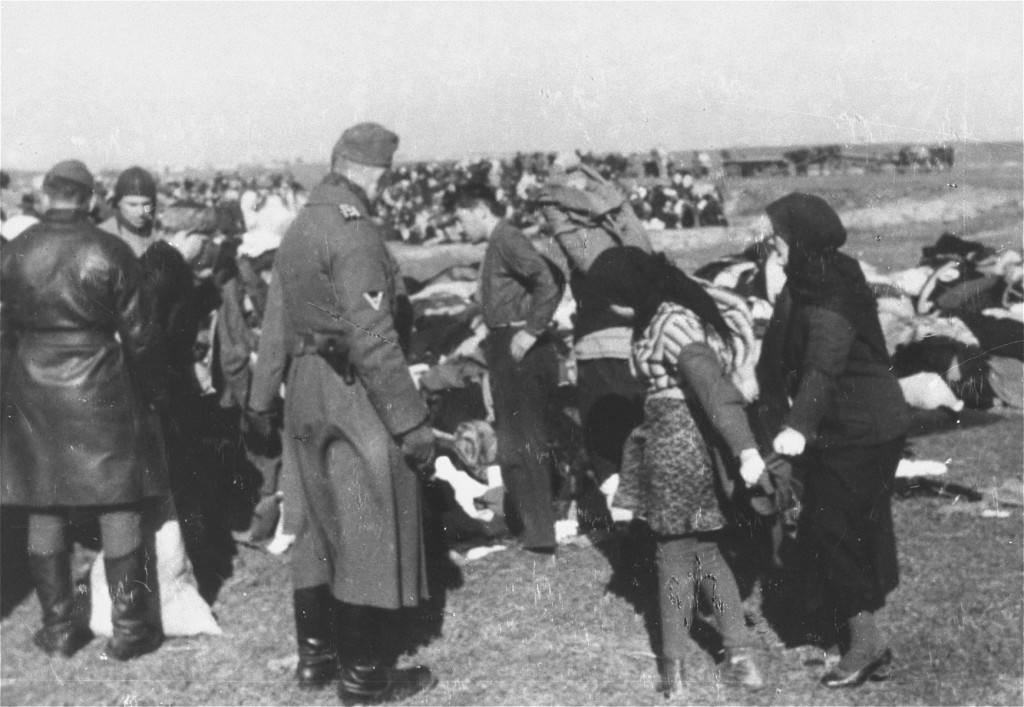
The Wehrmacht troops of the Sixth Army quickly take the Severity Order to heart. On the same day that the Severity Order is issued, the German commander of Lubny, Ukraine, east of Kyiv (about midway to Poltava on the main road), orders all Jews from the area to assemble on the 15th or 16th of October at an area outside of town named Zasulye Yar. There and then, approximately 4500 people are executed by Sonderkommando 4a and local auxiliaries. This is done in a similar fashion to the previous executions at Babi Yar.
The Severity Order becomes a very hot topic after World War II. Reichenau, who perished not long after its issuance, does not have to answer for it (at least to earthly justice), but others do. Field Marshal Gerd von Rundstedt, commander of Army Group South and thus Reichenau’s immediate superior, must approve the Severity Order before it is issued. Rundstedt not only approves the Severity Order, but he also urges all of the other army commanders in his command to issue similar orders (Rundstedt claims that he knows nothing about the Severity Order when testifying on his own behalf at the Nuremberg trials). It is unclear what General Hoth, commander or 17th Army, and General von Manstein, commander of 11th Army, do with this advice, but, apparently, they let the Severity Order pass in silence.
Hitler also supposedly likes the wording so much that he is going to have it issued as a model for other generals on the eastern front.
Reinhard Heydrich, in Prague, tells a conference of his subordinates that Hitler wants all the Jews removed from German space by the end of the year, if possible. All pending questions, he said, had to be resolved, and transportation should not be used as a reason for delay.
Heydrich also includes the Gypsies as being subject to “evacuation” (deportation to death camps) during the Prague conference.
Thousands of Slovak Jews are sent to labor camps at Sered, Vyhne, and Novaky, while the remaining Jews living in what had once been Czechoslovakia are ordered out of their homes and sent to specially designated ghetto areas in 14 selected towns.
Reinhard Heydrich established a camp-ghetto in Sudetenland in southern Germany (occupied Czechoslovakia) that would later be known as the Theresienstadt Concentration Camp. He recommended the site to be used to house deported German, Austrian, and Czechoslovakian Jews. He placed Adolf Eichmann and Rolf Günther in charge of establishing this camp-ghetto.
The Croatian revolutionary Ustashi have killed between 300,000 and 340,000 Serbs and pro-Yugoslav Croats since last May, according to figures compiled by intelligence experts from agents operating in Croatia and Bosnia.
Adolf Hitler ordered a stop to night intruder operations over RAF airfields in eastern England; 1/NJG2 who have been conducting successful harrying of returning RAF bombers were consequently transferred to the Mediterranean.
Allied convoy QP.1, which was consisted of 14 British and Soviet merchant ships escorted by British cruiser HMS London and four minesweepers, from Arkhangelsk, Russia arrived at Scapa Flow, Scotland, United Kingdom.
RAF Bomber Command, Night of 10/11 October 1941
Essen
78 aircraft to bomb the Krupps works; only 13 claimed to have bombed in the Essen area, because of bad weather. 2 Hampdens and 2 Whitleys were lost.
Cologne
69 aircraft; cloud and haze encountered. Cologne reports only minor damage, with 5 people killed and 6 injured. 5 Wellingtons lost.
Minor Operations: 5 Hampdens on searchlight-suppression flights in support of the Cologne and Essen raids, 23 Hampdens to Dunkirk, 22 Wellingtons and Whitleys to Ostend, 22 Wellingtons to Bordeaux, 13 Wellingtons to Rotterdam. 2 Wellingtons were lost from the Bordeaux raid and 1 Hampden from the Dunkirk raid.
Heavy cruiser HMAS Shropshire was detached from convoy QP.1 at 1900 for Scapa Flow, where she arrived at 0015/11th.
Light cruisers HMS Kenya and HMS Sheffield departed Scapa Flow for the Clyde where they arrived on the 11th.
Convoy ON.25 departed Liverpool, escorted by destroyer HMS Douglas. The convoy was joined on the 11th by destroyers HMS Saladin, HMS Skate, and HMS Veteran, corvettes HMS Abelia, and HMS Veronica, and anti-submarine trawlers HMS St. Zeno and HMS Vizalma. The trawlers were detached on the 13th and the corvettes on the 15th. The destroyers were detached on the 16th when relieved by corvettes HMCS Algoma, HMCS Chambly, HMCS Matapedia, HMCS Napanee, HMCS Orillia, and HMCS Pictou. Corvette HMCS Pictou was detached later that day. On the 19th, destroyer HMCS Ottawa joined. The convoy was dispersed on the 24th.
Sloop HMS Lowestoft departed Harwich at 1200 for Scapa Flow to work up after repairs. The sloop arrived at Scapa Flow at 1300/12th.
U-126, commanded by Kapitänleutnant Ernst Bauer, sank British steamer Nailsea Manor (4926grt) at 18-45N, 21-18W. At 0543 hours on 10 Oct 1941 the Nailsea Manor (Master John Herbert Hewitt), a straggler from convoy OS.7, was hit on the port side by one torpedo from U-126 and started to list to starboard. The deck cargo was hanging over the port side and a fire broke out in the shelter deck, where the mail was stowed. The crew, aware of the cargo of ammunition abandoned ship quickly before she sank northeast of the Cape Verde Islands. The master, 35 crew members, five gunners (the ship was armed with one 4in and one 12pdr gun and two Hotchkiss and four Lewis machine guns) and one passenger (a Petty Officer in charge of the landing craft) were picked up by HMS Violet (K 35) (LtCdr K.M. Nicholson), transferred to the British merchant City of Hong Kong when they rejoined the convoy later that day and landed at Freetown on 14 October. The Nailsea Manor was straggling since 1 October together with the Ger.y.Bryn and Hazelside when they had encountered bad weather west of Cape Blanco and started to have troubles with their deck cargoes. After the cargo was secured and the weather became better, the ships continued at 10 knots, accompanied by the corvette, which stayed with the ships since they dropped out of the convoy. The 4,926 ton Nailsea Manor was carrying military stores, including ammunition, mail, and a LCT as deck cargo and was bound for Suez, Egypt.
The British landing craft HMS LCT.102 (450 tons) stored in four sections on deck was lost with the Nailsea Manor. HMS LCT.102 was on transfer from the UK to the Middle East.
British steamer Kyma (3959grt) was sunk by mining in 53-53N, 0-21E. The entire crew was rescued.
Faroes auxiliary fishing vessel Fugloygjin (81grt) was damaged by German bombing at Klaksvig. The ship sank, but was later salved and returned to service.
Battleships HMS Barham and HMS Valiant, light cruisers HMS Ajax and HMAS Hobart, and destroyers HMS Jervis, HMS Jaguar, HMS Jupiter, HMS Kandahar, HMS Griffin, HMS Hasty, HMS Hotspur, HMS Decoy, HMS Avonvale, and HMS Eridge departed Alexandria to sweep westward. At 1800, the fleet turned back to the eastward. Destroyer Jervis attacked a submarine contact at 0730 in 31-14N, 29-14E. The destroyer remained searching for three hours before continuing. The Battle Fleet returned to Alexandria at 1130/11th.
Landing craft tanks A 2 (Sub Lt E. L. Clark RNVR), A 7 (Sub Lt A. C. Bromley RNVR), and A 18 (Sub Lt L. D. Peters RNVR), en route to Tobruk from Mersa Matruh, encountered U-331, commanded by Kapitänleutnant Hans-Diedrich Freiherr von Tiesenhausen, near Ashaila Rocks off Sidi Barrani. At 0402 and 0417 hours on 10 Oct 1941, U-331 fired one torpedo at the three landing craft HMS TLC.2 (A 2) (SubLt E.L. Clark, RNVR), HMS TLC.7 (A 7) (SubLt A.C. Bromley, RNVR) and HMS TLC.18 (A 18) (SubLt L.D. Peters, RNVR) near Ashila Rocks off Sidi Barrani. After the torpedoes missed, the U-boat began a gun duel and missed the vessels with another torpedo at 0439 hours. HMS TLC.18 (A 18) was slightly damaged by gunfire, wounding the navigator SubLt G.S. Sinclair, RNR and forcing the vessel to return to Mersa Matruh. The U-boat broke off the attack after being hit by some 40mm shells, which wounded two men of the gun crew and damaged the conning tower. Bootsmann Hans Gerstenich later died of wounds.
Destroyers HMS Hero, HMAS Nizam, and HMS Kipling departed Alexandria to join the battle fleet. Destroyers HMS Kandahar, HMS Griffin, HMS Jupiter, HMS Decoy, HMS Avonvale, and HMS Eridge were detached from the battle fleet at 1800 to sweep towards Bardia in response to the atack on the LCTs. The destroyers returned to Alexandria at 1430/11th after an unsuccessful search.
Italian steamer Citta Di Simi (25grt?) was sunk by submarine HMS Thunderbolt twelve miles from Cape Sidero, Crete, in 35-31N, 26-25E.
Submarine HMS Truant departed Gibraltar for Malta, arriving on the 16th.
Ocean boarding vessel HMS Maron departed Gibraltar for Western Patrol.
Convoy HX.154 departed Halifax escorted by destroyer HMCS Annapolis and corvette HMCS Amherst. The corvette was detached the next day. American destroyers USS Charles F. Hughes, USS Gleaves, USS Lansdale, USS Madison, and USS Simpson joined on the 12th. Destroyer HMCS Annapolis was detached on the 13th. The American group was relieved on the 19th by destroyers HMS Douglas, HMS Saladin, HMS Skate, and HMS Veteran, corvettes HMS Abelia and HMS Veronica, and anti-submarine trawlers HMS St. Elstan and HMS St. Zeno. Destroyers Douglas and Skate and the corvettes were detached on the 22nd. The convoy arrived at Liverpool on the 23rd.
In Washington today, President Roosevelt announced a program for the rehabilitation of youths rejected for military service because of physical disability and said that he would speak over the radio at 10 PM, October 27, in connection with the observance of Navy Day. The Chinese Ambassador was a caller, as were James G. Blaine, who presented to the President a scroll signed by students and teachers in Christian colleges in China, and Brig. Gen. Brehon B. Somervell.
The Senate was in recess.
The House passed the $5,985,000,000 Lease-Lend bill, received the Cartwright $170,000,000 Defense Highway Bill and adjourned at 5:50 PM until noon Tuesday.
With administration forces in full command, the house approved and sent to the senate unchanged tonight President Roosevelt’s request for a $5,985,000,000 lend-lease appropriation to continue aid to nations resisting aggression. The roll call vote on final passage was announced at 328 to 67, shortly after the members defeated, on a voice vote an attempt by Representative Lambertson, Kansas Republican, to eliminate the lend-lease fund from the omnibus bill in which it was contained. Also beaten was an attempt to forbid using any of the money for Russia.
The House Foreign Affairs Committee voted tonight to restrict hearings on neutrality act revision to two days of closed sessions and to consider only repeal of the provision banning the arming of American merchant ships. The vote was 12 to 7. Representative George Holden Tinkham, Massachusetts Republican, described the committee’s action as “outrageous” and as a “complete nullification of democratic processes.”
Battle lines over President Roosevelt’s request for authority to arm American merchant ships were forming in Congress today with critics of Administration foreign policy expressing the feeling that they were compelled to make a stand on this issue to ward off further and even more fundamental changes in the Neutrality Act. Some of these critics confessed frankly that they were not unalterably opposed to the ship-arming resolution, as introduced in the House and Senate following the President’s message yesterday. They expressed the fear, however, that if it were passed as quickly as Administration leaders predicted, it would be followed by another measure lifting the restrictions imposed by the Neutrality Act on American-flag vessels calling at belligerent ports and traveling in combat zones. To lift those prohibitions, the President’s opponents hold, would mean an all-out “shooting” war for the United States. Meanwhile, after a stormy executive session of the House Foreign Affairs Committee late today, Representative Bloom, chairman, announced that testimony of those favoring the resolution to repeal the ban on arming merchant ships would begin at 10 AM Monday in executive session and would be confined to one day, with Secretary Hull, Secretary Knox, Admiral Stark, Chief of Naval Operations, and Rear Admiral Land, Maritime Commission chairman, as witnesses.
The United States Army Air Corps may soon call for 25,000 women volunteers for enlistment in the regular Army in connection with the operation of the newly developed Army air-raid warning system that is receiving its first test in the East this week.
The threat of a strike at the huge bomber plants of the Consolidated Aircraft Corp. ended tonight as A.F.L. machinists voted to accept a compromise wage proposal providing an estimated $600,000 in retroactive wage raises. The union declined to announce the total vote, but election judges stated that 82.5 percent of those casting ballots had favored the settlement plan.
Tank production in Detroit, Michigan, is hampered by an inter-union struggle as CIO members refuse to handle parts made by AFL workers.
Plans for rehabilitating 200,000 of the 1,000,000 youths who have been rejected for military service because of physical or mental deficiencies were announced by President Roosevelt at his press conference today.
Without an audible word of protest, delegates to the convention of the American Federation of Labor paved the way today to oust from its executive council George F. Browne, president of the International Alliance of Theatrical and Stage Employees, who is on trial in New York with William Bioff, charged with extorting $550,000 from four motion picture companies.
Thurman Arnold, Assistant Attorney General in charge of anti-trust prosecutions, has warned the Federal Works Agency that denial of a contract to the Currier Lumber Company of Detroit, low bidder for 300 defense houses in Michigan, might require action on the part of the Department of Justice.
Two former convicts who confessed to the theft of an automobile at Louisville, Kentucky, stubbornly denied tonight that they were connected with the brutal slaying of Miss Marion Miley and her mother at Lexington, Kentucky, on September 29. Tom C. Penny, 33, Lexington, and Leo Gaddis, 43, Jacksonville, Fla., waived extradition to Kentucky to stand trial for the automobile theft as a further gesture toward their claims of innocence. Fort Worth detectives said, however, that circumstantial evidence drew the men closer to the early morning robbery and slaying at the fashionable country club where the Mileys lived.
A scroll signed by 10,000 Chinese students and teachers in American-supported Christian colleges in China was presented to President Roosevelt today by Dr. Hu Shih, the Chinese Ambassador, and James G. Blaine, chairman of United China Relief, as an expression of Sino-American friendship on the thirtieth anniversary of the founding of the Chinese Republic.
The U.S. Navy decrees that all fleet aircraft are painted flat light grey with all surfaces viewed from above to be painted flat blue grey.
TG 14.3 (Rear Admiral H. Kent Hewitt), comprising carrier USS Yorktown (CV-5), battleship USS New Mexico (BB-40), heavy cruiser USS Quincy (CA-39), light cruiser USS Savannah (CL-42), and Destroyer Divisions 3 and 16, sails from Argentia, Newfoundland, for Casco Bay, Maine. Encountering heavy weather en route, Yorktown, New Mexico, Quincy, Savannah, and destroyers USS Rhind (DD-404), USS Hammann (DD-412), USS Anderson (DD-411), USS Sims (DD-409), USS Mayrant (DD-402), USS Rowan (DD-405), USS Hughes (DD-410), and USS Trippe (DD-403) will all suffer varying degrees of weather damage before the force reaches Casco Bay on 13 October.
The motion picture “Never Give a Sucker an Even Break” is released today. Directed by Edward Cline, this comedy stars W.C. Fields (in his last starring film) and Franklin Pangborn. The plot has Fields attempting to sell his life story to Hollywood and on his way there, he runs into numerous crazy situations that are hilarious.
The new Panamanian government is expected to repeal soon the ban on the arming of merchant ships that had been decreed by the ousted Arias government.
The Chinese Army declared early today that Ichang, western stronghold of Japanese occupation, had been recaptured. A communiqué said, however, that slightly more than 1,000 Japanese garrison troops remained inside the city, holding out in concrete fortifications. The Chinese said these were being shelled. The communiqué said eight Japanese parachutists had been dropped inside the city, apparently with orders for the garrison, but two were captured and the rest killed before they reached the ground. The news, announced during a great official reception, set off wild rejoicing. Newspaper extras were shouted in the streets and firecrackers were set off. Military and diplomatic guests pumped the hand of War Minister General Ho Ying-chin and acclaimed the victory as China’s greatest since the battle of Taierhchwang, in southern Shantung Province, in 1938. Ichang is 750 miles up the Yangtze and the most important river port after Hankow. It is at the entrance to great gorges leading to Chungking. It has been held by the Japanese for two years.
The new German campaign against Moscow is being followed In Japan with the keenest attention, but so far without any conclusive indication as to what consequences Japan herself expects to draw from the outcome.
Captain Lester J. Hudson relieves Captain Richard E. Cassidy as Commander, South China Patrol, on board river gunboat USS Mindanao (PR-8) at Hong Kong, B.C.C.
No. 488 Squadron, RNZAF, arrives at RAF Kallang, Singapore, and is equipped with Brewster Buffalo Mk. Is to provide defense for the British colony.
Dow Jones Industrial Average: 122.46 (-0.07)
Born:
Peter Coyote [as Rachmil Pinchus Ben Mosha Cohon], actor (“E.T. the Extra-Terrestrial”, “Jagged Edge”) and narrator, in New York, New York.
Laurence Henry Tribe, Harvard Law professor, in Shanghai, China.
Dallas Smith, Candian NHL defenseman (NHL Champions, Stanley Cup-Bruins, 1970, 1972; NHL All-Star, 1971–1974; Boston Bruins, New York Rangers), in Hamiota, Manitoba, Canada.
Odell Barry, AFL wide receiver (Denver Broncos), in Memphis, Tennessee (d. 2022).
Naval Construction:
The Royal Navy LCT (Mk 2)-class landing crafts, tank HMS LCT 136 and HMS LCT 169 are laid down by Stockton Construction (Thornaby, U.K.).
The U.S. Navy YMS-1-class auxiliary motor minesweeper USS YMS-127 is laid down by the J. M. Martinac Shipbuilding Corp. (Tacoma, Washington, U.S.A.).
The Royal Navy Isles-class minesweeping trawler HMS Magdalen (T 279) is laid down by the Midland Shipyards Ltd. (Midland. Ontario, Canada). She is transferred to the Royal Canadian Navy and commissions as the HMCS Magdalen (T 279).
The Royal Navy Abdiel-class minelayer (Second Group) HMS Apollo (M 01) is laid down by Hawthorn Leslie & Co. (Hebburn-on-Tyne, U.K.).
The U.S. Navy SC-497-class (110-foot wooden hull) submarine chaser USS PC-648 (later SC-648) is laid down by the Delaware Bay Shipbuilding Co. (Leesburg, New Jersey, U.S.A.).
The Kriegsmarine (German Navy) Type IXD2 U-boat U-199 is laid down by AG Weser, Bremen (werk 1045).
The Royal Indian Navy Bathurst-class minesweeper-corvette HMIS Punjab (J 239) is launched by the Morts Dock & Enginering Co. Ltd. (Sydney, New South Wales, Australia).
The Royal Navy Fairmile B-class motor launch HMS ML 342 is commissioned.
The U.S. Navy transport ship USS Crescent City (AP-40) is commissioned. Her first commanding officer is Commander Walter C. Calhoun, USN.
The Royal Navy MMS I-class motor minesweeper HMS MMS 53 (J 553) is commissioned.
The U.S. Navy Accentor-class coastal minesweeper USS Advance (AMc-63) is placed in service. Her first commanding officer is Lieutenant Walter E. Goering, USNR.
The Вое́нно-морско́й флот СССР (ВМФ) (Soviet Navy) Project 7-class (Gnevny-class) destroyer Retivy (Ретивый, “Ardent”) is commissioned.
The Royal Navy aircraft carrier HMS Indomitable (92), sole ship of her class (modified Illustrious-class) is commissioned. Her first commanding officer is Captain Harold Edward Morse, DSO, RN.
Below is the full and disturbing text of the secret order issued by Field Marshal von Reichenau on 10 October 1941. This was appended to a more innocuous order.
SECRET!
Army H. Q., 10.10.41
Army Command 6., Sec. Ia-A. 7
Subject: Conduct of Troops in Eastern Territories.
Regarding the conduct of troops towards the Bolshevistic system, imprecise ideas are still prevalent in many cases. The most essential aim of war against the Jewish-Bolshevistic system is the complete destruction of their means of power and the elimination of Asiatic influence from the European culture. In this connection, the troops are facing tasks which exceed the one-sided routine of soldiering. The soldier in the eastern territories is not merely a fighter according to the rules of the art of war but also a bearer of ruthless national ideology and the avenger of bestialities which have been inflicted upon German and racially related nations.
Therefore the soldier must have full understanding for the necessity of a severe but just revenge on subhuman Jewry. The Army has to aim at another purpose, i. e., the annihilation of revolts in hinterland which, as experience proves, have always been caused by Jews.
The combating of the enemy behind the front line is still not being taken seriously enough. Treacherous, cruel partisans and unnatural women are still being made prisoners of war and guerilla fighters dressed partly in uniforms or plain clothes and vagabonds are still being treated as proper soldiers and sent to prisoner-of-war camps. In fact, captured Russian officers talk even mockingly about Soviet agents moving openly about the roads/ and very often eating at German field kitchens. Such an attitude of the troops can only be explained by complete thought-lessness, so it is now high time for the commanders to clarify the meaning of the present struggle.
The feeding of the natives and of prisoners of war who are not working for the Armed Forces from Army kitchens is an equally misunderstood humanitarian act as is the giving of cigarettes and bread. Things which the people at home can spare under great sacrifices and things which are being brought by the Command to the front under great difficulties, should not be given to the enemy by the soldier not even if they originate from booty. It is an important part of our supply.
When retreating the Soviets have often set buildings on fire. The troops should be interested in extinguishing of fires only as far as it is necessary to secure sufficient numbers of billets. Otherwise, the disappearance of symbols of the former Bolshevistic rule even in the form of buildings is part of the struggle of destruction. Neither historic nor artistic considerations are of any importance in the eastern territories. The command issues the necessary directives for the securing of raw materials and plants, essential for the war economy. The complete disarming of the civil population in the rear of the fighting troops is imperative considering the long and vulnerable lines of communications. Where possible, captured weapons and ammunition should be stored and guarded. Should this be impossible because of the situation of the battle so the weapons and ammunition will be rendered useless. If isolated partisans are found using firearms in the rear of the army drastic measures are to be taken. These measures will be extended to that part of the male population who were in a position to hinder or report the attacks. The indifference of numerous apparently anti-Soviet elements which originates from a “wait and see” attitude, must give way to a clear decision for active collaboration. If not, no one can com-plain about being judged and treated a member of the Soviet System.
The fear of the German counter-measures must be stronger than the threats of the wandering Bolshevistic remnants. Being far from all political considerations of the future the soldier has to fulfill two tasks:
- Complete annihilation of the false Bolshevistic doctrine of the Soviet State and its armed forces.
- The pitiless extermination of foreign treachery and cruelty and thus the protection of the lives of military personnel in Russia.
This is the only way to fulfil our historic task to liberate the German people once forever from the Asiatic-Jewish danger.
Commander in Chief
(Signed) von Reichenau
Field Marshal.

