Hitler publicly announced that the war against the Soviet Union is all but over. Adolf Hitler announces that the war in the East, for all intents and purposes, has already been decided in favor of the Reich. Otto Dietrich, Chancellor Adolf Hitler’s press chief, announces to war correspondents: “For all military purposes Soviet Russia is done with.”
Soviet Army reserves move into defensive positions on the direct approaches to Moscow. The 1st Guard Rifle Corps is committed at Mtsensk and temporarily stops the tanks of General Heinz Guderian’s 2nd Panzer Army from moving closer to Moscow.
A detachment of Soviet NKVD troops prevented a company of German Brandenburg 800 Division saboteurs from destroying the Istra Water Reservoir near Moscow, Russia.
Georg von Bismarck was named the commanding officer of the 20th Panzer Division.
The Jager Report (issued on 1 Dec 1941) noted that 1,169 adult male, 1,840 adult female, and 717 children, all Jews, were killed in Svenciany, Lithuania for a total of 3,726 people.
Twelve more persons were executed in Bohemia-Moravia today, it was announced in Prague. The executions came as Reinhard Heydrich, deputy Gestapo chief, who is acting administrator for the Protectorate, announced an “experimental” lifting of the curfew in nine provinces under a state of emergency. This was seen as a warning of sterner measures if order soon was not restored.
The Vichy Supreme Court indicted Léon Blum, Édouard Daladier, Guy La Chambre, Maurice Gamelin and Robert Jacomet for treason against their duties to the state during the years leading up to France’s defeat in 1940. The defendants would go on trial beginning in February 1942 in proceedings that would be known as the Riom Trial.
A trade agreement was signed between Turkey and Germany under which the latter would get no deliveries of chrome until 1943. Turkey signs a trade treaty with Germany to supply raw materials in exchange for manufactured goods.
No. 601 Squadron RAF mounted a mission with four P-39 Airacobra aircraft, strafing German barges near Dunkerque, France. This was to be the final Airacobra mission with the RAF.
Allied convoy QP.1 arrived at Scapa Flow, Scotland, United Kingdom.
There were no Bomber Command operations from 5 to 10 October, because of unfavorable weather conditions.
Heavy cruiser HMS London arrived at Scapa Flow at 0830 from Archangel. Destroyer HMS Offa embarked the party carried on the heavy cruiser at 1000 and sailed with them for Scrabster. The destroyer arrived back at Scapa Flow at 1330 that day.
Destroyer HMS Charlestown departed Loch Alsh at 1900 for Scapa Flow to carry out repairs to her oil tanks. The destroyer arrived at 0700/10th.
German fishing vessel Gunther (252grt) was lost near Gotland.
Light cruiser HMS Galatea departed Anchorage H (Towila) for Suez with the survivors of ships sunk. After landing the survivors, the light cruiser passed through the Canal on the 10th for Alexandria.
Sloop HMS Flamingo passed through the Suez Canal to return to Alexandria to rejoin the Mediterranean Fleet.
Ex-US Coast Guard cutters/escorts HMS Totland and HMS Sennen arrived at Gibraltar from Freetown escorting Norwegian tankers Vanja (6198grt) and Sandar (7624grt).
Corvettes HMS Azalea and HMS Spiraea departed Gibraltar for Bathurst, escorting the 26th Motor Launch Flotilla. Tanker La Carriere departed in company and proceeded to the West Indies. Motor Launch ML.244 later broke down and returned to Gibraltar.
Submarine HMS Porpoise departed Troon after refitting on the 2nd arrived at Gibraltar on the 9th.
Submarines HMS Unique, HMS Upholder and Polish ORP Sokol departed Malta on short notice to intercept a convoy between Pantelleria and Lampedusa. Upholder returned with generator problems.
Canadian troop convoy TC.14 departed Halifax with steamers Andes (25,689grt), Aorangi (17,491grt), Capetown Castle (27,000grt), Monarch of Bermuda (22,424grt), Reina Del Pacifico (17,702grt), and Warwick Castle (20,107grt). The convoy was escorted by destroyer HMCS St. Francis from 9 to 12 October, destroyer HMCS Restigouche from 9 to 15 October, destroyers HMS Harvester and HMS Havelock from 9 to 17 October, destroyer HMCS Skeena from 11 to 15 October, destroyer HMCS Buxton from 11 to 17 October, destroyers HMS Highlander and HMS Broadwater from 14 to 16 October, destroyer HMS Sherwood from 14 to 17 October, anti-aircraft cruiser HMS Cairo and destroyer HMS Belmont from 15 to 17 October. The convoy arrived on the 17th.
President Roosevelt slowly has been ratcheting up the pressure on the U-boat menace in the Atlantic. This has included, among many other things, sending U.S. warships on armed neutrality patrols for the benefit of the Royal Navy and escorting convoys from the United States to Iceland. As a major escalation in this process, FDR on 9 October 1941 FDR sends a message to Congress asking it to amend the Neutrality Act to permit U.S. flag merchant vessels to be armed for self-defense.
President Roosevelt asked Congress for immediate authority to arm American merchant ships. “We will not let Hitler prescribe the waters of the world which our ships may travel,” the president said. “The American flag is not going to be driven from the seas either by his submarines, his airplanes or his threats..” Denouncing the Nazis as “madmen” and “modern pirates,” President Roosevelt today asked congress to wipe out “crippling provisions” of the United States neutrality act. First of all, he asked repeal of that statute’s ban on armed merchant ships, “as a matter of immediate necessity and extreme urgency.” U.S. President Franklin D. Roosevelt asked the U.S. Congress to modify the Neutrality Act to allow American merchant ships to be armed and to allow their passage through combat zones stating, “We cannot permit the affirmative defense of our rights to be annulled and diluted by sections of the Neutrality Act which have no realism in the light of unscrupulous ambition of madmen… I recommend the repeal of section 6 of the act of 4 November 1939, which prohibits the arming of American-flag ships engaged in foreign commerce.”
This follows long-established United States Navy police (which continues actively into the 21st Century) to keep open international sea lanes. Since FDR’s political party controls Congress, approval of this request is a foregone conclusion.
In line with his increased determination to confront Hitler’s Germany at sea and to support his enemies with Lend-Lease supplies, President Franklin Roosevelt repeatedly authorizes actions in 1941 to shift the United States to a war-time posture even though the nation is at peace. On 9 October 1941, in addition to ramping up the war at sea, FDR takes a major step on a completely different track in his efforts that will have much more dramatic and long-lasting implications. These revolve around the development of nuclear weapons.
President Roosevelt has been a supporter of research into atomic energy since receiving Albert Einstein’s and Leó Szilárd’s famous 2 August 1939 letter urging research and development of nuclear energy and perhaps an atomic bomb. That letter stated in pertinent part:
“This new phenomenon would also lead to the construction of bombs, and it is conceivable — though much less certain — that extremely powerful bombs of a new type may thus be constructed.”
Roosevelt authorized such research in October 1939 (after the letter was brought to his attention) and has received periodic briefings ever since. He has taken periodic organizational steps to push the project forward. The British also have been investigating prospects for an atomic bomb, which resulted in its British Military Application of Uranium Detonation (MAUD) Committee Report on the topic. However, neither government is anywhere close to developing an atomic bomb. On 9 October 1941, this process speeds up dramatically.
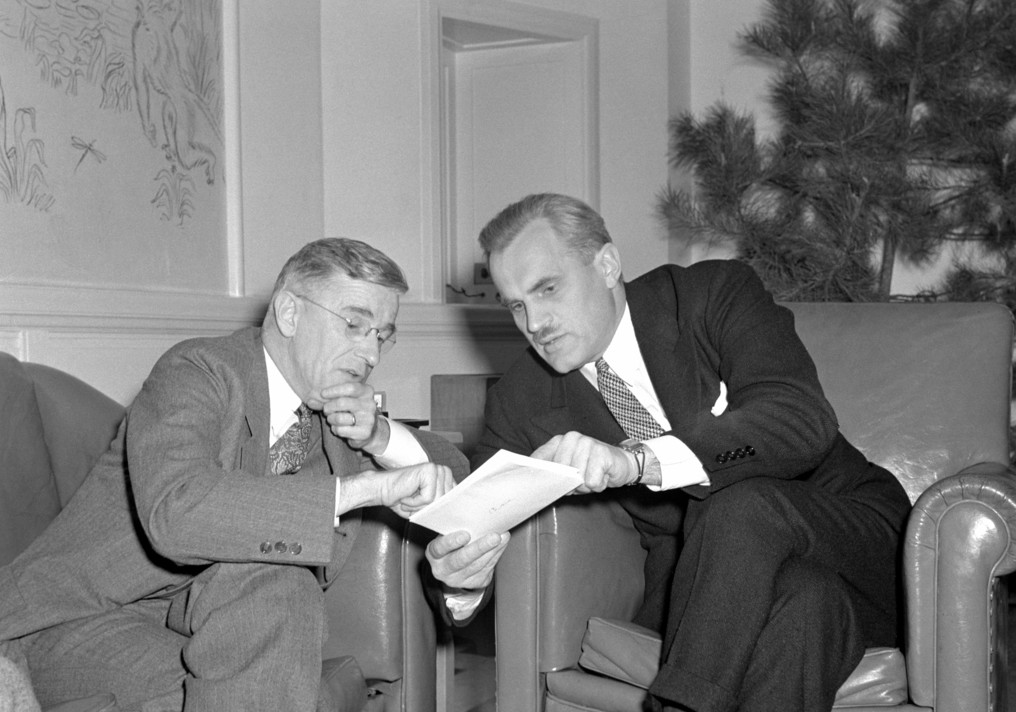
Vannevar Bush took the British Military Application of Uranium Detonation (MAUD) Committee Report to U.S. President Franklin Roosevelt, who agreed to work together with the British to develop atomic weapons. Dr. Vannevar Bush, head of the Office of Scientific Research and Development, briefed U.S. President Franklin D. Roosevelt and U.S. Vice President Henry A. Wallace on the state of atomic bomb research. Roosevelt instructed Bush to find out if a bomb could be built and at what cost. Bush received permission to explore construction needs with the Army.
Roosevelt authorizes Bush to explore further what it would take to build such a bomb — which remains completely theoretical and uncertain — and how much it would cost. He creates the Top Policy Group composed of himself, Wallace, Bush, James B. Conant, Secretary of War Henry L. Stimson, and the Chief of Staff of the Army, General George Marshall to review progress. In essence, Bush becomes a “Bomb Czar” with outsized influence to create organizational structures and to commandeer resources to pursue the development of an atomic bomb. There is little question that Bush is the “prime mover” behind nuclear weapons development and deserves much of the credit — or blame — for their eventual appearance. While there are many important dates in the progress of the Manhattan Project (which is not yet its name, that happens in 1942), the events of 9 October 1941 are perhaps the biggest acceleration in the development of nuclear weapons.
In Washington, President Roosevelt sent to Congress a message recommending repeal of that section of the Neutrality Act which prohibits the arming of merchant ships and suggesting other revisions. His callers Included Mayor La Guardia and Harold D. Smith, director of the Budget; Brigadier General Brehon B. Somervell, Vice President Wallace and Dr. Vannevar Bush and Secretary Stimson with General George C. Marshall, Brigadier General Lewis B. Hershey and Dr. Leonard Rountree.
The Senate confirmed the nomination of Arthur Bliss Lane to be Minister to Costa Rica, received the Connally Joint Resolution to permit the arming of merchant ships and adjourned at 1:49 PM until noon Monday. The Banking and Currency Committee favorably reported the bill to increase by $1,500,000,000 the lending authority of the Reconstruction Finance Corporation.
The House debated the lend-lease bill and recessed at 6:03 PM until 11 AM tomorrow.
President Roosevelt sent an urgent message to Congress today asking immediate authority for the arming of American merchant ships and simultaneously defying Adolf Hitler to drive the United States flag from the seas “either by his submarines, his airplanes or his threats.” Declaring that this country was dealing with modern pirates, who destroy defenseless ships without warning and without provision for the safety of passengers and crews, the President held that we must look to our own arms.
He recommended, specifically, the repeal of Section 6 of the Neutrality Act of 1939, by which the arming of American merchant vessels is prohibited. The arming of these ships, he asserted, “is & matter of immediate necessity and extreme urgency.” Although he did not demand other action at this time, he said there were other “crippling provisions” of the act, to the correction of which he hoped Congress would give “earnest and early” attention. The repeal or modification of these provisions, he added, “will not leave the United States any less neutral than we are today, but will make it possible for us to defend the Americas far more successfully and to give aid far more effectively against the tremendous forces now marching towards conquest of the world.”
General Robert E. Wood, national chairman of the America First committee, tonight declared that President Roosevelt had asked congress “to issue an engraved drowning license to American seamen.” Decrying the president’s request for revision of the neutrality act to permit arming American merchant ships, Wood asserted that “the country will be led into war on a wave of hysteria just as it was in 1917.” “Once in the war,” he said, “the British generals have told us we will have to send a huge new American expeditionary force.”
With the virtual collapse of opposition, the course of debate today on the $5,985,000,000 lend-lease bill clearly indicated that it would be passed by the House tomorrow without any major change. Administration leaders had difficulty in keeping their members on the floor, and the Republicans had to demand repeated roll calls to assure an audience. Representative Hamilton Fish of New York, a bitter opponent of the Administration’s foreign policy, conceded during an anti-Russia speech that there was a case for sending arms to the Russians on purely military grounds. “Lend-lease aid to the Communists, if it is based on freedom of religion or that Soviet religion is a democracy, is a fraud and a contemptible sham,” he said. “If lease-lend funds are to be made available to Godless Soviet Russia, it must be exclusively on military grounds-that Stalin is fighting Hitler, and the Communist Army the Nazi Army.”
Republicans accused the administration today of an “amazing lack of candor” and an unwillingness to disclose “cold, hard facts” about the progress of the defense program as the house debated the $5,935,000,000 lend-lease bill. Immediately after Representative Woodrum, Virginia Democrat, in a 50-minute speech told the house that the nation was making an industrial effort almost on a war basis, Representative Ditter, Pennsylvania Republican, arose to assert that “Hitler is better informed than the American people” about the extent of this country’s preparedness. “What the American people want to know is how well we are prepared to fight right now,” he said.
The American program of aid to Russia is proceeding undiminished, notwithstanding the great German drive to liquidate the remaining effective Soviet armies. This was said today by officials who emphasized that the view was maintained here that Russia was going to win eventually. The program calls for the delivery of tanks, airplanes and military equipment of every kind, as well as tools, on the basis laid down in the recent tripartite conference in Moscow. The details have not been disclosed but a great mass of material is involved. The plan is understood to be to ship it into Russia principally over the trans-Iranian railroad. Whether this will require the strengthening of that line has not been indicated. The military picture was obscure today in view of an absence of informative dispatches, but officials assumed that, even though two or more pockets might be closing around Soviet armies, the main forces immediately before Moscow had not yet been touched. It was believed that Moscow would not fall for some time, if ever. On the other hand, it was recognized that the German objective continued to be the Soviet armies rather than cities, even though the fall of Moscow might have an important psychological effect.
Invoking unparalleled veto power over the $11,000,000,000 construction industry, the Supply Priorities and Allocation Board prohibited today the start of any non-essential public or private construction which would divert vital materials from the defense effort. S.P.A.B. issued a policy ruling that projects which it deemed unnecessary to “direct national defense,” public health or safety would be barred for the duration of the emergency from “priorities” on such vital metals as steel, copper, bronze aluminum and brass.
A conference of farm leaders from 37 states drafted resolutions tonight calling upon congress to guarantee farmers higher prices than now prevail for many of their products. Congressional proposals to freeze agricultural prices at present levels or to authorize a ceiling on such prices encountered sharp opposition from the 60-odd governors, state agricultural commissioners, officials of national farm organizations, and congress members attending the conference.
A major responsibility for inflation, with rising cost of living wiping out wage increases, was put squarely up to the American worker today, and a remedy suggested, by Herbert E. Gaston, Assistant Secretary of the Treasury, in an address before the American Federation of Labor convention.
Destroyer USS Upshur (DD-144), in screen of convoy ON.22, carries out depth charge attack (like Dallas’s the previous day, evaluated as “non-submarine”) about 405 miles southeast of Cape Farewell, 56°47’N, 34°05’W.
The motion picture “Texas” is released today. Directed by George Marshall, this western stars Claire Trevor, William Holden, Glenn Ford, and Edgar Buchanan. The plot has two Virginia buddies heading for Texas and then splitting up. Years later, one has become a cattle rustler and the other a cattleman. To add romance, both compete for Claire Trevor’s affections.
Ricardo Adolfo de la Guardia Arango became President of Panama.
Chinese forces have occupied one-half of Ichang on the Yangtze River midway between Chungking and Japan’s major base in Hankow, it was announced officially tonight. It was the first time official sources had claimed entry of Chinese troops into Ichang. The Central News Agency prematurely had reported the entry of Chinese troops earlier in the week. The War Office said “very severe street fighting was under way in Ichang.” The announcement — made on the eve of China’s thirtieth “Double Ten” [tenth day of the tenth month] anniversary of the establishment of the modern republic — electrified the population, which immediately started street demonstrations. It came while many officials were at the airport to greet President Roosevelt’s Military Mission headed by Brig. Gen. John Magruder, which arrived here by airplane from Hong Kong shortly before midnight.
The Japanese ambassador to the U.S. sends the following message to the Foreign Ministry in Tokyo: “This morning, the 9th, I called on (U.S. Secretary of State Cordell) Hull and relayed the matter contained in your instructions and at the same time brought up the points discussed at the White House on 3 September. The Secretary, in reply, merely repeated that non-discriminatory treatment should extend over the entire Pacific area. He added that geographical proximity, etc., could be interpreted in many ways. He said that he would have Ballantine and others make a detailed reply to me later after the papers I submitted were carefully perused and studied. (Hamilton and Ballantine are supposed to call on me this afternoon.) Referring to the matter of evacuating or stationing of troops in China, I carefully and in detail described the political situation in China from the Japanese viewpoint and pointed out that stationing of our troops in certain parts of China was absolutely essential. I requested that this point be given a reconsideration in this light.”
The Japanese news agency Domei declared today on the authority of “economic and political observers here” that Japan was now indifferent to the oil embargo said to have been imposed on her by an agreement between the United States, Britain and the Netherlands Indies.
Japanese spokesmen and newspapers today criticized the “willful, arrogant” actions of the United States and warned that the war “is likely to spread to other regions” of the world at any moment.
Dow Jones Industrial Average: 122.53 (-1.60)
Born:
Trent Lott, American politician (U.S. Senator, R-Mississippi, 1989-2007; U.S. Representative, R-Mississippi, 1973-1989), in Grenada, Mississippi.
J.R. Williamson, AFL linebacker (AFL Champions-Raiders, 1967 [lost Super Bowl II]; Oakland Raiders, Boston Patriots), in El Dorado, Arkansas (d. 2020).
Larry Hale, Canadian NHL and WHA defenseman (Philadelphia Flyers; Houston Aeros), in Summerland, British Columbia, Canada (d. 2019).
Jeoff Long, MLB pinch hitter, outfielder, and first baseman (St. Louis Cardinals, Chicago White Sox), in Covington, Kentucky.
Brian Lamb, American broadcaster and founder of C-Span Networks, in Lafayette, Indiana.
Died:
Helen Morgan, 41, American singer and actress (“Show Boat”), of cirrhosis of the liver.
Naval Construction:
The Royal Navy Isles-class minesweeping trawler HMS Anticosti (T 274) is laid down by Collingwood Shipyards Ltd. (Collingwood, Ontario, Canada). She is transferred to the Royal Canadian Navy on completion and commissions as HMS Anticosti (T 274).
The Nihon Kaigun (Imperial Japanese Navy) Kaichū type submarine (K6 sub-class) HIJMS Ro-35 laid down by Mitsubishi (Kobe, Hyōgo Prefecture, Japan).
The Nihon Kaigun (Imperial Japanese Navy) Kaichū type submarine (K6 sub-class) HIJMS Ro-37 laid down by the Sasebo Navy Yard (Sasebo, Nagasaki Prefecture, Japan).
The Royal Navy “U”-class (Third Group) submarine HMS Untamed (P 58) is laid down by Vickers Armstrong (Newcastle-on-Tyne, U.K.); completed by Davey Paxman & Ricardo.
The U.S. Navy Baltimore-class heavy cruiser USS St. Paul (CA-71) is laid down by the Bethlehem Shipbuilding Corp. (Quincy, Massachusetts, U.S.A.). After the loss of USS Quincy (CA-39) at the battle of Savo Island, she is renamed USS Quincy (CA-71).
The Kriegsmarine (German Navy) Type VIID U-boat U-215 is launched by F. Krupp Germaniawerft AG, Kiel (werk 647).
The Kriegsmarine (German Navy) Type IXC U-boat U-512 is launched by Deutsche Werft AG, Hamburg (werk 308).
The Royal Navy “O”-class destroyer HMS Onslaught (G 04) is launched by the Fairfield Shipbuilding & Engineering Co. (Govan, Scotland).
The U.S. Navy Aloe-class net tender USS Eucalyptus (YN-11; later AN-16) is placed in service. Her first commanding officer is Lieutenant Stephen B McDonald, USNR.
The U.S. Navy Accentor-class coastal minesweeper USS Turaco (AMc-55) is placed in service. Her first commanding officer is Lieutenant (j.g.) Allard B. Heyward, USNR.
The Royal Navy Fairmile C-class motor gun boat HMS MGB 334 is commissioned.
The Royal Australian Navy Bathurst-class minesweeper-corvette HMAS Toowoomba (J 157) is commissioned. Her first commanding officer is Lieutenant Commander (emergency) Paul Hugill Hirst, RAN.
The Kriegsmarine (German Navy) Type VIIC U-boat U-334 is commissioned. Her first commanding officer is Oberleutnant zur See Hilmar Siemon.
The Kriegsmarine (German Navy) Type VIIC U-boat U-591 is commissioned. Her first commanding officer is Oberleutnant zur See Hans-Jürgen Zetsche.
The Royal Navy Hunt-class (Type II) escort destroyer HMS Southwold (L 10) is commissioned. Her first commanding officer is Commander Christopher Theodore Jellicoe, DSC, RN.

