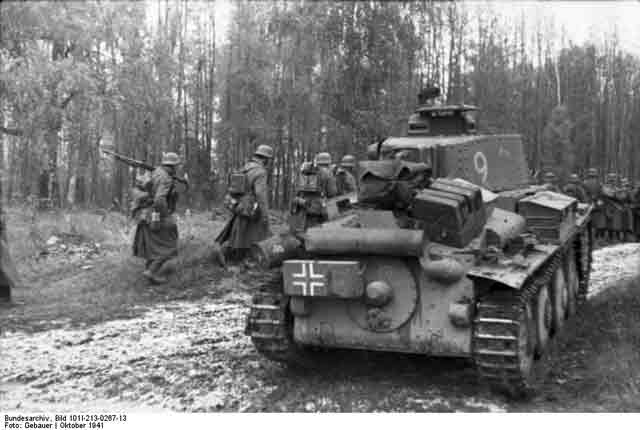
There are many dark moments during World War II for Soviet leader Joseph Stalin. Among these are the first days of Operation BARBAROSSA, when he unsuccessfully begs Hitler for peace via a Bulgarian emissary. Perhaps the greatest, however, is in the first two weeks of October. On 4 October 1941, signs begin to emerge that Stalin fears that the war is lost and all that is left is to await the end. Today, we might say that Stalin is “losing his nerve.”
Lieutenant-General Ivan Konev is the commander of Western Front. This force is defending the high road to Moscow that runs through Minsk and Smolensk. Currently, Konev’s troops are fighting the Vyazma Defensive Operation and having a very tough time of it, with German pincers threatening a massive encirclement at Vyazma — the last major city before Moscow. Loss of Western Front, whose main component is the Konev’s former command 19th Army (General M.F. Lukin) would make a successful defense of Moscow extremely difficult. Konev recalls:
“On 4 October I reported to Stalin about the situation in the Western Front and about the enemy penetration of the Reserve Front… and also about the threat of a large enemy grouping reaching our forces’ rear area…Stalin listened to me, however, made no decision. Communications were disrupted and further conversation ceased.”
To sum up, Stalin is paralyzed and incapable of making decisions. However, in the Soviet state, nobody dares to make any decisions on their own without approval from the Stavka — and Stalin controls the Stavka. It is a very dangerous situation for the Red Army.
Stalin has good reason to be scared. German General Erich Hoepner’s Panzer Group 4, composed primarily of LVI Panzer Corps (Erich von Manstein) and XLI Panzer Corps (George-Hans Reinhardt) is attacking Vyazma from the south while General Hermann Hoth’s Panzer Group 3 is approaching it from the north. Should those two forces meet in the vicinity of Vyazma, the Red Army could lose another massive force (31 Rifle Divisions, 3 Cavalry Divisions, 2 Motorized Divisions, and 3 tank Brigades). Today, Hoepner eliminates Soviet 33rd and 43rd Armies as it captures Kirov and Spa-Demensk, not far to the southwest of Vyazma. Soviet Group (Ivan) Boldin is counterattacking Hoth’s panzers, but Hoth, having reached an area southwest of Belyi, decides to head due east to sideslip the Soviet defenders for a deeper encirclement. Hoth also sends VI Army Corps north to take Belyi, which the Soviets contest bitterly.
Stalin’s refusal to issue orders means that the endangered Soviet troops are not authorized to retreat. Without authorization to retreat, no Soviet commanders will issue such orders lest they suffer the same fate as generals like Pavlov in the early days of the war who were shot for “cowardice.” Thus, another situation like Kyiv is developing, where any retreat orders may be issued too late and a giant hole may be blown through the Soviet lines — one that points directly at Moscow.
Panzer Group Hoeppner attacks near Vyazma from the south. Hoth attacks between Vyazma and Rzhev. Guderian attacks Orel and Bryansk. These German attacks threaten large numbers of Soviet troops west of Bryansk and Vyazma. 4th Panzer Army completed the destruction of the Soviet 43rd army and shattered the Soviet 33rd Army as it advanced east. These attacks created a 90 mile gap in the Soviet lines between the Bryansk and Reserve Fronts. The 10th Panzer Division reached Vyazma from the south. Large numbers of Soviet troops were threatened with encirclement and Soviet Marshal Josef Stalin refused to allow a retreat. German Panzergruppe 3 and Panzergruppe 4 began to surround rear elements of the Soviet Western Front in Russia, capturing Kirov and Spa-Demensk in the process. The German troops continued to advance toward Vyazma to complete the envelopment.
As with all other successful German offensives, the Luftwaffe has complete control of the skies. Air support is a critical component of the Blitzkrieg formula, and there are many top German aces clearing the way for the army. Luftwaffe fighter squadron JG 27 has a particularly good day, with the pilots starting early in the morning and flying multiple missions. Oblt. Erbo Graf von Kageneck of 9./JG 27 claims three Soviet planes — a DB-3, an SB-2, and a Pe-2 — and finishes the day with 60 victories. Ofw. Erwin Sallwisch of Stab/JG 27 (the headquarters group) claims four Soviet I-18 planes during the day. Top ace Hannes Trautloft of the same group downs an I-26, while several other JG 27 pilots also claim victories.
It is a virtual shooting gallery in the skies because these are areas the Red Air Force must defend, and so they are forced to do battle and be shot down. However, there are always more Soviet planes to replace the ones lost, which may be welcomed by victory-hungry Luftwaffe pilots but which is a troubling omen for the future.
The organization of the marauding partisan bands operating against the Germans deep behind the front line is becoming formalized under the control of the Stavka. Formed from pockets of Russian soldiers cut off by the Germans; often frightened of being punished if they returned to their own lines, they took to the forests and live by raiding German supply lines. They are a potent guerrilla force, harassing the Heer and sending back intelligence to regular Red Army formations. Officers, political commissars, radio transmitters and weapons are parachuted to the bands and a rigid discipline imposed. Some even operate as cavalry. They tie up thousands of Germans in protection duties; if they are caught, they are killed with great brutality, their bodies left hanging from the gallows as a warning to others.
This night a Finnish attempt to cross the River Syväri (Svir) by Battlegroup Kuistio fails, as the men of the attacking battalion refuse to follow orders. On the next night, another attempt by a different battalion fails for the same reason. Crossing of Syväri finally succeeds on 6 October after the troops had rested and Colonel Kuistio arranged fire-support for the operation. The troops had been continuously in offensive for three months now, and signs of war-weariness are showing. The general opinion among the soldiers is that the war is fought to reconquer the lands lost in the Winter War, and the continuation of the offensive past the pre-1939 borders had already caused cases of insubordination and desertion. Also the offensive operations after the capture of Petrozavodsk (which was rumored to be the final goal) came as a nasty surprise. It was thought that River Syväri would be the point where the rifles will be changed into spades. However, serious incidents of insubordination are few, usually a short period of rest combined with stern speeches by commanding officers are enough to restore the situation.
Early on the morning of October 4, 1941, German SS, police units, and Lithuanian auxiliary forces sealed off the Small Ghetto in Kovno (Kaunas), Lithuania. They locked all patients, doctors, and nurses inside the ghetto’s infectious disease hospital, boarded the doors, and set the entire structure on fire. Everyone inside was burned alive. The remaining residents of the Small Ghetto were rounded up and marched to the Ninth Fort, an old military installation on the edge of the city. Approximately 2,000 Jewish men, women, and children were shot and killed in mass trenches on this day. The Small Ghetto Action served as a terrifying prelude to an even larger massacre just weeks later. On October 28–29, 1941, the Nazis conducted the “Great Action” (Grosse Aktion), during which 9,200 more Jews from the Large Ghetto were selected and systematically murdered at the Ninth Fort.
The Jager Report (issued on 1 December 1941) noted that 432 adult male, 1,115 adult female, and 436 children, all Jews, were killed in Vilnius, Lithuania for a total of 1,983 people.
The Nazi regime warns the Norwegian people to co-operate or face starvation, after growing unrest and street riots.
Friedrich Knackfuss was named the civilian administrator of the Channel Islands.
Petain commutes the death sentence on Paul Colette, who attempted to assassinate Pierre Laval and Marcel Deat into Life imprisonment.
Petain also makes a single trade union compulsory for all workers.
The first group of U-boats attacked the British Alexandria-Tobruk shipping supply line in the Mediterranean, a shipping link vital to the British troops fighting in North Africa.
The German submarine U-111 was sunk southwest of Tenerife by depth charges from the trawler HMS Lady Shirley.
Reports from Afghanistan tonight to foreign diplomatic circles in Ankara gave strong indications that Soviet and British diplomatic activity was rapidly being intensified to force expulsion or internment of all Germans resident in Afghanistan, including fugitives from Iran.
Battleship HMS King George V and destroyers HMS Somali, HMS Bedouin, and HMS Eskimo departed Hvalfjord at 1300 for Akureyri. Aircraft carrier HMS Victorious, light cruiser HMS Penelope and destroyers HMS Ashanti, HMS Punjabi, and HMS Matabele were in company. The ships arrived on the 5th. Light cruiser HMS Aurora departed Hvalfjord and proceeded to Seidisfjord arriving the next day. On the 5th, battleship King George V and destroyers Somali, Bedouin, and Eskimo arrived at Akureyri and later departed that day after a visit. The ships arrived at Seidisfjord on the 6th. Light cruiser Penelope and destroyers Punjabi, Ashanti, and Matabele arrived at Seidisfjord on the 6th to refuel. Aircraft carrier Victorious remained at sea. The Commander in Chief, Home Fleet, transferred to light cruiser HMS Aurora on the 6th for passage to Scapa Flow. On the 6th, battleship King George V, aircraft carrier Victorious, light cruiser Penelope, and destroyers Ashanti, Bedouin, Eskimo, Matabele, Punjabi, and Somali departed Seidisfjord for operation EJ. Sub Lt (A) P. G. F. Dumas and Leading Airman M. S. Eastment in a Fulmar of 809 Squadron were lost in a practice flight on the 6th. Aircraft carrier Victorious, escorted by battleship King George V, light cruiser Penelope, and destroyers Somali, Eskimo, Ashanti, Bedouin, Matabele, and Punjabi, launched aircraft to strike at Bodo on the 8th. Two steamers were reported damaged in the air attack. Norwegian steamer Haakon Adalstein (710grt) was damaged in the attack. The only casualty in the operation was a slight wounding of one of the air gunners. Destroyer Bedouin lost two ratings overboard in heavy weather. A sweep in Vestfjord by destroyers Somali and Matabele in Operation EJ was cancelled due to the lack of available destroyers and poor weather. An inshore patrol north and south of Alesund by destroyers Somali, Matabele, Ashanti, and Eskimo was also cancelled. Submarine HMS P.35 was to support EJ, but was ordered to patrol west of Utsire. The Forces arrived back at Scapa Flow at 1000/10th. Destroyer Punjabi arriving independently.
Heavy cruiser HMS London departed Archangel and arrived at Scapa Flow on the 9th.
Convoy ON.23 departed Liverpool. The convoy was joined on the 5th by destroyers HMS Malcolm, HMS Sardonyx, and HMS Watchman, corvettes HMS Arabis, HMCS Arrowhead, HMS Celandine, HMS Dahlia, HMS Monkshood, and HMS Petuna, and anti-submarine trawlers HMS Lady Elsa, HMS Northern Gem, HMS Northern Pride, and HMS Northern Wave. Destroyer Sardonyx and the trawlers were detached on the 9th. Destroyers HMS Broadway and HMS Burwell and corvettes HMCS Brandon, HMCS Buctouche, HMCS Cobalt, and HMCS Galt joined on the 10th. Corvette HMCS Brandon was detached later that day with destroyer Malcolm and corvette Petunia. Destroyer Watchman and corvette Celandine were detached on the 11th. Corvettes HMCS Arrowhead and HMCS Buctouche were detached on the 17th and destroyers Broadway and Burwell on the 18th. The convoy arrived at Halifax on the 19th with corvettes HMCS Cobalt and HMCS Galt.
Destroyer HMS Hurworth departed the Tyne at 1250 for Scapa Flow to carry out working up practices. The destroyer called at Rosyth and departed at 1800/5th. Destroyer Hurworth spent the night at Methil and departed at 0630/6th. She was delayed by thick fog and anchored in Loch Eribol at 1818 on the 7th.
Destroyer HMS Express departed the Humber at 1612 for Scapa Flow to carry out working up exercises after long repairs.
Minesweeper HMS Bramble departed Belfast for Scapa Flow at 0400 to await the sailing of convoy PQ.2. The minesweeper arrived at Scapa Flow at 0600/5th.
U-111, commanded by Kapitänleutnant Wilhelm Kleinschmidt, was sunk by depth charges from the anti-submarine trawler HMS Lady Shirley southwest of Teneriffe, 27-10N, 20-24N. Of the ship’s complement, 8 died, including the commander, and 44 survived. During its career the U-111 sank 4 ships for a total of 24,176 tons and damaged 1 ship damaged for a total of 13,037 tons.
Returning to Gibraltar, trawler HMS Lady Shirley was met by destroyer HMS Lance on the 8th. The destroyer escorted trawler Lady Shirley into Gibraltar, arriving on the 9th.
Submarine HMS Thorn departed Gibraltar for Malta, arriving on the 10th.
On the 3rd, a convoy of Italian tanker Torcello (3336grt) and French steamer Theophile Gautier (8194grt), escorted by torpedo boats Monzambano, Calatafimi, and Aldebaran, departed Salonika for Piraeus. Submarine HMS Talisman sank French steamer Theophile Gautier (8194grt) in the Aegean in Doro Channel, in 37-45N, 24-35E.
Submarine HMS Upright arrived at Malta from patrol.
Submarine HMS Regent departed Malta on short notice to intercept an Italian convoy east of Tripoli.
Polish submarine ORP Sokol departed Malta on short notice to search for the crew of a missing Blenheim. The search was unsuccessful and the submarine arrived back at Malta on the 6th. The aircrew was later rescued off Djerba.
A submarine was reported by aircraft north of Bardia in 33-00N, 25-30E steering towards Alexandria. Destroyers HMS Kipling, HMS Griffin, HMS Jupiter, and HMS Hotspur departed Alexandria on the 5th and were ordered to search the area.
Minesweeper HMS Aberdare departed Alexandria with twelve torpedoes for the Fleet Air Arm at Cyprus. After delivering the torpedoes, the minesweeper relieved minesweeper HMS Bagshot at Beirut.
Antisubmarine whaler HMS Whippet (ex-Kos XXI, 353grt, Lt A. R. J. Tilston RNR), towing a D lighter, was sunk by German bombing in the Mediterranean. The whaler was in company with minesweeping whaler HMS Svana (286grt). Four survivors reached Tobruk in trawler Svana. The remainder of the crew returned in the D lighter to Mersa Matruh. T/Sub Lt (E) A. Hodgson RNVR, lost on the whaler, was the only fatality in the loss.
Anti-aircraft ship HMS Coventry was withdrawn from the Suez Escort Force and passed through the Canal for Alexandria. This was in preparation in leaving for repairs at Bombay.
New Zealand light cruiser HMNZS Achilles departed Suva to search for raiders with Australian light cruiser HMAS Adelaide and armed merchant cruiser HMNZS Monowai. Light cruiser HMAS Adelaide was detached on the 6th for escort duties. Light cruiser HMNZS Achilles and armed merchant cruiser Monowai returned to Auckland on the 10th.
Argentine destroyer Corrientes was sunk in a collision with heavy cruiser Almirante Brown during fleet maneuvers off Tierra del Fuego.
A poll indicated today that the U.S. Senate would approve some modification of the neutrality law but that any proposed change would meet substantial opposition. At the same time a large group of senators was uncommitted, having adopted a wait-and-see attitude pending President Roosevelt’s forthcoming recommendations to congress. Here is how the senate lined up on the issue: Favoring complete repeal or modification to permit arming ships and sending them anywhere: 29. For arming ships but opposing other changes: 6. Opposed to any change in present law: 20. Desiring more time to study the question: 18. Out of Washington or unavailable: 23.
The Office of Production Management announced tonight that 1,914 military aircraft were delivered during September, a new monthly record. The output exceeded the previous monthly record set in August by 60 planes and the O.P.M. pointed out that September was a short month of only 30 days and included the Labor Day holiday. September deliveries brought the total of aircraft turned over to the army, navy and foreign governments for the first nine months of this year to 12,651.
Estimating that defense spending would reach a rate of $2,000,000,000 a month in the spring, Budget Director Harold D. Smith predicted today that defense expenditures out of the treasury will total $18,000,000,000 this fiscal year or $135 for every person in the country. “In the near future,” he said, “defense costs will take 18 percent of the national income.” This estimate was $2,500,000,000 higher than a similar calculation he made a few months ago. He said the increase was due to faster defense factory construction, higher prices on some items, and new appropriations.
Louis D. Brandeis, 84-year-old retired justice of the U.S. Supreme Court, lapsed into a coma tonight and physicians were understood to have despaired of saving his life. Brandeis, whose liberal views won him wide renown during his 23 years on the supreme bench, suffered a serious heart attack at his home on Wednesday.
President Roosevelt has approved the Social Security Board’s proposal for a single, all-inclusive national social insurance system and will soon send a message to Congress recommending such a system. The goal sought by the President is a combination of all social insurance into a Federal system which would cover old age, survivors, disability and unemployment insurance and to obtain the maximum amount of security at a minimum cost. Probably the most striking feature of the plan is the proposed Federalization of the fifty-one State and territorial unemployment compensation systems. This suggestion, which has long hung fire, is likely to evoke opposition from States which desire to retain their own systems. Employers who fear the present State merit rating systems would be abolished by a national system also are expected to oppose the proposal. Old-age and survivors’ insurance are already Federalized. Disability insurance would be Federalized under the Social Security Board’s proposal.
President Roosevelt spent much of yesterday in the seclusion of his New York homes selecting, with the aid of Mrs. Roosevelt, the furniture and bric-a-brac that he wants to transfer to his home at Hyde Park on the Hudson. The two adjoining homes at 47 and 49 East Sixty-fifth Street have been for sale since the death of the President’s mother, Mrs. Sara Delano Roosevelt, on September 7.
Lower temperatures and kindlier winds reduced the hazards In fire weary portions of California today, and major conflagrations were reported quelled or confined. Forest officials stressed, however, that conditions would remain dangerous pending rains or heavy fog and warned hunters and hikers to use the utmost caution. The most bothersome area was Los Padres National Forest in Monterey County where flames have spread over 8,000 acres, some of it virgin timber, and still could not be called definitely controlled. Flames which raced 20 miles across Yuba County, north of Sacramento, apparently had burned themselves out after blackening nearly 50,000 acres of brush and pasturage. No livestock or homes were reported destroyed. A compilation of estimates indicated probably not more than 1,500 men, of an original 7,500, were fighting fires last night, and that flames had not covered much more than the total of 65,000 acres listed Friday night. A few fires were reported to have broken away for a time but by last night were believed under control. They included a 2,200-acre blaze on Strawberry peak near Sonora, and the Arch Rock fire in Yosemite which had covered around 2,000 acres.
The U.S. Navy awarded a contract to build Dock No. 4 and a 20,000-kilowatt bomb-proof power plant at Pearl Harbor Naval Shipyard, Oahu, U.S. Territory of Hawaii.
The first jet engine built by the Allies arrives from England to an airport in the United States (Boston), to be modified for mass production by General Electric (GE).
Washington: Britain and the US agree to send planes and tanks to the USSR every month.
Lend-lease agreements are concluded with Brazil, the Dominican Republic, Haiti and Paraguay.
“Piano Concerto In B Flat” by Freddy Martin and his Orchestra reaches Number 1 on the Billboard Pop Singles chart in the U.S. This song, which debuted on the charts on 9 August 1941, was charted for 24 weeks, was Number 1 for 8 weeks and was ranked Number 3 for the year 1941.
A 20-minute short, color movie is released. “The Tanks Are Coming” was filmed at Fort Knox, Kentucky, and stars George Tobias (as a former cab driver) and Gig Young. This is one of many pre-WWII short films that try to make the public aware of how good the military is.
Norman Rockwell’s Willie Gillis character debuts on the cover of the Saturday Evening Post.
A football game is held at Kezar Stadium in San Francisco between Naval Air Station, Moffett Field and St. Mary’s College. Service teams will be increasingly part of the American football scene throughout the war. Many of the players from these teams will go on to stardom in the NFL and short-lived AAFC after the war.
Major League Baseball, World Series, Game 3:
The third game of the 1941 World Series between the Brooklyn Dodgers and the New York Yankees moves from Yankee Stadium to 32,000-seat Ebbets Field in Brooklyn, New York. The series is tied 1–1. The starting pitchers are Marius “Lefty” Russo (14–10 with a 3.09 ERA) for the Yankees and Freddie “Fat Freddie” Fitzsimmons (6-1 with a 2.07 ERA) for the Dodgers. In the 7th inning of a scoreless tie, Yankees pitcher Russo breaks pitcher Fitzsimmons’ knee with a line drive off the kneecap. The ball caroms to Reese who throws him out to end the inning. The Yankees score 2 in the 8th off Hugh Casey to win 2–1. Fitzsimmons will pitch in just one game in 1942 before retiring to the coaching ranks. The Yankees take a 2–1 lead in the series.
New York Yankees 2, Brooklyn Dodgers 1
The Japanese Foreign Ministry sends the following message to the consulate in Manila, “I want you to make a reconnaissance of the new defense works along the east, west and southern coasts of the Island of Luzon, reporting on their progress, strength, etc. Also please investigate anything else which.
The new Labor Party Australian Prime Minister, who assumes office Tuesday, John Curtin, spent a busy day consulting officials on the mechanics of the change in government, including the time required to prepare a new budget.
The New Zealand Parliament passed a bill guaranteeing free medical care for all citizens.
Dow Jones Industrial Average: 126.1 (+0.04)
Born:
Anne Rice, American Gothic novelist (“Interview with the Vampire”), in New Orleans, Louisiana (d. 2021).
Roy Blount, Jr., American writer and humorist (“Sports Illustrated”), in Indianapolis, Indiana.
Elizabeth Eckford, American civil rights figure, one of the Little Rock Nine, in Little Rock, Arkansas.
Jerrel Wilson, AFL-NFL punter (AFL champions-Chiefs, 1966, 1969; Lost Super Bowl I, Super Bowl IV champions, 1969; Pro Bowl, 1970–1972; Kansas City Chiefs, New England Patriots), in New Orleans, Louisiana (d. 2005).
Don Brumm, NFL defensive end (Pro Bowl, 1968; St. Louis Cardinals, Philadelphia Eagles), in Chicago Heights, Illinois.
Frank Lasky, NFL tackle (New York Giants), in New York, New York (d. 2023).
Lori Saunders, American actress (“Petticoat Junction”, “Dusty Trails”), in Kansas City Missouri.
Robert Wilson, American experimental theater stage director and playwright (“Einstein on the Beach”; “The Black Rider”; “POEtry”), in Waco, Texas (d. 2025)
Naval Construction:
The Royal Navy River-class frigate HMS Teviot (K 222) is laid down by Hall, Russell & Co. Ltd. (Aberdeen, Scotland).
The U.S. Navy Aloe-class net laying ship USS Yew (YN-32, later AN-37) is launched by the John H. Mathias Co. (Camden, New Jersey, U.S.A.).
The Royal Navy LCT (Mk 2)-class landing craft, tank HMS LCT 140 is launched by Stockton Construction (Thornaby, U.K.).
The Royal Navy Isles-class minesweeping trawler HMS Trondra (T 181) is launched by J. Lewis & Sons Ltd. (Aberdeen, Scotland).
The Royal Australian Navy Bathurst-class minesweeper-corvette HMAS Gawler (J 188) is launched by Broken Hill Pty. Ltd. (Whyalla, South Australia, Australia).
The Kriegsmarine (German Navy) Type VIIC U-boats U-457 and U-458 are launched by Deutsche Werke AG, Kiel (werk 288 and 289).
The Royal Canadian Navy Flower-class corvette HMCS Halifax (K 237) is launched by the Collingwood Shipyards Ltd. (Collingwood, Ontario, Canada).
The Kriegsmarine (German Navy) Type IXC U-boat U-159 is commissioned. Her first commanding officer is Kapitänleutnant Helmut Witte.
The Kriegsmarine (German Navy) Type VIIC U-boat U-252 is commissioned. Her first commanding officer is Kapitänleutnant Günther Schiebusch.
The Royal Canadian Navy Flower-class corvette HMCS Kamsack (K 171) is commissioned. Her first commanding officer is T/Lieutenant Egbert Randell, RCNR.

