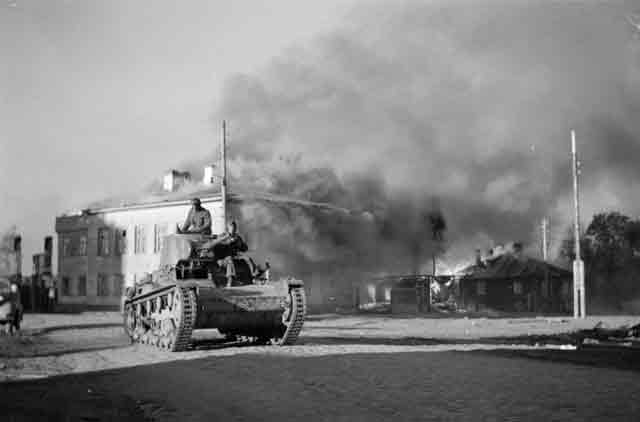
The Germans score a clean breakthrough of Red Army lines on 1 October 1941 during the opening stages of Operation Typhoon, the attack toward Moscow. The German Panzergruppe 2 under General Heinz Guderian scores a clean breakthrough of the Soviet lines around Bryansk, driving 50 miles (80 kilometers) closer to Orel. The Soviet 13th Army is nearly surrounded After driving east toward Kharkov and paving the way for the infantry units, the Panzergruppe 1 turns south toward Rostov. In his war diary, OKH Chief of Staff Franz Halder, who usually is extremely pessimistic and studied, writes in the evening what for him is a joyous assessment:
“Guderian has broken clean through the enemy line with his central group and has rushed 60 km into enemy territory in a sweeping advance. His right wing, still far behind and under enemy attacks, is causing concern. His left wing has advanced about 20 km. All quiet on the rest of the front.”
Even Halder believes that a 60 km breakthrough in two days is extraordinary and perhaps a sign that the Soviets are weakening across the line. His great worries that the advance on Moscow has been left too late in the season may be easing a bit.
The German XLVII Corps (motorized, General Lemelsen) captures Serek, while General von Kleist’s Panzer Group 1 makes dramatic progress toward Kharkov before reorienting south toward Rostov and the Caucasus — Hitler’s true goal because of its oil wealth. General Manstein’s 11th Army has sealed off the Crimea forms the extreme south of the German line, with 17th Army slightly to the north.
The Germans have 1,929,406 troops with 14,000 artillery pieces and 1000 tanks committed to Operation Typhoon, all supported by 1390 Luftwaffe planes which have aerial superiority. This is roughly two-thirds of their strength across the entire Eastern Front. While this sounds like a true juggernaut, it is nowhere close to the power that was mustered at the opening of Operation Barbarossa. However, the Soviets also are greatly weakened, so the relative strengths are comparable. The results show on the field of battle, where Guderian’s Panzer Group 2 comes close to surrounding Soviet 13th Army in only two days. Operational Group Ermakov, composed of five divisions (three infantry, two cavalry, and two tank brigades) attempts a counterattack to link back up with the 13th Army but fails.
In fact, things are going well for the Axis all the way up and down the front. Finnish troops reached Petrozavodsk, the capital of Soviet Republic of Karelia, further cutting off Leningrad in northern Russia. Petrozavodsk falls to Finnish forces as they attack west of Lake Onega. Early in morning, troops of Battlegroup Paalu (formed from 1st Division) and Detachment Lagus enter Petrozavodsk in eastern Karelia. It’s the largest population center outside the pre-1939 borders conquered by Finnish Army. The city is renamed Äänislinna. In the ravaged city the Finnish troops find, to their immense delight, the liquor distillery’s tank intact and full. An AT-rifle is used to make hole in the tank, and soon the soldiers are boozing happily. As night is falling, streets are filled with drunken soldiers singing loudly and firing their weapons in air. One group takes over the city sports stadium and organizes an armed guard to ensure that nobody disturbs their peace. Several detachments of military police are needed to clean up the mess.
The Karelian Army is ordered to continue its attack towards Karhumäki.
While these are not decisive gains by any means, they are good omens for the future and an indication that the harsh campaign may be over before the winter snows.
Odessa, Ukraine: German forces use gliders to land behind Russian lines.
The German High Command feels quite confident, or perhaps relieved is a better way to describe their recent successes in the field, but is troubled by growing partisan activity. General Wilhelm issues another controversial order to address this blemish on the offensive. This order mandates that instead of just selecting random hostages from the civilian population for execution in retaliation for partisan attacks, prominent local leaders and well-known businessmen should be chosen. This, Keitel feels, will enhance the effectiveness of retaliation. Of course, everyone knows that the entire idea of shooting illegals is contrary to international law, but those are worries for another day.
An Allied planning conference in Moscow concludes. The British-American Mission, headed by Minister of Supply Lord Beaverbrook and special envoy W. Averell Harriman, signed a treaty with the Soviets whereby the British and U.S. governments agreed to provide materials critical to the Soviet war effort for a period of nine months. The protocol produced at the end of the US-UK-USSR aid conference determined immediate and long-term deliveries to the Soviet Union, with the agreement subject to annual review. The USA will allocate 1,200 tanks a month to Britain and the USSR between July 1942 and January 1943, and a further 2,000 tanks a month for the following six months. This will mean initial U.S. consignments of 400 tanks a month for the Soviets from 1 July. In addition the USA will send 3,600 aircraft to Russia between 1 July 1942 and 1 July 1943, over and above the planes already being sent by Britain. The Soviets will supply Britain and the USA with urgently needed raw materials.
ShCh-320 fired a torpedo at a merchant ship north of Danzig Bay; the torpedo missed.
The Soviet NKVD ordered the release of 51,257 Polish prisoners of war for the formation of a Polish unit under General Wladislaw Anders to fight against Germany.
Composer Dmitri Shostakovich is evacuated by plane to Moscow.
Operations began at the Majdanek Concentration Camp near Lublin, Poland. Majdanek concentration camp becomes operational. It is intended as a work camp like Mauthausen, but 79,000 people perish there.
Vilna, Lithuania: 3,000 Jews are rounded up and shot dead in Ponary woods.
Wilhelm Keitel ordered that, in regards to the hostages the German military had been holding and executing in retaliation of partisan attacks, choice of victims would be important, as well-known victims would have greater effect in keeping the occupied peoples in line.
Another Croat concentration camp is established at Jasenovac.
In the Polish Archdiocese of Posen, 74 Catholic priests have been shot or have died in the concentration camps, and 451 are being held in prisons or camps. Of the 441 churches in this diocese only 30 are still open for Poles.
Alfred Rosenberg, Reichsführer of the Easter Territories, requests T-4’s assistance in liquidating the Jews in the Polish Ghettos this month. The decision is made to build centers for mass murder by gas in the eastern territories.
The extermination camp of Chelmno (Kulmhof) is set up in Wathegau over the next two months.
Premier-General Alois Elias, two retired generals, and an unstated number of other Czechs fell before firing squads yesterday in the German protectorate of Bohemia-Moravia, making a total of nearly 100 executions In four days. The German gestapo grilled 265 other Czechs suspected of treasonable activities including industrial sabotage and an attempt to overthrow the protectorate, it was announced. The German news agency DNB said that Gen. Elias “acknowledged his guilt” in Prague before being led to the execution wall. Since the deputy gestapo leader, 37-year-old Reinhardt Heydrich, arrived in Prague to take charge and the arrests, trials and executions began, only five Czechs have been acquitted.
HMS Edinburgh departed Malta.
German government reports published this month noted that 2,139,553 foreign workers were employed, about half of which, 1,007,561, were Polish.
The Italian “M” battalions were established.
King George VI of the United Kingdom granted the name Royal New Zealand Navy to the New Zealand ships fighting within the British Royal Navy.
The British House of Commons voted for the third £1,000,000,000 war credit of year.
The war has dramatically changed the lives of children as well as adults on the home front in Great Britain. After the turmoil and tears of evacuation — often more than once, as the threat of aerial bombardment came and went — a major problem has been how to keep an education system alive.
Hundreds of schools have been hit by bombs, forcing children to have lessons in churches or even pubs. Many private schools have been moved lock, stock and blackboard to the country. But after the first wave of evacuation many school buildings which escaped unscathed were used as Civil Defence depots. By January 1940 it was estimated that one third of all city children were receiving no schooling at all. Large numbers of evacuees also swamped village schools, so many were taught in people’s homes
There has also been a desperate shortage of teachers, as many were called up for war duties. Classes have therefore become quite large, often with as many as 50 or 60 children in a single classroom. And when the children can get to school, what they learn is also affected by the war. Pencils are shared and margins have been abolished because of the paper shortage. Geography is taught by following troop movements and gardening has replaced games in many schools, where it is taught as part of the “dig for victory” campaign.
General de Gaulle’s French government-in-exile sets up Radiodiffusion-Télévision Française.
The British RAF reported internally on Hugh Dowding’s (forced) retirement. When Prime Minister Winston Churchill learned of it, he was extremely displeased, and demanded the RAF to find a new position for Dowding. Dowding had originally conceded to political pressure and was preparing his retirement, but ultimately yielded to Churchill’s wish and accepted whatever new position the RAF would give him.
The Spitfire Mk. VC with the “universal wing” appears this month. This wing allows the installation of different types of armament.
RAF Bomber Command, Night of 1/2 October 1941
Karlsruhe
44 Hampdens and 1 Wellington; all recalled because of fog forecasts at airfields. 3 aircraft flew on to Karlsruhe; 22 bombed alternative targets. 1 Wellington lost.
Stuttgart
27 Whitleys and 4 Wellingtons; only 10 aircraft claimed to have bombed in the Stuttgart area, through thick cloud. Stuttgart records only 1 load of bombs, in woods near the city. No aircraft lost.
Minor Operations: 7 aircraft to Boulogne, 2 Hampdens minelaying in the Frisians. No losses.
Heavy cruiser HMS Kent, escorted by destroyer HMAS Norman, arrived at Scapa Flow at 1830 to work up after repairs. Destroyer HMAS Norman arrived to carry out working up exercises.
Destroyer HMS Dulverton arrived at Scapa Flow at 0730 to carry out working up exercises.
Norwegian destroyer HNoMS Draug departed Scapa Flow towing MTB.56 to Bergen for operation BAREFOOT. The MTB sank Norwegian tanker Borgny (3015grt), en route to Trondheim escorted by two trawlers, off Bergen on the 3rd. The MTB returned to destroyer Draug which was standing off the port and they returned to Lerwick, arriving on the 4th.
Convoy WS.12 with one ship departed Avonmouth on 29 September, seven ships from Liverpool on 29 September, and sixteen ships from the Clyde on 30 September. The convoy rendezvoused off Oversay on the 1st. The convoy was composed of steamers Clan Campbell (7255grt), Empire Trust (8143grt), Highland Brigade (14,134grt), Sarpedon (11,321grt), Perseus (10,286grt), Almanzora (15,551grt), Empire Pride (9248grt), Leopoldville (11,509grt), Strathaird (22,281grt), Empress of Russia (16,810grt), Empress of Canada (21,517grt), Narkunda (16,632grt), City of Paris (10,902grt), Ormonde (14,982grt), Samaria (19,597grt), Franconia (20,175grt), Mendoza (8199grt), Duchess of Richmond (20,022grt), Dominion Monarch (27,155grt), Highland Princess (14,133grt), Prince Baudouin (3050grt), Royal Ulsterman (3244grt), Clan Lamont (7250grt), and Perthshire (10,496grt). Steamer Highland Princess was detached as convoy CT.4. Armed merchant cruiser HMS Cathay, minelayer HMS Agamemnon, and destroyers HMCS Assiniboine and HMCS Saguenay escorted the convoy from 30 September to 4 October. Destroyer HMS Sikh escorted the convoy from 30 September to 5 October. Destroyers HMS Bradford, HMS Badsworth, HMS Brighton, HMS Lancaster, and HMS Newark escorted the convoy from 1 to 3 October. Anti-aircraft cruiser HMS Cairo and destroyers HMS Whitehall, HMS Witch, and HMS Verity escorted the convoy from 1 to 4 October. Destroyer HMS Beverley escorted the convoy on 2 and 3 October. Destroyer HMS Blankney escorted the convoy from 1 to 7 October. Aircraft carrier HMS Argus escorted the convoy from 30 September to 5 October, when she was detached to Gibraltar. Heavy cruiser HMS Devonshire escorted the convoy from 30 September to 12 October, when she was detached to Freetown. Heavy cruiser HMS Dorsetshire escorted the convoy from 12 to 14 October. Destroyer HNLMS Isaac Sweers departed Gibraltar on the 4th escorted the convoy on the 7th. Destroyer HMS Gurkha departed Gibraltar on the 3rd and escorted the convoy on the 8th. Destroyers HMS Wrestler, HMS Velox, HMS Vimy, and HMS Vansittart and corvettes HMS Amaranthus and HMS Armeria escorted the convoy from 11 to 14 October, when the convoy arrived at Freetown. The convoy departed Freetown on the 19th, less steamer Narkunda. The convoy was escorted by destroyers HMS Velox and HMS Wrestler and corvettes HMS Mignonette, HMS Anchusa, and HMS Calendula from 19 to 22 October. Heavy cruiser HMS Devonshire escorted the convoy from 19 to 30 October. Heavy cruiser HMS Dorsetshire escorted the convoy from 19 October to 3 November. Armed merchant cruiser HMS Derbyshire escorted the convoy from 30 October to 3 November.
Steamers Ulster Monarch and Royal Ulsterman were detached to Takoradi on the 21st. Steamer Prince Baudouin was detached the same day to St Helena, arriving on the 24th. The steamer departed the same day and met armed merchant cruiser HMS Derbyshire the same day. The steamer arrived at Capetown with the convoy. Steamers Strathaird, Empress of Canada, Dominion Monarch, Empire Pride, Leopoldville, Mendoza, Clan Campbell, Empire Trust, Perthshire, and Sarpedon arrived at Capetown on the 29th. Steamers Franconia, Richmond, Empress of Russia, Highland Brigade, Perseus, Ormonde, and Samaria arrived at Durban on 3 November, escorted by armed merchant cruiser Derbyshire. On 5 November, steamers Strathaird, Leopoldville, Mendoza, Empire Pride, Empire Trust, Perthshire, Empress of Canada, and Dominion Monarch departed Capetown on 5 November, escorted by armed merchant cruiser HMS Dunnottar Castle. On 8 November, steamers Samaria, City of Paris, Nieuw Amsterdam from Durban, Franconia, Clan Lamont, Clan Campbell, Empress of Russia, Almanzora, Ascanius from Mombasa, Mendoza, Perseus, Nova Scotia from Durban, and Duchess of Richmond departed Durban and rendezvoused at sea with the Capetown section.
On 8 November, battlecruiser HMS Repulse relieved armed merchant cruiser HMS Dunnottar Castle. The battlecruiser remained with the convoy until 14 November in 5-10S, 34-00E when battleship HMS Revenge joined the convoy. The convoy arrived at Aden on 20 November. On 17 November, steamers Dominion Monarch, Empress of Canada, Duchess of Richmond, and Perseus were detached as WS.12 J in 6-05N, 52-30E. The convoy was escorted by light cruiser HMS Glasgow to Colombo arriving on 23 November. Steamers Dominion Monarch and Empress of Canada departed Colombo on 24 November escorted by light cruiser Glasgow. in 6-14N, 92-00E, steamer Awatea escorted by light cruiser Dragon joined the convoy and relieved light cruiser Glasgow. Light cruiser Glasgow took steamer Awatea to Colombo. The convoy arrived at Singapore on 28 November.
When a Roc of 772 Squadron crashed near Crinan, Argyllshire, T/Sub Lt (A) J. W. T. Cooper RNZVR, and Leading Airman J. Stewart were killed.
British steamer Serenity (557grt) was damaged by near misses of German bombing in 51-29N, 4-45W, ten miles southeast by east of St Goven’s Light.
U-94, commanded by Oberleutnant zur See Otto Ites, badly damaged British tanker San Florentino (12,842grt) in 52-50N, 34-40W. At 2357 hours on 1 Oct 1941 the San Florentino (Master Robert William Davis), a straggler from convoy ON.19, was hit amidships by one torpedo from U-94 southeast of Cape Farewell. The tanker had been spotted at 1810 hours and missed by a first torpedo at 2336 hours, but continued after being hit while firing into the direction of the U-boat. At 0249 hours on 2 October, the San Florentino was hit in the bow by a torpedo in grid AK 8194, radioed the position 52°42N/34°51W, dropped fog buoys and continued. She even proceeded after being hit in the bow by a third torpedo in grid AK 8434 at 0426 hours and evaded another torpedo 25 minutes later, but broke in two at 0502 hours. The wreck was hit by a coup de grâce at 0552 hours, that caused a boiler explosion. The bow remained afloat upright and the stern only sank slowly, so the U-boat fired 34 rounds from the deck gun into it and then left the area. Parts of the wreck were scuttled by gunfire by HMCS Alberni (K 103) (LtCdr G.O. Baugh) on 2 October. The master, 21 crew members and one gunner from San Florentino were lost. 31 crew members and four gunners were picked up by HMCS Mayflower (K 191) (LtCdr George Stephen) and landed at St. Johns. The 12,842 ton San Florentino was carrying ballast and was bound for Curaçao.
U-552 was attacked by a Hudson aircraft which dropped one bomb and damaged the U-boat slightly.
Flag Officer, Force H transferred his flag from battleship HMS Nelson to battleship HMS Rodney.
Battleship HMS Prince of Wales and destroyers HMS Laforey, HMS Lightning, HMS Lively, and HMS Oribi departed Gibraltar for Scapa Flow, arriving on the 6th. Destroyer Lively was detached on the 4th and returned to Gibraltar.
Light cruisers HMS Kenya and HMS Sheffield departed Gibraltar to return to the Clyde, arriving on the 6th. The cruisers were ordered to search en route for an enemy supply ship off the north coast of Spain.
Light cruiser HMS Euryalus and destroyers HMS Farndale and HMS Heythrop departed Gibraltar for Freetown in company with British steamers Port Chalmers and Melbourne Star bound for Buenos Aires.
Corvettes HMS Coreopsis and HMS Fleur de Lys departed Gibraltar escorting tanker Benedick until dark on the 4th.
Submarine HMS Talisman unsuccessfully attacked a convoy of steamers Lauretta and Arkadia, escorted by torpedo boat Libra, off the Zea Channel.
Submarine HMS P.34 departed Gibraltar for Malta.
Dutch submarine HNLMS O.24 departed Gibraltar for patrol in the Tyrrhenian Sea.
Submarine HMS Thrasher arrived at Malta from patrol in the Gulf of Sirte.
Polish submarine ORP Sokol arrived at Malta from Gibraltar and patrol supporting Operation HALBERD.
Submarine HMS Rorqual departed Alexandria for Malta to return to the United Kingdom. The submarine arrived at Malta on the 12th and Gibraltar on the 27th, laying two minefields en route.
Minesweeping whaler HMS Sotra was damaged below the water line by gunfire at Tobruk. One rating was wounded. The whaler was able to depart Tobruk at 1900/2nd with lighter A 9 and minesweeping whaler Soika.
The New Zealand Division of the Royal Navy became the Royal New Zealand Navy as of this date.
In Washington today, President Roosevelt conferred with Secretary Hull on international affairs. His callers included Attorney General Biddle, Dr. Thomas A. Lebreton, Argentine Minister to London, and Sir Shanmukham Chetty, chief of the India Purchasing Mission in the United States.
With the Senate in recess, the committee investigating the gasoline shortage questioned Secretary Ickes.
The House was in recess. An appropriations subcommittee approved the $5,986,000,000 lend-lease appropriation and the Banking and Currency Committee heard Marriner S. Eccles of the Federal Reserve Board and Edward A. O’Neal, president of the American Farm Bureau Federation, on the Price Control Bill.
United States, British, and Soviet representatives conclude a three-day conference in Moscow on aid to the Soviet Union.
President Roosevelt’s action in calling attention to the Russian constitution’s guarantee of freedom of religion brought replies today that the guarantee means nothing. Chairman Dies of the House Committee on Un-American Activities sent a letter to the president saying flatly that freedom of religious worship “is and always has been nonexistent in the Soviet Union.”
U.S. Navy Secretary Knox speaks on behalf of Freedom of the Seas. Although the United States has made defeat of the totalitarian powers a part of its national policy by both executive and legislative action, it is contributing as yet “only a part of our share” toward this end, Secretary Knox declared today before a general meeting of the American Bar Association holding its convention in Indianapolis. Expressing his confidence that this country would “proceed from one measure to another measure until we have taken adequate steps to bring defeat to the legions of Hitler and his satellites in Italy and Japan,” the Secretary of the Navy said that he had not the slightest doubt of the ultimate overthrow of Nazism. Secretary Knox declared that after military victory over Germany had been won the United States and Great Britain must join hands for “at least 100 years” to make certain that peace would be enforced. Other nations of peace-. ful inclinations might help in this effort, he added. “If we are to be able to help re-establish a world ruled by laws and not by men, we must provide both the major power and the dominant leadership,” he said.
The American Army under training today is very moderate in its size, compared with the population of the country, and represents the minimum necessary for its task, Secretary Stimson told a press conference today. He denied recent reports to the effect that the size of the Army might be reduced in order to free material for transmission to Great Britain and Russia.”We are trying to maintain a very moderate sized Army, but a very well trained one,” he said. “Maybe we have erred on the side of conservatism.” The Secretary pointed out that the Army exceeded by only a small margin the size of the combined armies of Holland and Belgium on the eve of their invasion by Germany. Those countries, he said. had mobilized 8 percent of their population. The United States has 1.4 per cent of its citizens under arms. Mr. Stimson’s discussion of the Army’s size was prompted by a question whether the induction of trainees would be halted and the Army reduced in size. “There is not the slightest truth in that story,” he replied. “I have also heard stories that we planned to reduce the size of the Army. That is incorrect.”
A field force of the United States Army, infantry, artillery, and engineer, signal, ordnance and medical units, has arrived in Reykjavik, Iceland with vast supplies of equipment and materials.
O.P.M. had before it tonight a recommendation from one of its consultants, W. A. Hauck, that because of “strategic reasons” the west coast be made substantially independent of eastern mills for its steel supplies. Hauck’s support was contained in a report of a study of the need for further expansion of steel facilities which was made at the direction of President Roosevelt. The supply priorities and allocations board last night accepted Hauck’s recommendation that a 10,000,000-ton expansion be approved immediately. The report disclosed that steel companies have proposed 1,865,000 tons of additional capacity in the west coast area, including new plants proposed by Bethlehem Steel Co. at Los Angeles and by Columbia Steel Co., a U.S. Steel Corp. subsidiary, at Pittsburg, California, near San Francisco.
Harry Bridges, west coast C.I.O. director, issued a statement today denying he was or had been a member of the Communist party and denouncing the recommendation of a justice department inspector that he be deported to his native Australia. “Judge (Charles B.) Sears’ decision shows little understanding of labor problems and the working peoples’ efforts to secure decent living standards through organization,” Bridges said. “The Sears decision proves that big business lobbyists in Washington have to be appeased, and the honor of the government department which presented the charges and then itself selected Judge Sears to rule on those charges, has to be protected. The Soars decision indicated that red-baiting witch-hunting, discrimination against American unionists for unpopular political beliefs must be adopted as a conduct of behavior for union leaders if they would avoid being found guilty of ‘Communist affiliation.”
Sale of War Savings Bonds to naval personnel is inaugurated on this date; under the direction of a Coordinator for War Savings Bonds, Supply Corps officers are designated as issuing agents and assigned to 28 major shore activities. Actual sales of the bonds will amount to $61,000,000–over 50 in excess of the predicted sales.
Secretary of the Navy Knox approves “popular” names for naval combat aircraft: “Avenger” (Grumman TBF), “Buccaneer” (Brewster SB2A), “Buffalo” (Brewster F2A), “Catalina” (Consolidated PBY), “Coronado” (Consolidated PB2Y), “Corsair” (Vought F4U), “Dauntless” (Douglas SBD), “Devastator” (Douglas TBD), “Helldiver” (Curtiss SB2C), “Kingfisher” (Vought OS2U/Naval Aircraft Factory OS2N), “Mariner” (Martin PBM), “Sea Ranger” (Boeing PBB patrol bomber), “Seagull” (Curtiss SO3C), and “Vindicator” (Vought SB2U). Names supplement the Navy’s letter-number designations, which remain unchanged and continue to be used in correspondence. As can be seen, the name “Avenger” is assigned well before either Pearl Harbor (7 December 1941) or the slaughter of torpedo planes at the Battle of Midway (4-6 June 1942). These two events are commonly believed to have motivated the assignment of this particular nickname to the TBF/TBM series. The name “Seagull” is also applied unofficially to the Curtiss SOC series which is in use in cruiser-based observation squadrons. Ironically, the SO3C proves a failure in service, and the SOC it was designed to replace serves on.
North American Aviation, Inc. today announced their new bomber assembly plant at Kansas City, Kansas, will be dedicated formally January 10, 1942. The company said actual production of planes in the new factory would begin about November 1.
The 122d Observation Squadron, Louisiana National Guard based New Orleans, is inducted into Federal Service.
Hugh Martin and Ralph Blane’s musical “Best Foot Forward,” starring June Allyson with choreography by Gene Kelly, opens at the Ethel Barrymore Theatre in New York City and runs for 326 performances
Like millions of other Americans, President Roosevelt listened to the world series game today. He ordered a portable radio sent to his office and listened to several innings while lunching with Attorney General Biddle. A New Yorker, the chief executive was described as neutral In the subway series between the Yankees and Dodgers.
Major League Baseball, World Series, Game 1:
The first game of the 1941 World Series between the American League pennant winner, the New York Yankees, and the National League pennant winner, the Brooklyn Dodgers, is played in the 71,000-seat Yankee Stadium in the Bronx, New York City. This is the first time the Dodgers have played in a World Series since 1920; the Yankees have appeared in eleven World Series. The Dodgers, managed by Leo Durocher, had a 100-54 record for the year finishing 2 ½ games ahead of the second place St. Louis Cardinals. The best batting average was achieved by center fielder Pete Reiser who batted .343; the top pitcher was Kirby Higbe who was 22-9 with a 3.14 ERA. The Yankees, managed by Joe McCarthy, had a record of 101-53 for the year and finished 17-games ahead of the second place Boston Red Sox. The top hitter was Joe DiMaggio who batted .357 and set a record by hitting in 56-consecutive games; the top pitcher was Lefty Gomez who was 15-5 with a 3.74 ERA.
The starting pitchers for the first game are Red Ruffing (15-6 with a 3.54 ERA for the season) for the Yankees and Curt “Coonskin” Davis (13–7 with a 2.97 ERA for the season) for the Dodgers. The Yankees win the game 3–2.
Going into the 7th inning, the Yankees were leading 3–1. The Dodgers score a run in the 7th making it 3–2 and with one out, Pee Wee “The Little Colonel” Reese, the Dodger shortstop, was on second when Jimmy Wasdell hit a foul pop to Yankee third baseman Red Rolfe; Reese attempts to run to third but he is thrown out ending the inning. There was one home run in the game by Yankee second baseman Joe Gordon. Red Ruffing, who completed the game, is the winning pitcher. Curt Davis, who pitched 5 ⅓ innings is the loser. Davis was relieved by Hugh Casey in the 6th inning; Johnny Allen came on in the 7th inning and finished the game. The Yankees now have a 1–0 lead in the Series.
Brooklyn Dodgers 2, New York Yankees 3
AP reports: “Japanese forces in Hunan province are retreating in great disorder with heavy losses in “a debacle many times worse than in 1939,” Chinese military dispatches claimed tonight. Japanese military authorities here said their troops were withdrawing from the provincial capital, Changsha, because they had accomplished their purpose of smashing the Chinese in Hunan. Dispatches from Chungking said the Chinese there had amassed a million firecrackers to celebrate the great victory as soon as an official observation was launched. It was in a thrust at Changsha in October, 1939, that the Japanese suffered one of their worst defeats of the entire China “incident,” and fell back on Yochow, 100 miles to the north. Chinese military quarters said that this time the Japanese actually were being cut off from Yochow as they fled north.”
China scores a rare victory in its fighting with Japan. At Changsha, Japanese troops were today on the run in Hunan after the collapse of their two-month-long offensive aimed at seizing the provincial capital, Changsha. First estimates put the Japanese losses for the campaign as high as 40,000. The failure to take this vital town on the Manchuria-Canton railway is a setback for the Japanese. Control of Changsha would have made possible the opening of a new route for moving troops and materials to the Malayan and Burmese fronts. The turning-point came four days ago as the Japanese main force, supported by 100 planes, launched an all-out attack on Changsha. By late afternoon a Japanese detachment in civilian clothes had got inside the city. But its backup, an airborne unit which it should have linked up with to destroy the cities defenses, was dropped too far close to the Chinese front line and wiped out. The Chinese troops, under General Hsueh Yueh, encircled the retreating Japanese between the Lao-tao and Liu-yang rivers, inflicting heavy casualties. A simultaneous offensive was launched in Yichang, tying down the only Japanese force available to relieve the fleeing 11th Corps.
Lieutenant General Douglas MacArthur vehemently protests Rainbow-5 to War Department. MacArthur insists he can hold the Philippines if given more support. It has been assumed for decades that any war in the Western Pacific would mean writing off the islands initially. MacArthur’s estimation of the fighting value of barely trained Philippine Army troops and the time he has to prepare for war are both badly mistaken.
There are now 113,887 soldiers on full-time duty in Australia; 61,396 are Militia and 36,357 are Australian Imperial Force.
The New Zealand Division of the Royal Navy becomes the Royal New Zealand Navy and all ships’ names prefixed by HMNZS instead of HMS (example: HMS Leander becomes HMNZS Leander from this date).
Dow Jones Industrial Average: 126.85 (+0.03)
Naval Construction:
The Royal Navy YMS-1-class auxiliary motor minesweeper HMS BYMS 2027 (J 827) is laid down by the Ballard Marine Railway Co. (Seattle, Washington, U.S.A.).
The Royal Navy Isles-class minesweeping trawler HMS Egilsay (T 215) is laid down by Cook, Welton & Gemmill (Beverley, U.K.); completed by Holmes.
The U.S. Navy PC-461-class (173-foot steel hull) submarine chaser USS PC-556 is laid down by the Luders Marine Construction Co. (Stamford, Connecticut, U.S.A.).
The U.S. Navy Gato-class submarine USS Haddo (SS-255) is laid down by the Electric Boat Co. (Groton, Connecticut, U.S.A.).
The Kriegsmarine (German Navy) Type XB U-boat U-234 is laid down by F. Krupp Germaniawerft AG, Kiel (werk 664).
The Kriegsmarine (German Navy) Type VIIC U-boat U-340 is laid down by Nordseewerke, Emden (werk 212).
The Kriegsmarine (German Navy) Type VIIC U-boat U-469 is laid down by Deutsche Werke AG, Kiel (werk 300).
The Kriegsmarine (German Navy) Type VIIC U-boat U-731 is laid down by F Schichau GmbH, Danzig (werk 1522).
The Royal Navy Minotaur-class light cruiser HMS Blake is laid down at the John Brown Shipyard in Clydesbank, Scotland. Her construction is given a low priority due to the war and need for escort ships. She is renamed Bellerophon, then Tiger in 1945 but soon laid up. Eventually it is decided to complete her to a substantially modernized design in 1951, but work does not start until 1954. Finally she is commissioned as HMS Tiger (20) in 1959, some 18 years after she had been conceived.
The U.S. Navy Bogue-class escort aircraft carrier USS Bogue (AVG-9, later ACV-9, finally CVE-9) is laid down as the civilian merchant ship Steel Advocate by the Seattle-Tacoma Shipbuilding Corp. (Seattle, Washington, U.S.A.).
The U.S. Navy YMS-1-class auxiliary motor minesweeper USS YMS-32 is launched by the Hiltebrant Dry Dock Co. (Kingston, New York, U.S.A.).
The Kriegsmarine (German Navy) Type IXD2 U-boat U-177 is launched by AG Weser, Bremen (werk 1017).
The Kriegsmarine (German Navy) Type VIIC U-boat U-597 is launched by Blohm & Voss, Hamburg (werk 573).
The Royal Navy British Power Boat 63-foot-class motor anti-submarine boat HMS MA/SB 33 is commissioned.
The Royal Navy anti-aircraft ship HMS Tynwald (D 69) is commissioned. Her first commanding officer is A/Captain (retired) Frederic Thornton Peters, DSO, DSC, RN.
The Вое́нно-морско́й флот СССР (ВМФ) (Soviet Navy) “M” (Malyutka)-class (3rd group, Type XII) submarine M-115 is commissioned.
The Royal Norwegian Navy Flower-class corvette HNoMS Andenes (K 01) is commissioned. She had been launched as HMS Acanthus before her transfer on completion to the Royal Norwegian Navy.
The Royal New Zealand Navy Leander-class light cruiser HMNZS Achilles (70), formerly HMS Achilles, is commissioned into the RNZN. Captain Hugh Merriman Barnes, RN, remains her commanding officer.

