The United States and the Soviet Union have resumed high‐level discussions on a new agreement to curb strategic arms, although American officials doubt that a breakthrough can occur before next year. Officials said today that there was no reason to expect any rapid progress on the controversial negotiations, but they wanted to wait until President Ford conferred with Foreign Minister Andrei A. Gromyko at the White House tomorrow before ruling out progress conclusively. In addition to technical problems, political considerations in Washington are holding up the negotiations. Secretary of State Henry A. Kissinger, the last American until now to have had high‐level talks with the Russians, visited Moscow in January and came home optimistic that a breakthrough could be achieved. But Mr. Ford, fearful of criticism from Ronald Reagan as well as such Democrats as Senator Henry M. Jackson, decided not to seek a concession from within the American Government that might antagonize some Pentagon officials and lead to leaks in the press. Instead, he authorized a response to the Russians in February that asked that the differences over the Soviet bombers that NATO has code‐named Backfire, and the American cruise missile be put aside and that agreement be signed on noncontroversial issues. The Russians, in March, said that that was not acceptable to them and since then there have been no new exchanges of proposals.
North Atlantic Treaty Organization and Warsaw Pact nations opened the 10th round of talks on mutual force reduction in central Europe that have been stalled since they began nearly three years ago. Western officials said a statement presented by Warsaw Pact nations after a two-month summer recess produced “nothing encouraging.” Western delegates said privately that they expected the negotiations, which started in October 1973, to mark time at least until after the United States Presidential election. During today’s 50‐minute meeting delegates of the North’ Atlantic Treaty Organization and the Soviet‐dominated Warsaw Pact alliance restated positions taken during earlier sessions.
A Pentagon spokesman said that partial information from the examination of a Soviet MIG-25 jet in Japan indicates the plane is “a very capable high-altitude interceptor.” There had been reports from Japan that the study of the MIG by U.S. and Japanese experts had shown the plane, to their surprise, to be less sophisticated than previously thought.
After a week of searching, a Navy and civilian team has not yet located the wreckage of an F-14 fighter plane that sank to the bottom of the Atlantic Ocean off Scotland, the Pentagon said. The Navy is still confident that its salvage experts will find and raise the F-14, which rolled into nearly 1,900 feet of water from the deck of the carrier John F. Kennedy more than two weeks ago. A spokesman said a Navy tug had scanned almost 10 square miles of ocean floor with sonar equipment looking for the plane. Bad weather had impeded the search, the spokesman said.
Speculation that Aleksei N. Kosygin may soon step down as Soviet Prime Minister has gained strength in some Soviet circles with the private circulation of a new account of the accident he is reported to have suffered last month. London newspapers reported in August that the 72‐year‐old Mr Kosygin had had a heart attack while swimming near his Moscow country home, but was recovering. The report was attributed to Viktor Louis, a Soviet journalist with intelligence links who later disclaimed responsibility. According to the new account, filtering down through channels close to the Kremlin, the Prime Minister fell from his boat while fishing and was pulled unconscious from the water by a bodyguard who was on the bank. Mr. Kosygin went into shock on his way to the hospital and subsequently suffered a stroke that impaired his ability to work, according to this account.
Greek Cypriot Foreign Minister John Christophedes said he will challenge American policy toward Turkey when he meets with Secretary of State Henry A. Kissinger at the United Nations next week. Christophedes said Kissinger was following “a policy of caresses” toward Ankara in the mistaken belief that this would persuade Turkey to make concessions on Cyprus. The Cyprus government, the official said. believes Turkey will make concessions only when faced with “effective pressure exercised on her by those powers which are capable of doing so.”
New evidence of strain between President Valéry Giscard d’Estaing and the Gaullist party surfaced here today at a meeting of Gaullist members of Parliament, the largest bloc supporting the Government. In speeches and discussion, Gaullists made it clear that they would go along with the austerity program of the Government, in which their party is represented, but that they could not be relied upon for enthusiastic help in Mr. Giscard d’Estaing’s long‐range plans. It was the legislators’ first meeting since Prime Minister Jacques Chirac, a Gaullist, resigned last month and was replaced by Raymond Barre, who belongs to no political party. Mr. Chirac resigned over his conviction that only early elections and an all‐out political attack on the opposition leftists could keep the left from winning power, a course that the President, who belongs to the small Independent Republican Party, opposed.
Fire and explosions in a coal mine killed at least 16 men near Merlebach in northeastern France. Fire in the state-owned mine spread quickly, setting off two gas explosions. At least nine of those killed were members of a mine safety team who were fighting the fire when the second explosion occurred. Authorities said the cause of the fire was not known. The mine is about 30 miles from Metz and 230 miles east of Paris.
The value of Britain’s pound remained critical as Chancellor of the Exchequer Denis Healy sought support at the annual conference of his Labor Party for a government request for a $3.9 billion loan from the International Monetary Fund. The party supported London’s request.
In advance of the October 3 parliamentary elections in West Germany, incumbent Chancellor Helmut Schmidt and his challenger, Christian Democrat leader Helmut Kohl, engaged in a bitter debate.
The Orient Express, the train that in literature, films and legend was a luxurious and sinister setting for the adventures of aristocrats, spies, elegant women and others on journeys between Paris and Istanbul, will end service next May, a conference of European railway administrations has decided.
Palestinian leaders met in a mountain village east of Beirut to decide whether to accept a Syrian offer of negotiations. The leaders, headed by Yasser Arafat, chief of the Palestinian Liberation Organization, also were assessing the military defeat that Syrian troops inflicted on their forces. The meeting was at Aleih, 10 miles southeast of Beirut and within three miles of Syrian lines. There were reports that direct contacts between the P.L.O. and Syrian officials had already begun but these could not be confirmed. As Mr. Arafat, the P.L.O. chairman, conferred with his associates in a command post, three artillery shells were fired into the area, the first landing a few hundred yards away, the second nearby and the third within 50 yards. The guerrilla leaders then reportedly decided to shift their discussions to Beirut, according to The Associated Press. As a result of a two-day Syrian offensive ending yesterday, the Palestinians were driven out of a dozen villages in the mountain area stretching northward from a point just east of Aleih to the 6,000-foot peak of Jebel Sannin, 25 miles northeast of Beirut. Among the places they abandoned was Ain Tura, which controls one of the main highways connecting the Lebanese Christian territory here and to the north with eastern Lebanon and Syria.
A controversy over Iran’s order of 80 Grumman jet fighters for more than $2 billion has been deepened by recent statements of Iran’s chief arm purchasing officer. The officer, General Hasssan Toufanian, charged in a recent letter made public here and during an interview in his office, that the president of the Grumman Corporation of Bethpage, L.I., had given false and misleading testimony about the deal. In the interview, on Monday, the general also denounced some former Grumman sales agents, a group of brothers named Lavi, as “fraudulent swindlers.” General Toufanian, who is Deputy Minister of War, was affirming Iran’s position on one aspect of the controversy — the sales methods employed. That position is that Grumman behaved improperly in engaging sales agents for the fighter, the F‐14 Tomcat, when, in the Iranian view, no middlemen were required.
Ana Teresa Diego, 21, Argentine astronomer at the La Plata Astronomical Observatory became one of the many desaparecidos killed during Argentina’s roundup of leftists during the Dirty War. She was seen in internment camps on two occasions but was never seen in public again. She would be mentioned by name in the 2011 inauguration speech of President Cristina Fernández de Kirchner. The asteroid 11441 Anadiego is named in her honor.
Two former Sudanese cabinet ministers were sentenced to death in their absence for their role in an abortive coup against President Jaafar Numeiri last July, the Sudan News Agency reported. The two men, former Prime Minister Sadik Mahdi and former Finance Minister Sharief Hindi, were among 26 persons on trial before a special military court on charges of waging war against Sudan and attempting to overthrow the government. Testimony showed that the uprising had been plotted at a meeting in London of Mahdi and Hindi.
The first trial connected with Japan’s Lockheed payoffs scandal opened in Tokyo district court. Tsuneo Tachikawa, 39, a top aide to powerful right-wing influence peddler Yoshio Kodama, is charged with violating the foreign exchange law by setting up a ghost company in Hong Kong in 1975 to receive Lockheed payments. He is also charged with using improper methods to force the resignation of a construction company president in 1975. Prosecutors charged. that Tachikawa received about $267,000 from Lockheed through the ghost company on Kodama’s behalf.
Prime Minister Ian D. Smith would lead the Rhodesian Government delegation to the proposed initial black-white talks on progress to black majority rule for Rhodesia, a spokesman for the Prime Minister’s office said tonight. The spokesman said that Mr. Smith had replied to Britain’s proposals for a conference to be held somewhere in southern Africa. But the reply was “confidential,” the spokesman said. Earlier the Rhodesian Government spokesman had said that the initial talks should not constitute a full‐scale constitutional conference. Although Rhodesian nationalists and some black African leaders had welcomed the proposal for talks, the Government spokesman in Salisbury sounded a cautious note.
Conflicts among Rhodesia’s black nationalists emerged today as a major obstacle in the path of the conference that Britain has called to set up an interim multiracial government in the white-ruled territory. Differences between two of the key figures in the nationalist movement were on display as this capital city celebrated the 10th anniversary of the independence of Botswana, the huge and mostly arid country that borders Rhodesia to the southwest. Joshua Nkomo and Bishop Abel Muzorewa, rival leaders of nationalist factions, took up seats at n conspicuous distance from ‘each other at festivities in the city’s main stadium, maintaining an estrangement that was broken only briefly by a chance encounter during a factory tour yesterday. Both said they had no present plans to meet again. During the day, the two men gave interviews in which each suggested that he was the key figure in the nationalist movement. Each appeared to be hoping to form an alliance with a third contender for control of the nationalist movement. Robert Mugabe, who is in Mozambique.
Representatives from the South-West African People’s Organization said today that Secretary of State Henry A. Kissinger had been unable to obtain any “meaningful commitment” from South Africa regarding independence for Namibia also called South-West Africa.
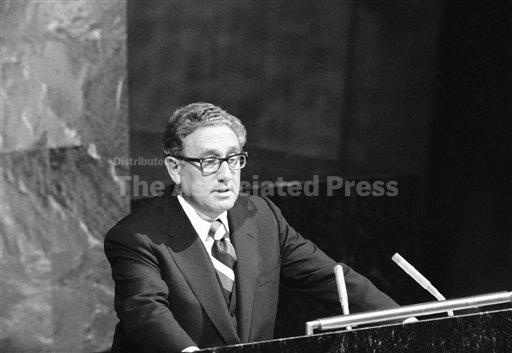
African leaders were urged by Secretary of State Kissinger to avoid interracial war and shape their political future without outside interference. Addressing the U.N. General Assembly, he said the United States would “back no faction” in Rhodesia or elsewhere and not seek to impose solutions anywhere. We call on all other non‐African states to do likewise.” Diplomats, mindful of unsuccessful United States efforts in Angola last year, interpreted this as a warning to the Soviet Union and Cuba, whose partisans defeated American‐backed Angolan factions. Cuban representatives ostentatiously boycotted Mr. Kissinger’s appearance — they sat in the delegates’ lounge throughout — and, though the Soviet Foreign Minister, Andrei A. Gromyko, was in town, lower‐level representatives filled the Soviet table in the crowded Assembly hall.
The first organic chemistry test by the Viking 2 lander has failed to turn up any evidence of organic material in the soil of Mars, project scientists reported today. The scientists cautioned, however, that the results were preliminary, the first from eight planned experiments searching for organic clues to past or present Martian life. But they conceded that the negative finding did not bode well for life‐on-Mars theories. Dr. Klaus Biemann of the Massachusetts Institute of Technology, leader of the organic chemistry experiment, announced at a,news conference here that no organic compounds were detected down to levels of 10 parts per billion. The Viking 1 sander, likewise, found no signs of organic compounds.
Congress easily overrode President Ford’s veto of the $56 billion appropriations bill for social services today, with conservatives of both parties joining liberal Democrats in the rebuff to the White House. The Senate vote of 67 to 15 came several hours after the House had voted to override by 312 to 93. As noted by Representative Thomas P. O’Neill Jr. of Massachusetts, the majority leader, the House vote was the ninth time this year that the chamber had overridden a Presidential veto. “The amazing thing about President Ford’s record on vetoes is that he is proud of it,” Mr. O’Neill said in a speech on the House floor. “He is proud of the negativism that has kept Americans out of work and slowed our economic recovery.” The bill also contains a provision barring the use of Federal funds for abortions except in cases where the mother’s life would he endangered by completing the pregnancy.
Congress gave final approval and sent to the White House a $3.2 billion, three-year authorization to help states and local communities fight crime. It also would limit the terms of FBI directors to 10 years. The FBI currently accounts only to the House and Senate appropriation committees for its budget requests but the bill would require it to come before authorizing committees starting October 1, 1978. The measure also provides for a community program which would provide, among other things, for escorts for elderly persons in high crime areas and for “block mother networks” to look after youngsters in such neighborhoods.
The United States Centers for Disease Control began its nationwide program to vaccinate all Americans against the swine flu, with the first inoculations being administered at a health fair in Indianapolis, Indiana.
The latest Gallup Poll on the Presidential contest shows that Jimmy Carter’s lead over President Ford has been reduced from 18 percentage points to 8. Interviews with 867 registered voters from last Friday to last Monday, the Gallup organization reported yesterday, showed 50 percent favoring Mr. Carter, 42 percent for President Ford and 8 percent undecided or preferring other candidates. In the previous Gallup survey, taken August 27 through August 30, 54 percent preferred Mr. Carter and 36 percent were for Mr. Ford with 10 percent for others or undecided. The polling organization said that the President had achieved his gains over the last month by overtaking his Democratic challenger among independent voters, reducing Mr. Carter’s wide margin in the South and increasing his level of support among his fellow Republicans.
The Watergate special prosecutor’s investigation into the diversion of campaign funds, President Ford told a group of reporters, will show him to be free of any wrongdoing. The President called for a swift conclusion to the inquiry. Mr. Ford also denied any improprieties in golfing outings as the guest of corporate executives.
No criminal prosecution of President Ford is being contemplated as the special prosecutor’s office winds up its investigation into the President’s campaign finances, according to officials in Grand Rapids, Michigan, and government sources in Washington. Several sources said that the prosecutor, Charles Ruff, would shortly make a public statement indicating that no basis had been found to file charges or continue the inquiry.
Faced with a filibuster threat by Democratic opponents, the Senate dropped efforts to confirm the nomination of George F. Murphy Jr. to be a member of the Nuclear Regulatory Commission. Murphy, a Democrat, has been a member of the staff of the congressional Joint Committee on Atomic Energy for 18 years and is now its staff director. Among those speaking out against Murphy was Senator William Proxmire (D-Wisconsin). He said it was important that members of the NRC be independent and that Murphy might lack the objectivity to serve in an administrative capacity after such long service on the congressional committee.
The Senate killed a major reform of federal lobbying laws but Senator Abraham Ribicoff (D-Connecticut), its chief sponsor, vowed to bring the bill back before the Senate in January. Ribicoff tried to get the chamber to take up the bill, which had passed the House, but Senator John G. Tower (R-Texas) objected and killed any chance of passage before Congress adjourns Saturday. Ribicoff said the measure was strongly opposed by a number of organizations, including consumer advocate Ralph Nader, the Chamber of Commerce and the National Association of Manufacturers.
A Senate subcommittee issued a subpoena today for a Federal official who is charged with taking thousands of dollars in payments from private computer companies that were seeking antifraud contracts with the Medicaid program. The Federal employee, Charles A. Cubbler, refused to appear today to answer the charges of the investigations subcommittee of the Government Operations Committee, even though he had been instructed to do so by F. David Mathews, Secretary of Health, Education and Welfare, which administers the $19 billion Federal‐state health program for the poor.
Philadelphia Mayor Frank L. Rizzo does not have to face a special recall election in November, the Pennsylvania Supreme Court ruled. The court reversed Common Pleas Judge David N. Savitt, who had ruled that a citizens’ committee had collected the required number of valid signatures to force a recall election. The recall movement began in January, three months after Rizzo won reelection by a landslide and after his administration announced that the city faced an $80 million to $100 million deficit and that new taxes would be necessary.
Swine flu immunizations will begin tomorrow in Boston and Indianapolis for the elderly and for adults with chronic diseases. Most communities, however. will not begin receiving the shots until next week or even later.
The nation’s economic recovery slowed more than had been predicted in the third quarter of 1976, according to many private economists. If the government’s official third-quarter report, to be issued October 19, confirms the assessments, the slowing could strongly affect the final two weeks of the election campaign.
Surprising Wall Street, the nation’s basic money supply fluctuated widely by falling a record $2.8 billion in the latest weekly report by the Federal Reserve Bank of New York. The drop, after a record rise a $4.5 billion in the preceding week, indicated that future Federal Reserve policy will he harder to analyze.
A Federal appeals board ordered today an indefinite halt in construction of a $1.6 billion nuclear power plant in Seabrook, New Hampshire, the last nuclear power facility to be approved before a nationwide moratorium on nuclear power. The Atomic Safety and Licensing Appeals Board, an arm of the Nuclear Regulatory Commission, suspended the construction permit, effective October 8, because of unanswered questions about nuclear waste disposal. A commission spokesman in Maryland. Clare Miles, said the suspension would remain in effect until otherwise ordered by either the appeals board or the full commission. Frank Shants, a spokesman for the Public Service Company of New Hampshire, said today that the company would “take whatever legal steps are necessary to continue construction of the Seabrook station.” Mr. Shants said his company remained convinced that nuclear power was necessary to fulfill the power needs of New England. An antinuclear power group, the New England Coalition on Nuclear Pollution, had sought suspension of the construction permit pending full hearings on questions of how nuclear wastes from the Seabrook plant would be disposed of or reprocessed.
Chancery Court Judge George Haynes, sitting in Jackson, Mississippi, refused to relax appeal bond procedures for the NAACP and 128 persons held liable for $1.2 million damages in a Port Gibson racial boycott in the late 1960s. Haynes also rejected a motion for a new trial. The NAACP said it had been unable to raise the $1.56 million bond needed to prevent the judgment from being collected while the case goes to the Mississippi Supreme Court. Frank Parker, attorney for individual defendants, said he planned to ask the state supreme court to delay collection until the judgment was appealed. Haynes stood firm on his finding that 12 white merchants were victims of an illegal secondary boycott.
The “Richard Nixon love letters” are forgeries, says Chief Postal Inspector C. Neil Benson. “A handwriting analysis has determined that the letters were not written by Mr. Nixon or any of the other individuals who were known to possess copies of them,” Benson said in a letter to Nixon’s lawyer. Herbert J. Miller. Last June 3. New York literary agent Scott Meredith said he had an unauthenticated set of love letters supposedly written by Nixon to an unnamed woman during the last days of his Presidency. “The Inspection Service was able to trace the letters back as far as a Washington salesman, now deceased, who apparently knew the letters were a hoax but who did not himself write them.” Benson’s letter said.
A District Court judge dismissed charges against three persons accused of plotting to kill Senator Edward M. Kennedy and ordered the trio freed today because he said there was no probable cause for prosecution. Judge George Bregianes first granted a continuance in the case and later threw out the charges against Robert E. White, 42 years old; David J. King, 31, and Sandra R. Rondeau, 37. The three were arrested September 11 and charged with conspiracy to assassinate the Massachusetts Democrat when he made a campaign appearance the same day. After their arrests, Mrs. Rondeau and Mr. King were released without bail and Mr. White, accused of organizing the alleged plot, was held first on $50,000 and later on $25,000 bail before he, too, was released on his own recognizance. They were charged after Mr. King told the police and reporters that Mr. White offered him $30,000 to help kill Mr. Kennedy at a hotel where Mrs. Rondeau worked as a waitress. Mr. Kennedy later attended a fund‐raising breakfast at the hotel without incident.
“The Nancy Walker Show,” a situation comedy starring Nancy Walker, premiered on ABC, who was also playing a recurring character on the CBS situation comedy Rhoda and had recently had a supporting role as comic relief on the NBC detective series McMillan & Wife. Her show was canceled after 13 episodes.
Major League Baseball:
The Chicago White Sox try a different approach against California, using a lineup in numerical order by field position. As noted by historian Greg Beeson, the batting order is: Downing—2: L. Johnson—3: Stein—4: Bell—5: Dent—6: Bannister—7: Lemon—8: Hairston—9. Finishing off the lineup is 53-year-old designated hitter Minnie Minoso. The Angels are unimpressed, winning, 7–3, behind Sid Monge (6–7). Ron Jackson collected three hits, driving in one run and scoring another, while pinch-hitter Bill Melton accounted for two runs with a bases-loaded single. Facing Monge for the 2nd time this year, Minnie is 0-for-2. Minnie’s next appearance will be on October 4, 1980.
With two out in the fourth inning, the Tigers erupted for five runs and defeated the Indians, 6–4. Phil Mankowski singled to start the outburst and scored on a double by Pedro Garcia. Mark Wagner singled, driving in Garcia. Following a single by Marvin Lane, Rusty Staub batted in two runs with a double before scoring himself on a single by Willie Horton. Ed Glynn, with help from Steve Grilli, gained credit for his first major league victory.
Chicago White Sox 3, California Angels 7
Detroit Tigers 6, Cleveland Indians 4
Stock prices eased in slow trading and the Dow Jones industrial average lost one point in closing at 990.19. Credit market prices rose slightly in response to the $2.8 billion drop in a week in the basic money supply.
Dow Jones Industrial Average: 990.19 (-1.00, -0.10%)
Born:
Aida Linares, Spanish actress (“Clueless”; “Cookie”), in Miami, Florida.
Wane McGarity, NFL wide receiver and punt returner (Dallas Cowboys, New Orleans Saints), in San Antonio, Texas.
Dallas Neil, NFL tight end (Atlanta Falcons), in Great Falls, Montana.
Angie Hamblin, WNBA guard and forward (Detroit Shock), in Gary, Indiana.
Died:
R. K. Shekhar (stage name for Rajagopala Kulashekharan), 43, Indian film score composer and conductor.
Leanna Field Driftmier, 90, American radio personality whose Kitchen-Klatter homemaking hints show had been on the air since 1926. Although she turned over hosting duties to her daughter Lucile Driftmier Verness in 1959, she continued to make occasional appearances as a guest on the show.

