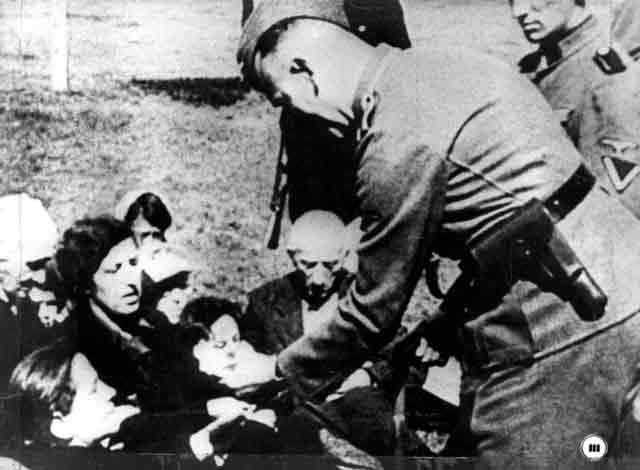
It is day two of the Babi Yar operation. On 28 September 1941, the Germans posted the following message on billboards throughout the recently captured city of Kyiv:
“All Jews living in the city of Kiev and its vicinity are to report by 8 o’clock on the morning of Monday, September 29th, 1941, at the corner of Melnikovsky and Dokhturov Streets (near the cemetery). They are to take with them documents, money, valuables, as well as warm clothes, underwear, etc.
“Any Jew not carrying out this instruction and who is found elsewhere will be shot. Any civilian entering flats evacuated by Jews and stealing property will be shot.”
The common conclusion of those reading this notice was that the Germans would follow their typical practice and deport the Jews. This would not be the case.
In the outskirts of Kiev, four strike squads sent by Henrich Himmler today begin killing 33,771 Jews in the Babi Yar ravine north of the city. Jews were marched in small groups to the ravine, ordered to strip naked and then were machine-gunned. The massacre is completed tomorrow and the bodies, living and dead, are covered over with dirt and rock. Babi Yar is a picturesque ravine situated in the Syrets suburb of the city of Kiev. It is about 3 kilometers (1.9 miles) long, over fifty meters (164 feet) deep and separated from the residential area by the local Jewish cemetery and a civilian prison. Soon after the German takeover a series of horrific explosions rocked the city demolishing a number of buildings that housed the German administration and the army hierarchy. On 26 September, the military governor, Major General Friedrich Georg Eberhardt, decides that in retaliation for the atrocity all the Jews in Kiev are to be put to death.
Today, the SS Einsatzgruppe C (SS Special Commando C), with the help of the Ukrainian police, herd the whole Jewish population of Kiev and the surrounding area into the ravine and systematically began to slaughter the entire 33,771 people. The Jews are forced to go through a narrow corridor lined with barbed wire and German soldiers to the Babi Yar Ravine. The Jews are taken in small groups to the edge of the ravine, lined up, and shot so that they fall into the ravine. A layer of sand then covers the corpses before the next batch of naked victims are brought in. However, this is just the opening stage of the pogrom, as ultimately over 100,000 people, primarily Jewish but also including others who are out of favor with the German authorities, are executed in the same way. In the months that follow, thousands of Gypsies and Russian POWs are slaughtered here. These executions are later adjudged to be crimes against humanity and are a key step in the progression of the Holocaust.
In August 1943, as the Soviet Army begins its march westwards the decision is taken to erase all evidence of the mass killings, in fact to efface it from history. Soviet prisoners and 327 men from the nearby slave camp at Syretsk begin the task of digging up the bodies and cremating them. The remains are then burned in pyres, built on slab gravestones taken from the Jewish cemetery, each pyre containing around 2,000 corpses. This gruesome task ended on 19 September1943. Only 14 of the 327 slave laborers survive by escaping from Babi Yar. Later, the SS brings in excavators and bulldozers and the ravine is again filled in.
In early October, Moscow informs the outside world of the discovery of the mass graves. The West, mistrustful of the Russians, dismisses the news as “products of the Slavic imagination.” During the 778 days of the German occupation of Kiev, many thousands of Russian POWs, Ukrainians, Gypsies, and other nationalities are murdered at Babi Yar. Of a total population of around 900,000, only 180,000 are living in Kiev at the end of the German occupation. Nobody is ever brought to trial specifically for this atrocity. In 1976, a 15 meter (49 foot) high memorial is unveiled on the site to commemorate the Soviet POWs who were killed there. However, no reference is made to the Jews or number of Jewish dead.
The implementation of the order was entrusted to Sonderkommando 4a, commanded by Blobel, under the general command of Friedrich Jeckeln. This unit consisted of SD and Sipo, the third company of the Special Duties Waffen-SS battalion, and a platoon of the 9th Police Battalion. Police Battalion 45, commanded by Major Besser, conducted the massacre, supported by members of a Waffen-SS battalion.
The commander of the Einsatzkommando reported two days later:
“The difficulties resulting from such a large scale action — in particular concerning the seizure — were overcome in Kiev by requesting the Jewish population through wall posters to move. Although only a participation of approximately 5,000 to 6,000 Jews had been expected at first, more than 30,000 Jews arrived who, until the very moment of their execution, still believed in their resettlement, thanks to an extremely clever organization.”
According to the testimony of a truck driver named Hofer, victims were ordered to undress and were beaten if they resisted:
“I watched what happened when the Jews — men, women and children — arrived. The Ukrainians led them past a number of different places where one after the other they had to give up their luggage, then their coats, shoes and over-garments and also underwear. They also had to leave their valuables in a designated place. There was a special pile for each article of clothing. It all happened very quickly and anyone who hesitated was kicked or pushed by the Ukrainians to keep them moving.”
— Michael Berenbaum: "Statement of Truck-Driver Hofer describing the murder of Jews at Babi Yar"
The crowd was large enough that most of the victims could not have known what was happening until it was too late; by the time they heard the machine gun fire, there was no chance to escape. All were driven down a corridor of soldiers, in groups of ten, and then shot. A truck driver described the scene.
“Once undressed, they were led into the ravine which was about 150 meters long and 30 meters wide and a good 15 meters deep … When they reached the bottom of the ravine they were seized by members of the Schutzpolizei and made to lie down on top of Jews who had already been shot … The corpses were literally in layers. A police marksman came along and shot each Jew in the neck with a submachine gun … I saw these marksmen stand on layers of corpses and shoot one after the other … The marksman would walk across the bodies of the executed Jews to the next Jew, who had meanwhile lain down, and shoot him.”
In the evening, the Germans undermined the wall of the ravine and buried the people under the thick layers of earth. According to the Einsatzgruppe’s Operational Situation Report, 33,771 Jews from Kiev and its suburbs were systematically shot dead by machine-gun fire at Babi Yar on 29 September and 30 September 1941. The money, valuables, underwear and clothing of the murdered victims were turned over to the local ethnic Germans and to the Nazi administration of the city. Wounded victims were buried alive in the ravine along with the rest of the bodies.
An Allied planning conference in Moscow continued. Special envoy W. Averell Harriman attended for the United States, Minister of Supply Lord Beaverbrook attended for Great Britain and Commissar for Foreign Affairs Vyacheslav Molotov headed the Soviet delegation.
The attacks by Heeresgruppe Süd (von Rundstedt) to force an entry into the Crimea are halted. Soviet resistance prevented the Germans from moving from southern Ukraine into the Krym (Crimea) region of Russia.
At the Wolf’s Lair at Rastenburg, Adolf Hitler ordered that Leningrad, Russia was to be wiped out by artillery and aerial bombardment. Germany could not and would not feed its population, which was of no use for the future of Germany.
Soviet submarine ShCh-319 attacked German minesweepers M151 and M203 off Liepaja, Latvia and then disappeared; she was presumed lost after striking a naval mine.
The first Allied convoy for the Arctic, PQ.1, departed Hvalfjörður, Iceland (having originated from Scotland, United Kingdom) at 1845 hours with 11 merchant ships escorted by cruiser HMS Suffolk, destroyer HMS Antelope, destroyer HMS Impulsive, and four minesweepers. By the end of the year five other convoys had followed it, landing 120,000-tons of supplies at Murmansk, Russia, including 600 tanks, 800 aircraft and 1,400 motor vehicles. It was somewhat embarrassing to the Germans that, between 29 September and 31 Dec 1941, all 55 vessels of these first six convoys reached their destination without loss.
Reinhard Heydrich arranged for the arrest of the Protectorate of Bohemia and Moravia Prime Minister Alois Eliáš. Prime Minister General Alois Elias of Bohemia and Moravia is arrested. This comes two days after the appointment of Heydrich as German Governor. He is tasked with wiping out all opposition to the Nazi occupation. Martial law was declared yesterday and hundreds of Czechs have been rounded up, including, today, the puppet premier Elias. He has been sentenced to death.
The Drama Uprising was suppressed. This was a spontaneous revolt by the population of Drama, Greece, against the Bulgarian occupation. The Bulgarian Army swiftly suppressed the revolt. The military carried out massive reprisals, executing hundreds of local Greek citizens. The Communist Party of Greece (KKE) had provided guidance for the resistance. Bulgarian troops moved into Drama and the other rebellious cities to suppress the uprising and seized all men between 18 and 45. They were reported to have executed between 360 and 500 people in Drama alone. According to the Bulgarian military reports, up to 1,600 Greeks were killed in the uprising and in the weeks that followed — but Greek sources claim thousands of civilian casualties. Most of the members of the Communist Party of Greece were slaughtered by the Bulgarians, except for one member. In the villages of Doxato and Choristi a total of 485 men were executed оn September 29.
The massacres precipitated an exodus of Greeks from the Bulgarian into the German occupation zone in Central Macedonia. Bulgarian reprisals continued after the suppression of the uprising, adding to the torrent of refugees. Villages were destroyed for sheltering “partisans” who were in fact only the survivors of villages previously destroyed. The terror and famine became so severe that the Athens government considered plans for evacuating the entire population to German-occupied Greece.
Mr. Churchill today told British MP’s about an historic meeting which began yesterday in Moscow between the USSR, Britain and the USA. He told them that although Allied aid to Russia as only now been formally agreed, many desperately needed supplies have already been dispatched. Russia’s relative inaccessibility, hemmed in on all sides by enemies or freezing weather, is a major obstacle.
RAF Bomber Command, Night of 29/30 September 1941
Stettin
139 aircraft – 67 Wellingtons, 56 Whitleys, 10 Stirlings, 6 Halifaxes – to 4 aiming points in Stettin. 8 aircraft – 4 Whitleys, 2 Wellingtons, 2 Stirlings – were lost and 5 aircraft crashed in England. 95 aircraft claimed good bombing in conditions of slight haze.
Hamburg
93 aircraft – mostly Hampdens and Wellingtons. 2 Wellingtons lost and 2 Hampdens crashed in England.
Searchlight glare prevented accurate bombing. Hamburg reports 9 fires, 48 people killed, 73 injured and 1,102 bombed out but no details of particular damage are available.
Minor Operations: 6 aircraft to Le Havre, 3 to Cherbourg, 5 Manchesters minelaying off Swinemünde. No losses, but 2 aircraft crashed in England. This was the first Manchester minelaying operation.
Total effort for the night: 246 sorties, 10 aircraft (4.1 percent) lost, 9 further aircraft crashed in England.
An allied conference aboard battleship HMS King George V between Admiral Commanding, Home Fleet, Admiral Commanding, Western Approaches, Admiral Commanding, Iceland Command, Air Officer Commanding Iceland, US Rear Admiral R. C. Giffen (SO, US Naval Forces in Iceland), and staffs concluded. Admiral Commanding, Western Approaches, which had arrived by air on the 26th, took passage back to England in destroyer HMS Ashanti.
Submarine HMS Ultimatum arrived at Gibraltar from Barrow.
Light cruiser HMS Galatea departed Port Said.
Destroyers HMS Avonvale and HMS Eridge arrived at Suez from Gibraltar, via Capetown. The destroyers were held at Suez for duty with Suez Escort Force until 5 October. At that time they proceeded to Alexandria and joined the 2nd Destroyer Flotilla in the Mediterranean Fleet.
Australian destroyer HMAS Vendetta and two ML’s departed Alexandria for Haifa.
Italian tanker Fluvior (389grt) was sunk by mining at Tripoli.
Italian steamer Ilvania (487grt) was sunk at Port Torres, Sardinia, to unknown cause.
Italian tanker Superga (6154grt) was sunk by Soviet submarine SC.211 in 43-00N, 27-58E near Varna in the Black Sea.
Heavy cruiser HMS Hawkins arrived at Montevideo.
Submarines HMS Thorn and HMS Truant arrived at Gibraltar. Submarine Thorn had departed Holy Loch on the 22nd. Submarine HMS Truant departed St Johns, NF, on the 19th after refitting at Portsmouth, NH, and had been delayed by engine defects.
Convoy PQ.1 of steamers Atlantic (5414grt), Blairnevis (4155grt), Elna II (3221grt), Harmonic (4558grt), Panamanian North King (4934grt), Belgian Ville D’anvers (7462grt), British oiler RFA Black Ranger (3417grt), Panamanian Capira (5565grt), Gemstone (4986grt), Lorca (4875grt), and River Afton (5479grt) departed Hvalfjord at 1845 escorted by heavy cruiser HMS Suffolk, destroyers HMS Antelope and HMS Impulsive, and minesweepers HMS Britomart, HMS Gossamer, HMS Leda, and HMS Hussar. Destroyer HMS Anthony departed Hvalfjord with oiler RFA Black Ranger on the 29th and sailed with the convoy. On 4 October, the destroyer and oiler met returning convoy QP.1. Destroyer HMS Antelope was detached on 2 October to Scapa Flow. Destroyer HMS Escapade departed Scapa Flow at 2100/28th for Seidisfjord for refueling. The destroyer arrived at 0800/30th. She departing and joined the convoy on 2 October, escorting it to 11 October. Convoy PQ.1 arrived at Murmansk on 11 October at 0240.
The troopships of convoy WS.11X, less Leinster, departed Gibraltar for Freetown, escorted by destroyers HMS Vimy and HMS Wild Swan. The troopships were turned over to corvettes HMS Woodruff and HMS Mignonette on the 2nd. The destroyers, after spending 2 to 5 October at Bathurst, were to join aircraft carrier HMS Eagle off Bathurst on 6 October. Aircraft carrier Eagle and sloop Commandant Duboc, escorted by light cruiser HMS Dunedin, sloop HMS Bridgewater, and corvettes HMS Armeria and HMS Aster, had departed Freetown 4 October. Destroyer Vimy was detached and destroyer WILD SWAN finally met the aircraft carrier and sloop. Destroyer HMS Croome departed Gibraltar on 5 October to join the ships and escorted them to Gibraltar, arriving at Gibraltar on 11 October.
Convoy SC.47 departed Sydney, CB, escorted by corvettes HMCS Chicoutimi, HMCS Matapedia, HMCS Napanee, and HMCS Sherbrooke. Corvette HMCS Chambly joined on 1 October and destroyers HMS Ramsey and HMS Richmond and corvette HMCS Orillia on 4 October. Destroyers HMS Broke, HMS Mansfield, and HMS Wolverine, corvette HMS Eglantine, and anti-submarine trawler HMS King Sol joined on 11 October. Destroyers Ramsey and Richmond and corvettes HMCS Chambly, HMCS Matapedia, HMCS Orillia, and HMCS Sherbrooke were detached on 12 October, destroyers Broke, Mansfield, and Wolverine on 15 October, corvette Eglantine on 16 October, and anti-submarine trawler King Sol on 17 October. The convoy arrived at Liverpool on 20 October.
The Senate in Washington confirmed the nomination of Gerard Reilly as a member of the National Labor Relations Board, and recessed at 12:28 PM, until noon on Thursday.
The House received the May bill to authorize funds for the Office of Civilian Defense to provide adequate protection against bombing attacks, heard Representative Fish charge that a “smear” campaign was being waged against opponents of the Administration’s foreign policy, and adjourned at 2:08 PM, until noon on Thursday. The Banking and Currency Committee heard Marriner S. Eccles, Federal Reserve chairman, on price
control legislation.
President Roosevelt will hold a White House conference with Secretary Hull on revision of the Neutrality Act tomorrow at 10 AM, soon after arriving in Washington from Hyde Park. He has postponed a scheduled meeting with Congressional leaders until Wednesday, when he can lay before them the results of his talk with the Secretary of State. Mr. Hull, who consulted with the President this morning by long distance telephone, is understood to have worked out with State Department legal authorities and leaders in both houses of Congress a formula for revising the neutrality law. Mr. Roosevelt is represented as being anxious to consult with the Secretary about this formula or draft, and perhaps suggest changes, before submitting it to leaders in Congress. It was expected that the two men would discuss the Japanese situation. Joseph C. Grew, the United States Ambassador, and Admiral Teijiero Toyoda, Japanese Foreign Secretary, had a long conference today. The British Ambassador in Tokyo, Sir Robert Leslie Craigie, has just postponed plans to leave his post for a three months’ vacation in the United States. These developments in Tokyo were interpreted by experts here as pointing to some important decision.
Administration forces appeared today to be moving for a quick showdown on repeal or modification of the Neutrality Law so that American ships, under their own protection, may deliver lend-lease material directly to belligerent ports or wherever else they may be most effective in stopping Axis aggression. With agitation for outright repeal of the law gaining in Congress, word came from Hyde Park. that President Roosevelt, returning from Hyde Park tomorrow, would confer with Secretary of State Hull at once and with legislative leaders Wednesday. Secretary Hull maintained at his press conference today his former position that the matter of the Neutrality Law was primarily up to Congress, but added that he had tried to indicate on other occasions that he favored its modification. The question would be dealt with more fully in the forthcoming conferences, the Secretary intimated.
Declaring the United States now should “reassert and reordain our adherence to the doctrine of freedom of the seas.” Senator Connally, Texas Democrat, asserted to night if American aid to Britain was to be effective this nation should deliver arms and munitions “where they can be effectively employed.” Connally, chairman of the powerful senate foreign relations committee, told a radio audience over N.B.C. that Adolf Hitler “sinks our ships wherever they may be. He sends his lurking submarines Into our defensive waters. He defies us. He murders our citizens. He assassinates our ships.” Speaking on the forum program of the Washington Evening Star, the Texan added “the repeal of the so-called neutrality act would not be un-neutral.”
Fullest possible United States aid for Russia in combating the German war machine was pledged by W. Averell Harriman, chief of the American mission, at the opening session of the momentous tri-power conference today. “I have been instructed,” he said, “to pledge you the fullest support today, tomorrow, and as long as the conflict lasts.” “We come with your British ally with the same object to give you every assistance in your heroic, magnificent resistance against the violent and unprovoked attack upon you by Hitler and his cohorts,” Harriman continued. “Your success means everything to the American people. Now let’s get down to work.”
A ceiling on wages and farm prices, more taxes, and an overall agency with full authority to fix general prices, were advocated today by Marriner S. Eccles, chairman of the Federal Reserve Board, as measures needed to halt “runaway inflation.” Mr. Eccles testified before the House Banking and Currency Committee, which is considering the emergency price-fixing bill advocated by the Administration. “Whether or not you include within the terms of this bill a declaration of policy or discretion to deal with labor and farm prices,” Mr. Eccles told the committee, “the fact is that you cannot leave wages and salaries, which are the main factor in prices, to rise indiscriminately and be realistic about preventing inflation. “You cannot, in my judgment, realistically put a high-level floor under farm prices and no ceiling,” he added. Other Administration witnesses have refused to advocate a wage ceiling, and there have been few who favored setting a limit on farm prices.
Control of wages is not included in the pending Price Control Bill because workers cannot sit idly by while their living costs go out of sight, Leon Henderson, Federal Price Administrator, said here last night. He addressed 800 manufacturers from the New York and New Jersey industrial districts at a “Preparedness Conference” sponsored by the National Association of Manufacturers at the Hotel Astor.
Subjected to sharp criticism from businessmen and congress members, Secretary Morgenthau’s proposal for a 6 percent limit on corporation profits was put on the shelf today. Secretary Morgenthau told his press conference today that although his assistants were preparing a bill to limit corporation profits to 6 percent on invested capital it would not be submitted to Congress before January and would not be made retroactive to apply to 1941 profits.
Deportation of Harry Bridges was recommended today by a special justice department inspector in a report which may become an important precedent in future proceedings under new alien laws. The report found the American Communist party, from organization in 1919 advocated overthrow of the government by violence and consequently any alien ever affiliated with It was subject to deportation. Bridges, It said, had been so affiliated. It also held affiliation with the Marine Workers Industrial union, an organization of seamen and shoremen formed in 1930 and liquidated in 1935, was automatic ground for deportation. But it found Bridges’ membership in the Industrial Workers of the World in 1921 was not ground for deportation.
The U.S. Army is still six months to a year short of being ready for combat service, according to evidence given by the largest and most successful maneuvers in the country’s history, the Louisiana Maneuvers, which were completed yesterday.
Colonel Dwight D. Eisenhower, chief of staff to General Walter Kreuger, Commander Third Army at Fort Sam Houston, Texas, is promoted to Brigadier General (temporary).
Joe Louis beat Lou Nova by technical knockout in the sixth round at the Polo Grounds in New York City to retain the world heavyweight boxing title.
Major League Baseball:
A crowd estimated at one million jams downtown Brooklyn to cheer the Brooklyn Dodgers, the National League baseball pennant winners, in a parade.
In a statement to The Globe and Mail, Commander Andrew McNaughton called the Canadian Corps “a dagger pointed at the heart of Berlin,” a phrase that made for great copy in the press back home while Canadian forces continued waiting to see front line action.
In Honolulu, Territory of Hawaii, the Japanese consulate sends the following message to Tokyo: “The following codes will be used hereafter to designate the location of vessels:
- Repair dock in Navy Yard: KS.
- Navy dock in the Navy Yard (The Ten Ten Pier): KT.
- Moorings in the vicinity of Ford Island: FV.
- Alongside in Ford Island: FG. (East and west sides will be differentiated by A and B respectively.”
Japanese Ambassador to the United States, Admiral Nomura Kichisaburō urged for a fourth time for a meeting between Japanese Prime Minister Konoe Fumimaro and U.S. President Franklin D. Roosevelt stating “… if nothing came of the proposal for a meeting between the chiefs of our two Governments it might be difficult for Prince Konoe to retain his position and that Prince Konoe then would be likely to be succeeded by a less moderate leader.”
Japanese Ambassador to the United States Kichisaburō Nomura is an extremely skilled diplomat who secretly does not desire war. He has engaged in quiet diplomacy with Secretary of State Cordell Hull which has included lunches downtown in addition to official meetings. Today, however, he has to deliver a message from Tokyo that decidedly escalates the rhetoric.
While the message is phrased as diplomatically as possible, the message is clear: deal, or there will be trouble. Everyone knows — including Washington, which is kept well-informed by its ambassador in Tokyo Joseph Grew — that the Japanese military is eager for war and dominates the Cabinet.
Chinese relief troops arrive at Changsha, forcing the Japanese to retreat. At Changsha, China, the fighting turns in favor of the defending Chinese. The Chinese 9th War Area goes over to the offensive against the Japanese 11th Army, reinforced by relief troops. The Chinese may not have many modern weapons to equal the Japanese planes and guns, but they have one thing in abundance: men. The Japanese are forced to retreat.
The air war is not going particularly well for the Chinese. Their outdated fighters are no match for the new Japanese Mitsubishi A6M Zero, and their pilots are not trained to the high standards of the Imperial Japanese Army Air Service and the Imperial Japanese Navy Air Service (Kōkūtai). On 29 September 1941, those problems are compounded when the commander of the 2nd BS, Zhang Tiqing, defects during a raid at Changsha. While leading his command of SBs of the Chinese 1st and 2nd BGs, Tiqing leaves his fellow pilots and willingly lands at the Japanese-held aerodrome at Hankou. In addition to presenting a complete SB to the Japanese for study, Zhang Tiqing’s desertion causes the others in his flight to get lost. Eight SBs must make forced landings in fields. This leads to losses of pilots and planes. The Chinese have to replenish the unit from men and equipment from the 6th BG.
The British now face the possibility of war in the Pacific “without anxiety,” Vice Admiral Sir Geoffrey Layton, Commander in Chief of the British fleet based on Singapore, told this correspondent today in an interview at his shore headquarters at the famous Singapore naval base. Asked to give an indication of the increase in British strength at Singapore, Sir Geoffrey said that had Singapore been attacked a year ago the defenders would have had “definite cause for anxiety.” “Now,” he said, “we view the possibility of attack without anxiety.” Britain, he said. “obviously does not want a war in the Pacific now.” but he declared that “if any of our territories are attacked we shall certainly fight.”
[Ed: Umm. About that. Maybe more anxiety is in order.]
Imperial Japanese Navy light carrier HIJMS Hosho was relieved the duty of being Carrier Division 3’s temporary flagship.
Fifty P-40E Warhawk fighters are received at Nichols Field, Luzon, Philippine Islands.
Dow Jones Industrial Average: 126.05 (+0.02)
Born:
Fred West, English serial killer, in Much Marcle, Herefordshire, England, United Kingdom (d. 1995).
Jon Brower Minnoch, American, world’s heaviest recorded man at 1,400lb (635 kilograms; 100 stone), in Bainbridge Island, Washington (d. 1983).
Rich Reese, MLB first baseman and outfielder (Minnesota Twins, Detroit Tigers), in Leipsic, Ohio.
Kermit Zarley, American golfer, author (Canadian Open, 1970), in Seattle, Washington.
Don Nix, American ‘Memphis Soul’ saxophonist (Last Night), in Memphis, Tennessee.
Died:
Friedrich Angel, 79, German mathematician (group theory),.
Herbert Samuel Holt, 85, Irish-born Canadian civil engineer and businessman.
Naval Construction:
The Royal Navy Isles-class minesweeping trawler HMS Filla (T 212) is laid down by John Crown & Sons Ltd. (Sunderland, U.K); completed by Holmes.
The Royal Canadian Navy Tribal-class destroyer HMCS Haida (G 63) is laid down by Vickers-Armstrong Ltd. Newcastle-on-Tyne; completed by Parsons.
The Royal Navy Bar-class boom defense vessel HMS Barova (Z 94) is commissioned.
The U.S. Navy Accentor-class coastal minesweeper USS Barbet (AMc-38) is commissioned. Her first commanding officer is Ensign Stuart T. Hotchkiss, USNR.
The U.S. Navy Accentor-class coastal minesweeper USS Dominant (AMc-76) is commissioned. Her first commanding officer is Lieutenant (j.g.) H. J. Theriault, USNR.
The Royal Canadian Navy Bangor-class (VTE Reciprocating-engined) minesweeper HMCS Mahone (J 159) is commissioned. Her first commanding officer is T/Lieutenant Donald McIntosh Stewart, RCNR.
The Royal Norwegian Navy Flower-class corvette HNoMS Montbretia (K 208) is commissioned. Her first commanding officer is Lieutenant Commander Halvor Søiland, RNoN.
The Royal Australian Navy “N”-class destroyer HMAS Norman (G 49) is commissioned. Her first commanding officer is Commander Henry Mackay Burrell, RAN.

