The mass of the German forces that were said to have trapped and defeated five Russian armies east of Kiev is now being maneuvered into position for a new offensive in the Eastern Ukraine, it was reported in Berlin tonight.
Georgy Zhukov announced to his troops that family members of those who become captured by the enemy would be arrested and shot.
The first British convoy of supplies for the Soviet Union departed Iceland for Arkhangelsk. Allied convoy QP-1, which was consisted of 14 British and Soviet merchant ships escorted by British cruiser HMS London and four minesweepers, departed Arkhangelsk, Russia at about 1200 hours for Britain.
An Allied planning conference began in Moscow. Special envoy W. Averell Harriman attended for the United States, Minister of Supply Lord Beaverbrook attended for Great Britain and Commissar for Foreign Affairs Vyacheslav Molotov headed the Soviet delegation. W. Averell Harriman and Lord Beaverbrook and their staffs and the Anglo-American delegations to the Tri-Power Economic Conference in Moscow arrived today on the eve of the opening sessions of talks designed to facilitate supplies for the Soviet fighting forces in the war against Reichsführer Hitler’s Germany and to add to the vast resources at the disposal of this country the reserves and manufacturing output of the English-speaking world.
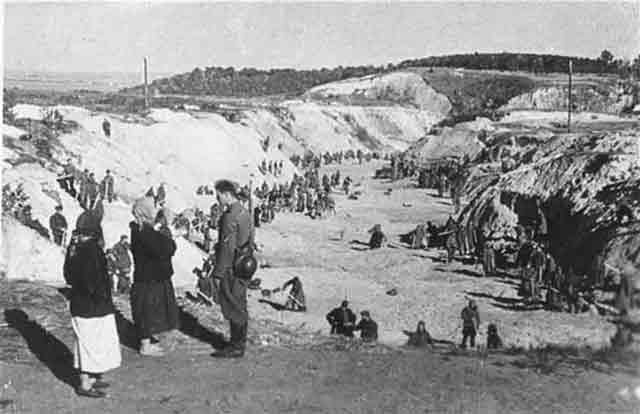
A notice was posted in Kiev, Ukraine, requiring all Jews in the region to gather at Dorogozhitshaya Street at 0700 hours the next day. A curt notice, its text printed in Russian, Ukrainian and German, appears on buildings, tree trunks and fences in Kiev. It orders all Jews to report the following day to the old Jewish cemetery on the outskirts of town, not far from the railway station. The notice suggests that the Jews are going to be resettled.
Reich Protector of Bohemia-Moravia Reinhard Heydrich imposes martial law on six districts of the German Protectorate of Moravia and Bohemia created when Germany invaded Czechoslovakia on 15 March 1939. The Germans stated that “… irresponsible elements in the service of Europe’s enemies” had committed acts antagonistic to the Reich, were endeavoring to stir up the people against Germany.”
A revolt broke out in the city of Drama, Macedonia region, Greece against the Bulgarian occupation and quickly spread throughout Macedonia. In Drama a crows attacked city hall and killed four Bulgarian policemen. In Doxato the entire police force of twenty men were massacred. The rebellion would be quickly suppressed by the Bulgarian military with thousands of Greeks being executed.
The Transportation Ministry in Berlin issued new restrictions for Jews today and the newspaper Berliner Boersen Zeitung forecast additional stringent steps against the Jews, possibly including the ghetto.
The Allied Operation HALBERD convoy arrived in Malta and began to disembark 50,000-tons of supplies aboard its ships. The entire population of Malta seems to crowd the shoreline to cheer as three cruisers — their bands playing and crews lined up as though they are on a peacetime cruise — lead a vitally needed convoy into the Grand Harbour of Valetta today.
The British transferred the airfield RAF Bassingbourn in Cambridgeshire, England, United Kingdom to the US Army. The airfield would soon house the USAAF 91st Bombardment Group, which would remain until the end of the war.
The Oak Leaves and Swords to the Knights Cross of the Iron Cross award, and Oak Leaves, Swords, and Diamonds to the Knight’s Cross of the Iron Cross, were both established in Germany.
RAF Bomber Command, Day of 28 September 1941
3 Blenheims on an uneventful shipping sweep off Dunkirk.
RAF Bomber Command, Night of 28/29 September 1941
Frankfurt
30 Hampdens and 14 Wellingtons. 1 Hampden and 1 Wellington lost; 5 aircraft crashed in England.
Genoa
39 Wellingtons and 2 Stirlings dispatched and claimed successful bombing. 3 Wellingtons lost.
Emden
6 Wellingtons and 1 Stirling. No losses.
Destroyer HMS Offa departed the Clyde at 1400 for working up exercises at Scapa Flow, where she arrived at 1200/29th.
Minesweepers HMS Leda, HMS Britomart, HMS Gossamer, and HMS Hussar arrived at Hvalfjord for escort duty in convoy PQ.1.
Convoy ON.19 A departed Reykjavik, escorted by destroyer HMCS St. Croix and corvettes HMCS Agassiz, HMCS Eyebright, and HMCS Prescott. The convoy was dispersed on 4 October.
Convoy ON.21 departed Liverpool, escorted by destroyer HMS Keppel. On the 30th, destroyers HMS Sabre and HMS Venomous, corvettes HMS Dianella and HMS Sunflower, and anti-submarine trawlers HMS Lady Elsa, HMS Man O’ War, and HMS Northern Dawn joined. Destroyer Sabre was detached on 2 October and destroyers Keppel and Venomous were detached on 5 October. The remainder escort ships were detached on 6 October after destroyer HMCS St. Laurent and corvettes HMCS Bittersweet, HMCS Chilliwack, HMCS Collingwood, HMCS Snowberry, and HMCS Trail joined on 5 October. The convoy was dispersed on 14 October and the escorts detached.
Destroyer HMS Southwold was damaged in a collision with patrol sloop HMS Shearwater off Sheringham. Neither ship received more than minor damage. Destroyer Southwold was repaired during refitting at Chatham from 10 October to 7 November. The sloop was repaired at Harwich from 4 to 8 October.
British fishing trawler Murielle (96grt) was badly damaged by a mine eight to nine miles southwest by south of Morecambe Bay Light Vessel. The trawler sank in tow. There were no casualties.
Convoy QP.1 departed Archangel at 1200 with Dutch steamer Alchiba (4427grt), British oiler RFA Black Ranger (3417grt), British steamers Esneh (1931grt), Llanstephan Castle (11,348grt), New Westminster City (4747grt), Lancastrian Prince (1914grt), and Trehata (4817grt), and Soviet steamers Sevzaples (3947grt), Sukhona (3124grt), Alma Ata (3611grt), Budenne (2482grt), Mossovet (2981grt), Rodina (4441grt), and Stary Bolshevik (2974grt). Local escort for the convoy was Minesweepers Halcyon, Harrier, and Salamander from 28 to 30 September. Heavy cruiser HMS London escorted the convoy from 28 September to 2 October. Heavy cruiser HMS Shropshire departed Scapa Flow at 1900/28th escorted the convoy from 2 to 10 October, relieving heavy cruiser London in 74-55N, 27-30E. Destroyers HMS Electra escorted the convoy from 28 September to 9 October, HMS Active from 28 September to 5 October, and HMS Anthony from 4 to 9 October. Trawlers HMS Macbeth and HMS Hamlet of the 73rd Minesweeping Group escorted the convoy from 28 September to 9 October. Trawler HMS Ophelia escorted the convoy from 28 September to 5 October. Trawler Ophelia, escorting tanker RFA Black Ranger en route to convoy PQ.1, developed defects and was towed by destroyer Active to Akureyri, arriving on 10 October. Soviet steamers Sukhona and Mossovet straggled from the convoy, but arrived safely. The convoy dispersed off the Orkneys on 10 October, the steamers proceeding to their destinations in convoy WN 91. Heavy cruiser HMS Shropshire was detached at 1900 on 10 October and arrived at Scapa Flow at 0015 on 11 October. Destroyer Anthony escorting oiler Black Ranger and steamer Llanstephan Castle arrived at Scapa Flow at 0900 on 11 October. Destroyer Electra arrived at Scapa Flow at 1039 on 11 October.
Destroyers HMAS Napier and HMS Jackal departed Alexandria to reinforce the Suez escort force. The destroyers passed through the Canal on the 29th.
Submarine HMS Tetrarch damaged German steamer Yalova (3751grt) twenty miles south of San Giorgio. The steamer was able to beach herself, but was finished off on 3 October by submarine HMS Talisman.
Italian submarine Fisala was sunk by Corvette Hyacinth off Jaffa in 32-19N, 34-17E.
Informed legislators predicted today that President Roosevelt would ask Congress for discretionary power to arm merchant ships and to send them into belligerent ports, rather than seek outright repeal of the Neutrality Act. If such a course were followed, the Neutrality Act’s prohibitions against the arming of ships or their entering combat zones technically would be left standing unless the president found it necessary to put them aside. Senator Tom Connally of Texas, chairman of the Foreign Relations Committee, indicated today that the Administration would not push for amendment of the Neutrality Act until after the second Lend-Lease Bill is passed. He estimated the $5.985,000,000 arms appropriation would pass both houses of Congress within a week after it is sent up for debate.
Mr. Connally, who will discuss the Neutrality Act in a radio speech tomorrow night, said that no decision had yet been taken on whether the Administration would ask for amendment of the Neutrality Act or outright repeal. He stated, however, that some parts of the act, such as that providing government control over munitions exports, might be retained and that the Administration would be content with freedom of operation of its merchant vessels anywhere in the world and the arming of all merchantmen. It is understood that the Administration has already taken steps to prepare some of its merchant vessels for both anti-submarine and anti-aircraft guns in order to be ready when and if Congress grants permission to mount the guns. This precaution is believed to have been taken because of the time involved in erecting special steel braces to withstand the recoil of the guns.
Kentucky Police worked desperately but cluelessly tonight in efforts to solve the slaying of Marion Miley, 27, attractive woman golf star, and the critical wounding of her mother, who were shot early today by two thieves at the fashionable Lexington Country club. Coroner J. Hervey Kerr reported the shooting occurred shortly after 4 a.m. when two masked robbers broke into the colonial structure, stole $145 in dance receipts, then knocked Mrs. Fred Miley to the floor, shot her three times in the abdomen, and turned on Miss Miley, shooting her in the head and back. The country club does not employ a nightwatchman. Mrs. Miley underwent an emergency operation for removal of the slugs in her body. St, Joseph hospital attaches said her condition is “grave.”
A strike of 17,000 C.I.O. workers in plants of the Tennessee Coal, Iron and Railroad Company was settled yesterday when Governor Frank Dixon ordered Home Guardsmen withdrawn. Representatives of the union agreed that the workers would return to their jobs at 11 PM last night at all the plants. The local of the union at Ensley voted to resume work in all departments there, including the open-hearth furnaces, where it had at first been believed the strike would be continued by 500 men. It was understood that company and union officials would begin negotiation of the grievances which caused the walkout at Ensley. The mill at Ensley was shut when 4,500 members of the Steel Workers Organizing Committee walked out Friday in an unauthorized strike. Governor Dixon sent a detachment of Home Guardsmen to the Ensley mill Saturday. In protest workers spread the strike to all steel and coke works of the company.
Eight hundred San Francisco Bay Area train and bus operators who run the Key system’s interurban lines today made official their decision to repudiate officers of their A.F.L. local and to stay on the job despite a jurisdictional controversy. The train and bus men, composing division 192 of the Amalgamated Association of Street, Electric Railway & Motor Bus Employees, took the formal action at a 2 a.m. meeting. They petitioned the international union to provide “a disinterested representative” to manage affairs of the division until a new set of officers can be chosen at a regular election In November.
The 21 percent rise in wholesale prices which has occurred in two years is attributable chiefly to increases in farm products and to higher hourly wage rates, the Brookings Institution reported today. As a result, it said, the government’s pending price control bill could exert no effective control over the price system as a whole and must be supplemented by stabilization of farm prices and wages in general.
Army GHQ Maneuvers in Louisiana that began on September 14 concluded. The Army’s neglect of aviation support for its ground troops during the interwar period compelled it to ask the U.S. Navy to provide planes to take part. Five Navy and four Marine Corps squadrons took part in the large-scale war games.
A message from General George C. Marshall, Chief of Staff of the United States Army, to officers and men of the Jewish faith was read over the radio yesterday in a broadcast sponsored by the Jewish Welfare Board at the approach of Yom Kippur, the Jewish Day of Atonement, which begins at sundown tomorrow.
Joseph Rochefort warned U.S. commanders at Pearl Harbor, U.S. Territory of Hawaii that the recent Japanese Navy communications changes might mean the preparation of a large exercise or another major action.
Major League Baseball:
The year 1941 was perhaps the most dramatic in the history of Major League Baseball. It was almost as if the players knew it was all about to end and they had to get in one final effort to show that there’s more to the world than death and destruction. There also is valor and glory off the battlefield, even if it doesn’t involve trying to seize someone else’s country or eliminate some inconvenient foreign leader. Joe DiMaggio of the New York Yankees hit in 56 straight games over the summer (57 straight games if you count the All-Star Game), something that hadn’t been done for decades, hasn’t been done since and almost never will be done again in the future. That would seem to be an impossible act to top… but Ted Williams, the “Splendid Splinter,” somehow manages to do it on the last day of the season.
The story of Ted Williams’ final two games of the 1941 season is well known, but let’s go through it one more time. It is a doubleheader at Shibe Park against Connie Mack’s Philadelphia Athletics and he is hitting an amazing .3995, which rounds off to .400 and would make Williams the first player in the history of baseball to hit .400 for an entire season. After the Red Sox arrived in Philadelphia, a reporter asked Williams whether maybe he shouldn’t just take the day off since these are meaningless games anyway in order to preserve his record. Ted says no, saying “I either make it or I don’t.”
Williams has plenty of reasons to sit out the games, including the fact that on Saturday, he had only gone 1-4, dropping his season average just below the .400 level. The season was ending, the sun was not as high in the sky so shadows played across the field, there was no motivation for the pennant race, and everyone was tired. Williams’ manager, Joe Cronin, offers him the choice of playing or not, telling him, “You don’t have to be put in if you don’t want to. You’re officially .400.” Williams recounts decades later “that hit me like a goddamn lightning bolt! What do you mean I don’t have to play today?” He responds, “I want to have more than my toenails on the line.”
Cronin is in Williams’ corner all the way, telling a reporter:
“If there’s ever a ballplayer who deserved to hit .400, it’s Ted. He’s given up plenty of chances to bunt and protect his average in recent weeks. He wouldn’t think of getting out of the lineup to keep his average intact. Moreover, most of the other stars who have bettered the mark before were helped by no foul strike rules or sacrifice fly regulations.”
Everybody on the ballfield knows what is at stake, including the home plate umpire, Bill McGowan, who mentions it during Williams’ first at-bat.
Well, after all the drama, Ted Williams goes 4-5 in the first game, including hitting his league-leading 37th home run of the season in the fifth inning. Then, now hitting above .400 and with every reason to sit out the nightcap of the doubleheader, Williams plays anyway and goes 2-3. Ted Williams winds up hitting .4057, rounded up to .406. For the day, he goes 6-8, one of his best days of the entire season. And that is the last time anyone ever hit .400 in the Major Leagues.
Ted Williams will receive his draft notice in January 1942, join the Navy Reserve on 22 May 1942 after a highly criticized decision to get him declared 3-A (ineligible for the Draft), and go on active duty in 1943. He becomes a Naval Aviator in the United States Marine Corps but doesn’t see any action, serving as a flight instructor. However, when the Korean War breaks out, he serves in Korea as John Glenn’s wingman.
The Major League seasons come to an end today, with the Yankees and Dodgers looking forward to meeting in the World Series.
A jubilant crowd at Ebbets Field watches as the Dodgers beat the Phillies 5–1, handing the Phillies their 111th loss, a club record. For Brooklyn, it is their club-record 100th win. The crowd sets a new season attendance record at 1,215,253. The Dodgers finish the season with a 100-54 record, 2 ½ games ahead of the St. Louis Cardinals. But the Dodgers must now meet the mighty New York Yankees in a “subway series.”
The New York Giants finished their season today, beating the Boston Braves, 2–1, with Rookie Dave Koslo, southpaw from Milwaukee, pitching a six-hitter and fanning seven. This was his first major league victory against one loss.
The St. Louis Cardinals closed the season today with a 3–1 victory over the Chicago Cubs. Eddie Beazley, rookie pitcher from New Orleans, made a successful major league debut for St. Louis with a ten-hit performance.
At Briggs Stadium, the White Sox stop the Tigers, 3–0, behind Thornton Lee’s 22nd win. It is also his league-leading 30th complete game. The Sox’s pitch staff total of 106 complete games will not be matched the rest of the century.
A crowd of 7,909 at Yankee Stadium watched yesterday as the Senators’ right-hander Sid Hudson blanked the American League champions, 5–0, with a four-hit pitching achievement in the last game of the regular season. Hudson pitched a perfect game until two were out in the fourth, when Tommy Henrich singled and Joe DiMaggio followed with a double. However, the runners were stranded at third and second. In the eighth, with one out, Joe Gordon and Phil Rizzuto singled, but nothing further developed. Hudson ended the game by fanning the fence-aiming DiMaggio.
Ted Williams of the Boston Red Sox entered the final day of the baseball season batting .3995535, which would have been rounded up to .400 in the official statistics. Williams believed he didn’t deserve to hit .400 if he couldn’t do it from the beginning of the season to the end, so he played in the doubleheader at Shibe Park against the Philadelphia Athletics, telling a reporter that “I either make it or I don’t.” Williams collects 4 hits in 5 at bats in the 12–11 first-game slugfest victory in Philadelphia to bring his average to .404. He goes 2-for–3 in game 2 against rookie Fred Caligiuri, who beats Lefty Grove 7–1. Grove gives up 4 hits in the 1st inning and leaves the game, his last Major League appearance. Williams will finish the season with a .406 batting average, the first .400 hitter in the American League since Harry Heilmann in 1923. Joe Cronin estimates that Williams hit 14 sacrifice flies in 1941, one of the years in which any fly advancing a runner is charged as a time at bat. Bobby Doerr drives in 3 runs in game 1, giving him 8 RBIs in his last 4 games, and 93 RBIs for the year. The Red Sox finish with all 4 infielders over 90 RBIs (Foxx, 105; Tabor, 101, Cronin, 95), second to the 1934 Tigers and just the second and last team this century to reach the mark. All four infielders have hit 20 home runs, the only time this century that this has been accomplished. The Texas infield of 2004 will be the second team to reach this mark.
Pittsburgh Pirates’ Rookie Bill Clemensen stopped Bucky Walters’s bid for his twentieth victory today as the Pirates defeated the Cincinnati Reds, 3–2. Clemensen allowed only five hits.
The St. Louis Browns, whose chief claim to fame is the trouble they cause higher ranking teams, retained this form today by defeating the Cleveland Indians, 5–4.
Philadelphia Phillies 1, Brooklyn Dodgers 5
New York Giants 2, Boston Braves 1
St. Louis Cardinals 3, Chicago Cubs 1
Chicago White Sox 3, Detroit Tigers 0
Washington Senators 5, New York Yankees 0
Boston Red Sox 12, Philadelphia Athletics 11
Boston Red Sox 1, Philadelphia Athletics 7
Cincinnati Reds 2, Pittsburgh Pirates 3
Cleveland Indians 4, St. Louis Browns 5
The Duke and Duchess of Windsor returned to British Empire territory in Saskatchewan today when their train crossed the border from the United States at 2 p.m. On hand to greet them were 1,000 cheering Canadians many of whom motored here for the occasion.
Over 100 are killed as a hurricane strikes the Cabo Gracias area of Nicaragua.
Convoy BP.16 departed Bombay, escorted by Greek cruiser RHS Georgios Averoff. The cruiser was detached en route and arrived back at Bombay on 4 October for boiler repairs. The convoy arrived at Basra on 5 October. Convoys BP.17 through BP.40 in April 1942 traveled without escort.
The Second Battle of Changsha continued between Japan and China. A Chinese Army spokesman declared tonight that the capital of Hunan Province, Changsha, remained in Chinese hands despite reiterated Japanese claims of its capture. “I conversed by telephone with the Chinese headquarters at Changsha at 8 o’clock tonight,” the spokesman said. “A few Japanese plain-clothesmen broke into the city last night, but were annihilated in bitter street fighting by morning. Japanese troops are being held several miles north of Changsha.” The Chinese Central Daily News reported that a fierce now battle started last night and raged past noon today along the whole Northern Hunan front. Japanese troops, attacking repeatedly with the support of planes, were said to have been repulsed.
The Imperial Japanese Navy light carrier Hosho became the temporary flagship of Carrier Division 3.
The will to war against Japan is very strong in the Netherlands Indies, Singapore, Australia and New Zealand. The general feeling here is that the United States-Japanese talks in Washington are useless but are giving the United States time for defense and offensive preparations that are rapidly nearing completion in the Philippines.
Australian troop convoy US.12B departed Fremantle with liners Aquitania (44,786grt), Johan Van Oldenbarneveldt (19,429grt), Marnix Van St. Aldegonde (19,355grt), and Sibajak (12,226grt). Steamer Sibajak was detached to Singapore.
Born:
Charley Taylor, NFL wide receiver and running back (Hall of Fame, inducted 1984; Pro Bowl, 1964–1967, 1972–1975; Washington Redskins), in Grand Prairie, Texas (d. 2022).
Edmund Stoiber, German politician, in Oberaudorf, Germany.
Naval Construction:
The Royal Navy MMS I-class motor minesweeper HMS MMS 125 is launched by United Engineers (Singapore). She is scuttled at Singapore in February 1942.
The U.S. Navy Mackerel-class submarine USS Marlin (SS-205) is launched by the Portsmouth Navy Yard, Kittery, Maine.
The Regia Marina (Royal Italian Navy) Acciaio-class submarine Bronzo is launched by Cantieri Tosi (Taranto, Italy). She is captured in 1943 by the Royal Navy and becomes the HMS P 714, and later the Les Forces Navales Françaises Libres (Free French) Narval (P 714).
The Regia Marina (Royal Italian Navy) Soldati-class (Second Group) destroyer Mitragliere is launched by Cantiere Navale Riuniti (Ancona, Italy).
The Вое́нно-морско́й флот СССР (ВМФ) (Soviet Navy) Project 7-class (Gnevny-class) destroyer Redky (Редкий, “Rare”) is launched by Zavod imeni Leninskogo Komsomola (Komsomolsk-na-Amur, U.S.S.R.) / Yard 199.
The Royal Navy Fairmile B-class motor launch HMS ML 338 is commissioned.
The Royal Navy Hunt-class (Type II) escort destroyer HMS Dulverton (L 63) is commissioned. Her first commanding officer is Lieutenant Commander William Napier Petch, OBE, RN.
.
.
.
70 days to Pearl.

