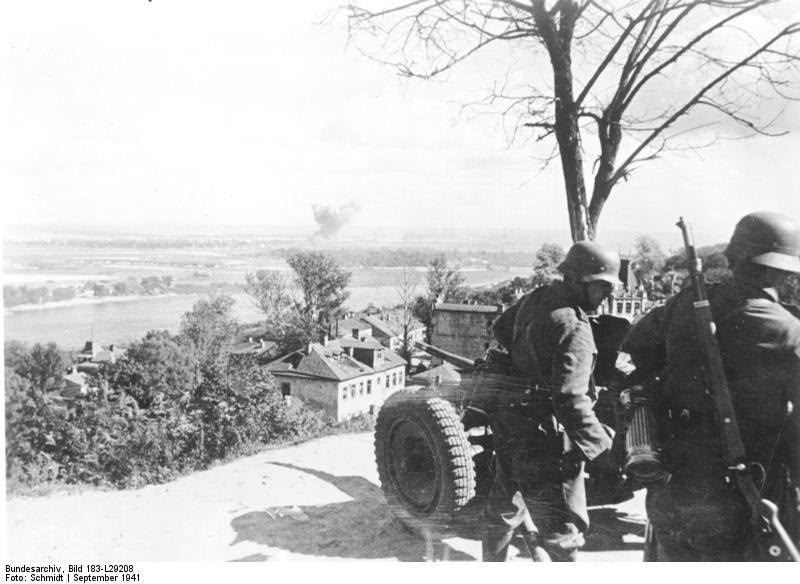
The First Battle of Kiev ended in German victory. Having surrounded almost a million Soviet soldiers near Kyiv, Ukraine earlier in the month, the combined forces of Army Groups Center and South finish subduing the pocket on 26 September 1941. Out of the approximately 850,000 Soviet troops originally surrounded, only about 150,000 managed to escape to the east. The rest either go into captivity or stay on the battlefield forever.
The Germans, led by Field Marshal Gerd von Rundstedt, are mystified at how easy it was to eliminate such a large force. They know that the Soviets have large forces nearby to the east and northeast, but those forces have made no attempt to try to break through and rescue their trapped comrades. General Franz Halder writes in his war diary that:
“Mopping up of the pockets east of Kiev is drawing to a close. Guderian continues the concentration of his forces toward the north while pushing away the enemy on his eastern flank.”
General Guderian’s Panzer Group 2 is down to 20% of its original forces, so being able to defend against the Soviets to the east of the pocket so easily shows that the Soviets simply aren’t interested in rescuing the men at Kyiv. This is contrary to all military logic, and the Germans almost automatically would launch a relief drive. This illustrates a fundamental difference between the two sides, as the Soviet attitude is that those who have lost a battle are unworthy of being rescued.
The Wehrmacht is able to process the hordes of Soviet prisoners at its leisure, with about 650,000 Soviet men heading to very rough POW camps in cattle cars. The Germans do not feel bound by the humanitarian provisions of the Geneva Convention in their war against the Soviets, so very little care is taken to ensure the prisoners’ survival. It is estimated that only about 6,000 of the Soviets ever return to their homeland — about the same as the number of Germans who return after surrendering at Stalingrad just over a year later.
The pocket of trapped Soviet soldiers is a scene of wild chaos. Artillery shells explode amidst groups of defenseless men and horses, food is running short, and there is no leadership following the death of General Mikhail Kirponos on 20 September in a German ambush in the woods. About 100,000 Red Army soldiers perish before the guns fall silent, and more thereafter on the trip west. It is the largest battle of annihilation since… it is the largest battle of annihilation in world history. In a sense, this may be the peak of German military fortunes during World War II, though there are many claimants to that title. The way is now clear for the Wehrmacht to reorient its attack east toward Moscow.
The Soviets do get some revenge for their massive defeat at Kyiv. Before departing, they have boobytrapped major downtown administrative buildings in Kyiv. They wait until the Germans have fully occupied them and settled in and then, around 26 September 1941, set off the hidden explosions by wireless commands. The explosions kill hundreds of Wehrmacht soldiers and SS officers. The Germans are furious and decide to retaliate against the civilian population, with the main focus coming to rest on the Jews of Kyiv.
Further south, General Erich von Manstein continues pushing his 11th Army into the Crimea. Halder opens his report not with this historic news at Kyiv, but the situation there:
“A breakthrough is developing at Perekop; the Panzer Group has started attack southeast; Seventeenth Division is slowly gaining ground.”
While Manstein’s progress is good news, it subtly illustrates a larger problem for the Germans. Every success, every feat of arms, only leads to more campaigns with an enemy who always has somewhere new to run. Manstein is gaining ground, but that only means a completely new area of operations in the Crimea — which has many areas that are easy to defend. The war in the East is endless, and the further east the Wehrmacht goes, the more new battles it faces.
The Spanish Blue Division, en route to Army Group Center, are at Vitebsk when they are suddenly rerouted to Army Group North. There, they will become part of the German 16th Army.
A few days after the occupation of Kiev, downtown buildings were blown, killing hundreds of members of the Wehrmacht. Today, SS and Wehrmacht officers meet and decide that as a reprisal the majority of the Jews in Kiev shall be killed.
In trial testimony long afterwards, a former SS officer at the meeting described the division of labor between the SS and Wehrmacht by saying that “We had to do the dirty work. I will never forget how … [Brigadier General Kurt] Eberhard said to us in Kiev, ‘You have to do the shooting’.” However, Wette continues, “not only did the general have no objections to the plan for the massacre as such, but, given the ongoing arson attacks, he was actively promoting it, as an SS report to Berlin confirms: ‘The Wehrmacht welcomes the measures and requests a radical approach’”
The Jews of Swieciany in Lithuania are rounded up, taken to a former army camp in the nearby Polygon woods, and massacred. On the evening before, several hundred young men and women had managed to break through the Lithuanian police cordon and escape eastward to towns not yet reached by the killing squads.
1,608 Jews in Kaunas were loaded into trucks, driven to the outskirts of the city and killed.
British minelaying cruiser HMS Latona and destroyers HMS Jackal, HMS Kimberley, and HMS Hasty departed Alexandria, Egypt with troops and supplies for the besieged Tobruk, Libya; they would set sail to return to Alexandria overnight, arriving in the following day.
Regia Marina (Royal Italian Navy) Admiral Angelo Iachino commands an Italian naval task force of 2 battleships, six cruisers and 14 destroyers to intercept the British convoy of Operation Halberd. The British convoy nine merchantmen, one aircraft carrier, three battleships, five cruisers and eighteen destroyers left Gibraltar on 24 September for Malta.
German battleship Tirpitz sailed with other warships to patrol off of the Aaland Islands in the Baltic Sea to prevent Soviet naval maneuvers.
General de Gaulle’s Free French government signed an alliance with the Soviet Union.
German submarines U-124 and U-203 attacked Allied convoy HG.73 500 miles north of the Azores islands and sank 6 merchant ships; HMS Larkspur counterattacked U-203 with depth charges but caused no damage.
In London, the War Office announced today that Miss Mary Churchill, youngest daughter of the Prime Minister, had become a private in the Women’s Auxiliary Territorial Service.
All-out aid of scientists to the Allied armed forces against the Nazis was advocated here today by United States Ambassador John G. Winant so that in the world to follow there would be greater scope for science in “the service of constructive civilization.”
RAF Bomber Command, Night of 26/27 September 1941
Cologne, Emden, Mannheim, Genoa
104 aircraft to these targets were all recalled because of forecasts of fog at bases. 23 aircraft flew on and bombed various targets, including a solitary Wellington piloted by Sergeant Musalek of 311 (Polish) Squadron which reached and bombed Genoa. This aircraft returned safely but 1 Wellington was lost from the Emden raid and 4 more Wellingtons crashed in England.
U-66, commanded by Korvettenkapitän Richard Zapp, sank Panamanian steamer I. C. White (7052grt) at 10-26S, 27-30W. At 2310 hours on 26 September 1941 the unescorted and unarmed I.C. White (Master William Mello) was hit by one of two torpedoes from U-66, while proceeding fully lighted and neutrally marked. The U-boat had spotted the tanker already on the morning of 24 September and observed her since then. Zapp asked the BdU for advice after seeing the Panamanian flag and got the answer that it is only allowed to sink the vessel outside of the Pan-American security zone. He attacked the I.C. White after she left the zone because they were transporting oil to a British port. The torpedo struck on the starboard side between #7 and #8 tanks. The explosion threw flaming oil up over the boat deck aft. The ship stopped but continued after about 15 minutes and two more torpedoes had to be fired at 0404 hours on 27 September which both hit and caused her to break in two, so that water ran across the deck amidships. At 0530 hours, a coup de grâce missed but the tanker sank anyway at 0740 hours about 500 miles off Recife. The survivors abandoned ship in three lifeboats and some rafts. Later the survivors were evenly distributed between two of the lifeboats, which then headed for Brazil. The occupants of one boat were picked up on 3 October after sailing 470 miles by the American steam merchant Delnorte (Master C.A. Hoehn) about 40 miles off Porto de Maceio, Brazil in position 10°16S/35°23W. The remaining survivors in the other boat were also picked up on 3 October after sailing 500 miles by the American steam merchant West Nilus (Master John Stern). All survivors landed four days later in Rio de Janeiro from which they were repatriated aboard the American steam passenger ship Brazil, arriving at New York on 20 October. The 7,052-ton I.C. White was carrying crude oil and was headed for Capetown, South Africa.
German steamer Gillhausen (4339grt) was lost south of Krakens, Norway.
Attacks on convoy HG.73 continue.
U-203, commanded by Kapitänleutnant Rolf Mützelburg, on the 26th sank Norwegian steamer Varanberg (2842grt) in 47-50N, 24-50W and British steamer Avoceta (3442grt) in 47-57N, 24-05W in 47-48N, 23-45W from the convoy. At 0031 hours on 26 September 1941, U-203 fired a spread of four torpedoes at the convoy HG.73 north of the Azores and heard four detonations, but made no observations because they had to dive to evade an attack by HMS Larkspur (K 82) (Lt S.C.B. Hickman, RNR). Two ships were hit and sunk in this attack: Varangberg in station #52 and Avoceta, the ship of the convoy commodore in station #51.
The Varangberg (Master Edward Steen Stenersen) was hit by two torpedoes on the port side at #1 hatch and forward of the bridge and sank immediately. The master 19 crew members and one passenger (the chief engineer of Spind, sunk by U-552 on 23 August) were lost. The survivors had no time to launch lifeboats and rescued themselves on debris and rafts that floated free until being picked up by HMS Jasmine (K 23) (LtCdr C.D.B. Coventry, RNR (retired)), which landed them at Milford Haven on 30 September. The 2,842-ton Varangberg was carrying iron ore and was headed for Cardiff, Wales.
The Avoceta (Master Harold Martin) was the ship of the convoy commodore Rear-Admiral K.E.L. Creighton, MVO, RN. The ship was hit on the port side close to the engine room by one torpedo and sank quickly. 43 crew members, four gunners and 76 passengers were lost. The master, the commodore, five naval staff members 19 crew members, two gunners and 12 passengers were picked up by HMS Periwinkle (K 55) (LtCdr P.G. MacIver, RNR) and HMS Jasmine (K 23) (LtCdr C.D.B. Coventry, RNR) and landed at Milford Haven on 30 September. Three crew members were picked up by the Cervantes, which was sunk by U-201 (Schnee) the next night. The men survived the second sinking, were picked up by the British steam merchant Starling and landed at Liverpool on 1 October. The 3,442-ton Avoceta was carrying passengers, general cargo, and mail and was headed for Liverpool, England.
U-124, commanded by Kapitänleutnant Johann Mohr, sank British steamer Cortes (1374grt) in 47-48N, 23-45W. At 0232 hours on 26 September 1941 the Cortes (Master Donald Roy MacRae) in station #12 of convoy HG.73 was hit aft by one torpedo from U-124 and sank immediately by the stern north-northeast of the Azores. After both ships ahead of her were torpedoed, the Lapwing in station #13 stopped and launched a lifeboat for rescue work. Among the survivors picked up were three men from Cortes, but they had to abandon ship again when she was sunk by U-203 (Mützelburg) at 0634 hours. The lifeboat of Lapwing made landfall in Ireland two weeks later, but two crew members from Cortes had died from exposure in the boat and the last survivor, boatswain Alfonso Pimentil, died later in a hospital in Clifden. The master, 30 crew members, six gunners and six passengers (DBS) were lost. The 1,374-ton Cortes was carrying general cargo, including potash and cork and was headed for London, England.
U-124 next quickly sank British steamer Peterel (1354grt) in 47-40N, 23-28W in 47-40N, 23-30W. At 0234 hours on 26 September 1941 the Petrel (Master John William Klemp) in station #11 of convoy HG.73 was hit amidships by one torpedo from U-124 and sank by the bow north-northeast of the Azores. After both ships ahead of her were torpedoed, the Lapwing in station #13 stopped and launched a lifeboat for rescue work. Among the survivors picked up were 17 men from Petrel, but only one survived when she was sunk by U-203 (Mützelburg) at 0634 hours and this man died of wounds in the lifeboat that picked him up again. Only the master, seven crew members and one passenger who had been picked up from a raft by the lifeboat of Lapwing survived, landing at Slyne Bay, Co. Galway on 9 October. 19 crew members, three gunners and one passenger (DBS) were lost. The master John William Klemp was awarded the Lloyds War Medal for bravery at sea. The 1,354-ton Petrel was carrying general cargo and cork and was headed for Bristol, England.
U-203 next sank British steamer Lapwing (1348grt) in 47-40N, 23-30W. During the night of 25/26 September 1941, both ships ahead of Lapwing (Master Thomas James Hyam) in station #13 of convoy HG.73 were torpedoed and the vessel stopped to launch a lifeboat with six men for rescue work. The boat brought 17 survivors from Petrel and three from Cortes to Lapwing, then returned to pick up more survivors from Petrel from a raft. In the meantime HMS Larkspur (K 82) (Lt S.C.B. Hickman, RNR) came across the stopped vessel (not identified at that time), assumed that it had been torpedoed and set one of her cutters adrift to help the survivors because she had orders to return to the convoy. At 0401 hours, U-203 fired one torpedo at the corvette lying close to a stopped tanker but it missed, like the spread of two G7a torpedoes fired three minutes later. Apparently these attacks remained unnoticed aboard the corvette while the U-boat left the area at full speed and dived to reload the torpedo tubes. When U-203 returned to the area, they found the stopped Lapwing again which was just about to recover her lifeboat with the remaining survivors, but before this could be done the ship was hit amidships by one torpedo at 0634 hours and sank within 3 minutes north-northeast of the Azores. Only three crew members from Lapwing, the three survivors from Cortes and one survivor from Petrel survived the sinking and were picked up by the lifeboat, which made landfall at Sylne Bay, Co. Galway on 9 October. But two survivors from Cortes and one survivor from Petrel died of wounds and exhaustion in the boat and the last survivor from Cortes later died in a hospital, only nine crew members from Lapwing and nine survivors from Petrel survived. After the corvette returned to the convoy, her report of a disabled ship behind the convoy started a salvage operation and the rescue tug HMS Zwarte Zee (W 163) was sent out with HMS Leith (U 36) (LtCdr E.C. Hulton, RN) as escort with a Catalina aircraft searching the area. The sloop did find one final survivor from Lapwing at the sinking position, but nothing else so the search was broken off in the evening on 2 October. The 1,348-ton Lapwing was carrying cork and pyrites and was headed for Glasgow, Scotland.
Late this evening the U-124 sank the Siremalm (2468grt) in 49-05N, 20-10W. At 2335 hours on 26 September 1941 the Siremalm (Master Haakon Svendsen) in station #23 of convoy HG.73 was hit aft by one torpedo from U-124 and sank immediately north-northeast of the Azores. HMS Hibiscus (K 24) (LtCdr C.G. Cuthbertson, RNR) was ordered to pick up survivors, but the master, 25 crew members and two British gunners were lost. The 2,468-ton Siremalm was carrying iron ore and was headed for Barrow, England.
British steamer British Prince (4979grt) was sunk by German bombing in 53-52N, 0-25E. There were no casualties on the steamer.
British schooner Kantara was lost, cause and location unknown.
British steamer Oriole (489grt) was damaged by mining off South Bishops, Cardigan Bay. The steamer was towed to Milford on the 27th.
Italian fishing boat Capodoglio (184grt) was sunk by British bombing 16 miles 346° from Marsa Dili.
The Mediterranean Fleet departed Alexandria at 0900 with battleships HMS Queen Elizabeth, HMS Barham, and HMS Valiant, light cruisers HMS Ajax, HMS Neptune, and HMAS Hobart, and destroyers HMS Jervis, HMS Jupiter, HMS Kingston, HMS Kipling, HMS Hero, HMS Hotspur, HMS Decoy, and HMAS Vendetta to act as a diversion for operation HALBERD being carried out by Force H Destroyer HMAS Napier departed Alexandria after fueling and joined the Fleet at 1430. The Fleet returned to Alexandria at 1400/27th.
Minelaying cruiser HMS Latona and destroyers HMS Jackal, HMS Kimberley, and HMS Hasty departed Alexandria for Tobruk on Serial 12 of the SUPERCHARGE operation. The ships arrived back on the 26th.
Anti-submarine whaler HMS Southern Sea (344grt) attacked a submarine contact in 33-29N, 34-45E. The whaler was joined by corvettes HMS Delphinium and HMS Erica, but the search was unsuccessful.
Submarine HMS P.34 arrived at Gibraltar after departing Barrow on the 16th. En route on the 21st, she was ordered to conduct a diving patrol in the vicinity of 42-50N, 10-40W and look for enemy submarines.
Submarine HMS Tetrarch sank Italian steamer Citta di Bastia in 36-21N, 24-23E. The steamer was from a convoy of steamers Citta de Marsala (2480grt), Citta di Bastia (2499grt), Trapani (1855grt), and Santaganta (4299grt) that departed Piraeus for Candia on the 26th, escorted by destroyer Sella, torpedo boat Libra, and armed merchant cruiser Brioni.
Heavy cruiser HMS Exeter departed Aden.
Convoy HX.152 departed Halifax. The convoy was joined on the 28th by destroyer HMCS Annapolis. The destroyer was detached on the 30th when relieved by American destroyers USS Babbitt, USS Broome, USS Leary, USS Mayo, and USS Schenck. In heavy weather all the American destroyers suffered varying degrees of storm damage. The American group was relieved on 9 October by destroyers HMS Keppel, HMS Sabre, HMS Shikari, and HMS Venomous, corvettes HMS Dianella and HMS Sunflower, and anti-submarine trawlers HMS Lady Elsa, HMS Man O’ War, and HMS Northern Dawn. Destroyer Shikari was detached on 9 October, the corvettes and the trawlers on 11 October, destroyer Keppel on 12 October, and destroyers Sabre on 13 October. The convoy arrived at Liverpool on 14 October.
In Washington, President Roosevelt issued an Executive order continuing until June 30, 1942, the reduced postal rate on books and reading matter, received Lynn U. Stambaugh, National Commander of the American Legion; presided at a Cabinet meeting, attended funeral services for his brother-in-law, G. Hall Roosevelt, and departed for Tivoli, New York, where burial will take place tomorrow.
With the Senate in recess, an Interstate Commerce Subcommittee heard further testimony on charges of war propaganda in motion pictures.
The House was in recess. Its Banking and Currency Committee continued questioning of Leon Henderson on the price control bill.
The U.S. Navy orders protection of all ships engaged in commerce in U.S. defensive waters — by patrolling, covering, escorting, and by reporting or destroying German and Italian naval forces encountered.
A projected major revision of the priorities system, under which defense industries will get specific allocations of raw materials instead of preference ratings, was outlined to the House Banking Committee today by Donald M. Nelson. The executive director of the newly created Supply Priorities and Allocations Board, testifying on behalf of early enactment of the Administration’s price control bill, said the new system still was under study, but asserted that he thought its adoption was unavoidable. Mr. Nelson told reporters he was not quite sure exactly how the plan could be carried out, but said he intended to use the agricultural implements industry as “a guinea pig” on which to test his idea. Under the existing priorities system, he explained to the committee, firms receive certain ratings, such as 1-A, in the order of their importance to the defense program and the civilian population. “But a manufacturer cannot operate unless he knows how much material he is going to get and when he will be able to get it,” the former vice president of Sears Roebuck said. “He can’t get that information from a mere preference rating, because many other firms in the same business may have the same rating.”
Full-scale American aid to Russia is being delayed by the difficulty of obtaining from the Moscow government “full knowledge” of the Russian position, which President Roosevelt and Prime Minister Churchill insisted in their joint message to Premier Joseph Stalin was the prerequisite to the proper supplying of needs, several informed officials said today.
Amid a confusion of shouted charges and counter-charges witnesses told the Senate movie investigating committee today that persons of German, Jewish or south Irish ancestry were not wanted as employees at the British purchasing agency here. Senator McFarland, Arizona Democrat, promptly denounced their testimony as “hearsay,” deplored the injection of a “racial prejudice” issue into the hearings and said it was done to “insinuate against one of our great fellow countries.”
The Congressional hearings on allegations of propaganda in American films adjourned with the intention to resume in January 1942. The media was almost universally critical of the attacks made on the film industry during the hearings, as the isolationist Senators who initiated the proceedings came across as anti-Semitic and more paranoid about Hollywood than any threat from Hitler.
German Chargé d’Affaires Hans Thomsen replies to Secretary of State Hull’s note of 19 September concerning reparations for the loss of Robin Moor: referring to the notes of 20 June and 19 September 1941, Thomsen replies that “the two communications made are not such as to lead to an appropriate reply by my government” (see 3 November).
With the danger of Hitlerism confronting them, the people of the United States must unite in a total effort to preserve the security of this nation in a perilous hour, William O. Douglas, associate justice of the Supreme Court, warned the Clvitan Club of Atlanta today.
General disapproval of Secretary Morgenthau’s proposal to limit corporation profits to 6 per cent during the emergency was voiced today by members of Congress who were in the city, and any idea that such an enactment could be put through the legislative body was described as “fantastic.”
The Duke and Duchess of Windsor ended a 30-hour visit to Washington early this afternoon, after the Duke, acting in his official capacity as Governor of the Bahamas, had conferred with high-ranking Army and Navy officials, including Henry L. Stimson, Secretary of War.
More than a million W.P.A. workers soon may get pay raises so they can meet the rising cost of living, Works Project Commissioner Howard O. Hunter revealed today. He said a plan is being studied for raising wages of about 1,034,629 workers approximately 10 percent and predicted some action within 30 days. The present W.P.A. pay scale ranges from $81 a month high in the south to a $94 high in the north. Hunter, contending that in the past two years weekly wages in manufacturing industries has risen 32 percent and retail food prices 15 percent, said: “Having based our security wage on a minimum, I think we are justified in considering a wage increase.”
That part of America on daylight saving time, about 52,000,000 people, can turn back the clock Sunday with full government sanction. The federal power commission said today that a survey of the power situation had uncovered no emergency justifying the continuation of daylight saving time as a measure to conserve electricity. If a power shortage should develop to threaten defense production, the commission said, steps would be taken to bring that area under daylight saving time.
The State, County and Municipal Workers of America, C.I.O. union of civil service employes, revised its constitution today to establish machinery for strikes in government departments and public and private hospitals.
The U.S. Army establishes the Military Police Corps.
Action of atomic bullets, catapulted from the 225-ton atom-smashing machine at the University of California with an energy of 96,000,000 volts, four times more powerful than the highest energies obtained before, was described today at a symposium of the fiftieth anniversary celebration of the University of Chicago, held jointly with the American Association for the Advancement of Science.
RKO Radio Pictures releases “Lady Scarface.” It stars Dennis O’Keefe and features Judith Anderson (later Dame Judith Anderson) as the title character.
Major League Baseball:
Big Al Benton, who usually comes to the rescue of his mates, got some assistance himself today as he pitched the Tigers into a tie for the American League’s third place by defeating the White Sox, 4–3. Benton, recording his fifteenth victory, received an early lead through a three-run third-inning rally off Lefty Edgar Smith and Rudy York’s twenty-seventh home run in the fifth, but Chicago narrowed the gap to one run in the ninth. Then John Gorsica went to the mound and saved the game.
The Yankees win a pair of three hitters, beating the Senators, 4–1 and 1–0. Spud Chandler wins game one, and in game two Mario Russo outduels Washington’s Early Wynn, 1–0, handing the prize rookie his first loss after three straight wins. Russo allows 3 hits, while Wynn gives up six, including a first inning pop homer down the LF line by rookie Phil Rizzuto. New York also turns four DPs to give them the American League record at 190, breaking the mark of the 1928 Indians. DiMaggio has an RBI to take the American League lead by one over hobbled teammate Charlie Keller. Gordon and Rolfe each score a run. The Yankees finish with five players with more than 100 runs scored: DiMaggio, Gordon, Henrich, Keller and Rolfe. Not until 2002 will a Yankee team even have four players with 100+ runs.
Johnny Vander Meer chalked up seven strikeouts today to push his seasons’ total to 202 as the Cincinnati Reds downed the Pittsburgh Pirates, 4–3.
Cleveland Indians pitcher Bob Feller pitches a one-hitter as he leads the American League in victories, innings pitched, and strikeouts. It is Feller’s last game until 24 August 1945 due to his enlistment in the U.S. Navy immediately following the Japanese attack on Pearl Harbor. Rick Ferrell’s bunt single — intended as a sacrifice bunt — in the 5th inning is the only hit against Bob Feller as Cleveland edges St. Louis 3–2 in game two of a doubleheader. It is Feller’s 25th win and his 5th one-hitter. The Browns win the opener, 6–5, in 11 innings.
Chicago White Sox 3, Detroit Tigers 4
Washington Senators 1, New York Yankees 4
Washington Senators 0, New York Yankees 1
Cincinnati Reds 4, Pittsburgh Pirates 3
Cleveland Indians 5, St. Louis Browns 6
Cleveland Indians 3, St. Louis Browns 2
Lieutenant General A.G.L. McNaughton, general officer commanding the Canadian Corps in Britain, told a group of visiting Canadian editors tonight that “there will have to be an invasion of the Continent.”
Japanese forces encircle Changsha in China. The Japanese military announced today that their troops had entered the outskirts of Changsha, bitterly defended capital of Hunan Province, and that hand-to-hand fighting was raging. A Japanese dispatch from the front said the invaders entered the northeast corner of the city and that there the Chinese defenders were putting up a battle to the death. Earlier Japanese reports claimed the destruction of four of the seven defending Chinese armies and the encirclement of another. Chinese sources here admitted yesterday that Changsha was gravely endangered, and the Japanese reported a general Chinese retreat was under way. Total size of the Chinese forces was not disclosed, but 300,000 Chinese were declared to be retreating along a 180-mile front, suggesting that even larger numbers were originally engaged by the new Japanese campaign against a city where they met disastrous defeat in the Autumn of 1939.
Making the keynote address for the celebration of the first anniversary of the signing of the Axis alliance, Vice Admiral Teijiro Toyoda, Japanese Foreign Minister, declared today that the aim of the alliance was the creation of a “new order” in the world, but he also emphasized that the new order was to be constructed by Germany and Italy in Europe and by Japan in the Far East, “respectively,” and that while the three powers cooperated in that aim the purpose of the pact was to limit and not to spread the scope of hostilities. Speaking at the luncheon that he gave to the Axis diplomats, Admiral Toyoda said: “During the year following the conclusion of the three-power pact the situation of the whole world has undergone a great change.” Then he recalled the mission performed by the pact in this year. “We think it is of great significance,” he said, “that the pact has been further strengthened through the successive participation of those countries which, sharing the same ideals with Japan, Germany and Italy, are willing to cooperate for the construction of the new order, such as Hungary and Rumania.
The Japanese cabinet adopted an emergency foodstuff program today aimed at increasing production and cutting down consumption. Coupled with a rise in rice imports, this would result in enlarging food reserves against the future.
Raizo Tanaka was named the commanding officer of 2nd Destroyer Squadron; he broke his flag aboard light cruiser HIJMS Jintsu.
The Imperial Japanese Navy aircraft carrier HIJMS Zuikaku arrives at Kure.
A Japanese diplomat in Davao, Mindanao, sends the following message to Tokyo: “Upon my arrival to take up my post here, I heard the following report concerning Zamboanga: [a] Since last August American destroyer tenders, destroyers and submarines enter that port from the South Seas every Saturday. After they have lain at anchor for one or two days they leave again for the South. In summing up the statements of members of the crews of these boats, it appears that these warships ply the waters from Jolo [b] to Tawao [c] and Tarakan [d] on the island of Borneo.”
Despite the increased burdens the £322,000,000 Australian budget presented yesterday is cheerfully accepted as the inevitable result of trebled expenditures in the last three years in which the cost of defense has risen from £14,000,000 to £217,000,000.
Dow Jones Industrial Average: 125.81 (-0.57)
Born:
Martine Beswick, Jamaican-English actress and model, in Port Antonio, Jamaica.
Joe Bauer, American rock drummer (Youngbloods — “Get Together”), in Memphis, Tennessee.
Eugene Sykes, AFL safety (AFL champions-Bills, 1964; Buffalo Bills, Denver Broncos), in New Orleans, Louisiana (d. 2018).
Gerry Ward, NBA shooting guard (St. Louis Hawks, Boston Celtics, Philadelphia 76ers, Chicago Bulls), in the Bronx, New York, New York (d. 2026).
Naval Construction:
The Royal Navy LCT (Mk 2)-class landing craft, tank HMS LCT 146 is laid down by Stockton Construction (Thornaby, U.K.).
The Royal Navy LCT (Mk 2)-class landing craft, tank HMS LCT 163 is launched by Redpath Brown (Meadowside, Scotland, U.K.).
The Kriegsmarine (German Navy) U-boat UD-5, formerly the (captured) Dutch submarine HNMS O 27, is launched by the (occupied) Rotterdam yard, Rotterdam, Netherlands.
The Nihon Kaigun (Imperial Japanese Navy) Yūgumo-class destroyer HIJMS Kazagumo (風雲, Wind and Clouds) is launched by the Uraga Dock Company (Uraga, Yokosuka, Kanagawa Prefecture, Japan).
The U.S. Navy Gleaves-class destroyers USS Hambleton (DD-455) and USS Rodman (DD-456) are launched by the Federal Shipbuilding and Dry Dock Co., Kearny, New Jersey.
The Royal Navy Fairmile B-class motor launch HMS ML 444 is commissioned.
The U.S. Navy Accentor-class coastal minesweeper USS Adamant (AMc-62) is commissioned.

