The German Army Group South (Heeresgruppe Süd) begins an offensive against the vital land bridge to the Crimea at Perekop, this is a heavily fortified natural Soviet defensive barrier at the great ‘tartar Ditch’ (‘Tartarengrab’) stretching across the narrow 5-7 km wide isthmus of Perekop which separates the Crimean Peninsula from the Ukraine. The attack is made by elements of Gen. d. Inf. von Manstein’s 11. Armee.
Meretskov assumes command of Soviet 7th Army on the Svir.
The German Armeegruppe Sud started its offensive from southern Ukraine towards Crimea, Russia.
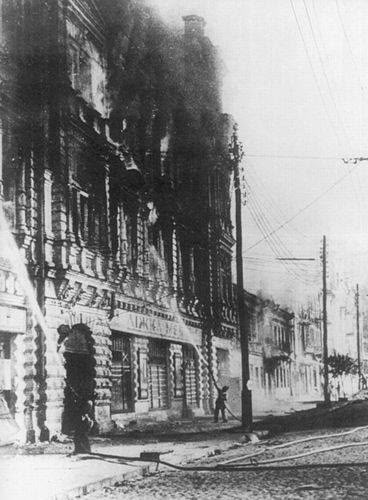
A bomb explodes in German headquarters in the Hotel Continental in Kiev. Several bombs were detonated in Kiev (Kreshchatik and Prorizna Streets), and destroyed some buildings in the center of the town, including the army headquarters and the Hotel Continental, where German officers resided. Hundreds of German soldiers and officers were killed. The resulting fire also destroyed some further buildings. These bombs had been placed by a special command of NKVD agents who intentionally remained in Kiev for this purpose. Alfred Jodl Chief of the Operations Staff of the High Command of the Armed Forces testified at his trial in Nuremberg: “hardly had we occupied the city when one tremendous explosion after another occurred. The major part of the inner city burned down, 50,000 people were made homeless. German soldiers were used to fight the flames, and suffered considerable losses, because further large amounts of explosives detonated during the fire… At first, the local commander in Kiev thought that it was sabotage on the part of the population, but then we found a demolition chart, which had already been prepared a long time ago, listing 50 or 60 objectives in Kiev for destruction. This chart was, in fact, correct, as investigation by engineers at once proved. At least 40 more objectives were ready to be blown up; for the most part, remote control was to set off the explosion by means of radio waves. I myself had the original of this demolition chart in my hands.” German troops caught and executed a Jew on Kreshchatik Street, when he cut a water hose that was being used for fighting the fire. That may have been the excuse the Germans needed to accuse the Kiev Jews of being responsible for the explosions.
Hitler visits Rundstedt at headquarters of Army Group Center.
SS Legion Niederlande formed with Dutch volunteers.
SS Legion Flandern formed with Flemish volunteers.
The German Einsatzgruppe C set up its headquarters in Kiev, Ukraine.
British minelaying cruiser HMS Abdiel and destroyers HMS Napir, HMS Kingston, and HMS Hotspur departed Alexandria, Egypt with troops and supplies for the besieged Tobruk, Libya; they would set sail to return to Alexandria overnight, arriving in the following day.
Josip Broz Tito, Commander of the Yugoslav Liberation Army, leading a poorly armed and equipped band of 70,000 partisans, attacks and takes the town of Uzice with its rifle factory capable of making 400 weapons a day. Tito and his troops would hold the city for two months.
Operation HALBERD begins today and lasts through the 30th. A major effort to move supplies from Gibraltar to Malta. The 9 transports are covered by a naval force including 3 battleships, HMS Nelson, HMS Prince of Wales and HMS Rodney, one aircraft carrier (HMS Ark Royal), 5 cruisers and 18 destroyers. This convoy, bringing 50,000-tons of supplies mostly food, will reach Malta losing only 1 transport. The British will sink one Italian submarine and sustain minor damage on HMS Nelson from a torpedo plane. Pantellaria will also be shelled.
German submarine U-107 and U-67 attacked Allied convoy SL.87 and sank four British ships 350 miles west of Madeira island; 16 were killed, 197 survived.
Allied convoy ON.18 became the first westbound convoy to be escorted by American ships as it made rendezvous with US destroyers USS Madison, USS Gleaves, USS Lansdale, USS Hughes and USS Simpson in the middle of the Atlantic Ocean.
The first German U-Boat passes Gibraltar today. Over the next two weeks 6 more U-Boats will pass into the Mediterranean during the next two weeks. The German Submarine Force will later have about 50% of its active submarine force engaged in the Mediterranean.
At a meeting of the Inter-Allied Council in St. James’ Palace in London the governments of Belgium, Czechoslovakia, Greece, Luxembourg, the Netherlands, Norway, Poland, the Soviet Union, Yugoslavia, and representatives of General Charles de Gaulle, leader of the Free French, unanimously adopted adherence to the common principles of policy set forth in the Atlantic Charter. With Anthony Eden in the chair, the meeting began in the ornate Picture Gallery of St James’s Palace, with a statement by Ivan Maisky, the Soviet ambassador, denouncing the “gang of Hitlerite marauders, armed to the teeth and proclaiming itself to be the master race.” By contrast he spoke of the Soviet Union “guided by the principle of self-determination of nations” and committed to defending the territorial integrity of every country and the “right to establish such a social order and a form of government as it deems opportune and desirable.” The Atlantic Charter commits the signatories to a postwar world of mutual co-operation and of freedom for countries under Nazi occupation, with no annexations or frontier changes without the freely expressed wishes of the people concerned.
Arthur Coningham was made Knight Grand Cross of the Order of the Bath.
Tobacco ration in Paris, France dropped to 4 cigarettes per day for men and 0 for women.
Hans-Joachim Marseille shot down a Maryland bomber and five Hurricane fighters near Buq Buq, Egypt, his 19th through 24th kills. Among his victims were South African Captain C. A. van Vliet, South African Second Lieutenant J. Mac Robert, South African Lieutenant B. E. Dodd, and New Zealand Pilot Officer D. F. Westenra.
U-67, commanded by Kapitänleutnant Günther Müller-Stöckheim, sank British steamer St. Clair II (3753grt) in 30-25N, 23-35W. At 0028 hours on 24 September 1941, U-67 fired the bow torpedoes at three ships in convoy SL.87 west-northwest of the Canary Islands, hit the first ship with one torpedo and saw it sinking by the stern. Twelve crew members and one gunner from St. Clair II (Master Harry Readman) were lost. The master, 26 crew members and four gunners were rescued: 26 survivors by the HMS Gorleston (Y 92) (Cdr R.W. Keymer) and landed at Ponta Delgada, Azores and five survivors by HMS Lulworth (Y 60) (LtCdr C. Gwinner) and landed at Londonderry on 4 October. The 3,753-ton St. Clair II was carrying palm kernels, palm oil, and sundries and was headed for Liverpool, England.
U-107, commanded by Korvettenkapitän Günter Hessler, sank British steamers JOHN Holt (4975grt, Convoy Commodore) and Lafian (4876grt) in 31-12N, 23-32W and British steamer Dixcove (3790grt) in 31-13N, 23-41W. At 0631 hours on 24 September 1941, U-107 attacked the convoy SL.87 southwest of Madeira and reported three ships sunk. These ships were John Holt, Lafian and Dixcove.
The John Holt (Master Cecil Gordon Hime) was the ship of the convoy commodore Cdr A. MacRae, DSC, RNR. The master, the commodore, five naval staff members, 45 crew members, seven gunners and nine passengers were picked up by HMS Gorleston (Y 92) (Cdr R.W. Keymer, (retired), RN) and landed at Ponta Delgada, Azores. One gunner was lost. The 4,975-ton John Holt was carrying West African produce and was headed for Liverpool, England.
The master, 37 crew members, five gunners and four passengers from the Lafian (Master Evan Llewellyn Phillips) were picked up by HMS Gorleston (Y 92) (Cdr R.W. Keymer, Rtd, RN) and landed at Ponta Delgada, Azores. The 4,876-ton Lafian was carrying palm kernels, timber, palm oil, and bullion and was headed for Liverpool, England.
The master, 36 crew members, eight gunners and six passengers from the Dixcove (Master Richard Jones) were picked up by the Ashby and the Norwegian steam merchant Fana, later transferred to the HMS Gorleston (Y 92) (Cdr R.W. Keymer, RD, RN) and HMS Lulworth (Y 60) (LtCdr C. Gwinner, RN) and landed at Londonderry on 4 October. Two crew members were lost. The 3,790-ton Dixcove was carrying West African produce and was headed for Liverpool, England.
British steamer Daltonhall (7253grt) was damaged by mining in 51-45-06N, 5-16-30W. The steamer arrived at Holyhead under her own power. She later proceeded to Liverpool for repairs.
German minelayer Konigin Luise was lost on a mine near Helsinki.
American Captain F. D. Kirtland assumed escort of convoy ON.18 at the mid ocean meeting point with a force of destroyers USS Madison, USS Gleaves, USS Lansdale, USS Hughes, and USS Simpson. This is the first westbound convoy escorted by the United States Navy.
Battleship HMS Rodney and destroyers HNLMS Isaac Sweers, ORP Piorun, and ORP Garland arrived at Gibraltar at 0900.
Corvettes HMS Jonquil, HMS Spiraea, and HMS Azalea departed Gibraltar to join the troopships of convoy WS.11X convoy at 0900 and bring them into Gibraltar. The ships arrived at Gibraltar at 0230/25th.
Light cruiser Edinburgh departed Gibraltar at 1230 to join the HALBERD convoy. Destroyers HMS Foresight, HMS Forester, HMS Gurkha, and HMS Lance arrived at Gibraltar at 1600 from convoy WS.11X escort. Battleship HMS Nelson with destroyers HNLMS Isaac Sweers, ORP Piorun, and ORP Garland departed Gibraltar on Operation HALBERD at 1815. Destroyers HMS Legion, HMS Lively, and HMS Zulu arrived at Gibraltar from WS.11X escort at 1830. Oiler RFA Brown Ranger, escorted by corvette HMS Fleur de Lys, departed Gibraltar at 2000 as Force S to oil destroyers in the HALBERD operation. Battleship HMS Rodney, aircraft carrier HMS Ark Royal, light cruiser HMS Hermione, and destroyers HMS Duncan, HMS Foresight, HMS Forester, HMS Lively, HMS Zulu, HMS Gurkha, HMS Legion, and HMS Lance departed Gibraltar at 2330 on the HALBERD operation. Convoy HALBERD of steamers Clan Macdonald, Clan Ferguson, Ajax, Imperial Star, City of Lincoln, Rowallan Castle, Dunedin Star, City of Calcutta, and Breconshire passed Europa Pont at 0130/25th escorted by Force A of battleships HMS Nelson, HMS Rodney, and HMS Prince of Wales, aircraft carrier HMS Ark Royal, and destroyers HMS Duncan, HMS Legion, HMS Lively, HMS Lance, HMS Gurkha, ORP Garland, ORP Piorun, and HNLMS Isaac Sweers and Force X of light cruisers HMS Hermione, HMS Kenya, HMS Edinburgh, HMS Sheffield, and HMS Euryalus and destroyers HMS Lightning, HMS Laforey, HMS Cossack, HMS Zulu, HMS Oribi, HMS Foresight, HMS Forester, HMS Fury, HMS Heythrop, and HMS Farndale.
Submarines HMS Utmost, which departed Malta on the 18th, in the northern approach to Messina Straits, HMS Upright, which departed Malta on the 22nd, in the northeastern approach to Messina Straits, HMS Urge, which departed Malta on the 22nd, north of Palermo, HMS Upholder, which departed Malta on the 23rd, northward of Marittimo to Cape St Vito, HMS Unbeaten, which departed Malta on the 23rd, in the vicinity of Cape Spartivento and Cape del Armi, and HMS Ursula, which departed Malta 23 September south of Straits of Messina, Polish ORP Sokol, which departed Gibraltar on the 22nd, north of Sicily, HMS Trusty, which departed Gibraltar on the 20th, north of Sicily, and Dutch HNLMS O.21, which departed Gibraltar on the 21st, off Cagliari were in the area of the convoy’s track to intercept Italian warships.
Italian battleships Littorio and Veneto with destroyers Granatiere, Fucliere, Bersagliere, and Gioberti of the 13th Destroyer Division and Da Recco, Pessagno, and Folgore of the 16th Destroyer Division departed Naples. Heavy cruisers Trento, Trieste, and Gorizia with destroyers Corazziere, Carabiniere, Ascari, and Lanciere of the 12th Destroyer Division departed Meesina, and light cruisers Abruzzi and Attendolo with destroyers Maestrale, Grecale, and Scirocco of the 10th Destroyer Division departed Palermo to intercept the convoy on the 26th. The two battleships and seven operated as one group. The five cruisers and seven destroyers operated as the second group. The remainder of the Italian Fleet could not sail due to fuel shortages.
Battleship HMS Nelson was damaged by an aerial torpedo on the 27th and had her speed reduced to eighteen knots. Lt Cdr J. R.B. Longden, CBE, was wounded. Destroyer HMS Zulu was damaged by splinters from the near miss of an air bomb. Battleships HMS Prince of Wales, HMS Nelson, and HMS Rodney and six destroyers were detached to attack this force. When battleship HMS Nelson was reduced further and she was forced to drop out, light cruisers HMS Edinburgh and HMS Sheffield replaced her. No contact was made with the Italian force.
On the 27th, troopship Imperial Star was badly damaged in 37-31N, 10-46E. Destroyers HMS Heythrop and HMS Farndale took off the survivors and destroyer HMS Oribi took the troopship in tow until it became necessary to scuttle the ship. There were no casualties on the troopship.
Battleship HMS Rodney shot down in error a Fulmar of 807 Squadron from aircraft carrier HMS Ark Royal. Sub Lt P. Guy and Leading Airman Jones were picked up by destroyer HMS Duncan. A second Fulmar of 807 Squadron was also shot down by battleship Rodney. Lt G. C. M. Guthrie and Petty Officer A. T. Goodman were also picked up by destroyer Duncan.
During the night of 27/28 September, light cruiser HMS Hermione bombarded Pantelleria for five minutes.
Steamers City of Calcutta and Rowallan Castle were damaged in a collision. Steamers Melbourne Star departed Malta at 1130 and arrived at Gibraltar on the 29th. Steamers Port Chalmers and City of Pretoria departed Malta at 1100 on 27September and arrived at Gibraltar on the 30th.
Lt M. W. Watson and A/Sub Lt (A) P. W. N. Couch of the 808 Squadron of aircraft carrier HMS Ark Royal were lost when their Fulmar was accidently shot by by gunfire from battleship HMS Prince of Wales.
Battleship HMS Nelson was detached with five destroyers to return to Gibraltar at dark on the 28th. She was escorted by destroyer HMS Duncan, ORP Piorun, and ORP Garland back to Gibraltar. Destroyer HMS Rockingham and corvettes HMS Jonquil, HMS Fleur de Lys, HMS Samphire, and HMS Arbutus departed Gibraltar on the 29th to join the escort. All arrived at Gibraltar on the 30th.
On the 27th, destroyer HMS Duncan picked up the pilot of a Fulmar aircraft accidently shot down by battleship HMS Rodney.
On the 28th, light cruiser HMS Hermione bombarded Pantelleria.
Italian submarines Diaspro at 0617 on the 29th in 37-32N, 6-45W, Serpente at 1642 in 37-22N, 6-16E, and Adua at 0350/30th attacked destroyers in Force H off Algeria. Destroyer HMS Gurkha damaged submarine Diaspro and destroyers HMS Legion and HMS Lance damaged submarine Serpente in counter attacks. Submarine Adua was sunk by destroyers HMS Gurkha and HMS Legion on the 30th east of Cartagena.
Battleship HMS Prince of Wales, light cruiser HMS Kenya and HMS Sheffield, and destroyers HMS Laforey, HMS Lightning, HMS Oribi, HMS Foresight, HMS Forester, and HMS Fury arrived at Gibraltar at 1750/30th.
Light cruisers HMS Kenya and HMS Sheffield departed Gibraltar at 0400 on 1 October to return to the UK and to search for a German supply ship reported off the coast of North Spain. Battleship HMS Rodney, aircraft carrier HMS Ark Royal, light cruisers HMS Hermoine, HMS Edinburgh, and HMS Euryalus, and destroyers HMS Farndale, HMS Heytrhop, HMS Cossack, HMS Legion, HMS Lance, HMS Lively, HMS Zulu, HNLMS Isaac Sweers, and HMS Gurkha arrived at Gibraltar at 0830 on 1 October. Tug HMS St. Day arrived at 0900.
Battleship HMS Prince of Wales and destroyers HMS Laforey, HMS Lightning, and HMS Oribi departed Gibraltar for the UK, escorted locally by destroyer Lively at 2000 on 1 October.
Light cruiser HMS Euryalus and destroyers HMS Farndale and HMS Heythrop departed Gibraltar at 2345 on 1 October for Freetown, escorting steamers Melbourne Star and Port Chalmers for Buenos Aires.
At 0130 on 2 October, light cruiser HMS Edinburgh and destroyers ORP Piorun and ORP Garland departed Gibraltar for the UK, escorting steamers Leinster and City of Pretoria. They were escorted locally by destroyers HMS Cossack and HMS Zulu, which then joined aircraft carrier HMS Argus and escorted her to Gibraltar.
Minelaying cruiser HMS Abdiel and destroyers HMAS Napier, HMS Kingston, and HMS Hotspur departed Alexandria for Tobruk on Serial 10 of the SUPERCHARGE operation.
Destroyers HMS Jaguar and HMS Griffin were at sea exercising and remained at sea for the night of 24/25 September.
An Italian convoy of steamers Castelverde, Perla, and Amsterdam, escorted by destroyers Lapino, Oriani, and Fulmine, Strale, reported a submarine attack off Pantelleria. No damage was done. There is no corresponding report.
Submarine HMS Triumph damaged Italian steamer Poseidone (6613grt) four miles off Ortona and Italian steamer Sidamo (2384grt) in Ortona Harbour.
Submarine HMS Tetrarch made an unsuccessful attack on a steamer in the Gulf of Athens.
Greek submarine RHS Triton made an unsuccessful attack on Italian naval ship Cyclops off Suda Bay.
Italian steamer Prospero (971grt) was sunk by British bombing at Benghazi.
Corvettes HMS Samphire and HMS Convolvulus arrived at Gibraltar escorting the 26th Motor Launch Flotilla of ML.209, ML.244, ML.251, ML.271, ML.277, ML.279, ML.281, and ML.289.
Greek steamer Stamatios G. Embiricos (3941grt) was sunk by German raider Kormoran at 1-01S, 64-30E. Five crewmen were lost on the steamer. Five men and the Captain of the steamer were picked up by the armed merchant cruiser. Another twenty four survivors in a boat lost touch in dark and were rescued three days later by the armed merchant cruiser. They became prisoners of war.
Convoy SC.46 departed Sydney, CB, escorted by corvettes HMCS Lethbridge, HMCS Napanee, and HMCS Shediac. Corvette HMCS Galt joined on the 25th. The original escort group was detached on the 27th. Destroyers HMS Broadway, HMS Burwell, and HMCS Ottawa and corvettes HMCS Algoma, HMCS Brandon, HMCS Buctouche, and HMCS Cobalt joined on the 27th. Destroyers HMS Caldwell, HMS Vanoc, HMS Volunteer, and HMS Walker joined on 4 October. The 27 September joining group was detached on 5 October. Destroyer Volunteer was detached on 9 October and the convoy arrived at Liverpool on 10 October.
Convoy SL.88 departed Freetown escorted by destroyer HMS Vansittart to 27 September, sloop HMS Enchantress to 8 October, corvettes HMS Aster, HMS Burdock, and HMS Vervain to 27 September, and anti-submarine trawlers HMS Fandango and HMS Morris Dance to 27 September. On the 27th, escort vessels HMS Hartland and HMS Walney joined to 8 October. Destroyers HMS Vimy and HMS Wild Swan escorted the convoy on 1 October only. The convoy rendezvoused with convoy HG.74 on 8 October. The convoy arrived Liverpool on 18 October.
In Washington this day, President Roosevelt received numerous callers and transacted official business. The State Department announced that the scheduled luncheon for the Duke and Duchess of Windsor at the White House tomorrow had been called off because of the illness of G. Hall Roosevelt, Mrs. Roosevelt’s brother.
The Senate was in recess. An Interstate Commerce subcommittee questioned Nicholas Schenck on war propaganda in motion pictures and conferees reached an agreement on the defense property seizure bill.
The House received the La Guardia request for authority to provide cities with facilities to cope with bombing attacks and adjourned at 1:01 PM until noon tomorrow. A Banking and Currency Subcommittee heard Secretary Morgenthau on the price control bill.
There were strong indications today that President Roosevelt would request virtual repeal of the neutrality act next week, and Senator Connally, Texas Democrat, said he believed American ships should be able to sail the high seas to any port in the world. Mr. Roosevelt indicated at a press conference yesterday he would ask that the act be changed to permit the arming of American merchant vessels.
Secretary Morgenthau recommended today that all corporation profits over 6 percent on invested capital be taxed away by the government for the period of the emergency, asserted that additional restrictions on bank credits might become necessary and opposed fixing by legislation of a price ceiling on wages. Testifying before the House Banking and Currency Committee in endorsement of the Administration’s Price Control Bill, the Secretary of the Treasury held up his concept of profit limitations as “something to shoot at” and gave it merely as a “rule of thumb” representing his own “sincere” conviction. “In times like these when a corporation earns 6 percent on its capital it ought to be satisfied,” the Secretary said. “In times like these all the rest ought to be taken to pay for these unusual and fantastic figures that represent defense expenditures.”
House restrictions on the Administration’s Property Seizure Bill were accepted by a joint Senate-House conference committee today and the action cleared the way for a final Congressional vote. The compromise measure authorizes the President to requisition military and naval equipment, supplies, munitions and similar articles until he declares the emergency ended or until June 30, 1943, whichever time comes first. “Fair and just compensation” would be paid.
The America First committee tonight defended Charles A. Lindbergh against charges of anti-Semitism growing out of his recent address at Des Moines, Iowa, and accused “interventionists” of injecting the race topic into the debate on foreign policy. Lindbergh, a member of the America First group, told a radio audience that the British, the Jews and the administration were leading “agitators” for war. On the defensive since Lindbergh’s remarks in Des Moines, the America First Committee issued a statement denying that Lindbergh or his fellow AFC members were anti-Semitic and invited Jews to join the organization’s ranks.
The Roosevelt-Churchill Atlantic Declaration is the direct and conclusive answer to “those who would continue to put their country in danger” by preferring a minority-inspired policy of “wait and see,” Dr. Nicholas Murray Butler, president of Columbia University, declared yesterday at the opening exercises of Columbia’s 188th academic year.
The twelve-day shipping strike ended today when the unions involved accepted the proposal of the National Defense Mediation Board that the strikers return to work pending a negotiation conference under the board’s auspices next Monday.
The first break in the ranks of 22,000 anthracite miners who revolted against increased union dues and assessments came today when two collieries reopened in the Hazleton area despite the presence of pickets. Some 1,400 men returned to work in all. All of the other forty collieries in the C. I. O. United Mine Workers District 7, embracing the Southern anthracite field, remained idle for the second week.
John L. Lewis, president of the United Mine Workers, today told a committee representing anthracite miners striking for a reduction of dues and assessments that his advice to them was to call off the strike and present their grievances to the international union’s executive board.
The automobile industry was in effect put on trial before a Congressional investigating committee today on charges of having pursued a “business as usual” policy despite the national defense program, and of having contributed only “a negligible” share to that program.
Nicholas Schenck, president of Loew’s Inc., denied before a Senate Interstate Commerce subcommittee today that motion picture makers had ever agreed among themselves on a policy of producing war propaganda pictures.
Muskogee, Oklahoma, is in a furor tonight over a proposal of the city council to place a tax of 25 cents each month on all toilet seats. City officials estimated the tax would raise approximately $40,000 annually, enough to balance the city budget. Ralph Bentley, secretary of the Muskogee Hotel Men’s association, warned that the tax would bring Muskogee “$100,000 of bad publicity.” Ho said that hotel and apartment owners were active in protesting the plan, but emphasized that private citizens, “folks with only one toilet,” were against the tax, too.
Refugees by the thousands returned tonight to the Gulf Coast homes they fled to escape a tropical storm which killed three persons and caused millions of dollars’ damage to crops and property. The heaviest blow in years spent its violence as it moved northeastward before veering west into Texas again near Sulphur Springs.
U.S. Marine Corps 1st Provisional Marine Brigade was detached from US Navy jurisdiction for service with the US Army in Iceland.
Destroyer USS Eberle (DD-430), in TU 4.1.1, screening convoy HX.150, rescues the crew of British freighter Nigaristan, which has suffered an engine room fire.
Major League Baseball:
At Boston, the Dodgers maintain their 1 ½ game lead over the Cards by beating the Braves, 4–2. Celebrating his birthday, Dixie Walker’s 7th inning fly ball triple, lofted over a close-in Max West, drives home three Dodger runs, and Kirby Higbe wins his 22nd.
Thornton Lee allows 2 hits as the White Sox edge the Indians, 2–1. It is Lee’s 21st victory. Lee outlasted Jim Bagby in a duel which found the White Sox making only six hits. Cleveland scored its run in the fourth inning when Ken Keltner lifted his twenty-third homer of the season into the left field stands. The other hit off Lee was Gerald Walker’s double to left in the seventh.
The 1940 world champion Reds sewed up third place in the National League pennant race today, Bucky Walters blanking the Cubs, 2–0, for his nineteenth victory as St. Louis crowded Pittsburgh out of the running.
The Yanks down the A’s, 7–2, as Joe DiMaggio hits #29 and #30, the fifth year in a row he’s reached the 30 mark. His three RBIs moves him close to the idle Charlie Keller. DiMaggio also came through with the best defensive play of the game in the ninth, when he tore in for Bob Johnson’s low liner and picked it off his shoestrings.
The Giants sweep a pair from the Phillies, winning 3–1 behind Hal Schumacher and 2–0 on Tom Sunkel’s 2-hitter. Sunkel, who has sight in just one eye as a result of a childhood accident, doesn’t allow a hit until 2 outs in the 8th inning when Johnny Rizzo singles. He strikes out 12.
The Cardinals top the Pirates, 4–0 behind Harry Gumbert, as Musial drives in 3 runs. But the Cards have just 3 games left. Determined to play out their string to the bitter end, Billy Southworth’s doughty Cardinals thrashed the Pirates today and then retired to their dressing room to hear the disheartening news from Boston, which all but sounded the death knell to their pennant hopes tonight.
Buck Newsom held the Browns hitless the first three innings today, then lost his magic and St. Louis defeated the Tigers, 3–1. In the fourth three singles produced one run for the Browns, Roy Cullenbine driving in the tally. The bases were filled as Newsom walked Chet Laabs and the Browns scored again as Johnny Berardino walked, forcing in Harlond Clift.
The Giants sweep a pair from the Phillies, winning 3–1 behind Hal Schumacher and 2–0 on Tom Sunkel’s 2-hitter. Sunkel, who has sight in just one eye as a result of a childhood accident, doesn’t allow a hit until 2 outs in the 8th inning when Johnny Rizzo singles. He strikes out 12.
At Washington, the Red Sox take a pair from the Senators, winning 7–2 and 5–4 as Dom DiMaggio has a grand slam in the opener. Ted Williams has a hit in game 2, but goes hitless in game 1. However, he receives two walks which never get credited in his year-end totals, according to research in 2002 by Herm Krabbenhoft. Williams’ base on balls total for the year should read 147.
Brooklyn Dodgers 4, Boston Braves 2
Cleveland Indians 1, Chicago White Sox 2
Chicago Cubs 0, Cincinnati Reds 2
Philadelphia Athletics 2, New York Yankees 7
New York Giants 4, Philadelphia Phillies 1
New York Giants 2, Philadelphia Phillies 0
St. Louis Cardinals 4, Pittsburgh Pirates 0
Detroit Tigers 1, St. Louis Browns 3
Boston Red Sox 7, Washington Senators 2
Boston Red Sox 5, Washington Senators 4
In Buenos Aires, Deputy Raul Damonte Taborda, head of the Chamber committee investigating anti-Argentine activity, charged today that a subversive plot by members of the Army Air Force, smashed by the government last night, was “another Nazi attempt to seize control of the Argentine Government through Quislings.”
instructions in Telegram No. 83 to ramp up his spying efforts. The Japanese Consul in Hawaii, Nagai Kita, was instructed to report on the precise number and type of warships moored at Pearl Harbor. The following message is sent to the Japanese consulate in Honolulu, Territory of Hawaii: “Henceforth, we would like to have you make reports concerning vessels along the following lines insofar as possible:
- The waters (of Pearl Harbor) are to be divided roughly into five sub-areas. (We have no objections to your abbreviating as much as you like.)
Area A. Waters between Ford Island and the Arsenal.
Area B. Waters adjacent to the Island south and west of Ford Island. (This area is on the opposite side of the Island from Area A.)
Area C. East Loch.
Area D. Middle Loch.
Area E. West Loch and the communicating water routes. - With regard to warships and aircraft carriers, we would like to have you report on those at anchor, (these are not so important) tied up at wharves, buoys and in locks. (Designate types and classes briefly. If possible we would like to have you make mention of the fact when there are two or more vessels along side the same wharf.)”
These new instructions are a reflection of the increased pace of planning in the Japanese Navy for an attack on Pearl Harbor.
The Japanese have been spying on US Navy activities both in Honolulu and in the Philippines for months. In fact, they have gone to the extent of putting a specially trained expert in military espionage on the staff of the Honolulu Consulate. In a 17 September 1941 cable from Santiago to D.C., the Japanese Embassy was instructed:
“All of our offices in North America should give their immediate attention to the selection of spies.”
So, while today’s development marks a new phase in the degree of Japanese spying, it is not a completely new tactic. Rather, it is an extension of a growing attempt by the Japanese to develop intelligence that would be useful during a conflict with the United States.
There is spying going on by both sides. While the Japanese are spying on the US military in Hawaii, the Americans are reading the Japanese diplomatic code J-19 under which the spy reports are sent to Tokyo. The United States naval intelligence intercepts the instructions to Consul Kita, but the intercepted message must be sent to Washington to be decoded. This being spy stuff, the intercepted message can’t just be sent by cable lest the Japanese intelligence services intercept the intercepted message in turn and realize their own codes are being read (the spy business gets very complicated sometimes). So, the transmission must be hand-carried and hand-delivered and generally treated with extreme care. There aren’t any flights, so the courier goes by sea. Once the message gets to Washington, there aren’t enough experts to decode it quickly. The whole process becomes a sort of “comic opera” version of spying.
The end result is that the transmission isn’t actually decoded by the “Magic” cryptanalysis project until 9 October 1941. Two of the Magic experts then find the message to be concerning and submit separate assessments to that effect. However, their superiors in the War Plans and Intelligence Divisions in Washington don’t read anything sinister into the heightened spying efforts. Instead, the Magic staff just use the intercept to make some essentially literary criticisms of a Japanese tendency to pay too much attention to details. Pearl Harbor is never even notified that the Japanese are spying or warned that this might mean something for the future.
German auxiliary cruiser Kormoran stopped, evacuated, and scuttled Greek ship Stamatios G. Embiricos in the Indian Ocean 600 miles west of the Maldives islands; the crew of 31 were captured.
Domei, the Japanese news agency, reported today that Japanese troops had encircled three Chinese armies near Changsha, the capital of Hunan Province, and boasted that Changsha soon would fall. The news agency, in a dispatch from a Japanese Army base in Central China, said that the occupation of Changsha “is believed only a matter of time” as the result of the occupation of Kintsing, twenty miles northeast of Changsha, which completed the encirclemént of three Chinese armies. The Central News Agency, organ of the Chungking Government, said the Chinese Air Force was in action against the Japanese in the Changsha campaign and reported its bombers had attacked Japanese shipping on Tungting Lake, north of Changsha. The dispatch was the first mention of the new Chinese Air Force that was built up with United States aid.
To free all available funds, labor and materials for national defense the Japanese Cabinet today slashed the budget by 1,323,000,000 yen. The current budget previously had been put at 12,875,000,000 yen though the total government expenditures during the current fiscal year, including all armament and war expenditures, is estimated at 21,500,000,000 yen. The economies are welcomed in business circles and in the press but both declare they do not go far enough. Financial quarters urge further tax increases to consolidate wartime finance. The vastness of Japan’s national effort in aiming at creating the “Greater East Asia Co-Prosperity Sphere” is indicated by the fact that Japan’s whole national income last year was put at only 30,000,000,000 yen and her tax revenues, including monopoly profits and “other income,” amounted to only 4,395,000,000 yen.
Dow Jones Industrial Average: 127.54 (-0.49)
Born:
John Mackey, NFL tight end (Hall of Fame, inducted 1992; NFL Champions, Super Bowl V-Colts, 1970; Pro Bowl, 1963, 1965–1968; Baltimore Colts, San Diego Chargers), in Queens, New York, New York (d. 2011).
Linda McCartney [née Eastman], American musician (Wings), photographer and animal rights activist, wife of Paul McCartney, in Scarsdale, New York (d. 1998).
Guy Hovis, American singer (“The Lawrence Welk Show”, 1970-82), in Tupelo, Mississippi.
Died:
Gottfried Feder, 58, German economist and early member of the Nazi Party.
Naval Construction:
The Kriegsmarine (German Navy) Type 39 torpedo boat T28 is laid down by F. Schichau, Elbing, East Prussia (werk 1487).
The Royal Navy Assurance-class rescue tug HMS Adherent (W 108) is launched by Cochrane & Sons Shipbuilders Ltd. (Selby, U.K.).
The Royal Navy Isles-class minesweeping trawler HMS Kerrera (T 200) is launched by Fleming & Ferguson Ltd. (Paisley, Scotland). She is lent to the Royal Norwegian Navy in 1944 and becomes the HNoMS Oksøy.
The Royal Navy Hill-class ASW trawler HMS Portsdown (T 221) is launched by Cook, Welton & Gemmill (Beverley, U.K.); completed by Holmes.
The Imperial Japanese Navy Type “C” landing craft carrier HIJMS Akitsu Maru (あきつ丸) is launched by Harima Shipbuilding, Harima, Japan.
The Imperial Japanese Navy Type B1 (I-15-class) submarine HIJMS I-45 is launched by Mitsubishi (Kobe, Hyōgo Prefecture, Japan). She is renamed I-35 before commissioning.
The Royal Navy Flower-class corvette HMS Godetia (K 226), laid down as HMS Dart, is launched by John Crown & Sons Ltd. (Sunderland, U.K.); completed by Clark.
The Royal Navy Bar-class boom defense vessel HMS Barfoam (Z 182) is commissioned.
The Royal Navy LCT (Mk 2)-class landing craft, tank HMS LCT 144 is commissioned.
The Royal Navy British Power Boat 63-foot-class motor anti-submarine boat HMS MA/SB 32 is commissioned.
The Royal Navy “U”-class (Third Group) submarine HMS P-36 is commissioned. Her first commanding officer is Lieutenant Harry Noel Edmonds, DSC, RN.

