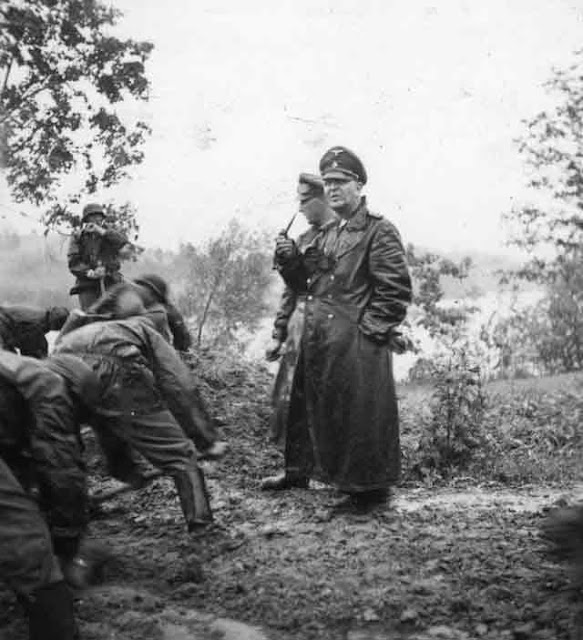
He was a key figure in the development of Nazi concentration camps. Eicke served as the second commandant of the Dachau concentration camp from June 1933 to July 1934, and together with his adjutant Michael Lippert, was one of the executioners of SA Chief Ernst Röhm during the Night of the Long Knives purge of 1934. He continued to expand and develop the concentration camp system as the first Concentration Camps Inspector. In 1939, Eicke became commander of the SS Division Totenkopf of the Waffen-SS, leading the division during the Second World War on the Western and Eastern fronts. Eicke was killed on 26 February 1943, when his plane was shot down during the Third Battle of Kharkov.
Cheated the hangman, but at least he died.
The Luftwaffe has been pounding Leningrad for weeks now as of 23 September 1941. However, the Germans are learning that their medium bombers and Stuka dive bombers are not having much impact. While the bombers are effective for what they were designed — supporting the army — they are ineffective in a strategic role in Russia just as they were against London in 1940.
Part of the problem for the Germans is that Leningrad is simply too large and has too many strong stone buildings. Other problems are the fierce anti-aircraft defenses over the city, which comes from artillery, defending fighters, and the Soviet fleet anchored at Kronstadt. The Luftwaffe has not had much impact against any of these, but today it makes a determined effort against the ships many of which are damaged but whose anti-aircraft and main guns remain in action.
Oblt. Hans-Ulrich Rudel began World War II as an air reconnaissance pilot. Throughout 1940, he basically had a desk job as a regimental adjutant for the 43rd Aviators Training Regiment, based at Vienna. However, in early 1941, he trained as a Junkers Ju-87 Stuka pilot, not the most glamorous of jobs and certainly one of the more dangerous ones in the entire Wehrmacht. To date, Rudel has been flying with Sturzkampfgeschwader 2 (StG 2) and doing a competent job though nothing that has earned him any notoriety. However, it is during this period of attacks against Leningrad that Rudel comes into his own and begins developing the Rudel legend.
On the morning of 23 September, the Stukas attacked the Soviet ships at anchor off Kronstadt, a Soviet base on nearby Kotlin Island. Their biggest success previously, on the 21st, was damaging 23,600-ton Soviet battleship Marat, which now is sitting on the shallow seafloor but remains operative. Rudel flies his Stuka in against the ship today and lands a 1000-kg bomb that falls down through the ship’s funnel and explodes deep inside it. This tears the Marat apart. Rudel’s gunner excitedly tells Rudel, that the “ship is blowing up, you got her.” Rudel thus earns the rare distinction of not only being the war’s top dive-bomber pilot (and, most would agree, the top dive-bomber pilot of all time), but also one who destroys a battleship. Other Stuka pilots sink Soviet 1914 battleship Petropavlovsk at her moorings with two 1000-kg bombs near the forward superstructure. The harbor now is littered with ships that have been sunk or are sinking or have been damaged in previous attacks.
The Luftwaffe is not content with just the morning raid, however. In the afternoon, Rudel and his men return and further damage Soviet cruisers Maksim Gorki and Kirov, which previously suffered damage. In addition, the Stukas attack the dockyards and sink submarines P-2 and M-74. Unfortunately for the Germans, though, this second attack comes at a high price, as the Soviets shoot down Hptm. Steen, Gruppenkommandeur of III./StG 2.
While the Luftwaffe is making progress, the German army units outside Leningrad have been stopped. German 18th Army attacks the Soviet defenders at Pulkovo without success. Having transferred its panzer units south for the drive on Moscow, the Wehrmacht’s Army Group North has lost its cutting edge and no longer has the ability to blast its way through the dug-in Soviet defenders. Some of the Luftwaffe units, such as Rudel’s Stukas, are soon to follow them. The battle already is turning into a siege, but every day that the Soviets hold out keeps the Germans from transferring even more units south for the attack on Moscow.
Soviet submarine M-74 of the Baltic Fleet is sunk by German air attack at Kronstadt.
German troops in France are ordered to send their blankets to their eastern front colleagues.
The German-controlled Croatian Government has executed fifty men described as “Communists and Jews” as “intellectual instigators” of the recent bomb explosions in the Zagreb central telephone exchange, in which a German major, twelve German soldiers and several Croats were wounded, according to dispatches from Zagreb printed in the Italian press today.
German soldiers massacre the population of Krasnaya Gora after partisans kill three German sentries.
The three-day curfew imposed on Paris by the military governor, General Stülpnagel, has now been lifted. He had imposed draconian measures after a spate of attempts by the Resistance to assassinate members of the German occupation forces. Travel has been banned between 9pm and 5am and places of entertainment have been forced to close at 8pm. Those arrested for breaking the curfew are treated as hostages to prevent any further resistance. Last week, the Germans murdered 22 hostages in reprisal for crimes which included the attempted assassination of a Wehrmacht captain.
The German authorities in Paris, France issued a decree that stated that any French man concealing or assisting a British Airman would be shot, and any woman would be sent to a concentration camp.
The formation in London of a French National council to serve as a provisional government was announced by Free French Leader General Charles de Gaulle. He said that it would be up to the United States and other countries to recognize the committee as his country’s government in exile, rather than the German-backed Vichy regime. In fact, de Gaulle retains all authority and merely consults his nine commissioners, who include Admiral Muselier for the navy, Maurice Dejean, a former diplomat, for foreign affairs and Herve Alphand for the economy. Most colorful is Thierry d’Argenlieu, a former naval captain who spent several years a Trappist monk and escaped to England in a small boat disguised as a Norman fisherman.
Cetniks and Tito’s Partisans cooperate in attack on German garrison in Krusevac in Serbia.
Exiled King Zog writes to Allied leaders, petitioning to be recognized as legitimate ruler of Albania and head of the country’s anti-Axis resistance.
Battleship HMS King George V, aircraft carrier HMS Victorious, light cruiser HMS Aurora, and destroyers HMS Somali, HMS Matabele, HMS Bedouin, HMS Eskimo, HMS Ashanti, and HMS Punjabi departed Scapa Flow at 1800 for Hvalfjord where they arrived at 1400/25th for Operation EJ.
Heavy cruiser HMS Suffolk departed the Clyde to return to Scapa Flow, arriving on the 24th.
Light cruiser HMS Penelope departed Hvalfjord on the 23rd and arrived back at Reykjavik on the 29th. The cruiser then proceeded to Hvalfjord.
Soviet battleship Marat was sunk by German bombing at Kronstadt.
Soviet battleship Oktyabrskawa Revolutsia was damaged by German shore guns at Kronstadt.
Soviet destroyer Minsk, under repair at Kronstadt, was bombed and damaged.
Soviet cruiser Maksim Gorki, under repair at Leningrad, was damaged by German bombing. Cruiser Kirov, also repairing at Leningrad, was attacked, but was not damaged.
Minelaying cruiser HMS Latona and destroyers HMS Jervis, HMS Kimberley, and HMS Hasty departed Alexandria for Tobruk on Serial 9 SUPERCHARGE operation. These ships arrived back at Alexandria on the 24th. Also sailing was petrol carrier Pass of Balmaha (758grt), Greek steamer Samos (1208grt), and A 2 and A 9 lighters, carrying tanks, in convoy for Tobruk, escorted by anti-submarine trawler HMS Falk and minesweeping trawler HMS Sotra in Serial 11. The convoy arrived on the 26th.
Destroyer HMS Jupiter arrived at Suez to join the fleet after having proceeded independently from Gibraltar. The destroyer was in need of docking for repair to serious leaks in her oil fuel tanks. The destroyer arrived at Alexandria on the 25th.
Submarine HMS Triumph sank German steamer Luvsee (2373grt) six miles northeast of Sebenico.
Submarine HMS Triumph damaged Italian steamer Poseidone (6613grt) four miles off Ortona on the 24th.
Submarine HMS Thrasher made an unsuccessful attack on a steamer near Benghazi.
Submarine HMS Torbay made an unsuccessful attack on a steamer off Suda Bay.
Italian steamer Carmelo Noli (109grt) was sunk on a mine south of Livorno.
Battleship HMS Prince of Wales and destroyers HMS Laforey, HMS Lightning, and HMS Oribi arrived at Gibraltar from Greenock late on the 23rd. The ships were refueled and departed before daylight to rejoin the WS.11 X convoy.
Destroyers HMS Cossack, HMS Heythrop, and HMS Farndale departed Gibraltar to join convoy WS.11 X at 0800/24th.
Convoy OS.7 departed Liverpool. On the 24th, sloops HMS Folkestone and HMS Weston and corvette HMS Auricula joined the convoy. The sloops were detached on 12 October. The corvette arrived with the convoy at Freetown on 14 October for duty in the South Atlantic. On the 26th, sloop HMS Londonderry and corvette HMS Violet joined the convoy and were detached on 12 October. On 10 October, destroyer HMS Brilliant joined the convoy and on 11 October, corvettes HMS Clover and HMS Cyclamen joined. All arrived with the convoy on 14 October. Corvettes HMS Anchusa, HMS Mignonette, and HMS Woodruff joined the convoy on 14 October outside Freetown.
Convoy ST.4 departed Freetown, escorted by sloop HMS Bridgewater, corvettes HMS Armeria and HMS Calendula, and anti-submarine trawler Copinsay. The convoy arrived at Takoradi on the 28th.
In Washington today, President Roosevelt indicated at a press conference that he was preparing to ask Congress to modify the Neutrality Act to permit the arming of merchant ships. His callers included Secretary Hull, Dr. Jesus Maria Troncoso, Minister from the Dominican Republic, who presented his credentials, and Senators Lucas and Herring.
The Senate was in recess. An Interstate Commerce subcommittee heard Nicholas Schenck on war propaganda in the motion pictures.
The House heard discussion of the Rivers and Harbors Bill and the St. Lawrence project and of foreign policy, and adjourned at 12:52 PM, until noon tomorrow. The Banking and Currency Committee again questioned Leon Henderson on the Price Control Bill.
U.S. President Franklin D. Roosevelt announced the possibility of arming American merchant vessels against German attacks. President Roosevelt revealed today that the United States is preparing to arm American merchant ships and that he will ask congress to clear the way for such a move by either repealing or revising the neutrality law. He said he would decide next week whether to request piecemeal modification or outright repeal of the law which bars arming of American merchantmen and forbids them to enter combat zones. No doubt was left by the President that Congress would be asked soon either to modify or repeal the Neutrality Act so that the arming of merchantmen would be possible. Congressional leaders are working upon a measure to effect this end. Speaking out in his press conference less than twenty-four hours after the State Department had disclosed that the freighter Pink Star, owned by the government, had been sunk between Greenland and Iceland in defiance of his warning to German and Italian raiders to keep out of these defense waters, the Chief Executive made clear that the United States would do everything possible to protect Atlantic shipping and maintain the freedom of the seas.
Mr. Roosevelt disclosed that the Pink Star, which flew the flag of Panama, was armed and was traveling with a Canadian convoy when sunk by a submarine at 11:25 PM, Greenwich mean time (6:25 PM, E.D.T.), Friday. The Pink Star was en route to Iceland, he said, and was sunk 275 miles northeast of Cape Farewell at the southern tip of Greenland.
Secretary Knox, speaking at ceremonies today following the launching of the 35,000-ton battleship Massachusetts seven months ahead of schedule, demanded repeal of our Neutrality Act without delay, asserted that “our Army must be used wherever and whenever it is needed” and warned that the day might come when we should have to fight Hitler on our own soil. After the USS Massachusetts, newest, biggest and most expensive of all the Navy’s ships of the line, had slid into Fore River from the Bethlehem shipbuilding yards, Secretary Knox, speaking extemporaneously, referred to Hitler as “the enemy” and urged that the manacles of the Neutrality Act be stricken from the hands of an America whose own salvation, he said, depends upon the rescue of Britain and those who are fighting with her against the aggressor. Nearly 50,000 spectators thronged the yards as the Secretary declared that the Massachusetts must be ready to aid her sister ships, the Washington and the North Carolina, “to keep the sea lanes clear, to keep war as far away from our shores as possible.”
In a meeting with U.S. Secretary of State Cordell Hull, the Japanese Ambassador to the United States, Admiral Nomura Kichisaburō, urged that a meeting between U.S. President Franklin D. Roosevelt and Premier Konoe Fumimaro take place. “… the holding of a meeting such as suggested would be of great value in counteracting the influence of the pro-Axis elements in the Japanese Government and in providing support for those elements desiring peaceful relations with the United States.”
Opposition to any restriction that would prohibit lend-lease assistance to Russia was reported to have been expressed before a house subcommittee today by Edward R. Stettinius, lend-lease administrator. Before the same group, Secretary of Agriculture Wickard also testified a minimum of $1,000,000,000 would be needed to keep England supplied with food over the next five months. Both spoke in behalf of the new $5,985,000,000 appropriation recently requested by President Roosevelt for the lend-lease program.
Opening the Administration’s drive for the quickest possible enactment of the new $6,000,000,000 lease-lend and defense appropriation, Secretary Wickard told a subcommittee of the Appropriation Committee of the House today that the United States must send $1,000,000,000 of foodstuffs to Great Britain in the next five months or else the latter might lose the war.
The Federal Reserve Board today ordered banks to set aside a larger proportion of deposits in reserve accounts as a step to prevent credit inflation. The increase amounted to about one-seventh and took about $1,200,000,000 of idle bank cash out of accounts where It could be loaned or invested. The board took the action after consulting the treasury. The two agencies issued a statement saying it was part of the general anti-inflation program of the administration which includes a price control bill now pending in congress.
The Duke and Duchess of Windsor reached Miami by chartered plane today on the first leg of a six weeks’ tour of the United States and Canada and were greeted by the cheers of several thousand Miamians. They were met at the airport by leading officials, representatives of the British embassy and the United States State Department and quickly left for an overnight stay in a bay-front hotel.
The famous Norden bombsight, believed to have been this country’s most closely guarded aerial defense secret, figured again in the testimony yesterday at the Brooklyn espionage trial as the government opened its case against Herman Lang, accused with fifteen others of espionage and failure to register as agents of a foreign government.
A special grand jury presented an indictment today against Frank B. Burch, Akron, Ohio, Republican leader, on charges Burch failed to register with the State Department as a secret propaganda agent of the German government. The charge was an outgrowth of a justice department investigation of publishing houses suspected of being financed and controlled by the Nazis. The indictment stated Burch was persuaded by Karl Kopp, German consul at Cleveland, to become a Reich agent. Kopp, it continued, arranged for Burch to be “public relations counsel, agent, representative and attorney for the Berlin government.”
With a majority described by union officials as “overwhelming,” members of the machinists’ union of the American Federation of Labor in secret balloting last night and today authorized a strike against the Consolidated Aircraft Corporation, builder of long-range bombers, which holds defense orders exceeding $750,000,000.
A tropical hurricane hurled winds of 90 and 100 miles an hour against the Texas coast today from Freeport to Matagorda.
Major League Baseball:
Jack Kelly, head of a syndicate to buy the Phillies, drops his plans. The group’s reported $500,000 offer was turned down by Gerry Nugent. National League prexy Ford Frick says he is powerless to intervene.
Taking advantage of a jittery defense that committed four errors, the Cubs routed Johnny Vander Meer in a four-run second inning today and went on to defeat the Reds, 5 to 1, behind Bill Lee’s eight-hit hurling.
A triple by Eddie Collins, Jr, triggers a 2-run 9th inning rally as the A’s beat the Yankees, 9–8. Red Ruffing takes the loss, despite hitting a homer, triple and single and driving in 3 runs. Four errors by New York, three by Joe Gordon, help the A’s. DiMaggio homers and has 2 RBI in his RBI race with idle Charlie Keller. Bill Dickey plays 4 innings to set a Major League record of catching 100 games in each of 13 seasons, breaking the record of 12 set by Hartnett and Schalk.
The Giants, who have been throwing recruit pitchers at the opposition for the past two weeks, were up against a pair of new Phillie hurlers today themselves, and split even, dropping the first game, 8–2, and then winning, 8–6. Paul Masterson, fresh from Allentown, in the Interstate League, found himself ahead, 4–0, when the Phillies pounded Cliff Melton for four runs in the first inning of the opener and hugged his advan tage doggedly, pitching a seven-hit, full route victory in his major league debut.
With the Dodgers idle, the Cardinals lose the critical opener of two to the Pirates, dropping St. Louis two games back. Pirate hurler Ken Heintzelman allows just 6 hits. The Birds win the nightcap, 9–0, as Stan Musial has three hits, including his first homer, off Luke Sewell.
The Tigers staged a rally in the tenth inning today to defeat the Browns, 4-1, and move from a fourth-place deadlock with the idle Indians into a third-place tie with the White Sox. The loss, meantime, buried the Brownies a full notch deeper in seventh place.
A two-run uprising in the ninth brought Washington a 4–3 decision over Boston today for the Senators’ sixth straight victory. Pinch-Hitter Buddy Lewis drew a walk to open the final frame and went to second when George Case walked. Roger Cramer drove a single to left center, scoring Lewis, and Case raced home with the winning run when Dom DiMaggio fumbled in fielding the ball.
Chicago Cubs 5, Cincinnati Reds 1
Philadelphia Athletics 9, New York Yankees 8
New York Giants 2, Philadelphia Phillies 8
New York Giants 8, Philadelphia Phillies 6
St. Louis Cardinals 0, Pittsburgh Pirates 4
St. Louis Cardinals 9, Pittsburgh Pirates 0
Detroit Tigers 4, St. Louis Browns 1
Boston Red Sox 3, Washington Senators 4
Warning of the danger of a two-ocean attack by Germany and Japan against the United States and Canada if the Nazis conquer Russia and Great Britain, Premier Mitchell F. Hepburn of Ontario last night denounced strikes in war industries as disloyal and called for drastic measures against radical agitators who promote them.
Soldiers guarding the home of Mexican President Manuel Avila Camacho at Chapultepec Heights fired on a crowd representing the Union of Munition Workers this afternoon, killing eight and wounding twenty-four, according to reports from hospitals.
Argentine troops occupied the nation’s two most important military airdromes today and were reported moving fast into all the air bases in the country to forestall any surprise move by Nazi conspirators.
British troopship Stirling Castle departed Bombay with 1650 personnel. The troopship was escorted by light cruiser HMS Emerald to 5-26N, 80-59E, then by light cruiser HMS Glasgow to 6-05N, 93E. Light cruiser HMS Dauntless escorted the troopship on to Singapore, arriving on the 29th.
The following message is sent from the Japanese Embassy in Buenos Aires to the Japanese Embassy in Panama: “When (Japanese) Minister (to Chile) Yamagata was in Panama he was asked by the Italian Minister there to deliver some maps and charts of the Panama Canal Zone for him, which he did. Since then, we had Usui go to Chile to take charge of those maps and upon their arrival here they are delivered to the Italian Ambassador. At the same time, we requested that we be given copies of them.”
Japanese 11th Army advancing toward Changsha against minimal opposition.
More than 100,000 Japanese troops and scores of bombers are battering against Chinese positions about fifty miles north of Changsha, Hunan Province, in thus far indecisive fighting. Chinese dispatches said today.
Changsha was under alarm all day yesterday as Japanese warplanes roared overhead through a steady rain, bombing scattered parts of the province. Changsha itself was not bombed, but Liuyang, highway center, fifty miles to the east, was raided three times.
The Japanese Army in China announced today. capture of the tungsten-producing railroad town of Toishan, chief city of the West River delta, west of Hong Kong. Chinese dispatches assert that the Japanese have been repulsed north of Canton, but they acknowledge heavy fighting in the West River area.
Imperial Japanese Navy battleship HIJMS Mutsu operates off Murozumi.
Dow Jones Industrial Average: 128.03 (+0.39)
Born:
Bob Vogel, NFL tackle (NFL champions, 1968, 1970-Colts; lost Super Bowl III; Super Bowl V champions-Colts, 1970; Pro Bowl, 1964, 1965, 1967, 1968, 1971; Baltimore Colts), in Columbus, Ohio.
George Jackson, American criminal, author, and Black Guerrilla Family gang founder, born in Chicago, Illinois (d. 1971).
Naval Construction:
The U.S. Navy YMS-1-class auxiliary motor minesweeper USS YMS-61 is laid down by the Gibbs Gas Engine Co. (Jacksonville, Florida, U.S.A.).
The U.S. Navy SC-497-class submarine chasers USS PC-646 (later SC-646) and USS PC-647 (later SC-647) are laid down by the Robinson Marine Construction. Co. (Benton Harbor, Michigan, U.S.A.).
The Kriegsmarine (German Navy) Type VIIC U-boat U-634 is laid down by Blohm & Voss, Hamburg (werk 610).
The Royal Navy LCT (Mk 2)-class landing craft, tank HMS LCT 125 is launched by Tees-Side Bridge (Middlesbrough, U.K.).
The Royal Navy LCT (Mk 2)-class landing craft, tank HMS LCT 147 is launched by Stockton Construction (Thornaby, U.K.).
The Royal Navy MMS I-class motor minesweeper HMS MMS 60 (J 560) is launched by J & G Forbes & Co. Ltd. (Sandhaven, England, U.K.).
The Royal Navy MMS I-class motor minesweeper HMS MMS 139 (J 639) is launched by Frank Curtis (Par, England, U.K.).
The Royal New Zealand Navy minesweeping trawler HMNZS Manuka (T 401), lead ship of her class of 12, is launched by Senior Foundry (Auckland, New Zealand); completed by Muir & Houston, Glasgow, Scotland, U.K.)
The Kriegsmarine (German Navy) Type XB U-boat U-118 is launched by F. Krupp Germaniawerft AG, Kiel (werk 617).
The Kriegsmarine (German Navy) Type VIIC U-boat U-409 is launched by Danziger Werft AG, Danzig (werk 110).
The Royal Navy Flower-class corvette HMS Nettle (K 212) is launched by Alexander Hall & Co. Ltd. (Aberdeen, Scotland). She is renamed HMS Hyderabad (K 212) before commissioning.
The Royal Canadian Navy Tribal-class destroyer HMCS Iroquois (G 89) is launched by Vickers Armstrong (Newcastle-on-Tyne, U.K.); completed by Parsons.
The U.S. Navy Gleaves-class destroyer USS Macomb (DD-458) is launched by the Bath Iron Works (Bath, Maine, U.S.A.).
The U.S. Navy South Dakota-class battleship USS Massachusetts (BB-59) is launched by the Bethlehem Shipbuilding Corp. (Quincy, Massachusetts, U.S.A.).
The Royal Navy Bangor-class (Reciprocating-engined) minesweeper HMS Fraserburgh (J 124) is commissioned. Her first commanding officer is Lieutenant Commander (retired) George Walter Alexander Thomas Irvine, RNR.
The Royal Canadian Navy Bangor-class (VTE Reciprocating-engined) minesweeper HMCS Georgian (J 144) is commissioned. Her first commanding officer is Lieutenant Alfred George Stanley, RCNR.
The U.S. Navy patrol yacht USS Ruby (PY-21) [ex-Placida] is commissioned.
The Royal Australian Navy Bathurst-class minesweeper-corvette HMAS Warrnambool (J 202) is commissioned. Her first commanding officer is T/Lieutenant Eric John Barron, RANR(S).

