Hitler issues Führer Directive No. 36 regarding operations in the far north (Karelia):
The Führer And Supreme Commander of the Armed Forces.
The Führer’s Headquarters. 22nd September, 1941. 12 copies
Directive No. 36
I. Owing to unusual difficulties of the terrain, defective lines of communications, and the continual arrival of Russian reinforcements in Karelia and Lapland, the weak forces of Army High Command Norway and 5th Air Fleet have not so far succeeded, in spite of immense efforts and the bravest actions, in reaching the Murmansk railway. The interruption by the enemy of our sea communications along the Arctic coast has still further reduced the likelihood that the Mountain Corps will reach Murmansk this year.
We have, however, succeeded in tying down strong enemy forces and in drawing them away from the main Russian front, in driving back the enemy across the former Finnish frontier at all points, and in eliminating, so far, all threats to northern Finland, and above all to the nickel mines.
II. The ultimate aim of our operations in northern and central Finland remains constant. It is to destroy the enemy forces around Murmansk and along the Murmansk railway.
The importance of this area lies in the nickel mines which are vital for the German war effort. The enemy realises this importance. It is likely that the English will deploy strong air forces around Murmansk and Kandalaksha, and may perhaps even commit Canadian or Norwegian troops there, and that they will send as much war material as possible to Murmansk. We must expect air attacks, even in winter, against the nickel mines and the homes of the miners. Our own efforts must correspond with the greatness of this danger.
III. I therefore order as follows:
- Army High Command Norway:
(a) The attacks in the sector of III (Finnish) Army Corps will be halted and the forces thus released transferred to XXXVI Army Corps.
(b) All preparations are to be made by XXXVI Army Corps for resumption of the attack towards Kandalaksha in the first half of October with the aim of at least cutting Murmansk off from its rail communications by the time winter sets in. Moreover, the question whether the continuation of this attack in the winter will have greater prospects of success than in the autumn is to be considered.
The Finnish High Command will be requested to transfer 163rd Division, by rail via Rovaniemi, to the High Command of the Army at the proper time.
(c) The offensive of the Mountain Corps towards Murmansk is to be halted for the time being, and the northern flank will advance only so far as is required to improve the position and to mislead the enemy. On the other hand it is necessary, in the light of the tasks assigned to the Navy, at least to occupy the western end of the Fisherman’s Peninsula before the beginning of the winter and thereby to prevent the enemy from hampering access to the port of Liinahamari by artillery and motor torpedo boats.
The collection of intelligence and planning for this attack will begin at once, and the result will be reported as soon as possible. Special weapons suitable for use against targets on land and at sea, which are still lacking, will be provided.
Whether the plan of Army High Command Norway for the winter can be carried out can only be decided later. This plan is to leave two reinforced Mountain Divisions in the Petsamo area, and to allow 2nd Mountain Division to rest in the Rovaniemi area. If possible this will be done. It is also planned to relieve 3rd Mountain Division by 5th Mountain Division or by a newly raised Mountain Division.
(d) Numbers of lorries will be bought or hired in Sweden in order to shift the supply route of the Mountain Corps to the Arctic Highway. If this transport is not sufficient, reinforcements will be brought from home.
(e) I have instructed Reichsminister Dr. Todt to construct a field railway from Rovaniemi along the Arctic Highway to Petsamo by the ruthless employment of Russian prisoners of war.
For the resumption of the attack on Murmansk, all modern weapons suitable for use in the tundra will be supplied.
- Navy:
It is the task of the Navy to attack enemy supplies moving to Murmansk even in winter, and particularly at times when air operations are more or less crippled.
For this purpose a suitable subsidiary base for light naval forces will be established — preferably in Petsamo Bay — in case we succeed in capturing the western part of the Fisherman’s Peninsula. The flow of supplies by sea to Kirkenes and Petsamo, even should it be interrupted for a time, must be constantly attempted.
Coastal defenses in the bays of Petsamo and Kirkenes will be strengthened so that they are capable of meeting attacks even by heavy enemy ships.
- Air Force:
It is of decisive importance that 5th Air Fleet should remain in northern Norway with strong forces suitable for action in winter.
These forces are to be large enough to give effective support to the attack on Kandalaksha and the capture of the western part of the Fisherman’s Peninsula up to the beginning of the bad weather. Meanwhile it is necessary to make continuous attacks on the enemy’s shipping and rear communications as well as his supply and equipment depots.
These attacks are to be continued throughout the period of bad weather whenever opportunity offers, and to be extended particularly to shipping and bases under construction.
Airforce ground establishments must therefore remain, as far as possible, in northern Norway and Finland and must be protected against the winter by all possible means.
Protection against enemy air attack of our own camps and communications and, above all, of the nickel mines and the naval base which is to be established must be ensured.
Ground organizations and supplies will be increased so that, when the time comes, the resumption of the attack on Murmansk can be supported by considerably stronger air forces than hitherto.
Signed,
Adolf Hitler.
Throughout the early part of World War II, when he still has the initiative, Adolf Hitler issues a string of commands that are only seen by a carefully chosen handful of top generals (with top secrecy, including numbered copies). On 22 September 1941, Hitler issues Führer Directive 36, which is devoted to the northernmost areas of the Eastern Front. This directive offers great insight into the critical importance that economic factors play in military operations during World War II.
Führer Directive 36 is not particularly well known, but there are several interesting aspects to it. It begins off with an unusual tone, one that admits failure at a time when everything supposedly is going well for the Wehrmacht:
“Owing to unusual difficulties of the terrain, defective lines of communications, and the continual arrival of Russian reinforcements in Karelia and Lapland, the weak forces of Army High Command Norway and 5th Air Fleet have not so far succeeded, in spite of immense efforts and the bravest actions, in reaching the Murmansk railway. The interruption by the enemy of our sea communications along the Arctic coast has still further reduced the likelihood that the Mountain Corps will reach Murmansk this year.”
When one reads this, it is clear that Hitler at least is being honest about the desultory state of operations in northern Norway, an area usually overlooked in histories of the war. After a quick initial advance, the Wehrmacht stopped completely in northern Norway instead of advancing further to cut off Allied access to the ports at the end of the Murmansk railway line.
When many students of World War II think of northern Norway, they quickly see its importance to the war as being its proximity to the Allied convoys bringing supplies to the Soviets at Murmansk. However, Hitler takes a completely different view of the region’s importance which offers some insight into how he views the overall strategy. As Hitler’s directive puts it:
“The importance of this area lies in the nickel mines which are vital for the German war effort. The enemy realizes this importance. It is likely that the English will deploy strong air forces around Murmansk and Kandalaksha, and may perhaps even commit Canadian or Norwegian troops there, and that they will send as much war material as possible to Murmansk. We must expect air attacks, even in winter, against the nickel mines and the homes of the miners. Our own efforts must correspond with the greatness of this danger.”
As so often during World War II, Hitler is right about an issue, but for the completely wrong reasons. Another example of this includes Hitler’s decision never again to use airborne forces for major operations due to the heavy losses at Crete — which, unknown to Hitler, were due to the Allies reading his military codes, not some inherent defect in that form of warfare as he supposed.
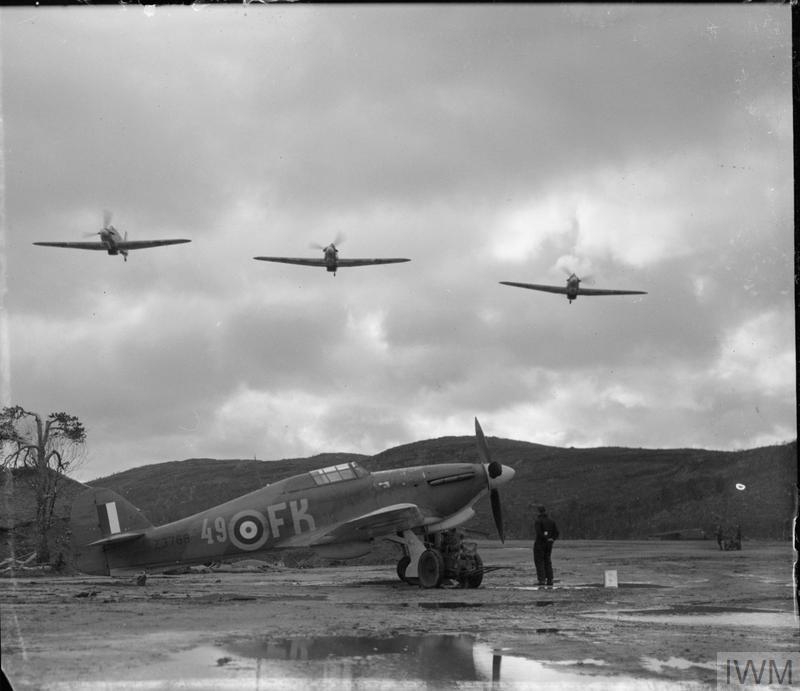
In the case of Northern Norway, the British do, in fact, send some troops to the area, one of the very few instances of direct cooperation between British and Soviet forces during the war. RAF Squadron Nos. 134 and 151 operate out of the Kola Peninsula near Murmansk. However, their presence there has nothing to do with the Kolosjoki nickel mines in Petsamo. Instead, the RAF pilots are there simply to protect the Allied convoys coming from the British Isles to Murmansk. It’s not clear that the British gave even the slightest thought to the nickel deposits there.
Given that Hitler doesn’t see Murmansk as being of particular importance since it doesn’t have anything to do with German control of the nickel deposits near Petsamo, it’s not surprising to see him order in the directive:
“The offensive of the Mountain Corps towards Murmansk is to be halted for the time being, and the northern flank will advance only so far as is required to improve the position and to mislead the enemy.”
However, almost as an afterthought, Hitler does order the Navy in an offhand fashion to “attack enemy supplies moving to Murmansk even in Winter.” The Luftwaffe also is ordered to remain active throughout the winter, but the emphasis is not on the Allied convoys — instead, it is to “give effective support to the attack on Kandalakssha.” As with the navy, the directive mentions after this that the air force is to “make continuous attacks on the enemy’s shipping and rear communications.” However, no particular importance is placed on the Allied convoys already starting to run right under the German troops’ noses next to Northern Norway.
Taken as a whole, Führer Directive 36 is full of misunderstandings and misappreciations. The nickel may be important to the German war machine, but the Allies couldn’t care less about it at this point. Instead, they are only worried about the all-important convoys bringing vital equipment and supplies to the northern Soviet ports. The result is that the Germans defend areas that aren’t really threatened, while they miss the opportunity to hit the Allies at a true weak spot. Partly this has to do with Hitler’s obsession with “economic factors,” as he likes to call them.
Another, more basic, reason for this error is that Hitler is simply more comfortable with land operations and gives little thought to what is going on just offshore. The Allies, on the other hand, don’t give much thought at this time (or really later, either) to German vulnerabilities on land. It is a classic example of two opposing forces fighting completely different battles in the same area, both accomplishing their objectives in part because the other side is looking in a completely different direction.
Soviet forces in the Ukraine begin a head long retreat to the east as they regroup after the defeat at Kiev. Counter attacks are canceled and the new line will be Kharkov-Rostov.
“Russian Tank Week” began in the United Kingdom. From this day through September 26, all armored vehicles produced in Britain were to be delivered to the Soviets.
German Stuka dive bombers damaged Soviet destroyer Bezuprechny at 1300 hours, destroyer Besposhchadny at 1630 hours, and destroyer Boyki in the Black Sea off Odessa, Ukraine.
The German government tells Bulgaria to enter war or be occupied.
British cruiser HMS London departed Scapa Flow, Scotland, United Kingdom with Lord Beaverbrook and Averell Harriman aboard for Archangel, Russia for Lend-Lease discussions. She was escorted by Soviet and British destroyers.
The Jager Report (issued on 1 December 1941) noted that 512 adult male, 744 adult female, and 511 children, all Jews, were killed in Riess, Lithuania for a total of 1,767 people.
Thirty-five provisions on the required wearing of the Star of David by Jews have been communicated to the Jewish Central Council in Berlin to clear up uncertainties as to when and how the star, first required last Friday, must be displayed. The Jews were informed it must be worn where it may be seen every moment a Jew is outside his own home. It is not sufficient to have a star affixed to a coat or topcoat. If a Jew steps into his yard in his shirtsleeves, he must have a star on his shirt. If a Gentile rings his doorbell, the Jew must wear the star when he opens the door. Jews who hide the star by covering it with a briefcase or shopping bag in the streets may be sent to concentration camps. [Usually reliable sources said a sentence to a concentration camp was the standard punishment for violation of these regulations, The United Press reported. Parents and guardians were said to be liable to punishment for violations by children.]
At Vinnitsa, a squad of SS-trained Ukrainian militia helps the SS to kill 28,000 Jews. Mobile killing squads of the Nazi SS, specifically Einsatzkommando units under Einsatzgruppe D/C, directed the primary operations. German forces were supported by local auxiliary police and militia units trained or commanded by SS personnel during the open-air executions. Einsatzgruppe C, under the command of Dr. Emil Otto Rasch, consisted of 1,000 men and traveled eastwards through Ukraine along with the advance of the German Army. During the first weeks of the campaign, with the help of the Ukrainians its members murdered Jewish men in the towns and villages of Tarnopol, Dobromil, Sambor, Vinnitsa, Zhitomir, Beila-Tcharkov, Boguslav, Babi Yar, Uman, Lubny and others. Wehrmacht officer Lieutenant Erwin Bingel had been ordered to assist the Commandant of Uman district with men to guard the railway lines and around the airport.
He was aware that ditches had been dug on the perimeter of the airfield and a number of specialist SS men had arrived by plane. All the Jews of the area had been ordered to gather for a “census”. On 22 September 1941 Lieutenant Bingel and his men witnessed a second massacre in Vinnitsa. This was followed by a third, also in Vinnitsa, carried out by Ukrainian militia who had been trained by the SS, and were commanded by a small group of SS officers and NCO’s. In the first two massacres, Bingel calculated the first (on September 16) twenty-four thousand and then twenty-eight thousand Jews were killed. In the third, Ukrainian militia killings, six thousand were murdered.
Bingel recalled later:
“In the morning at 10.15, wild shooting and terrible human cries reached our ears. At first, I failed to grasp what was taking place, but when I approached the window from which I had a broad view over the whole of the town park, the following spectacle unfolded before my eyes and those of my men, who, alerted by the tumult, had meanwhile gathered in my room.
“Ukrainian militia on horseback, armed with pistols, rifles and long straight cavalry swords, were riding wildly inside and around the town park.
“As far as we could make out, they were driving people along before their horses – men, women, and children. A shower of bullets was then fired at this human mass. Those not hit outright were struck down with the swords.
“Like some ghostly apparition, this horde of Ukrainians, let loose and commanded by SS officers, trampled savagely over human bodies, ruthlessly killing innocent children, mothers, and old people whose only crime was that they had escaped the great mass murder, so as eventually to be shot or beaten to death like wild animals.
“The result of this proclamation was, of course, that all persons concerned appeared as ordered. This relatively harmless summons, it was thought, could be connected in some way or other with the preparations we were observing.
“It was because we took the matter so lightly that we were all the more horrified at what we witnessed during the next few hours.
“One row of Jews was ordered to move forward and was then allocated to the different tables where they had to undress completely and hand over everything they wore and carried.
“Some still carried jewelry which they had to put on the table. Then having taken off all their clothes, they were made to stand in line in front of the ditches, irrespective of their sex.
“The commandos then marched in behind the line and began to perform the inhuman acts, the horror of which is now known to the whole world.
“With automatic pistols and 0.8 pistols, these men mowed down the line with such zealous intent that one could have supposed this activity to have been their life work.
“The people in the first row thus having been killed in the most inhuman manner, those of the second row were now ordered to step forward.
“The men in this row were ordered to step out and were handed shovels with which to heap chloride of lime upon the still partly moving bodies in the ditch. Thereafter they returned to the tables and undressed.
“After that, they had to set out on the same last walk as their murdered brethren…”
Friedrich-Wilhelm Müller was awarded the Knight’s Cross of the Iron Cross.
Norwegian Ambassador J. W. Michelet presents the Finnish Foreign Minister Rolf Witting a British note, stating that if Finland doesn’t withdraw its forces behind the pre-1939 borders, His Majesty’s Government is forced to consider Finland an enemy. Even if Finns comply, diplomatic relations won’t be restored and blockade lifted as long as there are German troops in Finnish territory.
British minelaying cruiser HMS Abdiel and destroyers HMS Kandahar, HMS Jaguar, and HMS Griffin departed Alexandria, Egypt with supplies for Tobruk, Libya. They would arrive overnight and return on the following day.
King George II of Greece arrived in exile in England from Egypt with members of his family and government.
RAF Bomber Command, Day of 22 September 1941
24 Blenheims and 6 Hampdens; all were recalled.
RAF Bomber Command, Night of 22/23 September 1941
3 Wellingtons to Boulogne. No losses.
U-68, commanded by Korvettenkapitän Karl-Friedrich Merten, badly damaged British steamer Silverbelle (5302grt) at 25-45N, 24W. Between 0222 and 0224 hours on 22 September 1941, U-68 fired four torpedoes at the convoy SL.87 southwest of the Canary Islands and saw two hits on the first ship, causing a boiler explosion, a column of fire on a second ship following a small detonation and a hit on a tanker. However, the only ship hit was the Silverbelle (Master Hilon Rowe), which was taken in tow by FFL Commandant Duboc. The U-boat spotted the vessel with a heavy list being supported by two escorts the next day and fired two spreads of two torpedoes at her at 0322 and 0415 hours, but missed in both attacks and had to give up because they had no torpedoes left under deck. On 29 September, the Silverbelle had to be cut loose southwest of the Canary Islands and sank in 26°30N/23°14W. The master, 47 crew members, seven gunners and five passengers (among them two DBS) were picked up by the French escort and landed at Freetown. The 5,302-ton Silverbelle was carrying phosphate and general cargo, including palm oil, copper and cocoa beans and was headed for Liverpool, England.
U-103, commanded by Kapitänleutnant Werner Winter, sank British steamer Niceto de Larrinaga (5591grt) at 27-32N, 24-26W and British steamer Edward Blyden (5003grt) at 27-36N, 24-29W. At 2346 hours on 22 September 1941, U-103 fired four bow torpedoes at the convoy SL.87 southwest of the Canary Islands, turned around and fired two stern torpedoes at 2347 hours. They observed a ship capsizing after a small explosion and two other ships going down by their sterns after two further explosions. The fourth torpedo was a shallow hit causing a large column of water and the fifth exploded with a blue-green flash. Winter thought that four ships were sunk and another damaged. However, the Edward Blyden and Niceto de Larrinaga were each hit by two torpedoes.
One passenger (DBS) from the Niceto de Larrinaga (Master Frederick Moulton Milnes) was lost. The master, 41 crew members, five gunners and three passengers (DBS) were rescued, but one crew member and one gunner died of injuries. Eleven survivors were picked up by HMS Gardenia (K 99) (LtCdr H. Hill, RNR) and landed at the Azores. The remaining survivors were picked up by HMS Lulworth (Y 60) (LtCdr C. Gwinner, RN) and landed at Londonderry on 4 October. The 5,591-ton Niceto de Larrinaga was carrying palm kernels, manganese ore, groundnuts, and general cargo and was headed for London, England.
The master, 46 crew members, four gunners and 12 passengers from the Edward Blyden (Master William Exley) were picked up by HMS Bideford (L 43) (LtCdr W.J. Moore, RNR) and landed at Londonderry on 5 October. The 5,003-ton Edward Blyden was carrying general cargo and was headed for Liverpool, England.
The attack on convoy SL.87 continues on the 24th.
On the 24th, U-67 sank British steamer HMCS St. Clair II (3753grt) in 30-25N, 23-35W. Twelve crewmen and one gunner were lost on steamer HMCS St. Clair.
On the 24th, U-107 sank British steamers John Holt (4975grt, Convoy Commodore) and Lafian (4876grt) in 31-12N, 23-32W and British steamer Dixcove (3790grt) in 31-13N, 23-41W. One gunner was lost on steamer John Holt. There were no casualties on steamer Lafian. One crewman was lost on steamer Dixcove.
After three nights of attacks, only four ships of the eleven ship convoy remained.
U-562, commanded by Oberleutnant zur See Horst Hamm, sank British steamer Erna III (1590grt) in 61-45N, 35-15W. At 0244 hours on 22 September 1941 the unescorted Erna III (Master Knud Christian Sørensen) was hit amidships by one G7e torpedo from U-562 and sank by the bow within 14 minutes about 275 miles east-northeast of Cape Farewell. The U-boat had first sighted the ship about 18 hours earlier and had to overtake it three times after missing with a spread of two G7e torpedoes at 1545 hours on 21 September and one G7e torpedo at 0106 hours on 22 September. The fourth torpedo eventually struck after a running time of just 18 seconds respectively a distance of only 270 meters. The Germans observed that two lifeboats were launched, but did not question the survivors who were never found: the master, 22 crew members and four gunners were lost. The Erna III was reported missing after straggling from station #12 in convoy ON-16 due to heavy weather on 21 September and was presumed lost about 25 September. The 1,590-ton Erna III was carrying ballast and was headed for Montreal, Canada.
Destroyer HMS Badsworth departed Scapa Flow at 0715 for Scrabster with the Captain of the Fleet and returned at 1045 with the officers taking passage to Murmansk in heavy cruiser HMS London. Heavy cruiser London departed Scapa Flow to take the Anglo American supply mission to Archangel, arriving at 1600/27th.
Minelaying cruiser HMS Welshman laid minefield SN.23C.
Destroyers HMS Lamerton and HMS Badsworth departed Scapa Flow at 1730 after working up exercises to join the Western Approaches. Destroyer Lamerton arrived at Liverpool at 1100/24th. Destroyer Badsworth was ordered at 1918 to proceed to Iceland and after refueling join convoy HX.150. Destroyer Badsworth arrived at Hvalfjord on the 24th. After refueling, the destroyer departed at 1700 to join convoy HX.150.
Destroyer HMS Lancaster departed Scapa Flow at 1900 on completion of exercises to rejoin Rear Admiral Minelaying at Loch Alsh, arriving at 0630/23rd.
Norwegian motor torpedo boat MTB.56 departed Harwich at 1100 for Scapa Flow, via the Tyne and Aberdeen. The motor torpedo boat arrived at Scapa Flow on the 25th.
Motor launch ML.144 was lost in a mining in the English Channel.
Dutch steamer Vechtstroom (845grt) was sunk by German bombing two miles east by north of 62 C Buoy. The entire crew was rescued.
Light cruisers HMS Kenya and HMS Euryalus, which had departed convoy WS.11 X on the 21st, arrived at Gibraltar at 2300. The cruisers refueled and departed on the 23rd before daylight to rejoin the convoy. The flag of CS.10 was transferred from light cruiser HMS Sheffield to light cruiser Kenya.
Minelaying cruiser HMS Abdiel and destroyers HMS Kandahar, HMS Jaguar, and HMS Griffin departed Alexandria for Tobruk on Serial 8 of the SUPERCHARGE operation. Light cruisers HMS Ajax, HMS Neptune, and HMAS Hobart departed Alexandria to cover the destroyers and rendezvous with minelaying cruiser Abdiel at daylight on the 23rd. All ships involved arrived back at Alexandria on the 23rd.
Returning to Hal Far after searching for merchant ships between Kuriat and Pantellaria, T/Lt (A) L. F. E. Aldridge RNVR, was killed and his gunner Leading Airman K. Pimlott died in hospital from injuries when their Swordfish of 830 Squadron crashed and exploded on landing.
Sub Lt R. G. Drake was lost in a captured He.115 flown by a Free French crew, which crashed shortly after takeoff from Malta. The two French crewmen were lost as well.
Submarine HMS Clyde departed Gibraltar for a patrol in the vicinity of the Canary Islands and then to proceed to Freetown. On the 25th, she was ordered to patrol in Cape Verde Islands, as German submarines were suspected of using Tarafa Bay.
Italian destroyers Corazziere, Ascari, Carabiniere, and Lanciere laid mines southeast of Malta escorted by destroyers Aviere and Camicia Nera.
Convoy SL.87, escorted by sloop HMS Bideford, cutter HMS Gorleson, corvette HMS Gardenia, and French sloop Commandant Duboc, was sighted by German submarines.
Convoy HX.151 departed Halifax, escorted by destroyer HMCS Annapolis. The destroyer was detached on the 24th when relieved by American destroyers USS Decatur, USS Kearney, USS Livermore, and USS Plunkett. The American group was relieved on 1 October by destroyers HMS Beagle, HMS Montgomery, HMS Roxborough, and HMS Salisbury, corvettes HMS Heather, HMS Lobelia, and HMS Narcissus, and anti-submarine trawlers HMS Norwich City and HMS St. Loman. Destroyers Beagle and Salisbury were detached on 4 October. Destroyer Roxborough and corvettes Heather, Lobelia, and Narcissus were detached on the 5th and destroyer Montgomery on 6 October. The convoy arrived at Liverpool on 7 October.
In Washington today, President Roosevelt returned from Hyde Park and conferred with Vice President Wallace and Congressional leaders, later sending to Congress Budget Bureau estimates calling for $150,198,874 additional defense appropriations. He received from Secretary Stimson and General George C. Marshall, Chief of Staff, reports on the Army maneuvers and conferred with Secretary Hull.
The Senate met and adjourned at 12:18 P. M. until noon on Thursday.
The House heard Representative Fish discuss foreign policy and adjourned at 1:40 P. M. until noon tomorrow. The Banking and Currency Committee continued hearings on the Price Control Bill.
At a legislative strategy conference held soon after he returned today from Hyde Park, President Roosevelt received assurances from Democratic Congressional leaders of the speediest possible passage of the $5,985,000,000 lend-lease appropriation. They agreed, furthermore, to tie to this measure a deficiency bill carrying about $100,000,000 in defense items. Both of these measures were necessary, the President told his conferees, to keep aid moving to nations fighting the Axis. A few hours later the President sent to the Capitol estimates of the budget bureau calling for $150,198,874 additional for defense, including $120,996,000 for naval ordnance. At the White House conference were Vice President Wallace, Speaker Rayburn, Senator Connally, chairman of the Foreign Relations Committee; Senator McKellar, ranking majority member of the Appropriations Committee; Representative McCormack, floor leader; Representative Cannon, new chairman, and Representative Woodrum, ranking majority member of the Appropriations Committee.
While President Roosevelt conferred with advisors on accelerating American assistance to nations fighting the axis, Secretary of State Hull indicated today he thought the time had come to lift neutrality act restrictions. Already modified by repeal, in 1939, of its rigid embargo on sale of arms to belligerents, the act still forbids arming merchant ships, prohibits them from combat zones, and requires belligerents to take title to implements of war obtained in the United States before such implements are shipped. Hull declined any prediction as to whether congress soon would repeal or modify the act. He commented at his press conference both he and President Roosevelt had criticized the neutrality act from the start as a measure more likely to get this country Into war than to keep it out.
William S. Knudsen, Director General of the Office of Production Management, predicted today that longer working hours and a lower standard of living were just ahead for America under the national rearmament program. Mr. Knudsen spoke before 1,400 business men and civic leaders at the Union League Club. They comprised the largest audience to gather for one speaker in the club’s sixty-two years of history. The address was considered by some as Mr. Knudsen’s strongest public utterance since he was named head of the OPM. He made an indirect reference to Führer Hitler’s world-circling ambitions, America’s role in stopping him and stressed that speed is vital. He added that “war is like a drunken party; you never know what will happen next.” “When millions of lives are lost and tens of millions of lives are ruined because of an insane ambition to get everything everywhere under one thumb, then I think it is up to us to help stop it,” he said. “It is up to us, and now I mean all of us, to get behind the President and our government and see this job through, regardless of the sacrifices we have to make in our comfortable standards of living.”
Eleanor Roosevelt, the First Lady of the United States, was appointed assistant director of the Office of Civilian Defense.
The United States is working on an armament program that will reach a total of more than $66,000,000,000 if the request for a new lend-lease appropriation is approved by Congress in its present form, according to Office of Production Management figures disclosed today.
Navy Secretary Knox, appealing for speed in every defense operation, told 12,000 United Aircraft Workers today that “it is hard for you to realize that American sailormen are today at sea fighting dictatorships.
Representative Fish, New York Republican, said tonight he would propose to congress next week a resolution calling for an immediate declaration of war against Germany and predicted the house would defeat it “more than 2 to 1.” “But I think it’s time for the congress to act and there can be no unity in this country until such a vote is taken,” he declared. “The American people are opposed to an undeclared war. Congress has the responsibility and the issue should be settled. The house will vote down the resolution by more than 2 to 1.”
United States Senator Gerald P. Nye, addressing an America First rally in the Brooklyn Academy of Music with 500 policemen on guard against disorder, charged last night that he and other non-interventionists were being “smeared” with the issue of anti-Semitism.
A high official of the Civil Aeronautics Administration testified yesterday at the Brooklyn espionage trial that he had been approached in the Spring of 1940 with a request to furnish information on United States airplane shipments to the Allies to members of an alleged German spy ring.
That President Roosevelt’s foreign and defense policies will be endorsed at the fourth annual convention of the Congress of Industrial Organizations was the expectation reported here today following a conference of C.I.O. division chiefs with President Philip Murray.
A call for immediate settlement of the A.F. of L. seamen’s strike that has tied up twenty-three ships in United States ports was issued from Washington last night by the Maritime Commission as members of the Seafarers International Union met in fourteen cities to discuss a general strike.
A new system of gas rationing for October for the seventeen Eastern States, where the government says a shortage exists, has been suggested to the Petroleum Coordinator’s office in Washington by the Eastern Petroleum Marketing Committee, it was learned yesterday.
Authorizations designed to improve the oil and gas situation in the Eastern States, and to prevent development of a shortage of supplies on the Pacific Coast in consequence of the diversion of tankers to transport aviation gasoline to Russia, were issued today by Secretary Ickes.
Army air corps officers announced tonight the wreckage of a twin-motored bomber, in which six men vanished before dawn 13 days ago, had been sighted on a rugged Olympic peninsula peak, and a few hours later reported the crash of a training plane that had been engaged in the far-flung search for the bomber. Two men in the training plane escaped without serious injury.
A Gulf storm, with winds of more than seventy-five miles an hour, was headed inland tonight and expected to strike between Port Arthur and Port O’Connor, Texas.
The U.S. 1st Marine Brigade (Provisional) was placed under the command of the US Army’s Iceland Base Command.
Major League Baseball:
Because of a waiver rule violation, Commissioner Landis cancels the September 10th deal in which the Cardinals sold pitcher Hank Gornicki to the Cubs for $7,500. Gornicki made one appearance for Chicago before going back to the Birds. Undeterred, the Cards will sell Gornicki to Pittsburgh in December.
The A’s waive Tom Ferrick to the Indians for $7,500.
Making a last-minute fight for a first division berth, the Tigers climbed into a fourth-place tie with Cleveland today with an 11–0 victory over the White Sox. The Tigers pounded Bill Dietrich, Johnny Humphries, and Pete Appleton in an 18-hit attack. Al Benton and Luther Thomas yielded only six. Birdie Tebbetts paced the Detroit assault with two doubles and a triple.
The Indians slipped into a tie for fourth place with the Tigers today by dropping a 5–0 decision to the Browns in their final home game. Only about 1,500 fans were in the stands as St. Louis handed Bob Feller his thirteenth defeat and the tribe its second straight shut-out.
The Giants buried their 1941 season at the Polo Grounds yesterday and just missed burying Casey Stengel’s Braves under the wreckage. After having swept the first two of three successive doubleheaders, the Giants looked to be on their way to bagging the third when the venerable Carl Hubbell turned back the Braves in the first engagement, 5 to 3. That extended the Giants’ belated winning streak to five games in a row to match their longest string of the year, which, oddly, was recorded in their first five engagements. But the Braves effected a miraculous escape in the closing innings of the nightcap to win, 2–1.
The Dodgers’ Curt Davis shuts out the Phillies, 5–0, on six hits to boost Brooklyn’s lead to 1 ½ games over the idle Cards. Rube Melton yielded eight hits and took the loss for the Philadelphia. Brooklyn put the game away with four runs in the sixth inning.
Detroit Tigers 11, Chicago White Sox 0
St. Louis Browns 5, Cleveland Indians 0
Boston Braves 3, New York Giants 5
Boston Braves 2, New York Giants 1
Brooklyn Dodgers 5, Philadelphia Phillies 0
The United States removes the embargo on export of arms to Cuba.
A Chinese Army spokesman declared today that the Japanese had sustained 15,000 casualties in the large offensive they launched in northern Hunan province last Wednesday. Sixty thousand Japanese, with 20,000 more in reserve, were engaged on a front of forty-five miles across the Canton-Hankow Railway, he said. Most of the Japanese, he asserted, were operating in five columns east of the railway, with a comparatively small portion driving southward from the lake area west of the railway. The Japanese were reported to be using twenty warships on Tung Ting Lake along with 200 steam launches for landing operations. Two hundred planes make up the air force for the offensive, the spokesman said. The column immediately east of the railway, he added, has reached a point fifty miles from Changsha, the nearest the offensive has carried to the Hunan capital.
After holding the Japanese advance along the south bank of the Milo River, strong Chinese columns on the north bank have struck westward, attacking the Japanese flank, declared a Chinese military spokesman at today’s press conference, in reviewing the Hunan battle. “The Chinese,” he said, “adopted the tactics of drawing the Japanese troops into lines and then into points, after which the Chinese isolated and attacked the separate points. The Chinese therefore offered only perfunctory resistance in the early stages of the battle, drawing the Japanese further southward until they reached the south bank of the Milo River when the Chinese suddenly counter-attacked on September 20. Simultaneously, strong Chinese columns on the Japanese eastern flank moved westward in three columns, cutting the Japanese left flank in two and forcing the Japanese to halt temporarily their southward advance and divert part of their troops to meet the Chinese menace in the rear.”
Eight waves of Japanese bombers struck Changsha. Japanese sources claimed their troops were thirty miles from the city and expected to occupy it soon.
The Japanese Minister for Foreign Affairs, Admiral Toyoda Soemu, hands a document to the U.S. Ambassador in Japan, Joseph Grew, listing the nine point terms of peace with China.
Japan, under economic pressure by the United States and Britain, tightened her belt another notch today with drastic reductions of steel and iron goods production and looked anew to diplomatic discussions in Washington to produce a possible key to accord.
The Imperial Japanese Navy aircraft carrier HIJMS Hiryū receives flag from Soryu and becomes flagship of ComCarDiv 2. Hiryu remains in the Kagoshima vicinity through the end of the month and through October.
Lieutenant General Douglas MacArthur and Admiral Thomas Hart, Commander-in-Chief of the U.S. Asiatic Fleet, meet. MacArthur informs Hart he will ignore any plans which do not call for the full defense of the Philippines.
Chief of Naval Operations Admiral Harold Stark informs Hart that he will receive 12 new Fleet submarines, an additional submarine tender, and 6 PT boats and outlines Army reinforcements being sent by the War Department.
Dow Jones Industrial Average: 127.64 (+0.1)
Born:
Ernest Green, American criminal defendant, one of the Little Rock Nine, in Little Rock, Arkansas.
Cesare Salvadori, Italian fencer (Olympic gold medal, sabre team 1972; silver, 1964, 1968), in Turin, Italy (d. 2021).
Jeremiah Wright, American pastor (Trinity United Church of Christ), in Philadelphia, Pennsylvania.
Naval Construction:
The Kriegsmarine (German Navy) Type VIIC U-boat U-633 is laid down by Blohm & Voss, Hamburg (werk 609).
The Royal Navy River-class frigate HMS Kale (K 241) is laid down by A & J Inglis Ltd. (Glasgow, Scotland).
The U.S. Navy Gleaves-class destroyer USS Thompson (DD-627) is laid down by the Seattle Tacoma Shipbuilding Corp. (Seattle, Washington, U.S.A.).
The Royal Navy Minotaur-class light cruiser HMS Swiftsure (08) is laid down by Vickers Armstrong (Newcastle-on-Tyne, U.K.).
The Royal Navy LCT (Mk 2)-class landing craft, tank HMS LCT 126 is launched by Tees-Side Bridge (Middlesbrough, U.K.).
The Royal Navy LCT (Mk 2)-class landing craft, tank HMS LCT 139 is launched by Stockton Construction (Thornaby, U.K.).
The Royal Navy MMS I-class motor minesweeper HMS MMS 54 (J 554) is launched by Herd & McKenzie Ltd. (Buckie, Scotland, U.K.).
The U.S. Navy motor torpedo boat USS PT-55 is launched by the Electric Launch Company Ltd. (Elco), (Bayonne, New Jersey, U.S.A.). She is transferred to the Royal Navy on completion and commissions as HMS MTB 313.
The Kriegsmarine (German Navy) Type IXC U-boat U-511 is launched by Deutsche Werft AG, Hamburg (werk 307).
The Royal Navy Flower-class corvette HMS Rose (K 102) is launched by William Simons & Co. Ltd. (Renfrew, Scotland). She is transferred to the Royal Norwegian Navy upon completion and commissions as HNoMS Rose (K 102).
 History Diaries