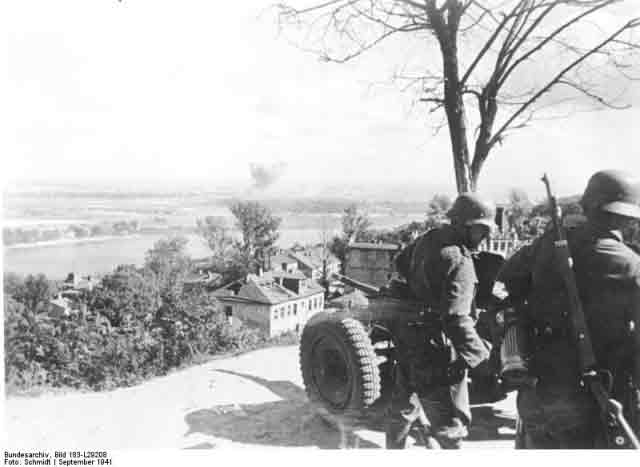
Having surrounded an immense pocket of Soviet troops near Kyiv and taken the city itself on the 19th, the Wehrmacht begins reducing the cauldron on 20 September 1941. There are over 800,000 Red Army men in the area, all desperate to avoid the horrors of special German POW camps for captured Russians. Men attempt to break out in all directions, and some succeed. However, large groups are blocked by the German panzers and about 75% of the trapped men ultimately go into captivity.
Among the trapped Soviet soldiers are numerous generals. Stalin could have rescued them — but he sacrifices them as an example to the rest of the Red Army. Some try to slip away through the woods, but the Germans are everywhere. In the Shumeikovo Woods, General Mikhail Kirponos, the commander of the Kyiv Military District, leads an ad hoc force composed of 1,000 men from his headquarters staff and about the same number recruited on the way in a desperate escape attempt. Kirponos is killed, Major General V. I. Tupikov also perishes, and Lieutenant General Potapov is captured.
The 5th Army’s artillery commander, General V.N. Sotensky, also is captured near Lokhvista by the 3rd Panzer Division under the command of Lieutenant General Walter Model. This helps to raise Model’s profile, whose forces previously closed the encirclement of Kyiv at Lokhitsa by meeting the 16th Panzer of Army Group South there. Because of these achievements, Model soon will be promoted to General of Panzertruppen and given command of XLI Panzer Corps.
As the day ends, the Soviet pocket is a scene of chaos and fleeing men. Each hour brings more German troops to strengthen the line so that the Red Army soldiers cannot escape. As is often the case in such situations, the Soviet forces to the east of the pocket do almost nothing to try to relieve their trapped comrades, a tendency that mystifies the Germans throughout the war. However, the trapped Soviet soldiers, having lost the battle, now are deemed unworthy and thus appropriate to leave to their doom.
It all seems like a perfect victory for the Wehrmacht. However, OKH Chief of Staff Franz Halder, privy to reports from across the front and now extremely cynical of “final victories,” is not so sure. He writes in his war diary:
“The enemy must have been able to extricate from Kiev more troops than we thought he would, and he now seems to be fighting for elbow room in the northeastern and eastern direction. We are now approaching the crisis stage of the encirclement.”
The encirclement is complete and the enemy commanders are dead — and the “crisis stage” has not even been reached because there are large Soviet forces nearby that haven’t made a serious effort to relieve the trapped men at Kyiv! This reflects another tendency that repeats itself throughout the war on the Eastern Front and which also mystifies the Germans: no matter how badly they are beaten, the Soviets always have more troops available to create more crises. It is a problem the Germans never understand, never solve, explain away repeatedly in highly detailed staff analyses, and which ultimately dooms them.
Bulgarian diplomatic relations were strained to the breaking point tonight, according to reports to high foreign diplomatic sources here, and, in the light of Sofia’s strong new protest to Moscow and the unexplained sinking of a Bulgarian vessel in the Black Sea, authoritative foreign circles in Ankara declared that only a miracle now could prevent open warfare between the two powers.
Martial law was declared in Bulgaria.
Despite the heavy pressure of German propaganda trying to persuade Sweden of the necessity of joining the “crusade against bolshevism,” Swedish Prime Minister Per Albin Hanssen declared today that Sweden was firmly resolved not to let herself be dragged into it.
Enigma decodings give Britain and the USSR advance warning of an all-out German assault on Moscow.
The Jager Report (issued on 1 December 1941) noted that 128 adult male, 179 adult female, and 99 children, all Jews, were killed in Nemencing, Lithuania for a total of 403 people.
Some “Aryan” Germans were seen on the streets of Berlin today approaching Jewish acquaintances and ostentatiously shaking hands with them. The reason for the hand-shaking today was the imposition of the new rigid anti-Jewish laws which compel all Jews in Germany to wear a yellow and black star of David with the superscription “Jude” [Jew]. The same type of greeting occurred three years ago after the Nazi window-smashing campaign against the Jews was launched in November, 1938.
British minelaying cruiser HMS Abdiel and destroyers HMS Jervis, HMS Kimberley, and HMS Hasty delivered 1,000 troops and 120-tons of supplies to Tobruk, Libya after sundown. They departed for Alexandria, Egypt 30 minutes after arrival.
The Regia Marina (Royal Italian navy) submarine Scirè launched three manned torpedoes into Gibraltar harbor in the early morning hours, which sank tanker Fiona Shell (killing 1), damaged tanker RFA Denbydale, and damaged freighter Durham. All six Italian personnel manning the three torpedoes swam to Spain and would eventually return to Italy as heroes.
An accidental fire aboard HMS Eagle killed one aircraft mechanic and damaged many Swordfish aircraft while sailing in the South Atlantic.
The ferry vessel SS Portsdown sank in the Solent between the Isle of Wight and England, United Kingdom after hitting a mine. There had been disquiet for some time that that no minesweeping had been carried out in the eastern Solent, despite enemy mines becoming an increasing problem. The day before the sinking a meeting of steamer captains agreed by a majority of 4 to continue the night time sailings to the island and Captain H. Chandler, who was commodore of the Southern Railways Company fleet, decided he would take command of the next night crossing which was to be a 4 am mailboat, the SS Portsdown. Captain Chandler died along with 20 crew members, military personnel (going home on leave) and one civilian.
Attacking the policy of isolation, Bertrand Russell, British philosopher, declared yesterday at a conference on “War Aims and Peace Terms” that no nation can secure peace for itself through this method. He admitted that during the last World War he had been an isolationist, but confessed that he had been wrong.
Paris: A curfew is imposed between 9pm and 5am.
Reports from foreign diplomatic circles in Ankara tonight indicated that the new Shah of Iran was making a desperate but probably unsuccessful attempt to retain his throne by a series of sweeping declarations and decrees designed to implement constitutional reforms and wipe out the corruptness of his father’s reign.
RAF Bomber Command, Day of 20 September 1941
48 Blenheims and 6 Hampdens carried out an extensive series of sea sweeps and escorted raids to targets just beyond the French coast. Ships and land targets were bombed. 1 Fortress also bombed Emden. 3 Blenheims lost.
RAF Bomber Command, Night of 20/21 September 1941
Berlin
74 aircraft; all were recalled because of worsening weather. 10 aircraft did not receive the signal and bombed alternative targets; none reached Berlin. 3 Wellingtons and 1 Whitley were lost and 12 more aircraft crashed in England.
Frankfurt
34 aircraft dispatched but were recalled; some flew on and bombed Frankfurt. No aircraft lost but 3 crashed in England.
Ostend
28 ‘freshmen’ crews dispatched without loss.
While flying an offensive sweep over Northern France, the pilots of No. 452 Squadron, RAAF, equipped with Spitfire Mk. VBs and based at Kenley, Surrey, England, claims seven Luftwaffe Bf 109s shot down and two damaged.
The de Havilland Mosquito enters service. The first successful sortie by the photo-reconnaissance variant of the de Havilland Mosquito was made today when W 4055 (LY-T) of the RAF Photographic Development Unit based at RAF Benson flew a daylight reconnaissance over Brest, La Pallice and Bordeaux, returning over Paris. Although it was chased by three Messerschmitt Me 109 fighters, the Mosquito easily outpaced them at 23,000 feet.
The first ‘Hurribomber’ Hawker Hurricane fighter-bomber conversions go into service today on Malta. They can carry two 250-lb bombs.
Allied convoy SC.44 was attacked in the North Atlantic by Wolfpack Brandenburg.
U-74, commanded by Kapitänleutnant Eitel-Friedrich Kentrat, sank British CAM ship Empire Burton (6966grt) from convoy SC.44 in 61-34N, 35-05W. At 0113 hours on 20 September 1941, U-74 fired a spread of four torpedoes at the convoy SC.44 east of Cape Farewell. Kentrat reported two hits on a first ship and one hit on a second vessel which sank later. The fourth torpedo hit a third ship but was a dud. However, only the Empire Burton (Master John Mitchell) was hit and sunk. One crew member and two gunners were lost. The master, 41 crew members, three gunners and six passengers (RAF personnel) were picked up by HMS Honeysuckle (K 27) (LtCdr G.W. Gregorie, RNR) and landed at Reykjavik. The 6,966-ton Empire Burton was carrying wheat and was headed for Liverpool, England.
U-552, commanded by Kapitänleutnant Erich Topp, sank British tanker T. J. Williams (8212grt) in 61-36N, 35-07W, Panamanian steamer Pink Star (4150grt) in 61-36N, 37-07W, and Norwegian tanker Barbro (6325grt) in 61-30N, 35-00W from the convoy.
At 0138 hours on 20 September 1941, U-552 fired the stern torpedo at a ship in convoy SC.44 east-northeast of Cape Farewell and missed the intended target but the torpedo struck the T.J. Williams (Master Robert Thomas Charles Wright) in station #102 after 2 minutes 2 seconds. The tanker sank fast by the stern after being hit. 15 crew members and two gunners were lost. The master, 20 crew members and one gunner were picked up by HMS Honeysuckle (K 27) (LtCdr G.W. Gregorie, RNR) and landed at Reykjavik, Iceland. The 8,212-ton T.J. Williams was carrying motor fuel and was headed for Stanlow, England.
At 0151 hours on 20 SSeptemberep 1941, U-552 fired a spread of two torpedoes at the convoy SC.44 and observed a hit on the targeted ship without seeing any effect and a hit on a ship beyond which sank immediately after breaking in two. In fact, only the Pink Star (Master John S. MacKenzie) was hit and sunk. The 4,150-ton Pink Star was carrying general cargo and was headed for Liverpool, England.
At 0327 hours on 20 September 1941 the Barbro (Master Lauritz Knudsen) in convoy SC.44 was hit by two torpedoes from U-552 and her cargo caught fire. At 0430 hours, U-69 (Zahn) tried to administer a coup de grâce, but the torpedo did not detonate. All on board, the master and 33 crew members died in the flames, helplessly watched by other ships around her. The 6,325-ton Barbro was carrying petrol and was headed for Stanlow, England.
U-124, commanded by Kapitänleutnant Johann Mohr, sank British steamers Baltallinn (1303grt) and Empire Moat (2922grt) from convoy OG.74 in 48-07N, 22-07W. At 2331 hours on 20 September 1941, U-124 fired three torpedoes in two minutes intervals at the convoy OG.74 north-northeast of the Azores and heard one detonation, then a tanker was observed being hit (there was a burst cloud). Another ship was hit and sank immediately after a heavy explosion. Mohr claimed two ships with 15,000-tons sunk and another with 8000-tons damaged. In fact, the Baltallinn and the Empire Moat were hit and sunk.
Seven crew members from Baltallinn (Master Charles Walter Browne) were lost. The master, 22 crew members and five gunners were picked up by the British rescue ship Walmer Castle (Master Gerald Lewis Clarke). On 21 September, the rescue ship was bombed and sunk by a German aircraft. Ten crew members and one gunner from Baltallinn were lost. The master, 12 crew members and four gunners were picked up by HMS Deptford (L 53) (LtCdr H.R. White) and landed at Gibraltar on 28 September. The 1,303-ton Baltallinn was carrying government stores and was headed for Gibraltar.
The master, 28 crew members and three gunners from the Empire Moat (Master James Fawcett Travis) were picked up by the British rescue ship Walmer Castle (Master Gerald Lewis Clarke). On 21 September, five crew members were lost when the rescue ship was bombed and sunk northeast of the Azores in 47°16N/22°25W by a German Fw 200 aircraft of I./KG 40. The remaining men from the Empire Moat were picked up by the HMS Marigold (K 87) (Lt W.S. Macdonald) and the HMS Deptford (L 53) (LtCdr H.R. White) and landed at Gibraltar on 28 September. The 2,922-ton Empire Moat was carrying ballast and was headed for Gibraltar.
On the 21st, U-201 sank British steamer Runa (1575grt) in 46-20N, 22-23W and British steamers Lissa (1511grt) and Rhineland (1381grt) in 47N, 22W from OG.74 convoy. Twelve crew and two gunners were lost on steamer Runa.
Convoy rescue ship Walmer Castle (906grt) was badly damaged by German bombing in 47-16N, 22-25W. The rescue ship had thirty survivors of steamer Empire Moat, twenty eight survivors from steamer Baltallinn, and twenty three crewmen from steamer City of Waterford (1071grt), which had been sunk in a collision with tug Thames on the 19th. Ten crew and passengers were lost in the ship. The rescue ship was scuttled by sloop Deptford and corvette Marigold of the convoy escort on the 21st.
Convoy HG.73, which departed Gibraltar on the 17th, was sighted by Italian submarine Torelli and U-371, but contact was soon lost. U-371 was en route to the Mediterranean. Contact with the contact was regained on the 21st, but the submarine was soon badly damaged by destroyer HMS Vimy. Italian submarine Da Vinci found this convoy on the 23rd. From reports from a German aircraft, Italian submarine Malaspino sank two steamers on the 24th, but the submarine then went missing and what became of her is unknown.
U-124 sank British steamer Empire Stream (2922grt) in 46-03N, 24-40W on the 25th. Four crew, two gunners, and two stowaways were lost on steamer Empire Stream.
U-203 on the 26th sank Norwegian steamer Varanberg (2842grt) in 47-50N, 24-50W, British steamer Avoceta (3442grt) in 47-57N, 24-05W, and British steamer Cortes (1374grt) in 47-48N, 23-45W from the convoy. Twenty one crewmen were missing on steamer Varanberg. Forty three crew, four gunners, and seventy six passengers were missing on steamer Avoceta. Corvette HMS Periwinkle rescued the convoy Commodore Creighton and other survivors. Some survivors were picked up by steamer Cervantes which was later sunk. Surgeon Lt F. Bagot of battleship HMS Nelson was lost in steamer Avoceta. The survivors from steamer Cortes were rescued by British steamer Lapwing. All but one were lost when Lapwing was sunk.
U-124 sank British steamer Peterel (1354grt) in 47-40N, 23-28W and British steamer Lapwing (1348grt) in 47-40N, 23-30W on the 26th from the convoy. Nineteen crew and three gunners were lost on steamer Peterel. The survivors were picked up by steamer Lapwing. Nine survivors returned to England. Twenty one crew and three gunners were lost on steamer Lapwing. Nine survivors were rescued.
U-124 sank British steamer Cervantes (1810grt) in 48-37N, 20-01W on the 26th from the convoy. Three crew, two gunners, and three passengers were lost on steamer Cervantes.
Auxiliary fighter catapult ship HMS Springbank (Captain C. H. Godwin DSO) was sunk by U-201 in 49-10N, 20-05W on the 27th from the convoy. T/A/Sub Lt (E) J. Moir RNVR, and thirty one ratings were lost on the ship.
U-201 sank Norwegian steamer Siremalm (2468grt) in 49-05N, 20-10W and British steamer Margareta (3103grt) in 50-15N, 17-27W from the convoy on the 27th. The submarine also reported sinking a corvette and a steamer from the convoy. The entire crew on steamer Siremalm was lost. There were no casualties on the steamer Margareta.
German steamer Metz (728grt) was lost near Vlaardingen.
U-111, commanded by Kapitänleutnant Wilhelm Kleinschmidt, sank British steamer Cingalese Prince (8474grt) at 2S, 25-30W. On 20 September 1941 the unescorted Cingalese Prince (Master John Smith) was torpedoed and sunk by U-111 east-southeast of St.Paul Rocks. The master, 48 crew members and eight gunners were lost. 15 crew members and three gunners were rescued after 12 days by the Spanish merchant Castillo Montjuich and landed at St.Vincent, Cape Verde Islands. One crew member was picked up by the British sloop HMS Weston (L 72) (Cdr J.G. Sutton) and one officer by the British sloop HMS Londonderry (L 76) (Cdr J.S. Dalison) and landed at Londonderry on 3 November. The 8,474-ton Cingalese Prince was carrying general cargo, including manganese ore and pig iron and was headed for Liverpool, England.
Monitor HMS Erebus departed Scapa Flow at 0800 for Chatham on completion of working up practices. Destroyer HMS Vivacious departed Scapa Flow at 1030 for Sheerness on completion of her working up practices. The destroyer was ordered to overtake the monitor and escort her to Sheerness. Destroyer HMS Windsor departed Harwich at 1130 to meet monitor Erebus and destroyer Vivacious off May Island and act as additional escort to Sheerness. Monitor Erebus and destroyer Vivacious arrived at Sheerness at 1845/22nd.
Norwegian destroyer HNoMS Draug departed the Humber at 2000 for Scapa Flow and arrived at 0600/21st.
Minelaying cruiser HMS Manxman departed Portsmouth and laid minefield JT off Le Havre.
Anti-aircraft ship HMS Ulster Queen departed Scapa Flow after working up. The ship arrived at Belfast at 1200/21st to join the Western Approaches.
British ferry Portsdown (342grt) was sunk on a mine in 50-46-07N, 6-25W. Eight crew and fifteen passengers were lost on the steamer.
British trawler Marconi (322grt) was lost in a collision off Harwich.
The Battle of Convoy SC.44 continues.
Minelaying cruiser HMS Abdiel and destroyers HMS Jervis, HMS Kimberley, and HMS Hasty departed Alexandria with about 1000 troops, brought to Alexandria by the 7th Cruiser Squadron, and one hundred and twenty tons of stores in Serial 5 of the SUPERCHARGE operation. The ships arrived back at Alexandria on the 21st.
Destroyers HMS Hero and HMS Jackal departed Haifa for an anti-submarine sweep of the Haifa — Port Said — Alexandria shipping routes.
Destroyer HMS Havock grounded to the west of the Great Pass while waiting to enter harbour after an anti-submarine exercise. Both propellers were damaged beyond repair and both shafts and A bracket were distorted. Repairs in dock required some fourteen days.
British steamer Clan Forbes with twenty four officers and four hundred and eight other ranks and troopship Glenroy with thirty seven officers and five hundred and forty four other ranks departed Suez for Port T, which was the Indian Ocean anchorage at Addu. The ships were escorted from Aden by heavy cruiser HMS Cornwall and arrived on the 30th.
French steamer Monselet (3372grt) was sunk and Italian steamer Marigola (5996grt) was damaged by RAF aircraft off Sfax.
Light cruiser HMS Sheffield departed Gibraltar to rendezvous with convoy WS.11X.
Submarine HMS Trusty departed Gibraltar for patrol in the Mediterranean to support HALBERD operations.
At St Helena, aircraft carrier HMS Eagle had a serious fire in her hangar deck. Fourteen aircraft were seriously affected by salt water used to extinguish the fire. The aircraft carrier sustained some damage. One rating died from injuries. On the 28th, the aircraft carrier, escorted by heavy cruiser HMS Dorsetshire, departed St Helena for Freetown, arriving 3 October. The ship called at Gibraltar for emergency repairs and finally arrived back at Liverpool on 26 October. Aircraft carrier Eagle was refitting from 30 October to 9 January 1942.
The Congress passes the Revenue Act of 1941 which lowers exemption levels and increases taxes on excess profits being made on the war effort. These changes do more than simply increase revenues; they expand the tax base to include all but the lowest-paid workers.
With President Roosevelt’s signature, the $3,553,400,000 revenue bill became law today. The chief executive signed the legislation at his Hyde Park, N.Y., home, where he had taken it for a study of its provisions. Both senate and house approved it earlier this week and sent it to the White House. Existing taxes and the new levies are expected to bring in between $13,000,000,000 and $15,000,000,000 next year, but even this amount will fall far short of meeting Secretary of the Treasury Morgenthau’s recommendation that government spending be financed two-thirds from taxes and one-third from borrowing.
While Senator Tom Connally of Texas was predicting repeal or modification of the Neutrality Act “within a few months,” Senator Walter F. George, Democrat of Georgia, Mr. Connally’s predecessor as chairman of the Senate Foreign Relations Committee, today urged the Administration to place “the ultimate decision” of war or peace before the American people.
Senator Gerald P. Nye appealed last night to “all loyal Americans” to oppose President Roosevelt’s foreign, policy program of all-out aid to nations fighting against Nazi Germany on the ground that it represented a deliberate attempt by the President and British leaders to involve this country against its will in the war.
Food prices and the cost of living have reached their highest point in 10 years under the impact of the armament effort, but an accompanying rise in weekly earnings of factory workers, government economists say, has more than kept pace with climbing prices. Records of the bureau of labor statistics show that the cost of living has gone up 10 percent since the start of the war in Europe. But in the same period average weekly earnings in manufacturing industries have increased 32 percent.
The International Association of Machinists, A.F.L., announced today that a strike vote would be taken Monday at the huge Consolidated Aircraft Corp. to thwart a “run-around” from defense mediation board officials in Washington.
All factions in the C.I.O. will support Philip Murray for re-election as national president, a survey indicated yesterday. Mr. Murray, who has just recovered from a two-month illness, has made no public announcement of his intentions, but persons in his confidence say he will be a candidate to succeed himself at the forthcoming C.I.O. convention.
Army shore battery fires across the bow of destroyer Charles F. Hughes (DD-428) as TU 4.1.2 (Commander Fred D. Kirtland) enters Hvalfjordur, Iceland in foggy weather conditions.
German submarines attack convoy SC.44; among the ships lost in the onslaught are Panamanian freighter Pink Star (ex-Danish Landby) and tanker T.J. Williams, torpedoed and sunk by U-552 at 61°36’N, 35°07’W and 61°34’N, 35°11’W, respectively.
Sylvester [J. Pussycat Sr.,], Warner Bros. cartoon character created by Friz Freleng (Looney Tunes and Merrie Melodies series), first debuts in “Notes to You”.
Major League Baseball:
Until a Spell of wildness overcame Charley Wagner in the eighth inning today the Yankees and Red Sox had quite a struggle at Fenway Park before 12,014 fans. When the next-to-last stanza started the McCarthymen were in front by 2–1. When it was over, the Yankees led, 8–1, and that’s how it ended. Marius Russo won his 13th of the season.
Thornton Lee wins his 20th for the White Sox, beating the Tigers, 4–3. Bobo Newsom loses his 13th. The Sox score two in the eighth inning and two in the ninth for the comeback victory.
Reds took a four-and-a-half game lead over Pittsburgh in the battle for third place today by defeating the Pirates in both ends of a double-header, 2–1 and 7–3, on the tight pitching of Bucky Walters and Paul Derringer. Walters, taking his eighteenth victory, allowed the Pirates five hits, and Derringer, getting his twelfth, was touched for seven. Frank McCormick hit his sixteenth and seventeenth homers of the year, one in each game, while Vince DiMaggio hit his twentieth in the opener for the Pirates. Walters and Max Butcher battled on almost even terms throughout, the one-run difference being a single by Ernie Lombardi, an error by DiMaggio on Mike McCormick’s short fly, and Lonnie Frey’s single in the fourth inning.
Home runs by Jeff Heath and Ken Keltner helped the Indians to tighten their hold on fourth place today with an easy 6–2 triumph over St. Louis in a series opener. Keltner’s four-bagger was the big noise of the Tribe’s first-inning three-run outburst against Bob Harris, first of three Brown hurlers. Heath’s liner came in the fifth.
Having been trounced six straight times by the ferocious western clubs, the Giants greeted the Braves with enthusiasm at the Polo Grounds yesterday. The New Yorkers bowled over the Bostonians in both ends of a double-header, 4–3 and 7–3, thereby blithely leaping over the Cubs into fifth place.
The first-place Dodgers sweep two from the Phillies, winning 3–1 and 6–1. Whit Wyatt, with Hugh Casey in relief, and Kirby Higbe are the winning pitchers, each recording their 21st wins of the year.
Leading 3–1 going into the 9th, the Cards give up 6 runs to the Cubs in the 9th to lose 7–3. In the 9th, reliever Howie Crist’s first pitch to rookie Bob Scheffing is hit for a grand slam, his first Major League homer. With the Dodgers sweeping, the loss leaves the Birds two games back in the National League pennant race.
Rookie Roger Wolf of Philadelphia and veteran Dutch Leonard of Washington staged a pair of pitching masterpieces today with the Senators coming through with a 1–0 victory. Dutch allows 4 hits while Wolff allows 3.
New York Yankees 8, Boston Red Sox 1
Detroit Tigers 3, Chicago White Sox 4
Pittsburgh Pirates 1, Cincinnati Reds 2
Pittsburgh Pirates 3, Cincinnati Reds 7
St. Louis Browns 2, Cleveland Indians 6
Boston Braves 3, New York Giants 4
Boston Braves 3, New York Giants 7
Brooklyn Dodgers 3, Philadelphia Phillies 2
Brooklyn Dodgers 6, Philadelphia Phillies 1
Chicago Cubs 7, St. Louis Cardinals 3
Philadelphia Athletics 0, Washington Senators 1
Rupture of relations between Argentina and Germany is now viewed as an imminent possibility as a result on the one hand of the resolution voted by the Chamber of Deputies Monday implicitly demanding expulsion of Ambassador Baron Edmund von Thermann, and on the other of the German Government’s attitude as manifested by an anti-Argentine press campaign under way in the Reich.
Negotiations with Japan looking toward a settlement of Japanese-American relations have reached a virtual standstill, although they are being kept open in the hope of effecting an eventual settlement, it was reported on good authority today. Japan’s insistence upon terms that would give the Japanese considerable control in China and the unwillingness of Secretary of State Cordell Hull to depart from his insistence that Japan should have no special status in East Asia are understood to have caused negotiations to bog down for the moment at least.
Meanwhile, more than half of the United States Navy is forced to remain in the Pacific at a time when it is operating against German and Italian submarine, surface and air raiders in the Atlantic. It is feared the reverses suffered by Russia in the Ukraine and around Leningrad will encourage Japan and increase the difficulties in the way of a settlement of the Far Eastern situation. According to reliable diplomatic sources, Secretary Hull’s insistence that Japan drop her plans to obtain a privileged status in China, and his refusal to talk detailed terms until the Japanese altered their present attitude, led to the decision of Prince Fumimaro Konoe, Japanese Premier, to attempt to negotiate directly with President Roosevelt.
Light cruiser HMS Emerald arrived at Colombo from the Seychelles.
Japanese Army and Navy units were declared in a Japanese communiqué today to have captured several strategic points on the southeastern shore of Tungting Lake, occupied Tsingkang and cut the Hankow-Canton railway twenty-five miles south of Tsingkang. These operations, described as part of a major offensive southwestward from Hankow, have paved the way for encirclement of more than 20,000 of Generalissimo Chiang Kai-shek’s troops, Japanese said. Hundreds of prisoners and large quantities of ammunition were reported taken. Foreign military observers in Shanghai expressed belief that the Japanese drive was intended to relieve Chinese pressure in the Hankow area. Chinese were recently reported operating against communications within twenty miles of Hankow.
Tokyo receives reports on the U.S. fleet movements from both Manila, Philippine Islands, and Seattle, Washington, U.S.
At the Kure Navy Yard, Imperial Japanese Navy light aircraft carrier HIJMS Hosho and supply ship HIJMS Mamiya are anchored near a large fitting-out pontoon servicing battleship HIJMS Yamato in her later stage of construction. Heavy cruisers HIJMS Kako and HIJMS Kinugasa are anchored nearby.
The Imperial Japanese Navy aircraft carrier HIJMS Kaga arrives at Ariake Bay.
The U.S. Army Air Forces activated the Philippine Department Air Force, later redesignated Far East Air Force and still later 5th Air Force, at Nichols Field, Luzon. This unit is not manned and all USAAF units in the Philippines remain under the control of Air Force, U.S. Army Forces in the Far East.
Dow Jones Industrial Average: 127.54 (-0.41)
Born:
Butch Byrd, AFL-NFL cornerback (AFL Champions-Bills, 1964, 1965; AFL All-star, 1964–1966, 1968, 1969; Buffalo Bills, Denver Broncos), in Watervliet, New York.
Dennis Ribant, MLB pitcher (New York Mets, Pittsburgh Pirates, Detroit Tigers, Chicago White Sox, St. Louis Cardinals, Cincinnati Reds), in Detroit, Michigan (d. 2023).
Ray Cullen, Canadian NHL centre (New York Rangers, Detroit Red Wings, Minnesota North Stars, Vancouver Canucks), in Ottawa, Ontario, Canada (d. 2021).
Dale Chihuly, American glass sculptor, in Tacoma, Washington.
Died:
Mikhail Kirponos, 49, Soviet Ukrainian general, Commander of the Southwestern Front.
Naval Construction:
The Royal Fleet Auxiliary King Salvor-class salvage vessel RFA Salvestor (W 176; postwar A499) is laid down by Wm. Simons & Co. Ltd. (Renfrew, Scotland).
The Royal Navy “T”-class (Third Group) submarines HMS Thule (P 325) and HMS Tudor (P 326) are laid down by the Devonport Dockyard (Plymouth, U.K.).
The Royal Navy LCT (Mk 2)-class landing craft, tank HMS LCT 158 is launched by A. Findlay (Old Kirkpatrick, Scotland, U.K.).
The U.S. Navy Accentor-class coastal minesweeper USS Energy (AMc-78) is launched by W.A. Robinson Inc. (Ipswich, Massachusetts, U.S.A.).
The U.S. Navy Accentor-class coastal minesweeper USS Guide (AMc-83) is launched by the Camden Shipbuilding and Marine Railway Co. (Camden, Maine, U.S.A.).
The U.S. Navy Accentor-class coastal minesweeper USS Ideal (AMc-85) is launched by the Warren Boat Yard Inc. (Warren, Rhode Island, U.S.A.).
The U.S. Navy Accentor-class coastal minesweeper USS Summit (AMc-106) is launched by the Snow Shipyards Inc. (Rockland, Maine, U.S.A.).
The Royal Navy “P”-class minesweeping trawler HMS Promise (T 193) is launched by Uniao Fabril (Lisbon, Portugal).
The U.S. Navy SC-497-class submarine chaser USS PC-515 (later SC-515) is launched by the Elizabeth City Shipyard (Elizabeth City, North Carolina, U.S.A.).
The Royal Navy “S”-class (Third Group) submarine HMS P 222 is launched by Vickers Armstrong (Barrow-in-Furness, U.K.).
The Kriegsmarine (German Navy) Type VIIC U-boat U-89 is launched by Flender Werke AG, Lübeck (werk 293).
The Kriegsmarine (German Navy) Type VIIC U-boat U-254 is launched by Bremer Vulkan-Vegesacker Werft, Bremen-Vegesack (werk 19).
The U.S. Navy Gato-class submarine USS Greenling (SS-213) is launched by the Electric Boat Co. (Groton, Connecticut, U.S.A.).
The Royal Navy Assurance-class rescue tug HMS Frisky (W 11) is commissioned.
The U.S. Navy Accentor-class coastal minesweeper USS Tapacola (AMc-54) is commissioned. Her first commanding officer is Lieutenant (j.g.) Russell E. Fitzpatrick, USNR.
The Kriegsmarine (German Navy) Type VIIC U-boat U-251 is commissioned. Her first commanding officer is Kapitänleutnant Heinrich Timm.
The Royal Navy “O”-class destroyer HMS Offa (G 29) is commissioned. Her first commanding officer is Lieutenant Commander Robert Alastair Ewing, RN.
 History Diaries