Kiev Falls
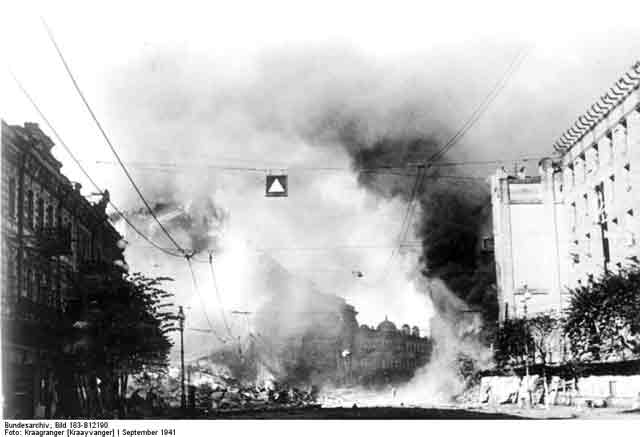
Kiev falls into German hands. Elements of the German 6th Army broke through the Soviet defenses at Kiev and entered the city. German Major General W. Stemmermann’s 296th Infantry Division of General von Reichenau’s 6th Army breaks through crumbling Soviet defenses and advances into Kyiv on 19 September 1941. Soviet Southwestern Front has 850,000 troops under the command of General Mikhail Kirponos, who is trapped in the pocket with his men. While the German cordon around Kyiv still is fairly porous and some Soviet troops are able to break out (against German opposition), the vast majority of Kirponos’ men are trapped in a giant, hopeless, and diminishing cauldron.
German troops captured Kiev, Ukraine, along with 600,000 prisoners, 2,500 tanks, and 1,000 artillery pieces. Kiev falls to the Germans after 40 days of fighting. German losses are estimated at 100,000. In a series of communiqués the Nazis boasted: “The attack on Kiev was begun in the course of encircling operations. After a bold thrust through the strong fortifications on the banks of the Dnepr our troops have penetrated into the town. The Reich flag has been flying from the citadel since this morning.” The communiqué’s claim that the jaws of Guderian and von Kleist’s pincer movement snapped shut at Lokhvitsa, 125 miles east of Kiev. “The ring has thus been closed round four Soviet armies. Their annihilation is now in progress.”
Stalin’s orders were “stand fast, hold out, and if need be die.” When Marshal Budenny, the Soviet commander in the south, requested permission to retreat, Stalin sacked him.
General Kirponos, commanding in Kiev, eventually got Stalin’s permission to withdraw, but it came too late. Kirponos has been killed in an ambush along with most of his 1,000 strong command column; the Red Army is facing its greatest disaster of this war.
There is little doubt that Kirponos is a scapegoat. Stalin has flown his good friend Marshal Budenny out of the Kyiv pocket, and Marshal Timoshenko is taking a “hands-off” attitude” and is just following Stalin’s orders. The generals in Moscow are in no danger, at least not yet. Kirponos, in command on the spot, is seen as a bit of a cautious and pessimistic general by Stalin and his cronies even though he has shown outstanding tactical judgment from the start of Operation Barbarossa. General Zhukov is quoted by Nikita Khrushchev, a Commissar in Kyiv, as saying:
“I am afraid your commander (Kirponos) here is pretty weak.”
While Stalin easily could send a special plane in to rescue Kirponos, this is not done. Instead, Kirponos forms up his headquarters troops of about 1000 men and attempts a breakout. Kirponos is not part of “the club” and is left to fend for himself, just another victim of Stalin’s callous indifference to his minions.
Taking a global perspective, Kyiv is the first (and ultimately only) of the principal objectives of the three Wehrmacht army groups to fall. Leningrad is isolated and basically surrounded, but the Germans already have terminated their attempt to capture Leningrad and instead have resorted to medieval siege tactics there.
Trapped in the open, the Russian infantrymen are fighting with their customary stubbornness as the German tanks hunt them down and Stukas blast their strongpoints. But they are running out of ammunition and food. The end cannot be long delayed. Kiev itself is a shattered shell of a once beautiful city, littered with the debris of war and stripped bare of anything of use to the invader. Power stations and waterworks have been put out of action, and thousands of timebombs have been left to complete the destruction. The executions of party officials and Jews, to “liquidate the Bolshevik menace”, have already started in the city as the SS murder squads move in on the heels of the Panzers.
The sole remaining major objective for the Germans in 1941 remains Moscow. The capital of the Soviet Union is still hundreds of miles behind the front, which is reassuring when the Stavka looks at a map. However, the fall of Kyiv releases massive German forces which now can be redirected (after the lengthy process of subduing the remaining Soviet forces near Kyiv) toward Stalin’s place of residence. With the fall of Kyiv, the ultimate outcome of Operation BARBAROSSA now becomes a race between the German ability to grind forward toward Moscow and the weather, which already is showing the first signs of winter.
Luftwaffe bombers attack Leningrad and kill more than 1,000 Russian civilians.
Soviet light cruiser Voroshilov bombarded Axis troop positions near Sevastopol, Russia.
The Bulgarian cargo ship Rodina struck a naval mine in the Black Sea and sank.
Jews in Germany and German-occupied areas are obliged to wear the yellow Star of David as a mark of recognition from this day.
Heinrich Jöst, a German sergeant, smuggles a camera into the Warsaw ghetto, and against all regulations, photographs the suffering and misery of the Jews trapped inside.
Eight alleged Communists accused of terrorism and anti-German “manifestations” were executed in Paris today amid a new outbreak of sabotage in which ten men wrecked several German Army cars in a Paris garage and escaped.
They are changing the guard today at the Peacock Palace in Tehran, Iran. Soviet troops who have occupied the city for several days are leaving and British troops are replacing them, with much saluting. This is the first time that British and Russian troops have seen each other. The British troops are impressed by the Russian soldiers’ armor. The Russian troops seem surprised by the British soldiers’ short trousers.
Cruisers HMS Ajax, HMS Neptune, and HMAS Hobart arrived in Alexandria, Egypt after delivering supplies to Tobruk, Libya and began to embark troops of the UK 70th Infantry Division.
Josef Broz Tito and Draža Mihailović met for the first time to discuss resistance to the Germans. The talks went well enough but no real agreement was reached due to the different concepts of resistance between the two groups. Major political differences divided the Yugoslavian partisan groups led by the two men and no accommodation was reached.
Lord Woolton called the black market in Britain “a thorn in our side”.
German submarine U-74 sank Canadian corvette HMCS Lévis of Allied convoy SC.44 125 miles east of Iceland at 0603 hours; 18 were killed, 40 survived). At 1433 hours, German submarine U-372 attacked the same convoy 100 miles east of Iceland, sinking already-damaged British ship Baron Pentland; 2 were killed, 39 survived).
Sunspots caused a major geomagnetic storm, knocking out radio equipment and telegraph lines.
RAF Bomber Command, Night of 19/20 September 1941
Stettin
72 aircraft, mostly Wellingtons; 60 reached and bombed this distant city but, most of the individual targets allocated to crews were difficult to find. 1 Wellington and 1 Whitley lost.
The first Rhubarb (armed recce) by Curtiss Tomahawks of the RAF is flown today by No. 239 Squadron from Gatwick.
U-372, commanded by Kapitänleutnant Heinz-Joachim Neumann, sank British steamer Baron Pentland (3410grt), straggling behind convoy SC.42 after being torpedoed by U-652 on the 10th, in 61-15N, 41-05W. At 0452 hours on 10 September 1941, U-652 (Fraatz) fired two single torpedoes at ships of the convoy SC.42 northeast of Cape Farewell, heard two detonations after three minutes and reported two ships probably sunk. In fact, Tahchee and Baron Pentland were damaged. Two crew members from Baron Pentland (Master Alexander Bleasby Campbell) were lost. The master, 30 crew members and eight gunners abandoned ship in position 61°15N/41°05W and were picked up by HMCS Orillia (K 119) (T/LtCdr W.E.S. Briggs, RCNR) of the 24th Escort Group and landed at Reykjavik. The vessel remained afloat due her load of timber despite of a broken back and the wreck was eventually torpedoed and sunk by U-372 at 1433 hours on 19 September. The 3,410-ton Baron Pentland K was carrying timber and was headed for Hartlepool, England.
The Battle of Convoy SC.44 begins.
U-74, commanded by Kapitänleutnant Eitel-Friedrich Kentrat, sank Canadian corvette HMCS Levis (Lt C. W. Gilding RCNR), which was escorting convoy SC.44 in 60-05N, 38-48W. At 0603 hours on 19 September 1941, U-74 fired a salvo of four bow and one stern torpedoes at the convoy SC.44 about 120 miles east of Cape Farewell and observed two hits on each of two ships. The first vessel sank immediately and the other flashed a lamp signal Help and sank within one minute. However, Allied reports only confirm one hit on HMCS Levis (K 115) (T/Lt C.W. Gilding, RCNR) of the 19th Escort Group, which lost her bow and was abandoned by the crew. She was taken in tow after two hours by HMCS Mayflower (K 191) (LtCdr G. Stephen, RCNR) until the tow parted at 0900 hours, but it could be reestablished about 90 minutes later. About 1910 hours, the damaged ship capsized to starboard and sank. 18 ratings were lost. The 40 survivors were picked up by HMCS Mayflower (K 191) and HMCS Agassiz (K 129) (Lt B.D.L. Johnson, RCNR). The commander T/Lt C.W. Gilding, RCNR was reprimanded for ordering the ship to be abandoned without inspection of the damage, leaving in the first boat and not returning with the reboarding party when the corvette did not sink.
The Convoy SC.44 Battle continues the next day. On the 20th, U-74 sank British CAM ship Empire Burton (6966grt) from the convoy in 61-34N, 35-05W. The submarine claimed sinking one more ship and damaging another. One crewman and two gunners were lost on the CAM ship.
U-552 on the 20th sank British tanker T. J. Williams (8212grt) in 61-36N, 35-07W, Panamanian steamer Pink Star (4150grt) in 61-36N, 37-07W, and Norwegian tanker Barbro (6325grt) in 61-30N, 35-00W from the convoy. The submarine claimed sinking a straggler from the convoy. Seventeen crewmen, including two gunners, were lost on the British tanker. Eleven crewmen were lost on the Panamanian steamer. The entire crew of the Norwegian steamer was lost.
British steamer Bradglen (4741grt) was sunk by mining two miles 230° from B.3 Buoy off Barrow Deep. Seven crewmen were missing and one crewman died in the hospital.
British fishing vessel Glen Alva (6grt) was sunk on a mine off Jenkin Buoy, Southend. Both crewmen on the vessel were lost.
British steamer Prestatyn Rose (1151grt) was damaged by German bombing in 51-52-25N, 1-35-45E, three miles northeast of Sunk Buoy, Harwich. The steamer arrived at Harwich on the 19th in tow and beached. Steamer Prestatyn Rose was refloated on the 28th and sailed to the Tyne on the 30th.
German fishing vessel Bunte Kuh (262grt) was lost on a mine in the Kattegat.
During the night of 19/20 September, Italian submarine Scire launched explosive boats into Gibraltar Harbour. Oil depot ship Fiona Shell (2444grt) and oiler RFA Denbydale (8145grt) were sunk and steamer Durham (10,893grt) was badly damaged on the 20th. One crewman was lost on ship Fiona Shell. Ship Durham was beached. She was refloated and drydocked. On the 3rd, steamer Durham sailed in tow from Gibraltar for Falmouth.
Light cruisers HMS Ajax, HMS Neptune, and HMAS Hobart departed Haifa with 6000 troops for Tobruk. Destroyers HMS Griffin and HMS Hotspur from Haifa joined the cruisers off Beirut and escorted them to Alexandria, arriving on the 20th.
Submarine HMS Torbay unsuccessfully attacked a steamer off Gaidoro.
Polish submarine ORP Sokol departed Gibraltar for patrol in the Mediterranean to support HALBERD operations.
Convoy ON.18 departed Liverpool. The convoy was escorted from 21 September by destroyers HMS Leamington, HMS Saladin, HMS Skate, and HMS Veteran, corvettes HMS Abelia, HMS Anemone, and HMS Veronica, and anti-submarine trawlers HMS St. Elstan, HMS St. Kenan, and HMS Vizalma. These escorts were detached on the 24th when relieved by American destroyers USS Charles F. Hughes, USS Gleaves, USS Lansdale, USS Madison, and USS Simpson. The American destroyers escorted the convoy until it was dispersed on 2 October.
Convoy ST.3 departed Freetown, escorted by corvettes HMS Burdock and HMS Marguerite. Corvette HMS Calendula joined on the 23rd. The convoy arrived at Takoradi on the 24th.
Secretary of State Cordell Hull sends a note to German Chargé d’Affaires Hans Thomsen concerning settlement of the Robin Moor incident, citing reparations to the amount of $2,967,092.00. The unarmed freighter was sunk on 21 May 1941 about 700 miles (1,127 km) off the west coast of Africa. The ship had been stopped by the German submarine U-69 and is then sunk by gunfire and torpedo even though US flags were prominently painted on both sides of her hull. She is the first American merchant vessel sunk in the war. All 38-crewmen and 8-passengers make it into life boats and the U-boat captain provides rations; 35 of the 46 survivors are rescued on 3 June and the remaining 11 are rescued on 8 June. The German Embassy acknowledges receipt of the note the same day (see 26 September 1941).
The presence of 12 British war vessels in United States harbors, among them the 35,000-ton battleship HMS Warspite, was officially revealed by the U.S. Navy today in the first major modification of Anglo-American publicity policies since such ships began streaming into American ports for repairs and supplies. The decision to give out this information and follow it up with similar reports in the future apparently was designed to enable both Americans and Britons to comprehend the full extent of naval assistance being given Britain by the United States under the lend-lease program.
Assurance that the United States is doing everything possible to give embattled Russia faster and fuller material aid came from Secretary of State Cordell Hull today as German legions raced to capture Soviet industrial sectors before effective American help can reach the red armies. Hull’s statement stemmed from a press conference question asking whether discouraging London reports of the Russian situation have had any effect on the U. S. program of aid to the Soviet. Replying to a question whether state department reports of the Russian situation were as gloomy as those from London, Hull said he could not go into that because no one has available a full and accurate report of all developments. Hundreds of American planes and tanks are en route to the red armies and should be arriving in quantity soon, but as yet they have reached there in only comparatively small quantities. At least three American shiploads of ‘ American aviation gasoline have reached Vladivostok. Means of intensifying the flow of American-British aid to Russia and allocating it most effectively will be discussed within the next few days.
Passage of a price-control bill is urgently necessary “not only to win the war but also the peace and to protect our people from unnecessary suffering and our American economic system from dissolution,” Bernard M. Baruch told the House Banking and Currency Committee today. The legislation, he said, should put a blanket ceiling on the national price structure, covering wages, rents and commodity prices, instead of imposing piecemeal price-fixing as the Administration’s pending bill proposes. At a day-long session, in which he was questioned for three hours by committee members, the man who was chairman of the World War’s War Industries Board called repeatedly for such legislation as “the greatest single necessity of our present crisis.” He agreed that it was only one of many things which must be done — some of which are being done to prevent a disastrous inflation. While he clung firmly to his plea for an overall price celling, he stated that Leon Henderson, present Price Administrator, was the best man to do the job no matter what kind of a bill is finally passed, and declared that Mr. Henderson’s judgment on the kind of a law needed was entitled to respect.
Senator Claude Pepper of Florida charged last night that John L. Lewis and Charles A. Lindbergh were representative of a small group of willful men in this country who were seeking to profit from the present critical period and who were “looking forward to the day when out of the nation’s misery they can set up their own kind of dictatorship.”
The American Jewish Committee and the Jewish tabor Committee, in a joint statement made public yesterday, denounced the “un-supported and unsupportable charge impugning the patriotism of Americans of the Jewish faith,” contained in the Lindbergh speech in Des Moines on September 11, and declared that “our interests and those of our country are one and indivisible.”
President Roosevelt questioned the legality of the “maintenance of membership” clause recommended by the National Defense Mediation Board in the case of the strikebound Kearny (New Jersey) yard of the Federal Shipbuilding and Dry Dock Company and was assured by the Mediation Board and Robert Watt, general counsel for the NLRB, that it did not conflict with the Wagner Act, it was revealed today.
President Franklin D. Roosevelt, in Rosh ha-Shanah greetings to the Jews of America, issued yesterday through the Jewish Telegraphic Agency, expressed “the confident hope that the temporary darkness which appears to encompass the world shall not extinguish the light of liberty and the blessings of peace and freedom.”
The navy, asserting that it is “in actual wartime conditions” under President Roosevelt’s shoot-first orders, today urged speedy enactment of legislation designed to eliminate “subversive” radio operators from merchant marine service. Speaking for the navy department, Rear Admiral S. C. Hooper told a senate commerce subcommittee that the legislation fell into the “urgent” category with Mr. Roosevelt’s announcement that the United States navy would protect merchant shipping in American defense waters. “As far as the navy is concerned,” he said, “we are in actual wartime conditions with the enemy close by.”
A.F.L. machinists reported tonight they had broken off wage negotiations with the Consolidated Aircraft Corps., and were prepared to strike to enforce their demands. George C. Castleman, general vice-president of the International Association of Machinists, said the controversy was referred tonight to the national mediation board after the company refused the union’s demand for a blanket 10-cent-an-hour wage boost.
C.C. Moskowitz, vice president of Loew’s, Inc., confirmed a report yesterday that Loew moving picture theatres in Jersey City had been threatened with a boycott by the Hudson County chapter of the America First Committee if they did not stop showing alleged pro-war propaganda movies and newsreels.
The comic book superhero ‘Green Arrow’ made his first appearance in More Fun Comics issue #73 (cover date November).
Major League Baseball:
While the Dodgers have Friday off in Philly, Leo Durocher uses the time off to get into an argument with sportswriter Ted Meier. Meier and Leo end up in a fight and Meier gets knocked down twice. A lawsuit results that will be settled out of court next year.
At St. Louis, the Cards top the Cubs, 3–1, as rookie Stan Musial goes 3-for–3 with a walk. Harry Gumbert wins his 5th game in a row and his 11th of the year. Paul Erickson, the Cubs most effective pitcher of late, takes the loss. The Cards (92–52) are a half game behind the Dodgers.
Chicago Cubs 1, St. Louis Cardinals 3
Japanese troops crossed the Milo River during advance on Changsha. Japanese Army spokesmen said today that a major offensive was under way southwestward from Hankow along the shores of Tungting Lake and in the vicinity of Yochow. where the Japanese were said to have crossed the Sungkiang River. Preliminary operations ended yesterday were said to have led to the death of 4,200 Chinese. The attack was said to be following the same strategy as that of the 1939 offensive, when Chinese turned back the invaders within sight of Changsha and scored their most important victory of the war. The spokesman declined to reveal the objective of the current offensive, wut expressed the wish “the Chinese won’t burn Changsha again, as they did in 1938, or carry off supplies, as in 1939.” Chinese armies on the south bank of the Sungkiang were much stronger than they were in 1939, the spokesman said, but Japanese forces supported by planes and artillery and mechanized units and crossed the river within three hours after opening of the offensive at 8 o’clock this morning and had driven twenty miles southward by nightfall.
The public and Parliament were stirred today by revelations of a government secret fund to combat “subversive activities” in Australia.
Dow Jones Industrial Average: 127.95 (-0.82)
Born:
Cass Elliot, American singer (Mamas & The Papas — “California Dreaming”; “Monday, Monday”; solo — “Dream A little Dream Of Me”; “Make Your Own Kind of Music”), in Baltimore, Maryland (d. 1974).
Umberto Bossi, Italian politician (founder and leader of the Northern League), born in Cassano Magnago, Italy (d. 2026).
Jim Fox, British pentathlete (Olympics gold medal, team 1976), in Pewsey, Wiltshire, England, United Kingdom (d. 2023).
Marv Woodson, NFL cornerback and safety (Pro Bowl, 1967; Pittsburgh Steelers, New Orleans Saints), in Hattiesburg, Mississippi (d. 2023).
Andre Gill, Canadian NHL and WHA goalkeeper (Boston Bruins; Chicago Cougars), in Sorel, Quebec, Canada (d. 2014).
Mariangela Melato, Italian actress (“Swept Away”; “Flash Gordon: Summer Night”), in Milan, Italy (d. 2013).
Naval Construction:
The U.S. Navy YMS-1-class auxiliary motor minesweeper USS YMS-60 is laid down by the Gibbs Gas Engine Co. (Jacksonville, Florida, U.S.A.).
The Royal Navy “S”-class (Third Group) submarine HMS Spiteful (P 227) is laid down by the Scotts Shipbuilding & Engineering Co. (Greenock, Scotland).
The U.S. Navy SC-497-class submarine chaser USS PC-524 (later SC-524) is launched by the Mathis Yacht Building Co. (Camden, New Jersey, U.S.A.).
The Royal Navy harbor defence motor launch HMS HDML 1081 is commissioned.
The Royal Navy LST (Mk 2)-class landing ship, tank HMS LCT 138 is commissioned.
The U.S. Navy patrol yacht USS Tourmaline (PY-20) [ex-Sylvia] is commissioned. Her first commanding officer is Lieutenant Commander Charles E. Judge, USNR.
The ex-German submarine U-570 is commissioned into the Royal Navy as the HMS Graph (P 715). Her first commanding officer is Lieutenant George R. Colvin. The U-570 was captured by British forces August 27, 1941 in the North Atlantic south of Iceland, after being damaged by a British Hudson aircraft from Squadron 269/S. She was towed to Thorlakshafn, Iceland and salvaged.
Les Forces Navales Françaises Libres (Free French Naval Forces) Flower-class corvette Roselys (K 57), laid down as the Royal Navy HMS Sundew, is commissioned.
The Royal Canadian Navy Flower-class corvette HMCS Shawinigan (K 136) is commissioned. Her first commanding officer is T/Lieutenant Charles Patrick Balfry, RCNR.
 History Diaries