Units of Heeresgruppe Süd capture Poltava in the Ukraine.
The Soviet Union announced conscription for all men aged 16-50.
Change of German strategy against Leningrad, Russia, switching from assault to besieging, led to the tanks of the German 4th Panzer Army being loaded onto trains for Moscow, Russia. This shift in strategy partially resulted from Adolf Hitler’s order earlier on this date that Leningrad was to be razed to the ground.
The Finnish Moscow embassy staff arrives home. They left Moscow on July 26 and spent from July 8th to August 31st stranded in railway carriages in the rail yard of Leninakan near the Turkish border. Denmark’s ambassador visited them at the end of July and observed that ‘the situation must be both physically and psychically very painful to Hynninen and his staff’. (In a meeting with Paasikivi shortly after returning Finland, Hynninen referred to 54 days spent ‘in difficult circumstances’ in Leninakan.) When they were finally able to leave, the journey continued through Ankara, Beograd, Vienna and Berlin to Lybeck, where they took a ship to Turku.
The United Kingdom decides it will reveal the secrets of radio-location (radar) to the U.S.S.R.
The Soviet river monitor Vitebsk was scuttled near Kiev to avoid capture by the Germans.
An ominous warning that Russia must have a swift flood-tide of war supplies or face military disaster, and perhaps capitulation, came tonight from a London source in a position to speak with authority.
Eleven Belgians have been sentenced to death by a German field court martial for espionage, printing of pamphlets against Germany and “assisting the enemy,” the German language newspaper Brusseler Zeitung said today.
German authorities have ordered a 9 PM curfew in Paris as a result of attacks on Nazi military officials in the occupied capital under cover of darkness, the morning newspapers announced today.
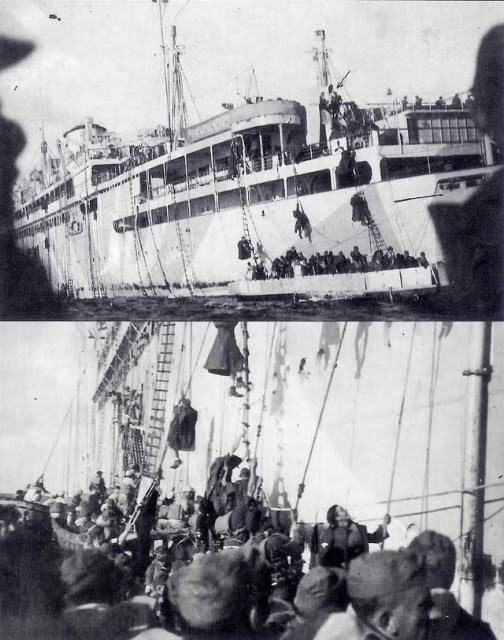
British aircraft located a convoy of three Italian troopships escorted by four destroyers from Taranto, Italy, sailing for Tripoli, Libya. Submarines HMS Upholder, HMS Upright, HMS Ursula, and HMS Unbeaten were dispatched to attack. HMS Upholder sank troopships Neptunia and Oceania over a four hour period about 70 miles east of Tripoli (384 killed, 6,500 survived), while HMS Ursula attacked troopship Vulcania unsuccessfully.
HMS Upholder (Lieutenant-Commander Malcolm David Wanklyn) torpedoes and sinks 19,425-ton Italian transport Neptunia and 19,507-ton Italian transport Oceania en route from Taranto to Tripoli. Mv Neptunia is sunk by one torpedo after the convoy was given away by intercepted messages. Due to this naval intelligence, the Royal Navy sent four submarines to intercept this heavily guarded convoy. Hours after sinking Neptunia, Wanklyn also torpedoes Oceania once and heavily damages it. The Italians take Oceania in tow, but Wanklyn then his the transport with two more torpedoes, causing it to sink in the evening.
Thus, these two sister ships are sunk within hours of each other by the same British submarine. The sinking set in motion a massive rescue operation. Pessagno, a destroyer whose normal complement was about 250 men, crammed aboard 2,083 survivors, while destroyer Da Recco (the escort leader) rescued 1,302 men; Da Noli, Gioberti and Usodimare picked up 682, 582, and 485 men, respectively. More survivors were rescued by the torpedo boats Clio (163), Perseo (131), and Circe (three) and by floatplanes (three). The combined losses are 384 men killed, 5434 men saved.
After dark, British minelaying cruiser HMS Latona and destroyers HMS Napier, HMS Havock, and HMS Nizam sailed from Alexandria, Egypt and delivered supplies to the besieged garrison at Tobruk, Libya. They would return to Alexandria in the morning of the next day. HMS Nizam was damaged on the return trip when she hit the wreck of Italian ship Serenitas at Tobruk.
The remnant of convoy SC.42 arrived in Liverpool. The cargo lost from SC.42 amounted to 15,050-tons of wheat, 14,400-tons of iron ore, 11,200-tons of steel, 9,300-tons of gas oil, 7,000-tons of other grains, 5,500-tons of sulfur, 4,275-tons of phosphates, 2,400-tons of pig iron, 2,100 general cargo, 525-tons of oats, and a large but unspecified tonnage of lumber. Sixteen ships were sunk and four damaged, out of a total of 65 merchant ships. Two hundred and thirty-seven merchant sailors lost their lives in this battle. The battle for convoy SC.42 is considered to be one of the greatest convoy battles of the Second World War.
An undisclosed number of Chileans have been arrested in Germany in retaliation for the arrest of German residents in Chile, authorized sources disclosed today.
RAF Bomber Command, Day of 18 September 1941
11 Blenheims to a power-station, near Rouen, which was bombed and 5 Hampdens to Abbeville but their operation was unsuccessful and no bombs were dropped. There were no losses on these raids. 9 Further Blenheims carried out shipping patrols. 3 aircraft of 88 Squadron, taking their turn in the Channel Stop operation, made a successful attack on a large and strongly escorted tanker off Blankenberg. Their bombs blew off the stern of the ship, which is believed to have sunk, but 2 of the 3 Blenheims were shot down soon afterwards by German fighters.
On a routine Roadstead mission over Ostend on 18 September 1941, RAF Hurricanes and Spitfires escorting Blenheim bombers of No. 88 Squadron encounter Focke Wulf Fw190 fighters for the first time. The encounter is fairly routine, with the eight Fw 190As of II./JG 26 shooting down two Blenheims at the cost of one of their own. The lost Luftwaffe pilot is Hptm. Walter Adolf, whose body washes up on a Belgian beach a few weeks later. Adolf finished with 45 victories and becomes the first combat casualty in the Fw 190.
The Fw 190, designed by Kurt Tank, is not as well known as the Bf 109, but quickly becomes the favorite mount of many front-line Luftwaffe pilots after some initial skepticism. To the extent that the Germans could assign different fighters to specific missions, they used the Fw 190 at lower altitudes and kept the Bf 109 for high-altitude bomber interceptions. Like the Bf 109, the new Fw 190 went through numerous revisions during the war which greatly altered its profile.
The air war over the Continent is slowly picking up, but it can fairly be called about even between the two sides at this point. The appearance of a completely new Axis fighter comes as a complete surprise to the British. They desperately want to get one of the new planes to test, but that does not happen until June 1942.
RAF Bomber Command, Night of 18/19 September 1941
11 ‘freshmen’ crews to Le Havre; no losses,
Destroyer HMS Antelope arrived at Scapa Flow at 0600 on completion of boiler cleaning at Rosyth, having departed on the 17th.
Destroyer HMS Eclipse departed Scapa Flow at 0800 to carry out boiler cleaning at Rosyth.
Destroyer HMS Inglefield departed Scapa Flow at 1500 for the Humber to refit at Hull. The destroyer arrived in the Humber at 1350/19th.
Destroyer HMS Bedouin departed Scapa Flow at 1500 for Thorshavn with the Governor of the Faroes Islands. The destroyer arrived at 0800/19th with the Governor. At 1800 that day, the destroyer departed Thorshavn to return to Scapa Flow, arriving on the 20th.
Destroyers HMS Matabele and HMS Punjabi departed Scapa Flow at 2030 to intercept a possible enemy minelayer off Saxavord. They proceeded to intercept to the westward of the North Rona — Faroes minefield. At 2145, destroyers HMS Ashanti, HMS Impulsive, and HMS Vivacious departed Scapa Flow to carry out a patrol between the Orkneys and Sule Skerry in support. Destroyers Ashanti, Impulsive, and Vivacious arrived back at Scapa Flow at 0030/19th after the patrol. Destroyers Matabele and Punjabi arrived back at Scapa Flow at 0918 after an unsuccessful search.
Minelaying cruiser HMS Manxman departed Plymouth laid minefield HF off Les Heaux.
British aircraft sighted Italian convoy of troopships Neptunia (19,475grt), Oceania (19,507grt), and Vulcania (24,469grt), escorted by destroyers Da Recco, Da Noli, Pessagno, Usodimare, and Gioberti which departed Taranto on the 16th for Tripoli. Submarines HMS Upholder, HMS Upright, and HMS Unbeaten stationed northeast of Tripoli and HMS Ursula stationed off Tripoli harbour were guided to the convoy. Submarine Upholder attacked this convoy off Misurata and sank troopship Neptunia and damaged troopship Oceania in 33-02N, 14-42E. Submarine Upholder returned four hours later and sank the damaged Oceania. Troopship Vulcania escaped and continued on to Tripoli escorted by destroyer Usodimare. Off Tripoli, troopship Vulcania was attacked by submarine Ursula, but was not damaged. The Submarines arrived back at Malta on the 20th.
Submarine HMS Triumph damaged Italian steamer Ardor (8960grt, shown in reports as tanker Liri) off Cape Cimiti in the Adriatic. The tanker was able to proceed into Crotone Harbour.
Minelaying cruiser HMS Latona and destroyers HMAS Napier and HMAS Nizam departed Alexandria with supplies and some troops. Destroyer Havock sailed later to load at Mersa Matruh and joined the ships en route in Serial 2 of the SUPERCHARGE operation. While berthing alongside the wreck of Italian steamer Serenitas (5171grt) at Tobruk, destroyer HMAS Nizam was damaged forward when a cross wind blow the destroyer into the wreck. The ships arrived back on the 19th. Destroyer HMAS Nizam was out of action for fourteen days to repair. In Serial 3 on the same date, A lighters A.2, A.9, and A.11 proceeded to Tobruk. Serial 4 was also conducted on this date with schooners Kheyr El Dine and Hilmi. However, these ships returned to Mersa Matruh and completed the operation on the 21st.
Australian destroyer HMAS Vendetta and British steamer Fouadieh (1853grt) departed Port Said for Famagusta.
Aircraft carrier HMS Furious departed Gibraltar for Bermuda, escorted by destroyers HMS Foresight, HMS Forester, HMS Fury, and HMS Legion. Destroyer Fury arrived back at Gibraltar on the 22nd and sailed again on the 23rd to join convoy WS.11X.
Convoy SC.45 departed Sydney, CB, escorted by armed merchant cruiser HMS Ranpura and corvettes HMCS Chicoutimi, HMCS Matapedia, and HMCS Sherbrooke. Corvette HMCS Spikenard joined on the 19th. The escort group departing Sydney with the convoy was detached on the 21st when the convoy was joined by corvettes HMCS Bittersweet, HMCS Chilliwack, HMCS Collingwood, HMS Dianthus, HMCS Pictou, and HMCS Snowberry. Destroyer HMCS St. Laurent joined on the 22nd and was detached on the 29th. The corvettes joining on the 21st were detached on the 30th when relieved by destroyers HMS Broadwater, HMS Leamington, HMS Skate, and HMS Veteran and corvettes HMS Abelia, HMS Anemone, HMCS Trail, and HMS Veronica. The convoy arrived at Liverpool on 4 October.
In Washington today, President Roosevelt sent to Congress a request for a $5,985,000,000 lend-lease appropriation and issued an executive order prescribing regulations pertaining to the .entry of coffee into the United States from countries signatory to the inter-American coffee agreement. His callers included Jesse Jones, Speaker Rayburn, Representatives Baldwin of New York and Johnson of Texas, and General Elezar Lopez-Contreras, former President of Venezuela. He later departed for Hyde Park.
The Senate confirmed the nomination of Solon J. Buck as Archivist of the United States and adjourned at 12:08 PM until noon on Monday.
The House received the Steagall bill to authorize $150,000,000 in Reconstruction Finance Corporation loans to cooperatives and municipalities for gas or electric utility systems, heard Representative Dirksen support the President’s order to Army and Navy forces to shoot on sight at Axis warcraft found in defense waters and adjourned at 1:34 PM until noon tomorrow. The Banking and Currency Committee continued hearings on the price control bill.
President Roosevelt today asked Congress for an appropriation of $5,985,000,000 with which to finance aid to the non-Axis allies under the lend-lease program through June 30, 1943. The request was submitted in a letter to Speaker Rayburn of the House and set forth again, as the President had done in his second quarterly lend-lease report, that out of the original $7,000.000,000 appropriated six months ago, aid in the amount of $6,280,000,000 “is now moving through the successive stages of allocation, obligation, production and delivery.” He said that additional funds were needed in order to avoid any interruption in the flow of aid “to those countries whose defense is vital to our own.
Congressional leaders tonight predicted prompt action on a new presidential request for lend-lease money, calling for an additional $5,985,000,000 to buy war equipment for Great Britain, China and other nations.
President Roosevelt left tonight for a weekend stay at Hyde Perk. He took with him the $3,553,400,000 tax bill, which congress sent to the White House on Wednesday, and it was thought he might sign the measure into law tomorrow.
President Roosevelt received today from his new Attorney General, Francis Biddle, a virtual carte blanche, from historical and legal points of view, to deal as vigorously and drastically with problems arising from the present world crisis as he believed the situation required. In his salutatory as a Cabinet member Mr. Biddle told the annual convention of the State Bar of California that “the magnitude of the threatened disaster” was the measure of the President’s “power and duty” to take steps necessary to avert it. Ordering the Navy to clear an Atlantic sea lane by sinking Nazi submarines, if necessary, was no different, he suggested later at a press conference, from sending American troops into the Boxer Rebellion to “shoot at sight.” In Iceland and the Atlantic, “as circumstances warranted,” the President had gradually expanded earlier territorial limitations dealing with protecting the lives of American citizens, but charges of “usurpation or dictatorial actions” by Mr. Roosevelt were, Mr. Biddle protested, “too lightly made” and it was “most utter nonsense” to say that during this emergency we were “going to sacrifice things that we shall never get back.”
Mayor La Guardia condemned Charles A. Lindbergh’s attack on Jews yesterday with the declaration that the Lindbergh statement was “a carbon copy of a Nazi paper.”
Requisitioning by the maritime commission of three ships tied up by a sailors’ strike yesterday was followed within a few hours by a union announcement that it was willing to arbitrate “on certain conditions.” The ships, tied up at Weehawken, New Jersey, by the strike of the Seafarers International union (A.F.L.), were the Alcoa Banner, Alcoa Trader and Alcoa Scout. Eight other vessels were tied up by the strike call, but the maritime commission issued no word whether they might be taken over. The commission told the union and the Alcoa line, the owners, on Wednesday that it would take over the ships unless the strike issue was arbitrated.
President John L. Lewis of the United Mine Workers has advised Appalachian coal operators that “it may be necessary to exercise further shutdowns” in the soft coal fields to enforce his demands for a union shop in “captive” mines, it was learned tonight.
At its final session today, the American Legion Convention beat down a resolution that would have called for immediate legislation to conscript capital, labor and industry in time of war or national emergency on the same basis that “fighting man power” is now drafted.
Getting up from a sick bed and motoring thirty-four miles from New York, Sonja Henie, Norwegian-born ice skating star, took the oath of allegiance today in naturalization court to become an American citizen.
A general alarm fire that leveled four huge Boston warehouses and damaged four other buildings was brought under control tonight after causing damage estimated at between $500,000 and $1,000,000. The fire was the most extensive in Boston in many years and threatened to spread to congested tenements nearby. Fire Commissioner William J. Reilley estimated that between 200 and 250 pieces of apparatus answered an appeal for help sent to communities within a 10-mile radius of the city. Several firemen were treated for smoke inhalation but none was injured.
U.S. Navy ships escort eastbound British trans-Atlantic convoy for first time: TU.4.1.1 (Captain Morton L. Deyo), comprising destroyers Ericsson (DD-440), Eberle (DD-430), Ellis (DD-154), Dallas (DD-199), and Upshur (DD-144), assumes ocean escort duties for convoy HX 150, 150 miles south of Newfoundland.
First flight is made of the Curtiss prototype XP-60 fighter. This aircraft proved to be a disappointment. Due to shortages in the availability of the Packard Merlin engine, the P-60A was to have Allison engines. In the meantime, flight tests of the XP-60 prototype were not progressing smoothly. In addition to landing gear problems, expected top speed was not being met due to shortcomings in the laminar-flow wing surface finish, relatively high radiator drag (compared to the North American P-51 Mustang, which was then flying), and less than specified engine output performance. Consequently, work on the P-60A was stopped on 20 December 1941, when the USAAC recommended that Curtiss concentrate on license production of Republic P-47 Thunderbolts.
The Army will begin in three weeks experimental training of its first “infantry air-borne battalion,” a complete ground-fighting unit of 500 men who will be carried with all their equipment in transport airplanes.
A major solar storm causes the aurora borealis to be visible across much of the upper United States and Europe.
The drama film “Lydia” starring Merle Oberon was released.
Major League Baseball:
Bob Feller marked up his twenty-fourth victory of the season today, snapping a Red Sox victory string which had run to eight games as his Cleveland Indians battered three Boston Red Sox pitchers for a 6–1 decision.
The Giants were feeble and tired-looking as they wound up their last Western trip today. They got only four hits off Jake Mooty and lost to the Cubs, 7–1, Chicago scoring six runs in the seventh to break a deadlock. The outcome hoisted the Cubs to fifth place and dropped the Giants to sixth, where they finished last year. It was the seventh loss of the trip for the New Yorkers, who took only two games on their last swing, plus a tie in St. Louis.
The Reds shut the season’s book on Philadelphia with a double victory today, 5–0 and 9–2, and a sweep of the four-game series. It fell to Ray Starr, veteran minor leaguer just up from Indianapolis, to administer the whitewash in the opener. He scattered eight hits. Meanwhile, his mates, paced by Ernie Lombardi, hopped on Tommy Hughes for seven blows good for four runs and added another in the seventh as the big catcher unloaded his tenth homer of the year off relief hurler Lee Grissom. The second game found the Reds registering a run in the first, three more in the third on Frank McCormick’s fifteenth circuit clout, a pair in the sixth, one in the seventh and two in the eighth.
The Pirates, losing 5–4 in the 8th against the Dodgers, score 2 runs to win 6–5. Hugh Casey balks in the tying run on a questionable call by George Magerkurth, then gives up a game-winning triple to the weak-hitting shortstop Alf Anderson. Durocher is tossed by George Magerkurth for arguing too ferociously, and the ump will later be verbally accosted by a five Dodgers. The fivesome and The Lip will all receive fines from the National League. Starter Freddie Fitzsimmons leaves in the 4th after allowing 4 runs, but does not get the loss, preserving his streak of 13 straight wins over the Pirates.
Meanwhile, the 2nd place Cards, with Musial batting cleanup, not only lose 4–1 to the Braves but lose slugger Johnny Mize again. Big John tears ligaments in his right arm and will sidelined for the rest of the year. The Cards are still just a game out.
The Senators defeated St. Louis, 9–8, today after halting a four-hit rally that produced a pair of Brown tallies in the ninth. Walter Masterson, Washington’s third hurler, struck out pinch-hitter John Lucadello with runners on first and third to end the contest.
Cleveland Indians 6, Boston Red Sox 1
New York Giants 1, Chicago Cubs 7
Philadelphia Phillies 0, Cincinnati Reds 5
Philadelphia Phillies 2, Cincinnati Reds 9
Brooklyn Dodgers 5, Pittsburgh Pirates 6
Boston Braves 4, St. Louis Cardinals 1
St. Louis Browns 8, Washington Senators 9
The Navy Department approves Admiral Thomas Hart’s proposal to confine the Asiatic Fleet to Philippine waters.
While Russian-German armies are locked in a death struggle in Europe, Far Eastern Soviet armies are closely guarding the Siberian-Manchurian border against any possibility of an attack by Japanese legions, and Soviet naval bases in icy northern seas are being steadily strengthened.
Thousands of torches formed a moving ridge of fire in Chungking tonight as a spectacular parade brought to a climax the commemoration of the tenth anniversary of the beginning of the Japanese occupation of Manchuria. Earlier in the day a huge mass meeting and other patriotic demonstrations marked the event that inaugurated ten years of Japanese territorial expansion.
Chinese Communists will fight Japan until the Japanese have been driven out of Manchuria as well as out of China inside the Great Wall, Chou En-lai, a ranking Chinese Red leader, wrote in the Communist New China Daily today. Commenting on the anniversary of the Japanese invasion of Manchuria, General Chou wrote that “the Communists never will be discouraged by Japanese mopping up and encirclement such as is now being conducted in the border districts of Shansi, Hopel and Chahar Provinces.”
At least eight persons were killed and more than eighty-five wounded in widespread terrorist attacks Wednesday, on the eve of the tenth anniversary of the so-called Mukden Incident that was the beginning of the Japanese occupation of Manchuria, the Japanese Domei News Agency reported today. The most serious of the incidents was at Nanking, capital of the Japanese-sponsored “national government of China,” where eight were killed and thirty-five injured when a time bomb exploded in the grounds of the railway station. In South China, Domei said, a series of bombs exploded in Canton wounding fifty or more Chinese and two Japanese.
The Imperial Japanese Navy battleship HIJMS Hyuga is dry-docked at Kure Navy Yard.
Admiral Soemu Toyoda was named the commanding officer of Kure Naval District, Japan.
Dow Jones Industrial Average: 128.77 (-0.55)
Born:
Dick Dietz, MLB catcher and first baseman (All-Star, 1970; San Francisco Giants, Los Angeles Dodgers, Atlanta Braves), in Crawfordsville, Indiana (d. 2005).
Billy Gambrell, NFL split end and flanker (St. Louis Cardinals, Detroit Lions), in Athens, Georgia.
Butch Wilson, NFL tight end (Baltimore Colts, New York Giants), in Hueytown, Alabama (d. 2026).
Jim Battle, NFL tackle (Cleveland Browns), in Shreveport, Louisiana (d. 2004).
Hafliði Hallgrímsson, Icelandic cellist, and composer (Herma; Sonnambulo), in Akureyri, Iceland.
Died:
Fred Karno, 75, English theatre impresario.
Naval Construction:
The Royal Navy YMS-1-class auxiliary motor minesweepers HMS BYMS 2009 (J 809) and HMS BYMS 2010 (J 810) are laid down by the Associated Shipbuilders (Seattle, Washington, U.S.A.).
The Royal Canadian Navy Bangor-class (VTE Reciprocating-engined) minesweeper HMCS Sarnia (J 309) is laid down by the Davie Shipbuilding and Repairing Co. Ltd. (Lauzon, Quebec, Canada).
The U.S. Navy SC-497-class submarine chaser USS PC-654 (later SC-654) is laid down by the Westergard Boat Works Inc. (Biloxi, Mississippi, U.S.A.).
The Royal Navy “U”-class (Third Group) submarine HMS Usurper (P 56) is laid down by Vickers Armstrong (Newcastle-on-Tyne, U.K.); completed by Davey Paxman & Ricardo.
The Kriegsmarine (German Navy) Type VIIC U-boat U-269 is laid down by Bremer Vulkan-Vegesacker Werft, Bremen-Vegesack (werk 34).
The Kriegsmarine (German Navy) Type VIID U-boat U-214 is launched by F. Krupp Germaniawerft AG, Kiel (werk 646).
The Royal Canadian Navy corvette HMCS Port Arthur (K 233) is launched by the Port Arthur Shipbuilding Co. (Port Arthur, Ontario, Canada).
The Royal Navy Fairmile B-class motor launch HMS ML 285 is commissioned. Her first commanding officer is T/Lieutenant Michael Reynolds Hole, DSC, RNVR.
The Royal Navy Fairmile B-class motor launch HMS ML 290 is commissioned.
The U.S. Navy Aloe-class net tender USS Mango (YN-19; later AN-24) is placed in service. Her first commanding officer is Lieutenant Howard W. Gaidsick, USNR.
The Royal Navy MMS I-class motor minesweeper HMS MMS 44 (J 544) is commissioned. Her first commanding officer is T/Lieutenant George Stanley Peyton, RNVR.
The U.S. Navy Accentor-class coastal minesweeper USS Detector (AMc-75) is placed in service.
The Kriegsmarine (German Navy) Type VIIC U-boat U-456 is commissioned. Her first commanding officer is Oberleutnant zur See Max-Martin Teichert.
The Kriegsmarine (German Navy) Type VIIC U-boat U-588 is commissioned. Her first commanding officer is Kapitänleutnant Victor Vogel.
.
.
.
80 days to Pearl.
 History Diaries