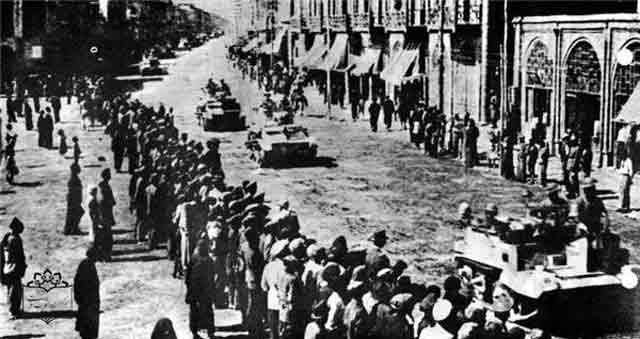
The Anglo-Soviet invasion of Iran concluded. Great Britain and the Soviet Union set up a joint occupation of the country. British and Soviet troops occupied the Iranian capitol, Tehran. This action was taken after the failure of the Iranian government to hand over all remaining German nationals to the British and Soviet authorities.
After weeks of trying to hold on to power, Reza Shah abdicates in Iran as Soviet troops lose patience with his delaying tactics and occupy Tehran. Reza Shah is arrested before he can escape and placed in British custody. Crown Prince Mohammad Reza Pahlavi takes the oath to become the Shah of Iran.
This ends the brief campaign in Iran that began on 25 August 1941 and only involved a few days of fighting. The rest of the time has been taken up with negotiations with Reza Shah that ultimately collapsed. This leaves the Soviets in control in the north of the country and the British south of Hamadan and Qazvin.
While Iran does not get a lot of attention during World War II, it plays a big role. About 26–34 percent of the supplies sent to the Soviet Union under the Lend-Lease Act are sent through Iran. The country serves as a key supply corridor from the Western Allies to the Soviet Union that the Germans can never interdict except with occasional U-boat successes. It is close to the British power center in India and serves as another strand in the British web of strategic outposts in the Indian Ocean.
Reza Pahlavi goes on to serve as Shah Iran for over thirty years until he is finally ousted in a religious uprising on 16 January 1979.
The tragic death of General Eugen Ritter von Schobert in a bizarre airplane accident (his pilot landed in a Soviet minefield, why he was landing there is unclear) creates an opportunity for someone that will have a huge impact on the course of the campaign in Russia. On 17 September 1941, Erich von Manstein is appointed to replace von Schobert in command of the 11th Army.
Manstein already is very well known by the top levels of the German Army despite being only a Corps commander. He is known for having a good relationship with Adolf Hitler, with whom Manstein developed the famous Ardennes breakthrough in 1940. During Operation Barbarossa, Manstein’s LVI Panzer Corps has played a leading role in the advance through the Baltic States toward Leningrad. Manstein is sent from his headquarters near Demyansk to the extreme southern flank of the front. Manstein’s task at the 11th Army will be to take the Crimea, which is not considered to be an exceptionally difficult task.
Elsewhere in the Army Group South sector, the Soviets finally get some good news. The withdrawal from the Kiev pocket is finally approved by Soviet Premier Joseph Stalin, but it is far too late. Colonel General Mikhail Kirponos, commander of the Southwestern Front, would share the fate of many of his soldiers when his column, attempting to withdraw is ambushed and he is cut down. In the end, only 15,000 would escape the encirclement. This is a grave blow to the Soviet Army. German successes mark the heavy fighting in the outskirts of Kiev (Kyiv).
The Romanian Army continues trying to capture Odessa, but they have managed only local successes. The Soviet Black Sea Fleet plays a big role in the defense. Today, Soviet destroyer Dzerzhinski provides naval gunfire in support of the defenders. The Soviets have been bringing troops in from Novorossiysk, and the Soviet high command has high hopes that a determined relief operation in a few days may break the siege and deal the Romanians a mortal blow.
A decree issued by the Soviet State Committee of Defense, restoring Vsevobuch “Universal compulsory military training of the citizens of the USSR” in the face of the “Great Patriotic War”
Bulgaria in a formal note has requested permission for eight Bulgarian destroyers, a submarine, three E-boats and a torpedo boat to pass through the Dardanelles into the Black Sea, it was revealed tonight.
At Adolf Hitler’s Wolfsschanze headquarters in East Prussia, Germany, Erich Raeder once again asked Hitler for permission to attack American shipping; Hitler again rejected him.
The general deportation of German Jews began. Hitler authorized requests made by various officials to deport German, Austrian, Czech, and Luxemburg Jews. Deportations to Lodz were set in motion as a result of this action. This change in policy occurred in a mood of military euphoria combined with the expectation that minor battles would continue into the spring of 1942.
Listening to foreign radio in the German Reich became punishable by death.
The Jager Report (issued on 1 December 1941) noted that 337 adult male, 687 adult female, and 247 children, all Jews, were killed in Vilnius, Lithuania for a total of 1,271 people. 4 Communists were also executed in Vilnius by Jager’s Einsatzgruppen on this date.
The German authorities in Paris served notice today that if and when acts of violence continued an increasingly large number of hostages would be executed in reprisal. The notice was placarded on walls and published in newspapers.
Following attacks on German soldiers in Belgrade, indefinite martial law has been proclaimed by the Serbian puppet regime set up by the Nazis. The regime is planning a punitive expedition into the mountains to round up rebels.
Australian 9th Division continued to be withdrawn from Tobruk, Libya. Relieving them was the British 70th Infantry Division, currently in Beirut in the French Mandate of Syria and Lebanon awaiting transportation by British cruisers HMS Ajax, HMS Neptune, and HMS Hobart which had just departed from Alexandria, Egypt. After sundown, British minelaying cruiser HMS Abdiel and destroyers HMS Jervis, HMS Jaguar, and HMS Hasty made a roundtrip from Alexandria to Tobruk with supplies for the besieged city.
At dawn today, a Royal Navy submarine landed a British agent, Colonel D T Hudson, on the Dalmatian coast for a rendezvous with Tito and the other resistance leader, Mihailovich. Hudson’s orders are to find out which of the two is putting up the tougher fight against the Nazi occupation.
Cardinal Bertram instructs the German bishops on methods of handling the “problem” of the “non-Aryan” Catholics. He suggests using St. Paul’s admonishment to the Romans and Galatians: “among those believing in Christ there is neither Jew nor Greek, for all are one in Jesus Christ.” (Roman 10:12, Galatians 3:28).
At a conference in Copenhagen, Denmark, German physicist Werner Heisenberg warned his mentor Niels Bohr that Germany had embarked on atomic weapon research and gave him a drawing of a reactor as proof.
The British are being cajoled into eating more potatoes, one of the few staple food of which there is no shortage. The ministry of food has fixed their retail price at a penny a pound throughout the year. Ministry advertisements featuring a cartoon character called “Potato Pete” suggest serving a pound per person per day. “Use potatoes in pastry,” he recommends, even going so far as to recommend mashed potato sandwiches. The ministry also sings the praises of carrots and swedes in all guises. Plans are now being made to apply “points” rationing to tinned foods, beginning in November. Each person will get 16 points to spend on what he or she chooses every four weeks.
Thirty-one Swedish sailors lost their lives, twelve were injured and three destroyers went to the bottom at 9:45 AM today in the worst catastrophe in the history of the Swedish Fleet. The explosion, the cause of which has not yet been determined, started aboard the destroyer Göteborg, lying in Haorsfjaerdens Naval Yard in the Stockholm Archipelago.
RAF Bomber Command, Day of 17 September 1941
24 Blenheims to Mazingarbe power-station and chemical works but only 10 bombed, 6 Hampdens to Marquise could not identify the target and did not bomb, 3 Blenheims on uneventful coastal sweeps. No losses of aircraft in any of the bomber forces.
RAF Bomber Command, Night of 17/18 September 1941
Karlsruhe
38 Wellingtons; claimed large fires in the city center. 1 aircraft lost.
Minor Operations: 1 Wellington to Le Havre, 14 Hampdens minelaying between Heligoland and the Elbe. No losses.
The first operation conducted by a British Mosquito aircraft was launched to take photographs of German-controlled ports.
Aircraft carrier HMS Argus and destroyer HMS Eclipse departed Scapa Flow for the Clyde at 0930. Off Shianti Island, destroyer Eclipse was detached and returned to Scapa Flow, arriving at 0600/18th. The aircraft carrier continued unescorted to the Clyde, arriving on the 18th.
Destroyer HMS Lancaster departed the Humber at 1600 on completion of refitting for Scapa Flow. The destroyer arrived at Scapa Flow on the 18th at 1800 to carry out working up exercises.
Submarine HMS Tigris unsuccessfully attacked German convoy R.152 one miles southwest of Loppa in 70-21N, 21-30E.
Convoy WS.11X, which departed Liverpool on the 16th and the Clyde on the 17th, rendezvoused off Oversay on the 17th. The convoy consisted by supply ship Breconshire and steamers Ulster Monarch, Queen Emma, Princess Beatrix, Royal Scotsman, Leinster, Stratheden, Clan Macdonald, Clan Ferguson, Ajax, Imperial Star, City of Lincoln, Rowallan Castle, Dunedin Star, and City of Calcutta. The convoy was escorted by battleship HMS Prince of Wales, light cruisers HMS Euryalus and HMS Kenya, and destroyers HMS Laforey, HMS Lightning, and HMS Oribi, which departed the Clyde on the 16th, HMS Whitehall, HMS Witch, HMS Blankney, ORP Piorun, ORP Garland, and HNLMS Isaac Sweers from 17 September to Gibraltar. Destroyers HMS Havelock and HMS Harvester escorted the convoy from 17 to 19 September when they were detached escorting liner Stratheden to Halifax. Destroyers HMS Foresight, HMS Forester, HMS Fury, and HMS Legion, escorting aircraft carrier HMS Furious, and HMS Zulu, HMS Gurkha, and HMS Lance departed Gibraltar on the 18th to join the convoy on the 19th in 42N, 22-30W. Light cruiser HMS Sheffield departed Gibraltar on the 20th to join the convoy. Destroyer HMS Lively departed Gibraltar on the 20th to join, as did destroyers HMS Cossack, HMS Heythrop, and HMS Farndale on the 23rd. Troopships Ulster Monarch, Queen Emma, Princess Beatrix, and Royal Scotsman, and Leinster proceeded only to Gibraltar. The remainder of the convoy was the HALBERD convoy for Malta. During the night of 20/21 September, troopship Princess Beatrix and stores ship Ajax were in a minor collision.
Convoy ON.17 departed Liverpool, escorted by destroyer HMS Boreas. On the 18th, destroyers HMS Belmont and HMS Bulldog, corvettes Aconit and HMS Heartsease, and anti-submarine trawlers HMS Angle, HMS Cape Warwick, HMS Daneman, HMS Notts County, and HMS St. Apollo joined on the 18th. Destroyers HMS Amazon, HMS Georgetown, and HMCS St. Croix joined the next day. These escorts were detached on the 21st when relieved by destroyer HMS Richmond and corvettes HMCS Fennel, HMS Gladiolus, HMCS Hepatica, and HMS Mimosa. Destroyer Richmond was detached on the 24th. The corvettes escorted the convoy until its dispersal on the 29th.
Destroyer HMS Mendip was escorting convoy FS 605 when it was attacked by German bombers.
German motor torpedo boats S.50, S.51, and S.52 of the 4th Motor Torpedo Boat Flotilla attacked a Convoy off Cromer. British steamer Teddington (4762grt) was badly damaged in 54-03N, 1-35E. The steamer was taken in tow, but went ashore on the 18th two and three quarters miles east, southeast of Cromer Pier. The entire crew was rescued. British steamer Tetela (5389grt) was damaged by a German motor torpedo boat in 53-04N, 1-35E. The steamer was taken in tow and beached at Haile Sand Flat. The steamer was refloated on the 18th and berthed at Hull.
In Stockholm Harbour, Swedish destroyers Klas Uggla, Klas Horn, and Goteborg were seriously damaged in an explosion. Destroyer Klas Horn was repaired from components of destroyers Klas Uggla and Goteborg. Destroyer Goteborg was not repaired.
German steamer Johann Wessels (4601grt) was lost on a mine on the Norwegian coast.
German fishing vessel Luneburg (473grt) was sunk near Osel on a mine and by Soviet artillery.
Convoy HG.73 departed Gibraltar with destroyers HMS Duncan, HMS Farndale, and HMS Vimy, sloop HMS Fowey, corvettes HMS Begonia, HMS Gentian, HMS Hibiscus, HMS Jasmine, HMS Larkspur, HMS Myosotis, HMS Periwinkle, and HMS Stonecrop, and fighter catapult ship HMS Springbank. Destroyer HMS Wild Swan departed Gibraltar on the 19th to join the escort. Destroyers Duncan and Farndale were detached on the 20th. Destroyers Vimy and Wild Swan on the 22nd. The catapult ship was sunk on the 27th. Destroyer HMS Highlander departed Gibraltar on the 20th and joined the convoy escort on the 22nd. She remained until 26 September. Destroyer HMS Wolverine joined the convoy on the 28th. The corvettes were detached on the 30th. The convoy arrived at Liverpool on 1 October with destroyer Wolverine.
From 17 to 27 September, 6300 British troops and 2100-tons of supplies were moved to Tobruk in Operation SUPERCHARGE. Light cruisers HMS Ajax, HMS Neptune, and HMAS Hobart departed Alexandria for Beirut to embark troops. Light cruisers Ajax and Hobart arrived at Beirut on the 18th. Light cruiser Neptune was detached to spend the night of 18/19 September at Haifa, rejoining at Beirut on the 19th. Minelaying cruiser HMS Abdiel and destroyers HMS Jervis, HMS Jaguar, and HMS Hasty departed Alexandria carrying supplies to Tobruk in Serial 1 of the Operation. The minelaying cruiser and destroyers arrived back at Alexandria on the 18th.
Light cruiser HMS Galatea arrived at Port Said.
Dutch steamer Westernland departed Bombay for Singapore with 2061 personnel. From Ceylon, the steamer was escorted by light cruiser HMS Dauntless. Steamer Westernland arrived at Singapore on the 25th.
In Washington today, President Roosevelt nominated Gerard D. Reilly, solicitor of the Department of Labor, to be a member of the National Labor Relations Board. His callers included A. A. Berle Jr., assistant Secretary of State; William C. Bullitt, Marshall Field and Secretaries Stimson and Hull.
The Senate completed Congressional action on the tax bill, passed several bills on the consent calendar, passed the bill to include the Cumberland River in the Tennessee Valley Authority area and adjourned at 2:15 PM until noon tomorrow. A Commerce subcommittee opened hearings on a bill to waive safety-at-sea regulations during the emergency.
The House elected Representative Clarence Cannon as chairman of the Appropriations Committee, authorized the Public Buildings Committee to make an investigation of the defense housing program and adjourned at 12:56 PM until noon tomorrow.
Final Congressional approval was given today to the greatest tax bill in history, and the measure was sent to the White House with every indication that President Roosevelt would sign it in a day or two. The Senate followed the House in approving the conference report. without a record vote, although several Senators expressed displeasure with some parts of the measure. The Treasury estimated that the bill would account for $3,553,400,000 in revenues, but Congressional sources indicated their belief that the yield would surpass $4,000,000,000, which would swell Federal receipts to an all-time high of more than $13,000,000,000. This would be slightly more than half of the estimated expenditures for the fiscal year 1942, which began July 1. Contained in the bill, along with unprecedented increases in various tax rates, was an amendment by Senator Byrd of Virginia calling for appointment of a joint committee of Congress, on which would sit the Secretary of the Treasury and the Director of the Budget, to study means of slashing nondefense expenditures. The committee, to consist of three members each from the House Ways and Means and Appropriations Committees, and three each from the Senate Finance and Appropriations Committees, was authorized to conduct an investigation and was directed to report its findings as soon as possible.
The U.S. Government was reported last night to be prepared to seize 11 strike-bound ships at four east coast and gulf ports unless striking A.F.L. seamen and ship owners agreed to submit a war bonus dispute to arbitration by noon today. It was learned that Admiral Emory S. Land, chairman of the U. S. maritime commission, had issued the ultimatum to both sides.
On the eve of President Roosevelt’s expected request to Congress tomorrow for a new appropriation of from $4,000,000,000 to $6,000,000,000 for lend-lease aid to non-Axis allies, the Administration moved today to make up to $100,000,000 cash available to Russia for the purchase of war supplies in this country.
Opposition to Leon Henderson as the prospective price control administrator appeared likely today to delay the administration’s price control bill still further, despite Henderson’s testimony that the nation already is In the midst of “mild inflation.” Meanwhile Henderson revoked a price ceiling on anthracite which the operators had defied Monday in raising their price 15 cents a ton.
The American Legion national convention by voice vote today endorsed the foreign policy of the president and congress and urged immediate repeal of the neutrality act and removal of all geographical limitations on movement of United States troops. The delegates swept aside a minority report which sought to forbid the national administration from giving lend-lease aid to Soviet Russia.
Secretary of the Navy Knox revealed today that the American navy was convoying British-bound cargoes on the north Atlantic and, in addition, had been searching for a German surface raider believed to be operating on the Pacific. The U.S. Navy takes over responsibility for some of the Halifax-U.K. convoys and most of the Iceland traffic. Canadian naval forces are escorting as far as 22 degrees West where the British take over.
Secretary of the Navy Frank Knox revealed today that the Navy Department was operating the Kearny, New Jersey, shipyard of the Federal Shipbuilding and Drydock Company, at least temporarily, in accord with recommendations of the National Defense Mediation Board, under which members of the C.I.O.’s Industrial Union of Marine and Shipbuilding Workers must remain in good standing as a condition of employment.
Replying to the address delivered in Chicago Tuesday evening by former President Herbert Hoover, in which he urged that this country adopt a waiting policy and let Hitler Germany destroy itself, Wendell L. Willkie assailed Mr. Hoover’s policy as based upon a “wholly unrealistic doctrine” and charged that American isolationism bears a great responsibility for the condition of the world today.
Holding the view that isolationism endangered this country’s future, 176 active or emeritus members of the Stanford University faculty issued a statement today supporting “a more dynamic policy of action” as our best protection against the totalitarian menace.
President Roosevelt’s radio address announcing orders to the Navy to shoot on sight to protect American defense waters also meant the “elimination of Congress,” Senator Charles W. Tobey, isolationist of New Hampshire, declared at a meeting in Carnegie Hall of the America First Committee last night.
Kansas City was without light and power and virtually without water early today as employees of the Kansas City Power & Light Co. struck suddenly at midnight. Only one small water pumping station was operating at 12:30 AM. The city went black at the stroke of midnight when, without warning, A.F.L. electrical workers threw the power company’s master switches. However, a sufficient force of non-striking employees returned to work to restore service before the majority of the sleeping populace was aware of the shutdown.
The government resorted yesterday to the use of motion pictures in open court to buttress its case against Frederick Joubert Duquesne, described as a veteran espionage agent of more than forty years’ experience, as the trial of Duquesne and fifteen others accused of espionage continued before Judge Mortimer W. Byers and a jury in the United States District Court in Brooklyn.
John L. Lewis, head of the United Mine Workers, C.I.O., proposed today a plan under which production would be resumed of bituminous in thirty “captive” mines, essential to steel production. However, details of the plan were not made public as coal operators and members of the National Defense Mediation Board studied it.
During the Louisiana maneuvers, the U.S. Army dropped paratroopers for the first time in a tactical exercise. Thirteen Douglas DC–3s acquired for the purpose dropped a parachute company.
The U.S. Government allocates US$100,000,000 (US$1.176 billion in year 2000 dollars) to the Soviet Union for the purchase of war materials.
Major League Baseball:
The Red Sox, surging from behind with a two-run ninth-inning rally, extended their victory string to eight straight today as they defeated the Indians and former team-mate Jim Bagby, 3–2.
The Chicago Cubs’ Vern Olsen (10-7) beats the New York Giants for the fourth time this season, as the Cubs win, 7–3. Due to wildness of the Giants’ starting pitcher, Lefty Dave Koslo, the new purchase from Milwaukee, and the carelessness of his support, the Cubs jumped away to a 2-run lead in the first round and were never caught.
The Reds took a twin bill from the Phillies today. A hit batsman with the bases full decided the second game, 3–2, after Johnny Vander Meer had yielded only three hits and fanned eleven to win, 1–0. The first game was Vander Meer all the way as he ran his season’s strikeouts to 195. He walked none until Johnny Rizzo batted for Rube Melton in the ninth. The nightcap was marked by three hit batsmen, with Bill Werber the last. Harry Craft was knocked out in the sixth and sent to a hospital for X-rays.
The Yankees took their last look at a Western club this year yesterday unless — if you will pardon so heretical a thought — they tangle with the Cardinals in the world series. They gazed at the White Sox and promptly flattened them at the Stadium, 5–3. It was a typical Bomber demonstration. Spud Chandler was nicked for four hits and three runs in the first three innings but then settled down to yield only one scratch safety the rest of the way. More typical, perhaps, was the way the New Yorkers reacted to the pitching of Edgar Smith.
Phil Marchildon’s generosity with bases on balls and a two-run error by Sam Chapman gave the Detroit Tigers a 3–2 victory over the Philadelphia Athletics today. The defeat was the fifth in a row for the A’s.
In Pittsburgh, the Dodgers win, 6–4, behind Curt Davis. Still sticking to their nerve-jangling habit of doing everything the hard way in the desperate drive for the first Brooklyn pennant in twenty-one years, the Dodgers today blasted their way from apparent defeat to a triumph over the Pirates by scoring five times in the ninth inning.
In baseball, 20-year-old Stan Musial makes his major league debut for the St. Louis Cardinals against the Boston Braves in Sportsman’s Park, St. Louis. Before just 3,585 fans in St. Louis for a double header with the Braves, the Cards take the opener, 6–1, behind Howie Pollet. In game 2, another rookie makes his debut as Stan Musial goes 2-for–4, hitting a 2-run double off knuckler Jim Tobin. St. Louis wins, 3–2, on Estel Crabtree’s homer. Musial, who started the season in the Western Association (Class C), will hit .426 in 12 games. The sweep moves the Cards to one game behind the Dodgers in the National League pennant race.
Three straight singles in the tenth inning brought the Washington Senators a 9–8 victory over the Browns today. Washington combed three St. Louis hurlers for 20 hits.
Cleveland Indians 2, Boston Red Sox 3
New York Giants 3, Chicago Cubs 7
Philadelphia Phillies 0, Cincinnati Reds 1
Philadelphia Phillies 2, Cincinnati Reds 3
Chicago White Sox 3, New York Yankees 5
Detroit Tigers 3, Philadelphia Athletics 2
Brooklyn Dodgers 6, Pittsburgh Pirates 4
Boston Braves 1, St. Louis Cardinals 6
Boston Braves 2, St. Louis Cardinals 3
St. Louis Browns 8, Washington Senators 9
Admiral Thomas Hart proposed to move his naval forces in the Philippine Islands south to combine with the British allies to better counter the more powerful Japanese Navy should it attack. He would change his mind on this plan before the start of the Pacific War.
Japanese troops crossed the Sinchiang River during advance on Changsha, China. The Japanese 11th Corps, some 125,000 strong, launches attacks at Changsha in the Hunnan Providence, 350 miles (563 kilometers) east of Chungking.
Sin Shun Pao, newspaper of the Japanese Army, charged today that Britain and Germany were trying to defeat Japanese-American diplomatic negotiations for better relations. Despite the alleged opposition, the newspaper said, “firm United States and Japanese determination” would bring a reconciliation based on the following principles:
• Conclusion of a friendship and non-aggression pact and the exchange of guarantees of permanent peace in the Pacific.
• Provision for special conferences to arbitrate problems that might arise.
• Respect for accomplished facts.
Apparently the “respect for accomplished facts” would entail American recognition of Japan’s satellite, Manchukuo, and of Japanese domination in China.
IJN light carrier Hosho departed Hashirajima, Japan and arrived at Kure, Japan later on the same day.
Australian Prime Minister Arthur W. Fadden, reviewing the war situation in the House of Representatives today, said Russia’s position was serious and that Australia’s security was imperiled as never before.
The New Zealand Labour Party abolishes the death penalty; it is reintroduced by the National government in 1950 before being finally removed from the statute book in 1961)
Dow Jones Industrial Average: 129.32 (+1.89)
Born:
Bob Matsui, American politician (Rep-D-California, 1979-2005), in Sacramento, California (d. 2005).
William Grut, Swedish pentathlete (Olympic gold medal, 1948), in Stockholm, Sweden (d. 2012).
Angela Pleasence, British actress (“Mansfield Park”, “The Barchester Chronicles”), in Chapeltown, England, United Kingdom (d. 2026).
Naval Construction:
The Kriegsmarine (German Navy) Type VIIC U-boat U-356 is launched by Flensburger Schiffsbau-Ges, Flensburg (werk 475).
The Kriegsmarine (German Navy) Type VIIC U-boats U-595 and U-596 are launched by Blohm & Voss, Hamburg (werk 571 and 572).
The Royal Navy Fairmile B-class motor launch HMS ML 273 is commissioned.
The Kriegsmarine (German Navy) Type VIIC U-boat U-405 is commissioned. Her first commanding officer is Korvettenkapitän Rolf-Heinrich Hopmann.
The Kriegsmarine (German Navy) Type VIIC U-boat U-656 is commissioned. Her first commanding officer is Kapitänleutnant Ernst Kröning.
The Вое́нно-морско́й флот СССР (ВМФ) (Soviet Navy) “K” (Katjusa)-class submarine K-51 is commissioned.
 History Diaries