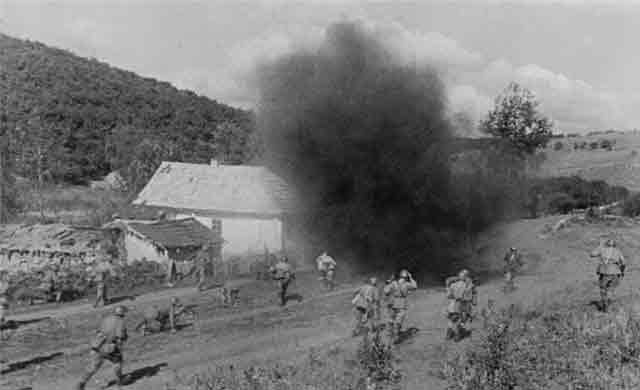
General Guderian’s Panzer Group 2 has been diverted from the road to Moscow in order to encircle Kyiv. However, as of 10 September 1941, for the past week or so the panzers have been stalled on the Desna River while beating off furious Soviet attacks on its eastern flank. This has led to a furious Hitler row and the Führer’s meddling in Guderian’s troop dispositions, which Hitler believed too far to the east.
Today, Guderian’s armor shakes off the Russian attacks and breaks loose to the southeast again. His forces take Konotop, cutting the main road from Kyiv to the east. Thirty miles to the south, General Walter Model’s 3rd Panzer Division of XXIV Army Corps (motorized) takes Romny. The grand plan is starting to come together.
OKH Chief of Staff General Franz Halder notes this sudden success with puzzlement in his war diary:
“Curiously, there are no attacks against [Guderian’s] east flank. Perhaps this has something to do with the extensive railroad demolitions by our air efforts. On the defensive front, the danger zones west of Bryansk and east of Smolensk stand out as never before, but temporarily at least there is a lull in the attacks Nevertheless, resumption of the attacks must be imminent in view of the railroad movements from Moscow or Tula to Bryansk, and of the very heavy motorized movement toward Smolensk.”
Today is usually marked as the end of the battle of Smolensk. Operation Barbarossa was supposed to go like this all along, so Halder’s skepticism is a sign of how different the reality has been.
This sudden fortuitous change in events seems to confirm Hitler’s recent interference in Guderian’s dispositions, which adds to his growing confidence in his own military judgment. These affirmations of Hitler’s amateurish interference have long-term consequences.
Not only is Guderian suddenly breaking out, but there are good signs for the Wehrmacht elsewhere as well. A couple of hundred miles to the south, General Ewald von Kleist’s Panzer Group 1 also breaks out from its bridgehead across the Dneipr at Kremenchuk. Soviet 38th Army counterattacks Kleist’s panzers ineffectively.
A quick glance at the map shows the extreme peril of the massive Soviet troop concentration holding Kyiv that is led by Marshal Budyenny. Hard-pressed by German Sixth Army’s frontal assault, the Soviets holding the city now face encirclement a hundred miles to the east. This area of Ukraine is an excellent tank area for tank movements, with flat plains and relatively few waterways. While Kleist’s and Guderian’s panzers are far apart on the map, they theoretically could meet within only a few days. The noose around Kyiv is tightening, and all of the military professionals on both sides can see it.
Soviet Colonel-General Mikhail Petrovich Kirponos, in command of the Southwestern Front at Kyiv, urges the Stavka to take precautions as diplomatically as he can. Instead of asking for himself, he simply “relays the concerns of others,” a standard tactic when one knows the request is likely to be denied:
“The enemy tank group has penetrated to Romny and Gaivoron. The 21st and 40th Armies are not able to liquidate this group. They request that forces be immediately transferred from the Kiev Fortified Region to the path of the enemy advance and a general withdrawal of front forces.”
Kirponos has a good grasp of the situation and is a competent commander. Among other things, he took the prospects of a German invasion seriously on the eve of Operation Barbarossa and managed to keep his forces in better shape than other frontier commanders. However, in Moscow, Kirponos, despite his proven success, is seen as a bit of a weak figure, someone without the true offensive spirit. That Kirponos urges a tactical focus on the defensive again is seen as just another sign of his lack of intestinal fortitude. The Stavka ignores him.
In any event, overall Southwestern Direction Commander Marshal Budyenny already has requested permission to withdraw from Kyiv, and that request has been denied. Stalin has told Budyenny to keep his forces where they are no matter what happens. This defies tactical logic but at this point in the war, Stalin is simply playing for time. Stalin needs to prolong the situation in the south at all costs because, otherwise, the situation in the north will deteriorate faster. He is awaiting lend-lease shipments, and the weather won’t stay nice forever. Stalin’s forces have to continue to hold out for weeks for his delaying tactics to work, but the Germans will decide if that happens more than Stalin will.
The Luftwaffe raids Leningrad hitting the cities dairy and starting dozens of fires. Two hundred citizens are killed in the night’s raid.
The entire Jewish community of Meretsch (Merkinė), in Lithuana, is exterminated, resulting in the mass murder of roughly 854 Jewish men, women, and children in a single day.
German authorities in Oslo, Norway, declared martial law and trade union officials were arrested in order to prevent a trade union plan for a general strike. Guards with Tommy guns are patrolling the streets of Oslo tonight after a savage crackdown by Josef Terboven. Hitler’s commissioner for Norway. Two trade union leaders have been executed after a summary court martial and four others have been sent to gaol. An 8pm to 5am curfew is in force. Dance halls are closed and the sale of alcohol is forbidden. Newspaper editors have been sacked and all meetings, indoors and outdoors have been banned. Terboven declared martial law after reports that the Norwegian unions were calling a general strike in opposition to the Nazi regime. Terboven accused “communist elements” in the unions of “disturbing the industrial peace in a criminal manner.” The underground anti-Nazi newspaper Fri Ragbevegelse has called on the people to remain calm, but to fight “with all secret means for their rights.”
The workers were upset that their milk rations were ended. This was the famous “Milk Strike.” The authorities arrest five labor activists and shoot two of them, lawyer and Communist Viggo Hansteen and labor activist Rolf Wickstrom. There is a monumental joint tombstone and memorial to them in Oslo.
Athens dispatches to the German newspaper Donauw Zeitung of Belgrade today reportad the imposition of death sentences on five Greeks and the confiscation of the properties of former Greek statesmen and all their relatives to the second degree. The newspaper said German military authorities in Greece had announced the death sentences of a Salonika merchant accused of having helped two Britons to escape, three farmers near Athens for the possession of weapons and a farmer in Crete for the sabotage of German telephones.
Scirè departed La Spezia, Italy for Gibraltar with three manned torpedoes on board.
Generalleutnant August Krakau succeeded Robert Martinek as the commanding officer of the German 7th Mountain Division.
HMCS Moosejaw and another Flower-class corvette HMCS Chambly shared the sinking of the German submarine U-501 by depth charges and ramming; 11 German sailors were killed along with 1 Canadian sailor who boarded the sinking submarine; 37 German sailors survived.
German submarines U-81, U-82, U-85, U-432, and U-652 attacked Allied convoy SC-42 100 miles east of Greenland, sinking 6 merchant vessels and damaging 2 more on this day. The Battle of Convoy SC.42 will continue and become one of the most costly convoy battles of the war.
The first B-24 Liberator bombers were en route for Britain.
The collaborationist Paris newspaper, L’Oeuvre describes the burgeoning black market for food. “Nothing has been settled about how to feed Paris. …. indispensable vegetables are swept off the board and only the minority who can pay through the nose enjoy them. People of average means are .. deprived, …and have not the wherewithal to take the time to go and eat in Normandy or Brittany. Potatoes are .. unfindable. But the Black Market manages to infiltrate enormous quantities for restaurants or customers willing to pay 8 or 9 francs a kilo.”
The Van–Erciş earthquake in eastern Turkey killed 192 people.
RAF Bomber Command, Day of 10 September 1941
6 Blenheims on shipping sweep off the Dutch Frisians. Ships near Terschelling were attacked but not hit. No losses.
RAF Bomber Command, Night of 10/11 September 1941
Turin
76 aircraft – 56 Wellingtons, 13 Stirlings, 7 Halifaxes. 4 Wellingtons and 1 Halifax lost. Bombing was affected by smoke and haze but good results were claimed in the center of the city and on the Fiat steelworks.
There were 3 O.T.U. leaflet sorties to France without loss.
Battleship HMS Prince of Wales departed Scapa Flow at 1300 with destroyers HMS Lamerton, HMS Badsworth, and HMS Puckeridge to exercise west of Hoy. At 1330, minelaying cruiser HMS Welshman and destroyers HMS Laforey and HMS Ashanti departed Scapa Flow to relieve the Hunt-class destroyers in the battleship Prince of Wales’ screen. The battleship and screen would then proceed to Hvalfjord to prepare for operations against the German heavy cruiser Admiral Scheer which was expected to attempt a break through into the Atlantic. Heavy cruiser HMS London was ordered to patrol the western approaches to Denmark Strait. At 1430, battleship Prince of Wales was ordered to remain in her practice area and at 2212 was ordered to return to Scapa Flow. The ships were ordered to revert to normal notice at 2025/11th. At 2051, heavy cruiser London was ordered to return to Hvalfjord. The ships arrived back at Scapa Flow on the 11th when the operation was canceled. Heavy cruiser London arrived back at Hvalfjord on the 12th.
Minelaying cruiser HMS Manxman departed Scapa Flow for Loch Alsh.
Light cruiser HMS Sheffield departed Scapa Flow for the Clyde in her return to Gibraltar. The cruiser arrived at the Clyde on the 11th.
Destroyer HMS Lightning, en route to Scapa Flow from escorting battleship HMS Duke of York, was in a collision with minesweeping trawler HMS Strathgeldie (192grt) in 58-12N, 2-21W. The destroyer was damaged and the trawler was badly damaged. Destroyer Lightning escorted the trawler to Wick before continuing on to Scapa Flow, where she arrived at 0530/11th. Destroyer Lightning departed Scapa Flow at 1730/15th for the Clyde for repairs.
U-501, commanded by Korvettenkapitän Hugo Förster, was sunk in the Straits of Denmark south of Angmagsalik, Greenland by depth charges and ramming from the Canadian corvettes HMCS Chambly (K 116) and HMCS Moosejaw (K 164). Of the ship’s complement, 11 died and 37 survived. One Canadian rating was lost after boarding the submarine prior to sinking. During its career the U-501 sank 1 ship or a total of 2,000-tons.
U-432, commanded by Oberleutnant zur See Heinz-Otto Schultze, sank British steamer Muneric (5229grt) from convoy SC.42 in 61-38N, 40-40W. At 0230 hours on 10 Sep 1941, U-432 fired four single torpedoes at three ships in convoy SC.42 south of Cape Farewell and heard two detonations. Schultze thought that he had hit two ships, but in fact only the Muneric (Master Frank Baker) was hit and sunk by two torpedoes. The master, 55 crew members, five gunners and two stowaways were lost. The 5,229-ton Muneric was carrying iron ore and was headed for Middlesbrough, England.
U-652, commanded by Oberleutnant zur See Georg-Werner Fraatz, damaged British steamers Tahchee (6508grt) and Baron Pentland (3410grt) in 61-15N, 41-05W. At 0452 hours on 10 Sep 1941, U-652 (Fraatz) fired two single torpedoes at ships of the convoy SC.42 northeast of Cape Farewell, heard two detonations after three minutes and reported two ships probably sunk. In fact, Tahchee and Baron Pentland were damaged.
The Tachhee in station #93 was hit by a torpedo just forward of the engine room, caught fire and was abandoned by the crew. Later the crew reboarded the vessel and managed to extinguish the flames. HMCS Orillia (K 119) (T/LtCdr W.E.S. Briggs, RCNR) of the 24th Escort Group came across her while looking for survivors behind the convoy and took the tanker in tow for Iceland at a speed of 7 knots. En route the corvette even had to refuel from the damaged tanker to safely arrive at Reykjavik after 700 miles on 15 September. Briggs was both praised and criticized for his actions because he had left the convoy without reporting it, but was later awarded the DSC. After temporary repairs Tahchee was towed to the Tyne in June 1942, repaired and returned to service in November 1942. The 6,508-ton Tahchee was carrying fuel and diesel oil and was bound for Liverpool, England.
Two crew members from Baron Pentland (Master Alexander Bleasby Campbell) were lost. The master, 30 crew members and eight gunners abandoned ship in position 61°15N/41°05W and were picked up by HMCS Orillia (K 119) (T/LtCdr W.E.S. Briggs, RCNR) of the 24th Escort Group and landed at Reykjavik. The vessel remained afloat due her load of timber despite of a broken back and the wreck was eventually torpedoed and sunk by U-372 at 1433 hours on 19 September.
U-432, commanded by Oberleutnant zur See Heinz-Otto Schultze, sank Dutch steamer Winterswijk (3205grt) 61-38N, 40-40W and Norwegian steamer Stargard (1113grt) in 61-30N, 40-30W from convoy SC.42. Between 0707 and 0709 hours on 10 Sep 1941, U-432 fired three bow torpedoes and one stern torpedo at ships in the convoy SC.42 and observed one ship sinking in two minutes and a hit on another ship. The ships hit were Winterswijk and Stargard.
The survivors from Winterswijk (Master J. de Groot) in station #25 were picked up by a corvette and landed at Gourock. Of the ship’s complement, 20 died and 13 survivors were picked up by a corvette. The 3,205-ton Winterswijk was carrying phosphates and was headed for Methil, Scotland.
The Stargard (Master Lars Larsen) was hit amidships in the engine room by one torpedo. The explosion tore open the bridge deck and destroyed both port lifeboats and caused a heavy starboard list when the ship settled by the stern with the entire midships section enveloped in steam. Two men on watch below were killed and the master and two crewmen were thrown overboard, but were rescued by a starboard lifeboat, which had been launched by three men. The remaining survivors stayed on board and were soon thereafter taken off by the Norwegian steam merchant Regin. The men in the boat were picked up after 30 minutes by a corvette and landed in Reykjavik on 13 September, where the master and two crewmen were taken to a hospital. The ship was last seen about two hours after being torpedoed, lying on her starboard side. The 1,113-ton Stargard was carrying lumber and was headed for London, England.
U-81, commanded by Kapitänleutnant Friedrich Guggenberger, sank British steamer Sally Mærsk (3252grt) from the convoy in 61-40N, 40-30W. At 0728 hours on 10 Sep 1941, U-81 fired two torpedoes at the convoy SC.42 east-northeast of Cape Farewell and observed a ship sinking after two hits. At 0729 hours, another spread of two torpedoes was fired and two detonations were heard, but at the time visibility was bad. At 0753 hours, the stern torpedo was fired that hit but was probably a dud. Guggenberger reported one ship certain and two others probably sunk, but from Allied reports only the sinking of Sally Mærsk (Master J.K. Lindberg) is confirmed. The master, 28 crew members and five gunners were picked up by HMCS Kenogami (K 125) (LtCdr R. Jackson, RCNVR) and landed at Reykjavik. The 3,252-ton Sally Mærsk was carrying wheat and was headed for Sharpness, England.
U-82, commanded by Oberleutnant zur See Siegfried Rollmann, sank British CAM ship Empire Hudson (7465grt) from the convoy in 61-28N, 39-46W. At 0957 hours on 10 Sep 1941 the Empire Hudson (Master John Campbell Cooke) in convoy SC.42 was torpedoed and sunk by U-82 northeast of Cape Farewell. Four crew members were lost. The master, 47 crew members, six gunners and nine RAF personnel were picked up by the British merchant Baron Ramsay and the Norwegian merchant Regin and landed at Loch Ewe. The 7,465-ton Empire Hudson was carrying wheat and was headed for Liverpool, England.
U-85, commanded by Oberleutnant zur See Eberhard Greger, sank British steamer Thistleglen (4748grt) from the convoy in 61-59N, 39-46W. At 1642 hours on 10 Sep 1941, U-85 fired a spread of two torpedoes at a ship in the convoy SC.42 northeast of Cape Farewell and reported one ship sunk and another probably damaged after observing one hit and hearing a second detonation. However, only Thistleglen (Master Gordon Frederick Dodson), the ship of the vice-commodore, was hit by one torpedo and sank later. Three crew members were lost. The master, 39 crew members and six gunners abandoned ship in three lifeboats and two rafts and were picked up after about one hour by the Lorient, a straggler from the same convoy and landed at Belfast. The 4,748-ton Thistleglen was carrying pig iron and steel and was headed for Glasgow, Scotland.
The great convoy battle of SC.42 would continue for many days.
On the 11th, U-85 sank British tanker Bulysses (7519grt) in 62-40N, 38-50W and steamer Gypsum Queen (3915grt) in 63-05N, 37-50W. Four crewmen were lost on the tanker. Nine crewmen and one gunner were missing on steamer Gypsum Queen.
U-432 sank Swedish steamer Garm from the convoy on the 11th in 63-02N, 37-51W. Six crewmen were lost on the Swedish steamer. U-433 damaged Norwegian steamer Bestum (2215grt) from the convoy on the 11th in 63N, 37W.
U-207 sank British steamer Stonepool (4815grt) in 63-05N, 37-50W, British steamer Berury (4924grt) in 62-40N, 38-50W, and Canadian steamer Randa (1558grt) in 63N, 37W from the convoy on the 11th. Forty two crewmen were lost on steamer Stonepool. One crewman was lost on steamer Berury. The steamer was scuttled by a British warship.
U-82 sank British steamer Empire Crossbill (5463grt) and damaged Swedish steamer Scania (1980grt) in 63-14N, 37-12W from the convoy. The entire crew on steamer Empire Crossbill was lost. U-202 sank damaged Swedish steamer Scania (1980grt), straggling behind the convoy, in 63-14N, 37-12W on the 11th. There were no casualties on the steamer Scania.
Corvettes HMCS Chambly and HMCS Moosejaw joined the convoy on the 11th. Later in the morning, the convoy was joined by Canadian corvette HMCS Wetaskiwin, Corvettes HMS Mimosa and HMS Gladiolus, and anti-submarine whaler HMS Buttermere. During the afternoon of 11 September, the 2nd Escort Group joined the convoy with destroyers HMS Douglas (SO ), HMS Veteran, HMS Saladin, HMS Skate, and HMS Leamington.
On the 11th, destroyers HMS Leamington and HMS Veteran sank U-207 in the Denmark Strait in 63-59N, 34-48W. The entire crew of forty one was lost in the submarine.
Destroyers HMCS St. Croix from convoy SC.41 and HMCS Columbia from convoy HX.147 joined the convoy on the 12th. On the 12th, U-84 attacked and reported damaging a steamer in the convoy. US destroyers USS Sims, USS Charles F. Hughes, and USS Russell joined the convoy to allow the destroyers of the 2nd Escort Group to refuel on the 13th.
On the 16th, U-98 sank British steamer Jedmoor (4392grt) in 59N, 10W and reported damaging another steamer. Thirty one crewmen, including five gunners, were lost on the steamer Jedmoor.
On the 19th, U-372 sank British steamer Baron Pentland (3410grt), straggling behind the convoy after being torpedoed on the 10th, in 61-15N, 41-05W.
U-111, commanded by Kapitänleutnant Wilhelm Kleinschmidt, sank Dutch steamer Marken (5719grt) north of Ceara, Brazil in the western Atlantic Ocean at 1-36N, 36-55W. At 1953 hours on 10 September 1941 the unescorted Marken (Master Anthonie Kokké) was hit on the port side in #2 hold by one torpedo from U-111 while steaming on a zigzag course at 12 knots about 335 miles north-northeast of Fortaleza, Brazil. The explosion blew the hatch covers off and lifted one of the aircraft carried as deck cargo into the air. The crew stopped the engines and began to abandon ship in two lifeboats after it was reported that the wireless gear and the 4in gun at the stern (the ship was also armed with four machine guns) were out of action, all hands having left about 15 minutes after the hit. Shortly afterwards a second torpedo struck on starboard side in #4 hold, falling the main mast and causing the ship to sink quickly. The U-boat then surfaced and approached the lifeboats to question the survivors. Initially the conversion was in English but soon carried on in German, asking for the name of the ship and nature of cargo. The commander asked if any of the boats needed food, brandy or a compass, offering to supply them if necessary, but no assistance was required so he only gave them the course to the nearest land. The survivors were picked up after 54 hours by the Panamanian steam tanker Stanvac Manila which was attracted by the use of a flashing lamp and landed at Santos on 19 September. The 5,719-ton Marken was carrying aircraft and was headed for Calcutta, India.
British drifter HMS Christine Rose (T/Skipper R. W. Griffiths RNR) was lost when she grounded on Knap Rock, Argyll. Griffiths was lost in the trawler.
German steamer Julius Hugh Stinnes 27 (2530grt) was lost on a mine near Kolberg.
German auxiliary minesweeper M.1102 (trawler H. A. W. Muller, 460grt) was sunk by an RAF aerial torpedo in 58-08N, 6-38E.
Battleship HMS Queen Elizabeth, minelaying cruisers HMS Abdiel and HMS Latona, and destroyers HMS Jackal and HMAS Nizam were exercising from Alexandria.
Light cruiser HMS Naiad with destroyers HMS Jackal and HMS Hotspur were at sea to direct night fighters.
Destroyer HMS Jackal rescued a party of two Army officers, three soldiers, and nine Greeks which had escaped from Greece in a caique and were making for Alexandria.
Submarine HMS Thunderbolt sank Italian steamer Svam I (388grt) in the Gulf of Sirte.
Panamanian steamer Honduras (4524grt) was damaged by German bombing at 28-04N, 33-29E off Suez. The steamer was able to arrive under her own power at Zafarana.
Italian submarine Topazio sank British ferry Murefte (691grt) in 33-12N, 34-35E. One crewman was lost on the ferry. The survivors were picked up by Egyptian steamer Talodi (1585grt). Destroyers HMS Kipling, HMS Jackal, HMS Hasty, and HMS Hotspur departed Alexandria and destroyers HMS Hero and HMS Griffin departed Haifa to hunt for this submarine. Destroyers Kipling and Hasty returned to Alexandria on the 13th. Destroyers Hero, Griffin, Jackal, and Hotspur arrived at Haifa on the 14th.
Submarine HMS Torbay damaged German steamer Norburg (2392grt) in Candia Harbour.
Submarine HMS Proteus arrived at Gibraltar from refitting at Portsmouth from December 1940 to 17 August. The submarine had departed Holy Loch on the 3rd.
RAF bombers from Malta damaged Italian heavy cruiser Bolzano at Messina. Twelve crewmen were killed and 30 wounded.
Convoy HX.149 departed Halifax, escorted by destroyers HMCS Annapolis and HMCS Hamilton and armed merchant cruiser HMS Ascania. Destroyer HMS Churchill joined on the 12th. Destroyers HMCS Annapolis and HMCS Hamilton were relieved on the 13th by corvettes HMCS Arrowhead, HMS Camellia, HMS Celandine, and HMCS Eyebright. Destroyer Churchill and the four corvettes were relieved on the 20th by destroyers HMS Malcolm and HMS Watchman, corvettes HMS Arabis and HMS Petunia, and anti-submarine trawlers HMS Northern Gem, HMS Northern Pride, and HMS Northern Spray. Corvette HMS Monkshood joined on the 22nd. The armed merchant cruiser and corvette Petunia were detached on the 24th. The convoy arrived at Liverpool on the 25th.
President Roosevelt conferred tonight with key members of his cabinet, immediately after his return to the capital, in preparation for his momentous announcement on foreign policy to be broadcast to the world tomorrow night. There was speculation that the broadcast may include a call for repeal of the neutrality act or the use of convoys to safeguard lend-lease shipments to nations resisting the Axis. President Roosevelt arrived in Washington at 9:15 (E.D.T.) tonight and held a two-hour conference at the White House with key officials to discuss final plans for ordering the Navy to take whatever steps may be necessary to protect American shipping on the seas, and to convoke Congress Monday or Tuesday to ask for repeal of the Neutrality Act. The Chief Executive is expected generally to announce steps taking the United States closer to active belligerency in his radio speech to the world from the White House tomorrow night at 10 P.M. (E.D.T.), and in tonight’s conference he was understood to have informed the Secretaries of State, War and Navy of his plans and obtained their advice. The first hint that repeal of the Neutrality Act figured in prospective developments came from informed circles in Capitol Hill, after it was learned that members of Congress, originally scheduled to be on vacation until September 22, had been requested to come back to Washington next Monday or Tuesday. The President was greeted at the Union Station here by Secretary Hull, who went aboard the Executive’s car for a brief chat before they drove to the White House, where they were joined by Secretaries Stimson and Knox.
An overall study of the Lend-Lease, defense and civilian requirements from America’s productive machine was ordered today by the Supply Priorities and Allocation Board in what was regarded as one of the most important steps taken in fifteen months by a defense agency. SPAB stated that it had assigned to Donald M. Nelson, its executive director, the responsibility for compiling and organizing for the first time in history a schedule which would show the requirements in terms of labor, raw materials and machinery for producing the war materials necessary to match the nation’s pledge of all-out defense and all-out aid to the nations resisting the Axis powers, and, at the same time, keep the civilian economy functioning on an even keel. While critics and friends of the defense program have argued that this was a long-felt need, it was the first time that any defense agency had admitted its urgency and taken steps to alleviate the lack of knowledge about an overall program so that realistic measures could be taken to correct apparent deficiencies.
While the State Department approved an Anglo-American agreement regulating Britain’s use of Lend-Lease materials and President Roosevelt prepared to send to Congress his second report on expenditures under the first Lend-Lease bill, government officials put the final touches today on a second Lend-Lease bill calling for an appropriation of nearly $6,000,000,000.
Charlie Chaplin was accused today of using the cinema to “poison the minds of the American people to go to war”. Senator Bennett Champ Clark, a leading isolationist, told a Senate sub-committee investigating propaganda charges against Hollywood that United Artists was dominated by Chaplin and Alexander Korda, two British subjects, who were using it to make pro-war propaganda. United Artists made The Great Dictator. Chaplin, he said, had made his fortune in America, but never thought well enough of it to become a US citizen. He claimed that British propaganda had dragged America into the last war.
Wendell L. Willkie, counsel for the motion picture industry, tonight accused senate non-interventionists of employing a “rump subcommittee investigating alleged movie war propaganda to fight “the foreign policy of their country.” He particularly assailed Senators Bennett C. Clark, Missouri Democrat, and Gerald P. Nye, North Dakota Republican, co-sponsors of a yet-unapproved resolution calling for a special senate committee to investigate film propaganda.
The national mediation board revealed tonight that Wayne Lyman Morse, Dean of the University of Oregon law school, will head the special five-man board set up by President Roosevelt to investigate the dispute between the nation’s railroads and their employees.
A joint conference committee worked today to adjust Senate-House differences in the record-breaking revenue bill, but ended the meeting without agreeing on any of the major controversies.
Major General William N. Porter, Chief of the Chemical Warfare Service, in an address tonight before the annual Autumn meeting of the American Chemical Society, warned that while poison gas warfare has so far Been absent from the battlefields of Europe and Asia, Hitler is likely to use it “at any moment.”
Hearings of a special Senate committee into the gasoline shortage on the Eastern seaboard were recessed today for a period of “watchful waiting” as Senator Maloney, the chairman, called upon the public to “take seriously the conservation of petroleum products and all other fuels.”
Richard T. Frankensteen, director of the Aircraft Division of the United Automobile Workers of America, C.I.O., threatened today to call a strike of 16,000 West Coast aircraft workers, but agreed that he would favor putting the dispute before the National Defense Mediation Board if direct parleys failed to break the deadlock.
Refusal of women relief recipients to accept jobs as crossing guards resulted in all but 100 of Los Angeles’ 325 school crossings remaining unpatrolled today as more than 300,000 children returned to classes in public and private schools. County Manager Wayne Allen said that of 1,300 women who were asked to take $50-a-month jobs as crossing guards, fewer than half responded and that virtually all excused themselves or were rejected for physical disabilities. Only 70 women guards were on duty today. Allen said women who refused the jobs would be eliminated from county relief rolls.
Answering an anonymous telephone call, police went to a lower east side New York tenement late last night. There they found four emaciated children, clad in rags and sobbing from hunger. On the floor of the tenement were 20 empty liquor bottles and an empty potato sack. The youngest child, aged 2, sat on a bare, dirty mattress. The oldest, aged 10, greeted police with, “Gee, we’re glad to see you.” Police still are searching for the parents.
The Navy has organized a force within the Marine Corps which will be trained and equipped with every modern device for lightning attacks on enemy shores. Establishment of the organization, known as the Atlantic Amphibious Force, was disclosed as a result of the announcement today of promotions of Marine Corps and naval officers. The composition of the force was kept secret, except that it will include marines from Quantico, Virginia, and Parris Island, South Carolina. Headquarters will be at New River, South Carolina Major General Holland M. Smith will be in command. Brigadier General Philip H. Torrey, commander of Quantico base, who was promoted today to major general coincident with his new assignment, will be the director of operations.
The U.S. 88th Infantry Battalion commenced training to convert to an air-landed role, following in the footsteps of the 550th Battalion which had successfully converted in late 1940.
Major League Baseball:
The Boston Red Sox closed their 1941 series with Detroit today by downing the Tigers, 11–2, thus breaking even in the season’s 22 games. Boston scored enough in the four-run first off Bobo Newsom to settle the issue.
In Chicago, Johnny Schmitz makes his pitching debut and notches a victory by throwing only one pitch in the 9th inning, hit for a double play by Cookie Lavagetto. The Cubs then rally for 3 runs and win 5–4 over the Brooklyn Dodgers. The Cubs win the nitecap, 5–3, and the two losses, combined with the Cards sweep of the Phils, cut Brooklyn’s lead to one game.
The Reds and the Braves put on a marathon game today and it was Boston that panted to victory in the fifteenth inning, 4–1. Paul Derringer, beginning to show his 1940 form after an operation to correct a training camp injury, and Jim Tobin fought for twelve innings with a run on each side, but Joe Beggs, premier fireman last year for Cincinnati, couldn’t hold the hose in the fifteenth.
Rookie Fred Caliguiri, late of the Wilmington, Del., Class B team, pitched the Athletics to a 6–4 victory over the Indians today. Caliguiri had a two-hit shutout for six innings but Ken Keltner led off in the seventh with a home run. In the ninth, shabby infield play helped the Indians to three scores.
A Giant pitching experiment mired today on rain-soaked Forbes Field as the Pirates subjected the Giants to a 10–7 defeat in the New Yorkers’ final appearance of the campaign here. Harry Feldman, Bronx youth up from Jersey City, made the game the occasion for his major league debut, with results that were disappointing. Through six innings the 21-year-old right-hander treated the Pirates to some fancy two-hit pitching, issuing only two passes and claiming six strike-out victims. His own error in the first inning paved the way for two runs that discounted a single run with which the Giants started. But in the seventh, after New York had taken a 3–2 lead, the Pirates scored five runs and the Giants went down to defeat.
The injury-harassed Cardinals, counted out of the pennant. race early in the week even by some of their faithful followers, leaped within one game of Brooklyn by winning a doubleheader from Philadelphia today, 3–2 and 1–0, while the Dodgersdropped a pair to the Cubs. Harry Gumbert was the hero of the shut-out, though one must not forget Johnny Mize’s triple and Marty Marion’s single which scored the only run in the fourth.
Thornton Lee chalked up his nineteenth victory as the White Sox slaughtered the Senators, 12–4, today to gain an even break in the two-game series. Lee yielded nine hits, but kept them well scattered except in the fifth, when Washington scored all its runs. He received stanch support from his infield.
Detroit Tigers 2, Boston Red Sox 11
Brooklyn Dodgers 4, Chicago Cubs 5
Brooklyn Dodgers 3, Chicago Cubs 5
Boston Braves 4, Cincinnati Reds 1
Cleveland Indians 4, Philadelphia Athletics 6
New York Giants 7, Pittsburgh Pirates 10
Philadelphia Phillies 2, St. Louis Cardinals 3
Philadelphia Phillies 0, St. Louis Cardinals 1
Chicago White Sox 12, Washington Senators 4
In Edmonton Alberta, the provincial government orders all schools closed due to the epidemics of infantile paralysis (poliomyelitis) and encephalitis.
Relations between Argentina and Germany enter into a critical phase tomorrow when the Chamber of Deputies begins discussion of the behavior of the German Ambassador, Baron Edmund von Thermann, and of the measures that should be taken to counter Nazi activities.
The Chinese Government “hopes and believes” that, while China is continuing her fight against Japan, the United States and other countries friendly to China will intensify their economic pressure upon Tokyo, or at least not relax it in any way, Generalissimo Chiang Kai-shek told The United Press in an interview today.
Recurring reports, particularly in Tokyo, that a preliminary agreement looking to an adjustment of relations between the United States and Japan was to be expected momentarily were regarded as premature today in view of a brief oral reply made by Secretary of State Cordell Hull to questions at his press conference today.
The Imperial Japanese Navy aircraft carrier HIJMS Shōkaku became the flagship of Carrier Division 5. She would remain at Yokosuka, Japan for the rest of the month.
Vice Admiral Nishizo Tsukahara was named the commanding officer of the Japanese Navy 11th Air Fleet.
Koichi Shiozawa stepped down as the commanding officer of the Yokosuka Naval District, Japan.
The Imperial Japanese Navy aircraft carrier HIJMS Hiryū exits the Sasebo drydock.
The German commerce raider Atlantis, disguised as the Dutch motor-ship Brastagi, captured the 4,793-ton Norwegian freighter Silvaplana between New Zealand and the Society Islands in the Southwest Pacific Ocean. The Silvaplana was bound for New York from Singapore with a cargo of crude rubber, coffee, Balinese carved wooden idols, and a valuable mixed cargo of hides, tin, copper, wax, sago, vanilla and spices, plus a full deck cargo load of teak. Rogge decided to keep the Silvaplana as a prize dispatched her to Bordeaux, France where she arrived safely on November 17, 1941.
Dow Jones Industrial Average: 126.53 (-0.9)
Born:
Stephen Jay Gould, American paleontologist and popular science writer, in New York, New York (d. 2002).
Pyotr Klimuk, Belarusian-Soviet cosmonaut (1965 Cosmonaut Group; Soyuz 13, 1973; Soyuz 18B, 1975; Soyuz 30, 1978), in Kamaroŭka, Byelorussian SSR, Soviet Union.
Ray Schoenke, NFL guard and tackle (Dallas Cowboys, Washington Redskins), in Wahiawa, Hawaii (d. 2026).
Ozzie Clay, NFL wide receiver (Washington Redskins), in Hickory, North Carolina (d. 2005).
Christopher Hogwood, English conductor and harpsichordist, in Nottingham, England, United Kingdom (d. 2014).
Gunpei Yokoi, Japanese video game designer, in Kyoto, Japan (d. 1997).
Naval Construction:
The Kriegsmarine (German Navy) Type IXC/40 U-boat U-525 is laid down by Deutsche Werft AG, Hamburg (werk 340).
The Royal Navy “S”-class (Third Group) submarine HMS Stubborn (P 238) is laid down by the Cammell Laird Shipyard (Birkenhead, U.K.).
The Royal Navy Flower-class corvette HMS Tay (K 232) is laid down by the Smiths Dock Co., Ltd. (South Bank-on-Tees, U.K.).
The U.S. Navy Gleaves-class destroyer USS Satterlee (DD-626) is laid down by the Seattle-Tacoma Shipbuilding Corp. (Seattle, Washington, U.S.A.).
The Royal Canadian Navy Fisherman’s Reserve patrol boat HMCS Nenamook (FY 13) is launched by the Star Shipyards (Mercer’s) Ltd. (New Westminster, British Columbia, Canada).
The Royal Navy Bangor-class (Turbine-engined) minesweeper HMS Tenby (J 34) is launched by William Hamilton & Co. (Port Glasgow, Scotland); completed by White.
The Royal Canadian Navy Flower-class corvette HMCS Charlottetown (K 244) is launched by the Kingston Shipbuilding Co. (Kingston, Ontario, Canada).
The Royal Fleet Auxiliary Dale-class fleet tanker RFA Dingledale (X 44; later A144) is commissioned.
The Royal Navy Fairmile B-class motor launch HMS ML 293 is commissioned.
The Royal Navy Fairmile B-class motor launch HMS ML 297 is commissioned.
The Вое́нно-морско́й флот СССР (ВМФ) (Soviet Navy) “ShCh” (ShChuka)-class (6th group, Type X-modified) submarine ShCh-407 is commissioned.
The Вое́нно-морско́й флот СССР (ВМФ) (Soviet Navy) “ShCh” (ShChuka)-class (6th group, Type X-modified) submarine ShCh-408 is commissioned.

