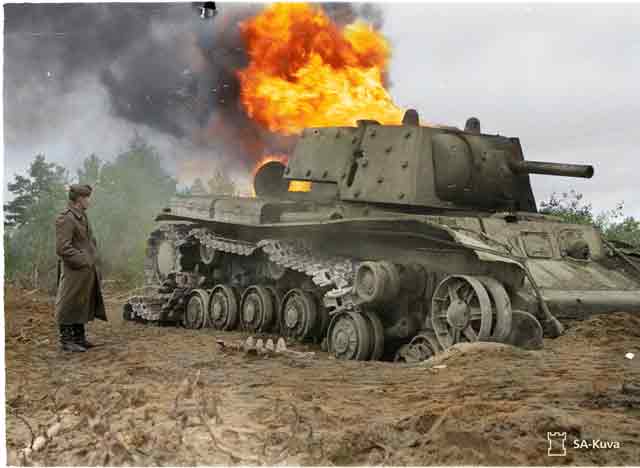
After weeks of gradually closing the vise on Leningrad, on 9 September 1941 the Germans begin their assault on the second city of Russia. Two Soviet battleships, “October Revolution” and “Marat,” open fire on the Wehrmacht with their main guns. The ships are immobile because their non-gunnery crews have been drafted for the ground defense of the city. The German panzers are still about ten miles outside of the city proper, but they have cut off all land escape routes and the only way in or out for the defenders is by air or over Lake Ladoga.
A volunteer Spanish “Spanish Division” arrives on the Leningrad Front to begin service with German forces against the Soviet Union. The Wehrmacht is getting help from a group of allies in its assault on Russia. Mussolini has sent an expeditionary corps, the Rumanian army is engaged in the drive on Odessa, the Hungarians are supporting the thrust through the Ukraine and Franco has sent his contingent of Spanish “volunteers”. The Slovaks too, have soldiers fighting for the Germans, and volunteers from Holland, Denmark, Belgium and Norway have been formed into legions of the Wehrmacht. The Finns are a disappointment to the Germans, doing no more than holding the northern line round besieged Leningrad.
The Luftwaffe mounts a major raid to soften the city up, a typical tactic for the Germans which they will follow again almost exactly a year from now at Stalingrad. Junkers Ju-87 Stukas of StG 2, accompanied by Bf 109 fighters of elite squadron JG 54, concentrate on the Soviet Baltic fleet parked at Kronstadt and Leningrad Harbor. Things go badly quickly for the Luftwaffe, as 43-ace Oblt. Hubert Mütherich, Staffelkapitän of 5./JG 54, perishes when his badly damaged Bf 109 somersaults upon landing. The Red Air Force is not much of a problem, but Soviet anti-aircraft fire over cities is deadly.
The vise on Leningrad is closing to the north of the city, too. Finnish troops reach of outermost ring defenses of Leningrad and stop according to their orders from Marshal Mannerheim. The Germans desperately want the Finns to put pressure on the Soviets from the north, but Mannerheim refuses. He views the Continuation War as one of recovery of lost territories, not conquest. The Finns dig trenches and at most let loose a few perfunctory artillery salvos to satisfy their German co-belligerents.
The Finns also advance far to the north, above Lake Ladoga. This is a far less critical sector for the Soviets, so they do not waste many units in this area. While the Finns form a very fierce and effective fighting force, the men are very leery of antagonizing the Soviet Union even at its time of greatest distress. The men in this sector grudgingly cross the old border in this area by rationalizing that a line further east would be shorter and be more defensible. The only question here is where to stop, everyone knows that Finnish troops are not heading to Moscow.
The first signs of war weariness are already showing in the men. There have been instances of men declining to follow orders to cross the pre-1939 border; the common opinion is that the war is fought to reconquer the territory lost in the Winter War, not to annex new ‘living space’ from east. However, the majority of men are content with grumbling, and the serious cases of insubordination are few. The official explanation for crossing the old border is to get as short lines of defense as possible. Tactically this is true, but the Finnish leadership is already discussing what shape the post-war ‘Greater Finland’ shall take. The most favored option is the so-called ‘border of three isthmuses’: Karelian Isthmus (between Gulf of Finland and Lake Ladoga), Onega Isthmus (between Lakes Ladoga and Onega) and the isthmus between Lake Onega and White Sea, of which English name I don’t have a clue (“Maaseln Kannas” is the Finnish name). The status of Kola Peninsula is still unclear; whether is will be claimed by Finland or Germany has not been decided yet.
This is a moment of great peril for the Soviet Union. Leningrad is now at hazard, and far to the south Marshal Budyenny also makes his first request to evacuate Kyiv today. Quick German capture of Kyiv would allow General Guderian to take his Panzer Group 2, now on the way south toward Kyiv, back toward Moscow. This would enable the Wehrmacht to assault Moscow according to the timetable that he set out in his Fuehrer Directive issued just yesterday. It is not inconceivable that successes now would enable the Germans to bag all three major Soviet cities — Moscow, Leningrad, and Kyiv — and force some kind of adverse settlement on the Soviets.
So, a collapse of Red Army morale right now would be fatal. However, Marshal Budyenny’s sole qualification as a general is that he does exactly what Stalin wants. Since Stalin wants him to stay in Kyiv, Budyenny stays in Kyiv regardless of the hopelessness of defending it against the German 6th Army. For his part, Stalin, whether consciously or not, is following the dictate of Czar Alexander I during the Napoleonic Wars of trading space for time. The bottom line is that everyone keeps fighting, the Germans are stopped, and men on both sides keep dying.
Reconnaissance elements of Generalleutnant Walter Model’s 3 Pz.Div. (XXIV Pz.K.) discovered a gap in Soviet defenses east between Konotop and Baturin.
Marshall Ion Antonescu fires the commander of the 4th Army, General Cuiperca. It comes after the first two rounds of bloody fighting, in which the Rumanians failed to completely breach the Russian defenses (backed up by prodigious quantities of artillery and mortar fire) at Odessa. Cuiperca frankly reported to Antonescu that his troops lacked the strength, both physically and in terms of morale, to successfully resume the assault. Antonescu, known for his frank speaking himself in a command culture where direct talk was often perceived as impolite and insulting, did not respond well to this analysis. Antonescu claims that Cuiperca lacks “faith in the battle capacity of the Rumanian Army.” Antonescu has brought in his own Defense Minister, Iacobici, to replace Cuiperca at 4th Army — a man considered one of the great academic brains of the Rumanian staff.
Slovakia passed the Codex Judaicus which was patterned after the German Nuremberg laws on how to deal with those of Jewish ancestry. Vojtech Tuka, with the guidance of German SS-Hauptstrumführer Dieter Wisliceny, enacted the Ordinance Judenkodex which required Slovakian Jews to wear the yellow Stars of David, annulled all debts owed to Jews, confiscated Jewish property, and deported all Jews from the capital Bratislava.
British carrier HMS Ark Royal launched 14 Hurricane fighters to reinforce Malta.
German and Italian shortwave radios stepped up their criticism of President Roosevelt throughout broadcasts today, C.B.S. listening station reported. Broadcasters in each country called the president a liar and elaborated on their daily accusation that he was trying to get the United States into the war. “His menacing remarks to the axis powers testify that war is the aim of the government of the United States,” said the Rome announcer. “Lying is one of the president’s habits. Nobody believes the declarations of Roosevelt concerning the Greer case. Not even the Americans believe him.” The Berlin announcer charged the president falsified the Greer incident to “look like a case of unprovoked aggression and bring about the desired indignation and war threat.”
The Iranian Government accepted the Soviet and British terms, which included the closure of Axis legations and the surrender of German nationals. Iran would remain occupied for the duration of the war. The Allies would control Iranian roads, airports and communication.
Allied convoy SC.42 was sighted near Cape Farewell, Greenland by the German submarine U-85. Over the next three nights a total of 16 ships from the convoy were sunk by a German Wolfpack.
German cruiser Admiral Scheer was ordered to sail from Oslo, Norway for Swinemünde, Germany (now Swinoujscie, Poland).
Hans-Joachim Marseille shot down a Hurricane fighter over the Bay of Sollum in the morning, his 15th kill. In the afternoon, on another mission, he shot down another Hurricane fighter, the 16th kill, while escorting Stuka dive bombers toward Bardia, Libya.
U-81, commanded by Kapitänleutnant Friedrich Guggenberger, sank British steamer Empire Springbuck (5591grt), straggling behind convoy SC.42, in 61-38N, 40-40W. At 0655 hours on 9 September 1941 the unescorted Empire Springbuck (Master Watson Edward O’Connell), a straggler from station #31 in convoy SC.42, was hit on port side in hold #1 and #3 by two G7e torpedoes from U-81 while steaming in good weather about 150 miles northeast of Cape Farewell. The ship was seen to quickly burn from stem to stern after the second torpedo hit and to sink immediately after several heavy explosions that shook the submerged U-boat in a distance of 1200 meters. The Germans assumed that the ship carried ammunition but apparently the cargo of phosphates had been ignited. The master, 33 crew members and five gunners were lost. The 5,591-ton Empire Springbuck was carrying steel and explosives and was headed for London, England.
U-85 attacked British steamer Jedmoor (4392grt) in convoy SC.42, but did not damage her.
Dutch submarine HNLMS O.24 sank Italian steamer Italo Balbo (5114grt) ten miles west of Elba in 42-47N, 9-57E.
Battleship HMS Prince of Wales and destroyers HMS Laforey, HMS Puckeridge, HMS Ashanti, HMS Castleton, HMS Lamerton, and HMS Badsworth were brought to half hours’ notice and battleship HMS King George V to one hour’s notice on the report that German heavy cruiser Admiral Scheer had departed Oslo. It was later found that she was returning to Swinemunde after two unsuccessful bombing raids on her while at Oslo on the 5th and 8th.
German steamer Trifels (6198grt, former French Sainte Louise recaptured at the fall of France, former German Trifels captured on 14 November 1939) was sunk by motor torpedo boat MTB.54 off Boulogne, which was part of a force of MTB.35 (SO), MTB.218 and MTB.54 (Norwegian crew commanded by Lt P E Danielsen). MGB.43 and MGB.52 were also at sea in the Varne area. German escorting patrol vessels Vp.202 (trawler Hermann Bosch, 470grt) and Vp.208 (trawler Walter Darre, 391grt) rescued the crew. Force M of heavy cruiser HMS Devonshire, aircraft carrier HMS Victorious, and destroyers HMS Somali, HMS Matabele, and HMS Punjabi refueled at Bell Sound. Force L had been detached, accompanied for a time by heavy cruiser HMS Suffolk, and was proceeding to Seidisfjord. Force M departed Bell Sound for Operation EGV.2 on the 10th. Before sailing, the Commander of the Force transferred from heavy cruiser Devonshire to aircraft carrier Victorious. Heavy cruiser Suffolk rejoined Force M on the 10th. Aircraft carrier HMS Argus, heavy cruiser HMS Shropshire, and destroyers HMS Inglefield, HMS Impulsive, and HMS Eclipse arrived at Seidisfjord for refuel on the 12th. The ships departed at 2000 that day for Scapa Flow. Force L arrived at Scapa Flow on the 14th at 0730.
Corvette HMS Candytuft, escorting convoy HX.148 with destroyer HMS Richmond and corvettes HMCS Bittersweet and HMCS Fennel, was damaged in 51-20N, 39-08W. Lt D. M. Hall RNR, and T/Sub Lt H. F. T. Davies RNVR, and nine ratings were killed when the ship’s starboard boiler exploded. The corvette was taken in tow by corvette HMCS Bittersweet and arrived at St Johns on the 14th. She was later taken from St Johns on 2 October for Halifax arriving on 6 October. Beyond the capacity of the Halifax repair facilities, the corvette was towed from Halifax on 8 October for New York where she arrived on 11 October. The corvette was repaired from 11 October 1941 to February 1942 at New York Navy Yard.
German steamer Erna Oldendorff (2095grt) was sunk in a collision with a tanker off St Nazaire.
Battleship HMS Barham, minelaying cruisers HMS Abdiel and HMS Latona, and destroyers HMAS Napier and HMAS Nizam were at sea from Alexandria for exercises. A Swordfish of 815 Squadron from Dekheila ditched offshore. Minelayer Abdiel picked up the pilot, Sub Lt D. W. Phillips and his crew after five and a half hours in the water. The light cruisers HMS Ajax, HMS Neptune, and HMAS Hobart of the 7th Cruiser Squadron were also at sea exercising.
British gunboat HMS Gnat departed Mersa Matruh for Tobruk, but returned when her engines broke down. The gunboat later proceeded to Alexandria for repairs.
President Roosevelt ordered his special train tonight and prepared to leave tomorrow for Washington to deal with urgent matters of state, including the sinking of an American ship in the Red Sea and an American-operated ship off Iceland. The President turned from a scene of deep personal grief to resume the burden of office. In a simple ceremony, the body of Sara Delano Roosevelt, his mother, was laid this afternoon in the family plot in St. James Church’s cemetery in Hyde Park, New York. As his train rolls to the capital, Mr. Roosevelt will work upon the speech of major international importance which he is to deliver to the world Thursday night at 10 PM (E.D.T.). Events have developed quick and fast in the three days since his mother’s death, during which he has been virtually isolated from the world.
In the seclusion which it had longed for but hardly dared hope to achieve, the nation’s first family took leave today of its matriarch, Mrs. Sara Delano Roosevelt Brevity and dignity marked the service that committed the mother of the President to her grave in St. James’s church yard this afternoon, beside the husband who had preceded her in death by forty years.
Congressional hearings opened in Washington investigating allegations of propaganda in American films. North Dakota Senator Gerald Nye set the tone of the hearings on the first day by suggesting that propaganda was being injected into films by a cabal of foreign-born Jews who owned or operated the major movie studios. A senate subcommittee launched its inquiry into alleged motion picture propaganda today with Senator Gerald P. Nye, North Dakota Republican, charging that the cinema industry has a financial stake in British victory and Wendell L. Willkie accusing Nye of fostering national disunity.
The Supply Priorities and Allocation Board rejected tonight a proposal by Secretary Ickes, Petroleum Coordinator, for high priorities on 480,000 to 700,000 tons of steel plates for speedy construction of a 1,500-mile petroleum pipeline from the Texas oil fields to the New York refining area at a cost of $70,000,000. SPAB’s action came a few hours after Ralph K. Davies, assistant to Mr. Ickes, had told the Senate committee investigating the Atlantic Coast gasoline shortage that a final solution of the transportation scarcity on the East Coast depended primarily on construction of the pipeline, which was to have been completed by next Spring. While no formal application by Mr. Ickes was before the board, SPAB made it plain that it would not permit diversion of steel facilities from the manufacture of plates for ships and railroad cars to the construction of such a huge pipeline. SPAB’s members indicated that they might approve a plan to build the pipeline with seamless tubes, which are extruded from steel billets and would not interfere with the naval and merchant shipbuilding program. But officials said that even if such approval was given construction would be required to proceed at a rate which would not tic up the facilities of tube manufacturing companies and interfere with the construction of shell casings. This would prevent completion of the pipeline before the middle of 1943.
Declaring the nation faces inflation now and “must deal with it at once,” Secretary of the Treasury Morgenthau tonight called upon laborers, farmers and businessmen to curb their desires for higher wages and profits in the interest of the nation’s welfare. The public must be taxed more, spend less, save faster, and submit to increased regulation, he added in a long-promised pronouncement of his views on inflation delivered before the Advertising club of Boston.
For sixteen months the Federal Bureau of Investigation has been in constant communication with the Nazi secret service in Hamburg, Germany, by means of a short-wave station on Long Island, exchanging worthless “information” about the American defense program for accurate reports on the activities of Nazi spies in this country, it was disclosed yesterday at the trial of sixteen persons accused of espionage and failure to register as agents of a foreign power.
The “Big Five” railroad brotherhoods have set September 15 at 6 AM as the time for a strike, it was announced here tonight by Alexander F. Whitney, president of the Brotherhood of Railroad Trainmen. A telegram was sent to the National Mediation Board, which failed to adjust the dispute between the unions and the carriers.
A 20-millimeter anti-aircraft gun which is able to call its shots on dive bombers when they swoop down to discharge their loads is being produced in the completed parts of the $20,000,000 naval ordnance plant being built at Centerline, Michigan, near Detroit, by the Hudson Motor Car Company. The gun, which will be turned out in large numbers when the fourteen buildings of the 135-acre plot are completed and equipped with tools and machinery, is the Oerlikon, of Swedish design. It is capable of firing 540 explosive shells a minute and in actual war experience has proved particularly deadly to dive bombers.
The rate of American defense production will be doubled in September and October, John Biggers, former director of the production division of the Office of Production Management, recently appointed Minister to London in charge of synchronizing British and American defense production, asserted yesterday when he left La Guardia Field aboard Pan American Airways’ Dixie Clipper bound for Lisbon.
The U.S. Navy Bureau of Aeronautics requests that the National Defense Research Committee and the Naval Research Laboratory to develop an interceptor radar suitable for installation in a single-engined, single-seat fighter, e.g., the F4U Corsair.
The U.S. Naval Coastal Frontier Forces are formed.
Major League Baseball:
The Cincinnati Reds purchase third baseman Bert Haas from the Cards.
The Cleveland Indians release Mel Harder, who has been plagued with arm problems.
He’s better than his brother, Joe. Dom DiMaggio hits his first grand slam and rookie Dick Newsome does the pitching as the Boston Red Sox beat Detroit, 6–0. Dom D will hit another grand slam on the 24th. He also tripled and scored in the first inning today, and doubled later.
Cushioned by two runs in the second and six in the third, the Cincinnati Reds withstood a last-minute four-run uprising by the Boston Braves today to win, 9–7, in an extra-base fray marked by twenty-nine hits and seven errors.
There was a “what of it? ” air about Yankee Stadium yesterday when the Yankees and Browns clashed for the last time. Only 3,006 fans were on hand to see the new champions take a 1–0 thriller. Time, it has been said, makes quite a difference, and that was apparent, for despite the tenseness of the struggle, the customers found it difficult to stifle yawns. Tommy Henrich’s 28th homer was the deciding blow. Spud Chandler got the victory.
Bob Feller chalked up victory No. 23 with little difficulty today as the Indians coupled thirteen hits and four walks with five Philadelphia errors to trounce the Athletics, 13–7. Feller allowed nine hits, but hurled two-hit shut out ball until the seventh. He coasted through the last three frames on a big lead his team-mates had built up at the expense of Lester McCrabb and Tom Ferrick.
The Giants inaugurated their reconstruction period and their last Western trip simultaneously today at Forbes Field with a ten-inning victory over Frankie Frisch’s Pirates. The score was 4–2, thanks to a couple of majestic home-run drives by Babe Young.
Rookie Arnold Anderson was effective with runners on the bases tonight and the Senators defeated the White Sox, 7–2, climbing out of the American League cellar. The Senators won with a six-run blast in the sixth inning during which eleven batters faced Edgar Smith and Johnny Humphries.
The scheduled game between the Brooklyn Dodgers and the Cubs at Chicago was rained out with the Dodgers leading 1–0 in the second. The game will be replayed in its entirety as part of a doubleheader tomorrow.
The scheduled game between the Philadelphia Phillies and the Cardinals at St. Louis was postponed due to rain. The game will be made up as part of a doubleheader tomorrow.
Detroit Tigers 0, Boston Red Sox 6
Boston Braves 7, Cincinnati Reds 9
St. Louis Browns 0, New York Yankees 1
Cleveland Indians 13, Philadelphia Athletics 7
New York Giants 4, Pittsburgh Pirates 2
Chicago White Sox 2, Washington Senators 7
Joseph Rochefort’s cryptanalytic team in U.S. Territory of Hawaii noticed Japanese aircraft carrier HIJMS Akagi was using new call signs in her radio communications.
United States Ambassador Joseph C. Grew has had twelve conferences with the Foreign Minister, Vice Admiral Teijiro Toyoda, in the last seven days, it was revealed last night, and informed Japanese quarters said today that “developments of the greatest importance” in the field of Japanese-American relations were possible within the next few days. The Japanese press seemed less incensed with the United States than they did a few days ago.
The Malay coastal defense area bordering on the South China Sea was extended today to a point more than 200 miles north of Singapore.
MacArthur complains to Grunert that the training of the mobilized Philippine troops is not going well.
Marshall advises MacArthur that he had “the highest priority” for supplies and for the filling of the “authorized defense reserve” of 50,000 men
Dow Jones Industrial Average: 127.43 (-0.08)
Born:
Otis Redding, American soul singer (“(Sittin’ On) The Dock of the Bay”), in Dawson, Georgia (d. 1967, in a light airplane crash).
Dennis Ritchie, American computer scientist (created C programming language, helped developed Unix), in Bronxville, New York (d. 2011).
Pat Richter, NFL tight end, split end, and punter (Washington Redskins), in Madison, Wisconsin.
Died:
Hans Spemann, 72, German embryologist (Nobel Prize in Physiology or Medicine, 1935).
Naval Construction:
The Royal Navy Bar-class boom defense vessel HMS Barfoil (Z 194) is laid down by George Philip & Sons Ltd. (Dartmouth, U.K.).
The U.S. Navy oiler USS Mattaponi (AO-41), lead ship of her class of 5, is laid down by the Sun Shipbuilding & Drydock Co. (Chester, Pennsylvania, U.S.A.).
The Royal Navy Bangor-class (Turbine-engined) minesweeper HMS Sunderland (J 193) is laid down by Lobnitz & Co. Ltd. (Renfrew, Scotland). She is renamed HMS Lyme Regis (J193) after the original ship of that name (J 197) is transferred to the Royal Indian Navy and renamed HMIS Rajputana.
The Royal Canadian Navy Bangor-class (VTE Reciprocating-engined) minesweeper HMCS Port Hope (J 280) is laid down by the Davie Shipbuilding and Repairing Co. Ltd. (Lauzon, Quebec, Canada).
The U.S. Navy SC-497-class submarine chaser USS PC-527 (later SC-527) is laid down by the Mathis Yacht Building Co. (Camden, New Jersey, U.S.A.).
The Royal New Zealand Navy Manuka-class minesweeping trawler HMNZS Rimu (T 402) is launched by Seagar (Auckland, New Zealand); completed by Gourlay (Dundee, Scotland, U.K.).
The Royal Navy Fairmile C-class motor gun boat HMS MGB 325 is commissioned.
The U.S. Navy 77-foot Elco patrol motor torpedo boat USS PT-47 is completed and placed in service and assigned to Motor Torpedo Boat Squadron Two (PTRon 2).
The Kriegsmarine (German Navy) Type IXC U-boat U-162 is commissioned. Her first commanding officer is Kapitänleutnant Jürgen Wattenberg.
The Royal Canadian Navy Flower-class corvette HMCS Dunvegan (K 177) is commissioned. Her first commanding officer is T/Lieutenant James Arthur Tullis, RCNR.

