The Ordeal of Leningrad begins
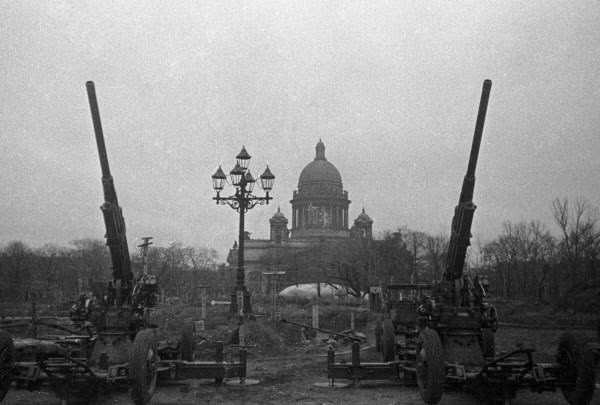
Food quickly became desperately scarce during the siege. Daily rations were reduced again and again; at the worst point in the winter of 1941–1942, civilians received as little as 125 grams of bread per day — often mixed with sawdust or other fillers. Starvation, disease, and exhaustion spread rapidly. Winters were brutal, with temperatures plunging far below freezing. With little fuel for heating and frequent power outages, families huddled in unheated apartments. Many people were too weak to bury the dead; bodies sometimes lay in streets and stairwells.
It is estimated that around one million civilians perished, most from hunger and cold rather than direct combat. Despite constant shelling and aerial bombardment, the city did not surrender.
A tenuous lifeline existed across Lake Ladoga. In winter, trucks crossed the frozen surface along the so-called “Road of Life,” bringing limited food supplies and evacuating some civilians. Though dangerous and insufficient, it helped the city survive.
On January 27, 1944, Soviet forces finally broke the siege. The ordeal left deep scars and remains a powerful symbol of endurance amid immense human suffering.
On 8 September 1941, the Wehrmacht’s Army Group North captures the small town of Schlusselberg on the shores of Lake Ladoga. Leningrad is now cut off from all land communication from the south, while Finnish troops on the Karelian Isthmus blocks all communications from the north. Really, though, the siege began when the Germans cut the last rail line in late August at Mga. The besieged city’s only source of supply from this point forward is by ferry across Lake Ladoga. This begins the “900 days” of Leningrad’s siege.
There are 2,950,000 civilians, including many women and children who have crowded into the city as refugees, and 450,000 soldiers/sailors left in Leningrad. The Wehrmacht is within ten miles of the city to the south, with 1st Panzer Division (Lieutenant General Friedrich Kirchner) advancing up the left bank of the Neva River and 6th Panzer Division (Major General Franz Landgraf) following the railway line embankment on the Moscow line. It is not going to be a walkover for them. They have been held up for three weeks by suicidal Russian counter-attacks. Their men and machines are worn out by fighting both the Russians and the mud caused by incessant rain. If they had made their assault a month ago they would be in the Romanov’s palaces today. Instead, they are caught up in hastily-built defenses manned by Opolchenye — militia units armed with rifles, Molotov cocktails and grenades. This is not the sort of fighting the Panzers enjoy. In fact, von Leeb’s attempt to capture the city may not last. Hitler wants to switch his tanks to the forthcoming attack on Moscow, leaving Leningrad to “wither on the vine”. Soviet militia forces (Opolchenye) man the line and there is artillery support from navy ships in Leningrad Harbor and Kronstadt Naval Base on Kotlin Island, but those are targets for constant Luftwaffe attacks.
Hitler has a choice to make. Does he attack Leningrad, or invest it through the winter and await a capitulation or starvation? He is inclined to wait it out despite the wishes of the commander of Army Group North, Field Marshal Ritter von Leeb, to seize it quickly. The decision is complicated by the outright refusal of Marshal Mannerheim to use Finnish forces in an attack on Leningrad. Hitler ultimately decides to wait it out and use artillery to soften up the Leningrad defenses because he has more pressing places to use his troops and armor. He would rather subject the city to a long siege by gun and bomber and so relieve the German army of the necessity of feeding the population during the winter. Von Leeb however, can almost taste the glory of capturing the old Tsarist capital and will carry on his assault until told to stop.
Finnish forces between Lake Ladoga and Lake Onega cut the railway track south from Murmansk. This would force the Soviets to build hundreds of miles of new lines to reach the important northern port vital for supplies from the west.
The Germans captured Kremenchuk.
The Yelnya Offensive ended in Soviet victory.
Hungarian Regent Miklós Horthy began a three-day visit to Hitler at his Wolf’s Lair.
The Soviets deported 600,000 ethnic Germans who had lived on the upper Volga for nearly 200 years to Siberia. Hundreds of villages in the area were emptied.
German authorities began herding Hanover’s Jews into the mortuary hall of the Jewish cemetery here tonight following the Mayor’s order evicting them from their homes on twenty-four hours’ notice. The eviction orders provided for the sale of their property, the proceeds to be turned over to them “at a given time.”
Local police and collaborators during this week rounded up the Jewish residents of Merech (Merkinė), along with some Jews from surrounding areas like Liepalingis, Liškiava, and Seirijai, forcing them into the town’s local synagogues and schoolhouse. They would be murdered on the tenth.
In Paris, the German authorities arrest 120 leaders of the city’s Jewish community as hostages for the murder last week of a German officer.
German aircraft attacked and damaged British destroyers HMS Kipling, HMS Kimberley, and HMS Decoy as the ships carried supplies from Alexandria, Egypt for besieged Tobruk, Libya.
Britain and Russia have delivered stiff notes to Iran demanding custody of German and Italian citizens in that country and expulsion of Axis diplomats, it was said today. The notes, couched in stern language, were reported to have demanded prompt action. Both British and Russian authorities already have arrested a number of Axis nationals in occupied parts of Iran, it was said. The Russians, it was said, have halted their advance into the rich oil country along a straight line running from the junction of the Russian-Afghanistan border to the junction of the Turkish-Iraq-Iran border. It was reported that the Iranian Parliament would meet tomorrow.
It is reported that Canadian troops, supported by British and Norwegian detachments, have occupied Spitsbergen in the Arctic Seas without enemy interference in a daring 2,500-mile expedition from Britain.
British Flying Fortress bombers unsuccessfully attacked the German cruiser Admiral Scheer in Oslofjord, Norway.
British destroyer HMS Croome forced Italian submarine Maggiore Baracca to surface 275 miles northeast of the Azores islands, then proceeded to ram the submarine, resulting in her sinking. 23 Italian sailors were killed; 34 survived. HMS Croome was damaged in the stern and was ordered to Gibraltar for repairs.
RAF Bomber Command, Day of 8 September 1941
4 Fortresses to attack the battleship Admiral Scheer at Oslo were intercepted by German fighters before reaching the target. 2 Fortresses were lost and 1 crashed in England.
RAF Bomber Command, Night of 8/9 September 1941
Kassel
95 aircraft – 52 Wellingtons, 27 Hampdens, 16 Whitleys – to railway workshops and an armaments factory. No aircraft lost.
This was the first large attack on this target. The weather was clear and good results were claimed. Kassel reports that 2 industrial concerns – a railway-wagon works and an optical-instrument factory – were seriously damaged, 3 public buildings – the Landesbibliothek, the Rotes Palais and the main railway station – were hit and II houses were destroyed and 77 damaged. 15 people were killed and 39 injured.
Minor Operations: 7 Wellingtons to Cherbourg, 6 Hampdens minelaying in the Frisians and off Denmark. No losses.
At Hatfield, Hertfordshire, the first prototype de Havilland Mosquito IV Bomber variant (W 4072) makes its maiden flight. The new bomber has a level speed of 400 mph and the agility of a fighter.
Destroyer HMS Vivacious departed Scapa Flow at 0800 to join destroyers HMS Lightning and HMS Icarus at the Clyde to escort battleship HMS Duke of York from the Clyde to Rosyth on the 9th. Destroyer Vivacious arrived in the Clyde at 0600/9th. At 0600/9th, battleship Duke of York, light cruiser HMS Penelope, and destroyers Lightning, Icarus, and Vivacious departed the Clyde for Rosyth to complete her working up. Destroyers Lightning and Icarus were released from the escort at 1600/10th. Destroyer Lightning returned to Scapa Flow and destroyer Icarus proceeded to the Humber to commence a refitting at Immingham, arriving at 1015/11th. Battleship Duke of York and destroyer Vivacious arrived at Rosyth on the 10th. At 1900/10th, destroyer Vivacious departed Rosyth to return to Scapa Flow, arriving at 0800/11th.
Mine destructor ship HMS Corfield (Lt Cdr W. J. Tucker RNVR ) was sunk on a mine two miles south of the Humber Light Vessel. There were no casualties on the vessel.
Sloop HMS Rosemary was damaged in a collision with Polish destroyer ORP Burza inside Milford Haven Harbour. The sloop was repaired at Milford Haven completing on the 15th. The destroyer was repaired at Glasgow completing on the 20th.
Aircraft carrier HMS Furious arrived at Gibraltar at 1500/7th. Twenty six Hurricanes were transferred to aircraft carrier HMS Ark Royal. Aircraft carrier Ark Royal and destroyers HMS Gurkha, HMS Forester, HMS Lively, and HMS Lance departed Gibraltar on Operation STATUS. They joined light cruiser HMS Hermoine which had departed to the westward the evening before. One flight of Hurricanes was flown off on the 9th. Force H returned to Gibraltar at 0900/10th. At 1900/10th, aircraft carrier Furious with destroyers HMS Legion, HMS Foresight, and HMS Forester departed Gibraltar. At 2100/10th, aircraft carrier Ark Royal, battleship HMS Nelson, light cruiser Hermione, and destroyers HMS Zulu, HMS Gurkha, HMS Lance, and HMS Lively departed Gibraltar. On the 13th, aircraft carriers Ark Royal flew off twenty six Hurricanes and Furious flew off nineteen Hurricanes to reinforce the embattled island of Malta.
Destroyers HMS Kipling, HMS Jaguar, and HMS Decoy departed Alexandria to carry supplies to Tobruk. Destroyers Decoy and Kipling were damaged by near misses of German air bombs near Tobruk. Neither destroyer spent any time out of action. Destroyer Kimberley at sea covering this operation was also near missed by bombing. The destroyer also spent no time out of action. The destroyers arrived back at Alexandria on the 9th.
Anti-aircraft ship HMS Carlisle departed Suez to relieve anti-aircraft ship HMS Coventry at Anchorage F at 27-49N, 33-57E.
Light cruiser HMS Naiad with destroyers HMAS Napier and HMAS Nizam were at sea from Alexandria controlling night fighters during the night of 8/9 September.
Italian submarine Maggiore Baracca was sunk by destroyer HMS Croome by gunfire and ramming east of the Azores, 40-30N, 21-15W. The Captain, five officers, and twenty eight ratings were picked up. The destroyer sustained damage to her stern. Destroyer Croome arrived at Gibraltar on the 10th and was under repair from 12 September to 4 October at Gibraltar.
Dutch submarine HNLMS O.21 unsuccessfully attacked a convoy in the Tyrrhenian Sea.
Today in Washington, Senate adopted a resolution of regret in the death of President Roosevelt’s mother, received the Hill resolution for investigation of the pay schedules of the armed services, approved the Bulow resolution for investigation of proposed improvements along the Missouri River and recessed at 12:25 PM until noon Thursday. The special committee continued hearings on the gasoline shortage.
The House heard the President’s mother eulogized and adjourned at 12:05 PM until noon Thursday.
The Senate and House adjourned out of respect for the memory of the President’s mother, Mrs. James Roosevelt, after brief sessions today. The House Chaplain, the Rev. James Shera Montgomery, eulogized Mrs. Roosevelt in his prayer and an adjournment was taken a few moments later. Senator Hill spoke briefly in eulogy and offered the following resolution, which was adopted: “Resolved, that the Senate has heard with profound sorrow of the death of the mother of the President of the United States, Mrs. Sara Delano Roosevelt, whose life exemplified in the highest degree the finest qualities of American womanhood. Resolved, further, that the Senate extends to the President and to the members of his family its deepest sympathy in their hour of personal grief. “Resolved, that as a further expression of esteem and condolence the Senate do now adjourn.”
Time virtually stood still today at the desk of the Chief Executive of the United States. The President, deeply affected by the passing of his mother, at noon on Sunday, withdrew at his family home on the Hudson into the deepest seclusion which the demands and responsibilities of his high office would allow, and shut himself off From the world more completely than at any time since he assumed his present post. Cables and telegrams of condolences from the ends of the earth poured in a steady stream into the local terminals, at a rate of 150 messages per hour. An even higher average was reported from WashIngton, and telephone calls from American statesmen and government officials besieged the Poughkeepsie switchboard without avail. None but the most pressing of national affairs could be put through to the house at Hyde Park, where the most stringent of regulations protected the President’s privacy.
Wendell L. Willkie, counsel for the motion picture industry, tonight challenged legality of the impending senate inquiry into production of war “propaganda” films and served notice that the industry’s witnesses would appear for questioning under protest. He made his stand known in a letter to Senator D. Worth Clark, Idaho Democrat, chairman of the Senate Interstate Commerce Subcommittee which will make the investigation.
A government prosecutor, outlining operations of a huge espionage ring that would match any mystery thriller, charged in Brooklyn federal court today that one of its members had delivered to Germany detail of the famed Norden bombsight, one of this nation’s most prized defense secrets. United States Attorney Harold Kennedy, naming the German Reich as co-conspirators, delivered the government’s opening argument at the trial of 16 persons accused of espionage for Germany. The defendants, with 17 others who have pleaded guilty, allegedly gathered important military information and transmitted it to Germany via trans-Atlantic clippers and liners and radio, with the aid of secret Ink, micro-cameras and elaborate code systems.
Twelve American cargo ships will be launched on September 27 in celebration of “Liberty Fleet Day.” Plans for the mass launching were made public by the Maritime Commission, which is handling the government’s Merchant Marine construction program. The ceremonies will be conducted in shipyards on both coasts and the Gulf of Mexico. President Roosevelt has been asked to speak on that date. The whole program, according to Rear Admiral Emory S. Land, is being planned as a demonstration of the acceleration in ship building which has come since the emergency program was begun less than a year ago.
Three American airmen, members of the Eagle squadrons of the Royal Air Force, were reported missing today after a sweep of northern France. They were identified as Pilot Officer W. H. Nichols, San Carlos, California; Pilot Officer H. S. Fenlaw, Lewisville, Texas, and Pilot Officer Eugene Quimby Tobin, Los Angeles. Nichols was believed to have been killed when his plane exploded in the air. The fate of Tobin and Fenlaw was uncertain, though one was believed to have parachuted to earth and the other last was seen gliding toward earth in the Boulogne area.
An American convoy departed Argentia for Reykjavik. The convoy was escorted by battleships USS Idaho and USS New Mexico, heavy cruiser USS Vincennes, and destroyers USS Morris, USS Sims, USS Hughes, USS Hammann, USS Mustin, and USS O’Brien of the 2nd Destroyer Squadron, USS Niblack, USS Hilary P. Jones, USS Gleaves, USS Charles F. Hughes, USS Madison, and USS Lansdale of the 7th Destroyer Squadron, and USS Simpson, USS MacLeish, USS Truxton, USS Overton, USS Reuben James, and USS Bainbridge. The convoy and escort arrived on the 16th.
Submarine USS Grampus began patrolling in the Caribbean Sea.
Major League Baseball:
The Dodgers embark on a 17-game road trip with a three-game lead in the National League.
No games were scheduled today.
Joseph Rochefort’s cryptanalysis team at Pearl Harbor detected increased radio traffic between carriers and land bases, and interpreted it as the Japanese Navy conducting fitting out operations of carriers with new air groups.
Emperor Hirohito will receive the Privy Council tomorrow to hear it recommendations on important matters of state, after which, it is understood, Premier Prince Fumimaro Konoe will make an “important public announcement.”
Having come to the conclusion that, irrespective of the consequences of the Greer incident, Japan’s main duty lies in defending East Asia from extension of war interference by third powers in line with the “autonomous, independent policy” of the third Konoye Cabinet, the Japanese press is beginning to address itself to Generalissimo Chiang Kai-shek of China and urge him to give up resistance in order to liberate East Asia from the “burden of the white man.”
The Imperial Japanese Navy aircraft carrier HIJMS Shōkaku arrived at Yokosuka, Japan and disembarked Commander First Air Fleet.
The Imperial Japanese Navy aircraft carrier HIJMS Sōryū arrived at Yokosuka.
Ho Chi Minh forms the League for the Independence of Vietnam (Viet Minh).
Vichy French light cruiser Lamotte Picquett departed Saigon for Osaka, where she arrived on the 15th for urgent repairs. She departed on the 27th escorting French steamer Kindia (1972grt) to Saigon, where they both arrived on 9 October.
Nine B-17’s of the 14th Bombardment Squadron arrive at Clark Army Airfield, Luzon, The Philippines.
Dow Jones Industrial Average: 127.51 (+0.25)
Born:
Bernie Sanders, American Socialist politician (Rep-(Independent)-Vermont 1991-2007, Senator-(I)-Vermont 2007-), in Brooklyn, New York, New York.
Alan Feinstein, American actor (Max-“Berrengers”, “Family Tree”), in New York, New York.
Naval Construction:
The Royal Navy “T”-class (Third Group) submarine HMS Trespasser (P 312) is laid down by Vickers Armstrong (Barrow-in-Furness, U.K.).
The Royal Navy River-class frigate HMS Dart (K 21) is laid down by Blyth Shipbuilding & Drydock Co. Ltd. (Blyth, U.K.); completed by Hawthorn Leslie & Co. (Hebburn-on-Tyne, U.K.).
The Royal Navy “S”-class destroyer (Flotilla leader) HMS Saumarez (G 12) is laid down by Hawthorn Leslie & Co. (Hebburn-on-Tyne, U.K.).
The Royal Navy Bar-class boom defense vessel HMS Barfoam (Z 182) is launched by W. Simons & Co. Ltd. (Renfrew, Scotland).
The Royal Navy LCT (Mk 2)-class landing craft, tank HMS LCT 149 is launched by Arrol (Meadowside, Scotland, U.K.).
The Royal Navy LCT (Mk 2)-class landing craft, tank HMS LCT 153 is launched by MacLellan (Old Kirkpatrick, Scotland, U.K.).
The U.S. Navy 77-foot Elco patrol motor torpedo boat USS PT-52 is launched by the Electric Launch Company Ltd. (Elco), (Bayonne, New Jersey, U.S.A.). She is transferred to the Royal Navy on completion and commissions as HMS MTB 310.
The U.S. Navy Gleaves-class destroyer USS Hobson (DD-464) is launched by the Charleston Navy Yard (Charleston, South Carolina, U.S.A.).
The Royal Navy harbor defence motor launch HMS HDML 1058 is commissioned.
The Royal Navy Higgins 70-foot motor gun boat HMS MGB 71 is commissioned.
The Royal Navy Flower-class corvette HMS Sweetbriar (K 209) is commissioned. Her first commanding officer is Lieutenant (retired) Jack Winston Cooper, RNR.
.
.
.
There are now 90 days to Pearl.

