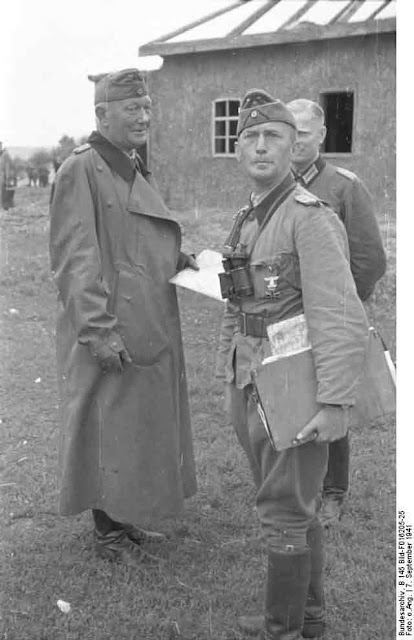
One of the continuing problems besetting the Germans during Operation BARBAROSSA had nothing to do with the Red Army. It was a perpetual lack of focus and direction. On 7 September 1941, Adolf Hitler tries to resolve the ambiguity once and for all with yesterday’s Führer Directive 35.
Directive No. 35 provides that the Soviet forces standing in front of Moscow “must be defeated and annihilated in the limited time which remains before the onset of winter weather.” The Directive is extremely detailed in terms of unit movements, specifying not only the units to be used for specific purposes but the days on which they are to attack.
The Directive provides that an attack toward Moscow is to begin “at the earliest possible moment (end of September).” A general pincer movement past Smolensk “in the general direction of Vyazma” is to destroy the Soviets’ “Army Group Timoshenko.” Once that is done, Army Group Center can then “begin the advance on Moscow with its right flank on the Oka River and its left on the Upper Volga River.”
The important thing about Directive No. 35 is that it finally, though belatedly, officially recognizes Moscow as an important Wehrmacht objective. This is cheering to Field Marshal von Bock at Army Group Center and many other generals who feel that Moscow is the key to the entire campaign. They felt that Moscow was the obvious objective for the campaign and should have been the priority from the beginning. The remaining question is whether there is enough time before blizzards begin to reach the Soviet capital.
The main issue with Directive No. 35 which makes it somewhat problematic is that by its own terms an advance on Moscow depends upon first destroying the Soviet forces in front of that city. On 7 September 1941, the Red Army is actually advancing west through Yelnya and is hardly defeated. The Soviets will have something to say about when and how Moscow is attacked.
In any event, Directive No. 35 is well-reasoned and tactically sound despite its limitations. It is one of the few Hitler Directives which will be carried out almost exactly as stated under the codename “Operation TYPHOON.” However, the eventual outcome may not be as the Germans wish.
The German 6th Armee broke through near Konotop, Ukraine. Mobile units of General Heinz Güderian’s 2nd Panzer Group achieve a breakthrough at Konotop. Güderian’s 2nd Panzer Group drives south, behind the Soviet forces defending Kiev, and reaches Lokhvista encircling nearly 600,000 Soviet troops in the Kiev area.
German XIII, XLIII and XXXV Army Corps captured Chernihiv.
The autonomous Volga German Republic was formally abolished; all German males were formed into construction brigades working as forced labourers wherever the regime directed them in conditions littler different from the Gulag camps.
The offensive by the German 20.Gebirgsarmee (Dietl) in northern Finland to capture the vital Lend-Lease port of Murmansk, U.S.S.R. comes to a halt.
HMS Argus delivered Hurricane fighters of No. 81 Squadron RAF and No. 134 Squadron RAF to Vaenga near Murmansk, Russia.
The Germans execute Pierre Roche, a member of the French Resistance who sabotaged German military telephone lines.
Mobile killing squads (Einsatzgruppen) and military units continued mass shootings and anti-Jewish actions in newly seized Soviet territories, a violent phase of the Holocaust often called the “Holocaust by Bullets”.
The convention of the Zionist Organization of America endorsed late today a declaration calling upon Great Britain and the world’s democracies “to proclaim establishment of the Jewish Commonwealth of Palestine as an integral and essential part of a democratic world order” when peace is restored.
German motor torpedo boats S.48, S.49, S.50, S.52, and S.107 attacked an Allie convoy off the coast of Norfolk, England, United Kingdom, sinking British ship Duncarron (9 killed) and Norwegian ship Eikhaug (15 killed, 4 survived).
British cruisers HMS Nigeria and HMS Aurora attacked a German convoy in Hammerfjord in northern Norway at 0130 hours, sinking German gunnery ship Bremse; HMS Nigeria was damaged in the bow and was sent back to Britain for repairs. Elsewhere, British Albacore aircraft from HMS Victorious searched for German shipping off Tromsø, Norway.
RAF Bomber Command, Day of 7 September 1941
12 Blenheims on shipping attacks off the Dutch coast. 2 ships were hit and sunk or severely damaged. 2 Blenheims lost.
RAF Bomber Command, Night of 7/8 September 1941
Berlin
197 aircraft – 103 Wellingtons, 43 Hampdens, 31 Whitleys, 10 Stirlings, 6 Halifaxes, 4 Manchesters – to 3 aiming points. 15 aircraft – 8 Wellingtons, 2 Hampdens, 2 Whitleys, 2 Stirlings, 1 Manchester – lost.
Good bombing was claimed by 137 crews in clear visibility. Berlin reports most bombs in the Lichtenberg and Pankow districts, which are east and north of the centre. Damage was reported to 4 war-industry factories, 10 transport and 13 public utilities, 2 public buildings, 1 zoo, 16 farms and 200 houses. 36 people were killed, 212 injured and 2,873 were bombed out, some only temporarily.
Kiel
51 aircraft – 30 Wellingtons, 18 Hampdens, 3 Stirlings – to bomb the Deutsche Werke submarine yard and the town area. 2 Hampdens and 1 Wellington lost.
Good bombing was claimed in clear weather, Kiel reports bombs in several areas with damage to 2 passenger ships, some warehouses and dwelling-houses. There were no casualties.
Boulogne
38 Wellingtons and 9 Whitleys; claimed excellent bombing results on dock areas in perfect visibility. No aircraft lost.
8 Hampdens minelaying in the Frisians. No losses.
Total effort of the night: 303 sorties, 18 aircraft (5.9 percent) lost. This was the highest loss in one night so far in the war.
Aircraft carrier HMS Argus flew two Squadrons of twelve Hurricanes each to an airfield at Vaegna at 1100/7th in Operation STRENGTH. Forces L of heavy cruiser HMS Shropshire and destroyers HMS Somali, HMS Matabele, and HMS Punjabi and M.of heavy cruisers HMS Devonshire and HMS Suffolk, aircraft carrier HMS Victorious, and destroyers HMS Inglefield, HMS Eclipse, and HMS Escapade operated nearby.
Light cruiser HMS Penelope departed Scapa Flow for the Clyde to escort battleship HMS Duke of York. The cruiser arrived on the 8th.
Destroyer HMS Ashanti departed Rosyth after repairs developed on passage to Scapa Flow. The destroyer arrived at Scapa Flow at 1545/7th to work up after long repairs.
Destroyers HMS Antelope and HMS Anthony departed Scapa Flow for Rosyth for boiler cleaning. The destroyers arrived at 0930/8th.
Minelayer HMS Agamemnon, escorted by destroyer HMS Castleton, laid minefield SN.61. After the operation, destroyer Castleton departed Loch Alsh for Scapa Flow at 2100/8th. The destroyer arrived at 0700/9th to dock and effect repairs to her anti-submarine fittings.
German motor torpedo boats S.48, S.49, S.50, S.52, and S.107 of the 4th Motor Torpedo Boat Flotilla attacked a Convoy off the Norfolk coast. British steamer Duncarron (478grt) was sunk three miles east of Sheringham. Six crew and three gunners were lost on the steamer. Norwegian steamer Eikhaug (1436grt) was sunk in 53-05-52N, 1-20-50E. Fifteen crewmen were lost. Four survivors were picked up.
British steamer Marcrest (4224grt) was sunk by German bombing in the vicinity of 54D Buoy, two miles 90° from Yarmouth. The entire crew was rescued.
British steamer Trsat (1369grt) was sunk by German bombing seven miles northeast by east of Kinnaird Head. Two crewmen and a gunner were lost on the steamer.
British fishing trawler Ophir II (213grt) was sunk by a mine four miles northeast of Humber Light Vessel. Five crewmen were missing.
British steam trawler Nairana (225grt) was damaged by German bombing seven to eight miles off Myggenaes, Faroes.
Soviet destroyer Sposobny was damaged by the near misses of German bombing in the Black Sea.
A German convoy of German steamers Livorno (1829grt) and Spezia (1825grt), escorted by torpedo boat Fabrizi, departed Naples for Benghazi. At Messina, torpedo boat Fabrizi was relieved by torpedo boats Polluce and Centauro. On the 11th, Submarine HMS Thunderbolt sank steamer Livorno off Bougie in 31-58N, 19-23E. The convoy arrived at Benghazi on the 11th.
Light cruiser HMS Naiad and destroyers HMS Havock and HMS Hotspur were at sea during the night of 6/7 September to control night fighters operating against enemy aircraft which might attack Alexandria or the Canal area.
Submarine HMS Torbay reported an enemy submarine in 32-42N, 28-55E. Destroyers HMS Griffin and HMS Hasty departed Haifa, destroyer HMAS Vendetta departed Port Said, and destroyers HMS Hero, HMS Havock, HMS Hotspur, and HMS Kingston departed Alexandria to carry out anti-submarine searched in the area. The search ended unsuccessfully. The destroyers returned to their respective ports of departure on the 10th.
Dutch submarine HNLMS O.21 unsuccessfully attacked an auxiliary minelayer in the Tyrrhenian Sea.
Aircraft carrier HMS Furious with destroyers HMS Cossack, HMS Legion, HMS Zulu, and HMS Lively arrived from England.
Destroyer HMS Wivern departed Gibraltar for refitting in the UK.
Convoy ON.14 departed Liverpool. It was joined on the 8th by corvettes HMS Lobelia, HMS Narcissus, and HMS Renoncule and anti-submarine trawlers HMS Arab, HMS Ayshire, and HMS Lady Madeleine. Destroyers HMS Beagle, HMS Boadicea, and HMS Salisbury and corvette HMS Heather joined on the 9th. On the 11th, destroyer Salisbury and trawlers Ayrshire and Lady Madeleine were detached and on the 12th destroyers Beagle and Boadicea were detached. The remaining escorts were with the convoy until dispersed on the 14th.
Sara Roosevelt, mother of the U.S. President, passed away at Hyde Park, New York, United States shortly before 1200 hours. Mrs. Sara Delano Roosevelt, nearly 87 years of age, who lived to see her only son become president of the United States, died today at the ancestral Roosevelt home overlooking the Hudson river. Death came at 11:15 AM of an acute circulatory collapse resulting principally from her advanced age. The first intimation of her declining health came last Friday when President Roosevelt left Washington for Hyde Park to visit his mother whom he said he wished to undergo a physical checkup. Mrs. Roosevelt died while her son the thirty-second president of the United States was preparing an address of major importance to the world scheduled to be broadcast from the White House in Washington tomorrow night.
President Roosevelt decided today, because of the sudden death of his mother, to defer from tomorrow night to Thursday night his speech on the international situation. This is expected to give time for developments growing out of the battle of a German submarine and the United States destroyer Greer to crystallize. It was thought likely here that, while the speech might lose some of the impact that its delivery at once would have involved, possible intervening developments might make it even more important than officially forecast. That the Executive’s decision yesterday to speak had been sudden was confirmed today when it was learned that broadcasting companies had not been informed much before the announcement was made yesterday. The President still intends to talk not only to the nation but, through rebroadcasts in some fourteen tongues, to the world. Yesterday’s was obviously a snap decision, provoked by German allegations that the Greer had initiated the fight by attempting to sink the German submarine.
Chairman Dies, Texas Democrat, of the House Committee on Un-American Activities, made public tonight a letter to President Roosevelt charging that at least four of Leon Henderson’s aides in the Office of Price Administration had expressed communistic views. Dies urged that Henderson and the aides be dismissed immediately from the government service.
Unarmed U.S. freighter Steel Seafarer (carrying cargo earmarked for the British Army in Egypt) is bombed and sunk by German plane (identified as a JU 88) off the Shadwan Islands in the Gulf of Suez; her 36-man crew is rescued unharmed.
U.S. National Championship Men’s Tennis, Forest Hills, NY: 1939 champion Bobby Riggs beats Frank Kovacs 5–7, 6–1, 6–3, 6–3.
U.S. National Championship Women’s Tennis, Forest Hills, NY: Sarah Palfrey Cooke beats fellow American Pauline Betz Addie 7–5, 6–2; sweeps all 3 women’s titles.
Major League Baseball:
With Durocher again at shortstop, the Dodgers, roll over the Giants, 13–1, behind Higbe’s 20th win of the year. Camilli hits 2 homers as the Brooks pound Carl Hubbell and 2 relievers. Brooklyn wins the nightcap, 4–3 in 10 innings.
The Boston Braves went on their biggest hitting spree of the year today to whip the Phillies twice, 17–6 and 10–1. Max West, with a home run and triple, led a twenty-hit assault in the opener, which saw Johnny Cooney, Paul Waner and Eddie Miller collect four hits each. In the second game, homers by Ray Berres, his first of the year, and Carvell Rowell were the big blows of a fifteen-hit attack. Berres’s circuit blow, coming in the second inning with two mates on base, was inside the park.
The St. Louis Browns continued in their late-season jinx role for the Chicago White Sox as the two teams met today for the last time this season. St. Louis scored two runs in the ninth to give Dennis Galehouse a 3–1 decision over Ted Lyons.
Major league players who are honored with a “day” often take a drubbing from the opposition, but Tommy Bridges did not let his admirers down today. The veteran Detroit hurler gave only six hits as the Tigers trounced the Indians, 4–1, for their third victory in the four-game series.
How do you score this? In the 4th of game 2, Boston batter Max West picks up a short passed ball and flips it to Phillies catcher Livingston who throws to pitcher Tom Hughes who relays back to the catcher to nail Frank Demaree coming in from third base. In the next inning, West is hit in the mouth by a foul ball while sitting in the dugout and taken to the hospital. West has 3 hits in game 1 as the Braves win twice, 17–6 and 10–1.
Washington rookie Early Wynn wins the first of his 300 victories. Wynn won 16 games for last-place Springfield (Eastern) this year. The last-place Senators climbed within a half game of seventh place in the American League today by sweeping a double-header with the Athletics, 3–2 and 4–2. A three-run uprising in the ninth inning against Phil Marchildon won the opener while the six-hit pitching of Rookie Wynn, up from Springfield of the Eastern League, kept Philadelphia in check during the nightcap. In the sixth inning of the second game a three-run rally against Luman Harris erased the Athletics’ 2–0 lead. Cecil Travis’s triple led to another run in the eighth.
Rookie Vallie Eaves and Babe Dahlgren joined forces today in the Cubs’ 3–1 victory over the Pirates in the last contest of the season between the clubs. Pittsburgh won thirteen of the twenty-two contests. Eaves allowed just five hits and had a shutout until the ninth inning.
The Reds jolted the second place Cardinals’ fading pennant hopes again today, scoring a 5–2 triumph in the second game of a twin bill called because of darkness after eight innings. Showing a spasm of the old fighting Gashouse Gang spirit, St. Louis won the opener, 11–7, after Cincinnati had tied the score at 6–6 with a rally in the seventh inning.
New York Giants 1, Brooklyn Dodgers 13
New York Giants 3, Brooklyn Dodgers 4
Philadelphia Phillies 6, Boston Braves 17
Philadelphia Phillies 1, Boston Braves 10
St. Louis Browns 3, Chicago White Sox 1
Cleveland Indians 1, Detroit Tigers 4
Boston Red Sox 5, New York Yankees 8
Washington Senators 3, Philadelphia Athletics 2
Washington Senators 4, Philadelphia Athletics 2
Chicago Cubs 3, Pittsburgh Pirates 1
Cincinnati Reds 7, St. Louis Cardinals 11
Cincinnati Reds 5, St. Louis Cardinals 2
360 refugees disembarked the Spanish freighter Navemar at Havana. Four died in the overcrowded conditions during the voyage across the Atlantic.
The results of a Gallup poll were published asking Americans, “Should the United States take steps now to keep Japan from becoming more powerful, even if it means risking a war with Japan?” 70% said yes, 18% said no and 12% expressed no opinion.
Amid the tightening blockade around Japan, war fever again is sweeping the country as the press and many officials warn Britain and the United States of Japan’s determination to force her way through the blockade if necessary.
Japanese forces attack Chinese positions near Yuezhou at the beginning of the Second Battle of Changsha.
Born:
Mogoboya Noko Nelson Ramodike, South African politician in Lebowa, in South Africa (d. 2012).
Died:
Sara Roosevelt, 86, American mother of U.S. President Franklin D. Roosevelt.
Naval Construction:
The Kriegsmarine (German Navy) auxiliary cruiser (commerce raider) Schiff 28 (Michel, HSK-9) [ex-freighter Bielsko] is commissioned.
The U.S. Navy Accentor-class coastal minesweeper USS Develin (AMc-45) is commissioned.
 History Diaries