Adolf Hitler issued Directive 35 for Operation TYPHOON, which he intended should destroy in a swift blow any remaining Soviet resistance:
The Führer And Supreme Commander of the Armed Forces.
The Führer’s Headquarters. 6th September, 1941. 10 copies
Directive No. 35
Combined with the progressive encirclement of the Leningrad area, the initial successes against the enemy forces in the area between the flanks of Army Groups South and Centre have provided favorable conditions for a decisive operation against the Timoshenko Army Group which is attacking on the Central front. This Army Group must be defeated and annihilated in the limited time which remains before the onset of winter weather. For this purpose it is necessary to concentrate all the forces of the Army and Airforce which can be spared on the flanks and which can be brought up in time.
On the basis of the report of Commander In Chief Army, I issue the following orders for the preparation and execution of these operations:
- On the southern sector of the front the aim is the annihilation of the enemy forces in the triangle Kremenchug-Kiev-Konotop by the forces of Army Group South which are advancing northward across the Dnieper River, acting in conjunction with the attack by the southern flank of Army Group Center. As soon as the completion of this task allows, those formations of 2nd and 6th Armies, and of 2nd Armored Group, which have become free, will be reformed for the new operation.
Beginning about 10th September at latest, the motorized forces of Army Group South, reinforced by Infantry Divisions, and supported at the main point of attack by 4th Air Fleet, will make a surprise movement from the bridgehead secured by 17th Army northwestwards on and beyond Lubny. At the same time 17th Army is to gain ground in the direction of Poltava and Kharkov.
The offensive against the Crimea from the lower Dnieper River will continue, with support from 4th Air Fleet; so will — so far as available forces permit — the offensive from the Dniepropetrovsk bridgehead. An advance by motorized forces south of the lower Dnieper River towards Melitopol would be of substantial advantage for the mission of 11th Army.
- On the Central Front, the operation against the Timoshenko Army Group will be planned so that the attack can be begun at the earliest possible moment (end of September) with the aim of destroying the enemy forces located in the area east of Smolensk by a pincer movement in the general direction of Vyazma, with strong concentrations of armor on the flanks.
For this purpose mobile focal points are to be established with motorized units as follows:
On the southern flank (probably in the area southeast of Roslavl, the direction of the thrust being northeast), from the available forces of Army Group Center and 5th and 2nd Armored Divisions, which will be released for the purpose.
In the 9th Army sector (the thrust being probably towards Bjeloj), by bringing the strongest possible forces from the area of Army Group North.
Only when Army Group Timoshenko has been defeated in these highly coordinated and closely encircling operations of annihilation will our central Army be able to begin the advance on Moscow with its right flank on the Oka River and its left on the Upper Volga River.
The Air Force will support the offensive with the 2nd Air Fleet, which will be reinforced at the appropriate time, especially from the northeastern area. It will concentrate on the flanks and will employ the bulk of its dive bomber units (VIII Air Corps) in support of the motorized forces on both flanks.
- On the Northeastern Front, in conjunction with the Finnish Corps attacking on the Karelian Peninsula, we must (after the capture of Schlusselburg) so surround the enemy forces fighting in the Leningrad area that by 15th September at the latest substantial units of the motorized forces and of 1st Air Fleet, especially VIII Air Corps, will be available for service on the Central Front. Before this, efforts will be made to encircle Leningrad more closely, in particular in the east, and, should weather permit, a large scale air attack on Leningrad will be carried out. It is particularly important in this connection to destroy the water supply.
In order to assist the Finnish advance beyond the fortifications along the old Russofinnish frontier, as well as to narrow the battle area and eliminate enemy air bases, forces of Army Group North will move north across the Neva sector as soon as possible.
With Finnish cooperation, the Bay Of Kronstadt will be so completely closed by mine laying and artillery that enemy forces will be unable to escape into the Baltic Sea to Hangö and the Baltic Islands.
As soon as the necessary forces can be made available, the battle area around Leningrad is to be covered to the eastward and on the lower Volkhov. The link up with the Karelian Army on the Svir River will only take place when the destruction of the enemy around Leningrad is assured.
- As regards further operations, it is intended that the offensive towards Moscow by Army Group Center should be covered by a flank guard composed of available motorized forces in the Army Group South sector and advancing in a general northeasterly direction, and that forces from Army Group North should be moved forward on both sides of Lake Ilmen to cover the northern flank and to maintain contact with the Finnish Karelian Army.
- Any saving of time and consequent advance of the timetable will be to the advantage of the whole operation and its preparation.
Signed,
Adolf Hitler.
During the Yelnya Offensive, the Soviets retook Yelnya itself.
The Red Army newspaper Krasnaya Zvezda (“Red Star”) noted that it was a shame to become captured by the enemy.
SS Obergruppenführer Reinhard Heydrich, head of the SD, orders all Jews, over the age of 6, to wear a distinctive yellow Star of David badge. This measure is only an example of the increasing barbarity shown to the Jews and other groups. Recently experiments at Auschwitz concentration camp have started in an attempt to find the most efficient method of exterminating large groups of people. Among other methods, the gas Zyklon-B will be tested. This information needs to be gathered before the methodical Germans will begin full-scale exterminations in early 1942.
The Vilna Ghetto was established in Lithuania, containing 40,000 Jews. The German authorities seal off two ghettos in Vilna (Wilno; Vilnius) in German-occupied Lithuania. By the 6th September 1941 between 5,000 and 10,000 Jews were murdered. German SS and police and their Lithuanian auxiliaries killed approximately 4,500 Jews in the nearby Ponary Forest in mid-September.
The hospital ship, RFA Maine, was badly damaged during an air raid on Alexandria, Egypt. Four of her crew, including a Medical Officer, were killed, but fortunately none of thew patients sustained injury.
The German training ship Bremse was rammed and sunk with the loss of over half the crew off the coast of Norway by the British cruiser HMS Nigeria.
Winston Churchill visited the Government Code and Cypher School at Bletchley Park in Milton Keynes, Buckinghamshire, England, United Kingdom. Alan Turing met British Prime Minister Winston Churchill during Churchill’s visit at the Government Code and Cypher School.
A German non-commissioned officer, Hoffman, is shot in the Gare de l’Est in Paris.
RAF Bomber Command, Night of 6/7 September 1941
Hüls
86 aircraft – 41 Whitleys, 27 Wellingtons, 18 Hampdens – to bomb a chemical factory. Good results were claimed in clear weather. 5 Whitleys and 2 Wellingtons lost.
24 Hampdens minelaying off Oslo. 1 aircraft lost.
U-141, commanded by Oberleutnant zur See Philipp Schüler, sank British fishing trawler King Erik (228grt) near Iceland. At 2330 hours on 6 Sep 1941, U-141 fired one torpedo at the King Erik (Skipper Francis Henry Davidson), which was hit after 53 seconds and sank immediately after a heavy explosion about 120 miles west-southwest of the Faroe Islands. The trawler had stopped in Tobermory to carry out repairs and was reported missing after leaving on 5 September.
The unescorted Panamanian motor merchant Trinidad was sunk by gunfire by the U-95, commanded by Gerd Schreiber, in the eastern Atlantic Ocean. At 2350 hours on 5 Sep 1941 the unescorted and neutral Trinidad was ordered to stop by U-95 and to bring her papers for contraband control about 380 miles west-northwest of Cape Finisterre. After ten minutes, some rounds were fired over the ship with a machine gun when her crew did not comply. Shortly afterwards a boat was launched and the master came aboard the U-boat. The papers revealed that they were obviously trading for British interests because the cargo was bought in London and the owner of the vessel was a Spaniard living in Cardiff. The master was not surprised when he was told that he and his crew had 20 minutes to abandon ship. The Trinidad was sunk with 37 rounds from the deck gun at 0123 hours on 6 September. The survivors were picked up after 22 days in a lifeboat by the Spanish trawler Moderno Agujos and landed at Oporto on 28 September. The 434-ton Trinidad was carrying port and cork and was headed for Dublin, Ireland.
Minesweeping trawler HMS Strathborve (216grt, T/Lt A. W. Johnston RNR) was sunk on a mine in the Humber. Johnston and three ratings were killed. T/Lt W. G. Lewis RNVR, died of wounds. Ten ratings were missing.
Destroyers HMS Chesterfield and HMS Burnham collided in St John’s Harbour. There was no serious damage to destroyer Chesterfield. The destroyer departed St Johns with convoys HX.149/SC 44 to Iceland. The destroyer arrived at Portsmouth on 6 October for refitting. Destroyer Burnham was sent to Boston for refit and repairs. She arrived on the 17th and repairs were completed on 23 October. The destroyer departed Boston on 1 November, when she sailed for Halifax.
British trawler Brora (530grt) was lost in a grounding in the Hebrides.
British steamer Empire Gunner (4492grt) was badly damaged by German bombing in 52-08N, 5-18W. The steamer sank early on the 7th in 52-09N, 5-16W. The entire crew was rescued.
British steamer Stanmount (4468grt) was damaged by German bombing off 54D Buoy off Great Yarmouth. The steamer arrived at Immingham the next day.
In a German air raid on Alexandria Harbor, destroyer HMS Kandahar and destroyer depot ship HMS Woolwich were damaged by near misses. The destroyer had no time out of action. Hospital ship Maine was near missed. Surgeon Cdr R. W. Nesbitt, MB, FRCPI, and four ratings were killed. Fifteen ratings were wounded.
Destroyer HMS Griffin departed Alexandria to relieve destroyer HMS Kingston at Haifa. Destroyer Kingston arrived back at Alexandria on the 7th.
Australian sloop HMAS Parramatta departed Alexandria to reinforce sloop HMS Flamingo operating in the Gulf of Suez. The sloop passed through the Canal on the 7th.
Submarine HMS Clyde departed Gibraltar on patrol. The submarine arrived back from the Atlantic patrol on the 9th.
Dutch submarine HNLMS O.24 attacked Italian anti-aircraft barque Carla (347grt) off La Spezia in 43-45N, 9-21E. The barque was forced aground by gunfire.
Dutch submarine HNLMS O.21 unsuccessfully attacked an armed merchant cruiser in the Tyrrhenian Sea.
Franklin Roosevelt arrived at Hyde Park, New York, United States to see his ailing mother Sara Roosevelt.
Japanese Ambassador Nomura hands Secretary of State Cordell Hull a draft proposal outlining what the U.S. and Japan will do to establish peace in the Pacific. Two of the items that the Japanese purpose to undertake are (1) that Japan will not make any military advancement from French Indo-China against any of its adjoining areas, and likewise will not, without any justifiable reason, resort to military action against any regions lying south of Japan and (2) that Japan will endeavor to bring about the rehabilitation of general and normal relationship between Japan and China, upon the realization of which Japan is ready to withdraw its armed forces from China as soon as possible in accordance with the agreements between Japan and China.
Diversion of materials from normal channels to the defense program appeared to be having an increasingly critical effect today as Floyd B. Odlum, head of the newly created Division of Contract Distribution, prepared to tackle President Roosevelt’s assignment to keep small industries functioning by bringing them into the defense effort. The War Department announced a “spread-the-work” program of its own under which it will contribute to the program distributing defense contracts as widely as possible throughout the country to companies of all sizes. Some indications of the increasing pressure upon the normal peace-time economy developed as follows:
- Sidney Hillman, assistant director general of the Office of Production Management, announced that the stoppage of silk imports, earmarking of remaining silk supplies for defense requirements and the difficulty in obtaining substitute yarns had made 14 percent of the silk industry’s labor force idle. Those idle number about 25,000.
- The Priorities Division of OPM announced that defense production would require the entire September pig-iron output of the nation, amounting to about 4,500,000 tons.
- Donald M. Nelson, Priorities Director, issued an order to assure an adequate supply of castings and forgings, electrical equipment and accessories, mechanical equipment and accessories, cutting tools and machine and shop tools to manufacturers of foundry equipment and parts. The priorities, which carry high defense ratings, apply only to work on defense contracts.
- Progress was reported by the Office of Price Administration toward development of what will be known as “the American Emergency Standard” for domestic refrigerators. The plan reduces the number of types of refrigerators, eliminates unnecessary accessories and otherwise assists in conserving materials and labor.
- The Chamber of Commerce of the United States reported after a survey of 6,000 manufacturers that nine of ten of the nation’s small non-defense manufacturers believe they will soon be forced to reduce operations drastically because of shortages of raw material or equipment. By far the great majority of these manufacturers were found to be using materials competing with requirements of defense industries.
AP Reports: “Between the first of the year and yesterday the U.S. Navy launched 249 ships, laid down 436 keels and put into service or made ready for service 213 more craft.”
Denouncing the “savage and bestial might” by which Germany seeks to challenge America’s freedom of the seas, Wendell L. Willkie, asserting that he voiced “the overwhelming sentiment of my fellow Americans,” urged President Roosevelt yesterday to meet the Nazi threat “with determination and force.”
President Roosevelt has again instructed the heads of all government departments and agencies to hire employes without regard to “creed, race or religion” and, particularly, to give the Negroes an opportunity to get their fair share of Federal jobs, including those related to defense.
Patrick Leo Garvey tried to put the bee on a store today but the law put the bee on Patrick. Strolling into the strike-bound Gimhel Bros, New York department store in the rush hour, he casually opened a paper bag filled with bees, police said. A dozen buzzed out, and women shoppers fled. Garvey was arrested on charges of disorderly conduct and cruelty to animals depriving the bees of “food, drink and air.” The United Retail, Wholesale & Department Store Employees Union is picketing the store. Garvey is waiting for a hearing and for the swelling to go down on his neck. One of the bees stung him.
Destroyer USS Lansdale (DD-426) rescues only three survivors from Panamanian freighter Sessa, sunk on 17 August; 24 crewmen (one of whom is an American) perish.
The CBS radio show, “The Life of Riley” ends its first run.
Major League Baseball:
The Dodgers beat the Giants, 4–1, to increase their National League lead to 2 games. With Reese, Medwick, and Lavagetto benched, Camilli hits his 30th homer to pace the attack. Curt Davis scattered nine hits to get the win for Brooklyn. The Giants only managed one unearned run.
Tommy Livingston’s pinch-hit single in the ninth inning gave the Phillies a 4–3 victory over the Braves today. Livingston’s hit to center field, bringing home Bob Bragan, who had singled and stolen second, came after Boston rallied to tie the count in the eighth on Max West’s eleventh home run. Jim Tobin, seeking his thirteenth victory, went the route for the Braves.
The Chicago White Sox came back to capture the second game of a doubleheader today, 7–1, after dropping the decision to the St. Louis Browns in the opener, 3–0. Bob Muncrief smothered the Sox with five singles in the opener, allowing only one runner to get as far as second, while three loopholes in the Chicago defense handicapped Lefty Thornton Lee, who got his tenth defeat instead of his nineteenth victory. Lee allowed four doubles, eight singles and five passes, but might have escaped unscored upon with normal support. The Sox came back to score six runs in the first inning iin the nightcap.
Buck Newsom and Al Benton gave a total of eleven hits in pitching the host Tigers to a double victory over Cleveland today, 7–2 and 6–2. As a result, Detroit climbed to a game and a half behind the fourth-place Indians.
Marvin Breuer stepped forth, blithely in a bid for his tenth victory yesterday as the new American League champions returned to the Stadium before a gathering of 10,286 fans, but the Red Sox sneaked in three runs before he was fully alive to what was happening and Joe Cronin’s men romped off with the ball game, 8–1.
Athletics maintained their two-and-a-half-game hold on seventh place in the American League by dividing a double bill with the last-place Senators today, winning the opener, 8–3, but going down before Emil Leonard in the nightcap, 8–4.
Vince DiMaggio’s nineteenth homer of the season, hit with two out and Elbie Fletcher on second base in the second inning, gave the Pittsburgh Pirates an early lead today as they defeated the Cubs, 6–4. Pittsburgh’s Ken Heintzelman, who gave up only eight hits, landed on base twice himself and drove in three runs.
The Reds Johnny Vander Meer fires a 2-hitter, striking out 14, to beat the Cards, 2–0, in St. Louis. He strikes out 5 in the 2nd and 3rd innings, walks a man, and records another K for six in two innings. Only a single by Johnny Hopp in the first inning and a double by Martin Marion in the fifth robbed Vander Meer, the only major league pitcher ever to hurl two successive hitless games, of his third no-hit performance.
New York Giants 1, Brooklyn Dodgers 4
Philadelphia Phillies 4, Boston Braves 3
St. Louis Browns 3, Chicago White Sox 0
St. Louis Browns 1, Chicago White Sox 7
Cleveland Indians 2, Detroit Tigers 6
Cleveland Indians 2, Detroit Tigers 7
Boston Red Sox 8, New York Yankees 1
Washington Senators 3, Philadelphia Athletics 8
Washington Senators 8, Philadelphia Athletics 4
Chicago Cubs 4, Pittsburgh Pirates 6
Cincinnati Reds 2, St. Louis Cardinals 0
Prince Konoe, as Prime Minister, bends under military pressure. An Imperial Conference decides that war preparations should be complete by the middle of October. And further that if agreement is not reached by then with the U.S. the decision to go to war should be taken. Further conciliatory proposals to the U.S. are not taken seriously.
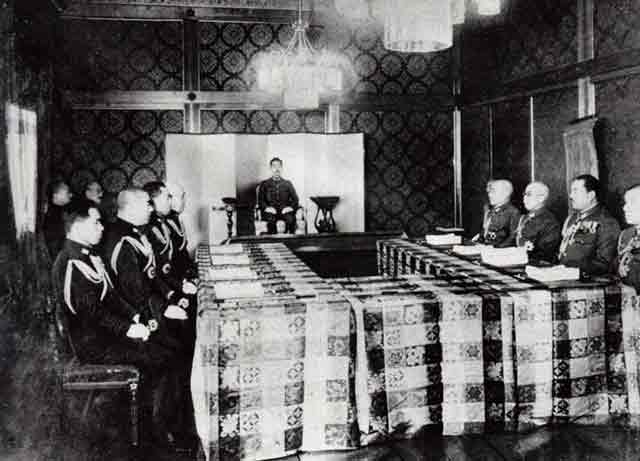
The Japanese hold an Imperial Conference to discuss the next steps to take regarding the United States and its allies. Those steps are decidedly warlike. Under consideration is a decision is to commit to war with the United States unless progress is made in peace talks with the United States by 10 October 1941.
Hirohito attends the conference. Typically, a sitting Emperor says little at such affairs and merely ratifies the decisions taken by others. This is not, however, how this conference turns out.
Everyone at the Imperial Conference expresses their support for war with the United States. However, under questioning by Baron Yoshimichi Hara, President of the Imperial Council and the Emperor’s representative, the service chiefs qualify their eagerness by saying that war should be a “last resort.” This is a very sharp turnabout from their usual bellicose posturing.
Now very concerned, Emperor Hirohito breaks with tradition and begins questioning the service chiefs himself. He recites a poem written by his grandfather, Emperor Meiji:
“The seas of the four directions—
all are born of one womb:
why, then, do the wind and waves rise in discord?”
This does not change the course of events but does reinforce the importance that the emperor places on a peaceful resolution. War planning continues and the net effect of the conference is to leave the current course of action — a military solution — intact.
U.S. Ambassador Joseph Grew meets with Japanese Prime Minister Prince Konoe. Prince Konoe states that Japan subscribes to the four principles of President Roosevelt and presents proposals for a basis of discussion. Grew goes on to say that, “The Prime Minister hopes that as a result of the commitments which the Japanese Government is prepared to assume . . . a rational basis has been established for a meeting between the President and himself.”
Grew concludes, however, that a failure to reach an agreement with the Japanese will result in a Japanese military dictatorship and eventual war. In any event, President Roosevelt already has informed the Japanese that he does not intend to have a summit meeting with Prince Konoe or anyone else.
The Battle of Changsha began as part of the Second Sino-Japanese War.
Japanese press quarters tonight took the view that the Greer incident had advanced the possibility of war between the United States and Germany and warned that the possibility of similar incidents in the Pacific “must be carefully thwarted.” The Japanese press gave great prominence to the Greer matter. Most of the newspapers held that American policies had made such incidents inevitable. Admiral Sankichi Takahashi, former commander-in-chief of the Japanese, combined fleet, held that American participation in the war was inevitable and that the day had been brought nearer by the Greer Incident. Takahashi, however, warned that although it probably would be against American interest to wage a two-ocean war, the combined British and American Atlantic fleets probably could handle Germany in the Atlantic and still leave a most formidable American fleet free for service in the Pacific.
The Imperial Japanese Navy aircraft carrier HIJMS Sōryū departed Kagoshima for Tokyo Bay.
The United States Army’s vigilance against military surprise in the Philippines has been augmented by rooftop patrols in half a dozen strategic Manila spots guarding against the unheralded approach of strange airplanes or unexpected developments of whatever nature.
Dow Jones Industrial Average: 127.26 (+0.09)
Born:
Michael “Micky” Waller, British blues and rock drummer (Long John Baldry; Jeff Beck Group), in Hammersmith, London, England, United Kingdom (d. 2008).
Monica Mason, British ballerina and arts administrator (Director of the Royal Ballet, 2002-12), in Johannesburg, South Africa.
Died:
Hugo Loudon, 81, Dutch businessman and co-founder of Royal Dutch Shell.
Naval Construction:
The U.S. Navy Accentor-class coastal minesweeper USS Observer (AMc-91) is laid down by F. L. Fulton Shipyard (Antioch, California, U.S.A.).
The U.S. Navy Accentor-class coastal minesweeper USS Rocket (AMc-101) is laid down by Anderson & Cristofani (San Francisco, California, U.S.A.).
The Royal Navy “T”-class destroyer HMS Tuscan (R 56) is laid down by Swan Hunter and Wigham Richardson Ltd. (Wallsend-on-Tyne, U.K.); completed by Wallsend.
The U.S. Navy Cleveland-class light cruiser USS Wilkes-Barre (CL-90) is laid down by the Cramp Shipbuilding Co. (Philadelphia, Pennsylvania, U.S.A.). She is renamed USS Astoria (CL-90) after the loss of the heavy cruiser of that name in the Battle of Savo Island in 1942.
The U.S. Navy Chicopee-class oilers USS Chicopee (AO-34) and USS Chicopee (AO-34) are launched by the Sun Shipbuilding & Drydock Co. (Chester, Pennsylvania, U.S.A.).
Les Forces Navales Françaises Libres (Free French Naval Forces) MMS I-class motor minesweeper D 291 is launched by Wilson Noble (Fraserburgh, Scotland, U.K.).
The Royal Navy MMS I-class motor minesweeper HMS MMS 82 (J 582) is launched by the Wivenhoe Shipyard Ltd. (Wivenhoe, England, U.K.).
The Royal Navy MMS I-class motor minesweeper HMS MMS 133 (J 633) is launched by Wilson Noble (Fraserburgh, Scotland, U.K.).
The Royal Navy MMS I-class motor minesweeper HMS MMS 136 (J 636) is launched by Richard Irvin & Sons (Peterhead, Scotland, U.K.).
The U.S. Navy Accentor-class coastal minesweepers USS Industry (AMc-86) and USS Liberator (AMc-87) are launched by theF. L. Fulton Shipyard (Antioch, California, U.S.A.).
The U.S. Navy Accentor-class coastal minesweeper USS Progress (AMc-98) is launched by Anderson & Cristofani (San Francisco, California, U.S.A.).
The Royal Navy Isles-class minesweeping trawler HMS Tiree (T 180) is launched by the Goole Shipbuilding & Repairing Co. Ltd. (Goole, U.K.).
The Royal Canadian Navy Bangor-class (Diesel-engined) minesweeper HMCS Granby (J 264) is launched by the Davie Shipbuilding and Repairing Co. Ltd. (Lauzon, Quebec, Canada).
The Royal Navy LCT (Mk 2)-class landing craft, tank HMS LCT 133 is launched by Stockton Construction (Thornaby, U.K.).
The Royal Navy Hill-class ASW trawler HMS Duncton (T 220) is launched by Cook, Welton & Gemmill (Beverley, U.K.); completed by Holmes.
The Kriegsmarine (German Navy) Type VIIC U-boat U-438 is launched by F Schichau GmbH, Danzig (werk 1480).
The Royal Canadian Navy Flower-class corvette HMCS Brantford (K 218) is launched by Midland Shipyards Ltd. (Midland, Ontario, Canada).
The Royal Navy Dido-class light cruiser HMS Argonaut (61) is launched by the Cammell Laird Shipyard (Birkenhead, U.K.).
The U.S. Navy Atlanta-class light cruiser USS Atlanta (CL-51) is launched by the Federal Shipbuilding & Drydock Co. (Kearny, New Jersey, U.S.A.)
The U.S. Navy Atlanta-class light cruiser USS San Juan (CL-54) is launched by the Bethlehem Shipbuilding Corp. (Quincy, Massachusetts, U.S.A.).
The Royal Navy Fairmile B-class motor launch HMS ML 302 is commissioned.
The Royal Navy Isles-class minesweeping trawler HMS Shapinsay (T 176) is commissioned. Her first commander is Skipper Wilfred Sidney Flowers, RNR.
The Royal Canadian Navy Bangor-class (VTE Reciprocating-engined) minesweeper HMCS Burlington (J 250) is commissioned. Her first commanding officer is Commander (retired) William John Fricker, RN.
The U.S. Navy 77-foot Elco patrol motor torpedo boat USS PT-46 is completed and placed in service and assigned to Motor Torpedo Boat Squadron Two (PTRon 2).
The Royal Canadian Navy Flower-class corvette HMCS Morden (K 170) is commissioned. Her first commanding officer is T/Lieutenant John J. Hodgkinson, RCNR.

