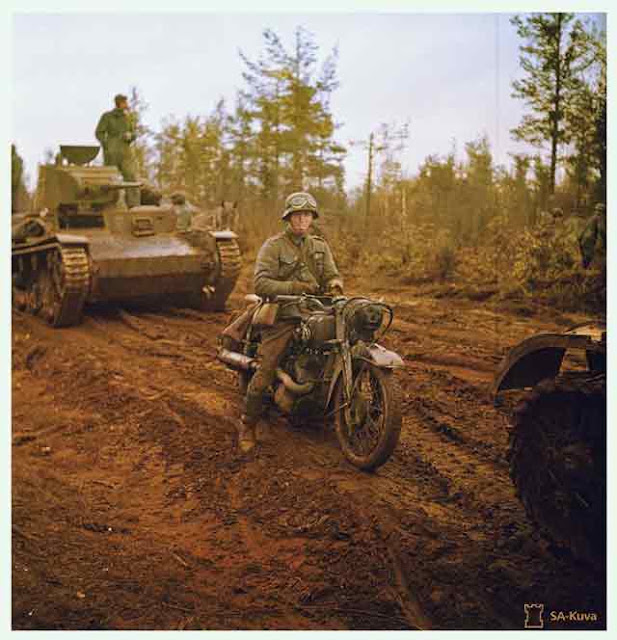
The Soviet Red Army achieves its first victory of the war by eliminating German opposition in the Yelnya salient. This exposed position on the road to Moscow had been a “lightning rod” for Soviet attacks for weeks. However, the departure of General Guderian’s Panzer Group 2 south toward Kyiv sealed its fate. Writing in his war diary, General Franz Halder, OKH Chief of Staff, praises the “great piece of staff work” that accomplished the “execution of the withdrawal from the salient.” Some historians mark the evacuation of Yelnya as the first true German retreat during World War II, but it is only a temporary reversal as the Wehrmacht focuses elsewhere.
The Germans complete the occupation of Estonia as the final Soviet forces flee by ship. The USSR had occupied Estonia in 1940 as part of a deal with Hitler regarding the Polish campaign. The only Soviet troops remaining in the Baltic states now are a few holdouts on the Baltic islands.
The Finnish reconquest of the Karelian Isthmus was completed.
As the Germans approach, all children under the age of 12 are evacuated from the city of Moscow.
The Pavoloch massacre occurred when the Einsatzgruppen shot 1,500 Jews in the Ukrainian shtetl of Pavoloch. The Nazis had orders from SS-Brigadeführer Otto Rasch to exterminate any Jews they found, and the Nazis obeyed the order to the letter. They rounded up all of the 1,500 Jews and took them to the Jewish cemetery, located outside of Pavoloch. The Nazis forced all of the Jews to dig a mass grave and made them kneel next to the grave. The Nazis shot all 1,500 of them, and the bodies fell into the mass grave. The Einsatzgruppen, seeing that their work was done, quickly filled the pit to exterminate any evidence of the slaughter and drove away.
The Australians reiterate to British Prime Minister Winston Churchill the request made by Australian Prime Minister Robert W. Menzies and General Sir Thomas Blamey, General Officer Commanding Australian Imperial Force, for the relief of the Australian troops at Tobruk, Libya.
British 1st Parachute Brigade was founded with Brigadier Richard Gale in command.
Remy Van Lierde joined the British Royal Air Force Volunteer Reserve.
The exhibition “Le Juif et la France” (“The Jews and France”) opened in Paris, France based on the work of the anti-Semitic French Professor George Montandon with the urging of the Nazi German occupation.
More blood was shed in Paris last night when Marcel Gitton, who was elected to the Chamber of Deputies in 1936 as a Communist but left his party when war was declared in 1939, was shot by a man on a bicycle in the working-class quarters of Les Lilas when he was returning home.
The press in Uruguay has acquired a copy of the text of the pastoral letter of the Catholic hierarchy of the Netherlands in which is reaffirmed the prohibition, against Catholics giving their support to either national socialism or communism on pain of being denied the last sacrament at time of death.
British bombers attacked chemical works at Hüls, Germany.
U-501, commanded by Korvettenkapitän Hugo Förster, sank Norwegian steamer Einvik (2000grt), which was straggling behind convoy SC.41,at 60-38N, 31-18W. The Einvik (Master Finn Wetteland) had lost contact with convoy SC.41 and was sailing alone since a week, when she was torpedoed by U-501 on 5 Sep 1941 about 450 miles southwest of Iceland and later sunk by gunfire. Iceland Radio had received her distress signals and an aircraft was sent to the position. The aircraft found nothing and they reported that there were probably no survivors. At that time all 23 crew members were heading for Iceland in two lifeboats, which were separated in a storm four days after the sinking. On 12 September, an Icelandic motor boat found twelve men in a lifeboat just west of Heimaey, Iceland and were brought to Vestmanna. The other lifeboat landed at Herdisvik, Iceland the next day. The 2,000-ton Einvik was headed for Cardiff, Wales.
The 190-ton Icelandic steam fishing trawler Jarlinn was torpedoed and sunk by the U-141, commanded by Oberleutnant zur See Philipp Schüler, in the northern Atlantic Ocean. At 2337 hours on 5 Sep 1941 the Jarlinn (Master Jóhannes Jónsson) was hit amidships by one torpedo from U-141. All of the ship’s complement of 11 died.
Italian submarine Baracca sank Panamanian steamer Trinidad (434grt) in 46-06N, 17-04W. Ten crew reached Oporto after twenty days in open boats.
Dutch submarine HNLMS O.21 sank Italian steamer Isarco (5738grt) twenty eight miles southeast of Ischia in 42-48N, 9-58E. The submarine picked up twenty two survivors from the steamer and arrived back at Gibraltar on the 12th.
Submarine HMS Perseus damaged Italian tanker Maya (3867grt) from a convoy of Rumanian steamer Balcik and tanker Maya, escorted by torpedo boat Sirio, which departed Piraeus for the Dardanelles on the 4th, off the Dardanelles in 39-43N, 25-57E. Because the steamer could not be towed, she was beached.
Battleship HMS King George V with destroyers HMS Bedouin, HMS Vivacious, and HMS Verdun departed Rosyth at 0930 for Scapa Flow. Destroyer HMS Laforey departed Scapa Flow at 1230 to relieve destroyer Verdun off Kinnaird Head. Destroyer Verdun, on relief, returned to Rosyth. The battleship and destroyers Bedouin, Vivacious, and Laforey arrived at Scapa Flow at 2012.
Light cruisers HMS Nigeria and HMS Aurora refueled from oiler RFA Oligarch and departed Seidisfjord to operate against German shipping off Norway. On the 7th at 0130, they attacked a German convoy of German steamers Barcelona (3101grt) and Trautenfels (6418grt), escorted by German gunnery ship Bremse, in an inlet east of North Cape. German ship Bremse was sunk in the action. Light cruiser Nigeria was badly damaged during the engagement, probably striking a Soviet mine. Light cruiser Nigeria was able to proceed only at eight knots. Destroyers HMS Bedouin and HMS Eskimo departed Scapa Flow at 0230 for Seidisfjord and proceeded from that port to meet the cruisers. The destroyers met the cruisers at 2000/9th. Heavy cruiser HMS London departed Hvalfjord at 0430/9th to assist cruiser Nigeria, but was recalled at 2322 to return to Hvalfjord for operations against German heavy cruiser Admiral Scheer. All four ships arrived at Scapa Flow at 2000/10th. At 1700/11th, cruiser Nigeria, escorted by destroyers HMS Lamerton and HMS Badsworth departed Scapa Flow for the Tyne. En route, destroyers HMS Holderness and HMS Meynell, which departed Sheerness at 1100/11th, relieved the destroyers off May Island at 0600/12th. The damaged Nigeria arrived in the Tyne on the 12th. She was repaired at Newcastle, completing on 15 December.
Destroyers HMS Electra and HMS Active arrived at Murmansk at 0730/5th. The destroyers sailed at 1800 that day for Archangel.
Monitor HMS Erebus, escorted by motor launch ML.188, departed Scapa Flow at 1600 for Lerwick to carry out special trials in the Shetlands. The two ships arrived at Lerwick at 1530/6th for trials expected to take six days.
Destroyer HMS Lincoln arrived at Scapa Flow at 1700 after escort duty in convoy ON.10 to refuel and carry out degaussing trials. Destroyer Lincoln departed Scapa Flow at 1330/6th to join convoy FS 588 and provide additional escort to the Thames.
Submarine HMS Osiris departed Malta for Alexandria with stores and twelve passengers. The submarine arrived on the 12th.
American steamer Steel Seafarer (5718grt) was sunk by German bombing two hundred miles south of Suez near Shadwan Island. Twenty four survivors had reached Shadwan Island by boat. These survivors were picked up by anti-aircraft ship HMS Coventry. A further twelve crewman had reached Hurghada by boat. No crewmen were lost.
South African anti-submarine trawler HMSAS Protea arrived at Suez from South Africa to join the 22nd Anti-Submarine Trawler Group.
Heavy cruiser HMS Hawkins arrived at Durban.
Convoy ON.13 departed Liverpool escorted by corvette HMS Veronica. The convoy was joined on the 6th by destroyers HMS Douglas, HMS Leamington, HMS Saladin, HMS Skate, and HMS Veteran, corvettes HMS Abelia and HMS Anemone, and anti-submarine trawlers HMS St. Kenan, HMS St. Zeno, and HMS Vizalma. Destroyer Leamington and trawler Vizalma were detached on the 8th and destroyers Douglas, Saladin, Skate, and Veteran on the 9th. The remaining escorts remained with the convoy until it was dispersed on the 11th.
An Italian convoy of steamers Ernesto (7272grt), Col Di Lana (5891grt), and Pozarica (7751grt) departed Tripoli for Naples, escorted by destroyers Da Recco, Freccia, Folgore, and Strale. The escort was joined on the 7th by torpedo boat Circe. Twenty miles north of Pantelleria, on the 7th, steamer Ernesto was damaged by Dutch submarine HNLMS O.21. Steamer Ernesto with destroyer Strale and torpedo boat Circe arrived at Trapani on the 8th. The convoy arrived at Naples later on the 8th.
Convoy SC.43 departed Sydney, CB, escorted by armed merchant cruiser HMS Ausonia and corvettes HMCS Arvida, HMCS Barrie, HMCS Dauphin, and HMCS Hepatica. The armed merchant cruiser was detached on the 8th and destroyer HMS Reading and corvette HMCS Prescott joined. On the 16th, destroyer Reading and corvettes HMCS Hepatica and HMCS Prescott were detached. Destroyers HMS Keppel, HMS Sabre, and HMS Venomous joined on the 16th and destroyers HMS Campbeltown, HMS St. Albans, and HMS Westcott joined on the 18th. The convoy arrived at Liverpool on the 20th.
United States Fleet is searching the Atlantic with orders from President Roosevelt to “eliminate” the submarine which yesterday tried to sink the American destroyer Greer while the ship was on the way to Iceland with mail. The President indicated that even more action might be taken later. Although Mr. Roosevelt did not reveal the nationality of the submarine during his press conference today, at which he disclosed that the sea hunt for the submarine was in progress, he hinted that it might be a German craft. The President avoided a question as to whether his orders meant undeclared warfare of the type which he recalled only a few months ago the American Navy had waged against the Barbary pirates. Asked whether “shooting war” was implied, he answered that the question was hypothetical. The Executive made clear that he believed the attack on the American naval vessel was deliberate and that he considered it no less serious because the destroyer had evaded destruction and had answered with depth charges. The attacks, he emphasized, clearly took place on the American side of the Atlantic.
By a vote of 67 to 5 the Senate adopted late today the 1941 revenue bill which calls for the record increase of $3,583,900,000 in taxes to help meet the costs of the defense program. After the Finance Committee had agreed to such a course the Senate eliminated the controversial amendment requiring husbands and wives in the “community property” States to compute taxes on income which each actually receives, instead of dividing it, and thus, on all except smaller incomes, decrease the tax liability. The “community property” States are Arizona, California, Idaho, Louisiana, New Mexico, Nevada, Texas and Washington. By a vote of 32 to 31 the Senate defeated an amendment increasing the tariff on certain oils and fats. Accepted, on a voice vote, was an amendment to raise the tax on jewelry from 10 to 15 percent and making it a manufacturers’ excise levy instead of a retail sales tax The Senate declined, 35 to 33, to remove from the bill the $5 annual “use” tax on automobiles and boats.
The U.S. Army’s Chief of Staff, General George C. Marshall, issues a memorandum giving a “Brief Periodic Estimate of the World Situation.” The estimate for Japan states “beset with uncertainties, may do nothing, may attack the Maritime Provinces (the islands north of Hokkaido and all of the Sakhalin peninsula), may seek to expand to the Southwest; it is even possible that she may withdraw from the Axis. Japan also has the capability of concentrating her newly augmented forces against China and seeking a decision there. No indication or likelihood of this is seen. In the general picture and excluding China, where she must continue to fight, her most likely, but by no means certain course is inaction.”
Roosevelt promises 5 B-17’s to the USSR as a token gesture.
Francis Biddle, the Solicitor General who has been Acting Attorney General since the elevation of Robert H. Jackson to the Supreme Court, was confirmed by the Senate today as Attorney General, and some hours later received his commission from President Roosevelt at the White House.
The gasoline and fuel oil situation in the Eastern States contains a real threat to the nation’s security that should be met in the speediest possible fashion, the Senate Oil Investigating Committee was told today by Leon Henderson. The chief of the Office of Price Administration and director of the Division of Civilian Supply of the Office of Production Management, stressing increased defense demands and consumer prosperity, apparently -convinced committee members who have repeatedly voiced skepticism that any shortage existed or was threatened.
A major new labor problem was dumped into President Roosevelt’s lap yesterday when 1,250,000 railroad workers authorized a strike for higher wages. At the same time, a strike of maintenance employees forced closing of a New Jersey steel plant and some 20,000 Alabama coal miners remained out of their pits. Although President Roosevelt has acted in his capacity aa commander-in-chief of the armed forces when intervening directly in other labor disputes notably the strikes at North American Aviation and at the Federal Shipbuilding & Dry-dock Co. the threatened railway strike will be referred to him under basic law.
The federal government today obtained consent decrees invalidating contracts between certain big American drug companies and the so-called German dye trust contracts which allegedly had restricted American participation in the Latin American drug market to the advantage of the German firm. The orders, granted by Federal Judge Samuel Mandelbaum at the request of Acting Attorney General Francis Biddle, declared contracts with I. G. Farbenindustrie, commonly known as the German dye trust, were illegal and void. The decrees, also restraining the companies from anti-trust law violations particularly in respect to restriction of markets in South America, were directed against the Alba Pharmaceutical Co., Inc.; the Bayer Co., Inc.; Winthrop Chemical Co.; Sterling Products, Inc.; and two Sterling company executives, President Albert H. Diebold and Board Chairman William Weiss. Federal Judge John Bright fined each corporation and Weiss $5,000, and Diebold $1,000. Biddle said in a statement that the effect of the order would make products of the American companies available to Latin American republics whose sources of drug supply had been interrupted by the war and that there would also be increased participation by the American firms in research and export trade.
Joseph Rochefort’s cryptanalytic team detected sudden increase in Japanese naval radio traffic.
Coastal defense guns in San Francisco are fired for practice.
The film “Citizen Kane,” directed by and starring Orson Welles, was released in the U.S.
Major League Baseball:
Elden Auker pitched five-hit ball as the St. Louis Browns defeated the Chicago White Sox, 3–1, before 22.691 persons tonight. The loss dropped the White Sox back into a second-place tie with, the idle Boston Red Sox. Auker, who turned in his season’s fourteenth victory and his fourth over the Sox, had trouble only with Shortstop Luke Appling, who had a perfect evening with a double and two singles.
The Reds score 8 runs in the 8th inning, five of them unearned, four on a grand slam by Eddie Joost, and top the Pirates, 10–4 in the first of two games. Paul Derringer gets the victory; Max Butcher takes the loss. The Pirates win the nightcap, 1–0.
The scheduled game between the Cleveland Indians and the Tigers at Detroit was postponed due to rain. The game will be made up as part of a doubleheader tomorrow.
St. Louis Browns 3, Chicago White Sox 1
Cincinnati Reds 10, Pittsburgh Pirates 4
Cincinnati Reds 0, Pittsburgh Pirates 1
At the end of its second report to Congress, presented today, the Chamber investigating committee, after detailing how Nazi propaganda in Argentina is financed, announces that at an early date it will recommend some action by Congress as a result of the German Embassy’s activities. The Ambassador may be expelled.
The reverberations from President Roosevelt’s refusal to meet with Prince Konoe continue. An Imperial Conference is scheduled to discuss the next steps, and those steps are decidedly warlike. Today, Prime Minister Konoe submits to the Emperor a draft of a decision taken on 4 September by the Cabinet to Emperor Hirohito. This Cabinet decision, in turn, is based on plans prepared by the Imperial General Headquarters, which is full of war hawks. The decision outlined in the report is to commit to war with the United States unless progress is made in peace talks with the United States by 10 October 1941.
Hirohito reviews the proposal and meets with Konoe, Chief of Staff of the Imperial Army General Sugiyama, and Chief of Staff of the Navy Admiral Osami Nagano. This is an extremely unusual meeting, as the Emperor typically does not engage in discussions about policy but instead merely ratifies them.
In response to a question by Hirohito, Sugiyama claims that Japan could defeat the United States and its allies. Hirohito refuses to accept this, pointing out that the army has promised success in China but failed to achieve it. When Sugiyama counters that China is simply too big to conquer, Hirohito responds with anger that the Pacific Ocean also is vast and would be difficult to conquer.
Admiral Nagano later recalls to a friend:
“I have never seen the Emperor reprimand us in such a manner, his face turning red and raising his voice.”
Considering that Hirohito is renowned for his placid demeanor, this is quite a statement. Hirohito decides to take an active role in the Imperial Conference scheduled for 6 September.
Admiral Yamamoto Isoroku, Commander-in-Chief of the Combined Fleet, presents his “Plan Z” to the Naval Staff College. This plan describes an attack on the U.S. Territory of Hawaii by carrier-based aircraft.
Although Japan remains firm in rejecting any “third power” — meaning American — mediation in China, Iichi Kishi, deputy spokesman of the Cabinet Information Board, declared today that if Wang Ching-wei and Chiang Kai-shek were to negotiate a settlement, “that would be an affair between two Chinese regimes.”
Marshall offers MacArthur a “first-class” National Guard division. MacArthur declines and asks for more aircraft.
Initial flight of nine B-17D’s of the 14th Bombardment Squadron of the 14th Bombardment Squadron of the 19th B.G. are transferred to the Philippines.
Japanese Navy Captain Shutoku Miyazato (former commanding officer of Naka) was posted as the Chief Equipping Officer of Battleship No. 1 (Yamato).
Captain Karou Umetani was named the commanding officer of light carrier Hosho; Hosho was relieved the duty of being Carrier Division 3’s flagship.
A song in mourning of Prince Nagahisa was released in Japan. The music was composed by Yuji Koseki, the lyrics were written by Count Yoshinori Futara, and it was performed by popular singer Akiko Futaba and veteran Takeo Ito.
New Zealand Division light cruiser HMS Leander departed Sydney with British liner Aquitania (45,747grt). The ships arrived at Wellington on the 8th.
Dow Jones Industrial Average: 127.17 (-0.34)
Born:
Dave Dryden, Canadian NHL and WHA goaltender (NHL All-Star, 1974; designer first mask-cage combination goalie mask; New York Rangers, Chicago Black Hawks, Buffalo Sabres; Chicago Cougars, Edmonton Oilers), in Hamilton, Ontario, Canada (d. 2022).
Harrison Gray, Canadian NHL goaltender (Detroit Red Wings), in Calgary, Alberta, Canada.
Elliot Mazer, American audio engineer and record producer (Chubby Checker; Neil Young), in New York, New York (d. 2021).
Julian Hunt, Lord Hunt of Chesterton, British meteorologist and director general of the Met Office (1992-1997), in Ootacamund, British India (d. 2026).
Died:
George Marchant, 83, Australian soft drink manufacturer and philanthropist.
Naval Construction:
The U.S. Navy Bogue-class escort carrier USS Croatan (AVG-14) is laid down by Western Pipe & Steel Co. (San Francisco, California, U.S.A.). She is transferred to the Royal Navy on completion and commissions as the Attacker-class escort carrier HMS Fencer (D 64).
The Royal Navy Vosper 72-foot motor torpedo boats HMS MTB 275 and HMS MTB 276 are laid down by the Annapolis Yacht Yard Inc. (Annapolis, Maryland, U.S.A.). Both are transferred to the Royal Indian Navy on completion and commission as HMIS MTB 275 and HMIS MTB 276.
The Kriegsmarine (German Navy) Type VIIC U-boat U-387 is laid down by Howaldtswerke AG, Kiel (werk 18).
The Kriegsmarine (German Navy) Type VIIC U-boat U-631 is laid down by Blohm & Voss, Hamburg (werk 607).
The Royal Navy “U”-class (Third Group) submarine HMS Universal is laid down by Vickers Armstrong (Newcastle-on-Tyne, U.K.); completed by Davey Paxman & Ricardo.
The Royal Navy River-class frigate HMS Nith (K 215) is laid down by Henry Robb Ltd. (Leith, U.K.); completed by Yarrow Shipbuilders Ltd. (Scotstoun, Scotland).
The Royal Navy Hunt-class (Type II) escort destroyer HMS Bicester (L 34) is launched by Hawthorn Leslie & Co. (Hebburn-on-Tyne, U.K.).
The U.S. Navy Accentor-class coastal minesweeper USS Buckeye (YN-8; later AN-13) is commissioned. Her first commanding officer is Lieutenant Elias Johnson, USNR.
The U.S. Navy Griffin-class submarine tender USS Pelias (AS-14) is commissioned. Her first commanding officer is Commander William Wakefield, USN.
The Nihon Kaigun (Imperial Japanese Navy) seaplane tender HIJMS Sanuki Maru (讃岐丸) [ex-Type S cargo ship] is commissioned. Her first commanding officer is Captain (retired) Tsuyuki Senji.
The Royal Navy MMS I-class motor minesweeper HMS MMS 43 (J 543) is commissioned. Her first commanding officer is T/Lieutenant Sidney Samuel Bell, RNVR.
The Royal Navy Isles-class minesweeping trawler HMS Pladda (T 144) is commissioned. Her first commanding officer is T/Lieutenant Pearce Trewhella Lovelock, DSC, RNVR.
The U.S. Navy Accentor-class coastal minesweeper USS Demand (AMc-74) is commissioned.
The Royal Canadian Navy Bangor-class (VTE Reciprocating-engined) minesweeper HMCS Ungava (J 149) is commissioned. Her first commanding officer is T/Lieutenant Clifford Winterbottom, RCNR.
The Вое́нно-морско́й флот СССР (ВМФ) (Soviet Navy) “ShCh” (ShChuka)-class (6th group, Type X-modified) submarine ShCh-136 is commissioned.
The Вое́нно-морско́й флот СССР (ВМФ) (Soviet Navy) Project 7-class (Gnevny-class) destroyer Reshitelny (Решительный; “Decisive”) is commissioned.
 History Diaries