Adolf Hitler as of 4 September 1941 has been actively following the fighting and making suggestions. However, he continues to refrain from taking active control over operations. As an indication of his frustration at how Operation Barbarossa has slowed, however, today Hitler vents his frustration on his top generals.
The particular issue is General Heinz Guderian’s move south with Panzer Group 2 from the Army Group South region toward Kyiv. This is being done at Hitler’s behest, as many of the other generals feel that sending the panzers east toward Moscow makes more sense. one of the problems with a move lateral to the front in this manner is that it exposes a unit’s flank to counterattacks by the enemy’s main troop concentrations, and that is exactly what is happening to Panzer Group 2.
The situation is compounded because many of the other generals are not very fond of Guderian, who has an abrasive personality and is a propaganda hero. In addition, they do wish to undercut Guderian in part to sabotage his drive south and keep his forces in the center of the front.
Hitler notices that Guderian has his 47 Panzer Corps east of the Desna River on its move southward, exposing it to attack. General Guderian probably has very good reasons for this disposition, but he is not there to defend himself and likely has no idea that he is under attack by the high command. Army Group Center commander Field Marshal Fedor von Bock joins in the recriminations against Guderian and immediately issues an order to Guderian to pull his forces to the west bank of the Desna. Hoping to take advantage of Guderian’s sudden disfavor, von Bock also requests that Army Commander Field Marshal von Brauchitsch relieve Guderian of command. However, Guderian remains in command as he has not actually disobeyed any orders, just run into unexpected and very unpleasant difficulties.
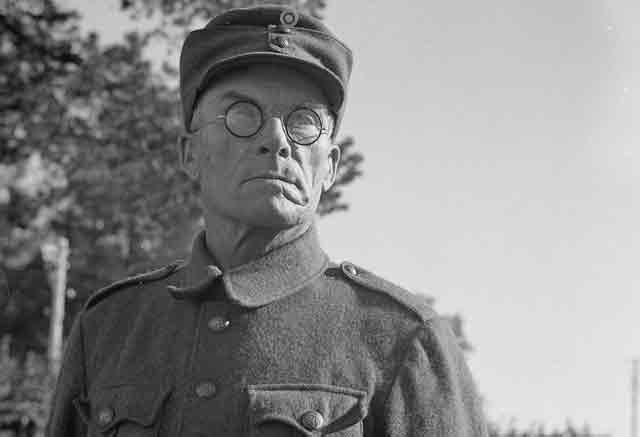
The Finnish conquest of East Karelia began. Finnish troops captured Beloostrov, which was 20 miles from Leningrad, Russia. Germany requested Finland to immediately press on against the city, but Finland rejected, noting that Finland was only attempting to reclaim territory lost to the Soviets.
General der Artillerie Alfred Jodl visits Finland. He discusses with the Finnish leadership about the Finnish war effort, particularly the possibility of a Finnish attack towards Leningrad. Mannerheim rejects the idea of a Finnish participation, but agrees to pursue the retreating Russians as far as the first Soviet fortification-line north of Leningrad. Mannerheim informs Jodl about the situation on the Finnish front: Karelian Army has just started its attack towards the River Syväri (Svir). Jodl also hands Mannerheim the Knight’s Cross Hitler had awarded him a couple of days earlier.
The first detachment of the Legion des Volontaires Français [Legion of French Volunteers] sets off to join the German army on the eastern front.
With the imminent loss of their forward airbases in Estonia, the Soviet Air Force launches the fifth, (and last for some time) air raid against Berlin. It causes no significant damage.
At the Wolf’s Lair, at Rastenburg, Hitler, infuriated by the slow progress of the German advance, starts looking for a scapegoat.
The Greer incident occurred in the North Atlantic when the German submarine U-652 fired a torpedo at the American destroyer USS Greer, perhaps believing that the American ship had launched an attack that had actually come from a British bomber. American destroyer USS Greer pursued German submarine U-652 for 2 hours 190 miles southwest of Iceland; the two ships attacked each other but no damage was inflicted on either side. The torpedoes fired at USS Greer represented the first German attack on a U.S. warship.
German cruiser Admiral Scheer departed the Baltic Sea for Oslo, Norway.
The first Lysander mission to France took place when a British Special Operations Executive agent was landed in a field near Issoudun, France, about 100 kilometers south of Orleans, and another was collected. The Lysander aircraft, painted matte black, spent just two minutes on the ground.
RAF Bomber Command, Day of 4 September 1941
18 Blenheims on escorted raids to Mazingarbe chemical works and Cherbourg docks. 3 Fortresses to Germany but none reached their targets; 1 aircraft bombed Rotterdam docks. 1 Blenheim was lost from the Mazingarbe raid.
Forces M and L rendezvoused for Operation STRENGTH.
Destroyers HMS Bedouin and HMS Vivacious departed Scapa Flow at 2100 to meet battleship HMS King George V at Oxcars Gate and provide escort for her to Scapa Flow on the 5th.
Minelayer HMS Port Quebec, escorted by destroyer HMS Newark, laid minefield SN.23 A.
Destroyer HMS Ripley ran aground off Flamborough Head. The destroyer was towed off the same day. She received temporary repairs at Grimsby until 25 September and permanent repairs at Middlesbrough to 15 March.
British steamer Abbas Combe (489grt) was sunk by German bombing five miles north, northwest of Bardsey Island. Four crewmen were missing on the steamer.
Dutch steamer Ton S. (466grt) was damaged by German bombing in 52-58N, 4-55W. The steamer arrived at Newport on the 6th for drydocking.
American destroyer USS Greer was cooperating with a British aircraft west, southwest of Iceland. The aircraft dropped two depth charges at U-652 which took them to be from the destroyer. The submarine fired a torpedo at destroyer Greer. Destroyer HMS Watchman joined briefly at 1415 and was then detached.
An Italian convoy of steamers Sirena (974grt), Sparviero (498grt), and Imperia (222grt), escorted by torpedo Pallade and Centauro, departed Tripoli for Benghazi. Torpedo boat Pallade was detached on the 5th.
On the 7th, Submarine HMS Thunderbolt sank steamer Sirena fifty miles west of Benghazi.
Australian destroyer HMAS Vendetta arrived at Port Said for escort duties to Famagusta. The destroyer escorting British steamer Salamaua arrived on the 6th. The destroyer then proceeded to Haifa.
Destroyers HMS Kingston and HMS Hasty departed Beirut for Haifa.
British steamer Harpalycus (5629grt) was damaged by German bombing off Ashrafi Reef, Gulf of Suez. British steamers City of Auckland (8336grt), Ross (4978grt), and King Edgar (4536grt) were also attacked, but were not damaged. Steamer Harpalycus arrived at Suez on the 5th.
Corvettes HMS Fleur de Lys and HMS Azalea departed Gibraltar escorting tanker Cordelia and steamer Deucalion westwards, and then met tanker Inverlee for inward escort. The corvettes and tankers Inverlee and British Freedom arrived at Gibraltar on the 13th.
Anti-submarine trawlers HMS Lady Shirley and HMS Lady Hogarth departed Gibraltar to meet tanker Noreg for inward escort. The trawlers arrived at Funchal on the 9th; Lady Shirley under tow with condenser problems. The tanker arrived at Gibraltar on the 10th, escorted by corvette HMS Jonquil.
Submarine HMS Severn arrived at Gibraltar from Atlantic patrol.
Submarine HMS Unbeaten arrived at Malta from patrol in the Straits of Messina.
Convoy SL.86 departed Freetown escorted by sloop HMS Egret to 24 September and corvettes HMS Aster and HMS Burdock to 7 September. On the 7th, escort vessel HMS Banff joined to 24 September and on the 8th, escort vessel HMS Fishguard joined to 24 September. Ocean boarding vessel HMS Hilary joined on the 18th to 25 September. Destroyers HMS Broke, HMS Chelsea, and HMS Mansfield joined on the 22nd to 26 September. Destroyer HMS Vansittart escorted the convoy on the 24th only. The convoy arrived at Liverpool on the 26th.
Convoy HX.148 departed Halifax, escorted by armed merchant cruiser HMS Alaunia and corvettes HMCS Lethbridge, HMCS Shediac, and HMCS Sherbrooke. The corvettes were relieved on 7 September by destroyer HMS Richmond and corvettes HMCS Bittersweet, HMS Candytuft, and HMCS Fennel. Corvettes HMCS Bittersweet and Candytuft were detached on the 10th and destroyer Richmond and corvette HMCS Fennel on the 11th. On the 12th, destroyers HMS Montgomery, HMS Whitehall, HMS Winchelsea, and HMS Witch, corvettes HMS Abelia, HMS Anemone, and HMS Veronica, and anti-submarine trawler HMS St. Zeno joined the escort. Destroyer HMS Boadicea joined on the 13th and destroyer Witch was detached. Destroyers HMS Beagle and HMS Shikari joined on the 14th and destroyer Montgomery was detached. On the 15th, destroyer Boadicea, the armed merchant cruiser and corvette Anemone was detached. Destroyers Beagle and Sabre and corvettes Abelia and Veronica were detached. The convoy arrived at Liverpool on the 17th.
In an executive order today in Washington, President Roosevelt established a Division of Contract Distribution in the Office of Production Management. He authorized the first lease-lend aid to Poland. His callers during the day included Dr. Solon Buck of the National Archives; the Advisory Committee of Political Refugees, headed by Dr. James McDonald, with Breckinridge Long, Assistant Secretary of State, and Joseph Davies; Bernard Baruch, and William Knudsen, Sidney Hillman, Robert P. Patterson and James V. Forrestal.
The Senate approved the reduction in personal income-tax exemptions in the defense tax bill and recessed at 5:32 PM until 11 AM tomorrow. The commerce subcommittee continued hearings on the gasoline shortage.
The House heard a eulogy of Representative Edward T. Taylor, and adjourned at 12:40 PM until noon Monday.
While en route to Iceland with mail for the Marines stationed there the destroyer USS Greer (DD-145), commanded by Commander J.J. Mahoney, was notified by a British plane that a U-Boat (the U-652 commanded by Oberleutnant zur See Georg-Werner Fraatz) had been spotted in the vicinity. The USS Greer began to track the U-652 which then fired torpedoes at the USS Greer. The USS Greer dropped depth charges in response. Neither vessel was damaged. The USS Greer became the first United States warship fired upon by a German U-boat in the war and the incident was used two days later on September 6, 1941 by U.S. President Franklin D. Roosevelt in his “Shoot on sight” order to the Atlantic Fleet.
The Senate voted 43 to 23 today to raise an estimated $303,000,000 by broadening the income tax base and then knocked about $46,000,000 out of its finance committee’s revenue bill by refusing to increase house-approved taxes on amusements. Keeping up yesterday’s swiftly-paced consideration of the record breaking bill, the senate acted promptly on a half dozen amendments, Including the controversial proposal to reduce present personal Income tax exemption from $2,000 to $1,500 for married persons and from $800 to $750 for single individuals.
President Roosevelt ordered today a wider geographical and corporate distribution of defense orders to speed up the production of arms and prevent the extinction of small business and alleviate “priorities unemployment.”. Some officials believe the total of idle may go as high as 2,000,000 workers in the next few months as material shortages force drastic curtailments in the production of nondefense durable goods. The President created in the Office of Production Management a new division of contract distribution, headed by Floyd B. Odlum of New York, and gave it broad powers to break up Army and Navy orders into smaller units, promote reforms in Federal buying practices, develop programs for converting nondefense factories to the manufacture of arms, stimulate pooling of productive facilities to permit small companies to share large orders, provide Federal engineering assistance for nondefense business men in all sections of the country desiring defense orders and stimulate subcontracting by holders of large prime contracts.
The War Department soon will ask Congress for a supplemental appropriation of about $1,000,000,000 to finance new contracts for the production of tanks, anti-tank weapons and anti-aircraft equipment. This program was announced late today by Robert P. Patterson, Under-Secretary of War, at a press conference, in which he said that a constantly growing need for greater “density of weapons” in the Army is being demonstrated both by war observation and tactical research. The money to be requested, which may exceed the round billion-dollar figure, will represent about $600,000,000 previously requested by the department but refused by Congress when it passed the last appropriating measure in August, plus new estimates based on the latest studies. The Under-Secretary stated in response to questions that much of this money could be obligated immediately, if it were available. He denied that the request for the new arms represented a plan to augment the Army beyond the total of 3,000,000 officers and men, now counted as the maximum needed war force.
The oil industry agreed tonight to use every available railroad tank car to haul petroleum to the east. An official said the industry was, in effect, calling on the American railroads to make good on a statement that tank cars could “cure” the threatened oil shortage on the Atlantic seaboard within two weeks. Ralph K. Davles, acting defense petroleum coordinator, announced that 11 principal east coast oil companies, after an all-day meeting here, signed pledges “to ask for and utilize in petroleum transportation all available railroad tank cars.”
Deliveries of U.S. military planes by manufacturers reached a peak of 1,854 in August, an increase of 394 airplanes in one month and more than three times the rate of delivery in August, 1940.
A collapse of the efforts to settle the wage dispute between the railroads and their 1,200,000 employees was predicted tonight in rail labor circles.
An estimated F2 tornado moved northeast from NW Minneapolis, diagonally across the city. A man was killed in Hennepin County at Soo Line Railroad repair shops. 200 freight cars were overturned, some full of coal weighing 80,000 pounds. There were 3 other fatalities along the 30 mile track.
U.S. oil tankers begin to arrive at Vladivostok.
The government extends Lend-Lease aid to Poland because “. . . the gallant resistance of the forces of the Government of Poland is ‘vital to the defense of the United States.”
Major League Baseball:
The New York Yankees clinched their fifth American League pennant in six seasons with a 6–3 win over the Boston Red Sox. This was the earliest major league clinching date ever for a 154-game season. The New York Yankees beat the Boston Red Sox behind Atley Donald (8–4) to clinch the American League pennant, the earliest date in Major League history. The Yankees need only 136 games, giving them a 91–45 record. This is their third straight pennant victory. Ted Williams is 1–for–1 with 3 walks and is hitting .411. Mississippi State prospect Boo Ferriss pitches batting practice for the Sox.
The pennant-pursuing Cardinals were knocked out of the National League leadership today when they dropped a pair of heartbreaking games to the Cubs, 3–0, and 4–3. The second game went eleven innings. The doubleheader saw the collapse of two of St. Louis’s ace starting pitchers, Lon Warneke and Morton Cooper. Warneke, making his first start since pitching a no-hit game against Cincinnati, failed to survive four innings in the first game after allowing the Cubs their three runs. He was touched for six hits and gave five bases on balls.
At Briggs, Bob Feller (22–11) goes 10 innings for the Indians as they edge the Tigers, 7–6. Rip Radcliff has one of the 10 hits off Feller to run his consecutive-game hitting streak to 20 games. The Indians scored three in the top of the tenth, and Feller barely held on in the bottom of the frame, giving up two runs.
The Pirates, aided by rain, beat the Reds and Cincinnati’s ace pitcher, Bucky Walters, today, 4–0, to move within one-half game of third place, now occupied by their opponents. A sudden downpour of rain in Pittsburgh’s half of the fifth inning, with one man out, caused the game to be called. Rip Sewell permitted only one hit, a stinging double by Junior Frey in the first inning, and fanned three batters.
New York Yankees 6, Boston Red Sox 3
St. Louis Cardinals 0, Chicago Cubs 3
St. Louis Cardinals 3, Chicago Cubs 4
Cleveland Indians 7, Detroit Tigers 6
Cincinnati Reds 0, Pittsburgh Pirates 4
William Mackenzie King, the Canadian prime minister, warned today that Britain is now the only obstacle in the way of an attack by Hitler’s “enslaving hordes of new barbarians” on the New World. He made an impassioned plea to the US for a declaration of support for Britain similar to that promised by Mr Churchill for the Americans in the Far East. Otherwise, he said, “the war may drag on for years, carrying in its train famine, pestilence and horrors still undreamed of.” The Canadian leader was speaking at the Mansion House, in the City of London. Mr. Churchill endorsed the Canadian call and added: “Time is short and the struggle is dire. To save humanity all free men must stand together.”
The atmosphere in Tokyo, which had turned to subdued optimism following Premier Prince Fumimaro Konoe’s message to President Roosevelt, was again registering increasing tension today.
At the second of two Imperial Conferences to discuss the attack plans of Imperial General Headquarters the Japanese Cabinet concluded “Our Empire, for the purpose of self-defense and self-preservation, will complete preparations for war … [and is] … resolved to go to war with the United States, Great Britain and the Netherlands if necessary. Our Empire will concurrently take all possible diplomatic measures vis-a-vis the United States and Great Britain, and thereby endeavor to obtain our objectives … In the event that there is no prospect of our demands being met by the first ten days of October through the diplomatic negotiations mentioned above, we will immediately decide to commence hostilities against the United States, Britain and the Netherlands.”
The Imperial Japanese Navy battleship HIJMS Mutsu is dry-docked at Yokosuka.
The Imperial Japanese Navy battleship HIJMS Hiei arrives at Yokosuka.
Dow Jones Industrial Average: 127.51 (-0.4)
Born:
Ken Harrelson, American first baseman and outfielder (MLB All Star, 1968; AL RBI leader, 1968; Kansas City A’s, Washington Senators, Boston Red Sox, Cleveland Indians) and broadcaster, in Woodruff, South Carolina.
Bernie Smith, MLB outfielder and pinch hitter (Milwaukee Brewers), in Ponchatoula, Louisiana (d. 2025).
Joanna Van Gyseghem, British actress (“Rumpole of the Bailey”, “Duty Free”), in Tunbridge Wells, England, United Kingdom.
Sushilkumar Shinde, Indian politician, in Solapur, British India.
Naval Construction:
The Kriegsmarine (German Navy) Type VIIC U-boat U-268 is laid down by Bremer Vulkan-Vegesacker Werft, Bremen-Vegesack (werk 33).
The Kriegsmarine (German Navy) Type VIIC U-boat U-632 is laid down by Blohm & Voss, Hamburg (werk 608).
The Kriegsmarine (German Navy) Type VIIC U-boat U-712 is laid down by H C Stülcken Sohn, Hamburg (werk 778).
The Nihon Kaigun (Imperial Japanese Navy) Agano-class cruiser HIJMS Noshiro (能代) is laid down by the Yokosuka Naval Arsenal (Yokosuka, Kanagawa Prefecture, Japan).
The Royal Navy Bangor-class (Turbine-engined) minesweeper HMS Hythe (J 194) is launched by the Ailsa Shipbuilding Co. Ltd. (Troon, Scotland).
The Royal Navy LCT (Mk 2)-class landing craft, tank HMS LCT 124 is launched by Tees-Side Bridge (Middlesbrough, U.K.).
The U.S. Navy SC-497-class (110-foot wooden hull) submarine chaser USS PC-531 (later SC-531) is launched by the Westergard Boat Works Inc. (Rockport, Texas, U.S.A.).
The Kriegsmarine (German Navy) Type IXC U-boat U-510 is launched by Deutsche Werft AG, Hamburg (werk 306).
The Royal Navy “M”-class destroyer HMS Matchless (G 52) is launched by A. Stephen & Sons Ltd. (Glasgow, Scotland).
The Royal Navy Fairmile B-class motor launch HMS ML 284 is commissioned.
The U.S. Navy auxiliary [repair ship] USS Alcor (AG-34; later AR-10) [ex-SS Dixie] is commissioned. Her first commanding officer is Commander Edward Alexander Mitchell, USN.
The Royal Navy Fairmile C-class motor gun boat HMS MGB 319 is commissioned.
The Royal Navy Fairmile C-class motor gun boat HMS MGB 324 is commissioned.
The Kriegsmarine (German Navy) Type IXC U-boat U-156 is commissioned. Her first commanding officer is Kapitänleutnant Werner Hartenstein.
The Kriegsmarine (German Navy) Type VIIC U-boat U-586 is commissioned. Her first commanding officer is Oberleutnant zur See Dietrich von der Esch.

