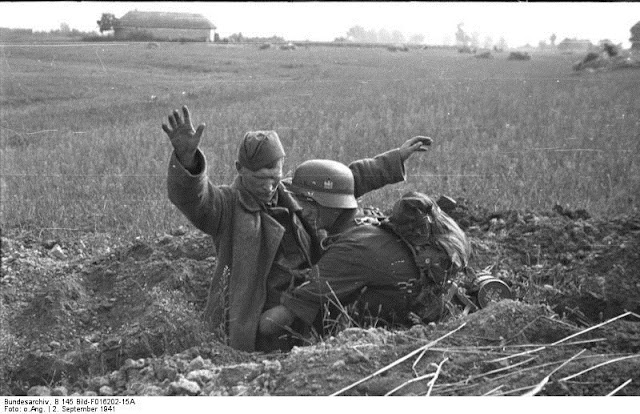
The German advance is at a standstill on 2 September 1941 due to a variety of factors. In some places, Soviet counterattacks are forcing many leading German elements to guard their flanks, while in others the Wehrmacht is simply consolidating past advances. There are some German gains, but they are local. In fact, there is a very rare occurrence to this point in the war, with the Germans deciding that they have to withdraw in the central sector due to Soviet pressure. OKH Chief of Staff General Franz Halder bemoans the “absence of any purposeful concentration of strength” at several points along the front. It is a growing problem for the Germans, not so much because of poor generalship as the growing spaces that need to be defended. Perhaps the most notable aspect of this conference in light of later events is that the decision to withdraw apparently is made without resistance from Hitler, who does, however, ask several pointed questions about why this situation developed when he is informed. In his war diary, Halder treats Hitler’s concerns as just an annoyance to be dealt with by others.
In the Far North sector, Finnish troops reach the pre-1939 border on the Karelian Isthmus. Contrary to some past incidents, the Finnish troops cross the border without any hesitation. Marshal Mannerheim orders the troops to advance until they have reached the shortest possible defensive line across the isthmus, which is beyond the old border but still well short of Leningrad.
All along the Eastern Front, Red Army withdraws from use its so-called five number code. This code was used in communications between divisions and armies, and the Soviets had become aware that it is compromised. After a week a new version of the code is introduced. For the Finnish codebreakers this marks an end of a golden era. Thanks to hard work, good luck, help from the Japanese and Soviet blunders, Finns had been able to read some 80% of the Soviet five-number code traffic from the beginning of the Continuation War in June. The significance of this intelligence for the Finnish offensive can be imagined. Major-General Taavetti Laatikainen, commander of the Finnish II Corps, once told to Lieutenant-Colonel Reino Hallamaa, chief of the radio intelligence, that thanks to the intelligence reports he received, Laatikainen often knew the enemy troop dispositions better than his own.
In the Army Group North sector, advances are minor. Halder criticizes Army Group Commander von Leeb, who he says (but not by name) “shies from taking risks and so pushes on only by inches.” About 20 miles south of Leningrad, advance Wehrmacht troops try to push through determined Soviet opposition. Soviet gunboats on the Neva River support the defenders. At the key railway junction of Mga somewhat to the southwest, the Germans finally end Soviet counterattacks and consolidate their hold on the town. While not of much use to the Germans, Mga’s loss ends any hope of the Soviets reestablishing the rail line from Moscow to Leningrad. There is a secondary rail line further north that is still in Soviet hands, but it is threatened, too.
This means that Leningrad’s rail links with the rest of Russia have been severed and the German ring around the city is almost complete. There is, however, little left here except people. While the Red Army has been holding up the Germans nearly 300 trains have carried the machine tools of 90 factories, including two heavy tank works, to safety behind the Urals where they are being reassembled.
The major problem which is emerging is food. Leningrad’s population of 2,500,000, with 100,000 refugees and the armed forces, must all be fed if a siege is mounted. Lack of bread, not bombs, may bring about Leningrad’s capitulation. Leningrad officials impose food rationing.
In the Army Group Center sector, General Halder holds a difficult conference with Army Commander Field Marshal von Brauchitsch and Army Group Center commander Field Marshal von Bock. After reviewing the heavy casualties and lack of reserves in the Yelnya “lightning rod” position, they decide to evacuate the salient. In retrospect, some consider the first time that the Germans have been forced to make a significant retreat during World War II. The situation is made more critical by the need to transfer all available reserves to support General Guderian’s Panzer Group 2 and accompanying the Second Army, which are facing heavy counterattacks south of the Desna. Guderian’s tanks give up some ground on the east flank when they are supposed to be advancing south toward Chernihiv on the road to Kyiv.
In the Army Group South sector, the Germans are consolidating their bridgeheads across the Dneipr and make no further major progress. German Sixth Army begins attacking Soviet 37th Army as it continues plowing into the Kyiv defenses.
Soviet cruisers Chervona Ukraina and Komintern support the ground troops at Odesa.
Finnish Thornycroft boat Syöksy sinks Soviet transport Meero south of Koivisto in Koivisto Sound.
Finnish minelayers conduct operations designed to bottle up the Soviet warships at Kronstadt and Leningrad.
Ponary massacre: German police and local auxiliaries massacred more than 3,700 Jews at Ponary near Vilnius.
Royal Navy submarines HMS Ursula and HMS Triumph arrive at Malta after completing patrols to the south.
Malta has just concluded its first full week without any enemy night air raids since early in the war. The moon, however, is now full, and before dawn, there is a lengthy raid that lasts for four or five hours. Damage is minor. There are no raids during the day or after dark.
A mine explodes at Ta Qali, killing three or four RAF soldiers.
The fascist newspaper Il Popolo d’Italia reported that German Chancellor Adolf Hitler and Italian Prime Minister Benito Mussolini decided at their Eastern front meeting to unite all Europe into a single axis-dominated state based on “harmonious co-operation of all European peoples…”
Free French destroyer La Cordeliere runs aground in Scotland and sustains some minor damage.
RAF bombers began daylight bombing of targets in northern France.
It is announced in the London Gazette that OS Albert Howarth (d. 1976) of HMS Foresight was blown into the sea when a ship exploded, but helped another man before being saved himself; it was then seen he had lost a foot. He is awarded the Albert Medal.
In Spitzbergen, Royal Navy transport Empress of Canada embarks the inhabitants and Canadian troops. Before they depart, the Canadians destroy the town after already having destroyed the nearby coal facilities. The force, which includes cruisers and destroyers, plans to leave on 3 September. The Germans remain completely unaware of the operation.
Royal Navy Force M, composed of the aircraft carrier HMS Victorious, heavy cruisers Devonshire and Suffolk, and six destroyers, departs from Sardam Bay on Operation EGV1. This is a planned attack on German convoys and installations at Tromsø in northern Norway.
Marshal Tito’s forces combine with the nationalist Chetniks in attacks on the German garrison in Krupanj in Serbia.
RAF Bomber Command, Day of 2 September 1941
6 Blenheims on a sweep from Dunkirk to Ostend set a merchant ship on fire but 1 Blenheim was lost. 3 Fortresses to Bremen, Duisburg and Hamburg but only Bremen was bombed. No losses.
RAF Bomber Command, Night of 2/3 September 1941
Frankfurt
126 aircraft – 71 Wellingtons, 44 Whitleys, 11 Hampdens. 3 Wellingtons and 1 Hampden lost. The only report available from Frankfurt simply says ‘bomb explosions’ for this date; it is probable that not many bombs fell in the city.
Berlin
49 aircraft – 32 Hampdens, 7 Halifaxes, 6 Stirlings, 4 Manchesters. 5 aircraft – 2 Halifaxes, 2 Hampdens, 1 Manchester – lost. The Manchester lost contained the commanding officer of 61 Squadron, Wing Commander G. E. Valentine, and Group Captain J. F. Barrett, the station commander of North Luffenham. Both officers were killed and are buried in the Berlin War Cemetery.
Minor Operations: 10 Wellingtons and Whitleys to Ostend, 16 Hampdens minelaying in the Frisians and off Denmark. 2 Hampdens and 1 Wellington lost.
Total effort for the night: 201 sorties, 12 aircraft (6-o percent) lost.
Force M, aircraft carrier HMS Victorious, heavy cruisers HMS Suffolk, HMS Devonshire and destroyers HMS Eclipse, HMS Escapade, HMS Inglefield, HMS Electra, HMS Active and HMS Impulsive departed Sardam Bay after refueling for a raid on a German convoy off Hammerfest on the 3rd. Senior Officer Force M transferred his flag from Devonshire to Victorious from 1 to 4 September when he returned to the heavy cruiser. At 0540/3rd, the force was sighted by German reconnaissance and the rendezvous with Force L was changed to 75-25N, 6-50E.
Light cruiser HMS Nigeria with destroyers HMS Icarus, HMS Antelope, HMS Anthony and liner Empress of Canada arrived at Isfjord from Archangel. Light cruiser HMS Aurora departed Sveagruva on the 2nd for Gronfjord. Trawler HMS Elm with four Norwegian prizes departed Gronfjord on the 3rd for Akureyri. The ships all arrived on the 10th to coal. They departed Akureyri on the 12th for Reykjavik, arriving on the 14th. The Spitzbergen community was embarked on the Empress of Canada and the town demolished. On the 3rd, the cruisers, destroyers, and the liner departed Spitzbergen for the Clyde. On the 4th, the cruisers were detached from the force. At 0100/6th, light cruiser HMS Penelope departed Scapa Flow to rendezvous with the ships in 62N, 05W at 1800. Destroyer HMS Lightning departed Scapa Flow at 2200/6th to rendezvous with the force. Lightning and Icarus escorted the liner to the Clyde, arriving at 2300/7th. Antelope and Anthony were detached to Scapa Flow, arriving at 1000/7th. Off Cape Wrath, Penelope was detached and returned to Scapa Flow, arriving on the 7th.
Heavy cruiser HMS London arrived at Hvalfjord from Scapa Flow, via Akureyri.
Light cruiser HMS Sheffield was detached from convoy WS.11 and proceeded to Scapa Flow, arriving on the 4th.
Light cruiser HMS Euryalus departed Scapa Flow for Rosyth to change a propeller, and arrived on the 3rd.
Destroyer HMS Eskimo departed London at 1500 on completion of refitting and arrived at Sheerness at 1845. On the 5th, she departed Sheerness for Scapa Flow, arriving at 1515/6th.
Free French destroyer La Cordeliere ran aground in Scottish waters and damaged her anti-submarine dome.
P/T/Midshipman (A) J. F. Williams RNVR, was killed when his Hurricane of 759/760 Squadron crashed near North Petherton.
Anti-submarine trawler HMS Cape Palliser (497grt) on Northern Patrol reported an enemy ship 20 miles 25° from 62N, 17W. Heavy cruiser HMS Berwick and light cruiser HMS Kenya at Scapa Flow was brought to one hour’s notice and heavy cruiser HMS London at Hvalfjord was ordered to stand by. This was later cancelled when it was determined the ship was a motor vessel.
German steamer Oslebshausen (4989grt) was sunk by a torpedo near Obrestad. As this does not correspond to any noted sinking, she was presumably lost on a mine.
Submarine HMS Ursula arrived at Malta from patrol east of Tripoli.
Submarine HMS Triumph arrived at Malta from patrol off the north coast of Sicily.
Convoy OS.5 departed Liverpool, escorted by destroyers HMS Mansfield and HMS Wolverine which were detached on the 8th. Sloop HMS Enchantress and escort vessel HMS Hartland joined on the 3rd and were detached on the 17th. Escort vessel HMS Walney joined on the 6th and was detached on the 17th. On the 17th, destroyer HMS Brilliant, corvettes HMS Amaranthus and HMS Asphodel, and anti-submarine trawler HMS Sarabande joined. The destroyer, corvette Amaranthus, and the trawler were detached on the 18th. Corvette Asphodel was detached on the 20th. The convoy arrived at Freetown on the 21st.
Convoy HG.72 departed Gibraltar escorted by destroyers HMS Boreas, HMS Farndale, HMS Vidette, and HMS Wild Swan, sloop HMS Leith, fighter catapult ship HMS Maplin, and corvettes HMS Campion, HMS Campanula, HMS Bluebell, HMS Wallflower, and HMS Hydrangea. The catapult ship and destroyer Vidette were detached later on the 2nd. Destroyer Boreas was detached to refuel at Ponta Delgada, then rejoined and escorted the convoy to Londonderry. Destroyers HMS Croome and HMS Vimy departed Gibraltar on the 4th to join the convoy. Destroyer Croome then was detached to convoy OG.73. On the 7th, destroyers Farndale and Wild Swan were detached to refuel at Ponta Delgada and then join convoy OG.73. Sloop HMS Rochester and corvettes HMS Carnation, HMS La Malouine, HMS Heliotrope, and HMS Mallow departed Gibraltar on the 4th and joined the convoy on the 8th. Sloop HMS Deptford joined the convoy on the 10th, sloop HMS Sandwich, French sloop Commandant Domine, and anti-submarine yacht HMS Philante joined on the 11th. Destroyers HMS Caldwell, HMS Vanoc, HMS Volunteer, and HMS Walker joined on the 12th. On the 14th, a Hurricane from catapult ship Maplin drove off a German Fw.200 bomber one hundred miles south of Ireland. Sub Lt C. W. Walker bailed out and was picked up by sloop Rochester. On the 15th, sloop Deptford was detached. The convoy arrived at Liverpool on the 17th.
Convoy ST.2 departed Freetown, escorted by corvettes HMS Armeria and HMS Asphodel, and arrived at Takoradi on the 7th.
The new supply priorities and allocations board made it clear today a shortage of raw materials needed for defense would necessitate closing some less essential industries. The board, appointed as the master agency of the defense production effort, took up its duties, as President Roosevelt announced a new drive to increase production by spending more money and putting extra shifts to work. Additional billions of dollars will be mobilized to increase the size of this country’s already vast armaments program and assist in the effort “to crush Hitler,” President Roosevelt announced today. Giving a strong hint that the request for a new lease-lend appropriation would go to Congress on Monday or Tuesday, the President indicated that additional requests would be made for the domestic armaments program. Asked at his press conference, following his return from Hyde Park this morning, what steps he planned in line with his Labor Day declaration that the output of weapons must be increased to conquer “the forces of insane violence,” the Executive stated that present plans were simply to spend more money and turn out more war materials. He remarked that appropriations for armaments would be spent as fast as they could be.
In using the huge sums already appropriated and to be appropriated for armaments and munitions, Mr. Roosevelt quickly went on to explain, additional men would be put on second and third shifts in arms factories, and sub-contracting would be increased so as to have all national production facilities at work. Coincidentally, following the first meeting today of the new Supply, Priorities and Allocations Board, Vice President Wallace, its chairman, declared that the United States must stop using materials, men and production facilities in non-essential industries because “every available man and machine must be employed either in direct defense requirements or at work essential to the civilian economy.” The President himself showed no inclination to minimize the fact that the amplified production program would cut in on civilian consumption of goods to an increasing extent. He said that as it became impossible for factories to turn out consumers’ goods because of lack of raw and partly finished materials, these plants would be converted for war production. There would be fewer new factories built, he said, thus stressing the need for speed, since it takes less time to convert existing factories than to build new ones.
Edward Stettinius replaces Roosevelt’s crony Harry Hopkins as Lend-Lease administrator.
The 1941 tax bill, hailed by some as a potential source of more revenue than the $3,672,400,000 estimated by the Treasury Department, was ordered reported to the Senate today by the Finance Committee. Discussion will begin tomorrow. Leaders plan to bring it to a vote early next week. Anticipating this relatively speedy action, House officials, after consultation with President Roosevelt, said today that they would request that House conferees to start “informal” consideration of differences between the terms as approved by the two branches in the hope that when “the holiday recess” is ended on September 15 the measure will be in shape for final action by the two Houses. This plan contemplates that the measure will be on Mr. Roosevelt’s desk by September 25. Should the measure bring in between $4,500,000,000 and $5,000,000,000 above the present Federal income, the total cash available next year for Treasury disbursement would approximate $15,000,000,000. This, however, would be only about half the sum expected to be actually spent for defense and “ordinary” disbursements and is little more than a third actually appropriated or authorized for expenditure.
Vice President Wallace, speaking for the newly-created Supplies Priorities and Allocation Board, said today that defense officials would stop the sapping by less essential industries of material, labor and machinery resources necessary for an all-out defense program so that “every available man and machine” may be employed on defense requirements or at work essential to the civilian economy.
By a vote of 382 to 5, delegates to the seventh national convention of the United Electrical, Radio and Machine Workers of America, C.I.O., approved today President Roosevelt’s policy of aid to Great Britain, Soviet Russia, China and all other nations resisting Hitlerism.
Representative Martin Dies, Texas Democrat, said today he would release from Washington tomorrow or within a few days facts that would prove Leon Henderson “is unfit to administer the price control efforts of the government and will justify his dismissal.” “I shall give the record of some of his chief assistants and my statement will be supported by a number of photostatic copies of a number of documents in my possession,” stated the chairman of the house committee investigating un-American activities.
Lillian Gish, stage and screen actress, announced today that she had resigned from the America First committee, which opposes United States intervention in the war. She gave no reason.
Three children playing along a busy street in Hempstead, New York, were burned to death today as a P-39 army pursuit plane crashed in flames and exploded. The victims were enveloped by a sheet of flaming gasoline almost without warning when the ship’s gasoline tank blew up as it plunged to earth. The pilot, Second Lieutenant Roy W. Scott, 8th Pursuit Group, Mitchel Field, parachuted to safety. He was alone in the plane. Casper Cucio, 5, and Georgene Kramer, 4, died in Meadowbrook hospital several hours after the accident, and Casper’s sister, Pauline, 7, died at 11 p.m. The children were playing about 25 feet from the spot where the plane rammed into the ground.
The Academy of Motion Pictures copyrights the Oscar statuette.
Major League Baseball:
The Cardinals sell pitcher Hank Gornicki to the Cubs and he will appear in one game for Chicago before the sale is voided. The Pirates will claim Gornicki in November and he will win 14 games for the Bucs in the next two seasons.
In chronological order Kirby Higbe lost his no-hitter, his shut out and his poise in the sixth inning of yesterday’s game between the Brooklyn Dodgers and the Boston Braves at Ebbets Field. He couldn’t, of course, regain the first two, but item No. 3 returned almost immediately and the Brooklyn right-hander coasted to a 9–2 victory. This was Higbe’s nineteenth triumph against nine setbacks. He leads the National League in victories and so do the Dodgers, but they still trail the first-place Cardinals by two percentage points. St. Louis was idle.
Charley Root, veteran Chicago Cubs’ right-hander, went to work on his third set of 100 pitching victories today, notching the two hundred and first triumph of his major league career by beating the Cincinnati Reds, 3–1, in the final game of the series. Root held the Reds to five hits and allowed their only run in the third when Eddie Joost walked, advanced on a sacrifice and scored on Lloyd Waner’s double.
Boston Braves 2, Brooklyn Dodgers 9
Cincinnati Reds 1, Chicago Cubs 3
The United States extends loans to Mexico to create a joint defense of the hemisphere. In addition, the two countries, and also Colombia and Ecuador, enter into currency stabilization agreements.
The Japanese army’s chief spokesman declared bluntly last night Japan was determined to use force if necessary to “break through the encirclement by the United States, China, Britain and the Netherlands” even though this may mean “entry into a long-term war against Britain and America.” The spokesman, Lieutenant Colonel Itsuo Mabuchi, chief of the army press section of Imperial Headquarters, told the nation in a broadcast Japan was resolved to build her co-prosperity sphere in East Asia despite British-American efforts at restraint. “The longer we remain passive against such moves, the more dangerous it will be for this country,” he said, adding: the Washington and London governments were well aware of this and were acting accordingly. Soldiers should not be used uselessly, the colonel declared, adding that therefore diplomatic efforts should be pushed as long as possible. “Peaceful means will not be allowed to be dragged along forever,” he said. He added if diplomatic means failed Japan would “break out of encirclement” forcefully before economic pressure reduced her to pauper status.
A plan to establish a “safety zone” around the Japanese islands and thereby possibly shut off the big Siberian port of Vladivostok from American shipments was before Premier Prince Fumimaro Konoe today while the Japanese press read a variety of meanings into President Roosevelt’s Labor Day speech. General Senjuro Hayashi, director of the Asia Development Federation which represents about 60 nationalist organizations, said Prince Konoye had agreed to consider the federation’s proposal for a safety zone. Vladivostok is approachable by sea only through straits between the Japanese islands; so such a program might isolate it just as the first American shipload of aviation gasoline for Soviet Russia is near Japanese empire waters.
Following up the speech of Colonel Hayao Mabuchi, chief of the Japanese Army Press section of Imperial Headquarters, in which he stated Japan must break “American, British, Chinese and Dutch encirclement” either by diplomacy or by force or face economic strangulation, the Great Japan and Asia Development League yesterday submitted to Premier Prince Fumimaro Konoe, who is its president, a four-point program that calls for:
- Adherence to the guiding spirit of Italian-German-Japanese Axis diplomacy.
- Firm enforcement of the “new order” in “greater East Asia.”
- Intensified attack on all aid to Generalissimo Chiang Kai-shek.
- Invocation of the right of self-defense in Japan’s coastal waters.
To the delegation submitting these recommendations, Prince Konoye replied: “I fully understand the purpose of the recommendations. I shall consult the various quarters concerned in regard to them and make them contribute to the execution of the country’s policies.”
The collaborationist government of Manchuria (“Wei Manzhouguo”) enacts its second five-year plan for economic growth.
The government in Tokyo sets up the Air Defense Bureau, which will organize air-raid precautions throughout Japan.
The Japanese consulate in Batavia, Netherlands East Indies, sends a message to Tokyo, Japan, stating that “conditioned by our military invasion of French Indo-China, it was a fact that the government of these islands had drastically stepped up their anti-Japanese tendencies and very evidently assumed an attitude of aid to China.”
There is no sense of urgency on the American side in the Pacific. General Douglas MacArthur informs Admiral Hart, CINC-Asiatic Fleet that there was “plenty of time” to prepare for war with Japan.
Dow Jones Industrial Average: 128.31 (+0.61)
Born:
John Thompson, NCAA basketball coach (Georgetown Univ., 1972–99, NCAA Division I tournament, 1984) and NBA center and power forward (NBA Championship-Celtics, 1965, 1966; Boston Celtics), in Washington, District of Columbia. (d. 2020).
Ron Carpenter, AFL linebacker (San Diego Chargers), in Marshall, Texas.
Jerry Crider, MLB pitcher (Minnesota Twins, Chicago White Sox), in Sioux Falls, South Dakota (d. 2008).
David Bale, South African entrepreneur and activist, in South Africa (d. 2003).
Jyrki Otila, Finnish quiz show judge and member of the European Parliament, in Helsinki, Finland (d. 2003).
Kay Patrick [Patricia Jackson], British television director (“Coronation Street”, 1994-2015), in Hull, England, United Kingdom (d. 2026).
Sadhana Shivdasani, Indian actress, in Karachi, British India (d. 2015).
Naval Construction:
The Royal Navy Round Table-class minesweeping trawler HMS Sir Tristam (T 229) is laid down by J. Lewis & Sons Ltd. (Aberdeen, Scotland).
The U.S. Navy Gato-class submarine USS Gurnard (SS-254) is laid down by the Electric Boat Co. (Groton, Connecticut, U.S.A.).
The Royal Navy Hunt-class (Type III) escort destroyer HMS Stevenstone (L 16) is laid down by J.S. White & Co. (Cowes, U.K.).
The Kriegsmarine (German Navy) Type IXC U-boat U-175 is launched by AG Weser, Bremen (werk 1015).
The Royal Canadian Navy Fisherman’s Reserve patrol craft HMCS Ehkoli (FY 12) is launched by the Star Shipyards (Mercer’s) Ltd. (New Westminster, British Columbia, Canada).
The Royal Canadian Navy Bangor-class (VTE Reciprocating-engined) minesweeper HMCS Miramichi (J 169) is launched by the Burrard Dry Dock Co. Ltd. (Vancouver, British Columbia, Canada).
The Royal Canadian Navy Flower-class corvette HMCS Fredericton (K 245) is launched by the Marine Industries Ltd. (Sorel, Quebec, Canada).
The Nihon Kaigun (Imperial Japanese Navy) escort aircraft carrier HIJMS Kasuga Maru (春日丸) is commissioned into service. Her first commanding officer is Captain Ishii Norie. In September 1942 this ship is renamed HIJMS Taiyō (大鷹; “Goshawk”).
The Royal Navy “U”-class (Third Group) submarine HMS Umbra (P 35) is commissioned. Her first commanding officer is Lieutenant Stephen Lynch Conway Maydon, RN.

