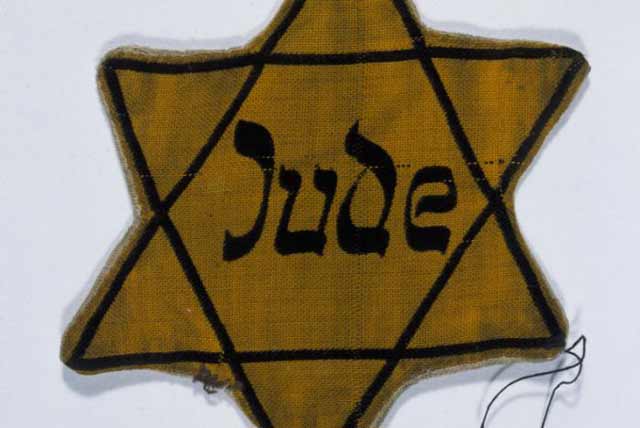
The wearing of the yellow star becomes compulsory for Jews in Germany this month.
[Ed: “Never Again” is Now.]
1 September 1941 marks the two-year anniversary of the invasion of Poland that most people consider the start of World War II. It is not an anniversary that gets much notice, but at such milestones, it is good to briefly summarize events to date.
To this point, the German war effort has been remarkably successful. Against many predictions and their own fears, the Wehrmacht generals stormed across most of western Europe with remarkable ease. As of this date, the Germans and their allies even have made inroads into Africa and Asia with greatly varying degrees of success. The war at sea has been moderately successful for the Germans due to the expanding U-boat fleet, but the Kriegsmarine’s weakness in surface ships has been confirmed by some embarrassing losses such as the battleship Bismarck in May 1941 and the cruiser Admiral Graf Spee in 1939. There is no doubt that the British and Americans control the seas, while the air war is a draw with only a very slight edge to the Luftwaffe so far despite its vastly superior numbers in the West. The recently restarted Finnish war effort has been outstanding in accomplishing Finnish war objectives, though those have not always been the same as overall Axis objectives.
There are some quibbles with this seemingly perfect picture. Great Britain has suffered privations, but its military remains completely intact. The British Army has defeated the Italians everywhere and is proving extremely troublesome for the Afrika Korps. The Luftwaffe offensive against Britain failed utterly due to the Royal Air Force, though it has caused tremendous misery. The advance into the Soviet Union continues to progress and many still expect the Germans to win, but the Soviets are fighting much harder than anyone expected. Several German generals, such as OKH Chief of Staff Franz Halder, already have drawn the correct conclusions from this unexpected defense. However, there is nothing that the generals can do about it because Hitler’s war aims are limitless and unyielding.
The collapse of the Italian war effort is probably the most significant drawback to the German war effort of the first two years of war. Other than at sea, the Italians have contributed at most some tangential support to the war effort and have had to be bailed out in Greece and North Africa. While not completely unexpected, the Italian military failures have forced the Wehrmacht to divide its focus when otherwise it might have been able to mount a more focused and successful attack on the U.S.S.R. The Germans have been forced to defend Italian possessions that serve no useful purpose, while the Italians contribute little beyond the defense of their own area.
Unknown to the Germans, the Italians already have made some tentative peace overtures through the Vatican, but they have gone nowhere. Hitler’s own half-hearted peace overtures to the British have been completely ignored, and the situation in France remains tense. The French Resistance is just getting started, motivated by terrorist incidents in Paris. In the Balkans, the partisans have occupied large stretches of “conquered” territory, and the Italian occupying forces have proven completely ineffective against them. This has required more German effort to suppress the partisans, a necessity that shows no sign of easing.
The great political imponderables remain the United States and Japan. The US obviously is doing everything short of declaring war that it can to help its British allies, a fact that irks Adolf Hitler but about which he can do nothing. Japan is playing a double game, feigning blind adherence to the German cause and paying lip service to German objectives while secretly trying to resolve its issues with the Americans short of conflict. The Imperial Japanese war effort in China is struggling but is aided somewhat by internal Chinese conflicts between the nationalist and communist forces. There seems little prospect of Japan subduing China, suggesting an endless campaign that never threatens Japan but requires constant supplies and reinforcements.
In sum, the Axis is in control at the two-year mark, although with some serious disappointments. There is a real danger of its forces getting overstretched, and the likeliest sector where that could first become apparent is on the Eastern Front.
All German Jews over the age of six are ordered to wear, from 19 September 1941, a yellow star of David with the word Jude [Jew] written on it. A new decree is issued ordering that all Jews are forbidden to leave their place of domicile without special permission; Jews six years of age or older can now appear in public only when marked with a Jewish star (Star of David). This decree covers so-called Mosaic Jews as well as baptized Jews. Only those who had converted to Christianity prior to September 15, 1935, the date of the Nuremberg laws, and “non-Aryans” married to an “Aryan” partner are exempted. (Note: The marking of Jews had first been applied to Jews in Poland, but is now extended to the entire Reich.)
Karl Jäger, commander of an SS Einsatzgruppe operating around Vilnius reports that day they killed “1,404 Jewish children, 1,763 Jews, 1,812 Jewesses, 109 mentally sick people, one German woman who was married to a Jew, and one Russian woman.” Jäger notes the essential help of local Lithuanians and says that 4,000 Jews were liquidated by pogroms and executions at the hands of Lithuanian partisans.
The 9th Company of German Police Battalion 322 participated in the murder of more than 900 Jews from the Minsk area in Byelorussia. On the same day, the Police Regiment South reported shooting 88 Jews, and Battalion 320 reported shooting 380.
Ukrainian Ulas Samchuk, the editor of newspaper Vollnyn, writes in an editorial that Jews and Poles “must disappear completely from our cities.”
The German euthanasia program officially ends, a rare case of Adolf Hitler bowing to public pressure. However, it continues in the camps without much notice by the outside world or the German public.
Alfons Bentele, a veteran of the Dachau camp, takes command of the Majdanek concentration camp.
The top levels of the German military command increasingly are opposing each other over strategy as resources grow tight. The offensive continues, but it has become impossible to maintain forward momentum in all three army groups at the same time. Choices must be made, and there are tempting major objectives in front of all three fronts.
Regarding the Far North sector, General Halder notes in his war diary that:
“[the] Finns have changed their minds and now will continue the drive beyond the national frontiers also on the Karelian Isthmus, but only with limited objectives conformable to their demands for frontier corrections.”
Halder later comments on this a little more bluntly, adding that the Finns “do not want to carry the attack beyond their old frontier on the Karelian Isthmus.” The Germans, of course, want the Finns to focus on a major objective, Leningrad. Relations with the Finns are still correct, but Marshal Mannerheim already has halted his troops more than once against German wishes.
Yesterday Finnish troops encircled two Soviet divisions (43rd and 115th) in the Porlammi — Ylä-Somme area south of Viipuri in the Karelian Isthmus. Today the Soviet units caught in the encirclement begin to surrender, although many men are able to break out, leaving their equipment behind. About 12,000 Soviet troops melt away through the forest, but the Finns take 9000 prisoners, 55 tanks, 306 artillery guns, and 246 mortars. There also are 7000 Red Army deaths.
In the Army Group North sector, Field Marshal von Leeb tonight proposes an “operational strategy’ that OKH Chief of Staff General Halder calls “which is completely out of harmony with our strategy, both in planning and in the direction of the attack.” It is easy to read between the lines and presume that von Leeb wants a massive effort north against Leningrad even as the high command is sending troops south to Kyiv. German grand strategy always has been divisive within the top generals, and von Leeb naturally wants the glory of taking Leningrad. However, Hitler views Kyiv as a higher priority.
German forces are now within artillery range of Leningrad. East of the city their advance nears the south edge of Lake Ladoga.
On the ground, there are heavy rains. There are some local German gains, but, otherwise, it is a quiet day. Panzer Group 4 recaptures Mga, a major rail junction, and continues on toward Lake Ladoga. These gains come at a heavy cost in lives. The Germans come within the artillery range of Leningrad.
In the Army Group Center sector, General Guderian’s Panzer Group 2, however, is stalled on its way south from Army Group Center toward Kyiv. Soviet General Timoshenko launches a major counterattack at Gomel which forces Guderian to adopt a defensive posture when he should be attacking south. Other Soviet offensives on the central sector, timed to begin together, also break out east of Smolensk and elsewhere. Soviet 24th Army makes some gains into the German 4th Army line at the lightning-rod position at Yelnya but takes heavy losses.
In the Army Group South sector, Eleventh Army expands its bridgehead over the Berislav River by pouring in five regiments, or about two divisions. In addition, the Germans take another bridge over the Dnepropetrovsk Ridge, a damaged railway bridge, and expand their bridgehead there. Sixth Army, however, reports “severe enemy pressure” on the approaches to Kyiv.
Protecting the crossings at the Dnepr, German fighter group JG 51 claims to have destroyed 77 Soviet bombers.
The German Kreigsmarine light cruiser Köln began supporting the invasion of Dagö and Ösel islands and disabled Soviet coastal batteries at Cape Ristna. The German 61st Infantry Division plans Operation BEOWULF, an amphibious invasion of Ösel (also called Saaremaa) and Dagö (also called Hiiumaa). The Soviet 3rd Rifle Brigade defends with 23,700 men. Today, Kriegsmarine cruiser Köln bombards the Soviet coastal batteries located at Cape Ristna, putting them out of action.
Soviet cruisers Chervona Ukraina and Komintern of the Black Sea Fleet support ground operations by bombarding German and Romanian positions.
Soviet river monitor Zhytomyr runs aground in the Dnepr River at Cherni, remains stuck, and ultimately is lost to scuttling due to the German advance.
Adolf Hitler meets with the commander of the Spanish Blue Division, General Agustín Muñoz Grandes. The division is on its way to the Army Group North sector of the Eastern Front and is marked by its high enthusiasm for the war.
The Soviets execute Estonian military leader Karl Parts. At this time, there is great enthusiasm within some quarters of Estonia at being “liberated” by the Germans.
General Golikov becomes the commanding officer of the 10th Reserve Army on or about this date.
General Halder notes in his war diary a meeting with General Buhle and “Count Stauffenberg.” Stauffenberg gives a “cheering” account of his visit to Army Group North. Stauffenberg reports that “the material situation” in the sector is “very good,” but a shortage of men is developing. Buhle adds that twelve divisions will have to be disbanded during the winter to make up for losses. Stauffenberg recommends that the soldiers be pulled out of the front to recuperate and make them “in shape for new operations.” Stauffenberg’s report today has nothing to do with the resistance, but we’ll be keeping an eye on him when he pops up at the top levels of the Wehrmacht because of his later resistance activities.
550 pilots and ground crew with 40 Hawker Hurricane fighters from Nos. 81 and 134 Squadrons arrived in Murmansk, Soviet Union. These squadrons would be formed into No. 151 Wing and fly in defense of the Soviet Naval base. Their objective was to provide immediate air defense against the Axis forces trying to capture this vital port. They were also there to train Soviet pilots to operate the first of what would eventually total almost 3,000 Hurricanes delivered to the Soviets.
The Germans activate Panzer Group Afrika. General der Panzertruppe Erwin Rommel is in command while General Crüwell is appointed to replace Rommel at Afrika Korps. Afrika Korps includes 90th Light Division, 15th Panzer Division, and Italian Corps C and XX.
The fifth Vichy French convoy evacuating the Middle East (following the French defeat there) departs from Haifa carrying 5216 French troops. This is all done per the armistice agreement with the British.
An Axis convoy of five merchant ships (Andrea Gritti, Rialto, Vettor Pisani, Francesco Barbaro, and Sabastiano Venier) escorted by four Italian destroyers departs from Naples bound for Tripoli. The RAF based on Malta attacks and sinks 6338-ton Andrea Gritti and damages 6343-ton Francesco Barbaro. Francesco Barbaro returns to Messina, while the remainder of the convoy proceeds to Tripoli.
Royal Navy submarine HMS Otus departs from Malta bound for Alexandria carrying mail, supplies and 15 passengers. The submarine attacks an Italian armed merchant cruiser later in the day but misses.
Royal Navy battleship HMS Queen Elizabeth becomes the flag vessel of the commander of the Mediterranean Fleet. The First Battle Squadron transfers its flag to the Barham.
Malta becomes the base for the Royal Navy’s 10th Submarine Flotilla under the command of Commander George W G Simpson.
Hitler tells Papen this month that he is upset about the continuing confiscations of Catholic Church property, and blames the hotheads of the Party for “this nonsense.”
Werner Heisenberg, Germany’s top nuclear physicist, discovers how to produce “Uranium 94” via a chain reaction. “Uranium 94”, he theorizes, can be used to make an atomic bomb. Element 94 soon becomes known as plutonium.
German Abwehr agent Alphonse Louis Eugene Timmerman arrives in England aboard a ship from Spain. He is quickly arrested.
The major portion of British Operation GAUNTLEY begins winding down in Spitsbergen. The Canadians continue destroying coal mines, while troopship HMT Empress of Canada and its escorts arrive back from Arkhangelsk. The Empress carries with it 200 French troops who have escaped from Soviet POW camps. The men of Operation Gauntlet evacuate the island along with about 800 local inhabitants and 15 sled dogs. The Allies have taken no casualties.
Lord Beaverbrook, a leading Conservative member of Churchill’s government, writes to Rudolf Hess requesting a meeting. Beaverbrook on this same day is appointed to head a Cabinet mission to Moscow to discuss aid for the Soviets.
Albanian communist partisans form a united front to oppose the Italian occupiers.
RAF Bomber Command, Night of 1/2 September 1941
Cologne
34 Wellingtons and 20 Hampdens bombed in good visibility. Many fires were claimed but some crews reported German decoy fires. Cologne reports only 35 bombs of all kinds, 1 house damaged, no casualties. 1 Hampden lost.
4 Hampdens minelaying off Denmark. No losses.
The British also conduct Roadsted Operations over France, during which they severely damage vorpostenboot V 1512 Unitas 8 at Barfleur, Manche, France.
The RAF also sends four Hampdens to lay mines off Denmark. They return without incident.
A Consolidated Liberator Mk. I, RAF s/n AM915, operated by British Overseas Airways (BOAC), crashes into a hillside near Campbeltown, Argyll, England; all ten aboard are lost.
The Luftwaffe sends 25 bombers against Newcastle. This causes extensive damage, destroying over a hundred houses and killing 49 people, with an additional 1000 or so made homeless in the Jesmond and Shildfield areas. Fires are started which blaze for days. A bomb that hits just outside an Anderson shelter kills a man and his two sons while injuring his wife.
The Luftwaffe makes numerous command changes, including installing Oberst Heinrich Conrady in command of KG 3 and Oblt. Georg Pasewald at KG 40.
An Air France Bloch 220, msn 12, registered F-AQNL, crashes into a lake after an engine failed on takeoff at Bollemont, France. Only 2 of the 17 aboard survive.
The last Spitfire Mk.Is are delivered this month.
The Focke-Wulf Fw 190 appears in combat this month. This is the Fw 190A-1 model which outperforms the Spitfire Mk.V, although is is too lightly armed. All available Fw 190s are sent to units on the French coast.
The Messerschmitt Me-163A powered by “cold” H. Walther rocket is successfully flown this month at Augsburg, Germany. Development of the Me-163 had begun in 1937, but “cold” engine proved unreliable. Flights were also made in October which reached speeds of 1,003 km/hr, or Mach 0.85.
The Soviet BI-1 rocket-powered prototype aircraft was ready for unpowered flight at Khimki, Moscow Oblast, Russia.
Heavy cruiser HMS Shropshire with destroyers HMS Somali, HMS Matabele, and HMS Punjabi (Force L) arrived off Seidisfjord at 0500, but in heavy fog only Punjabi was able to enter port, arriving at 1045. The others ships proceeded to rendezvous with Force M (heavy cruiser HMS Devonshire group) in 74N 8E. Punjabi departed Seidisfjord at 1300 to rejoin Force L.
Light cruiser HMS Nigeria, destroyers HMS Icarus, HMS Antelope, HMS Anthony with liner Empress of Canada arrived at Gronfjord from Archangel to embark Norwegians from Spitzbergen.
Convoy ON.12 departed Liverpool on 1 September, with escorts corvette HMS Heartsease, and anti-submarine trawlers HMS Angle, HMS Cape Warwick, and HMS St. Apollo. On the 2nd, anti-submarine trawler HMS Daneman joined. On the 4th, destroyers HMS Amazon, HMS Ambuscade, HMS Belmont, and HMS Bulldog, and corvettes Aconit, HMS Aubretia, and HMS Nigella joined while Ambuscade was detached. On the 7th destroyer HMS Broadway, and corvettes HMCS Cobalt and HMS Polyanthus joined; Heartsease, Angle, Cape Warwick, St. Apollo, Daneman, Amazon, Belmont, Bulldog, Aconit, Aubretia, and Nigella were detached. On the 10th, destroyer HMS Ramsey, armed merchant cruiser HMS Worcestershire, and corvettes HMCS Buctouche and HMCS Galt joined, while Broadway, Cobalt, and Polyanthus were detached. On the 14th, Ramsey, Worcestershire, Buctouche, Galt were detached. The convoy dispersed 14 September.
British trawler HMS Hazel, Belgian trawler Van Oost and tanker RFA Oligarch arrived at Sveagruva, and departed on the 3rd. Following operations EGV One and Two, these ships, with destroyer HMS Escapade, arrived at Reykjavik on the 14th.
Destroyer HMS Bedouin arrived at Scapa Flow at 1830 after refitting.
Destroyer HMS Ashanti was docked at Rosyth to correct a defect developed on passage to Scapa Flow.
The flag of Commander in Chief, Mediterranean Fleet, was transferred to the battleship HMS Queen Elizabeth, while Vice Admiral Commanding First Battle Squadron transferred to battleship HMS Barham.
Motor torpedo boats MTB.68 and MTB.215 arrived at Alexandria from Haifa, but both were out of action due to numerous serious defects. Trawler Vulcan, the MTB’s depot ship, arrived at Alexandria on the 2nd.
Submarine HMS Upholder arrived at Malta from patrol.
An Italian convoy of steamers Andrea Gritti (6338grt), Riallto (6099grt), Vettor Pisani (6339grt), Francesco Barbaro (6343grt), Sabastiano Venier (6311grt) departed Naples escorted by destroyers Da Recco, Dardo, Folgore, and Strale. At 0025/3rd, Andrea Gritti was sunk in an attack by nine British Swordfish of 830 Swordfish from Malta south, southeast of Cape Spartivento. In the same attack, Francesco Barbaro was damaged by 830 Squadron Swordfish, but taken in tow by destroyer Dardo and escorted by destroyers Ascari and Lanciere to Messina. The remainder of the convoy arrived at Tripoli on the 4th.
Submarine HMS Otus departed Malta with stores, mail and 15 passengers, and later that day, unsuccessfully attacked an armed merchant cruiser in 35-40N, 18-07E. She arrived at Alexandria on the 11th.
U.S. President Franklin D. Roosevelt gave a Labor Day radio address from his home in Hyde Park to the American people. “American labor now bears a tremendous responsibility in the winning of this most brutal, most terrible of all wars,” the president said. “In our factories and shops and arsenals we are building weapons on a scale great in its magnitude. To all the battle fronts of this world these weapons are being dispatched, by day and by night, over the seas and through the air. And this Nation is now devising and developing new weapons of unprecedented power toward the maintenance of democracy … Our vast effort, and the unity of purpose that inspires that effort, are due solely to our recognition of the fact that our fundamental rights — including the rights of labor — are threatened by Hitler’s violent attempt to rule the world..” Reminding his fellow Americans of their constant readiness to fight for their rights, President Roosevelt declared today “we must do our full part” in conquering “forces of insane violence” let loose by Adolf Hitler. There has never been a moment in our history,” he said, “when Americans were not ready to stand up as free men and fight for their rights.”
It is quite a warlike speech for a nation supposedly at peace.
President Roosevelt’s warning to labor that it has an extraordinary stake in this country’s defense program won general approval among the handful of Congressmen who spent Labor Day in the capital. Senator Gerald P. Nye of North Dakota, Republican isolationist, sounded one of the few critical notes.
Senator Byrd, Virginia Democrat, called tonight for fundamental replanning and basic reorganization of the defense program,” renewing his charges production of military supplies was lagging. “We have the choice of a shorter European war providing we speed up our defense production,” Byrd said in an address on the Washington Star radio forum. To attain this end, he urged an end to strikes in defense industries, replanning the defense effort in relation to civilian needs to abandon the doctrine of “business as usual”, and an executive head for the program.
Burton K. Wheeler, Montana Democrat, tonight summoned American workers to “resolve that this republic will not become embroiled in a foreign war” and instead enlist in a “noble war” against economic injustices at home. He branded as “traitors, those in the nation “who speak of the dignity of labor and then urge American entry into a foreign war.” In a reply to President Roosevelt’s address of today, Senator Wheeler declared tonight that American faith in democracy was being poisoned by “broken promises.” He spoke before a Labor Day assembly at St. Charles, III. His speech was sponsored by the America First Committee and was broadcast over the Mutual network.
The OPM is “reliably understood” to have prepared secretly a list of more than forty Industries, embracing thousands of business concerns, that face drastic retrenchment or complete shutdown as a result of “raw material starvation” under the national defense program, Leo M. Cherne, executive secretary of the Research Institute of America, Inc., yesterday told the institute’s one hundred district managers at the opening of a four-day meeting at the Hotel Pennsylvania.
More men and women are employed today, and at better wages and under better working conditions, than at any time in the history of the United States, Miss Frances Perkins, Secretary of Labor, said tonight in a Labor Day address broadcast by the network of the Columbia Broadcasting System.
Repudiating the isolationist stand of John L. Lewis, former president of the C.I.O., the national officers of the United Electrical, Radio and Machine Workers of America called upon the union’s seventh national convention today to support a policy of all-out aid to Great Britain and Soviet Russia.
American labor stands firm and united “against Hitler and against all he means,” Sidney Hillman, associate director of the Office of Production Management, declared yesterday during the “Salute to Labor” broadcast over the red and blue networks of the National Broadcasting Company.
Wendell L. Willkie., 1940 Republican Presidential candidate, has been retained to defend motion picture producers against charges, soon to be brought before a Senate interstate commerce subcommittee, that they are producing war propaganda movies, it was disclosed tonight.
The U.S. Navy assumes responsibility for trans-Atlantic convoys from point off Argentia to meridian of Iceland.
The U.S. Atlantic Fleet under the command of Admiral Ernest J. King forms a Denmark Strait Patrol The United States Navy assumed patrol of the Denmark Strait with battleships USS Idaho, USS Mississippi, USS New Mexico (two of these were on patrol at a time), heavy cruisers USS Wichita, USS Tuscaloosa, and destroyers of Destroyer Squadron 2 — USS Morris (Flag), USS Anderson, USS Hammann, USS Russell, USS Sims, USS Walke, USS Charles F. Hughes, USS O’Brien, USS Mustin and Destroyer Division 22, USS Gwin (Flag), USS Grayson, USS Meredith and USS Monssen. The announced goal is to protect US shipping. The US Navy permits its ships to escort convoys and escorts ships from Argentia, Newfoundland to Iceland, where the Royal Navy takes over.
General Marshall makes Walter Bedell Smith the Secretary of the General Staff.
Army Chief of Staff General Marshall assesses Hawaii as adequately defended and wishes all additional men and materiel sent to the Philippines.
First production order for 150 Northrop P-61 night fighters is placed.
Dr. Robert H. Goddard began work this month on liquid-propellant JATO under contract to USN and AAF, delivering a device to both agencies in September 1942.
KYW-TV, the first American television station outside New York, went on the air in Philadelphia, Pennsylvania.
Major League Baseball:
At Fenway, the Red Sox sweep 2 from the Senators, 13–9 and 10–3. Williams has only 5 official at bats, but has 3 hits — all homers — to take over the American League lead from Charlie Keller. Ted walks 4 times. The Sox were trailing when Williams got his first four-bagger against Al Carrasquel in the fifth inning of the opener. He hit another against Bill Zuber in the eighth, when Boston scored seven runs. His third homer launched a six-run drive against Arnold Anderson in the sixth frame of the nightcap.
In the first of two this Labor Day, Dolph Camilli hits the 200th home run of his career against the Braves to put the game into extra innings. Camilli then gives the Dodgers a 6–5 victory in the 15th inning with his 5th hit of the game. Camilli’s 29th home run of the year tied the game in the 8th, his double in the 10th with 2 on kept the Dodgers alive, and a 2-out single in the 15th won the game. Game 2 is cut short at 2–2 with Al Javery on the mound for Boston; he’ll get no rest tomorrow as he is the loser in a 9–2 Brooklyn win.
The Cubs rallied to score a 5–4 victory in the tenth inning today after the Reds had beaten them, 2–1, in the first game of a double-header before 25,107. Paul Derringer and Jake Mooty each allowed six hits in the opener. The Reds bunched three in the fourth inning to produce their only runs. The Cubs ‘scored in the sixth, an error by Frank McCormick paving the way. Phil Cavarretta’s walk-off RBI triple won the nightcap.
The White Sox kept on the heels of second-place Boston by sweeping a double-header with the Indians today. Thornton Lee won the first game, 7–5, the margin of two runs that he batted in. John Rigney posted the 4–3 nightcap victory by holding Cleveland to nine hits through twelve innings while his teammates were making thirteen against luckless Al Milnar.
The Detroit Tigers, batting as of old in their drive toward a first-division berth, exploded thirty-five hits for sixty bases in twice walloping the Browns today, before 22,180. Rudy York wallops 3 home runs and drives in 5 runs for the Tigers as they beat the Browns, 9–5 in game 1 in Detroit. The Tigers rattle 20 hits in the nightcap to win, 16–8.
The New York Giants swept a doubleheader from the Phillies with a salvo of home runs. Mel Ott set the fashion in the opener when he exploded his twenty-sixth of the campaign before Jo-Jo Moore’s sixth round-tripper put Tommy Hughes to flight, as the Giants gave Bob Carpenter his eighth victory, 7–2. In the nightcap Ott exploded No. 27 to tie the score in the eighth inning, setting the stage for Babe Young to carom his twenty-first home run off the right-field upper screen with a victory message in the tenth. The score was 4–3.
The New York Yankees and the Philadelphia Athletics split their twinbill today. The first game, a bruising struggle, went to the New Yorkers, 13–11, with Charlie Keller, George Selkirk and Joe Gordon contributing homers. In the nightcap the Yankees tripped right over Bill Beckman and went sprawling, 5–1. That defeat ended a winning streak of five straight games in addition to giving the three American League flag survivors-the Red Sox, White Sox and Indians, a little more of a breathing spell before being mathematically counted out. However. the pennant clinching cannot be far away. The Yanks need only three more victories.
The Cardinals ran their latest winning streak to seven games in a row and took a firmer grip on first place in the National League by sweeping a pair with the Pirates today, 5 to 3 and 6 to 3. The victories placed the Cards a half-game ahead of the Dodgers. A paid attendance of 34,812 — the largest here since August 13, 1939 — jammed Sportsman’s Park to see the double victory and the great work of the St. Louis rookie southpaws, Ernie White and Howard Pollet.
Washington Senators 9, Boston Red Sox 13
Washington Senators 2, Boston Red Sox 10
Boston Braves 5, Brooklyn Dodgers 6
Boston Braves 2, Brooklyn Dodgers 2
Cincinnati Reds 2, Chicago Cubs 1
Cincinnati Reds 4, Chicago Cubs 5
Chicago White Sox 7, Cleveland Indians 5
Chicago White Sox 4, Cleveland Indians 3
St. Louis Browns 5, Detroit Tigers 9
St. Louis Browns 8, Detroit Tigers 16
Philadelphia Phillies 2, New York Giants 7
Philadelphia Phillies 3, New York Giants 4
New York Yankees 13, Philadelphia Athletics 11
New York Yankees 1, Philadelphia Athletics 5
Pittsburgh Pirates 3, St. Louis Cardinals 5
Pittsburgh Pirates 3, St. Louis Cardinals 6
An attack on Pearl Harbor remains under fierce debate within the Japanese high command. Admiral Isoroku Yamamoto shuts down opposition within his own command and gets his men working on the grand project despite their own doubts:
“What you recommended was understandable but I have resolved to carry out the Pearl Harbor attack no matter what the cost. So please do your best to develop the plan from now on. I will place all the details of the project in your hands.”
Kusaka proceeds to draw up the plans.
The Japanese begin the Second Battle of Changsha by launching attacks across Lake Tun-Ting. Japanese 11th Army takes charge of the battle. Chinese planes attempt to interdict the offensive.
U.S. Consul General in Shanghai, China (Clarence Gauss), Commander Yangtze Patrol (Rear Admiral William A. Glassford) and Commanding Officer Fourth Marine Regiment (Colonel Samuel L. Howard, USMC) recommend that all naval forces in China (river gunboats and marines) be withdrawn.
A Japanese fishing trawler struck a mine and sank near the Soviet port of Vladivostok. The Japan would demand a guarantee of safety for their ships and reparations for the lost ship. The Soviets replied to Japan that they would pay for nothing and they should stay clear of Soviet ports.
Declaring that an American, British, Chinese and Netherland encirclement movement was strangling Japan economically and that Japan must break it without delay, by diplomacy if possible, by force if necessary, Colonel Hayto Mabuchi, chief of the Japanese Army press section of Imperial Headquarters, last night attacked the United States and Britain for their “unpardonable crimes.”
Mineichi Koga was named the head of the China Area Fleet of the Imperial Japanese Navy.
Nobutake Kondo was named the commanding officer of the Imperial Japanese Navy 2nd Fleet.
Imperial Japanese Navy Captain Chiaki Matsuda was named the commanding officer of cruiser Settsu.
Imperial Japanese Navy Vice Admiral Ikuta Sakamoto was named the commanding officer of Chinkai Guard District in southern Korea.
Imperial Japanese Navy Rear Admiral Kuwabara is relieved by Rear Admiral Kakuta as CarDiv 4 Commanding Officer.
The Imperial Japanese Navy battleship Hiei departs Hashirajima.
The Imperial Japanese Navy battleship Hyuga departs Hashirajima and arrives at Kure that same day. Captain (later Rear Admiral) Ishizaki Noboru (former CO of Iro) assumes command. Hyuga is assigned to Vice Admiral (later Admiral) Takasu Shiro’s (former CO of Isuzu) First Fleet in BatDiv 2 with Ise (F), Fuso and Yamashiro. Hyuga is home based at Kure Naval Base for repairs and crew rotations.
As aircraft rescue ship, Imperial Japanese Navy destroyer HIJMS Sawakaze is attached to Tateyama air station to assist in flight training.
The first 12 Filipino infantry regiments are inducted into Federal service. Philippine Army Field Marshal Douglas MacArthur mobilizes the Filipino military. These troops are inducted into US federal service under MacArthur’s command. General Marshal resolves to reinforce the Philippines because Hawaii is sufficiently defended.
Major General J. Northcott becomes commander of the Australian 1st Armored Division.
Born:
George Saimes, AFL-NFL safety (AFL Champions-Bills, 1964, 1965; AFL All-star, 1964–1968; Buffalo Bills, Denver Broncos), in Canton, Ohio (d. 2013).
John Van Hamersveld, American graphic artist of album cover art (Beatles — Magical Mystery Tour; Leo Kottke; Rolling Stones — Exile on Main Street; Gaslight Anthem), movie and concert posters, in Baltimore, Maryland.
Died:
Karl Parts, 55, Estonian military commander (executed by the Soviets).
“Kansas City” Frank [Melrose], 33, American jazz and blues pianist, killed in a bar fight in Hammond, Indiana.
Naval Construction:
The U.S. Navy PC-461-class submarine chaser USS PC-466 is laid down by George Lawley & Sons Inc. (Neponset, Massachusetts, U.S.A.).
The Royal Australian Navy Bathurst-class minesweeper-corvette HMAS Armidale (J 240) is laid down by the Morts Dock & Enginering Co. Ltd. (Sydney, New South Wales, Australia).
The U.S. Navy Kennebec-class oiler USS Merrimack (AO 37) is launched by the Bethlehem Steel Corp. (Sparrows Point, Maryland, U.S.A.).
The Royal Canadian Navy Bangor-class (VTE Reciprocating-engined) minesweeper HMCS Quatsino (J 152) is launched by the Prince Rupert Dry Dock and Shipyards Co. (Prince Rupert, British Columbia, Canada).
The Royal Navy submarine depot ship HMS Talbot (F 06) is commissioned.
The Вое́нно-морско́й флот СССР (ВМФ) (Soviet Navy) “ShCh” (ShChuka)-class (6th group, Type X-modified) submarine ShCh-135 is commissioned.

