Mannerheim says No.
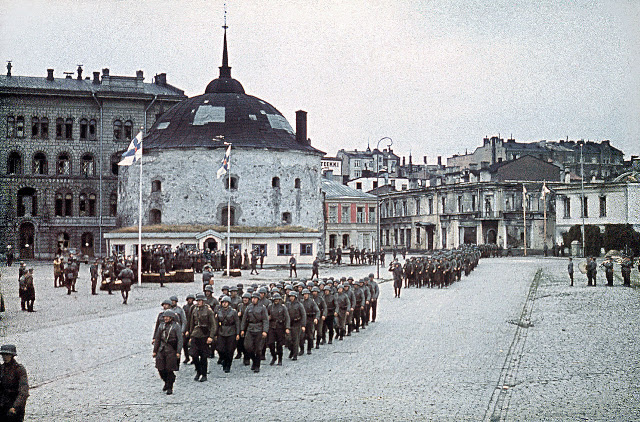
On 31 August 1941, the true nature of the relationship between the Finns and the Germans is starkly revealed without any possibility of misinterpretation. German General W. Erfurth contacts Finnish Field Marshal Carl Mannerheim on behalf of Field Marshal Keitel, head of OKW, and informs Mannerheim that Keitel will be sending a letter coordinating a joint attack on Leningrad. Mannerheim already has decided not to attack Leningrad, and politely replies that he is not interested. However, Erfurth later delivers the letter anyway.
Mannerheim is not acting alone, as the Finnish Social Democrat government led by President Risto Ryti is dead-set against any advances beyond the old border. Ryti and Mannerheim, after receiving Keitel’s letter shortly thereafter, collaborate on a negative reply. There will be no Finnish attack on Leningrad (though this is a sensitive topic to Russians who feel the physical evidence in the city of Finnish artillery shelling indicates otherwise).
In the Far North sector, Mannerheim orders that Finnish forces attack to the south but stop their advance once they reach a line well short of Leningrad. This line runs from the mouth of the river Rajajoki to Ohta and actually is slightly beyond the old border — which Mannerheim has requested and received permission from the government to do in order to achieve the best defensible positions (Minister of War Lt. General Walden also supports this). Ryti’s government demands in exchange for this slight concession that Germany supplies 25,000 tons of rye in order to support Finland keeping all of its men at the front (this is a continuing theme in Finnish/German relations throughout the war). Mannerheim leaves the exact line in between those two points unsaid in order to give his troops local flexibility on seizing the most advantageous defensive points (hills, rivers, marshes, etc.).
A quick look at the map shows that Mannerheim’s line represents a shortened front between the Baltic and Lake Ladoga while avoiding Soviet fortifications on the outskirts of Leningrad (the 22nd Karelian Fortified Region, or KaUR). Mannerheim’s specificity on stopping along a specific line avoids incidents encountered previously in other sectors in which some Finnish troops refused to cross the old border. The troops now are reassured that they are not advancing endlessly into the Soviet Union and thus feel more confident in advancing slightly into the USSR. Finnish 12th Division reaches the town of Kivennapa south of Viipuri on the old border today but continues advancing beyond pursuant to Mannerheim’s orders.
Soviet troops are in disarray on the Karelian Isthmus. Having lost Viipuri, they stream back toward Leningrad and prepare to make a stand in the Stalin Line anchored by the KaUR. On the other side of Leningrad, the Germans continue to advance but still do not have a tight line around the city.
This is a decisive moment in World War II. The Finnish Army has been the dominant force in the north, outclassing both its Soviet opponents and its German allies. German troops in the forests and swamps have had mixed success and have little hope of advancing further without Finnish military assistance. Finnish refusal to attack Leningrad from the north means that the Soviets can concentrate all of their defensive forces in the south, effectively doubling their effectiveness.
Finnish and German collaboration is far from over. The Finns simply have shown their own limits. From now on, though, their status as “co-belligerents” rather than true German “allies” is unmistakable.
In the Army Group North sector, the final Soviet troops evacuate from Tallinn and the Germans complete their capture of the city. The Soviets counterattack at Mga and retake it. The Germans complete the capture of Novgorod north of Lake Ilmen, providing a secure “block” on the eastern flank of Army Group North. Moscow radio announces in its usual vague wording that “the enemy is at the approaches of Leningrad.” The Leningrad government puts up posters throughout the city saying “The Enemy is at the Gates.” The city is prepared for a siege, with sandbags in store windows and everyone mobilized to help in the defense.
Field Marshal von Leeb is tightening his grip on Leningrad. The Red Army has abandoned Novgorod, 100 miles south of the city after a savage week-long battle, and tonight Moscow Radio admits “the enemy is at the approaches of Leningrad.” In the city posters proclaim: “The enemy is at the gates.” But the autumn rains have started early turning the battlefield into a quagmire, halting the Panzers and grounding the Luftwaffe. The Russians are using the respite to turn the city into a fortress. Shop windows are full of sandbags, militia units march through the streets and every gate is guarded. Everyone is expected to fight. Andrei Zhdanov, the city’s Communist Party secretary, says: “We must dig fascism a grave in front of Leningrad.” Large fires started in the city by General Wolfram von Richthofen’s Fliegerkorps VIII are being fought by action groups organized by Zhdanov. Special teams have also been organized to safeguard Leningrad’s treasures. Fire units are based on the city’s beautiful Tsarist palaces and churches, now kept as museums, ready to deal with incendiary bombs. The priceless paintings of the Hermitage are already safe. An armoured train took 500,000 of the finest works to safety as the threat to the city developed.
In the Army Group Center sector, General Guderian’s Panzer Group 2 and Second Army continue trying to drive south to Kyiv against fierce resistance from Soviet Bryansk Front. The Soviets are counterattacking and have stopped the Germans for the moment. Marshal Boris Shaposhnikov reports:
“The offensive on Roslavl by the Reserve Front’s 43rd Army is developing successfully. However, the enemy is bringing forces up for an attack from the south. Consequently, it is necessary to speed up the preparations for the 50th Army’s offensive and to begin it on 1 September or, in the last resort, on 2 September, in order to assist the 43rd Army’s attack and prevent the enemy from concentrating forces against it. The 50th Army must continuously and energetically continue reconnaissance with reinforced battalions along the front.”
The German defenders at Yelnya are under extreme pressure but continue holding their positions. Field Marshal von Bock does not have reinforcements at hand due to the diversion of Panzer Group 2 to Kyiv.
German forces, starting to run short of manpower and supplies, face a renewed Red Army offensive along the Dnepr River in Ukraine.
In the Army Group South sector, the Wehrmacht opens the offensive toward Rostov by building a pontoon bridge over the Dneipr. LII Corps (General of the Kavalrie von Briesen) captures a bridge at Derievka just south of Kremenchuk.
The German 5th R-Boat Flotilla lays 32 mines between German minefield Juminda and Finnish minefield Valkjarvi during the night. This was the scene of over 20 Soviet ships hitting mines and sinking recently during the evacuation of Tallinn.
A total of 164 Soviet vessels reach Kronstadt out of roughly 200 that participate in the Tallinn evacuation — the rest are at the bottom of the Baltic. The four convoys carry 28,000 troops and civilian evacuees — many thousands either drowned or were rescued along the way. The convoy escorts now change missions and provide shore bombardment in support of ground troops defending Leningrad.
The ships of Operation DERVISH, the first British convoy to the Soviet Union, reach Archangel. It includes six freighters an oiler escorted by the aircraft carrier HMS Victorious, heavy cruisers Devonshire and Suffolk, and several destroyers. Four Soviet destroyers greet the convoy at sea and guide it in.
Soviet submarine M-34 spots 4958-ton Italian tanker Tampico off Varna, Bulgaria. It attacks but misses.
The Germans sink several Soviet river warships on the Dneipr. The Soviets are learning through hard experience that river gunboats are no match for shore-based panzers and artillery.
Canadian forces remain in possession of Spitzbergen. Norwegian radio operators on the island continue feeding the Germans on the mainland false information about bad weather, keeping the Luftwaffe at bay. The native Norwegians on the island prepare to be evacuated to England.
At Vilnia, the German SS takes 3700 Jews (some sources say 1600), including 2019 women and 817 children, out to Ponar and execute them. This ostensibly is in retaliation for a partisan ambush of a German patrol.
With a ceasefire in effect, fighting is negligible today. The British eye occupying the “open city” of Kermanshah, while the Soviets also continue expanding their presence within their agreed northern zone of influence. Soviet and British troops meet in Qazvin (Kazvin) at Avej Pass. This basically halts the Soviet advance as both sides watch the diplomats try to arrange a final settlement.
The outcome of the campaign is a foregone conclusion, but the Allies want to convert Iran into an ally, not just subdue it. Iran represents a possible supply line (the “Persian Corridor”) from the Western Allies to the USSR, and the less opposition within the country to that idea, the better. The stumbling block is Reza Shah Pahlavi, who wishes to protect German, Italian, Hungarian, and Romanian nationals and give them an opportunity to escape. The Allies, of course, want to intern them. The Iranian government, led by new Prime Minister Mohammad Ali Foroughi, doesn’t care about protecting Axis nationals and simply wants the war over, so it is an unstable situation in which either someone gives in — or goes.
The Luftwaffe attacks Alexandria shortly before midnight. There are two deaths of Royal Navy officers and an officer is wounded, along with numerous other casualties. Damage to the port itself and shipping is minimal.
An Italian convoy of three large liners (Neptunia, Oceania, and Victoria) being used as transports, escorted by six destroyers, departs from Tripoli bound for Taranto. Royal Navy submarine HMS Upholder (Lt Cdr Wanklyn) attacks the convoy but misses. Another Italian convoy of five freighters and a mine-ship also departs from Tripoli bound for Naples.
Dutch submarine O.21 spots an Italian submarine in the Tyrrhenian Sea and makes an unsuccessful attack.
During the month of August, Royal Navy submarines based on Malta sink six ships totaling 50,000 tons, 1 Italian cruiser (Bolzano), and damage 4971-ton freighter Aquitania and perhaps a destroyer.
At 07:00, the Jadar Chetnik unit attacks Loznica. The Chetniks take many 18 killed and 93 casualties in total, including leader Lieutenant Colonel Veselin Misita, who is killed. Many Germans surrender (93), and the Chetniks take Loznica. The victors treat the captured Wehrmacht troops humanely, which is not always the case in this region. Those Germans who can get away flee to Banja Koviljača.
While the Chetniks are attacking Loznica, the 25-strong Cer Chetnik Detachment under the command of a regular artillery officer, Captain First Class Dragoslav Račić, attacks the village of Bogatić. This attack does not go as well as the attack on Loznica, as the Germans have reinforcements nearby. The Račić group continues the attack through the day and holds its position through the night.
The subtext behind these two attacks reveals much about the state of the partisan movement in Yugoslavia. The joint attacks take place despite the prohibition by Chetnik leader Draža Mihailović against attacks until there is a popular uprising. Thus, these attacks represent a splintering of the opposition forces in Yugoslavia.
Cheese rationing is introduced in Switzerland.
A mixed-gender anti-aircraft battery with 200 men and an equal number of women was established, with great public interest, in Richmond Park, London, England, United Kingdom. The women were the first to take a combat role in Britain.
Grave doubts about Bomber Command’s claims of damage done to enemy targets are prompted by a new analysis of photographs of the targets. This is made by D.M.D. Butt, a civil servant member of the war cabinet secretariat. Butt examined 633 flash photographs taken from aircraft at the time of bomb release. On 100 separate raids against 28 targets on 48 nights during June and July. He allowed as a hit any bomb falling within five miles of the target area: a zone of 75 square miles. He found that on average only one bomber in three got hits within the zone. In the industrial Rühr, the ratio lengthened to one in ten. Aided by a full moon, two out of five scored, but so did the enemy, for the better light aided night fighters. Since these figures excluded aircraft which did not find or attack the target area (and many did not), the proportion of hits to total sorties was well under one in three. The prime minister has said that the report demands urgent attention. Air Vice Marshal Robert Saundby, a senior air staff officer, accepted the report, but said that Butt’s figures “might be wide of the mark.”
RAF Bomber Command, Day of 31 August 1941
30 Blenheims on escorted raids to Lille power-station (12 aircraft), Lannion and St-Omer airfields and Le Trait shipyard (6 aircraft to each). Some alternative targets had to be bombed because of cloud. 3 Fortresses to Bremen, Hamburg and Kiel but only Bremen was bombed. No losses from any operation.
RAF Bomber Command, Night of 31 August/1 September 1941
Cologne
103 aircraft — 45 Wellingtons, 39 Hampdens, 7 Halifaxes, 6 Manchesters, 6 Stirlings — to railway targets and 5 further Manchesters on searchlight-suppression flights. 3 Hampdens, 1 Manchester and 1 Wellington were lost and a further Wellington was shot down by an Intruder over England. The weather was bad and only the estimated position of Cologne could be bombed. through cloud, by 68 aircraft. Cologne reports a few bombs and 1 person killed.
Essen
43 Whitleys and 28 Wellingtons to the Krupps works. 1 Whitley lost. Essen was also cloud-covered and bombing was poor. Only 1 house was damaged with 4 or 5 people killed (two reports differ) and 10 people were injured.
Minor Operations: 6 Wellingtons to Boulogne, 12 Hampdens minelaying in the Frisians and in Kiel Bay. 1 Wellington lost.
The Luftwaffe attacks Hull after dark. A bomb hits a shelter and causes many casualties. Approximately 200 homes are destroyed and 38 people are killed.
Nine Wellington bombers based on Malta attack Tripoli, damaging buildings.
Destroyer HMS Bedouin departed the Humber at 1945 to return to Scapa Flow on completion of her refitting, and arrived at 1830 on 1 September.
Italian steamer Recca (5441grt) was seized by Cuban authorities at Avana, Cuba, and renamed Libertad for Cuban use.
Australian light cruiser HMAS Hobart departed Haifa for Alexandria, where she arrived on 1 September.
Anti-aircraft ship HMS Carlisle arrived at Suez.
Sloop HMS Flamingo departed Alexandria for Port Said for intended duty in the Red Sea.
Australian destroyer HMAS Nestor departed Gibraltar to refuel at Ponta Delgada prior to joining convoy WS.11. She then proceeded with the convoy to Freetown.
Destroyer HMS Foresight, HMS Fury, and HMS Forester departed Gibraltar to carry out anti-submarine patrols in the Straits during the night.
Destroyer HMS Duncan arrived at Gibraltar from convoy OG.72 duty.
Corvettes HMS Azalea and HMS Fleur de Lys arrived at Gibraltar with tanker Cordelia, arriving from Curacao.
An air raid on Alexandria late on the 31st and early on 1 September caused a number of casualties on shore, but no damage was done to ships or facilities. Cdr E E Addis Rtd of HMS Nile and Sub Lt J Roper RNR of HMS Thorgrim were killed and another officer wounded. There were also a number of rating casualties.
Dutch submarine HNLMS O.21 made an unsuccessful attack on an Italian submarine in the Tyrrhenian Sea.
Submarine HMS Utmost arrived at Malta from patrol.
Italian convoy of liners Neptunia, Oceania, and Victoria, escorted by destroyers Aviere, Da Noli, Camicia Nera, Gioberti, Usodimare, and Pessagno, departed Tripoli for Taranto on the 31st. Off Tunisia, submarine HMS Upholder made an unsuccessful attack on the convoy, which arrived at Taranto without loss on 2 September.
President Roosevelt worked today upon his Labor Day speech which will be broadcast tomorrow upon the second anniversary of the start of the war. This is expected to include an appeal for all Americans to make sacrifices to meet the threat to the security of the United States growing out of Nazi Germany’s campaign of conquest. The President will speak from his study in the Franklin D. Roosevelt Library to the nation and through international hookups and rebroadcasts to most of the world. His ten-minute address, starting at 1:45 PM, Eastern daylight saving time, will be part of an hour’s “salute to labor,” beginning at 1 PM, in which Ernest Bevin of England and American leaders of labor will participate. The program, arranged by the Office of Production Management, will be rebroadcast in many languages, including German, Italian, French, Spanish, Portuguese, Russian and at least one Scandinavian tongue.
Passage by Friday or Saturday of the Senate’s $3,672,400,000 tax bill was predicted tonight by leaders. The record bill, which lowers the income tax personal exemption from $2,000 to $1,500 for married persons and from $800 to $750 for single persons, will be reported Tuesday after the Finance Committee has made a final check of its technical language. Debate is scheduled to start Wednesday. After Senate passage, the bill will go to conference to iron out points of difference, chief among which is the lowering of personal exemptions, which was not in the House bill. The House is continuing its “semi-vacation” until about September 15 and will transact no business of moment until that time. The principal legislation facing House action is the Price Control Bill, on which the Banking and Currency Committee will resume hearings when the “semi-vacation” is over.
Leaders of the nation’s defense setup and of organized labor, in Labor Day statements, today praised the workers’ contribution to arming the country and urged still greater efforts. Undersecretary of War Robert P. Patterson expressed “profound gratification” over “the patriotic manner in which they (workers) are rising to the needs of the present emergency.” In telegrams sent to William Green, president of the American Federation of Labor, and Philip Murray, president of the Congress of Industrial Organizations, Patterson added: “America can only hope to survive the real and imminent dangers confronting it today if every American worker makes himself a committee of one to refute the agents of discord and defeatism in our midst, to awaken our nation to its perils and to increase production to the level that modern armament demands.”
American defense needs and “business as usual” came to a parting of the ways last night as steel priorities and new credit restrictions, intended to slow the demand for non-defense durable goods whose manufacture must be curtailed, went into effect. Directly and indirectly, the two new government moves, made necessary by a war raging thousands of miles away, will make themselves felt from the bottom to the top of American life. They bring the developing war economy right into the average household. The manufacture of automobiles, refrigerators, irons, toasters, plumbing fixtures, hardware for the kitchen and the house, lawn mowers, garden rakes, junior’s Christmas building set, all will be affected by the rationing of steel, for which “priority” is a fancy name.
The United States Coast Guard reported tonight two small trawlers with 12 persons aboard were missing in Lake Superior following a heavy storm. The boats were part of a fleet of nine vessels that put out from Munising, Michigan, this morning on fishing trips. Seven have been accounted for, the coast guard said. The boats were caught in a 50-mile-an-hour wind that came up without warning, scattering the vessels over the lake. There was a possibility the missing boats may have found shelter off a protected island.
A dynamite blast in a shaft a half mile distant released an underground body of water today into the 2,700-foot level of Phelps Dodge Corporation’s Copper Queen mine in Bisbee, Arizona, one of the state’s richest and a heavy contributor of copper to national defense.
The radio show “The Great Gildersleeve” debuts on the NBC Red Network on Sundays at 1830 hours Eastern Time. The show is a spin-off of the “Fibber McGee and Molly” show and stars Harold Peary as Throckmorton P. Gildersleeve, a windbag, a most eligible bachelor, a bumbling-but-enthusiastic ladies’ man and the water commissioner of the town of Summerfield.
Major League Baseball:
Mainly through the device of passing Ted Williams intentionally three times, Phil Marchildon tossed a three-hitter at the Red Sox today to gain a 3–2 decision and an even break for the Athletics after Boston had taken a 5–3 decision in the first half of a twin bill. Williams had a three-run homer in the opener.
The Pirates came from behind today to defeat the Cubs, 4–3, for an even break in the two-game series. Elbie Fletcher drove in two runs with his tenth home run and tripled in the eighth to pave the way for the winning tally.
The Cardinals turned back a ninth-inning bid by the Reds today to win their fifth straight, 6–3, and keep the National League lead by 2 percentage points. Trailing, 6–2, the Redlegs loaded the bases in the ninth when a relief pitcher, Harry Gumbert, walked Eddie Joost after Bill Werber and Harry Craft had singled. Bill Crouch replaced Gumbert and let Werber score on a balk, but Mike McCormick slapped a grounder for the third out.
In game 1 in Cleveland, the Tigers hammer Bob Feller for 13 hits in 8 innings, but the loss goes to Clint Brown who surrenders 2 runs in the 9th. Detroit wins, 7–5. Joining in the offense for the Tigers is starter Schoolboy Rowe and reliever Dizzy Trout, both of whom hit triples. Chubby Dean gives up a pair of homers in the nightcap, but emerges with the win for Cleveland, 7–4.
Dolph Camilli and Leo Durocher each have four RBIs, combining to drive in eight runs, as the Brooklyn Dodgers hammer New York Giants pitchers for 15 hits and the Dodgers win, 13–6. Luke Hamlin gets the win for Brooklyn.
The Braves and the Phillies split a double-header today, Boston winning the first game, 8–3, and Philadelphia taking the second, 8–5. Both clubs owed their victories to five-run fifth-inning uprisings.
White Sox starter Ted Lyons is lifted against the Browns in St. Louis after 7 innings and 15 hits. It is his last incomplete game in the majors. He will finish 3 more in 1941, all 20 in 1942, and after serving in the Armed Forces, complete all 5 starts in 1946. The Browns win 12–8, then take the nitecap, 5–4 when Walt Judnich hits a bases-loaded triple in the 9th.
The Yankees downed the Washington Senators, 5–2. Lefty Gomez outpitched the eminent knuckleball exponent, Dutch Leonard, to bag this one for his thirteenth triumph of the year against only four defeats. While Lefty was unable to go the full nine innings, it was the heat that forced him out, not the Senators, who never were very hot.
Philadelphia Athletics 3, Boston Red Sox 5
Philadelphia Athletics 3, Boston Red Sox 2
Pittsburgh Pirates 4, Chicago Cubs 3
St. Louis Cardinals 6, Cincinnati Reds 3
Detroit Tigers 7, Cleveland Indians 5
Detroit Tigers 4, Cleveland Indians 7
Brooklyn Dodgers 13, New York Giants 6
Boston Braves 8, Philadelphia Phillies 3
Boston Braves 5, Philadelphia Phillies 8
Chicago White Sox 8, St. Louis Browns 12
Chicago White Sox 4, St. Louis Browns 5
New York Yankees 5, Washington Senators 2
Cuban authorities seize 5441-ton Italian freighter Recca at Havana and rename it Libertad.
An exodus of Japanese from Panama appears to be under way following Tokyo’s suspension of commercial relations with this country after the temporary closing of the canal several weeks ago.
Twenty-seven Japanese planes bombed the heart of Chungking again today in a devastating assault. Much new construction was destroyed. The raiders were one of six batches of planes, altogether numbering 135, which swarmed over Szechwan province.
The closing of the Manchukuoan-North China border to foreigners is concealing tremendous Japanese movements in Manchukuo. Shanghai diplomatic quarters believe that the Japanese and Russians are engaged in a diplomatic struggle that approaches in intensity the Japanese-United States “war of nerves.”
U.S. Navy Asiatic Fleet CinC Admiral Hart has advised British Vice-Admiral Sir Geoffrey Layton, Commander of the RN’s East Asia Squadron, that Washington was refusing to endorse proposed British plans for Allied cooperation should war come.
British Air Marshal Sir Robert Brooke-Popham, commander of the garrison in Malaya and Singapore, has made two visits this month to Manila to confer with Hart and MacArthur.
Prime Minister Winston Churchill informs new Australian PM Arthur Fadden that he intends to create a new Far East fleet built around capital ships. These ships would be based in Singapore.
Born:
Brian Conacher, Canadian NHL and WHA left wing and centre (NHL champions, Stanley Cup-Maple Leafs, 1967; NHL All-Star, 1968; Toronto Maple Leafs, Detroit Red Wings; WHA: Ottawa Nationals), in Toronto, Ontario, Canada.
Joe O’Donnell, AFL guard (Buffalo Bills), in Ann Arbor, Michigan (d. 2019).
William DeWitt, Jr., American businessman (Chairman of St. Louis Cardinals), born in St. Louis, Missouri.
Died:
Thomas Bavin, 67, Australian politician, 24th Premier of New South Wales.
Marina Tsvetaeva, 48, Russian poet (“The Train of Life”), by suicide.
Naval Construction:
The Royal Navy MMS I-class motor minesweepers HMS MMS 93 (J 593) and HMS MMS 94 (J 594) are launched by United Engineers (Singapore). Both are lost incomplete at Singapore in February 1942.
The Regia Marina (Royal Italian Navy) Soldati-class (Second Group) destroyer Velite is launched by Cantieri Odero Terni Orlando (O.T.O.), (Livorno, Italy).
For the month of August 1941, German U-boats sank 32 Allied ships (82,446 tons) and damaged 1 ship (10,917 tons).
For the month of August 1941, total Allied shipping losses edge up slightly, from 109,276 tons in July to 125,550 tons in August. Imports to — which now include the Soviet Union for the first time — edge up as well, from 3,765,724 tons to 4,002,450 tons. Allied losses to U-boats are down from 94,209 tons to 80,310 tons, but that is counterbalanced by increased losses to the Luftwaffe (from 9275 tons to 23,862 tons). Losses to mines fall from 8583 tons to 1400 tons, which is the lowest point of the war and also the lowest until August 1942.
The Allies lose 36 ships of 103,452 tons in the Atlantic and 5 ships of 27,247 tons in the Mediterranean. The Axis (primarily Italy) loses 11 ships of 52,538 tons in the Mediterranean, most along the vital convoy route from Naples to Tripoli which the Royal Navy knows all about and where it maintains patrols. RAF bombers based on Malta also are becoming more effective against Axis shipping. The Kriegsmarine loses four U-boats (which includes U-570, which is captured and the crew made prisoners of war) but has a new high of 65 available in the Atlantic.

